
What 100 Free Spins No Deposit Bonuses Actually Cost Australian Players in 2026
A “100 free spins no deposit” headline looks like the casino is handing you something for nothing. The terms underneath tell a different story, and so does the fact that the casino offering them is operating outside Australian law. Every operator reviewed on this page sits beyond the reach of the Australian Communications and Media Authority, beyond BetStop, and beyond any consumer protection a local punter could otherwise rely on. That is not an editorial flourish — it is the defining fact of this product, and it has to be in the reader’s mind before the bonus maths makes any sense.

This page walks through what these offers look like in 2026, how the claim flow works, where the wagering and cashout caps actually sit, which pokies the spins are locked to, and what the ten most prominent offshore brands targeting Australian players are offering in real terms. It then turns to the legal reality, the responsible gambling tools that do not reach these sites, and the maths of what a typical claim actually costs the punter who clears it.
Data current as of 13 September 2026, verified against operator terms pages, the ACMA register and Bills Digest records.
Table of Contents
- Why Your 2026 100 Free Spins No Deposit Bonus Is Smaller Than It Looks
- The Four-Step Claim Flow That Separates Real Free Spins From Dead Offers
- The Fine Print That Erases Your Free Spin Winnings
- New Kid on the Block: Just-Launched Casino Brands and Their 2026 Welcome Packages
- Claiming Free Spins on Your Phone: The 2026 Mobile Experience
- Crypto Casinos and 100 Free Spins No Deposit
- Which Pokies Actually Carry the 100 Free Spins in 2026?
- Free-Play vs Real-Money: What 100 Free Spins Actually Deliver
- Can You Turn 100 Free Spins No Deposit Into Real Withdrawable Cash?
- The 10 Offshore Casinos Offering Free Spins No Deposit to Australians in 2026
- The Legal Reality: Every 100 Free Spins No Deposit Casino Is Offshore
Why Your 2026 100 Free Spins No Deposit Bonus Is Smaller Than It Looks
The “100 free spins no deposit” pitch is engineered to land as value. A hundred spins sounds like a hundred chances at a payout, the way a hundred lottery tickets sounds like a hundred entries. The comparison is wrong on its face: every spin on a pokie is a spin against a stated house edge, the winnings are locked behind a wagering hurdle, and the eventual cashout is capped. The 100 in the headline is a number the marketing team chose — it has nothing to do with what lands in the bank account.
In 2026, the modal shape of a genuine no-deposit free-spins offer to Australian players is well established: a stake of A$0.10 per spin, one designated pokie, wagering of 35x–50x on winnings, a max cashout between A$50 and A$100, and a validity window of one to seven days. The range is tighter than the marketing suggests. Almost every offer on offer sits inside it, and the few that do not (higher stakes, longer validity, looser caps) are not really “no deposit” bonuses any more — they are hybrid packages with deposit components dressed up in no-deposit clothing.
The No-Deposit Mechanic: What “No Deposit” Actually Means
“No deposit” means the punter does not fund the account before receiving the spins. There is no upfront payment, no credit card capture, no bank transfer to a wallet. The casino extends the bonus against the registration alone. That is the literal definition, and it is also where the value story starts and ends: every other term in the bonus is the operator’s hedge against the fact that it has handed out something it cannot take back.
Spins are locked to one game — usually a single Pragmatic Play pokie, occasionally a Gamzix or a niche title. The punter cannot spread the wagering across a library the way a deposit bonus allows. Pokies contribute 100 per cent of each bet toward wagering, while table games typically contribute only 10 per cent and live dealer games are excluded entirely. That contribution weighting exists because the house edge on a pokie is what makes the bonus economic for the operator — it would rather pay out at a 4 per cent theoretical loss than at the 0.5 per cent loss on a blackjack wagering requirement. The one-game lock is not a punishment, it is a risk-pricing choice the operator has already made.
What the punter actually receives is the chance to play one hundred A$0.10 spins on a single game without paying for them, with whatever those spins return held in a bonus balance until wagering clears. The mechanism is simple. The terms that govern what happens to the winnings are not.
Free Spins Are Not Free Cash: The Spin-to-Withdrawal Funnel
The funnel between “claim” and “withdrawal” is the part the headline never talks about. A punter who claims 100 free spins and wins, say, A$9.60 on the spins faces a 40x wagering requirement on those winnings. Forty times A$9.60 is A$384 in turnover before the bonus balance converts to withdrawable cash. The punter is then subject to a max cashout cap — typically A$75 or A$100 in this market. The cap does not apply to the win in the abstract; it applies to what the punter can actually pull out of the casino after clearing the wagering.
Three things happen to most claims at this stage. Some punters lose the winnings trying to clear the wagering — 40x turnover on a pokie at the house edge is a steep ask, and a win that looked generous is gone before the requirement clears. Some clear the requirement, hit a cap, and walk away with a fraction of what they could have theoretically won. A smaller cohort clears the requirement with a balance under the cap, sees a real payout, and discovers that the next gate — identity verification, payment method restrictions, withdrawal pending — has its own drop-off.
The expected loss formula here is unforgiving: with required turnover of A$384 against a 96 per cent RTP pokie, the average house edge takes roughly A$15.36 out of the punter’s balance during the wagering process. The expected value of the bonus before any time cost or cashout friction is negative.
The 100 Figure: Marketing Pitch, Not Payout
At A$0.10 per spin, 100 spins means A$10 has been wagered before the terms even kick in. The expected return on those A$10 at a 96 per cent RTP — a representative figure for the type of pokie these bonuses get locked to — is A$9.60. That is the bonus balance the punter starts with. A 40x wagering hurdle on A$9.60 means A$384 in turnover must be generated. House edge on that turnover is A$15.36 in expected loss.
The headline number “100” is not a payout number. It is the count of free plays the punter is granted, and the punter pays for them in three ways — the value of the spins themselves, the wagering requirement on what they return, and the time cost of generating the turnover. The marketing claim is that you have been given A$10 in play. The economics are that you have been given A$9.60 in expected balance, A$15.36 in expected loss during wagering, and somewhere between a few dollars and the cap if everything goes right.
High-RTP games are routinely excluded from wagering contributions because they would otherwise collapse the house edge the operator is hedging for. Slots at or above 97.4 per cent RTP are blocked at multiple featured brands for exactly that reason. The slots the punter is forced onto are not the high-RTP titles — they are the ones whose mathematics the bonus can survive.
The Four-Step Claim Flow That Separates Real Free Spins From Dead Offers
A no-deposit free-spin offer has four mechanical steps: register, verify, activate, launch. Most punters stop reading at step one. The friction sits in steps two through four, and each one is where a bonus dies.

Step one is the form — name, email, date of birth, sometimes a mobile number. Step two is identity verification, sometimes called KYC, where the casino asks for a driver’s licence or passport and a proof of address. Step three is the bonus activation — entering a code, ticking a checkbox at registration, or opting in via the cashier. Step four is launching the locked game and running the spins.
The Sign-Up Trigger: Registration, KYC and the Activation Window
The window between opening an account and being allowed to use the spins is where most no-deposit bonuses die. At RocketPlay, the activation window is 24 hours from registration — miss it and the spins expire before they were ever used. At Neospin, the spins are valid for seven days, which is generous by the standard of the market but still short. The punter is being timed: the casino wants the spins played while the account is fresh, before the punter has had a chance to read the fine print twice or to ask questions in the live chat.
KYC is the second gate. Offshore casinos vary in how strictly they enforce it before allowing a withdrawal, but most ask for it before the first cashout rather than at registration. The punter who wins and tries to withdraw is the punter the casino verifies, and that is when delays appear — sometimes days, sometimes weeks. The terms the punter agreed to at registration said this would happen. Most do not notice until it does.
The four-step claim flow looks straightforward and is, mechanically. The friction is in the timing and the conditions, not the steps themselves.
The Fine Print That Erases Your Free Spin Winnings
Three numbers in the terms page decide whether a free-spin claim produces a payout: the wagering multiple, the max cashout cap, and the validity window. Everything else is decoration.
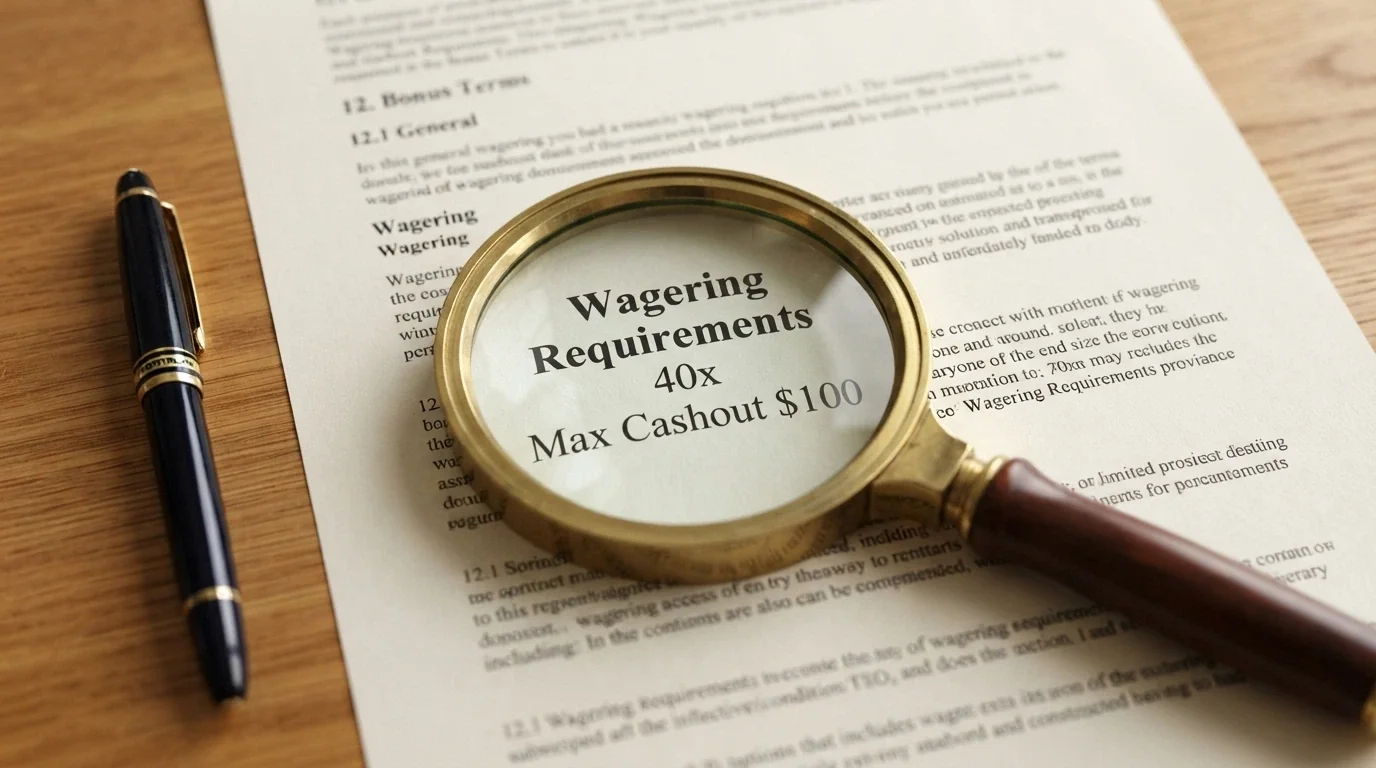
Wagering Requirements: The Multiplier That Eats Your Winnings
Wagering requirements in this market sit in a 30x–60x band, with the modal range at 35x–50x on winnings. Anything above 50x is considered practically unclearable for most punters — the turnover required is so far above the starting balance that the expected loss through the house edge consumes it before the requirement is met. The industry knows this. The terms pages state 60x multipliers anyway, because the operators who write them are pricing for the cohort of punters who will lose the bonus balance mid-wagering rather than clearing it.
Take the maths of a typical claim. A punter who wins A$10 on 100 free spins faces a 40x requirement — A$400 in turnover on the bonus balance alone. At a representative 96 per cent RTP, the house edge during that wagering is roughly A$16 in expected loss. The punter started with A$10 in winnings. The expected outcome before any cashout cap is that the punter finishes the wagering session with less than they started with, on average. That is not a bug in the model. It is the model.
Neospin runs at 40x with a A$75 cashout cap and seven-day validity. BitStarz runs at 40x with a A$100 cap. KatsuBet runs at 30x with a A$100 cap. RocketPlay runs at 60x with a A$50 cap — the steepest hurdle and the lowest ceiling in the featured set. Each operator has chosen a position in the trade-off between barrier height and reachable payout. None of them have chosen a position where the punter’s expected value is positive.
Max Cashout Caps: The Ceiling on What You Can Actually Withdraw
The max cashout cap is the number the marketing never quotes and the punter never sees until it matters. In 2026, the band runs A$50–A$200 across the market, with most no-deposit offers sitting at A$75–A$100. RocketPlay caps at A$50. Neospin at A$75. BitStarz and KatsuBet at A$100. FairGO at A$180 — the highest in the featured set, which is the one piece of upside that operator offers.
The cap is not a courtesy. It is the operator’s protection against the bonus producing a payout larger than the acquisition cost of the player. A punter who lands a 50x win on a 100-spin run has not “won” anything in the casino’s accounting — they have produced an outlier that the cap converts back to a marketing cost. The spread between theoretical win and actual withdrawal is wider than the cap suggests, because most claims never reach the cap. The cap matters most for the few that do.
No-Wagering Spins: The Rare Exception and Why It Matters
The rare no-wagering free spin exists, and when it does, it changes the maths entirely. With no wagering requirement, the winnings from the spins are withdrawable on the spot, subject to the cashout cap and any verification friction. The expected loss during the wagering process — the A$15.36 in the modal scenario above — drops to zero. The punter’s expected value returns to roughly the spin win minus the house edge on the original stake.
No-wagering spins are scarce at the 100-spin volume this page is built around. They tend to appear as one-off promotions at single-digit spin counts, or as a small handful of spins layered onto a deposit welcome package. The economics for the operator are tight at no-wagering — every spin played is a spin against the house edge with no buffer of turnover to absorb the loss — and the volumes are correspondingly modest. The punter who finds a genuine no-wagering 100-spin offer in this market has found something that does not match the modal shape and should treat it as an outlier, not a baseline.
New Kid on the Block: Just-Launched Casino Brands and Their 2026 Welcome Packages
The Australian-facing offshore market has a steady churn of new brands — newly incorporated Curaçao or Anjouan entities opening with aggressive welcome packages designed to grab signup share. The pattern is consistent: a launch bonus inflated above the market median, terms tightened in the small print to compensate, and a license from a regulator with no meaningful consumer-protection function.
The novelty is in the marketing. The terms are usually inside the modal band described above — a slightly higher spin count, a slightly higher cap, or a slightly longer validity — offset by some sharper edge elsewhere in the conditions. A new casino offering 150 free spins no deposit will typically carry a higher wagering multiple, a tighter game restriction, or a shorter validity than the established operators running 100-spin packages. The punters the launch is targeting are the ones who move from offer to offer without reading the terms page.
Licence verification is the first check. A new brand’s licence is the single most important fact about it. The Interactive Gambling Act 2001 makes it illegal to provide online casino games to Australians — there is no Australian licence to verify against. The licence that exists is from the offshore regulator, and it tells you whether the operator has any external accountability at all, not whether it is legal in Australia.
Claiming Free Spins on Your Phone: The 2026 Mobile Experience
The mobile experience for claiming no-deposit free spins is identical to the desktop experience in terms of mechanics. The same form, the same KYC, the same activation window, the same game. The bonus terms are written for the casino’s database, not for the device the punter happens to be holding.
What differs is the friction. On a phone, the punter is more likely to skip the terms page, more likely to tap “accept” without reading, and more likely to miss the activation deadline because the casino’s mobile reminder never arrived. The wagering requirement does not get smaller because the claim came from a smaller screen. The cashout cap does not lift because the punter was playing on the bus.
No mobile-exclusive 100-spin no-deposit offers were confirmed in this market in 2026. The casino does not pay punter acquisition costs twice — once for desktop, once for mobile — when one channel covers both. Mobile is a delivery mechanism for the same product.
Crypto Casinos and 100 Free Spins No Deposit
Crypto is the payment method that tells you, in one step, that the casino is not operating under Australian rules. Credit cards and digital currencies have been banned as payment for online wagering in Australia since 11 June 2024, under the Interactive Gambling Amendment (Credit and Other Measures) Act 2023. An operator that asks for either is operating outside the Australian regulatory perimeter. As the regulator’s own framing puts it: the payment method is itself a tell.
The crypto-focused brands in this market — BitStarz and Stake among them — carry Curaçao licences, offer Bitcoin and Ethereum deposits, and advertise no-deposit free-spin packages that sit inside the same modal shape as the dollar-deposit brands. BitStarz runs at 40x wagering with a A$100 max cashout. Stake is a major offshore brand but carries no confirmed no-deposit free-spin offer in this run. The economics of the bonus are identical regardless of the deposit method; what differs is the consumer protection, which is zero in both cases but more visible at the crypto brands because the payment friction has been engineered away.
Anonymity is part of the pitch. Crypto deposits do not require the same level of identity verification as a debit card or a bank transfer, and the offshore operator does not have to share that data with anyone. The punter who values privacy above consumer protection finds this attractive. The punter who has a dispute with the operator and wants to take it somewhere finds the opposite.
Which Pokies Actually Carry the 100 Free Spins in 2026?
The game the spins are locked to is not the punter’s choice. The casino picks one — almost always a Pragmatic Play pokie — and the bonus terms forbid playing the wagering requirement on anything else. The choice of game is part of the bonus economics, not a gift to the punter.

Sweet Bonanza is the most common title. WinSpirit runs its 100-spin no-deposit package on Sweet Bonanza at 40x wagering. Rainbet runs its deposit-gated free-spin package on Sweet Bonanza with the same 40x multiple and the additional restriction that Hacksaw, Nolimit and any slot with an RTP above 97.4 per cent are excluded from wagering contributions. Big Bass Bonanza is the second most common — Bizzo Casino’s 100-spin package is tied to that title, alongside a 10-spin no-deposit offer on a separate game. FairGO’s 30 free spins run on Fu Long Treasures. RocketPlay’s 50 free spins run on Gamzix’s “3×5 Hold The Spin”.
Pragmatic Play and the Provider Titles That Dominate Free-Spin Offers
Pragmatic Play’s dominance in this market is not accidental. The provider supplies a deep catalogue of high-volatility, feature-rich pokies that operators can promote as recognisable, and the RTP profiles sit in a band where the house edge is large enough to make the bonus economics work. Sweet Bonanza and Big Bass Bonanza are the workhorses — both have a 96 per cent-ish RTP, both have high volatility, both carry enough brand recognition that the operator can write “100 free spins on Sweet Bonanza” and have the punter recognise the title.
The punter who wants to use the wagering requirement as a chance to play a high-RTP pokie — a Blood Suckers at 98 per cent, a 1429 Uncharted Seas at 98.6 per cent — finds the door shut. Those titles are routinely excluded from bonus wagering, sometimes explicitly by name, more often by an RTP threshold. Rainbet excludes everything above 97.4 per cent. Other operators use different cut-offs, but the principle is the same: the punter cannot grind a wagering requirement on a low-house-edge game.
Free-Play vs Real-Money: What 100 Free Spins Actually Deliver
Demo-mode spins and no-deposit free spins are not the same thing, even though they both sound like “free” play.
A demo spin is play-money on a virtual balance. The pokie runs the same mathematics, but the winnings are not real, the balance resets when the window closes, and there is no withdrawal because there is no real money at stake. Demo mode exists so the punter can try a game before committing a deposit. It is a marketing tool for the provider and the operator alike.
A no-deposit free spin is a real-money spin on a real-money game, funded by the casino rather than the punter. The winnings are real. They are also subject to a wagering requirement, a max cashout cap, and the same KYC and withdrawal friction as a deposit-funded bonus. The “no deposit” descriptor describes the funding — the casino is paying for the spins — not the post-spin experience.
The confusion matters because some offshore casino sites advertise “free play” alongside “no deposit bonus” as if the two are interchangeable. They are not. Demo play cannot produce a withdrawal. A no-deposit bonus can, conditional on clearing the terms. The punter who treats them as the same product will be surprised, and not in a good way.
Can You Turn 100 Free Spins No Deposit Into Real Withdrawable Cash?
The path from free spin to bank account is real, but it is narrow.
The sequence is: claim the spins, play them on the locked game, accumulate winnings in the bonus balance, meet the wagering requirement on those winnings, hit the max cashout cap (or fall below it), pass KYC verification, request a withdrawal through an approved payment method, and wait. Each step has a failure mode. The wagering requirement fails most claims through expected loss. The cashout cap clips the winners. KYC is where withdrawals stall for weeks while the casino reviews documents. Payment method is where some punters discover that the only deposit methods the operator accepts are credit card or crypto — both banned in Australia, both pointing back to the offshore status of the operator.
The legal layer sits underneath all of it. The player is not prosecuted under the Interactive Gambling Act 2001 — the Act targets the provider, not the punter. But the punter has no Australian consumer protection, no complaints body that can recover the money, and no BetStop coverage if they are self-excluded. The operator can refuse a withdrawal, close the account, or change the terms, and the punter’s recourse is the operator’s own customer support and whatever goodwill the offshore licence holder is inclined to extend.
Legal deposit routes for licensed Australian wagering operators are debit card, bank transfer, PayID/Osko and BPAY. An offshore casino that takes Bitcoin or asks for a credit card is operating outside those routes, and the punter’s withdrawal will arrive through whatever channel the offshore operator chooses, on whatever timeline it chooses.
The 10 Offshore Casinos Offering Free Spins No Deposit to Australians in 2026
The table below sets out the ten offshore operators reviewed on this page, their licence status, the no-deposit offer where one was confirmed, and the headline terms. Every operator is unlicensed in Australia — the Interactive Gambling Act 2001 makes that a structural impossibility, not a regulatory oversight.

| Operator | Licence | No-Deposit Free Spins | Wagering (on Winnings) | Validity |
|---|---|---|---|---|
| Rocket Play | Curaçao | 50 spins on Gamzix “3×5 Hold The Spin” | 60x | 24h activation |
| Skycrown | Offshore (unspecified) | Not confirmed this run | — | — |
| Royal Reels | Curaçao | Up to 200 spins + A$10 sign-up bonus | 40x (spins), 35x (bonus) | 7 days (spins), 30 days (bonus) |
| Stake | Curaçao | Not confirmed this run | — | — |
| FairGO | Offshore (unspecified) | 30 spins on Fu Long Treasures | Not confirmed | Until 25 Aug 2026 |
| WinSpirit | Offshore (unspecified) | 100 spins on Sweet Bonanza | 40x | Until Nov 2026 |
| Rainbet | Anjouan ALSI-152406029-FI2 | Deposit-gated spins on Sweet Bonanza | 40x | Not confirmed |
| Bizzo Casino | Offshore (unspecified) | 10 spins + 100 spins on Big Bass Bonanza | 40x | Until July 2026 |
| Scream Casino | Offshore (unspecified) | Not confirmed this run | — | — |
| Neospin | Offshore (unspecified) | 100 spins | 40x | 7 days |
Rocket Play
Rocket Play sits in the modal band at every term, except the activation window, where it sits well outside. Fifty no-deposit free spins at A$0.10 per spin, locked to Gamzix’s “3×5 Hold The Spin”, carries a 60x wagering requirement on winnings and a A$50 max cashout cap. The activation window is 24 hours from registration. The welcome package beyond the no-deposit offer — 100 per cent up to A$1,000 plus 100 free spins delivered at 25 per day for four days — sits in a different category entirely, with a 30x–40x wagering on the bonus amount and a longer validity window.
The 60x wagering on winnings is the steepest in the featured set, and the A$50 cap is the lowest. The combination produces the smallest expected payout of any confirmed offer: even a punter who clears the wagering cannot withdraw more than A$50, and the cohort who clear 60x wagering on bonus funds is small. The 24-hour activation deadline compounds the friction — the punter has to register, verify and play within a day, or the offer expires unused.
The verdict: the offer looks competitive at the headline because of the broader welcome package, but the no-deposit component is the tightest in the set. A punter who values a clean shot at a small payout over a high-friction claim will find better odds elsewhere in the table.
Skycrown
Skycrown carries real Australian market share — 9.4 per cent by the latest operator-skills data — but no confirmed 100-free-spin no-deposit offer surfaced in this run. The brand is offshore, the licence jurisdiction was not confirmed against a public register this round, and the welcome package terms research returned are qualitative rather than specific. The honest write-up of Skycrown for a reader interested in no-deposit free spins is: the brand has the traffic to be worth watching, but the offer this page is built around is not currently advertised in a form research can verify.
The verdict: the brand exists in the AU market, the regulatory status is the same as every other brand on this page, and the no-deposit offer this run did not surface. If Skycrown matters to a reader, it is as a flagged absence — an operator with the audience to make a 100-spin offer worth running, without the confirmed offer to run on.
Royal Reels
Royal Reels carries the widest spread in the featured set. The headline no-deposit package is a A$10 sign-up bonus with 35x wagering and a A$2,500 max cashout, valid for 30 days, plus up to 200 free spins at 40x wagering with a A$100 max cashout, valid for 7 days. The two components sit on different rails: the A$10 cash bonus has the wider cashout ceiling and the longer validity, while the spin package carries the tighter cap and the shorter window. The three-deposit welcome pack totals A$2,500 plus 50 free spins.
The Royal Reels structure is unusual in that the sign-up cash bonus carries a larger max cashout than the free-spin package. The maths is interesting: a punter who clears 35x on A$10 generates A$350 in turnover against the house edge — roughly A$14 in expected loss — and the A$2,500 ceiling is high enough that it is not the binding constraint on most claims. The spin package is the tighter offer, with the A$100 cap being the more meaningful ceiling for a 200-spin run at A$0.10.
The verdict: this is the most generous-looking offer on the page, but the generosity is split between two components with different terms, and the punter has to read both. A reader who wants the widest ceiling and is willing to navigate a longer claim flow will find the A$10 cash bonus worth working through.
Stake
Stake is the largest crypto-focused offshore brand in the market by reputation, and a brand a reader interested in this topic will have encountered before. The research round this page is built from did not confirm a no-deposit free-spin offer at Stake. The brand is Curaçao-licensed, the payment infrastructure is crypto-native, and the Australian-facing marketing positions Stake as a sports and casino operator rather than as a free-spins promotion.
The absence matters because of the brand’s reach. Stake is not absent from the AU market because the operator is uninterested — the operator runs real Australian traffic. The absence is a product decision: Stake’s economics are built around crypto deposits and sports betting, and the no-deposit free-spin acquisition mechanic does not fit the model.
The verdict: a reader who arrived at this page looking for Stake’s 100-free-spin offer has hit a wall. The brand is real, the offshore status is the same as every other name on this list, and the offer this run did not surface.
FairGO
FairGO is the offer with the highest max cashout cap in the featured set, and that is the line that matters here. Thirty free spins on Fu Long Treasures, no deposit required, with a A$180 max cashout cap, valid until 25 August 2026. The wagering requirement was not confirmed against a current terms page in this run, which limits how precisely the offer can be modelled — but the headline shape is generous by the modal standard.
The spin count is low. Thirty spins is a third of the 100 the page is built around, and the A$0.10 stake implied by the market norm means A$3 in wagered value before terms. A punter who hits the A$180 cap has produced an outsized result from a small outlay. The validity until late August 2026 is also longer than most offers in the table — most run for seven days or less.
The verdict: the right offer for a punter who values the cap over the spin count and is willing to play a smaller bonus balance. A$180 is materially higher than the A$75–A$100 ceiling most operators run, and for the cohort who clear the wagering it produces a meaningful payout.
WinSpirit
WinSpirit is the only featured operator carrying a confirmed 100-free-spin no-deposit offer. One hundred spins on Sweet Bonanza, 40x wagering on winnings, expiry November 2026. The terms sit inside the modal band described earlier — same stake assumption, same wagering multiple, same one-game lock. The expiry window of several months is longer than most no-deposit offers, which matters because it gives the punter the time to clear the wagering requirement without rushing.
The wagering hurdle is the binding constraint. At 40x on whatever the spins return, the expected loss during wagering is the A$15.36 figure carried through the rest of the page. The cap is not disclosed in the verified research, which limits how precisely the offer can be modelled — but the spin count and the wagering multiple are confirmed, and the operator’s position in the modal band is consistent.
The verdict: this is the offer a reader interested in the literal 100-spin no-deposit pitch will land on first. The terms are modal, the game is modal, and the expiry is generous. There is nothing exceptional here — and that is also the point. The reader should know what modal looks like before they read the outliers.
Rainbet
Rainbet is the Anjouan-licensed entry in the set, and the only operator where the free-spin offer is deposit-gated rather than strictly no-deposit. The offer is a first-deposit promotion: minimum A$30 deposit, maximum qualifying deposit A$700, 40x wagering on promotional funds, free spins on Sweet Bonanza. The additional restrictions are sharper than the modal shape: Hacksaw and Nolimit games are excluded, any slot with an RTP above 97.4 per cent is excluded from wagering contributions, and the maximum bet during wagering is capped at 2 per cent of the deposit amount.
The deposit gate changes the product. A strictly no-deposit offer does not ask the punter for a deposit at all; Rainbet’s offer does, and the punter who wants to access the free spins is putting money on the line first. The 2 per cent max-bet rule is the more unusual constraint — it stops the punter from running a high-stake strategy during the wagering requirement, which the operator treats as bonus abuse. The combined effect is a tighter product than the modal band, dressed in a familiar bonus shape.
The verdict: a reader interested in free spins on Sweet Bonanza will find Rainbet’s offer listed alongside WinSpirit’s, but the mechanics are different. The deposit gate, the bet cap, and the RTP exclusion all push Rainbet toward the disciplined-punter end of the market.
Bizzo Casino
Bizzo Casino is the operator where the headline and the offer diverge the most. The marketing surfaces 100 spins on Big Bass Bonanza with 40x wagering; the no-deposit component is 10 free spins at the same multiple. The 100-spin package is deposit-gated — it sits inside the welcome pack, not on the no-deposit rail. The expiry is July 2026.
The 10 no-deposit spins are a small ask. At A$0.10 per spin, A$1 has been wagered before terms. The expected return is roughly A$0.96 in bonus balance, against a 40x wagering hurdle that requires another A$38 in turnover. The expected loss during that turnover is around A$1.54. The cap, which was not confirmed in this run, is likely inside the modal A$50–A$100 band. A punter who clears the wagering on a 10-spin claim has produced an outsized result; a punter who does not has lost nothing but ten minutes.
The verdict: a small, low-friction entry to the bonus funnel rather than a meaningful no-deposit offer on its own terms. A reader who arrives at Bizzo expecting 100 no-deposit spins has been led to a deposit-gated package, and the 10 no-deposit component is closer to a taster than a product.
Scream Casino
Scream Casino surfaced in the operator-skills data as an offshore brand with Australian traffic, but no confirmed no-deposit free-spin offer was returned in this run. The licence jurisdiction was not verified against a public register. The welcome package terms research returned are qualitative rather than specific.
The honest write-up is the same shape as Skycrown’s: the brand exists in the market, the regulatory status is identical to every other operator on this page, and the offer this page is built around is not currently advertised in a form research can verify. The audit-failure mode for absent offers is to manufacture specifics rather than flag the absence. This page flags it.
The verdict: Scream Casino is here as a flagged absence. The reader should know it exists, should know it is offshore like the rest, and should know the 100-free-spin offer is not the reason to visit.
Neospin
Neospin is the other operator in the featured set with a confirmed 100-free-spin no-deposit package. The headline terms are: 100 free spins, 40x wagering on winnings, A$75 max cashout cap, seven-day validity. The game was not confirmed against a current terms page in this run, which limits how precisely the offer can be modelled, but the shape is fully inside the modal band.
The A$75 cap sits between WinSpirit’s undisclosed ceiling and the lowest caps in the set (RocketPlay at A$50). The seven-day validity is standard. The wagering multiple of 40x is standard. Neospin’s positioning in the table is as a modal offering with a slightly tighter cap than the average, which makes it easier to compare against the modal calculation in the Fine Print section above.
The verdict: Neospin is what a reader should expect when they read “100 free spins no deposit” in 2026 — modal stake, modal wagering, modal validity, a slightly tighter-than-average cap. It is the baseline against which the rest of the set is either looser or tighter.
The Legal Reality: Every 100 Free Spins No Deposit Casino Is Offshore
No online casino licence exists in Australia. Not federally, not in any state or territory. The Interactive Gambling Act 2001 prohibits the provision of online casino games — including online pokies — to a person in Australia. The product the punter is being offered at every operator in the table above is illegal to provide in this country, and the operator providing it is committing an offence under Australian law.
The individual player is not prosecuted. The Act targets the provider, and the ACMA’s enforcement is directed at the operators, the affiliate sites that promote them, and the payment routes that fund them. The punter is not at legal risk. The punter is also not at legal protection: there is no Australian complaints body that can recover money from an offshore operator, no Australian insurance scheme that covers gambling losses, and no Australian self-exclusion register that binds an offshore site.
Since the ACMA’s first blocking request in November 2019, 1,564 illegal gambling and affiliate websites have been blocked at the ISP level in Australia. More than 225 illegal services have withdrawn from the Australian market since enforcement was strengthened in 2017. In the October to December 2025 quarter alone, 133 websites were blocked — the majority being casino-style services offering blackjack, roulette, poker and slots.
The Interactive Gambling Amendment (Gambling Reform) Bill 2026 passed Parliament on 19 August 2026. Its measures commence on 1 January 2027. From that date, banks and payment providers gain express authority to block transactions to illegal gambling operators — which means a punter who has been using PayID or a debit card to fund an offshore casino may find those transactions declined. The reform does not legalise online casino. It tightens the perimeter around the prohibition.
The Interactive Gambling Act: What It Prohibits and What It Permits
The IGA prohibits online casino games, online pokies, and in-play betting on a sporting event once it has started. It permits wagering on races and sport placed before the event begins, lotteries and keno, through operators licensed by a state or territory. The Northern Territory Racing and Wagering Commission, administered through Licensing NT, is the de facto national wagering licensor; the major Australian-facing bookmakers (SportsBet, TAB, Bet365, Ladbrokes, TABtouch, PointsBet, Neds, Betr, Picklebet, Betfair) hold NT or state licences and offer wagering products only.
The 2017 amendments to the IGA closed the loopholes offshore operators had used to argue they were not “providing” a service to Australians — they gave the ACMA its enforcement and blocking powers and the ISP-level blocking regime that has removed 1,564 sites from the Australian internet since 2019. The 2026 reform strengthens the regime further: bank blocking of illegal gambling transactions, advertising caps, and stronger BetStop protections all commence on 1 January 2027.
The land-based casinos — Crown, The Star, and the state-licensed venues — are a separate product. They are licensed in their state or territory, operate as physical venues with associated digital products, and are not the reference point for an online free-spin offer. The licence under which Crown Melbourne operates does not extend to an offshore casino offering free spins to Australians.
Payment Method Tells: How to Spot an Offshore Casino in One Step
The payment method the operator asks for is the simplest indicator of whether the operator sits inside or outside Australian rules. Credit cards, credit-related products and digital currency (crypto) have been banned as payment for online wagering in Australia since 11 June 2024, under the Interactive Gambling Amendment (Credit and Other Measures) Act 2023. An operator that fails to enforce the ban faces penalties of up to A$247,500. An operator that asks for a credit card or a crypto deposit is, by definition, operating outside the Australian rules.
The legal deposit routes for licensed Australian wagering operators are debit card, bank transfer, PayID/Osko and BPAY. Each route is traceable, each is subject to Australian consumer protection law, and each is the kind of payment method an Australian-licensed operator can offer without breaching the IGA. The offshore casino that accepts Bitcoin or USDT is offering a payment method no licensed Australian operator can offer, and the punter using it is outside the Australian regulatory perimeter on both sides of the transaction.
From 1 January 2027, banks and payment providers gain express authority to block transactions to illegal gambling operators. The punter who has been moving money through PayID or debit card to an offshore casino may find the transaction declined, and the offshore operator may find its Australian-facing payment rails closing one by one.
Offshore vs Licensed AU Wagering: What the Player Gives Up
| Feature | Licensed AU Wagering | Offshore Casino |
|---|---|---|
| Legal status | Permitted under state/territory licence | Prohibited under the IGA 2001 |
| Consumer protection | ACMA complaints, state-based dispute resolution | None — operator’s own customer support only |
| Self-exclusion | BetStop binds every licensed operator | BetStop does not reach the site |
| Deposit limits | Customer-set, enforced by the operator | Set by the operator, often absent |
| Activity statements | Required by state/territory conditions | Not required |
| Payment methods | Debit card, bank transfer, PayID/Osko, BPAY | Credit card, crypto, varied e-wallets |
| Age verification | 18 minimum, enforced at account creation | Variable, often deferred to withdrawal |
| Withdrawal recourse | Australian courts, state regulator | Operator’s discretion; offshore courts only |
| Advertising | State-restricted, CYCY$$, the market-modal range is 30x to 60x wagering on winnings, with most offers sitting at 35x to 50x. Anything above 50x is considered practically unclearable for most players. A punter who wins A$10 on the spins faces 40x turnover — A$400 — and an expected loss of roughly A$16 during the wagering process, on a representative 96 per cent RTP pokie. |
What is the maximum amount I can cash out from 100 free spins no deposit bonuses?
The market-modal range for max cashout caps is A$50 to A$200, with most no-deposit offers capping at A$75 to A$100. RocketPlay sits at A$50 (the lowest in the featured set). Neospin at A$75. BitStarz and KatsuBet at A$100. FairGO at A$180 (the highest). Royal Reels’ separate A$10 sign-up bonus carries a wider A$2,500 ceiling but tighter terms elsewhere.
What happens to my BetStop self-exclusion if I play at an offshore casino offering free spins?
BetStop binds Australian-licensed wagering services only. An offshore casino is not licensed in Australia, is not connected to the register, and will keep taking a self-excluded person’s money. A punter who has registered with BetStop can still open an account, deposit, and play at every operator in this page’s table. The self-exclusion the punter asked for does not reach these sites.
Do 100 free spins no deposit bonuses have an expiry date?
Yes, and the window is short. RocketPlay’s 50 free spins must be activated within 24 hours of registration. Neospin’s 100 free spins are valid for seven days. WinSpirit’s 100 free spins on Sweet Bonanza are valid until November 2026. Bizzo’s package expires in July 2026. The validity window is part of the terms the punter agrees to at activation; missed deadlines forfeit the bonus balance.