
$10 No-Deposit Bonus at PayID Casinos in Australia: What the Offer Really Buys You
 Available in AU
A $10 no-deposit bonus at a PayID casino sounds like free money. It isn’t. What the casino is offering is a free chip that you turn into withdrawable cash only after you have bet it thirty-five, forty, sometimes sixty times over, on games the casino has picked, inside a time window it has set, up to a withdrawal ceiling it has drawn. That is the shape of almost every bonus on this page, and it is the only honest way to read a $10 chip. PayID makes the money move faster; the bonus maths does not move with it.

The page below is a guide for Australian players who want to compare real offers at casinos that accept PayID, understand what the wagering requirements and withdrawal caps cost, and see plainly what offshore play means for consumer protection. Nothing here recommends a brand as a place to gamble. It ranks, compares and weighs so the reader can decide.
Verified against ACMA enforcement data and operator terms current as of 18 October 2026; AU-facing offers cross-checked against the Casino Terms and Conditions page at each operator.
Table of Contents
- What a $10 No-Deposit Bonus Actually Gets You
- PayID at AU Casinos: Your Money Moves Faster, but Your Winnings Might Not
- Why the Fine Print on a $10 Bonus Decides Whether You See a Cent
- The Best PayID Casinos We Reviewed With $10 No-Deposit Bonuses
- Online Casino Is Illegal in Australia — Here Is What That Actually Means
- Staying in Control When the Australian Safety Net Does Not Reach Offshore
- How We Selected and Ranked These PayID Casinos
- What a $10 No-Deposit Bonus Is Worth Once You Weigh Everything Up
- Frequently Asked Questions
What a $10 No-Deposit Bonus Actually Gets You
A $10 no-deposit bonus is the smallest chip a casino still bothers to call a real offer. Below that size — A$5 here, a handful of free spins there — most operators drop the chip and just give you the spins. The $10 figure is the floor where a bonus starts to feel like a bonus rather than a marketing sample, and at that floor the wagering multiple decides almost everything.
The typical $10 no-deposit chip at an AU-facing casino carries 35x to 45x wagering, a max cashout between $50 and $200, a bonus expiry of 7 to 14 days, and a maximum bet rule of A$5 to A$8 while the bonus is live. Each of those four numbers shrinks the offer. Wagering turns $10 of bonus credit into $350 to $450 of qualifying stake before any winnings become real money. The cashout cap cuts off the upside at $50 to $200 even if you run the bonus hot. The expiry window sets a deadline that the wagering burden has to clear. And the max bet rule stops a lucky spin from doing the work that forty small ones would.
Two distinctions are worth drawing early. A no-deposit bonus is not the same as a deposit match: the no-deposit chip is promotional credit you receive without funding the account, while a deposit match is the casino matching a percentage of your own deposit, usually across three or four tranches. And a $10 minimum deposit is not the same as a $10 bonus-eligible minimum: many casinos advertise the lower deposit figure but require $20 to $30 before the welcome bonus unlocks. NeoSpin is the rare exception where both numbers are A$10.
What a $10 No-Deposit Bonus Is
A no-deposit bonus is a chip of promotional credit an online casino credits to a new account without the player funding the deposit. The player does not hand over real money to claim it. The casino hands it over in the hope that the player will like the platform enough to deposit later, or will lose the bonus while playing.
The casino does not give away $10 out of generosity. It gives away $10 because the wagering attached to it almost always ensures the casino keeps it. At 35x, a $10 chip requires $350 in qualifying bets before any winnings can be withdrawn. At 45x it requires $450. The house edge on the games you are allowed to play does the rest. The arithmetic that powers a no-deposit bonus is the same arithmetic that powers every casino game on the floor — the player is paying for the chance to win with money they cannot yet withdraw, and the casino is collecting the edge on every spin.
The relevant comparison is between this kind of bonus and a deposit match. A deposit match gives you bonus credit in proportion to money you have already put down. A $100 deposit on a 100% match gives you $200 to play with, with the wagering running on the bonus portion (or on both, depending on whether the bonus is “sticky”). A no-deposit chip gives you $10 to play with from the first spin, and the casino is betting that the wagering burden and the game-weighting table will tilt the math back in its favour before the player ever opens the cashier to withdraw.
This is why a $10 chip is described, in the words of one industry review, as “the smallest size that still counts as a genuine free chip rather than a token gesture, and at this size the wagering multiplier decides almost everything.”
How PayID Changes the Game for Australian Players
PayID is an Australian payment addressing service that runs on the New Payments Platform (NPP), the real-time bank-to-bank rail operated by Australian banks and the Reserve Bank. Instead of typing in a BSB and account number, a payer types in something they already know — a phone number, an email address, an ABN — and the money moves across the NPP rail in seconds.
For Australian players at AU-facing casinos, PayID is what makes the deposit side of an account feel modern. A PayID deposit at a casino typically credits in 15 to 60 seconds. The bank app confirms the payment, the casino’s payment intermediary receives it, and the balance updates before the player has put the phone down. For anyone used to waiting two to five business days for a bank transfer to clear, the change is dramatic. PayID/Osko is a legal deposit route for licensed Australian wagering, sitting alongside debit card and BPAY in the list of payment methods the regulator recognises.
Casinos that support PayID typically partner with a payment intermediary. The bank transfer hits the NPP rail, then settles to the operator’s merchant account on the other side. The credit time the player sees is the casino’s processing time on top of the NPP rail time. That is why some operators quote “15 to 60 seconds” while others quote figures like 22 minutes or 35 minutes for an end-to-end PayID withdrawal — they are measuring the slowest leg of the journey, not the NPP settlement itself.
PayID changes the deposit side of an online casino account. The withdrawal side is a separate question, and it is the one this page returns to more than once.
What “$10 Minimum” Really Means at AU-Facing Casinos
Most AU-facing casinos advertise a $10 minimum deposit. The number is correct, as far as it goes. What the same casinos often do not advertise is a separate minimum for bonus activation: the deposit that has to land before the welcome offer unlocks. That number is more often $20 or $30, sometimes $50. A reader who funds the account with A$10 and finds that the welcome bonus has not unlocked is not misreading the page; they are reading the page the casino wrote.
The split exists because the casino wants to push the average first deposit up without losing the headline-grabbing $10 figure on the homepage. The headline reads “Deposit from $10.” The bonus terms read “Minimum qualifying deposit A$30.” Both are true; the second is the one that matters once a reader is at the cashier.
NeoSpin is the exception in the ranked set on this page. Both the deposit floor and the bonus-eligible minimum sit at A$10 across every payment method, PayID included. It is the only operator on this page where a $10 deposit both funds the account and unlocks the welcome offer without a separate top-up.
PayID at AU Casinos: Your Money Moves Faster, but Your Winnings Might Not
PayID makes a casino deposit feel like sending a text message. The same rail does not always work in reverse, and the gap between how fast money comes in and how fast it goes out is where most of the disappointment with offshore casinos sits.

The pattern at the operators ranked on this page: PayID deposit is near-universal, PayID withdrawal is mixed. Some operators support PayID both ways — deposit and cashout on the same rail. Others take PayID in but send winnings out via bank transfer, e-wallet, or crypto. The casino’s own merchant-account setup drives the choice, not the rail itself. PayID can move money both directions on the NPP; whether the casino has built a payout integration is a separate question.
How PayID Deposits Work at Online Casinos
A PayID deposit at an AU-facing casino is a four-step process that takes about a minute. The player selects PayID at the cashier. The casino displays a PayID identifier — typically an email, a phone number, or a long-form ABN — and the amount to send. The player opens their banking app, enters that PayID, confirms the amount, and authorises the payment. The NPP rail moves the funds in seconds. The casino’s merchant intermediary receives them. The player’s balance updates.
The difference between PayID and Osko is mostly a difference of branding. Osko is the consumer-facing name BPAY Group uses for NPP-powered instant transfers between bank accounts; PayID is the addressing service that lets those transfers find their destination without a BSB and account number. Both run on the NPP rail. Both clear in seconds. Both are legal deposit routes for licensed Australian wagering.
A test deposit at one AU-facing casino — DragonSlots — cleared in under 30 seconds from a CommBank account. That figure is not universal; other operators in the same rank can take longer because their merchant intermediary adds processing time on top of the NPP rail. The range of 15 to 60 seconds quoted by reviewers captures the realistic spread for a PayID deposit, with the slowest end dominated by the casino’s own integration rather than the rail.
The Withdrawal Gap: Why PayID Is Often Deposit-Only
A PayID deposit is one rail. A PayID withdrawal is a separate technical integration that some operators never build. The result is a deposit-only gap: the casino accepts PayID for funding but refuses PayID for cashout, and redirects withdrawals to bank transfer, e-wallet or crypto.
Wild Tokyo is the clearest example in the ranked set. PayID is available for deposits, but no PayID withdrawal — cashout goes via crypto or bank transfer. The asymmetry is visible in the casino’s own cashier once a player tries to withdraw, and it is the kind of detail that does not show up on the homepage.
The other operators on this page handle PayID withdrawal differently. NeoSpin reports a 22-minute average. Lucky7 reports 35 minutes. SkyCrown reports 9 minutes. Goldenbet reports 28 minutes. Each of these is the casino’s own processing time on top of the NPP rail, and each is fast enough to be the point of choosing PayID over bank transfer in the first place. But the speed only matters if PayID is built into the payout flow at all, and at operators like Wild Tokyo it isn’t.
The reason for the gap is straightforward. PayID deposits use the casino’s existing payment intermediary for inbound funds. PayID withdrawals require a separate payout integration, with the casino’s bank willing to send money to customer PayIDs on the NPP rail. The merchant-side work is heavier, and offshore operators with light Australian banking relationships tend to skip it.
Why a $10 Deposit Threshold Opens Doors Others Miss
A genuine $10 deposit floor — one that funds the account and unlocks the welcome offer at the same figure — is rare enough to be worth pointing out. The reason it matters is not the $10 itself but what it means about how the casino treats the smallest customers. A casino that builds the welcome offer around a $10 floor is signalling that it wants the small-stakes player, and it has structured the offer so the small-stakes player can actually claim it. A casino that advertises $10 but requires $30 to unlock the bonus is signalling something else.
The trade-off is plain. A $10 entry point usually pairs with a smaller welcome offer, because the casino is collecting less from each new deposit. A $30 entry point pairs with a larger headline number, because the casino is collecting more per player. The player who deposits $30 once and plays through a 200% match has a very different arithmetic from the player who deposits $10 and plays through a 100% match. Neither is automatically better. The question is which combination the player is willing to fund.
Why the Fine Print on a $10 Bonus Decides Whether You See a Cent
The bonus number is the part of the offer a casino puts on the homepage. The wagering multiple, the max cashout cap, the game eligibility list and the expiry window are the parts a casino puts in the small print. The fine print is where the offer lives or dies.
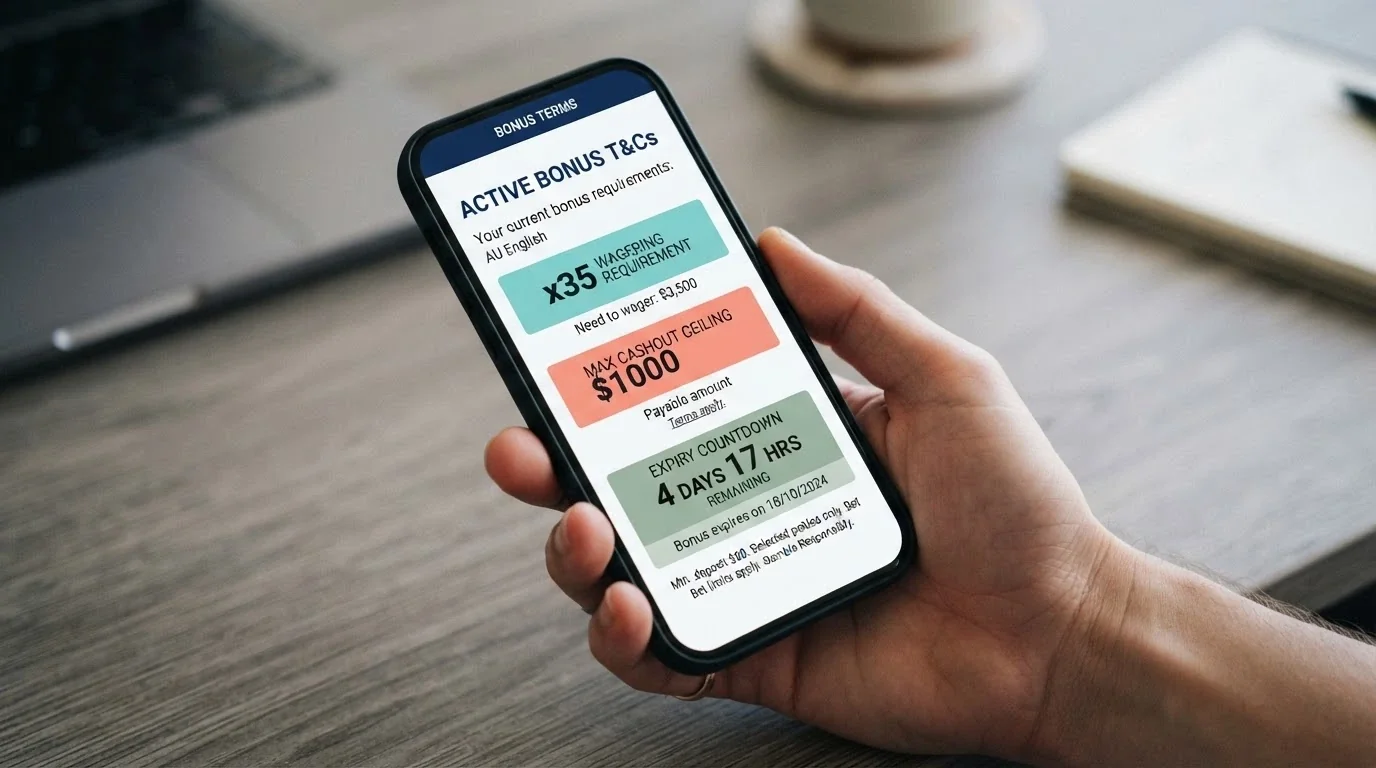
A $10 no-deposit chip with 35x wagering, a $100 max cashout and 14 days to clear is a different offer from the same $10 chip with 60x wagering, a $50 max cashout and 7 days to clear. The first is a low-cost way to test a platform. The second is closer to a token gesture that the wagering almost guarantees the player will not clear.
The $10 No-Deposit Bonus, Explained
A no-deposit bonus lands in the player’s account in one of two ways: either automatically at registration, or after entering a bonus code at the cashier or on a promotional page. Either way, the casino credits $10 of promotional funds that cannot be withdrawn directly — winnings become withdrawable only after the wagering requirement is met, the cashout cap is observed, and the bonus expiry has not passed.
A no-deposit bonus is not the same as free spins. Free spins are a fixed number of plays on a named pokie, usually at a fixed stake, with the bonus value paid as promotional credit rather than cash. A no-deposit bonus is a flat credit that the player chooses where to spend, subject to the casino’s eligible-games list. The casino’s reason for giving either is the same: get a new account through the door and into the wagering loop.
What the casino gets out of giving away $10 is the wagering burden itself. At 35x, the player has to bet $350 before the $10 becomes real-money winnings. The house edge on the eligible games does the rest. The casino is not betting $10 against the player’s full bankroll; it is betting $10 against the player’s time and the mathematics of the games it has chosen.
Welcome Packages vs Standalone No-Deposit Offers
A standalone no-deposit bonus is a single free chip, usually between $10 and $50, claimed once at sign-up. A welcome package is a tranched deposit-match offer that hands out bonus credit and free spins across three or four deposits. The two are different products at different price points, and the casinos on this page mostly offer the second rather than the first.
- NeoSpin — 300% up to A$11,000 + 300 free spins, spread across four deposits at A$30 minimum per tranche.
- Lucky7 — up to A$3,000 + 200 free spins, A$50 minimum to activate the welcome.
- Lucky Vibe — up to A$5,000 + 300 free spins across four deposits, A$30 minimum for the welcome.
- SkyCrown — A$8,000 + 400 free spins, A$30 minimum PayID deposit.
- Goldenbet — A$100 cash gift across three deposits (A$30 + A$20 + A$50) at 1x wagering — effectively no-wagering — plus 300 free spins a week for eligible players.
- 7Bit Casino — up to A$10,800 + 250 free spins.
- Rolling Slots — 310% up to A$6,400 + 570 free spins, 30x wagering.
- StoneVegas — 100% up to A$750 + 200 free spins.
- Wild Tokyo — 250% up to A$5,300 + 600 free spins, 35x wagering.
- DragonSlots — A$10,500 + 800 free spins, A$20 minimum PayID deposit.
Standalone no-deposit chips are the smaller cousin of the welcome package, and they are rarer in this rank. Where they do appear, they are usually a registration bonus the player spends before deciding whether to fund a first deposit.
Wagering Requirements: 35x on $10 Means $350 Before You Can Cash Out
Wagering is the multiplier a casino applies to a bonus to determine how much qualifying stake the player must run before any winnings become cashable. The maths is straightforward: wagering requirement times the bonus equals the qualifying stake. At 35x on a $10 no-deposit chip, the qualifying stake is $350. At 40x, it is $400. At 60x, it is $600. At 150x, it is $1,500.
The multiplier is the single number that decides whether a $10 bonus is worth claiming. A casino that advertises “$10 free” with a 150x wagering is offering a $1,500 qualifying-stake requirement for what is functionally $10 of house money. The player who runs the wagering at the eligible games is contributing far more in expected loss than $10 — and that is before any max cashout cap is applied.
Game weighting tables make the multiplier worse at the margins. A bonus that says “40x wagering on pokies, 5% on table games” is, in plain language, 800x effective on table games: only one dollar in twenty of every table-game bet counts toward the wagering requirement. Lucky Vibe’s terms carry exactly this split. A player who tries to clear the bonus at blackjack is doing eight hundred times the qualifying stake for the same $5,000 of bonus headroom.
Goldenbet is the operator in this rank whose wagering term changes the picture. Its A$100 cash gift across three deposits runs at 1x wagering — effectively no playthrough barrier. The arithmetic is no longer “bet forty times the bonus to withdraw”: it is “bet the bonus once.” That single number moves the offer from marketing to genuine player-friendly terms, and it is the reason Goldenbet sits in the rank it does.
Max Cashout Caps: Your Winnings Stop at $50–$200
A max cashout cap is a hard ceiling the casino places on what a player can withdraw from bonus winnings, regardless of how much the wagering was cleared at. The typical cap on a $10 no-deposit chip is $50 to $200. A player who beats the wagering, lands a balance of A$1,500, and tries to withdraw finds A$1,300 of it returned to the casino or voided.
The cap exists because the casino is pricing the no-deposit chip on the assumption that most players will not clear the wagering. The handful who do are a cost the cap absorbs. From the casino’s side, the cap is a hedge. From the player’s side, the cap is the reason a $10 no-deposit bonus is not a route to a meaningful payout — even with the wagering cleared, the upside is bounded at the cap.
Deposit-match bonuses at offshore casinos are less likely to carry the same hard cap, because the casino has already collected a deposit from the player and is competing with other casinos for the same customer’s next deposit. The cap is a feature of the smallest bonuses — the ones the casino is most worried about being abused.
Bonus Codes: What They Are and Whether You Need One
A bonus code is a short string — letters, numbers, or a mix — that the player enters at registration, in the cashier, or on a promotional page to unlock a specific offer. Some casinos use them to track which affiliate sent the player; others use them to keep individual promotions separate. Either way, the code is the difference between the bonus landing in the account and the bonus being invisible.
The operators on this page mostly use either automatic crediting at sign-up or opt-in buttons in the cashier. Whether a code is required for any specific $10 no-deposit bonus on a given casino is a per-operator detail that the player should confirm in the cashier before depositing. The terms page is where the casino writes the rule; the cashier is where the player meets it.
A player who forgets a code at the moment of registration does not lose the bonus forever. Most casinos let the player enter the code in the cashier before a qualifying deposit; a smaller number require the code at sign-up and refuse to apply it later. The safer move is to check the cashier for the bonus terms before funding the account.
Which Pokies You Can Actually Play With Your Bonus
A no-deposit bonus is not a blank cheque for the lobby. Every casino with a bonus runs an eligible-games list, and the games on that list are usually the ones the casino is comfortable the player will grind through the wagering on. High-RTP pokies — the ones a serious player would choose without a bonus — are often weighted at 0%, meaning they do not count toward wagering at all, or excluded entirely.
NeoSpin’s free spins, for example, are tied to a specific list of titles: Sweet Rush Bonanza, Candy Monsta, Fruit Million, Gates of Olympus Super Scatter, Bonanza Billion, 15 Dragon Pearls: Hold and Win, and Johnny Cash. A player who would rather play a pokie not on that list cannot use the free spins on it. The bonus forces the player onto games the casino has chosen, with the wagering tracking on the chosen games only.
The cost of playing an ineligible game with bonus money active is, at most offshore casinos, voiding the bonus. The casino’s terms reserve the right to cancel the bonus and any associated winnings if the player breaches the eligible-games rule. The reader who plays a $0.50 spin on a non-eligible pokie while a $10 no-deposit bonus is live is, technically, playing with money that the casino can take back at any moment.
The Best PayID Casinos We Reviewed With $10 No-Deposit Bonuses
The ten operators below are offshore, none holds an Australian online-casino licence, and the bonus at each is the headline offer the casino puts on its homepage. The ranking is by fit to the page’s $10 no-deposit / PayID angle — bonus value, PayID support, terms fairness, and minimum-deposit accessibility — not by an overall casino score.

| Rank | Casino | Welcome Bonus (A$) | Wagering | Free Spins | PayID Withdrawal | Game Count |
|---|---|---|---|---|---|---|
| 1 | NeoSpin | 300% up to A$11,000 | 40x (sticky) | 300 | Yes (~22 min) | — |
| 2 | Lucky7 | Up to A$3,000 | — | 200 | Yes (~35 min) | 6,000+ |
| 3 | Lucky Vibe | Up to A$5,000 | 40x (pokies) / 800x effective (table 5%) | 300 | Yes | 7,000+ |
| 4 | SkyCrown | A$8,000 | 40x | 400 | Yes (~9 min) | 7,000+ |
| 5 | Goldenbet | A$100 cash gift | 1x (effectively no wagering) | 300/week recurring | Yes (~28 min) | 4,000+ |
| 6 | 7Bit Casino | Up to A$10,800 | — | 250 | Yes | — (strong Megaways) |
| 7 | Rolling Slots | 310% up to A$6,400 | 30x | 570 | PayID + bank transfer | 15,000+ |
| 8 | StoneVegas | 100% up to A$750 | — | 200 | Yes | — |
| 9 | Wild Tokyo | 250% up to A$5,300 | 35x | 600 | No (deposit only) | 8,000+ |
| 10 | DragonSlots | A$10,500 | — | 800 | Yes (sub-30s deposit from CommBank) | 7,000+ |
Every operator in the table above is offshore. The wagering column is em-dashed where the figure was not confirmed in the research run; the reader should check the cashier before claiming. The game-count column is em-dashed where the operator’s provider range was not specified.
NeoSpin: The Only Reviewed Casino Where Deposit and Bonus Minimum Both Sit at A$10
NeoSpin is the operator in this rank that matches the $10 sweet spot of this guide’s focus. The deposit floor across every payment method, PayID included, is A$10 — and that is also the bonus-eligible minimum, the figure that activates the welcome offer. Most casinos in this rank advertise $10 on the homepage and require $20 or $30 to unlock the welcome. NeoSpin does not split the two numbers.
The welcome offer is 300% up to A$11,000 plus 300 free spins, spread across four deposits at A$30 minimum per tranche. The wagering runs at 40x on a sticky basis — meaning the bonus is deducted from the balance when the player withdraws, but the wagering applies to both deposit and bonus. The free spins are tied to a fixed list of pokies — Sweet Rush Bonanza, Candy Monsta, Fruit Million, Gates of Olympus Super Scatter, Bonanza Billion, 15 Dragon Pearls: Hold and Win, and Johnny Cash — and the wagering carries over to the free-spin winnings.
The PayID withdrawal is reported at a 22-minute average. That figure is the casino’s own processing on top of the NPP rail, and it is among the faster cashouts in this rank. For a player whose central question is “can I deposit $10, claim a welcome bonus, and cash out via PayID,” NeoSpin is the closest the rank comes to a yes on all three.
Lucky7: 6,000-Plus Pokies From 168 Providers With a 35-Minute PayID Cashout
Lucky7 brings the largest pokies catalogue in the rank by provider count: 168 providers, 6,000-plus pokies. The welcome offer is up to A$3,000 plus 200 free spins. The wagering multiple was not confirmed in the research run.
The PayID deposit minimum is AU$10, in line with the rank, but the bonus activation minimum is AU$50. A player who funds the account with $10 has a balance to play with; a player who wants to unlock the welcome offer has to top up to $50. The split between deposit floor and bonus-eligible minimum is the structure NeoSpin avoids.
PayID withdrawal is confirmed at a 35-minute average. The casino’s licensing was reported as Curaçao — a typical offshore jurisdiction for AU-facing brands, and not an Australian licence.
Lucky Vibe: A$5,000 Welcome Package With a 3-Day Clear Window and a Hard A$7.50 Max Bet
Lucky Vibe’s welcome is large — up to A$5,000 plus 300 free spins across four deposits — but the terms are tight. Wagering runs at 40x on pokies and 800x effective on table games at the 5% contribution rate. The bonus must clear within three days. The max bet while the bonus is active is A$7.50, lower than the rank average. Free spins expire one day after landing.
The three-day clear window is the headline constraint. A bonus that must clear in 72 hours is a different product from a bonus with a 14-day expiry. The player who cannot put in the hours over a weekend to clear the wagering will forfeit the bonus and any winnings tied to it. The max bet of A$7.50 caps the upside further — a player who runs hot on a single spin cannot put the full A$10 stake down while the bonus is live.
PayID deposit and withdrawal are both confirmed. Lucky Vibe is one of the operators where the PayID pipeline works in both directions, which is what the player who cares about the rail should look for.
SkyCrown: A$8,000 Welcome and 7,000-Plus Pokies, but PayID Entry Is A$30
SkyCrown’s headline is A$8,000 plus 400 free spins, with 7,000-plus pokies behind it. The wagering runs at 40x per the casino’s own terms. The PayID withdrawal is reported at a 9-minute average — the fastest in this rank — and PayID deposit and withdrawal are both confirmed.
The entry floor is where SkyCrown sits above the $10 sweet spot. The minimum PayID deposit is A$30, not A$10. A player whose budget is exactly $10 cannot fund a SkyCrown account via PayID; they have to push to $30 to enter the cashier at all. The library and the bonus size justify the higher floor for a player who can fund it. For a player whose budget stops at $10, SkyCrown is the wrong match.
Goldenbet: 1x Wagering — the Closest Thing to a Real Cash Bonus We Found
Goldenbet’s bonus structure is the outlier in the rank, and it is the one operator whose wagering term changes the arithmetic. The welcome is an A$100 cash gift split across three deposits — A$30 on the first, A$20 on the second, A$50 on the third — at 1x wagering. That is functionally no playthrough barrier: the player bets the bonus once and the winnings are cashable.
The free-spin offer is 300 a week, recurring, for eligible players. The PayID deposit minimum is A$10. The PayID withdrawal is reported at a 28-minute average. The game library is 4,000-plus titles across named providers — Play’n GO, BGaming, Playson — which is smaller than Lucky7 or Rolling Slots but covers the mainstream.
The cashback term is the second figure worth reading: 10% unlimited cashback with 45x wagering, max A$500, 15-day expiry. The cashback runs heavier than the welcome in terms of the multiplier, and the 15-day expiry is tighter than the rank’s typical 7-to-14-day window. The welcome is the better of the two offers by terms; the cashback is the recurring safety net for players who intend to keep depositing.
7Bit Casino: Megaways Pokies and Full PayID Both Ways
7Bit’s welcome is up to A$10,800 plus 250 free spins. PayID deposit and withdrawal are both confirmed. The casino’s Megaways catalogue is the standout feature — Megaways pokies are the high-variance titles with up to 117,649 paylines per spin, and 7Bit carries a strong range.
The wagering multiple was not specified in the research run. A player should confirm the figure in the cashier before claiming. The bonus validity period was also not confirmed.
Rolling Slots: 310% Bonus Across 15,000-Plus Games With 30x Wagering
Rolling Slots has the largest game library in the rank — 15,000-plus titles — and a 30x wagering multiple, the lowest confirmed in the rank. The welcome is 310% up to A$6,400 plus 570 free spins, which puts the free-spin count in the upper half of the rank. PayID and bank transfer are both supported.
The combination of low wagering and a large game library makes Rolling Slots the operator whose wagering arithmetic is closest to a real-money offer in the rank. A 30x multiple on a $100 bonus is $3,000 of qualifying stake, well below the 40x and 45x multiples that dominate the rest of the table.
StoneVegas: A Straight 100% Match With PayID Both Ways
StoneVegas keeps the welcome simple: 100% up to A$750 plus 200 free spins, with PayID deposit and withdrawal both confirmed. The wagering multiple, the game-provider range and the bonus validity period were not specified in the research run.
For a player who wants a flat 100% match without the four-tranche ladder that most of the rank runs, StoneVegas is the closest the page comes. The reader should confirm the wagering figure in the cashier before committing.
Wild Tokyo: 600 Free Spins and 8,000-Plus Games, but No PayID Cashout
Wild Tokyo’s welcome is 250% up to A$5,300 plus 600 free spins, with 35x wagering and 8,000-plus games behind it. The free-spin count is among the largest in the rank. USDT withdrawal is reported at an 11-minute average, which is fast — but it is not PayID.
The PayID position at Wild Tokyo is the asymmetry the player needs to see. PayID deposit is available; PayID withdrawal is not. A player who funds the account via PayID cannot cash out via PayID; the cashout route is crypto or bank transfer. The casino’s USDT speed is real, but it requires the player to hold USDT and to convert on exit. The minimum PayID deposit is A$20.
The licence was reported as Curaçao — an offshore jurisdiction, not an Australian licence.
DragonSlots: 800 Free Spins and a Sub-30-Second PayID Deposit From CommBank
DragonSlots is the operator in this rank with the most free spins — 800 — and the fastest confirmed PayID deposit. A test deposit cleared in under 30 seconds from a CommBank account, which puts DragonSlots at the leading edge of the rail for a player depositing from one of Australia’s big four banks.
The welcome is A$10,500 plus 800 free spins, with 7,000-plus pokies behind it. Named providers include Pragmatic Play, BGaming and Betsoft. The minimum PayID deposit is A$20, slightly above the $10 floor some of the rank runs. PayID withdrawal is confirmed.
The wagering multiple was not specified in the research run. The bonus validity period was also not confirmed. The reader should check the cashier.
Online Casino Is Illegal in Australia — Here Is What That Actually Means
The Interactive Gambling Act 2001 (Cth) prohibits the provision of online casino games, online pokies and in-play sports betting to anyone in Australia. There is no licence for online casino anywhere in Australia — not federally, not in any state or territory. The product is banned, not grey-area.

Every operator on this page is offshore. None holds an Australian licence for online casino games. The licensing jurisdictions reported in research (Curaçao, in particular) are offshore regulators with no relationship to the ACMA. The licensed Australian wagering market — Sportsbet, Tab, bet365, Ladbrokes, and others — is a separate legal product covering races and pre-event sports only, not online casino.
The Interactive Gambling Amendment (Gambling Reform) Bill 2026 passed Parliament on 19 August 2026. Its measures commence 1 January 2027. The reform tightens advertising rules, brings in payment-blocking authority for banks, and strengthens BetStop. It does not legalise online casino.
The ACMA has had 1,788 illegal gambling and affiliate websites blocked by Australian ISPs as of August 2026. Over 230 illegal gambling services have withdrawn from the Australian market since the ACMA began enforcing new rules in 2017. The enforcement is real and ongoing; the page that lists offshore casinos as if they were licensed options is the page that fails to tell the reader what they are actually doing.
The Interactive Gambling Act 2001: What It Prohibits
The IGA 2001 is the federal statute that makes online casino illegal in Australia. It prohibits the provision of online casino games, online pokies and in-play sports betting to anyone physically in Australia. The prohibition is on the provider, not the player: an Australian individual who uses an offshore site is not prosecuted, but the site is operating illegally, and the player loses Australian consumer protection by using it.
The IGA also makes it an offence to advertise a prohibited interactive gambling service to an Australian customer. The minimum age for any commercial gambling in Australia is 18.
Enforcement sits with the Australian Communications and Media Authority (ACMA). The ACMA investigates complaints, issues formal warnings, brings civil penalty proceedings, and directs ISPs to block illegal sites under section 313 of the Telecommunications Act 1997. The blocking is real and visible: a player who tries to load a blocked site from an Australian IP address is met with an ISP block page.
Licensed AU Wagering vs Offshore Casino: What the Difference Means for Your Money
The distinction between licensed Australian wagering and offshore online casino is the single most important difference on this page. Both involve real money and real bets. Only one is legal to provide to an Australian customer, and only one comes with the consumer protections that the Australian framework offers.
| Feature | Licensed AU Wagering | Offshore Casino |
|---|---|---|
| Legal Status | Legal to provide (racing, pre-event sport, lotteries, keno) | Illegal to provide (IGA 2001) — player not prosecuted but loses AU protections |
| Regulatory Body | State/territory wagering commission (NT Racing and Wagering Commission, state regulators) | Offshore (typically Curaçao) — no AU regulator |
| BetStop Coverage | Yes — covers ~150 licensed wagering providers | No — BetStop does not reach offshore sites |
| Deposit Payment Methods | Debit card, bank transfer, PayID/Osko, BPAY | PayID, bank transfer, e-wallet, crypto (varies by operator) |
| Credit Card / Crypto Ban Compliance | Yes — banned since 11 June 2024 | Most accept both — a “tell” that the operator is outside AU rules |
| Consumer Recourse If Operator Refuses Withdrawal | AU regulator, dispute resolution, AFCA scheme | None — operator’s own T&Cs and offshore licence only |
The credit-card and crypto ban is one of the clearest compliance tells on this page. Credit cards, credit-related products and cryptocurrency have been banned as payment methods for online wagering since 11 June 2024. A licensed Australian wagering operator cannot accept either. An offshore casino typically accepts both. The presence of credit-card or crypto deposit options at a casino is, by itself, evidence that the operator is outside the Australian regulatory perimeter.
Gambling winnings are not assessable income under section 6-5 of the ITAA 1997, and gambling losses are not deductible under section 8-1 — unless the person is carrying on a business of gambling. The ATO’s criteria (IT 2655) are whether the activity is systematic, organised and businesslike. No Australian case has held an ordinary punter’s winnings assessable. For most players, the winnings are tax-free.
ACMA Enforcement: 1,788 Sites Blocked — and Counting
The ACMA is the federal regulator responsible for enforcing the IGA’s online prohibition. Its enforcement record since November 2019 is the empirical answer to anyone who treats the prohibition as a paper rule.
In Q4 2025 alone, the ACMA looked into 483 enquiries and complaints, completed 23 investigations into 45 gambling sites, found 69 breaches of the IGA, and issued 10 formal warnings. Of the 69 breaches, 38 were for providing a prohibited interactive gambling service, 26 for providing an unlicensed regulated interactive gambling service, and 5 for advertising prohibited or unlicensed services.
The cumulative blocking tally since November 2019 is 1,788 illegal gambling and affiliate websites. Over 230 illegal services have withdrawn from the Australian market since 2017 — either pushed out by ACMA action or choosing to leave before being blocked. ACMA gambling advertising enforcement is one of the regulator’s five key compliance and enforcement priorities for 2026–27.
From 1 January 2027, banks and payment providers gain express authority to block transactions to illegal gambling operators. That change closes a gap that has existed since 2017: today, an Australian bank can decline individual transactions to known illegal operators on a case-by-case basis, but does not have a standing authority to block them as a category. After January 2027, it does. For an Australian player funding an offshore casino via PayID, this is the reform that most directly affects the deposit side of the page.
Staying in Control When the Australian Safety Net Does Not Reach Offshore
The Australian responsible-gambling framework — BetStop, the National Helpline, Gambling Help Online, state-based services — is real, established and well-funded. It is also built for licensed Australian wagering operators. Offshore casino sites sit outside it.

BetStop — the National Self-Exclusion Register — went live in August 2023. As at 31 July 2026 it had 67,480 registrations, of which 41,290 exclusions were still active. 78% of registrants were under 40, and 38% chose lifetime exclusion. A single BetStop registration excludes the player from every licensed Australian wagering provider — approximately 150 operators. A BetStop registration does nothing to an offshore casino. The self-exclusion stops at the Australian border.
The National Gambling Helpline is 1800 858 858 — free, confidential, staffed 24/7. Online chat and counselling are available through Gambling Help Online. State-based services — GambleAware NSW, Gambler’s Help in Victoria, and others — cover their respective jurisdictions. None of them can retrieve funds from an offshore casino that refuses a withdrawal, and none of them can block the next deposit.
About 2.1% of Australian adults — roughly 430,000 people — experience problem gambling, with high-risk gambling at 1.8%, according to the Australian Institute of Health and Welfare. The numbers are not large as a percentage, but they are large in absolute terms. The offshore route is where the Australian framework’s reach is thinnest.
Deposit Limits, Self-Exclusion and What Actually Works Offshore
A licensed Australian wagering operator is required to offer customer-set deposit limits and activity statements. The player picks a daily, weekly or monthly ceiling, and the operator enforces it. Offshore casinos are under no such obligation. A player who wants a deposit limit on an offshore site has to set it themselves — at the bank, in their own banking app, or by walking away from the cashier.
From 1 January 2027, banks and payment providers gain authority to block transactions to illegal gambling operators. That change does not impose a per-player deposit ceiling, but it gives Australian banks the standing to refuse payments they previously had to consider individually. For a player who has asked their bank to block gambling transactions, the new authority makes the block stickier.
The credit card and crypto ban is the other half of the controls layer. Since 11 June 2024, an Australian cannot fund a wagering account with a credit card or with cryptocurrency at a licensed operator. The ban does not reach offshore sites directly, but it removes two of the easiest ways to fund a session impulsively.
BetStop does not reach offshore sites. A player who has registered with BetStop and then funds an offshore casino account has not broken a rule, but has also not stopped gambling — they have moved the gambling to a venue the Australian self-exclusion register cannot see.
Where to Get Help: The National Helpline, BetStop and Their Limits
The Australian help infrastructure is structured around four entry points, each with a different scope.
The National Gambling Helpline is 1800 858 858 — free, confidential, staffed 24/7. It is the first call for anyone whose gambling has moved from entertainment to concern. Online chat and email counselling are available through Gambling Help Online.
BetStop — the National Self-Exclusion Register — is at betstop.gov.au. A single registration excludes the player from every licensed Australian wagering provider. The minimum exclusion period is three months; the maximum is lifetime. 38% of registrants chose lifetime exclusion as at 31 July 2026.
State-based services cover their jurisdictions directly. GambleAware NSW, Gambler’s Help in Victoria, and the equivalents in Queensland, South Australia, Western Australia, Tasmania and the ACT each run their own counselling, self-exclusion and financial counselling services.
None of these services can retrieve funds from an offshore casino that refuses a withdrawal. None of them can block the next deposit at an offshore site. What they can do is help the player stop gambling, help them manage the debt an offshore session may have created, and connect them with financial counselling. The scope of the help is real; the reach stops at the Australian border.
How We Selected and Ranked These PayID Casinos
The ten operators on this page were selected for their fit to the page’s central topic — a $10 no-deposit bonus at an AU-facing casino that accepts PayID — and ranked by qualitative comparison across five criteria: PayID support (deposit and withdrawal), bonus value and wagering fairness, minimum-deposit accessibility, game count and provider range, and transparency of terms.

Every operator above is offshore. None holds an Australian licence for online casino. The licence position was confirmed against the ACMA’s published guidance: there is no Australian licence for online casino games anywhere in the country, and the operators on this page operate from Curaçao or other offshore jurisdictions. The check is the kind of thing that is easy to skip on a competitor page and easy to fail by omission, and the omission is why no competing page on this topic tells the reader what they are actually doing.
The sources used to populate the operator write-ups were operator terms pages, ACMA enforcement and blocking data, affiliate audits, and player reports. Where a figure was not confirmed in the research run — a wagering multiple, a bonus validity period, a game-provider count — the cell in the comparison table is em-dashed rather than guessed. A reader who sees em-dashes in a row should treat that row as “ask the cashier before claiming.”
The ranking does not carry invented weightings. The position of Goldenbet, for example, is driven by the 1x wagering term, not by an editorial score. The position of DragonSlots is driven by the free-spin count and the confirmed sub-30-second PayID deposit. The position of Wild Tokyo reflects the PayID deposit-only gap that the player should see before funding the account. Each rank reflects a feature the page’s central topic — a $10 no-deposit bonus, PayID support, and terms a reader can read honestly — rewards.
What a $10 No-Deposit Bonus Is Worth Once You Weigh Everything Up
A $10 no-deposit bonus is not free money. It is a free chip with a price tag attached: a wagering multiple that turns $10 into $350 to $450 of qualifying stake, a cashout cap that bounds the upside at $50 to $200, a game eligibility list that confines the wagering to games the casino has chosen, and a bonus expiry that puts a clock on the whole arrangement. The price tag is the offer. The $10 is the headline.

The three forces that shrink the bonus are the wagering burden, the cashout cap and the game eligibility list. They compound. A player who beats 35x wagering on a $10 chip still has to clear the cap; a player who clears the cap has still played only eligible games; a player who plays eligible games has still bet the full $350 in qualifying stake. The arithmetic is built so that the casino keeps its edge across every scenario.
The legal reality is the second weight on the same scale. Every operator on this page is offshore. BetStop does not reach them. The ACMA cannot retrieve a refused withdrawal. The Australian consumer-protection framework stops at the licensed wagering perimeter. A player who uses an offshore casino has, by definition, opted out of the part of the Australian framework that would help them if the casino refuses to pay.
One operator in the rank changes the arithmetic. Goldenbet’s 1x wagering on the A$100 cash gift is functionally no playthrough barrier. A player who claims the Goldenbet welcome is not betting $350 to $450 of qualifying stake to clear it; they are betting the bonus once. That single term moves the offer from “marketing” to “player-friendly,” and it is the reason Goldenbet sits where it does in the table.
The honest answer is that a $10 no-deposit bonus is a low-cost way to test an offshore casino’s platform and withdrawal pipeline — not a route to a meaningful cashout. The player who treats it as entertainment rather than income is the only one who breaks even, because the player who treats it as income will eventually run the wagering in the wrong direction and lose both the bonus and the time. The ACMA’s own warning is the right frame: even if a service looks legitimate, Australians who use illegal gambling services risk losing their money.
The $10 chip is real. The terms behind it are real. The legal reality of using an offshore site is real. The reader’s decision is whether the upside of the bonus is worth the downside of the legal and consumer-protection position. That is the only question this page answers honestly.
Frequently Asked Questions
Can I use PayID to deposit $10 and claim a welcome bonus at online casinos?
Yes — at some, not all. The deposit side is the easier half: most AU-facing casinos on this page accept PayID for deposits, and several (NeoSpin, Goldenbet) take A$10 as the deposit floor. The bonus side is the harder half: many casinos require a separate $20 to $30 minimum to unlock the welcome offer, even when the deposit floor is $10. NeoSpin is the clearest exception where both numbers are A$10. Check the cashier before claiming.
What is BetStop and does it cover offshore casino sites?
BetStop is Australia’s National Self-Exclusion Register, run by the ACMA. A single registration excludes you from every licensed Australian wagering provider — approximately 150 operators covering racing and pre-event sport. It does not cover offshore casino sites. The self-exclusion stops at the Australian border, so a BetStop registration will not block a deposit or a session at any operator on this page.
What happens if an offshore casino blocks my account or refuses a withdrawal?
There is no Australian regulator to appeal to. The IGA targets the provider, not the player, but it also means there is no Australian consumer-protection framework covering offshore operators. Your recourse is the casino’s own terms and conditions, the casino’s offshore regulator (typically Curaçao), and whatever dispute-resolution process the operator has chosen to honour. None of these is enforceable in the way an Australian Financial Complaints Authority ruling is. This is the practical cost of choosing an offshore site over a licensed wagering operator.
Do I need to verify my identity before claiming a no-deposit bonus?
Usually not for the claim itself — most no-deposit bonuses credit at registration or via a code, before any document check. Identity verification (KYC) kicks in before the first withdrawal, when the casino is required to confirm the player is who they say they are. The verification typically asks for a government ID, proof of address, and sometimes a payment-method confirmation. Until the KYC clears, the casino may hold withdrawals — including winnings from a no-deposit bonus. Plan for this when sizing a session.
Are gambling winnings taxable in Australia?
No, for the typical player. Gambling and betting winnings are not assessable income under section 6-5 of the ITAA 1997, and gambling losses are not deductible under section 8-1. The ATO’s criteria (IT 2655) for treating gambling as assessable income are whether the activity is systematic, organised and businesslike — a standard aimed at professional gamblers, not ordinary punters. No Australian case has held an ordinary punter’s winnings assessable. Recreational winnings at an offshore casino are tax-free, with the same caveat that recreational is the operative word.
Written by the editors at Casino Apps Australia.