
The $300 No-Deposit Bonus in Australia: What the Headline Leaves Out
 Available in AU
Every Australian player chasing a $300 no-deposit bonus is chasing an offer that, in this country, is technically a product no operator is allowed to sell. The Interactive Gambling Act 2001 makes online casino games, online pokies and in-play betting unlawful to provide to a person physically in Australia, and no state or territory issues a licence for the product behind that headline. What fills that gap is an offshore market that operates outside Australian consumer law, outside BetStop coverage, and outside the ACMA’s blocking regime. This page is the honest reading of that market: what a $300 no-deposit bonus actually delivers, what the wagering arithmetic costs in time and money, and what a player is and isn’t protected against when they register.

Current as of 18 October 2026. Licence claims verified against ACMA registers and state and territory wagering licensing authorities.
Table of Contents
- What a $300 Casino Bonus Actually Means in 2026
- The $300 No-Deposit Bonus: What the Market Really Offers
- The Operators Advertising $300 Bonuses to Australian Players
- Pokies You Can Play With a No-Deposit Bonus
- Funding Your Play: PayID and Casino Deposits in Australia
- Why Every $300 Casino Bonus Targeting Australia Sits Offshore
- Playing Safe: Responsible Gambling Tools and Where to Get Help
- How We Selected the Operators on This Page
- Is a $300 No-Deposit Bonus Worth Your Time in 2026?
- Frequently Asked Questions
What a $300 Casino Bonus Actually Means in 2026
A $300 casino bonus looks like the best deal on the page until the wagering requirement lands. In 2026, the dense middle of no-deposit offers at Australian-facing offshore lobbies sits at A$10 to A$25 in bonus cash or 20 to 50 free spins, and three-digit no-deposit cash without extreme restrictions is rare enough that the same aggregator pages often relabel a deposit-match offer as “no deposit” to make the headline work. When a genuine A$300 no-deposit bonus does appear, it is usually structured as a free chip with a 35x playthrough and a maximum cashout of A$75, or as a deposit-match package with a 50x requirement and a tighter window. The terms are not hidden; they are the entire product. The number on the banner is the bait, and the small print is the cost.
How a bonus this size lands in your account
Bonus credit at an offshore casino arrives through one of two routes. Some sites credit automatically the moment registration is complete and identity verification passes — the A$300 chip appears in a separate “bonus funds” balance alongside the player’s real-money balance. Others gate the bonus behind a code, which the player enters at the cashier after sign-up. The code route is the more common shape for A$300-class offers, because operators use it to track acquisition channels and to limit the promotion to specific player segments. The mechanics differ, but the player’s experience is the same: a balance split into two line items, a wagering gate before any withdrawal, and a separate clock running on the bonus’s validity.
The validity window for a bonus this size runs 14 to 30 days in the typical offshore market — long enough to give a player time to use the credit, short enough to keep the operator’s exposure bounded. Where the bonus is delivered as a code, the code itself often expires in 24 to 72 hours if not used, and the wagering window then shrinks to one to seven days once the bonus is credited. A player who treats the bonus as a deposit they can sit on is reading the wrong contract. The clock starts the moment the bonus credits, not the moment the player notices it.
Online casino bonuses vs land-based promotions
A land-based casino in Australia — Crown Melbourne, The Star Sydney, the state-licensed venues in Queensland, South Australia, Western Australia and the ACT — runs promotions that are a fundamentally different product from anything an offshore site offers. A land-based free-play credit converts to withdrawable cash on meeting its turnover; there is no offshore-style maximum cashout that turns a A$300 win into a A$75 walk-away. Online, the wagering requirement is the differentiator. The same A$300 of bonus credit at an offshore site requires 40x to 60x playthrough before any withdrawal is permitted, and the maximum cashout cap — typically A$50 to A$200 — applies on top of that. Land-based operators don’t need the cap because the product is licensed and the regulator sets the rules. Offshore operators need the cap because the product is prohibited and the wagering multiple does the regulator’s job for them.
The reason the same word — “bonus” — describes two completely different products is that land-based venues answer to a state regulator (the Victorian Commission for Gambling and Liquor Regulation, Liquor & Gaming NSW, the Queensland Office of Liquor and Gaming Regulation, and the others), while offshore casinos answer to whichever jurisdiction issued their licence — usually Curaçao, Malta, or Anjouan. Neither is Australia. A licence that is not Australian does not give an Australian player an Australian remedy when a withdrawal is delayed, a win is voided, or the site simply stops responding. The land-based product is regulated; the offshore product is not. The word is the same. The product is not.
Bonus funds vs real-money balance: the key distinction
The two balances on an offshore casino account behave like two different wallets with one locked and one unlocked. Real money sits in the cash balance and can be withdrawn at any time, subject to the operator’s withdrawal minimums and any pending-deposit checks. Bonus funds sit in the bonus balance and cannot be withdrawn until the wagering requirement is met; the moment the player requests a withdrawal while any portion of the bonus remains unplayed, the bonus is typically voided along with any winnings derived from it.
The split is not incidental; it is the mechanism that converts the headline A$300 into something a player can actually take home. A genuine A$300 no-deposit offer with a 35x wagering requirement means a player must turn over A$10,500 before any of the resulting balance becomes cash-eligible, and the maximum cashout cap — commonly A$50 to A$200 for no-deposit offers of this size — then limits what the player actually walks away with. Claims of unlimited withdrawals from no-deposit bonuses rarely survive the small print at the bonus stage. The marketing word is “bonus”; the math says the player is paying for the privilege of running A$10,500 through a game with a house edge, and the operator is paying them back at most A$200 if they win. The asymmetry is not an accident. It is the price of admission.
The $300 No-Deposit Bonus: What the Market Really Offers
In 2026, a “genuine” A$300 no-deposit bonus — meaning no deposit required, no token verification payment, no code that activates only after a qualifying deposit — is rarer than the affiliate pages suggest. Where one does appear, it carries the highest turnover and the tightest cashout cap on the bonus menu. The market is split between offers that are real but expensive (35x playthrough, A$75 maximum payout) and offers that look generous but are deposit-gated (A$200 cash bonus on a minimum deposit, 50x wagering, A$100 maximum cashout). The table below compares the documented terms.
| Term | $300 Free Chip Offer | $200 Cash Bonus Offer | Typical AU-Facing Range |
|---|---|---|---|
| Wagering requirement | 35x (chip); 40x (free spins) | 50x | 40x–60x |
| Maximum cashout | A$75 | A$100 | A$50–A$200 |
| Validity window | 7 days (free spins) | 30 days | 14–30 days |
| Offer structure | Free chip + 100 free spins on Wild West TRUEWAYS | Cash bonus (deposit-gated) | Free chip, free spins, or deposit match |
The “Typical AU-Facing Range” column is the middle of the offshore market, not a guarantee at any specific site. A player evaluating any individual offer should treat the offer page — not this table — as the binding contract.
No-deposit vs deposit-match: two very different doors
A no-deposit bonus costs the player nothing to claim. A deposit-match bonus costs the player a real deposit to unlock. That is the entire structural difference, and it explains why the headline numbers on each are calibrated differently.
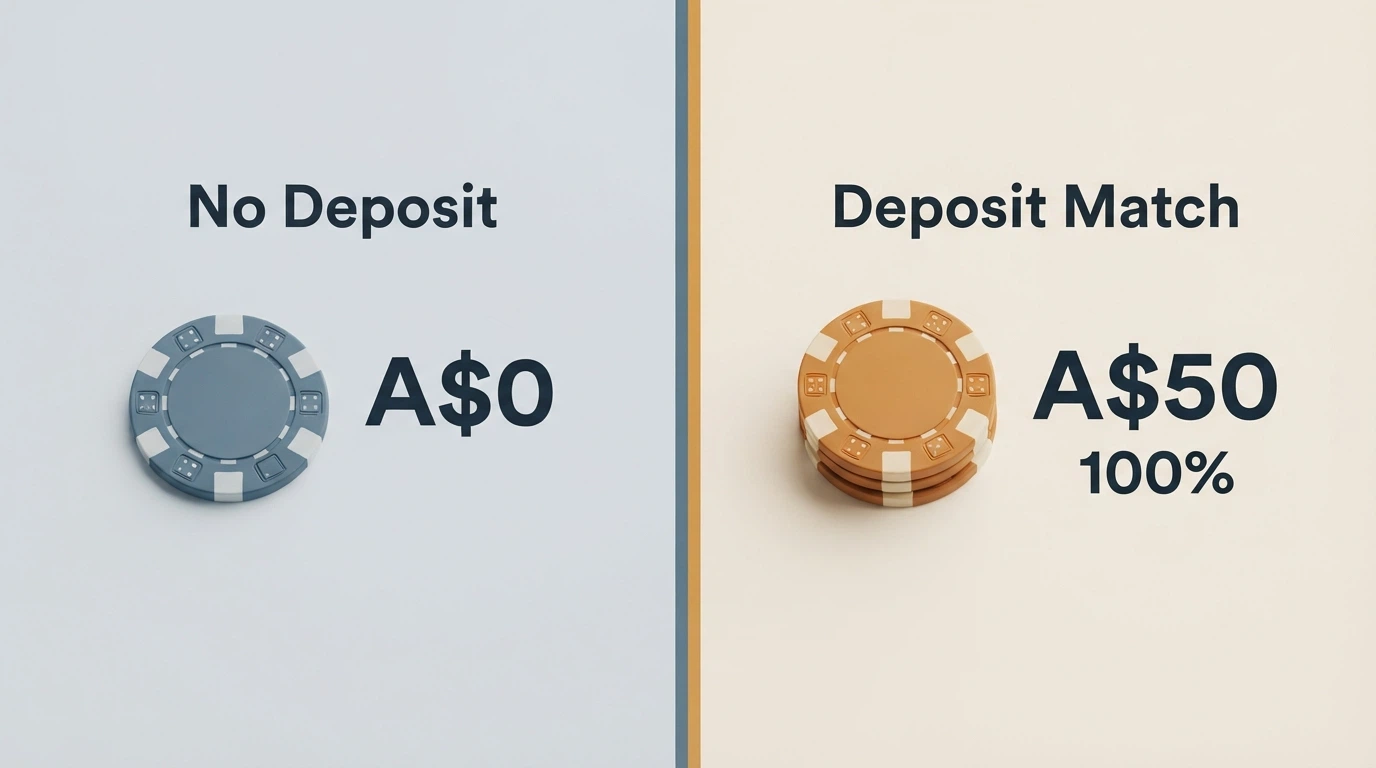
The A$300 free-chip offer that does surface in the offshore market — typically 35x wagering, maximum payout of A$75, sometimes paired with 100 free spins on a single named title — is a no-deposit offer in the strict sense. A player who claims it risks nothing from their own wallet, but they pay in time and in expectation. At 35x turnover on a A$300 chip, the player must wager A$10,500 before the A$75 cap can be reached. Assuming the player stakes only the maximum allowed per spin — A$5 at the low end, A$10 at the high end — that turnover translates to between 1,050 and 2,100 spins. At a steady five-second cadence, that is somewhere between roughly 1.5 and 2.9 hours of continuous play. In practice, navigation, decision-making, dead spins, locked games and the validity window stretch that figure considerably, and the expected loss over the same turnover — running the bonus through a typical pokie at the house edge the game is built around — is several multiples of the A$75 ceiling.
The arithmetic answer to “how long does it take to clear a A$300 no-deposit bonus” is: long enough that the A$75 ceiling starts to look like the operator’s true price for the player’s time. The bonus is free at the cashier and expensive at the clock.
By contrast, the A$200 cash bonus that appears alongside is deposit-gated. The player funds an account, the operator matches a portion of that deposit as bonus, and the wagering is applied to the deposit-plus-bonus sum. The headline is lower (A$200 versus A$300) but the maximum cashout (A$100) is higher in absolute terms than the A$75 cap on the free chip, and the player’s own money is what’s being turned over. A player who funds a A$300 deposit to unlock the A$200 bonus has A$500 of combined balance working through the wagering, not A$300 of house credit. The arithmetic changes. The structure does not.
The sign-up and welcome-bonus funnel
The path from search result to credited bonus at an offshore casino runs through four stages: registration, identity verification, bonus code entry (if required), and bonus credit. Each stage has its own failure mode.
Registration is the part every site makes frictionless. The form asks for email, password, country and currency; offshore sites typically accept AUD and route the player through to a localised lobby. The bonus banner is usually visible the moment the account is created, sometimes appearing as a pop-up, sometimes as a sticky banner across the top of the lobby.
Identity verification is the stage that breaks the funnel. Offshore operators verify identities for anti-money-laundering reasons even though they are not licensed in Australia — KYC checks at this level are standard practice across the offshore market. The verification is typically triggered at the first withdrawal request rather than at registration, which means a player can sign up, claim the A$300 bonus, and play through the wagering before any document is requested. The verification delay then hits at the moment the player wants their winnings, not before.
Bonus code entry is where many no-deposit offers die. Codes that are not used within 24 to 72 hours of credit expire automatically, and the wagering window for the bonus that does credit — once the code is used — often collapses to 1 to 7 days on small packages. A player who treats the bonus as something to “get around to” finds the offer has closed itself.
Cashable vs non-cashable: when the money is actually yours
A cashable bonus is one where, once the wagering is met, the bonus funds convert to real money and can be withdrawn up to the maximum cashout cap. A non-cashable (or “sticky”) bonus is one where the bonus amount itself is deducted from the balance at the moment of withdrawal — only the winnings above the bonus can be taken out, and then only up to the cap.
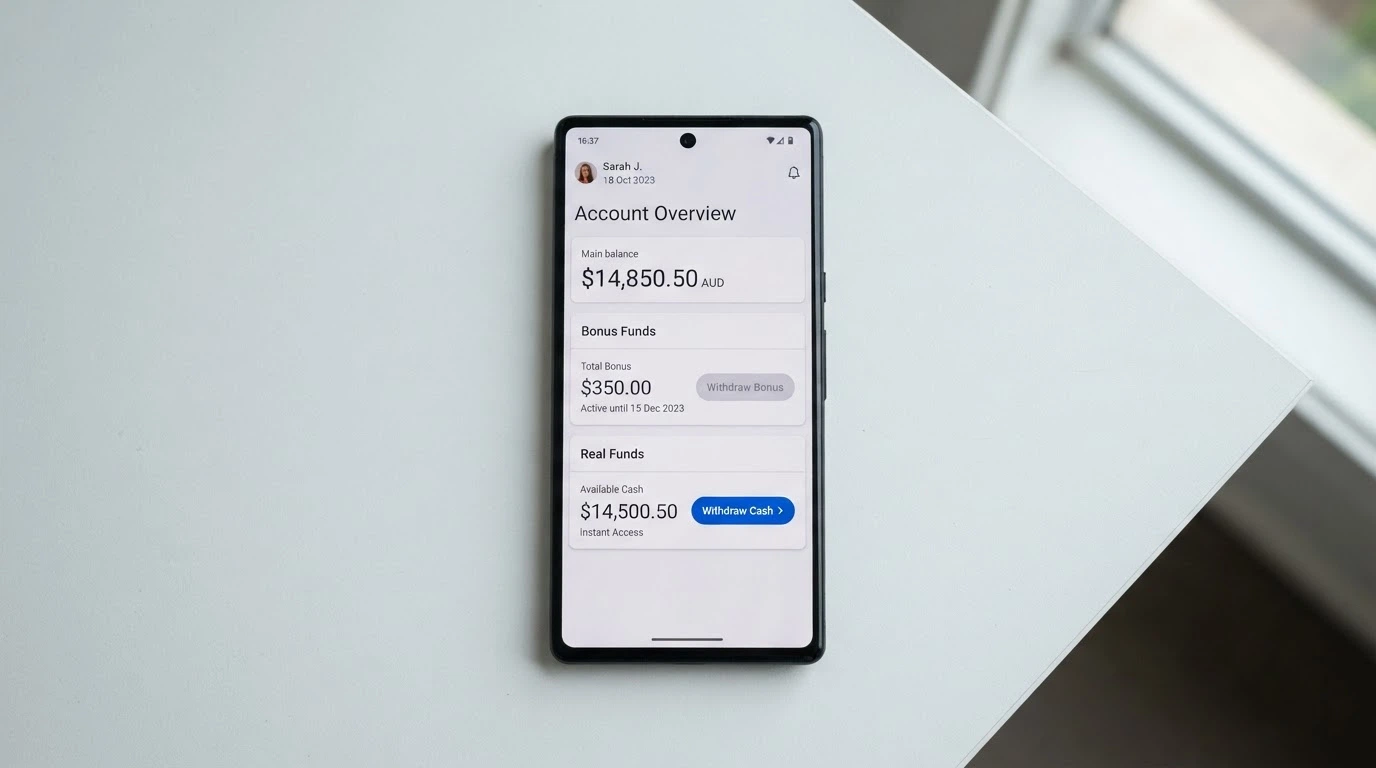
For the A$300-class offers in this market, both structures appear, and the player usually does not get to choose. A sticky bonus is more common on no-deposit offers because it costs the operator less: a player who runs A$10,500 of turnover, ends with A$400 in their balance, and requests a withdrawal under a sticky A$300 bonus walks away with A$100 (the winnings) — not A$400 (the balance minus the A$300 bonus they were never going to be paid anyway). Some offers combine a non-cashable bonus with a separate cashable free-spin package, which is the structure that produces the A$300 chip plus 100 free spins on a named title pattern. The cap is what turns either structure into a ceiling: claims of unlimited withdrawals rarely materialise at the bonus stage, and the operator who promises everything gives the player A$75.
Some operators run wagering multiples above this range — 99x has been documented on no-deposit bonuses in this market and has been described as mathematically designed for failure. The turnover required at 99x is so far beyond the expected return that clearing it works against the player from the first spin. The 40x to 60x middle is the offer most players actually attempt; the 99x structure is the offer most players should not.
Deposit-match percentages and first-deposit traps
A 100% deposit match on a A$300 deposit credits A$300 in bonus funds and locks the player’s own A$300 behind the wagering requirement alongside it. A 200% match credits A$600 on the same A$300 deposit. In both cases, the wagering is applied to the deposit-plus-bonus sum, not to the bonus alone, which doubles the effective turnover the player has to clear.
At 40x to 60x wagering on a A$300 deposit with a A$300 bonus, the player must turn over A$24,000 to A$36,000 before any withdrawal is permitted. At 50x to 70x on the same package, that range stretches to A$30,000 to A$42,000. The “match” doubles the player’s deposit — and the wagering requirement, applied to the combined sum, doubles the work as well. The arithmetic is straightforward; what it means in practice is that the player’s A$300 deposit buys them somewhere between four and eight hours of continuous play at maximum stake, with a maximum cashout that may be lower than the bonus itself.
This is the trap buried inside the deposit-match headline. The percentage looks like a gift, but the gift is added to the base on which the wagering is calculated. A 200% match is not a 200% boost in withdrawable cash; it is a 200% boost in turnover obligation. Read the small print on the specific offer before the deposit button is the only read that matters.
Bonus codes, expiry windows and the fine print
Every bonus of this size comes with three clocks running simultaneously: the code’s own expiry, the bonus’s validity window, and the wagering-completion deadline. None of them is generous.
The code expiry — 24 to 72 hours from credit — is the shortest. It applies before the bonus is even claimed; once the code is used, the bonus validity window of 14 to 30 days begins. The wagering-completion deadline is the one that matters most, and on small no-deposit packages it can be as tight as 1 to 7 days. A player who clears the bonus halfway through the window but does not finish in time forfeits the winnings derived from it.
The other fine-print items a player should read before claiming any of the offers on this page: the maximum bet per spin (typically A$5 to A$10, with a single over-stake spin forfeiting the bonus and all associated winnings); the game eligibility list (table games often contribute 0% to wagering, some pokies contribute less than 100%); and the maximum cashout cap that applies to the bonus type. None of these is hidden. All of them are in the terms page a player should read before they click “claim.”
The Operators Advertising $300 Bonuses to Australian Players
The table below lists the ten operators with the largest estimated share of Australian traffic among offshore casinos, ranked by that share. Every operator on this list is offshore. None holds an Australian online casino licence because none can — the product is prohibited. The market-share figures are traffic indicators, not endorsements of legal status.

| Operator | AU Licence Status | Est. AU Market Share |
|---|---|---|
| Rocket Play | Offshore (unlicensed in AU) | 9.4% |
| Skycrown | Offshore (unlicensed in AU) | 8.55% |
| Royal Reels | Offshore (unlicensed in AU) | 2.51% |
| WinSpirit | Offshore (unlicensed in AU) | 1.55% |
| Stake | Offshore (unlicensed in AU) | 1.28% |
| Rainbet | Offshore (unlicensed in AU) | 1.28% |
| Scream Casino | Offshore (unlicensed in AU) | 0.99% |
| FairGO | Offshore (unlicensed in AU) | 0.8% |
| Bizzo Casino | Offshore (unlicensed in AU) | 0.57% |
| Rocket Casino | Offshore (unlicensed in AU) | 0.57% |
The shares sum to roughly 28.5% of the Australian-facing offshore market — a useful proxy for “where the AU traffic goes” rather than a complete map of what is out there. The ACMA’s enforcement record tells the other half of the picture: 1,564 illegal sites blocked since November 2019, and more than 225 illegal services withdrawn from the Australian market since 2017. The operators on this list are not the entirety of what an Australian player can find; they are the largest of what reaches an Australian player searching for $300 no-deposit bonuses in 2026.
A note on bonus terms: the operator sweep this page was built from did not return confirmed $300 no-deposit bonus terms for any of these ten brands. The market-level figures in the previous section — 40x to 60x wagering, A$50 to A$200 cashout caps, 14 to 30 day validity — describe what the typical offer at this kind of site looks like, but a player who lands on any of these lobbies should read the bonus terms on the specific offer page before claiming, not assume the headline number survives the small print.
Rocket Play
The largest operator by Australian traffic share at 9.4%, Rocket Play is the brand an Australian player is most likely to land on when searching for a $300-class bonus. It is offshore, unlicensed in Australia, and operating from outside any Australian jurisdiction. Its bonus terms were not confirmed in this run — what the page can say with confidence is that an offer of this size at an operator of this profile sits in the 40x to 60x wagering range with a maximum cashout between A$50 and A$200, and that the player’s protection ends at whatever offshore licence the operator holds.
For a player already inside the offshore market, Rocket Play is the operator they were always going to land on; the question is whether the welcome bonus survives the terms page. It rarely does in the shape the banner advertises.
Skycrown
The second-largest by AU traffic at 8.55%, Skycrown sits in the same offshore profile as Rocket Play — prohibited product, no Australian licence, no Australian consumer remedy. Bonus terms not confirmed in this run; the market-level terms in the table above describe what a player should expect.
Where Skycrown is worth distinguishing from the larger operators is in the product mix. Sites at this traffic tier typically carry the same offshore game providers, the same bonus structures, and the same payment rails; the differentiation is usually in marketing (welcome packages, reload offers, free-spin drops) rather than in the underlying mechanics. Skycrown is Rocket Play with a different paint job and a slightly smaller audience. The offshore gap is the same.
Royal Reels
Royal Reels — Australian-branded, 2.51% AU market share, offshore — is a useful illustration of why the brand name tells the reader nothing about the licence. The name reads as Australian; the operator is not. No Australian licence for online casino exists, and the brand has none. Bonus terms not confirmed in this run.
For a player who chose this operator because the branding felt familiar, the realistic position is the same as at any other offshore site in this set: verify the licence the operator does hold (Curaçao, Anjouan, or similar), read the bonus terms on the specific offer, and understand that BetStop does not reach this account. The brand name is Australian. The licence is not.
WinSpirit
WinSpirit sits at 1.55% AU market share — mid-tier offshore, unlicensed in Australia. The bonus profile typical at this traffic level is the A$10 to A$25 no-deposit chip or 20 to 50 free spins, with the headline A$300 no-deposit offer rare and typically requiring the player to claim through a specific code path. The wagering on whatever bonus the site runs is most likely in the 35x to 50x range for no-deposit offers and the 40x to 60x range for deposit-gated packages, with a maximum cashout cap on no-deposit bonuses typically between A$50 and A$100.
For a player evaluating a mid-tier offshore site, the relevant comparison is not the welcome bonus but the terms on the specific offer. The headline does not survive the small print; the small print is the offer. For most readers, WinSpirit offers nothing the larger operators in this list do not also offer, with a smaller balance sheet behind it.
Stake
Stake — 1.28% AU market share, domain Stake.com, offshore and unlicensed in Australia — is the best-known brand on this list and the smallest by AU traffic. The name recognition comes from Stake’s global profile as a crypto-first operator; the Australian-facing footprint is narrower than the brand suggests. The contrast is the point: global recognition measured in millions of users; Australian traffic measured in 1.28%. Bonus terms not confirmed in this run.
A player who arrives at Stake expecting the same welcome package they saw on a YouTube review is usually surprised by what the AU-facing version actually offers. The site does not need to advertise a A$300 no-deposit bonus to drive AU traffic; the brand does that work. What a player should check before depositing is whether any bonus offer displayed on the AU-facing site is the same one advertised globally, or a localised variant with different terms.
Rainbet
Rainbet — 1.28% AU market share, offshore, unlicensed in Australia — is a smaller operator in the AU-facing set with no confirmed bonus terms in this run. The market-level expectation is the same as for any operator in this traffic band: a typical no-deposit offer of A$10 to A$25 if one exists, a deposit-match package as the main acquisition offer, wagering in the standard offshore range.
For a player who is going to use a smaller operator, the same terms-page reading applies as for the larger ones. The site may be smaller, but the offshore gap in consumer protection is the same. Rainbet is interchangeable with every other name on this list for the things that matter: licence status, BetStop gap, ACMA blocking risk.
Scream Casino
Scream Casino — 0.99% AU market share, offshore, unlicensed in Australia — is a niche operator in the AU-facing set. Sub-1% traffic means the operator is reaching a narrow segment of Australian players; it does not mean the site is operating outside the same offshore framework as the larger brands. Bonus terms not confirmed in this run.
A player at a sub-1% operator is taking on the same offshore-counterparty risk as at any other brand on this list, plus the additional risk that a smaller operator may have thinner reserves to honour a large withdrawal request. The bonus terms are the same kind of read; the counterparty is smaller, and that is a thing a player should weigh before they stake a large deposit.
FairGO
FairGO — 0.8% AU market share, offshore, unlicensed in Australia, Australian-themed branding — is the second illustration on this page of the brand-name-versus-licence gap. The branding leans Australian; the licence is not. No online casino licence exists in Australia to hold.
Bonus terms not confirmed in this run. The market-level expectation is the standard offshore profile, and a player drawn to the Australian branding should not mistake the theme for the jurisdiction. The same caveat applies here that applies at Royal Reels — read past the surface to the licence page, and read past the banner to the bonus terms.
Bizzo Casino
Bizzo Casino — 0.57% AU market share, offshore, unlicensed in Australia — rounds out the lower tier of the AU-facing set. Bonus terms not confirmed in this run; the standard offshore market profile applies.
For a player at this traffic tier, the practical advice is the same as for any operator in this list: read the terms on the specific offer, verify the licence the operator does hold, and treat the welcome bonus as a marketing surface rather than a guarantee. Bizzo is what an offshore operator looks like at the bottom of the AU traffic table — same product, smaller audience, same offshore gap.
Rocket Casino
Rocket Casino — 0.57% AU market share, offshore, unlicensed in Australia — shares a name with Rocket Play at the top of this list but is an independent offshore entity. The name similarity is worth noting for a player who is searching by brand; the two operators are not the same company, not on the same licence, and not offering the same bonuses.
For an Australian player who lands on Rocket Casino expecting Rocket Play’s offers (or vice versa), the surprise is in the terms. Read the bonus page on the site you are actually on, not the one you intended to reach. Two operators, one name overlap, two different sets of terms.
Pokies You Can Play With a No-Deposit Bonus
A “pokie” is what an Australian calls a slot machine — the same game an offshore casino lobby labels “slots” or “video slots.” The terminology gap matters when a player reads bonus terms written for an international audience: the eligible-games list on an offshore site is written in the international vocabulary, but the player is looking for the Australian names. The section below covers what the bonus terms actually say about game eligibility, and which titles appear most often in the bonus-spin offers documented in 2026.

Pokies vs slots: what Australian players call the games
“Pokies” is the Australian-English term for slot machines, derived from “poker machines” — the original name for the electro-mechanical devices that replaced the lever-pull one-armed bandits of the early twentieth century. “Slots” is the international term. They refer to the same product: a reel-based game with random outcomes, paylines, and a return-to-player percentage set by the developer.
For an Australian player reading an offshore casino’s bonus terms, the vocabulary mismatch is real. A “slots bonus” or “video slots eligible” line in the offshore terms is the same as a “pokies bonus” or “pokie eligible” line in the Australian player’s mental model — but a player searching for “pokies” in the site’s help pages may not find the same information as a player searching for “slots.” The terms are interchangeable for the bonus; the search is not.
The other vocabulary gap is on game features. “Megaways,” “free spins,” “cascading reels,” “hold and spin,” “jackpot” — all of these appear in both vocabularies and mean the same thing. The Australian-specific vocabulary adds “pokie” (slot) and keeps the international terms for everything else.
Real-money pokies and bonus-eligible titles
Most no-deposit bonuses at Australian-facing offshore casinos restrict play to specific game categories or weight different categories differently for wagering. Slots typically contribute 100% of each bet toward the wagering requirement; table games often contribute 10% to 20% or are excluded entirely; live casino games are usually excluded. The eligible-games list is in the bonus terms, and it is the list a player should read before claiming.
The one title the 2026 research surfaces as a bonus-eligible pokie is Wild West TRUEWAYS, paired with 100 free spins under the A$300 free chip offer — 40x wagering on the free-spin winnings, with a 7-day expiry on the spin package. Beyond this single named title, the research does not confirm per-title RTP figures for any of the pokies in this market. A player evaluating a specific game should check the developer’s published RTP (typically visible in the game’s information panel at the lobby) rather than assume the bonus-eligible title has a particular return profile.
What the absence of per-title data tells the player: the offshore market does not standardise RTP disclosure across bonus offers, and the eligible-games list is the operator’s choice, not the developer’s. A pokie running at 96% on one site may be running at 94% on another — same title, different configuration. The bonus terms name the game; they do not name the return.
New-casino pokies and where bonus spins land
New offshore casinos entering the Australian-facing market typically use free spins on a single named title as their acquisition offer — usually a high-profile slot from a major provider (Pragmatic Play, Hacksaw Gaming, Nolimit City, and the others that dominate offshore lobbies). The pattern is consistent: 50 to 100 free spins on one named title, 30x to 40x wagering on the spin winnings, 7-day expiry on the spin package.
The reason new entrants use this structure rather than a no-deposit cash bonus is that free spins on a single title are cheaper for the operator and more controllable. The spins are pre-loaded at a fixed stake; the wagering applies only to the spin winnings; the maximum cashout is set on the spin package rather than on a cash balance. A new casino running 100 free spins on a popular title knows its maximum exposure on the offer; a casino running a A$300 free chip does not.
For a player, the practical question on a new-casino free-spin offer is the same as on any no-deposit bonus: read the wagering requirement on the spin winnings, the max cashout on the spin package, and the validity window (typically 7 days for spin offers, tighter than the 14 to 30 days on a cash bonus). The game is usually named; the terms are the part that determines what a player keeps. The max-bet cap is what makes the difference: a A$5 to A$10 ceiling per spin during bonus play is standard, and a single stake over the ceiling forfeits the bonus and the winnings.
Funding Your Play: PayID and Casino Deposits in Australia
PayID is the dominant deposit method at Australian-facing offshore casinos, accounting for roughly 42% of deposit volume in this market — a larger share than Visa and Mastercard combined. The payment rail is fast, free, and built into every major Australian bank. What it is not is a guarantee of anything about the operator on the other end. PayID clears the money; the casino decides what happens next.
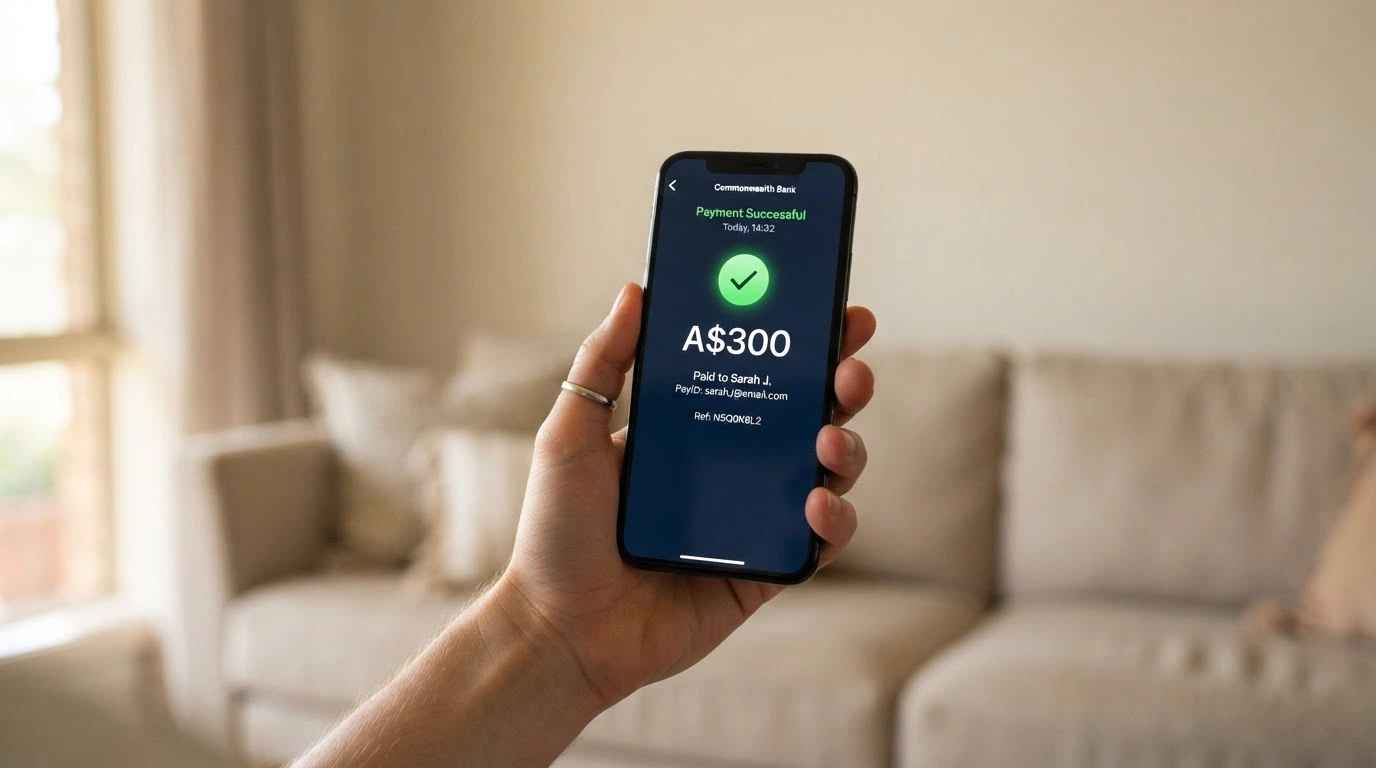
Making an instant deposit with PayID
PayID sits on top of the New Payments Platform (NPP) and routes through Osko, the real-time payment layer operated by Australian banks. A deposit made via PayID at an offshore casino typically clears in under 30 seconds — any day of the week, including weekends and public holidays, with no fees charged by either the sending bank or the receiving operator. A PayID casino is only as good as its internal processing rules, not the payment rail — the speed belongs to the rail, the credit belongs to the operator.
The setup for a first-time PayID user is the part that takes longer than the deposit itself. The player links a PayID to their bank account through their banking app — typically a mobile number or email address — and verifies the link. Once the PayID is active, deposits at an offshore casino run through the cashier: the player enters the deposit amount, selects PayID as the payment method, confirms the transaction in their banking app, and the balance appears in the casino account within seconds. The minimum deposit at most offshore casinos accepting PayID is A$10 to A$20; the maximum per transaction is typically A$1,500 to A$5,000.
What PayID does not do is verify the operator. The payment rail moves money from the player’s bank account to the operator’s account; the player’s bank may not flag the transaction as a gambling payment at all. From 1 January 2027, banks and payment providers gain express authority to block transactions to illegal gambling operators — a meaningful change that does not exist yet.
Funding the $300 deposit tier
A $300 deposit sits well within the typical PayID transaction limits at Australian-facing offshore casinos — A$1,500 to A$5,000 per transaction is the standard range, so the player is not bumping against the ceiling. The minimum deposit is not an issue either: A$300 clears the A$10 to A$20 floor at most sites.
The withdrawal path is the part that requires attention. PayID withdrawals at offshore casinos typically require a minimum of A$50 and allow a maximum of around A$9,000 per day — limits that are comfortable for most players, but the processing speed on the withdrawal is set by the operator, not by PayID. The payment rail moves the money in under 30 seconds once the operator releases it; the operator may hold the withdrawal for one to several business days for review. Bank transfer withdrawals at the same operators take 3 to 5 business days, but the PayID speed advantage disappears if the operator’s internal processing holds the funds for a comparable period before releasing them.
For a player funding a A$300 deposit at an offshore site, the practical question is not whether PayID will clear the deposit. It will. The question is how long the withdrawal will sit in the operator’s pending queue when the player eventually asks for it back. The rail does not set that clock; the operator does.
PayID casinos and pokies sites: what the payment rail does and doesn’t guarantee
A casino accepting PayID is not a PayID-endorsed casino. The payment method is a rail, not a regulatory stamp. What PayID guarantees is the speed and cost of the transfer; what PayID does not guarantee is that the operator is licensed in Australia, that the bonus terms are fair, or that the operator will process a withdrawal when requested. The offshore casinos in this market accept PayID because it is what Australian players want to deposit with; the operator’s bonus terms and player protections are unrelated to the payment method.
Two tells identify an offshore operator operating outside Australian rules without needing to read the licence page. The first is the acceptance of credit cards or crypto: both are banned as payment for online wagering in Australia since 11 June 2024, and an operator accepting either is not operating under Australian rules. Penalties for non-compliance reach A$247,500. The second is the absence of any Australian regulator’s name in the terms — a licensed Australian operator names its state regulator; an offshore operator names its Curaçao or Anjouan licence. The credit card and crypto acceptance is the faster tell.
The other structural change coming for the payment side is the 1 January 2027 commencement of bank payment-blocking powers. From that date, banks and payment providers in Australia gain express authority to block transactions to illegal gambling operators, which means PayID deposits to offshore casinos may be declined at the bank’s discretion — not at the casino’s. The change is not yet in force. When it commences, the speed advantage of PayID at an offshore casino becomes a moot point if the bank declines the transaction before it reaches the operator.
Why Every $300 Casino Bonus Targeting Australia Sits Offshore
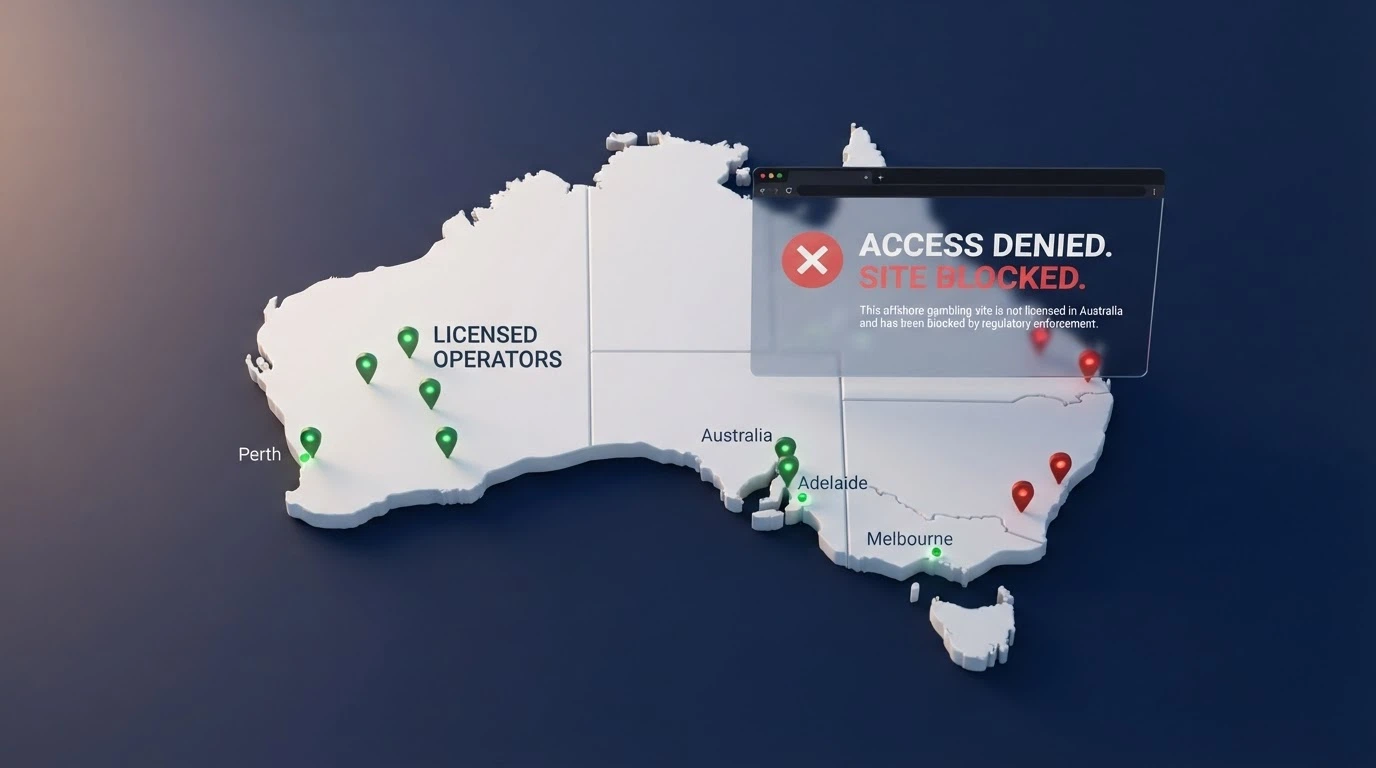
The reason every operator offering a $300 bonus to an Australian player is offshore is that no Australian licence for the product exists. The Interactive Gambling Act 2001 prohibits the provision of online casino games, online pokies, and in-play betting to a person in Australia. The 2017 amendment closed the loopholes offshore operators had been using and gave the Australian Communications and Media Authority the power to direct ISPs to block illegal services at the DNS level. The 2026 reform, commencing 1 January 2027, tightens advertising rules and adds bank payment-blocking powers but does not legalise online casino. The product behind the headline remains prohibited.
The Interactive Gambling Act 2001 and the ACMA’s enforcement powers
The Interactive Gambling Act 2001 is the federal statute that makes the provision of online casino games and online pokies to a person in Australia illegal. The Interactive Gambling Amendment Act 2017 strengthened the regime by closing offshore loopholes and giving the Australian Communications and Media Authority (ACMA) the power to issue formal warnings, refer operators for civil penalty proceedings, and direct internet service providers to block illegal services at the DNS level. The minimum age for all commercial gambling in Australia is 18.
The enforcement record since 2017 is the proof that the prohibition is enforced, not theoretical. The ACMA has had 1,564 illegal gambling and affiliate websites blocked by Australian ISPs since its first blocking request in November 2019. More than 225 illegal services have withdrawn from the Australian market entirely since enforcement was strengthened. The numbers are not a rounding error; they are the operation in progress. An operator offering a $300 bonus to an Australian player is one DNS direction away from being unreachable to that player, with whatever balance the player holds on the site at the time.
The 2026 reform — the Interactive Gambling Amendment (Gambling Reform) Bill 2026 — passed Parliament on 19 August 2026 and commences on 1 January 2027. It does not legalise online casino. It adds a cap of no more than three wagering ads per hour between 6:00 am and 8:30 pm, a live-sport blackout from 15 minutes before to 5 minutes after a sporting event, and a ban on inducement marketing for 14 days after sign-up and three months after BetStop deregistration. The product behind the $300 bonus remains prohibited. The minimum age for all commercial gambling in Australia is 18, and the individual player is not prosecuted under the IGA — the Act targets the provider, not the consumer.
Licensed wagering vs unlicensed offshore casinos
The licensed Australian wagering market covers racing and sports betting only. The operators licensed by the Northern Territory Racing and Wagering Commission — Sportsbet, TAB, Ladbrokes, Neds, PointsBet, bet365 Australia, among others — can offer bets on horse racing, harness racing, greyhound racing, and sporting events placed before they begin. They cannot legally offer online casino games or online pokies. Licensed Australian bookmakers can offer sports and race betting, but not online pokies. The product behind a $300 no-deposit bonus is not in their catalogue.
The offshore operators offering $300 bonuses to Australian players operate under licences issued by Curaçao, Anjouan, Malta, or similar jurisdictions — none of which is Australia, and none of which gives an Australian player an Australian remedy when a withdrawal is delayed, a win is voided, or the account is closed. The point is not that those licences are worthless; it is that they are not Australian. A dispute with an offshore operator is resolved under the law of the licence-issuing jurisdiction, in that jurisdiction’s courts, with the cost and friction that implies for an Australian complainant. The Northern Territory Racing and Wagering Commission issues wagering licences for sports and race; it does not issue casino licences.
The licensing gap also means the responsible-gambling tools that bind licensed Australian operators do not reach offshore sites. BetStop does not cover an offshore casino account. The state-based deposit-limit requirements do not apply. The activity-statement and intervention obligations do not exist. The offshore operator’s own terms are the entire contract.
What no-deposit offers are and aren’t allowed to do under Australian law
The Australian rules on advertising and payment for online wagering are tightening in stages, and several of them already bite. Since 11 June 2024, credit cards, credit-related products and digital currency (crypto) have been banned as payment for online wagering; an operator that accepts either from an Australian is breaking the rules, with penalties of up to A$247,500 per breach. The deposit side of an offshore casino that accepts Visa or Bitcoin is itself a tell that the operator is not operating under Australian rules.
From 1 January 2027, additional restrictions apply. The advertising rules cap wagering ads at three per hour between 6:00 am and 8:30 pm, with a live-sport blackout, online ads restricted to logged-in over-18 users with opt-out, and a ban on athletes, celebrities and influencers promoting wagering. The inducement marketing rules prohibit direct marketing of bonus offers to a customer for 14 days after sign-up and for three months after a person deregisters from BetStop. Banks and payment providers gain authority to block transactions to illegal gambling operators.
The $300 no-deposit bonus, advertised to an Australian player through an affiliate page or a YouTube review, falls foul of every layer of the regime. The product is prohibited. The payment method may be prohibited. The advertising may be prohibited from 2027. The bank may decline the deposit from 2027. None of these rules changes the offshore operator’s offer — they change whether the offer can reach the player at all. Tax is the other side most pages skip: betting and gambling winnings are not assessable income under section 6-5 of the ITAA 1997, and losses are not deductible under section 8-1 — unless the person is carrying on a business of betting or gambling. The ATO treats recreational gambling winnings as not assessable and losses as not deductible, which means the player pays tax on neither side of the bonus.
Playing Safe: Responsible Gambling Tools and Where to Get Help
The responsible-gambling framework in Australia is built for the licensed market. BetStop, the National Self-Exclusion Register, the state-based deposit-limit requirements, and the operator-side intervention obligations all bind Australian-licensed wagering services. Offshore casinos offering $300 bonuses to Australian players sit outside every layer of that framework. The tools that exist for Australian players are still worth using; they just do not reach the offshore account.
Account limits, deposit controls and self-exclusion
BetStop — the National Self-Exclusion Register — has been live since 21 August 2023. As of 31 March 2026, 59,830 people had registered, with 37,247 exclusions still active. A single registration excludes a person from every Australian-licensed online and phone wagering service at once, for a minimum of three months up to a lifetime. The registration is free, confidential, and takes effect across all participating operators simultaneously. 78% of registrants were under 40; 38% chose lifetime exclusion.
The critical limitation of BetStop is its scope: it binds Australian-licensed wagering services only. An offshore casino is not licensed in Australia, is not connected to BetStop, and is not required to honour a BetStop registration. A person who has registered with BetStop and then deposits at an offshore casino will not be stopped by the register, will not be contacted by the operator, and will not have the offshore account closed on the basis of the BetStop registration. The exclusion ends at the Australian border.
The other player-protection tools available inside the licensed system — customer-set deposit limits, activity statements, intervention from the operator when play patterns indicate harm — operate at the operator level under the relevant state or territory conditions. An offshore casino has no obligation to offer any of them. Only one in three wagerers is aware of BetStop at all, and of an estimated five million wagerers nationwide — including 400,000 high-risk gamblers — just 30,000 individuals have active exclusions.
For a player who is using both licensed and offshore services, the practical position is that BetStop covers the licensed side and nothing else. The offshore side requires its own self-management, and that management begins with a read of the operator’s own self-exclusion tools (where they exist) and ends with the helpline at 1800 858 858.
Harm-minimisation resources and support for Australian players
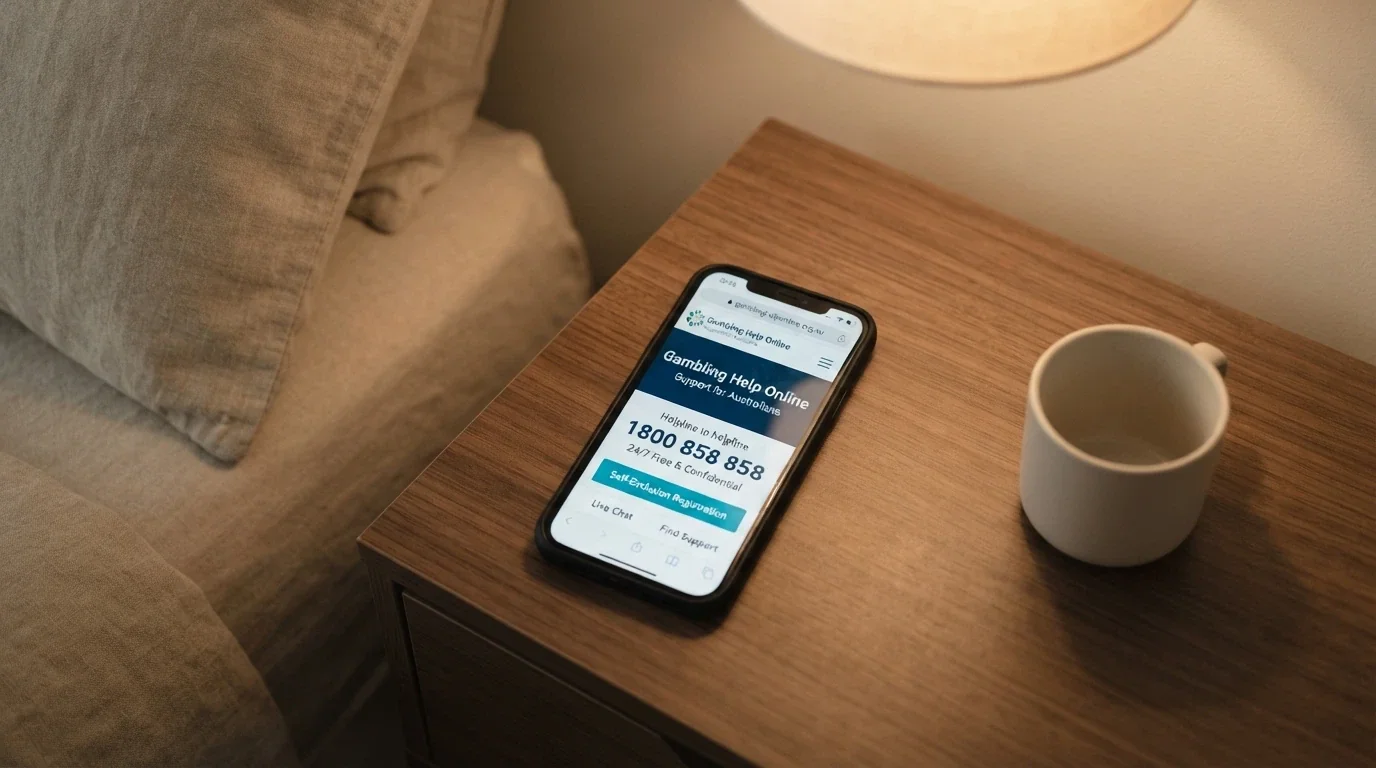
The National Gambling Helpline — 1800 858 858 — is free, confidential and staffed 24 hours a day, 7 days a week. Online chat and email support are available through Gambling Help Online at gamblinghelponline.org.au. Financial counselling is available through the state-level gambling support services for players who are unable to pay bills or meet commitments as a result of gambling.
The scale of harm in Australia is the reason these resources exist. Approximately 3.29 million Australians aged five and over are affected annually by their own or another person’s gambling, including around 1.38 million adult affected others. An estimated 1.97 million Australian adults are classified as having at-risk or problem gambling. Nationally, problem gambling affects between 0.4% and 1.2% of adults, with another 1.9% to 3.7% reporting moderate-risk gambling. The annual health loss from gambling-related harm in Australian adults is estimated at over 400,000 Years Lived with Disability.
Awareness of the available tools is the gap. Only one in three wagerers is aware of BetStop; of an estimated five million wagerers nationwide — including 400,000 high-risk gamblers — just 30,000 individuals have active exclusions. The tools exist; the uptake is not where it needs to be.
For a player who is using offshore casinos and wants support, the helpline and Gambling Help Online do not require the gambling to have happened through a licensed Australian operator. The support is for the person, not the platform. A call to 1800 858 858 is the same regardless of where the gambling occurred.
How We Selected the Operators on This Page
The ten operators on this page are ranked by estimated Australian traffic share among offshore casinos reaching Australian players searching for $300-class bonus offers. The market-share figures come from the operators skill’s AU market-share table and are traffic indicators, not endorsements. The licence status for each operator was checked against the ACMA’s blocked-sites list and the state and territory wagering licensing registers.
The bonus terms for the $300 no-deposit offer at each operator were not confirmed in this run. The operator sweep queries returned no specific terms for any of the ten brands, and the market-level figures in the bonus section describe the typical offshore offer rather than a specific bonus at a specific operator. A player who lands on any of these sites and sees a A$300 bonus banner should treat the offer page — not this article — as the binding contract on wagering, cashout, validity and game eligibility.
The criteria that ordered the list are: estimated AU traffic share as the primary ranking input; the operator’s presence in bonus offers targeting Australian players; and the absence of an Australian online casino licence (which applies to all ten operators by necessity, since no Australian licence for online casino exists). A player who is going to use any of these operators should treat the list as a starting point for the terms-page read, not as a vetted recommendation.
The legal framing — that online casino is prohibited in Australia and every operator offering a $300 bonus to an Australian player is offshore and unlicensed — is not editorial positioning. It is the legal position under the Interactive Gambling Act 2001, and it applies regardless of which operator is being discussed.
Is a $300 No-Deposit Bonus Worth Your Time in 2026?
The honest answer, drawing on this page’s own figures: for most Australian players, no. The arithmetic does not work in the player’s favour, the legal and consumer-protection gaps do not close the gap the arithmetic leaves, and the offshore risk lands squarely on the side of the person paying it.
The arithmetic of clearing a $300 no-deposit bonus
A $300 free chip with 35x wagering and a A$75 maximum cashout requires A$10,500 of turnover before any withdrawal is possible. The player’s expected loss over that turnover — running the bonus through a typical pokie with the house edge the game is built around — is several multiples of the A$75 ceiling. The arithmetic of “no-deposit bonus” assumes the player is paying for the privilege of running A$10,500 through a game with a negative expected return, with the operator paying back at most A$75 of the result. The bonus is free at the cashier and expensive at the table.
The other offers in this market tilt the numbers in different directions without changing the shape. A 99x playthrough on a no-deposit bonus, as some offshore operators require, has been described as mathematically designed for failure — the turnover required is so far beyond the expected return that a player clearing it is fighting the structure. A 40x to 60x range is the market middle; it is the offer that looks reasonable and costs the most because it is the offer most players actually attempt to clear. At 50x to 70x, the turnover on a $300 bonus runs A$15,000 to A$21,000 — and that is the range most deposit-gated offers sit in.
The offshore risk that does not move
A player who claims a $300 no-deposit bonus at an offshore casino is unprotected by every layer of the Australian responsible-gambling framework. BetStop does not reach the account. The state-based deposit-limit and intervention obligations do not apply. The ACMA’s blocking regime is a risk: the regulator has had 1,564 illegal sites blocked since November 2019, and an operator can be directed to be blocked while a player still has a balance on the site. There is no Australian consumer remedy for a delayed withdrawal, a voided win, or an account closure.
From 1 January 2027, the offshore picture gets harder. Banks and payment providers gain authority to block transactions to illegal gambling operators; the player’s deposit may be declined before it reaches the casino, and the operator’s payout may be declined before it reaches the player’s bank account. The 2027 regime does not target the player, but it constrains the player’s options on both sides of the deposit.
The honest verdict
A $300 no-deposit bonus, where it exists and is honoured, costs the player several multiples of what it pays back in the median case, offers no consumer protection under Australian law, and sits on a product the ACMA has the authority to block at any time. The exercise is worth roughly what the arithmetic says it is worth: an opportunity to spend several hours of playing time with a capped ceiling on the outcome and an offshore counterparty on the other side.
For a player who has decided to use an offshore casino anyway, the practical advice is to read the bonus terms on the specific offer, understand the wagering requirement and the maximum cashout before claiming, set a personal time and loss limit independent of the operator’s terms, and know that the support resources at 1800 858 858 are available regardless of where the gambling occurred. The bonus is a marketing surface; the operator’s terms are the contract; the arithmetic is the cost. None of them is a bargain.
Frequently Asked Questions
Is it legal to claim a $300 no deposit bonus at an online casino from Australia?
Online casino games and online pokies are prohibited under the Interactive Gambling Act 2001, and no Australian licence exists for the product. Every operator offering a $300 no-deposit bonus to an Australian player is an offshore entity, and the Act targets the operator rather than the player. Australian consumer protection does not reach the site.
What wagering requirements should I expect on a $300 no deposit bonus?
The market middle sits at 40x to 60x playthrough on no-deposit bonuses at Australian-facing offshore casinos. At 50x on a $300 bonus, the player must turn over A$15,000 before any withdrawal is permitted. A documented $300 free chip offer runs at 35x; some operators run higher, with 99x described as mathematically designed for failure.
How much can I actually withdraw from a $300 no deposit bonus?
Most Australian-facing offshore casinos cap no-deposit cashouts at A$50 to A$200 regardless of the final balance. A documented $300 free chip offer in this market has a maximum payout of A$75. Claims of unlimited withdrawals from no-deposit bonuses typically do not survive the small print; the cap applies regardless of how much the player wins.
Do I need a bonus code to claim a $300 no deposit offer?
Some operators credit the bonus automatically on registration; others gate it behind a code the player enters at the cashier after sign-up. Codes often expire within 24 to 72 hours if unused, and the wagering window on a small no-deposit package can then run as short as 1 to 7 days. The specific offer page shows what is required.
What happens to my money if the ACMA blocks an offshore casino I am playing at?
The ACMA has had 1,564 illegal gambling and affiliate websites blocked by Australian ISPs since November 2019, and an operator can be blocked at any time. A player whose balance sits on the site at the moment of blocking has no Australian consumer remedy; recovery depends on the offshore operator honouring the withdrawal through an unblocked channel.
Does BetStop cover the offshore casinos offering $300 no deposit bonuses?
No. BetStop binds Australian-licensed wagering services only. Offshore casinos are not licensed in Australia, are not connected to BetStop, and will continue accepting a self-excluded person’s deposits and play. A player who has registered with BetStop and wants to block themselves from offshore sites needs the operator-level self-exclusion tools at each individual site.
Published by the Casino Apps Australia team.