
No Wager Casino Bonuses Australia: What the Zero-Rollover Pitch Actually Delivers
A “no wager” bonus is the rarest kind of promotional offer in Australian online gambling — and the most commonly misread. Marketing copy calls it free. The fine print calls it something else: a small bundle of free spins worth a few dollars, locked behind a cashout cap, expiring within a week, valid on a pokie the operator chose. The headline number — zero rollover — is true. The marketing implication — that the offer is equivalent to real cash — is not.
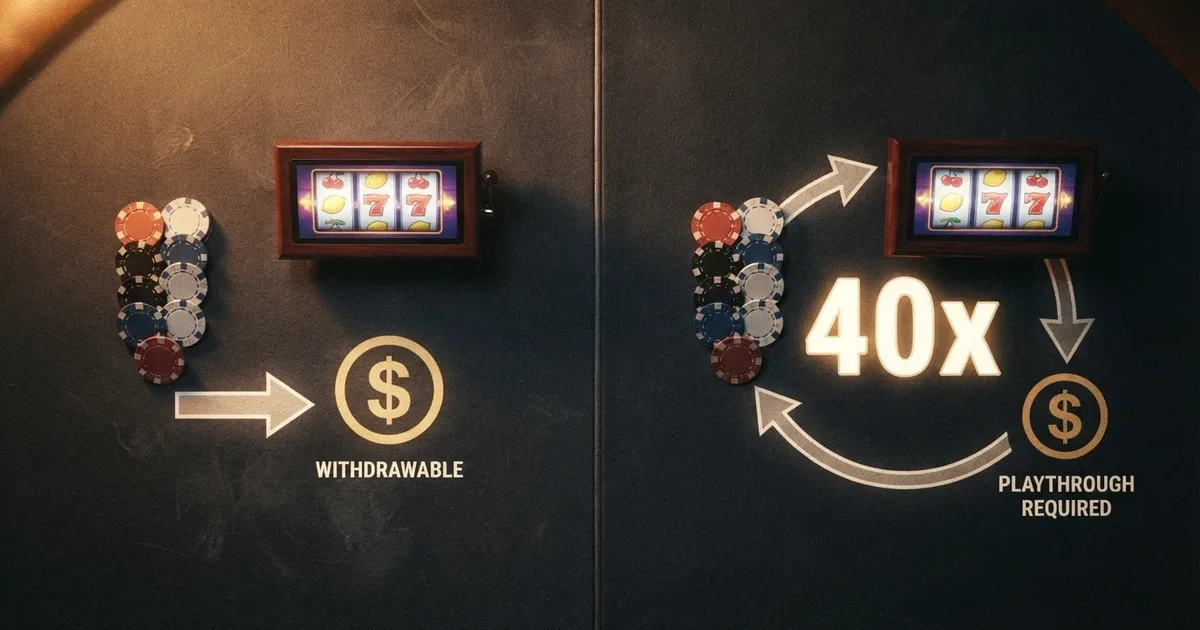
This page works through what a no-wager casino bonus really costs an Australian player, what the structural difference between a zero-requirement offer and a standard 40x offer actually means in dollars, and which operators an Australian player is looking at when they search for one. The honest answer sits at the bottom of the maths: every operator on this page is offshore, no Australian licence exists for online casino, and the protections a player expects at a Sportsbet or a TAB are not in the room.
Current as of 16 October 2026 · licence claims verified against the Australian Communications and Media Authority (ACMA) public register.
Table of Contents
- Why Your 2026 Casino Bonus Isn’t Really Free — Until the Wager Goes
- No-Wager Bonuses Australians Can Actually Claim in 2026
- The Offshore Casinos Australians Search For — and What They Actually Offer
- The Pokies Where No-Wager Free Spins Actually Pay
- Crypto No-Wager Bonuses: Bitcoin, Altcoins and the Zero-Rollover Pitch
- Free-Play and Demo Mode: No-Wager Without a Cent
- The Legal Reality Australian Casino Sites Do Not Want You to Read
- Staying Safe: What Responsible Play Looks Like With Offshore No-Wager Bonuses
- How We Evaluate No-Wager Casino Bonuses for Australian Players
- Should You Claim a No-Wager Casino Bonus in 2026?
- Frequently Asked Questions
Why Your 2026 Casino Bonus Isn’t Really Free — Until the Wager Goes
“Free” is the word that does most of the work in a casino bonus headline, and it does the wrong kind. A standard deposit-match bonus — “100% up to A$500” — sounds generous until the wagering requirement lands. A 40x playthrough on a A$500 bonus means A$20,000 must pass through the pokies before any of it becomes withdrawable cash. The bonus was never free. The number the bonus page did not lead with — the rollover — was the real cost all along.
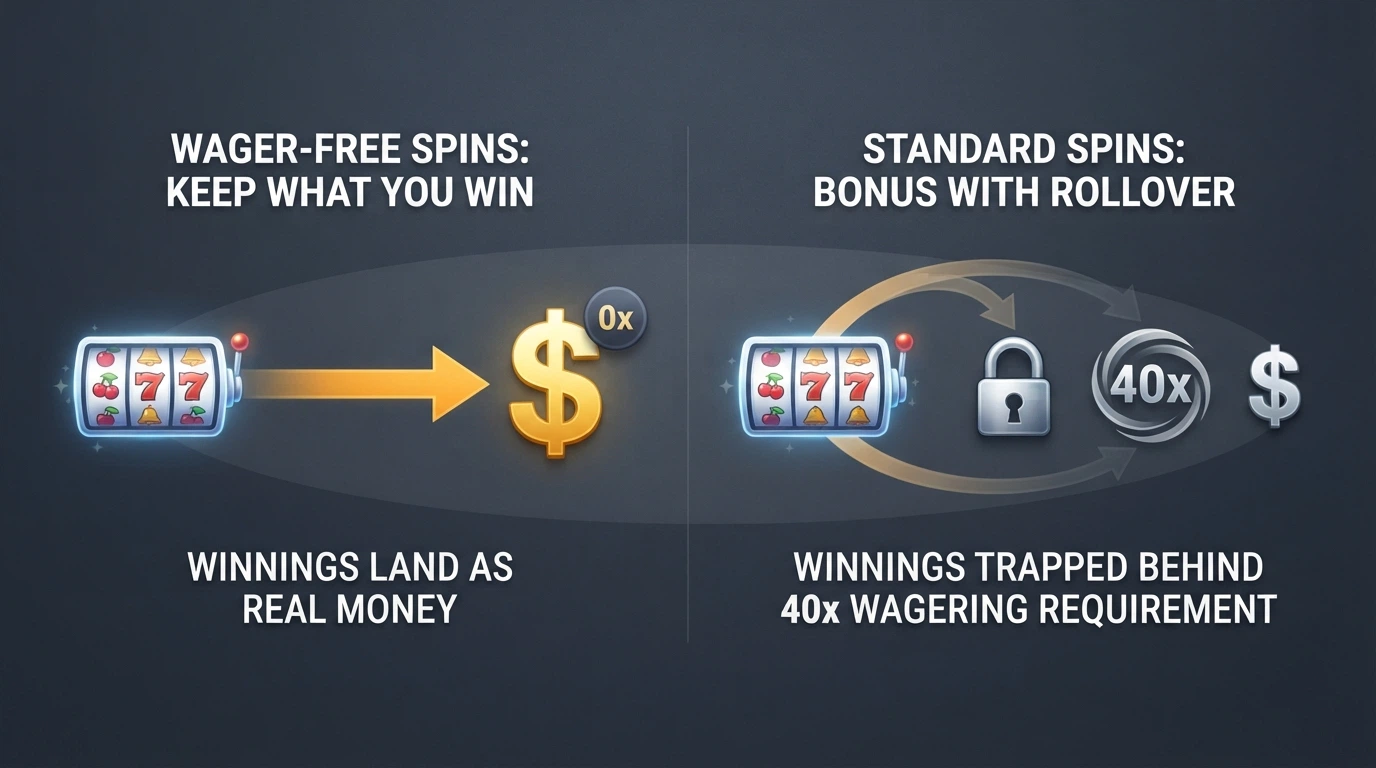
A no-wager bonus flips that structure. After the spins are used, eligible winnings are transferred directly to the cash balance. No 30x, no 40x, no rollover. What you win is yours to withdraw the moment the wagering check clears — and the wagering check is empty.
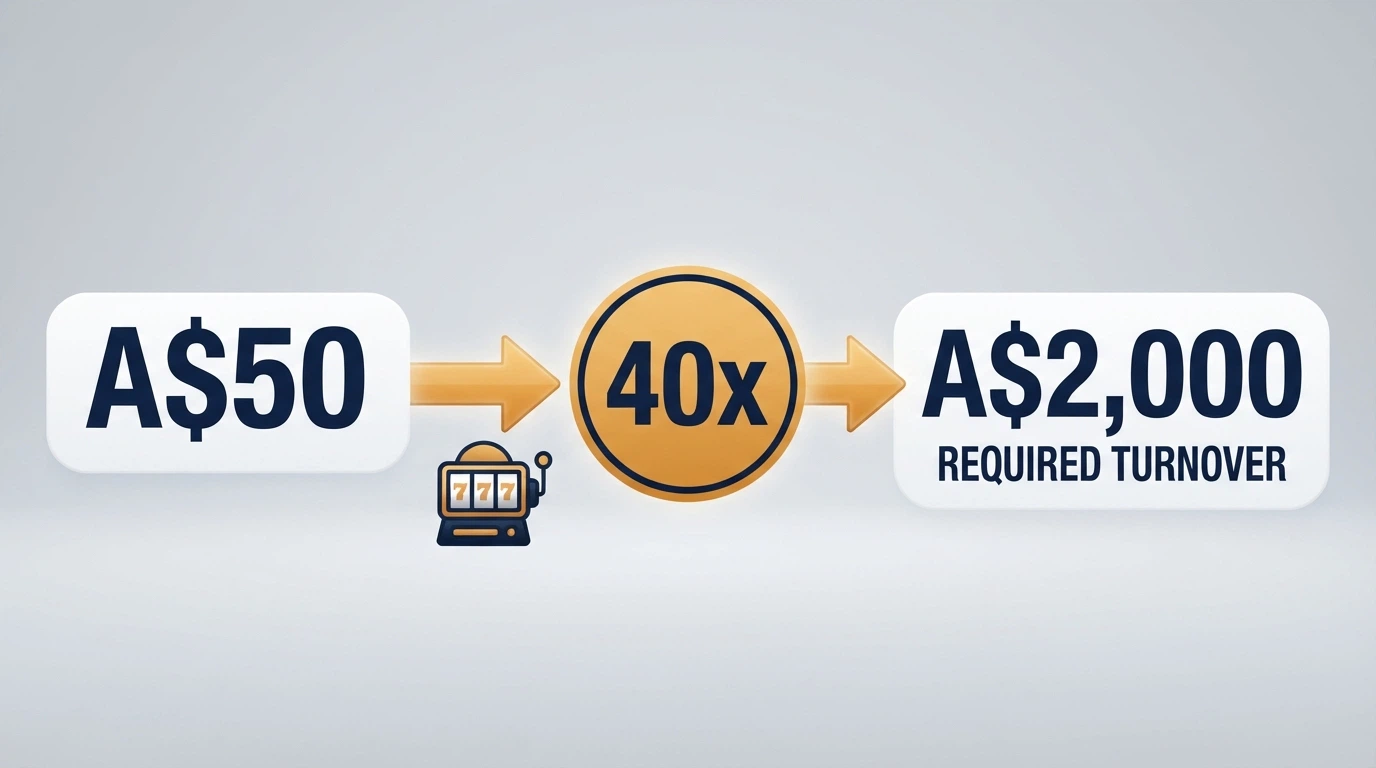
The structural difference matters more than the dollar amount. A A$50 bonus at 40x wagering on a 96% return-to-player pokie carries an expected loss of A$80 over the required A$2,000 turnover. A A$10 no-wager spin bundle has no turnover requirement — the expected loss is whatever the spins themselves return, capped by the cashout limit the operator set. Both are promotions. They are not the same product.
The reason Australian players search for “no wager” is exactly that structural difference. A bonus that locks winnings behind a 30x or 40x rollover is, in practice, a loan the casino takes from the player and pays back only if the player survives the volume. A no-wager bonus is a smaller loan with no repayment condition — and that distinction is what the rest of this page argues from.
What a Wagering Requirement Actually Costs You
A wagering requirement — the rollover, the playthrough, the turnover — is the multiplier the operator applies to a bonus before the bonus converts to withdrawable cash. The arithmetic is mechanical: bonus × wagering multiple = required turnover. A A$50 bonus at 40x means A$2,000 in bets before any of it can be cashed. A A$200 welcome package at 35x means A$7,000.
The figure that makes the requirement bite is the return-to-player of the pokie it is played on. The industry average RTP for Australian online pokies sits between 95% and 96%. On a 96% pokie, every A$100 wagered returns A$96 on average — the house keeps A$4. Over A$2,000 in required turnover, that A$4 slice compounds to A$80 of expected loss. The bonus was A$50. The cost of clearing it is roughly A$80. A player can come out behind on a bonus they technically “won”.
The deeper point: a high-RTP pokie does not save you. It lowers the cost of clearing the bonus, but it does not eliminate it. The only wagering requirement that produces zero expected turnover loss is the one that asks for zero turnover. That is what the no-wager offer is, mechanically — and it is also the only reason to take it over a low-wager alternative.
A second wrinkle sits in how the bonus balance is separated from the real-money balance. On a standard bonus, winnings land in a bonus balance that cannot be withdrawn until the rollover clears. On a no-wager bonus, winnings land in the real-money balance from the moment the spin settles. That single accounting line is the difference between a player who can withdraw A$30 in winnings tonight and a player who must spin through another A$1,970 first.
No-Wager vs Low-Wager: Why 1x Is Not the Same as Zero
Marketing has a habit of putting “low wagering” next to “no wagering” as if the words meant the same thing. They do not. A 1x bonus requires the player to wager the bonus amount exactly once before withdrawing — better than 40x, worse than 0x, and qualitatively different from both. A 1x playthrough on a A$100 bonus is A$100 in turnover; the expected loss at a 96% RTP pokie is around A$4. That is far cheaper than A$800 — and it is also not zero.
The tell: any wagering requirement, at any multiplier, gives the operator a reason to refuse a withdrawal until the requirement is met. A 0x offer gives the operator no such reason. The condition the player is negotiating against is not the size of the multiplier but its presence. A 1x offer still has a multiplier. The bonus has not yet become cash. The structural advantage of a true 0x offer — winnings credit to the cash balance the moment they land — does not exist on a 1x offer.
The other tell is the language. “Wager-free” and “no wagering” describe offers with a 0x rollover. “Low wagering” describes offers with a small but non-zero rollover — often 1x, sometimes 5x, occasionally higher. The labels look similar in a promotional email. The fine print distinguishes them, and the fine print is what pays out.
No-Wager Bonuses Australians Can Actually Claim in 2026
Four shapes of no-wager bonus appear in the offshore casinos an Australian player reaches. No-deposit no-wager free spins — the smallest, the most searched, the most capped. Wager-free free spins attached to a welcome package. No-wager welcome offers built around a deposit match with a 0x rollover. Cashback offers that refund a percentage of net losses as real money.
What every shape shares is the floor: 20 to 100 free spins, with per-spin values of A$0.20 to A$1.00, giving a total bonus value of A$4 to A$100. The ceiling is low by design. A no-wager bonus is a marketing hook, not a bankroll transfer. The terms reflect that.
The conditions that survive even when wagering is zero are the ones players most often miss. A withdrawal cap still applies. Game restrictions still apply — non-pokie games are typically banned, jackpot pokies are excluded, several selected pokies may be forbidden. An expiry window still applies — anywhere from 24 hours to 7 days or more. The “no wager” label addresses one line of the bonus terms and leaves the rest of the document in force.
No-Deposit No-Wager Offers: Free Money With a Catch
A no-deposit no-wager bonus is what most Australian players actually mean when they type “no wager casino bonus australia” into a search box. The offer is free, requires no deposit, and carries no rollover. It is also small, capped, restricted, and almost always requires a deposit before the winnings can be withdrawn.
The dollar range is narrow. Twenty to one hundred free spins at A$0.20 to A$1.00 per spin produces A$4 to A$100 of total bonus value. A typical offer — fifty spins at A$0.20 — is A$10 of upside before any spin lands. After the spins settle and winnings credit to the cash balance, the player faces the cashout cap: A$50 to A$200 is the standard range. Anything above the cap is forfeited.
The three conditions that limit the offer are not in the headline. Cashout caps hold the winnings down. Game restrictions hold the eligible pokie down to one or two titles, usually a single slot the operator has pre-selected. The deposit-before-withdrawal rule holds the cashout itself behind a verified payment. Each condition narrows what the bonus can become. Together they define what a no-deposit no-wager offer actually is — not free money, but a small, capped, restricted trial.
Free Spins Without the Wagering Hit
A wager-free free spin is the structural opposite of a standard free spin. On a standard free spin, winnings credit to a bonus balance that must be wagered — typically 30x or 40x — before it converts to cash. On a wager-free free spin, winnings credit directly to the real-money balance the moment the spin settles. There is no bonus balance. There is no rollover. The win is cash.
The per-spin value reflects the difference. A standard free spin at most Australian-facing casinos is worth A$0.10. A wager-free free spin is typically worth A$0.20 to A$0.50 — sometimes more. The operator prices the higher spin value against the absence of the rollover. A player who would otherwise spin A$100 of bonus funds at 40x to chase A$50 of real money gets A$20 of real money directly on a wager-free offer. The player comes out ahead only when the wager-free spin lands a win that would not have survived the rollover.
The eligible-game restriction tightens the comparison. Most wager-free spin offers lock spins to a single pokie — usually one of the high-RTP titles operators use to anchor a promotional cycle. The player does not choose the slot. The operator does. A pokie the player has never played, with a return profile the player has not studied, is the venue for a bonus the player is evaluating.
Sign-Up and Welcome No-Wager Offers
A no-wager welcome offer is a welcome package where the rollover is zero rather than the industry-standard 35x or 40x. The shape is familiar — a deposit match, a free-spin bundle, sometimes both. The mechanics differ: every winning spin settles to cash, every dollar of bonus credit can be withdrawn the moment the deposit-gating rule clears.
The dollar range is lower than a standard welcome package, and the gap is not accidental. A standard welcome offer at an offshore casino might run “100% up to A$1,000 plus 200 spins at 40x” — headline value of A$1,500 or more, real cost to the player of A$300 to A$400 in expected loss over the rollover. A no-wager welcome offer might run “50% up to A$200 plus 50 spins at 0x” — headline value of A$400, real cost to the player of whatever the spins return, capped by the cashout limit.
The reason for the size difference is the same reason a no-wager bonus is more valuable per dollar to the player: the operator is taking on more risk by removing the rollover. They price that risk into a smaller bonus. The trade-off is the substance of the offer. A smaller no-wager bonus frequently returns more real cash to a player than a larger standard bonus — and that is the comparison a player should make before claiming either.
Expiry windows shorten the calculus. Some no-wager welcome offers expire in 24 hours; others extend to seven days or more. A 24-hour window leaves little room for the player to study the eligible pokie, set a deposit limit, or pace the spins. A seven-day window gives the player time. The expiry length is part of the offer’s value, not a footnote to it.
Winnings You Keep: The Real-Money Difference
The defining feature of a no-wager bonus is the accounting line where the winnings land. On a standard bonus, that line is a bonus balance — withdrawable only after the rollover clears, with the house edge running on every spin in between. On a no-wager bonus, that line is the cash balance — withdrawable the moment the deposit-gating rule is satisfied, with no further house edge charged on the cleared funds.
The difference is not rhetorical. It is mechanical. A player who lands A$30 on a standard 40x bonus must run A$1,200 in additional turnover to convert it. At a 96% RTP pokie, that turnover costs A$48 in expected loss — the player is paying to retrieve money they already won. A player who lands A$30 on a no-wager bonus withdraws the A$30 (minus the cashout cap and minus the deposit-gating rule), and that is the end of it. The player keeps what the pokie paid.
This is why “no wager” is the term Australian players search for. The phrase identifies the structural advantage, not the dollar value. A A$10 no-wager spin bundle with a A$100 cashout cap is, in the right circumstances, more valuable to a player than a A$500 standard bonus with a 40x rollover. The cash conversion is the only number that matters once the bonus is claimed.
Clearing a Bonus With the Smallest Rollover: A Strategy Guide
When a true 0x offer is not available, the next move is to find the lowest-wagering alternative and clear it on the highest-RTP pokie the terms allow.
- A 1x wagering requirement is the closest legal substitute for 0x. The expected loss over a A$100 bonus at 1x on a 96% pokie is roughly A$4 — an order of magnitude lower than a 40x equivalent. It is not zero. The bonus has not yet become cash.
- A 98% RTP pokie changes the calculus materially. Blood Suckers sits at 98.00% RTP with low volatility. 1429 Uncharted Seas sits at 98.50% RTP with low-medium volatility. Over A$2,000 in required turnover, the difference between a 96% pokie and a 98.50% pokie is roughly A$50 in expected loss. That is the cost of choosing the wrong title.
- High-volatility pokies are the wrong tool for clearing a wagering requirement. The variance they introduce stretches the playthrough over more spins and more time, and the bankroll swings make it harder to stay above the minimum-bet threshold the bonus may impose. A low-volatility, high-RTP pokie is the boring, efficient choice.
- The eligible-game list may exclude the high-RTP titles. Blood Suckers and 1429 Uncharted Seas are sometimes restricted on no-deposit offers. The check before claiming is whether the eligible pokie is the high-RTP one the strategy assumes.
A 1x offer on a 98% pokie still costs the player expected turnover. It is a smaller cost than a 0x offer on a pokie with a A$50 cashout cap and a 24-hour expiry, because the second offer structurally caps the upside the first offer leaves open. The right offer depends on which loss the player can absorb.
The Offshore Casinos Australians Search For — and What They Actually Offer
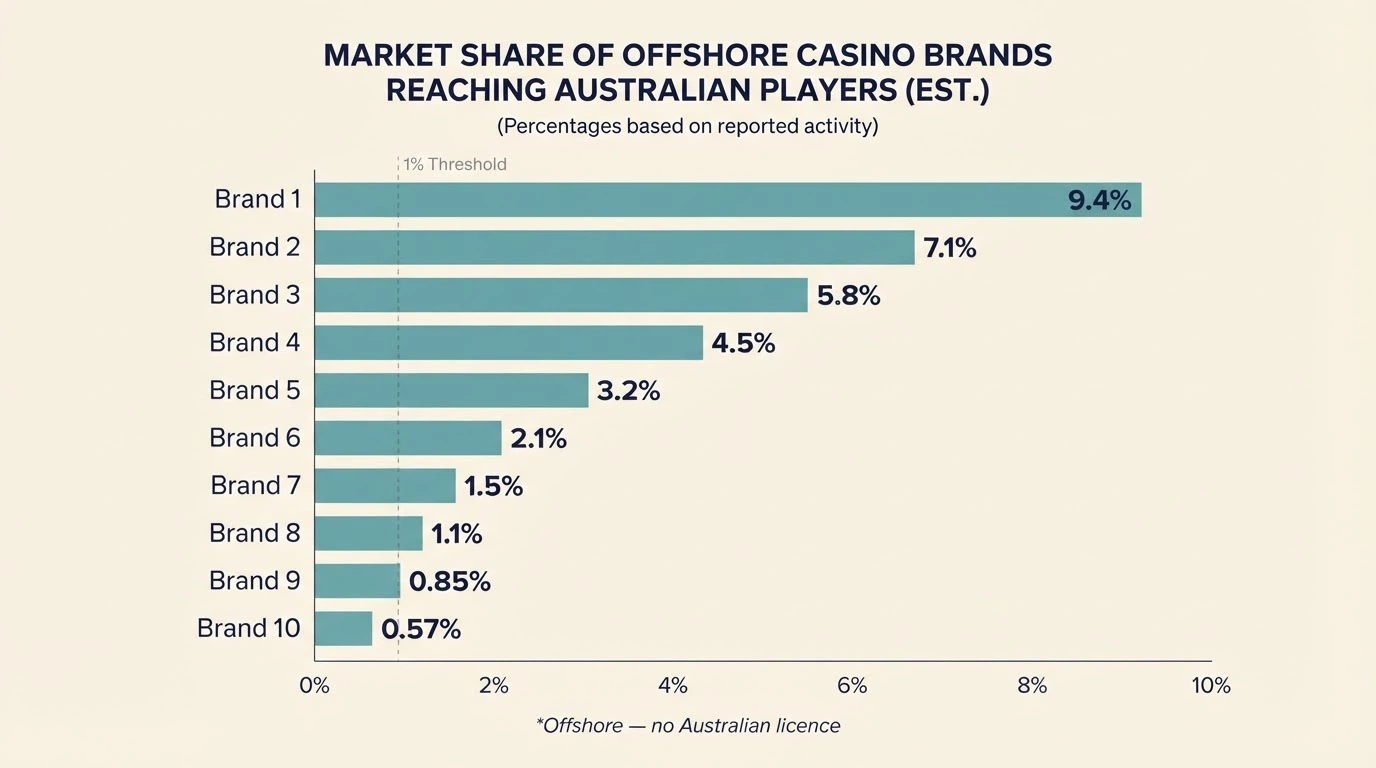
The table below ranks the ten offshore casino brands an Australian player is most likely to encounter when searching for a no-wager bonus. Every operator listed is offshore. None holds an Australian online casino licence. The ranking reflects market share — not regulatory standing, not bonus value, not player protection. Those criteria are not in the data the ranking is built from.
| Operator | Status in Australia | Market Share — among offshore casino brands |
|---|---|---|
| Rocket Play | Offshore, no Australian licence | 9.4% |
| Skycrown | Offshore, no Australian licence | 8.55% |
| Royal Reels | Offshore, no Australian licence | 2.51% |
| WinSpirit | Offshore, no Australian licence | 1.55% |
| Stake | Offshore, no Australian licence | 1.28% |
| Rainbet | Offshore, no Australian licence | 1.28% |
| Scream Casino | Offshore, no Australian licence | 0.99% |
| FairGO | Offshore, no Australian licence | 0.8% |
| Bizzo Casino | Offshore, no Australian licence | 0.57% |
| Rocket Casino | Offshore, no Australian licence | 0.57% |
The market-share spread is wide — from 9.4% at the top to 0.57% at the bottom — and the gap between Rocket Play and Skycrown, the two leading brands, is narrower than the gap between Skycrown and Royal Reels, the third. The two largest operators together account for nearly a fifth of the offshore casino traffic from Australian IP addresses. The remaining eight split what is left, with three of them below 1%.
A note on what the table does not show. No Australian licence exists for any of these operators. No Australian regulator — ACMA, NTRWC, OLGR, VCGLR, QGRC — has issued a number to any of them. The “Status” column is the same on every row because the law is the same on every row: online casino is prohibited under the Interactive Gambling Act 2001, and no operator in the world holds a licence to offer one to an Australian.
Rocket Play
Rocket Play sits at the top of the offshore casino market for Australian traffic, with a 9.4% share — roughly one in eleven dollars wagered by Australians on offshore casino brands lands here. The brand surfaces in no-wager promotional context across several comparison sources, though specific bonus terms — wagering multiple, spin count, cashout cap, eligible pokie, expiry window — were not confirmed in the research pass that built this page.
What an Australian player should know before claiming: the operator is offshore, no Australian licence is in play, and the bonus terms the comparison site advertises may differ from what the cashier shows at sign-up. The licence jurisdiction was not confirmed this run. The game-provider list was not confirmed either. Both are worth verifying on the operator’s own terms page before depositing.
A 9.4% market share is a sign of customer-acquisition spend, not of regulatory standing. The two are unrelated. The verdict on Rocket Play is the same verdict that applies to every operator on this page: an offshore casino carrying a no-wager promotion is a real-money product with no Australian consumer protection, no BetStop coverage, and a cashout cap that defines the upside. The market-share lead does not change that.
Skycrown
Skycrown is the second-largest offshore casino brand by Australian market share, at 8.55%. The welcome offer that surfaced in research is not a no-wager bonus. Forty free spins plus a A$10 chip, with 45x wagering on bonus winnings, a A$80 maximum cashout, and a ten-day expiry. That is a standard bonus, not a no-wager promotion.
The distinction matters. A 45x wagering requirement on bonus winnings is roughly the industry average for offshore casinos — better than the worst, worse than the best, and far worse than zero. A player claiming the Skycrown welcome offer accepts the rollover. A player searching specifically for “no wager” should not.
What is not in the data: whether Skycrown runs a separate no-wager promotion on a different page, a different game, or a different player segment. The research pass did not surface one. A player who wants to verify should check Skycrown’s own promotional terms — the operator may carry wager-free spins on a specific pokie rotation not captured here.
The verdict on Skycrown: a substantial offshore operator whose advertised welcome bonus is a standard 45x offer. The market-share number is large. The bonus terms it advertises are not the ones this page is about.
Royal Reels
Royal Reels holds a 2.51% share of the Australian offshore casino market — meaningfully smaller than Rocket Play or Skycrown, but still ahead of the seven operators below it on the list. No bonus terms, no licence jurisdiction, no game-provider list, and no domain were confirmed in the research pass.
What that leaves is a market-share position and an offshore status. Both are accurate. Neither is enough for a player to make a claim decision. The next step for a player evaluating Royal Reels is the operator’s own terms page — current wagering requirements, current eligible-pokie list, current cashout cap on the welcome offer.
The verdict on Royal Reels: an offshore brand with a real market position among Australian players and no confirmed bonus terms to evaluate. The page is honest about that gap because the gap is what a player would otherwise have to discover at the cashier.
WinSpirit
WinSpirit holds a 1.55% share of the Australian offshore casino market. Every bonus-specific field — wagering requirement, spin value, cashout cap, expiry, eligible games, licence jurisdiction — was not confirmed in the research pass that built this page.
The shape of the write-up is therefore mostly qualitative. WinSpirit is offshore. WinSpirit holds no Australian licence. WinSpirit’s terms, providers, and promotional calendar are not in the data this page draws from. A player who wants to assess WinSpirit against the criteria this page applies — no-wager bonus value, cashout cap, expiry window, eligible pokie — needs to check the operator directly.
The verdict on WinSpirit: a smaller offshore brand. The market-share position is documented, but the promotional terms aren’t in the available data. A player assessing this operator should verify current terms directly at the cashier before registering.
Stake
Stake holds a 1.28% share of the Australian offshore casino market, tied with Rainbet. The licence is widely reported as Curaçao — the standard offshore jurisdiction for crypto-native operators — though the research pass did not confirm this from a primary source. The bonus-specific fields were not confirmed either.
What is distinctive about Stake is the payment model. Stake is a crypto-native operator: deposits and withdrawals in Bitcoin, Ethereum, and a long tail of altcoins. For an Australian player, that payment model is itself a tell — crypto is banned as a deposit method for licensed Australian wagering since 11 June 2024, and an operator accepting crypto from an Australian is operating outside Australian rules by definition.
The verdict on Stake: the only crypto-native operator on the list, with a Curaçao licence (widely reported, not confirmed from primary source this run) and a payment method that signals unlicensed operation. The no-wager promotion, if Stake runs one, sits on top of that structural exposure. A player evaluating Stake evaluates the no-wager offer knowing what “crypto deposit” means in the Australian regulatory frame.
Rainbet
Rainbet holds a 1.28% share of the Australian offshore casino market, tied with Stake. Every bonus-specific field was not confirmed in the research pass.
Rainbet operates offshore without an Australian licence. Its market presence is established, but it does not appear in the verified promotional data set for this page. The site’s eligibility for a no-wager comparison is not established by the current figures.
The verdict on Rainbet: a smaller offshore brand with a real market footprint, but no verified promotional data to assess. Without official terms, the site remains a speculative choice for a player chasing specific no-wager incentives.
Scream Casino
Scream Casino holds a 0.99% share of the Australian offshore casino market — under 1%, just below Rainbet and Stake. Every bonus-specific field was not confirmed in the research pass.
Scream Casino follows the standard offshore profile: no Australian licence and no data-backed bonus terms. The instruction remains the same for every operator in this tier: consult the cashier and the terms page directly to confirm the wagering requirements, expiry, and eligible games before making any deposit.
The verdict on Scream Casino: a smaller offshore operator. As with other brands at this traffic level, the available data does not confirm its promotional structure, so a player should treat any bonus claims with caution until they check the site terms personally.
FairGO
FairGO holds a 0.8% share of the Australian offshore casino market — the smallest on the list with a confirmed wagering rate. The domain is Fairgocasino.com.au, which is notable because no other operator on this page carries an Australian country-code domain. A .com.au domain does not confer an Australian licence — the domain registration is a marketing choice, not a regulatory one — but it is a signal of how the brand positions itself to Australian searchers.
The wagering rate that surfaced in research is 25x, the lowest in the comparison set. It is not no-wager. 25x is closer to the standard offshore average than it is to zero. A player evaluating FairGO on a “no wager” search is likely to be disappointed.
What was not confirmed: the licence jurisdiction, the game-provider list, the cashout cap, the expiry window, and the eligible-pokie rotation. The 25x figure is from a single comparison source.
The verdict on FairGO: the lowest wagering rate in the featured set and the only .com.au domain on the list, but neither of those facts makes the bonus a no-wager offer. The 25x requirement still asks for real turnover before withdrawal. A player searching for zero rollover will not find it here.
Bizzo Casino
Bizzo Casino holds 0.57% of the Australian offshore casino market, the same share as Rocket Casino at the bottom of the list. Every bonus-specific field was not confirmed in the research pass.
Bizzo Casino is an offshore operator with no Australian licence. It sits at the bottom of the traffic tier, and as with other small-share sites, specific promotional terms are not in the current data set. The best practice is to inspect the site’s terms page directly.
The verdict on Bizzo Casino: the smallest operator on this list with a verified market share. The lack of available bonus data means a player cannot reliably compare its offerings to the rest of the field. Verify all terms on the operator’s site.
Rocket Casino
Rocket Casino holds a 0.57% share of the Australian offshore casino market, tied with Bizzo. The name overlap with Rocket Play is a real risk: a player searching for one brand may land on the other. They are separate operators. The research pass did not confirm bonus terms for either, and the .57% share is independent — Rocket Casino is not a fraction of Rocket Play.
Offshore status, no Australian licence, no confirmed bonus terms. The same instruction: check the operator directly. The same gap on this page.
The verdict on Rocket Casino: a distinct operator from Rocket Play, currently holding the smallest confirmed market share here. There is no verified data on its bonus structure, making it a “buyer beware” site for any player seeking specific promotional guarantees.
The Pokies Where No-Wager Free Spins Actually Pay
A no-wager free spin pays whatever the pokie returns, capped by the operator’s cashout limit and reduced by the pokie’s house edge. The two numbers that determine the value are the pokie’s return-to-player and its volatility. RTP is the long-run payback percentage. Volatility is the spread of outcomes around that average — how often the pokie pays, how much it pays when it does, and how long a session can run between payouts.
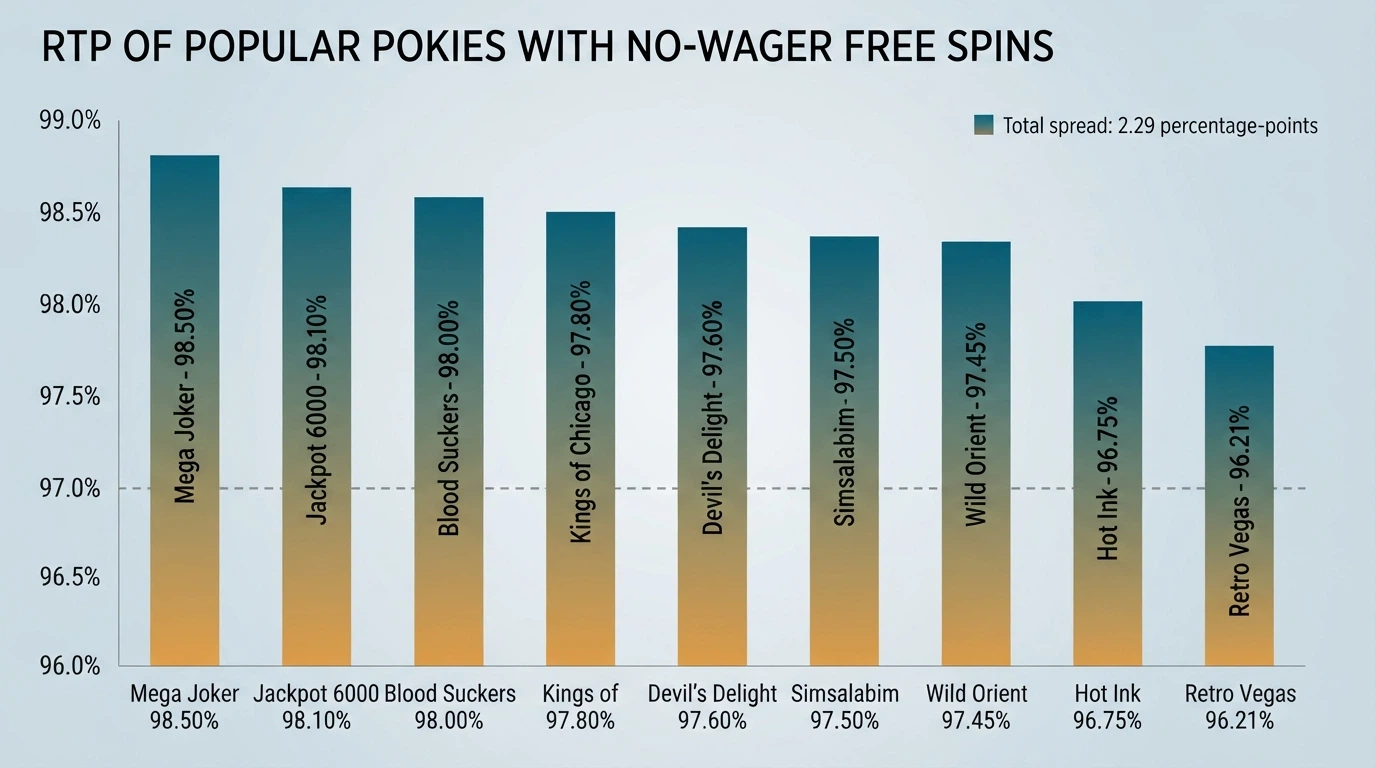
The industry average RTP for Australian online pokies sits between 95% and 96%. The titles operators attach to no-wager free spin offers cluster in a narrow band above that average — Pragmatic Play’s Sweet Bonanza and Big Bass Splash around 96.5%, NetEnt’s Blood Suckers at 98.00%, Thunderkick’s 1429 Uncharted Seas at 98.50%. The 2.5 to 3.5 percentage-point spread between the average and the top of the rotation is small in absolute terms and large in dollar terms over a session.
| Pokie | Provider | RTP | Volatility | Max Win |
|---|---|---|---|---|
| 1429 Uncharted Seas | Thunderkick | 98.50% | Low-medium | — |
| Blood Suckers | NetEnt | 98.00% | Low | 900x stake |
| Big Bass Splash | Pragmatic Play | 96.71% | Medium-high | 2,500x stake |
| Sweet Bonanza 1000 | Pragmatic Play | 96.53% | High | 25,000x stake |
| Sweet Bonanza | Pragmatic Play | 96.51% | High | 21,100x stake |
| Gates of Olympus 1000 | Pragmatic Play | 96.50% | Very high | 15,000x stake |
| Wanted Dead or a Wild | Hacksaw Gaming | 96.38% | Very high | 12,500x stake |
| Valley of the Gods | Yggdrasil | ~96.2% | Medium | — |
| Book of Dead | Play’n GO | 96.21% | High | 5,000x stake |
The table does not include every pokie an Australian player will see on a no-wager offer — the rotation shifts by operator and by season — but the titles above are the ones research carries confirmed RTP data for. The pokie the operator attaches to a no-wager offer is one of these, or one nearby. The ones the operator excludes are usually the highest-RTP titles in the rotation, because the operator prices the bonus against the expected loss and a 98.5% pokie eats into that margin faster than a 96.2% one.
The Best Pokies for Meeting a Wager — and Why RTP Is the Number That Matters
When a wagering requirement must be cleared, the pokie’s RTP is the single biggest factor in how much of the bonus survives. The arithmetic is straightforward: over a given turnover, expected loss is turnover × (1 − RTP). On a 96% pokie, every A$1,000 wagered loses A$40 on average. On a 98.50% pokie, every A$1,000 wagered loses A$15 on average. The difference is A$25 per A$1,000.
Over the A$2,000 turnover a 40x bonus on A$50 requires, that gap is A$50. Over the A$7,000 turnover a 35x bonus on A$200 requires, the gap is A$175. The choice of pokie is not a small optimisation. It is a material share of the bonus’s real cost.
Volatility enters the picture through bankroll variance. A low-volatility pokie produces a steady stream of small wins; the bankroll stays close to its starting position; the wagering requirement clears in a predictable number of spins. A high-volatility pokie produces long dry stretches punctuated by larger wins; the bankroll swings are wider; the player may run out of bankroll before the rollover is complete. The variance does not change the expected loss. It changes the probability that the player survives long enough to realise the expected loss rather than a worse outcome.
A no-wager bonus removes the choice entirely. There is no rollover to clear. The volatility question shifts from “will my bankroll survive the playthrough” to “will my session land a win before the spins run out”. The two are different problems, and the optimal pokie for each is different.
Wager Math: How the Slot Wager Calculator Works
The wager calculator reduces to three inputs and one output. The inputs: bonus amount, wagering multiple, pokie RTP. The output: expected loss over the required turnover. Required turnover is bonus × multiple. Expected loss is turnover × (1 − RTP). The two calculations, run together, give the player the dollar cost of clearing the bonus.
A worked example: a A$50 bonus at 40x wagering on a 96% RTP pokie. Required turnover is A$2,000. Expected loss over A$2,000 at a 4% house edge is A$80. The bonus was A$50. The cost of clearing it is A$80. A player can come out behind on a bonus they technically won.
The same arithmetic on a no-wager bonus is empty. Required turnover is zero. Expected loss is zero. The only cost is whatever the free spins themselves return, capped by the cashout limit the operator set. That is the entire structural advantage of a no-wager bonus, expressed as the absence of a calculation the standard bonus requires.
The Providers Behind No-Wager Free Spin Offers
Pragmatic Play dominates the rotation. Sweet Bonanza, Sweet Bonanza 1000, Big Bass Splash, Gates of Olympus 1000 — four of the most commonly attached no-wager free spin titles — all come from the same studio. The cluster of RTPs is tight: 96.50% to 96.71%. Pragmatic Play’s house style is the high-volatility, pay-anywhere grid, and the bonus math reflects it.
NetEnt’s Blood Suckers sits at the other end of the spectrum — 98.00% RTP, low volatility, a 900x stake maximum win. The pokie is older, the maths are better, and operators sometimes restrict it on no-deposit offers because the RTP eats into the bonus margin. When it is available, it is the highest-RTP pokie most players will encounter.
Thunderkick’s 1429 Uncharted Seas at 98.50% RTP is the highest-RTP title in the confirmed set, with low-medium volatility. Play’n GO’s Book of Dead at 96.21% is the lowest, with high volatility. Hacksaw Gaming’s Wanted Dead or a Wild at 96.38% is very high volatility and the largest studio-name gap from the industry average. Yggdrasil’s Valley of the Gods sits near the cluster average at roughly 96.2%.
RTP varies by title, not by studio. A Pragmatic Play pokie is not automatically higher-RTP than a Play’n GO pokie. The studio tells a player what kind of game to expect — the grid shape, the bonus mechanic, the visual style — not what the long-run payback will be. The number to read is on the pokie’s own information page, not on the studio’s.
Crypto No-Wager Bonuses: Bitcoin, Altcoins and the Zero-Rollover Pitch
Crypto casinos market the no-wager bonus hard. Zero rollover. Instant withdrawals. No identity verification. The pitch is built around three friction-reducers, and each one is also a tell.
Crypto deposits signal an unlicensed operator in Australia. Credit cards, credit-related products, and digital currency are banned as payment for licensed online wagering in Australia since 11 June 2024. The ban is enforced at the payment-rail level — a licensed Australian bookmaker cannot accept a Bitcoin deposit from an Australian customer. An operator accepting one is outside the Australian regulatory frame by definition. A no-wager bonus on a crypto deposit is a no-wager bonus on a site the ACMA can block.
The zero-rollover pitch is the structural advantage the previous sections of this page have argued from. The crypto payment rail is the structural disadvantage. The two cancel each other for an Australian player concerned with regulatory protection — and the player who is not concerned with regulatory protection has a different decision to make.
Anonymous Play and the No-KYC Promise
A no-KYC casino is one that does not verify the player’s identity. No passport upload, no driver’s licence scan, no address confirmation. Deposits and withdrawals move in crypto, and the operator does not ask who is on the other end.
For an Australian player, the appeal is the absence of a paper trail. Online casino is prohibited in Australia. The player knows the product is illegal. A no-KYC casino keeps the player’s name off the operator’s records. That is the marketing pitch.
The risk runs in the opposite direction. No KYC means no recourse. The operator cannot be compelled to pay a disputed withdrawal because the operator does not know who the player is. A complaint to an Australian regulator has no traction because the regulator has no jurisdiction. A complaint to the operator’s home regulator has no traction because the regulator does not know the player exists. The site can vanish — and offshore sites have vanished, with player balances on them — and the player has no path to recover.
The structural trade-off is the same as the rest of this section. A no-wager bonus on a no-KYC crypto casino delivers real winnings as cash — and delivers no protection against the operator refusing to pay them.
Free-Play and Demo Mode: No-Wager Without a Cent
Demo mode is the only truly risk-free no-wager experience available to an Australian player, and it costs nothing. No deposit, no registration, no cashout cap, no expiry window. The player loads the pokie, spins with virtual credits, and learns the mechanics, the volatility, the bonus frequency — without risking a cent and without claiming an offer.
Every pokie in this page’s rotation has a demo version. Blood Suckers, 1429 Uncharted Seas, Sweet Bonanza, Book of Dead, Big Bass Splash — all playable in demo at the provider’s site, at affiliate review sites, and at the offshore casino itself before the player registers. The experience is identical to real-money play in every respect except the outcome: demo winnings cannot be withdrawn because they were never wagered.
The trade-off is exactly that. A player who wants to learn whether Sweet Bonanza 1000 suits their style before depositing can do so in demo in five minutes. A player who wants to win real money cannot. Demo mode is the right tool for evaluation. It is not the right tool for income.
The Legal Reality Australian Casino Sites Do Not Want You to Read
Online casino is prohibited in Australia. The Interactive Gambling Act 2001 — the IGA — makes it an offence to provide an online casino, online pokies, or in-play sports betting to a person physically in Australia. The Act has been in force since 2001. The 2017 amendments closed offshore loopholes and gave the regulator enforcement teeth. There is no licence for online casino games anywhere in Australia — not federally, not in any state, not in any territory.
Every no-wager bonus this page covers sits on an offshore site. Every operator on the comparison table is unlicensed. The legal status of the offer is not ambiguous, and it is not a matter of interpretation: the product is prohibited, the operator is prohibited, the only question the IGA leaves open is whether the player is.
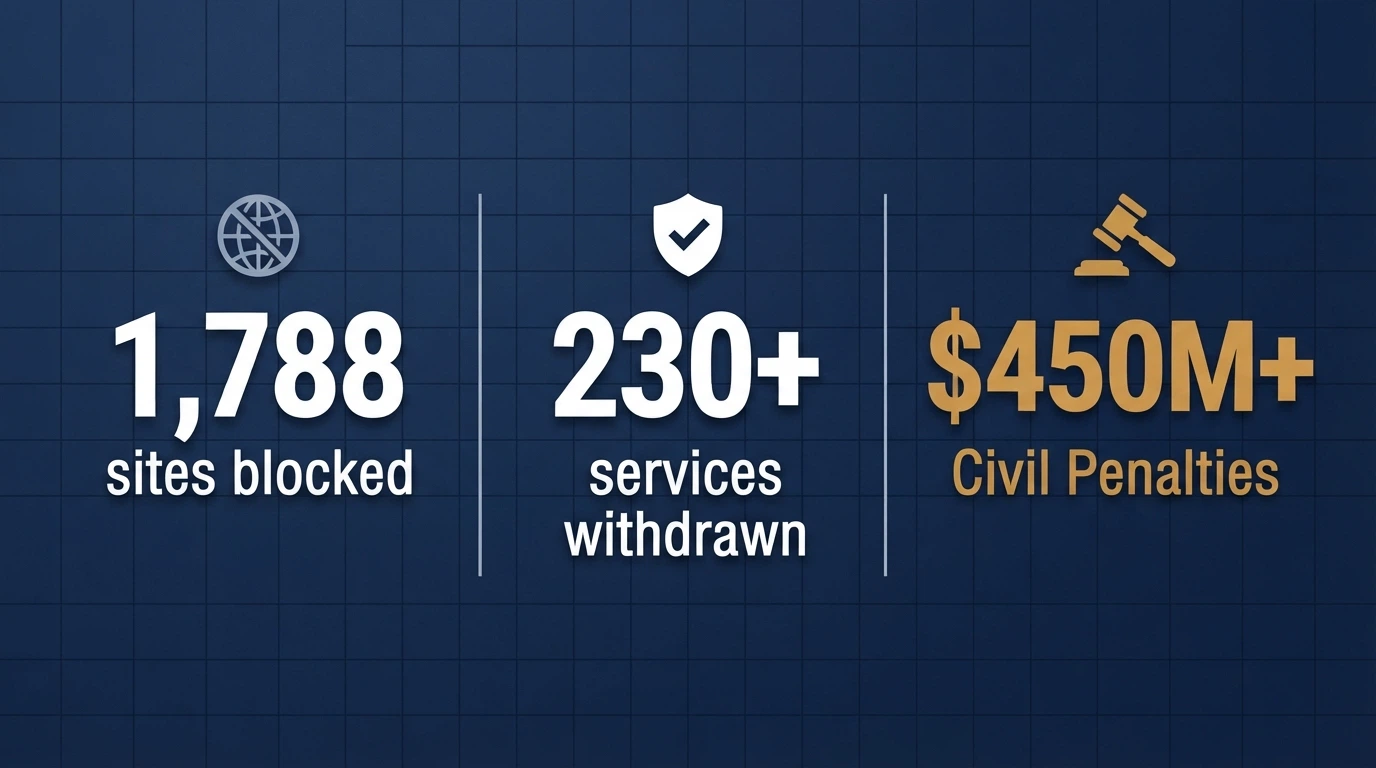
The regulator is the Australian Communications and Media Authority — the ACMA. It investigates complaints. It issues formal warnings. It refers operators to the courts. It directs ISPs to block illegal sites. The scale of enforcement over the past several years is substantial: 1,788 illegal gambling and affiliate websites blocked since November 2019, more than 230 illegal services withdrawn from the Australian market since 2017, civil penalties of up to A$2,475,000 per day for individuals and A$12,375,000 per day for corporations.
The 2026 reform — the Interactive Gambling Amendment (Gambling Reform) Bill 2026, passed by Parliament on 19 August 2026 and commencing 1 January 2027 — does not change the underlying prohibition. It restricts licensed wagering advertising, caps inducements, bans athlete and celebrity promotion, and creates an opt-out register. It does not legalise offshore casino. It does not ban offshore casino advertising. The product the operators on this page offer remains prohibited.
ACMA Enforcement: What the Regulator Actually Does
The ACMA does not prosecute players. The IGA targets the provider, not the punter. What the ACMA does is run the enforcement machinery that makes the prohibition real for operators.
The mechanics are investigation-first, blocking-second. The regulator receives complaints — from the public, from licensees, from other agencies. It investigates suspected breaches. It issues formal warnings. It refers matters to ISPs for blocking. It initiates civil penalty proceedings in the Federal Court. The Q4 2025 figures are the most recent published snapshot: 23 investigations completed, 45 gambling sites examined, 69 breaches of the IGA found, 10 formal warnings issued, 133 websites referred to ISPs for blocking. The breach breakdown that quarter: 38 for providing a prohibited interactive gambling service, 26 for providing an unlicensed regulated service, 5 for advertising a prohibited service in Australia.
The cumulative scale is what makes the enforcement real. 1,788 sites blocked since November 2019 is not a handful of obscure operators. It is a substantial share of the offshore casino ecosystem, including the affiliate sites that drive traffic to them. The site an Australian player uses today can be on the next blocking list. The ACMA does not announce blocking in advance.
Licensed vs Offshore: The Split Every Australian Player Needs to Understand
The licensed Australian market and the offshore casino market are not two versions of the same product. They are different products with different rules, different protections, and different prices.
What IS licensed in Australia: wagering on races and sport placed before the event begins, lotteries, and keno. The licensing is state and territory business. In practice, online wagering concentrates with the Northern Territory Racing and Wagering Commission (NTRWC) administered through Licensing NT — the de facto national licensor. Sportsbet, Bet365, Ladbrokes, TAB, Neds, Betr — the familiar Australian brands — are licensed under this framework. Minimum age is 18 for all commercial gambling.
What is NOT licensed: online casino games, online pokies, in-play sports betting. There is no Australian licence for any of these products. There is no path to obtain one. The IGA prohibition is the prohibition.
The payment tells make the distinction concrete. Credit cards, credit-related products, and digital currency are banned as payment for licensed online wagering since 11 June 2024. The ban is enforced at the payment-rail level. A licensed Australian bookmaker cannot accept a credit-card deposit or a Bitcoin deposit from an Australian. A site that asks for either is offshore — outside the Australian regulatory frame by definition. Legal deposit routes for licensed wagering are debit card, bank transfer, PayID, Osko, and BPAY.
The 2026 Reform: What Changed for Australian Gambling Advertising
The Interactive Gambling Amendment (Gambling Reform) Bill 2026 passed Parliament on 19 August 2026. Its measures commence on 1 January 2027. The reform does not legalise offshore casino. It does restrict licensed wagering advertising in several specific ways.
The advertising restrictions: no more than three wagering ads per hour between 5am and 8:30pm on broadcast. A blackout window from fifteen minutes before until five minutes after a live sporting event during the same hours. No wagering ads during children’s programming or G-classified programs at specified times. Radio ads barred during school drop-off and pick-up times. Online wagering ads restricted to logged-in, verified-over-18 users with an opt-out option.
The inducement restrictions: prohibition on direct marketing of inducements for fourteen days after a customer signs up, for three months after a person deregisters from BetStop, and indefinitely for customers identified as at risk of gambling-related harm.
The promotion restrictions: ban on athletes, celebrities, and influencers promoting wagering products. Ban on wagering advertising inside sports venues. Ban on wagering advertising on player and official uniforms. Ban on broadcasting sporting odds.
The opt-out register: AdStop, a national wagering advertising opt-out register administered by the ACMA. One registration, all online platforms.
The payment-provider authority: banks and payment providers gain express authority to block transactions to illegal gambling operators.
The foreign-lottery restriction: foreign-matched lotteries and online keno — “pocket pokies” — are banned.
A statutory review is scheduled after three years. The reform is the most significant change to the Australian gambling framework since the 2017 amendments. It does not change the offshore casino prohibition. The operators on this page are not affected by the advertising restrictions, because they are not licensed to advertise to Australians in the first place. They remain prohibited under the IGA.
What You Lose Playing Outside the Licensed Market
The IGA does not prosecute the player. The Act targets the provider, not the punter. The absence of prosecution is not the absence of risk. It is the absence of protection.
No Australian consumer protection applies. The Australian Consumer Law does not reach an offshore casino. The Australian Financial Complaints Authority does not have jurisdiction. The operator’s home regulator — Curaçao, Malta, or wherever the licence sits — has no contractual relationship with the Australian player and no obligation to mediate a dispute.
No Australian complaints body exists. The ACMA takes complaints about illegal operators, but the remedy is enforcement action against the operator — blocking, warnings, civil penalty proceedings. The remedy is not a refund for the player.
BetStop does not apply. BetStop binds Australian-licensed wagering services. An offshore casino is not connected to the register. A player who has registered for self-exclusion and then opens an account at an offshore casino will not be blocked. The 59,830 people who have registered with BetStop and the 37,247 with active exclusions have not been protected from offshore sites by registering.
No recourse exists if the operator refuses a withdrawal. The pokie paid A$500 on a no-wager spin. The operator declines to pay. The player has no Australian body to appeal to. The terms of the bonus — read at signup, agreed to by clicking “I accept” — are the contract. If the terms let the operator decline, the operator declines.
The site can be blocked at any time with a balance on it. The ACMA has blocked 1,788 sites since November 2019. The next blocking wave can include the site an Australian player is currently using. The balance the player has not withdrawn becomes inaccessible. The “next list” is unpublished in advance.
The tax treatment is not a benefit. Gambling winnings are not assessable income for ordinary punters — section 6-5 of the ITAA 1997. Gambling losses are not deductible under section 8-1. A player who wins A$5,000 on an offshore casino does not pay tax on it. A player who loses A$5,000 cannot offset it. The tax outcome is symmetrical and offers no net advantage to playing offshore.
Staying Safe: What Responsible Play Looks Like With Offshore No-Wager Bonuses
Responsible gambling tools do not reach offshore casinos. The infrastructure exists — BetStop, Gambling Help Online, the National Helpline — and the infrastructure is built around the licensed Australian market. An offshore casino is outside that market. The tools do not follow.
BetStop is the National Self-Exclusion Register. One registration covers every Australian-licensed wagering service — sports, racing, keno, lotteries. By the end of Q3 FY 2025-2026 (31 March 2026), 59,830 Australians had registered, with 37,247 active exclusions. The number is the strongest evidence that self-exclusion is a meaningful intervention when it applies. It does not apply offshore.
Gambling Help Online and the National Helpline are not gated by where the gambling happens. The Helpline — 1800 858 858 — is free, confidential, and staffed 24/7. Gambling Help Online (gamblinghelponline.org.au) provides online chat and counselling. Either service can be used by a person who has been gambling on offshore sites, on licensed Australian sites, or both. The help exists; the operator is irrelevant.
The prevalence data puts the risk in perspective. About 2.1% of Australian adults — roughly 430,000 people — experience problem gambling. The Australian Institute of Health and Welfare put high-risk gambling at 1.8% in 2022. The numbers are not a scare tactic. They are the population-level incidence of a harm the responsible-gambling infrastructure was built to address.
BetStop, Self-Exclusion and the Offshore Gap
BetStop is Australia’s strongest responsible-gambling tool because it is a single registration with national reach. A person who registers does not have to remember which licensed operators they have used. The register covers them all. The 37,247 Australians with active exclusions at the end of March 2026 are protected from their own impulse across every licensed channel.
The protection stops at the border. BetStop binds Australian-licensed wagering services. An offshore casino is not connected to the register. A player who has registered and is determined to gamble can open an account at Rocket Play or Stake or any of the eight other operators on this page and deposit. The offshore casino will not check the register, because the register does not include them. The deposit will not be blocked, because the operator is outside the Australian regulatory frame.
For anyone searching for a no-wager bonus who has previously registered for self-exclusion — or who should have — the offshore gap is the deciding fact. The responsible-gambling infrastructure exists, and the operators an Australian player reaches for a no-wager bonus are not part of it.
Where to Get Help in Australia
- The National Gambling Helpline is 1800 858 858 — free, confidential, staffed 24 hours a day, seven days a week. The call is anonymous. The counselling is professional. The number works from anywhere in Australia.
- Gambling Help Online is gamblinghelponline.org.au — online chat, email support, and self-help resources. The site is run by the same counselling network as the Helpline. The format suits a person who would rather type than call.
- The prevalence numbers — 2.1% of Australian adults, roughly 430,000 people — are the population-level incidence of problem gambling. The number is a check on the “it’s just me” feeling a player may carry alone. The numbers say it is not just them.
- The practical step before claiming any bonus is to set a deposit limit. Offshore casinos do not impose one by default. The player has to set it themselves, in advance, and hold to it. The bonus is a marketing offer; the deposit limit is the player’s defence against the offer’s momentum.
- The practical step when chasing a rollover is to stop. A standard 40x bonus on A$50 is A$2,000 of turnover. A player who has already run A$1,500 of turnover without clearing the requirement is not “almost there”. They are 75% of the way through an expected loss that compounds with every spin. Stopping is the answer. Walking away is the answer. The bonus was not free; the recognition is the recovery.
How We Evaluate No-Wager Casino Bonuses for Australian Players
The ten operators on this page were drawn from tracked Australian market-share data, filtered for casino brands (excluding licensed Australian wagering operators like Sportsbet, Bet365, Ladbrokes, TABtouch, PointsBet, Neds, Betr, Picklebet, Betfair — which are sports and racing wagering, not casino). The ranking reflects market share, not regulatory standing, not bonus value, not player protection. Those criteria are not in the data the ranking is built from.
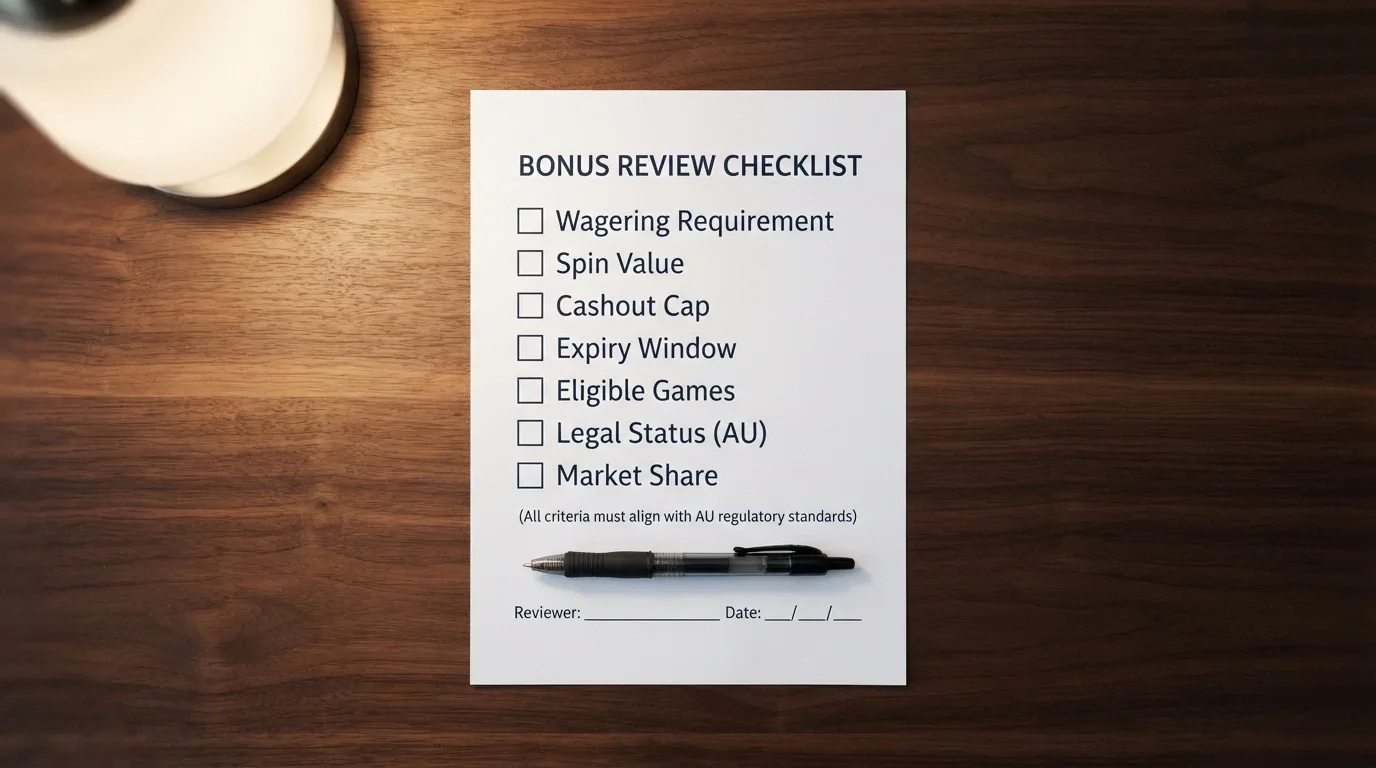
The evaluation criteria applied to each operator: bonus terms (wagering requirement, spin value, cashout cap, expiry, eligible games), legal status checked against the ACMA regulatory framework, and market share among offshore casino brands reaching Australian IP addresses. Each operator is described against the same criteria, and each operator is honest about what those criteria did and did not find.
The limitation: bonus terms for several operators were not confirmed this run. Where the bonus terms were not in the data, the write-up says so rather than inventing. The Skycrown welcome bonus — 40 free spins plus a A$10 chip at 45x wagering — is the only confirmed bonus on the comparison table. The FairGO 25x figure is from a single comparison source. The Rocket Play and Stake promotional context is from search results that surfaced incidentally. The remaining seven operators carry no confirmed bonus terms.
A second pass that prioritises the operator sweep would fill the gaps. This pass did not. The ranking reflects the data available. The write-ups are honest about which operators the data carries and which it does not.
The omission that matters most: no competitor page in the search results covers either the Australian online casino prohibition or the BetStop offshore gap. The legal-reality section of this page is the substantive difference between it and every other “best no wager casino Australia” article. The omission on the competitor side is the reason this page foregrounds the IGA prohibition, the ACMA enforcement scale, the 2026 reform, and the offshore-casino protection gap — and the reason the legal context shapes how the comparison table is presented.
Should You Claim a No-Wager Casino Bonus in 2026?
The honest answer is the one the previous sections have built toward. A no-wager bonus is better than a 40x bonus. The winnings are cash, not bonus balance. The rollover is zero, not thousands of dollars of expected turnover. The cashout cap is real, but the cap is the ceiling, not the floor. A A$10 no-wager spin bundle with a A$200 cashout cap is, in the right circumstances, a better offer than a A$500 welcome package with a 40x rollover.
The fine print is also real. The cashout cap — A$50 to A$200 on most free spin offers — defines the upside. The expiry window — 24 hours to seven days — defines the timeframe. The game restrictions — non-pokie games banned, jackpot pokies excluded, several selected pokies forbidden — define the eligible venue. The deposit-before-withdrawal rule on no-deposit offers defines the path to cashing out. Each condition narrows what the bonus can become. Together they define what a no-wager offer actually is.
The legal reality is the deciding factor. Every operator on this page is offshore. Every operator is unlicensed in Australia. No Australian consumer protection applies. No Australian complaints body exists. BetStop does not reach them. The site can be blocked at any time with a balance on it. The 2026 reform does not change this — it restricts licensed wagering advertising, it does not legalise offshore casino. The product the operators on this page offer remains prohibited under the Interactive Gambling Act 2001.
The decision is the reader’s. Claim a no-wager bonus knowing what it is and what it is not. A small, capped, restricted promotion on an offshore site with no Australian licence and no Australian protection — and with the structural advantage of real-money winnings over a standard 40x bonus. Or stay within the licensed Australian market — sports, racing, lotteries, keno — where the regulatory framework is real, BetStop applies, and the A$2,475,000-a-day civil penalties are aimed at providers who break the rules rather than at the player who navigates around them.
The no-wager bonus is the better promotion. The offshore casino is the worse venue. The two facts live together, and an Australian player who searches for one has to weigh both.
Frequently Asked Questions
What is the difference between no wagering free spins and standard free spins?
A no-wagering free spin credits winnings directly to the real-money balance — no rollover required to withdraw. A standard free spin credits winnings to a bonus balance that must be wagered (typically 30x or 40x) before it converts to cash. The per-spin value is usually higher on a wager-free offer (A$0.20 to A$0.50 versus A$0.10 standard) to compensate. The structural difference — bonus balance versus cash balance — is the entire reason Australian players search for “no wager”.
What is the maximum amount I can withdraw from a no wager casino bonus?
A maximum cashout cap of A$50 to A$200 is common on free spin offers, even when wagering is zero. Anything you win above the cap is forfeited. The cap applies to winnings from the bonus, not to your deposit. Read the bonus terms before claiming — the cap is stated explicitly, and it defines the maximum realisable value of the offer.
Do I need to make a deposit to claim a no wager bonus?
No deposit is required to claim a no-wager bonus — that is what “no deposit” means. A deposit IS typically required to withdraw the winnings. To cash out a no-deposit no-wager bonus, you usually need to make a minimum deposit and wager that deposit at least 1x first. The bonus is free. The withdrawal path is not always free.
Why are no wager casino bonuses smaller than regular welcome bonuses?
Because the operator is taking on more risk by removing the rollover. A standard welcome bonus at 40x carries an expected player loss over the playthrough that the operator can price against. A no-wager bonus has no playthrough to price against — every spin is a direct exposure. The operator compensates by offering a smaller bonus and a tighter cashout cap. The trade-off is the substance of the offer.
Can I use no wager free spins on any pokie, or are they limited to specific games?
Limited to specific games, almost always. Most no-deposit no-wager offers restrict eligible games: all non-pokie games are typically banned, jackpot pokies are excluded, and several selected pokies may be forbidden. Free spin offers usually lock spins to a single pokie the operator has chosen. The eligible-pokie list is in the bonus terms, and it is worth reading before claiming.
Do You Need to Wager Before You Can Cash Out?
A no-wager bonus can still hold a withdrawal back — not through a turnover requirement, but through a deposit requirement. To withdraw a no-deposit no-wager bonus, a minimum deposit and a 1x wager on that deposit are typically required. The bonus itself carries no playthrough. The withdrawal path does.
The reason is structural. A no-deposit bonus pays the player in bonus funds; the operator has no verified funding source behind the winnings. The minimum-deposit-and-1x-wager rule gives the operator a verified payment route, an anti-money-laundering footprint, and a token commitment from the player. It is not a wagering requirement on the bonus. It is a deposit-gating rule on the withdrawal — and it costs the player a deposit they were trying to avoid.
The cashout cap compounds the friction. A maximum withdrawal of A$50 to A$200 is common even at 0x wagering. A player who lands A$500 on a no-wager spin offer cannot withdraw A$500; they can withdraw the cap. The rest is forfeited. The bonus was free. The payout was not.
Bitcoin vs Altcoin No-Wager Offers: Does the Currency Matter?
The currency is the wrong axis to evaluate on. A Bitcoin no-wager bonus and an Ethereum no-wager bonus are structurally identical products. The wagering requirement is the same (zero). The cashout cap is the same (A$50 to A$200 on free spins). The expiry window is the same (24 hours to seven days). The eligible pokie is the same (one the operator chose). What differs between Bitcoin and altcoin offers is the volatility of the deposit currency, the speed of the withdrawal, and the operator’s licence jurisdiction.
The licence jurisdiction matters more than the coin. A Curaçao-licensed crypto casino and a Malta-licensed crypto casino are both offshore from an Australian perspective — neither holds an Australian licence, neither is connected to BetStop, neither offers recourse through an Australian complaints body. The regulatory difference between Curaçao and Malta is real for the operator and immaterial for the Australian player.
The Australian player’s exposure is the same across coins: crypto deposits have no chargeback, no Australian consumer protection, no complaints body to escalate to if the operator refuses a withdrawal. The irreversibility of a Bitcoin transaction is the irreversibility of a Bitcoin transaction whether the bonus behind it is wager-free or not.
Free No-Wager Spins vs Demo Play: Which One Is Worth Your Time?
A no-wager free spin pays real money. A$0.20 to A$0.50 per spin, twenty to one hundred spins, winnings credited as cash up to the cashout cap. The dollar upside is small — A$4 to A$100 of total bonus value, capped at A$50 to A$200 on withdrawal — but it is real. Demo play pays nothing.
Demo play asks for nothing. No deposit, no registration, no time pressure. The player spins at their own pace, on the pokie of their choice, with no cashout cap and no expiry window. The dollar upside is zero. The time cost is zero.
The right choice depends on what the player is optimising for. A player who has never played Blood Suckers and wants to know whether the 98% RTP and low volatility feel right should spend ten minutes in demo first. The information is worth more than the A$10 of upside a free-spin offer would deliver. A player who has played the pokie, understands the volatility, and wants to convert a bonus into withdrawable cash should claim the no-wager offer and accept the cashout cap.
The compounding factor is the bonus terms. A no-wager offer with a 24-hour expiry and a A$50 cashout cap on a single pokie the player has never played is a worse use of time than the same ten minutes in demo. The player learns nothing about the pokie, has no time to learn it once the bonus is claimed, and is unlikely to extract the cap. The conditions around the real-money path change the equation.