
What No-Deposit Bonuses Really Pay an Australian Player in 2026
Every NDB casino an Australian sees online is offshore, unlicensed in Australia, and offering a product the Interactive Gambling Act 2001 specifically prohibits from being supplied here. That is the legal floor under the rest of this page. The bonuses are real. The cashout caps are real. The wagering requirements are real. The Australian licence behind them does not exist, and no Australian regulator can hear a complaint about a withheld withdrawal or a voided win.

Verified as of 16 October 2026 against the Australian Communications and Media Authority’s register of illegal offshore gambling services and the Interactive Gambling Act 2001.
Table of Contents
- What “No Deposit” Really Delivers to Australian Players
- How Much Your “Free” Bonus Actually Costs
- Ranked: The NDB Offers Australians Can Actually Claim in 2026
- Which Pokies Your NDB Unlocks (And Which Games It Won’t)
- The Payment Method That Tells You Everything
- New NDB Casinos: Fresh Faces, Same Offshore Reality
- Free Play vs. Real Money: The Moment You Deposit
- The Legal Reality Australian NDB Guides Won’t Tell You
- Playing Safely When the Australian Safety Net Isn’t There
- How We Evaluated These NDB Casinos
- What Your NDB Is Actually Worth
- Frequently Asked Questions About NDB Casinos in Australia
What “No Deposit” Really Delivers to Australian Players
NDB stands for “no deposit bonus” — credit the casino credits to a new account before the player has paid in anything. The format is the simplest hook an online casino can run: register, verify, claim, play. The player takes no financial risk to start. That is also where the apparent simplicity ends. Every condition that turns a free bonus into either a small withdrawal or an unpaid job sits in the terms a player has to read before claiming, and the conditions are not standard across operators.
The mechanic works because the house always has the edge. A no-deposit bonus is priced into the operator’s margin; the offer is a marketing cost with a return attached, not a gift. The return is the wagering requirement, the max-cashout cap, and the bonus validity window. Those three clauses decide whether a player ever sees a cent of real money. Get them wrong and the screen balance is decoration.
Every NDB casino an Australian can reach runs from outside the country. Online casino games, online pokies and in-play sports betting are prohibited in Australia under the Interactive Gambling Act 2001, as amended by the Interactive Gambling Amendment Act 2017. There is no online casino licence available federally or in any state or territory. The brand may carry an Aussie motif — a kangaroo, a flag motif, “Fair Go”, “Ozwin” — and the offshore licence is the only licence it holds. The Australian theme is decoration; the jurisdiction is Curaçao.
The player is not the target of the IGA. The Act criminalises the provider, not the person using the service. That detail keeps an Australian from any criminal record for playing, and it is the only protection the Act offers them. The moment a player signs up offshore, every Australian consumer safeguard falls away: no Australian Financial Complaints Authority, no chargeback on a crypto deposit, no BetStop coverage, no recourse to the ACMA. The casino’s own terms and the casino’s own regulator are what the player has, and the regulator is in another hemisphere.
The Mechanics: Register, Verify, Claim, Wager, Withdraw
- Register. Create an account with an email, a username and a password. Most NDB casinos will not let an Australian player deposit in Australian dollars without routing through crypto or an offshore card processor; the sign-up itself is straightforward.
- Verify. Identity verification — phone, email or document upload — is the step that releases the bonus on most featured operators. Skycrown releases 20 free spins automatically and 100 free spins only after phone verification. Royal Reels releases its AU$10 chip after phone verification. Mirax and KatsuBet credit automatically. Verification matters because the wagering clock starts when the bonus lands.
- Claim. The bonus is either auto-credited on registration or activated at the cashier. Activation flows differ across affiliate listings and the operator’s own promo page. A flow that worked last week may be dead today; NDBs are rotated constantly.
- Wager. The wagering requirement is the multiplier applied to the bonus (cash chips) or the winnings (free spins). For a AU$20 chip at 40x, the player has to make AU$800 in bets before any withdrawal is possible. For free spins, the same multiplier applies to the spin winnings, not to the spin value.
- Withdraw. The withdrawal request is where most NDB players stop. The bonus has to be wagered in full, within the validity window, on games that contribute at 100%, before any cashout is allowed. The max-cashout cap then clips whatever the wagering produced — and the screen balance is rarely the payout.
Online NDB Casinos vs. Land-Based: Two Completely Different Worlds
A land-based casino in Australia operates under a state-issued gaming licence and answers to the relevant state regulator — the Victorian Commission for Gambling and Liquor Regulation, Liquor & Gaming NSW, or the equivalent body in the home state. Crown Melbourne, Crown Perth, The Star Sydney and The Star Gold Coast are the headline venues. Every pokie machine on the floor, every table game, every chip issued, is bound by Australian consumer law and the state’s gaming code. A punter can walk into the venue’s responsible-gambling centre, set a pre-commitment card, exclude themselves, and take a dispute to the state regulator or the Australian Financial Complaints Authority. That infrastructure exists. It is real. It is also not available online.
An online NDB casino is, in Australian terms, a foreign operator whose product is banned from being offered here. The Interactive Gambling Act 2001 makes the supply of online casino games, online pokies and in-play sports betting to a person in Australia an offence. The provider — not the player — is the target of the statute. The provider has, in nearly every case, registered in Curaçao, the Kahnawake jurisdiction in Canada, or another small offshore licensing hub, and accepts Australian customers because the only practical consequence is being blocked by an Australian ISP at the ACMA’s request. The contrast with the land-based sector is sharp: a venue in Melbourne answers to a Victorian regulator across town; an offshore site answers to a master licence holder 15,000 kilometres away.
The land-based comparison matters because a punter evaluating an online NDB is rightly comparing it to the experience they have locally. The product is similar — pokies, blackjack, roulette — and the legal category could not be more different. A free-spin offer at Crown is a member promotion under a Victorian licence. A free-spin offer at Skycrown is a marketing tool for an illegal product. The marketing copy rarely makes the distinction.
The Terms You Overlook: Wagering, Caps and Expiry
Three clauses do nearly all of the work turning a “free” bonus into either a small payout or an unpaid job. They sit in the bonus terms and conditions, normally reached from a link at the bottom of the promotions page, and they are not the page that sold the bonus.
The first clause is the wagering requirement, the multiplier applied to the bonus or the bonus winnings. For free spins in the Australian-facing offshore market, 30x to 50x is the typical band, applied to the winnings. For cash chips, 40x to 60x is the typical band, applied to the chip amount. A AU$20 chip at 40x means AU$800 in bets before any withdrawal is allowed; AU$120 won from 50 free spins at 40x means AU$4,800 in bets before any withdrawal is allowed. The number on screen at the end of wagering is rarely what comes out.
The second clause is the max-cashout cap. Free-spin NDBs in Australia cap cashouts at AU$20 to AU$100; cash-chip NDBs cap at AU$50 to AU$200. The cap is applied to net winnings after wagering, not to the screen balance. A lucky run on a high-volatility pokie can show a five-figure balance and pay out a fraction of it.
The third clause is the bonus validity window. Most NDBs run for 7 days from credit; some run for 14. The window covers the time to complete wagering and submit the withdrawal request. Miss the window and the bonus balance, the wagering progress and the bonus itself are voided. The wagering maths that looks manageable at 40x becomes unmanageable when the player has six days left and AU$600 still to wager at AU$1 a spin.
How Much Your “Free” Bonus Actually Costs
The price of a no-deposit bonus is the expected loss the wagering maths forces on a player, before the max-cashout cap clips whatever survives. The marketing word for the offer is “free”. The mechanism for collecting on it is a wagering requirement applied to either the bonus amount or the winnings, played out on games whose return-to-player rate is below 100% by design.
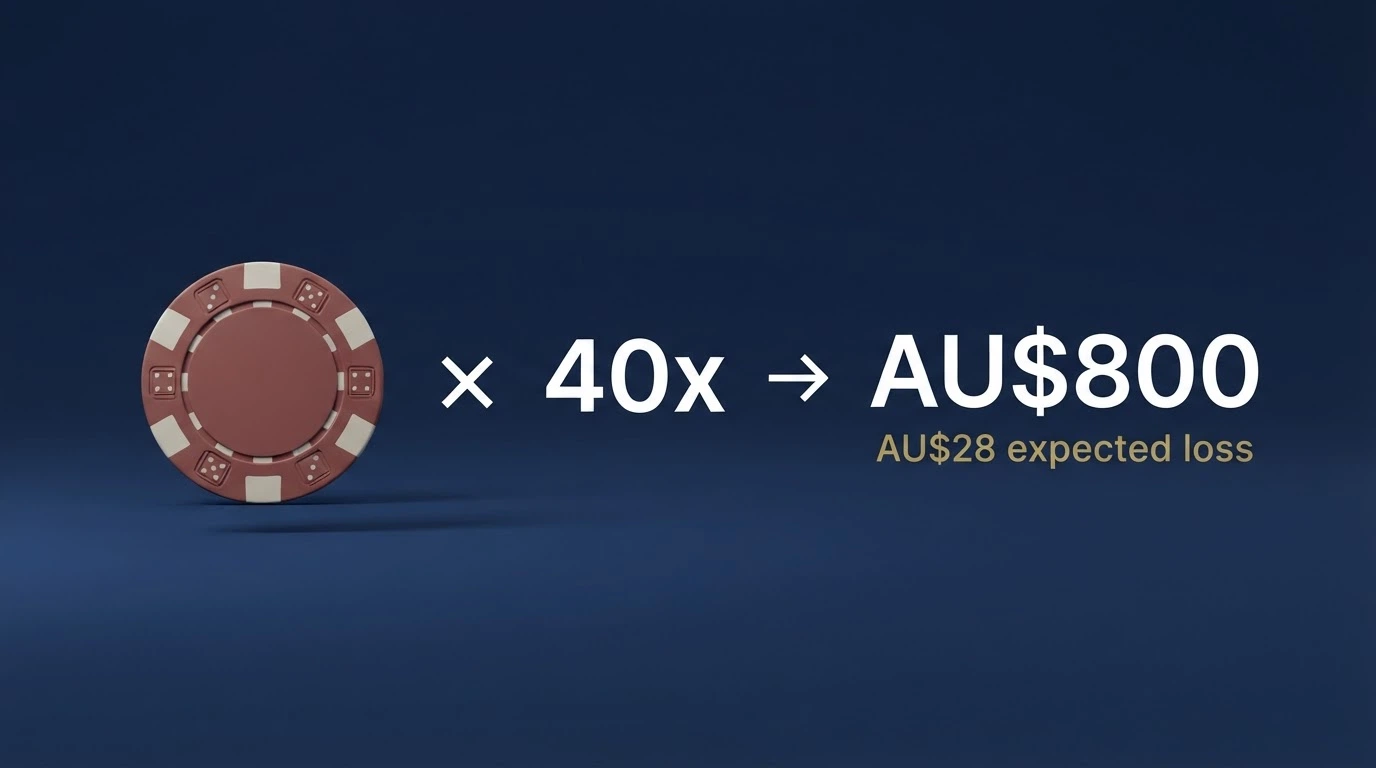
Run the maths once on a typical NDB. The AU$20 chip with a 40x wagering requirement forces AU$800 in bets on games contributing at 100%. Play those bets on a standard-configuration pokie like Gates of Olympus at 96.50% RTP, and the expected loss against the 3.5% house edge works out to AU$28. The chip was worth AU$20. The wagering is expected to cost AU$28 before the max-cashout cap clips whatever survives on the screen. The bonus is priced into the offer; the operator has already accounted for the AU$28 in its margin before the bonus was advertised.
The same maths hits the free-spin player. Take 50 free spins that win AU$120, then apply a 40x wagering requirement. The player must make AU$4,800 in bets at 96.5% RTP, which costs an expected AU$168 against the house edge. The win was AU$120. The price of converting it was AU$168. The cap then limits what can be withdrawn in any case.
Game contribution rules decide whether the maths above even applies. Pokies are the only category that reliably contributes 100% to wagering. Table games typically contribute 10% or are excluded entirely. Live dealer games are almost always excluded. Progressive jackpot pokies often contribute 0% or 10%. The effect is severe: AU$800 of blackjack play at a 10% contribution rate does not count as AU$800 toward wagering — it counts as AU$80, which means the player has to wager AU$8,000 in blackjack to clear a AU$20-chip bonus. The operator’s terms push the player to the pokies, where the house edge is the largest.
That is the structure. The offer is free. The cost is baked in. The terms route the player to the games where the operator earns the most. The cap then ensures the cost is paid before any meaningful payout.
Free Spins, Free Chips and Free Play: Three Bonuses, Three Traps
The three no-deposit formats each carry their own trap, and a player choosing between them is really choosing which trap they prefer.
Free spins are the most common NDB in the Australian-facing offshore market, typically 20 to 100 spins credited on registration or after phone verification. Wagering requirements run 30x to 50x, applied to the winnings rather than the spin value. Max cashout is the tightest of the three formats, usually AU$20 to AU$100, because the wagering base is whatever the spins produced. A typical 50-spin offer at 40x on a moderate-volatility pokie will, on average, return less than the cashout cap, which means the cap rarely fires and the player walks away with the wagered amount — which is rarely anything.
Cash chips — AU$5 to AU$20 credited as bonus funds — carry a higher wagering base (40x to 60x applied to the chip), but a higher max cashout (AU$50 to AU$200) and a longer practical runway. Royal Reels offers AU$10 after phone verification with a AU$200 cap, double the typical free-spin limit. The trap is the wagering: AU$10 at 40x is AU$400 in bets before any withdrawal is possible, and the cap applies to net winnings, not to the screen balance. A pokie hot streak during the wagering window is what unlocks a real payout; without one, the chip converts into turnover the operator keeps.
Free play is the third format, less common at NDB scale: time-limited credit, often 30 to 60 minutes, with a higher ceiling (sometimes AU$500 or more) and a short fuse. The clock starts the moment the bonus is claimed. The format rewards fast play and accepts high variance — a single bonus-bet spin during the window can dominate the payout. The trap is the wagering multiplier, usually applied to the bonus itself, and the validity clock, which is shorter than the spin or chip formats.
Across all three, the offer value as advertised and the offer value as cleared are different numbers. The advertised value is the headline; the cleared value is the wagering outcome minus the house edge minus the cap.
Bonus Codes: Where to Find Them and How to Redeem Them
A bonus code is the string an operator requires at registration or in the cashier to release a particular promotion. Codes are how operators distinguish between affiliate-tracked players (who arrived through a partner site) and direct sign-ups (who arrived through the operator’s own marketing), and they are how the same operator offers different deals to different channels.
Activation steps appear in three places: affiliate pages, operator promo emails, and the operator’s own bonus page. Affiliate pages like those dominating the Australian NDB search results publish activation details for a commission; the operator emails them to inactive players as a reactivation tool; the operator’s bonus page carries them for direct sign-ups. The same activation flow can be valid across all three channels, or an operator can run channel-specific versions.
A code is entered during registration, usually in a field labelled “Bonus Code”, “Promo Code” or “Coupon”. Some operators lock the choice at sign-up — a player who picks the wrong code cannot retroactively claim the offer. Other operators let a player enter a code in the cashier before making the first deposit. Mirax is one of the operators where source variance is clearest — the activation flow differs across affiliate listings and the operator’s own promo page.
Codes expire. An NDB code that worked last week may be dead this week. The most common reasons are operator rotation, affiliate-channel termination, and the bonus reaching its enrolment cap. The rotation cadence for NDBs in the Australian market runs from a few days to a couple of weeks. A punter who plans to claim a code should do so the same day they find it.
A tracked affiliate code and a public code can carry different terms. The affiliate version may include a higher spin count, a lower wagering multiplier, or a longer validity window. The trade-off is the cookie attribution: the affiliate gets the commission, not the operator’s own marketing team. Neither version is “better” in any absolute sense; they are different offers with the same marketing structure behind them.
Wager-Free NDBs and Cashout Caps: When the Terms Actually Favour the Player
A wager-free NDB is the unicorn of the Australian offshore market: a bonus credited with no wagering requirement, where any winnings are withdrawable subject only to identity verification and the operator’s standard withdrawal limits. Wager-free offers exist in regulated European markets and in some US sweepstakes-casino products; in the Australian-facing offshore NDB space, the format is rare to the point of absence.
What the wager-free offer is supposed to look like: a free spin credited on registration, winnings paid as cash or as bonus funds with a 1x rollover, no cap on cashout beyond the operator’s standard withdrawal limits. A player who wins AU$120 from 50 free spins keeps AU$120 — or close to it — without having to wager AU$4,800 first.
The replacement catch, when an operator does run a wager-free bonus, is the max-cashout cap. Most wager-free NDBs in any market cap withdrawals at a low fixed figure (often AU$50 or less), turning a lucky spin into a small payout. The cap is the alternative mechanism to the wagering multiplier: instead of paying for the bonus through forced turnover, the operator pays through a ceiling on what the player can ever withdraw. The arithmetic is the same; the surface is different.
A punter reading the terms before claiming looks for two numbers: the wagering multiplier and the max-cashout cap. Where research gives the multiplier (every operator in the featured set here), the cap is the second number to check. Royal Reels’ AU$200 cap on a AU$10 chip is the most generous in the featured set; Fair Go’s unspecified cap on a A$5 chip is the least generous. The first number a player sees on the bonus page is the offer amount. The second number, in the terms, is the one that decides what the offer is worth.
Ranked: The NDB Offers Australians Can Actually Claim in 2026
Ten operators serve Australian players with no-deposit bonus offers in 2026. Every one is offshore. Every one is offering a product the Interactive Gambling Act 2001 prohibits from being supplied in Australia. The ranking table weights offer size against term fairness; a lower wagering multiplier is worth more than a higher spin count when the multiplier is the difference between clearing the bonus and forfeiting it.
| Operator | AU Licence Status | NDB Offer | Wagering | Max Cashout | Bonus Validity |
|---|---|---|---|---|---|
| Skycrown | Offshore (Curaçao) | 20 FS, or 100 FS via phone | 25x | AU$100 | 7 days |
| BitStarz | Offshore (Curaçao, Dama N.V.) | 50 FS | 40x | AU$100 | 7 days |
| 7Bit Casino | Offshore (Curaçao GCB OGL/2023/174/0082) | 30 FS | 45x | AU$100 | 7 days |
| KatsuBet | Offshore (Curaçao) | 30 FS | 50x | AU$100 | 7 days |
| Mirax Casino | Offshore (Antillephone 8048/JAZ) | 20 FS | 45x | AU$100 | 7 days |
| Royal Reels | Offshore (Curaçao GA 365/JAZ) | AU$10 cash chip | 40x | AU$200 | 7–14 days |
| Fair Go Casino | Offshore (Deckmedia, ACMA breach) | A$5 chip | 60x | — | — |
| Ozwin Casino | Offshore (Curacao, ACMA breach) | A$20 chip | 60x | — | — |
| Bizzo Casino | Offshore (Curaçao GCB + Kahnawake) | Not confirmed | — | — | — |
| Stake | Offshore (Curaçao) | Not confirmed | — | — | — |
The AU Licence Status column tells the reader what they need to know at a glance: none of the ten operators holds an Australian online casino licence, because no such licence exists. The licence numbers listed are the offshore registrations only. The gap between “licensed” as a marketing word and “licensed in Australia” as a legal fact is the gap this table does not paper over.
The wagering column shows where the offer value actually lives. Skycrown’s 25x on 20 free spins is the lowest in the featured set; KatsuBet’s 50x on 30 free spins is the highest among the spin offers. Royal Reels’ 40x on a AU$10 chip is the lowest among the cash-chip offers; Fair Go and Ozwin both carry 60x on their chips, which is the steepest in the table. The max-cashout column shows where the offer gets clipped, with Royal Reels’ AU$200 cap on a cash chip the most generous in the set.
Skycrown: 7,000+ Games and the Lowest Wagering of the Featured Set
Skycrown holds a Curaçao licence and serves a 7,000+ game library with 75+ live dealer tables. The NDB is 20 free spins credited automatically on registration, with 25x wagering — the lowest multiplier in the featured set — or 100 free spins activated only after phone verification, depending on the source. The wagering sits at the bottom of the table; the spin count sits at the top. The max cashout is the standard AU$100.
The welcome package, for the player who clears the NDB and decides to deposit, runs to AU$8,000 plus 400 free spins across four deposits, with a AU$30 minimum. The combination of NDB and welcome pack is the strongest player-acquisition offer in the table. Withdrawal testing recorded an AU$150 USDT withdrawal landing in 14 minutes. Skycrown is the closest thing to a “fastest payout” benchmark on the list, and the 25x wagering is the closest thing to “lowest barrier” on the list.
The 25x on 20 free spins is the lowest barrier to a cleared bonus in the featured set. The 100-free-spin variant through phone verification changes the trade — higher spin count, same wagering, same cap, and a verification step that adds friction. Either way, the terms are more favourable than the 40x to 60x the other spin offers carry.
BitStarz: 50 No-Deposit Spins and Sub-10-Minute Crypto Payouts
BitStarz operates under a Curaçao licence held by Dama N.V., the same operator behind 7Bit Casino. The NDB is 50 free spins at 40x wagering, with a AU$100 max cashout and a 7-day validity window. The 50-spin count is the highest in the featured set. The library runs to 7,100+ titles, drawing from Kalamba, Wazdan, Play’n GO, Evolution, GameArt and BGaming, among others.
Crypto withdrawals have been measured under 10 minutes in testing. The welcome package runs to €500 or 5 BTC across the deposit structure. The bonus terms on the welcome package apply the same 40x on bonus funds, with a €5/$5 maximum bet during wagering. The NDB carries a 40x multiplier on winnings — middle of the table, not the lowest, not the highest.
Half a hundred free spins is the headline; the 40x on winnings is the catch. For a player who values spin count over wagering barrier, BitStarz’s 50 free spins is the largest no-deposit sample size on the list. The sub-10-minute crypto payout is a real benchmark, not a marketing claim — the testing was third-party. The trade is the 40x on winnings, which is roughly Skycrown’s 25x plus 60%.
7Bit Casino: A Decade of NDB Offers Under a Curaçao GCB Licence
7Bit Casino has operated since 2014, the longest tenure in the featured set. The operator runs on the SoftSwiss platform under Dama N.V., licensed by the Curaçao Gaming Control Board under OGL/2023/174/0082. The licence number is verifiable; the year on the licence (2023) is when the current GCB master licence was issued, not when the brand launched. The NDB is 30 free spins at 45x wagering with a AU$100 cap.
The library runs to 7,000+ titles across NetEnt, Microgaming, Pragmatic Play, Evolution, BGaming, Betsoft, Play’n GO and Endorphina. Crypto withdrawals have been measured at 1 to 3 hours for BTC — slower than BitStarz’s sub-10-minute figure but materially faster than a bank wire. The minimum deposit on the crypto side is 0.22 mBTC.
The wagering at 45x sits between Skycrown and the high end; the verifiable licence number is the part no other decade-old operator in the set can match. Beyond the licence, 7Bit’s decade of continuous operation suggests a level of stability rare in the offshore market, even if the spin count is average.
KatsuBet: 30 Free Spins With the Broadest Provider Mix
KatsuBet operates under a Curaçao licence, with a game library of 7,000+ titles drawn from the broadest provider spread in the featured set: Microgaming, Betsoft, Endorphina, Amatic, BGaming, Nolimit City, Pragmatic Play Live, Gamebeat, Platipus and KA Gaming. The NDB is 30 free spins at 50x wagering — the highest multiplier among the spin offers in the table — with a AU$100 max cashout and a 7-day validity.
The welcome bonuses carry 35x wagering with a 14-day validity window, which is materially better than the NDB terms. Crypto payouts are near-instant, comparable to BitStarz’s sub-10-minute figure. The provider breadth is the standout: a player looking for Nolimit City’s high-volatility titles or Pragmatic Play Live’s game-show formats will find both at KatsuBet in a way the single-provider RTG casinos cannot match.
At 50x on NDB winnings, the cap is the part of the offer a player rarely reaches. While the KatsuBet library breadth is superior to competitors, the higher wagering multiplier makes the bonus harder to clear than at Skycrown or BitStarz.
Mirax Casino: The 2022 Newcomer With a Clear Curaçao Antillephone Licence
Mirax Casino was established in 2022, the newest operator in the featured set with a clear licence number. The licence is Curacao Antillephone N.V. 8048/JAZ, the same master licence holder behind several major offshore brands. The NDB is 20 free spins at 45x wagering with a AU$100 max cashout and a 7-day expiry. The library covers 30+ providers including Pragmatic Play, Evolution, NetEnt, Hacksaw Gaming, Nolimit City, Push Gaming and Relax Gaming.
Crypto payouts run from instant to 24 hours depending on congestion. Activation method varies across the affiliate sources that list Mirax: some describe automatic credit on registration, others describe a step required at the cashier. A player claiming the Mirax offer should confirm the activation flow at the time of registration.
The 7-day expiry is the shortest in the spin offers; the 2022 establishment and Antillephone number are the parts a player can verify. Mirax’s transparency with paperwork provides a measurable degree of reassurance that is notably absent at older, less documented brands.
Royal Reels: AU$10 Cash Bonus With the Highest NDB Max Cashout
Royal Reels operates under Curaçao Gaming Authority licence 365/JAZ and has run since 2021. The NDB is a AU$10 cash bonus after phone verification — a cash chip, not free spins — with 40x wagering and a AU$200 max cashout. The AU$200 cap is the highest in the featured set and double the typical free-spin ceiling. The library covers 5,400+ pokies from 40+ providers.
The welcome bonus carries 30x wagering, the lowest in the featured set among the welcome packages. Instant crypto and PayID withdrawals are listed, though the Australian player accessing Royal Reels is paying through crypto or an offshore route — PayID is a local real-time payment rail that does not natively serve an unlicensed operator.
AU$200 on a AU$10 chip is the most generous cashout ceiling in the featured set, though the phone-verification requirement acts as an additional hurdle. If the max-cashout cap is your primary criterion, Royal Reels remains the clear choice here.
Fair Go Casino: A$5 Chip From an ACMA-Investigated Operator
Fair Go Casino runs under a Curacao eGaming licence managed by Deckmedia N.V., with an RTG-only library of 280 titles. The NDB is an A$5 cash chip at 60x wagering — the highest multiplier in the featured set. The welcome package is a five-tier structure: 100% up to A$200 on each of the first five deposits, totalling A$1,000.
Fair Go is one of the operators the ACMA has formally investigated and found in breach of subsection 15(2A) of the Interactive Gambling Act 2001. The finding is not a warning; it is a formal regulatory determination that the service has been contravening Australian law. Proxous Advanced Solutions, the RTG software supplier, was found by the ACMA to be involved in contraventions across 13 online casino services including Fair Go.
Five dollars at 60x is the smallest chip at the highest multiplier in the table, and the ACMA breach finding is the part no terms page can overwrite. The combination of an underwhelming offer and a negative regulatory determination suggests that Fair Go provides little value to a serious player.
Ozwin Casino: A$20 No-Deposit Chip, RTG-Only, ACMA-Flagged
Ozwin Casino operates on RTG as a single-provider casino, the same supplier chain Fair Go uses. The NDB is an A$20 cash chip at 60x wagering — the largest chip amount in the table, paired with the highest wagering multiplier. The ACMA has found Ozwin in breach of subsection 15(2A) of the IGA as one of 13 contravening services.
Payout options include BTC, PayID and bank wire. The payout rail is the only part of the operator where the Australian player sees a familiar payment name, and PayID here is routed through an offshore processor rather than the Australian real-time network.
Four times the chip of Fair Go at the same multiplier; the same regulator finding; the same offshore channel. Deciding between Ozwin and Fair Go is less about finding a competitive offer and more about assessing two operators that the Australian regulator has already named.
Bizzo Casino: Dual-Licensed With PayID and 22+ Cryptocurrencies
Bizzo Casino launched in 2021 under TechSolutions Group N.V., carrying a dual licence: Curaçao Gaming Control Board (8048/JAZ2017-067) and Kahnawake Gaming Commission. The dual licence is the only one in the featured set; every other operator holds a single offshore registration. The library runs to 3,000+ games from 70+ providers. Bizzo accepts AUD, supports PayID alongside 22+ cryptocurrencies, and runs a welcome package of up to AU$7,750 plus 175 free spins across four deposits at 40x wagering.
No-deposit bonus availability was not confirmed in this review. Bizzo appears in some affiliate listings as carrying an NDB, but the specific terms did not surface in the operator-level data. A player considering Bizzo for the NDB should verify the offer directly at the cashier.
Dual licence, AUD and PayID support, 70+ providers — the paperwork story is the strongest in the table, and the NDB is the one thing to confirm at the cashier. For a player who values licence diversity, Bizzo’s dual registration is the standout paperwork entry; the AUD and PayID support is the most Australia-friendly banking surface in the featured set, though PayID is still routed offshore.
Stake: The Market-Share Leader With No Confirmed NDB
Stake is the largest offshore casino by Australian market share, holding 1.28% of the AU market and AU$115.67M in revenue. The operator runs on a Curaçao licence. No active no-deposit bonus offer for Australian players was confirmed; Stake appears in the Australian market table by share but no NDB terms surfaced. The operator may hold an NDB not captured here, particularly as a tracked-acquisition offer through an affiliate partner. The market-share position does not tell a reader whether a current NDB exists, only that an Australian customer base of meaningful size has been built without one (or with one that has since been retired).
Stake’s market position in the Australian offshore market does not compensate for the missing NDB data. The other nine operators in the table have at least the NDB terms on the page; Stake has a market-share figure and a verification gap that the player must close themselves.
Which Pokies Your NDB Unlocks (And Which Games It Won’t)
The games an NDB unlocks are not the games a player would pick from a casino lobby. The bonus terms restrict play to specific categories, with specific contribution rates, and the restrictions decide how much of the wagering actually counts.
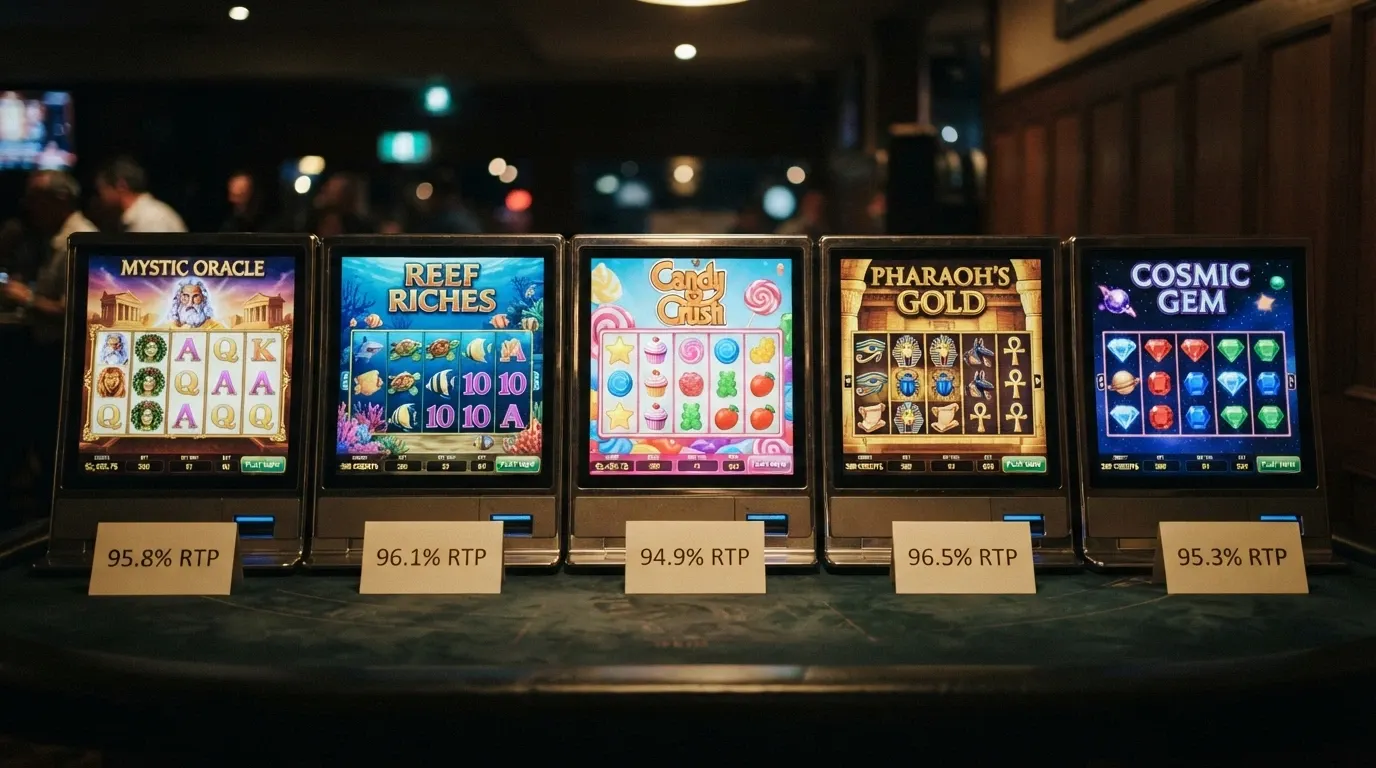
Pokies are the only category that reliably contributes 100% toward wagering on the featured operators. Table games typically contribute 10% or are excluded entirely. Live dealer games are almost always excluded. Progressive jackpot pokies often contribute 0% or 10% — the highest-prize games on the floor are the ones most likely to be excluded from bonus play. The effect of contribution rules is to push every bonus player toward the same destination: the standard 100%-contributing pokie.
Pragmatic Play is the most prolific provider in the AU-facing offshore market, with a standard RTP around 96.5%. The same applies to most other major providers at the standard configuration. The problem is that “standard configuration” is a setting the operator chooses, and the setting can be lower.
The Pokies Your Free Spins Actually Land On
The pokies most commonly tied to NDB free-spin offers in the Australian-facing offshore market are Gates of Olympus, Sweet Bonanza, Big Bass Bonanza, Book of Dead and Starburst. The RTP figures are the standard configurations; reduced configurations exist at the operator’s discretion.
| Slot Title | Provider | Standard RTP | Volatility |
|---|---|---|---|
| Gates of Olympus | Pragmatic Play | 96.50% | — |
| Sweet Bonanza | Pragmatic Play | 96.48% | — |
| Big Bass Bonanza | Pragmatic Play | 96.71% | High |
| Book of Dead | Play’n GO | 94–96% | High |
| Starburst | NetEnt | 96.09% | Low |
| Wolf Gold | Pragmatic Play | 96.01% | Medium |
| The Dog House | Pragmatic Play | 96.51% | High |
| Dead or Alive 2 | NetEnt | 95.92% | High |
Gates of Olympus is the workhorse NDB pokie in the market. The standard RTP is 96.50%, which means a player who wagers AU$800 over a long session gets back AU$772 on average and loses AU$28 to the house edge. That AU$28 is the cost of clearing the bonus; the cap then limits what can be withdrawn from whatever survives. Sweet Bonanza sits at 96.48% — effectively the same economics, different visual.
Big Bass Bonanza runs at 96.71% with high volatility, which means the long-run return is slightly better than Gates of Olympus but the variance is much higher. A session of 800 spins on Big Bass Bonanza will produce a wider distribution of outcomes: longer losing runs offset by occasional large hits. For a player converting a bonus, high volatility is a double-edged sword — the bonus either clears quickly on a hot streak or grinds down through a cold one.
Book of Dead, from Play’n GO, is the high-volatility classic in the market, with an RTP that ranges from 94% to 96% depending on configuration. Starburst, from NetEnt, is the low-volatility counterpoint at 96.09% — small hits, frequent hits, slow balance movement. Reduced configurations exist for both: Book of Dead’s floor is below the standard band, and Starburst’s reduced configuration runs at 90.05%.
Beyond the Bonus: Pokies Worth Playing After the NDB
The high-RTP, high-max-win pokies that give a player the best shot at converting NDB winnings into a withdrawable balance are not the ones the bonus terms push toward. Wolf Gold runs at 96.01% with medium volatility, which produces a more even balance curve than Big Bass Bonanza. The Dog House sits at 96.51% with high volatility — the same RTP band as Gates of Olympus, with a higher variance. Dead or Alive 2 runs at 95.92% with high volatility, slightly below the standard 96.5% band but with a distribution that rewards patience.
Money Train 4, from Relax Gaming, carries the highest max-win figure in the offshore Australian market at 100,000x. The pokie is high volatility, and the RTP sits in the provider’s standard band. The max-win figure is not a forecast; it is a ceiling on a single spin. A player chasing the ceiling is playing a game that pays out rarely and pays out big when it does. The bonus terms on most operators either restrict or exclude Money Train 4 from wagering contribution, which means a player who wants to play it during bonus clearing has to wager on a different pokie first.
Provider RTP Configurations: Why the Same Pokie Plays Differently Across Casinos
Pragmatic Play ships Gates of Olympus at a standard RTP of 96.50%. The same provider ships a reduced configuration of the same game at 84.08%. The two configurations are mathematically different games for the same screen name. Sweet Bonanza carries the same structure: 96.48% standard, 84.07% reduced. Big Bass Bonanza carries 96.71% standard and 84.23% reduced. Starburst, from NetEnt, runs 96.09% standard and 90.05% reduced.
The operator chooses the configuration. A player who sees “Gates of Olympus” in the lobby of Skycrown cannot tell, from the game name, whether the spins are running at 96.50% or 84.08% — both configurations use the same math model under the hood, with the return-to-player rate set at the operator level. The configuration choice is opaque to the player. The way to detect it is empirical: a session that returns noticeably below the standard 96.5% over a long spin count is being played at the reduced configuration.
The implication for an NDB player is direct. The expected loss on a AU$800 wagering requirement at 96.50% RTP is AU$28. The expected loss on the same AU$800 wagering requirement at 84.08% RTP is AU$127. The same bonus at the same wagering multiple costs more than four times as much at the reduced configuration. The operator is not required to disclose which configuration it is running. The bonus page does not say. The lobby does not say. The player finds out in the session outcome.
The Payment Method That Tells You Everything
The payment method an online casino asks an Australian player to use is itself the clearest signal of whether the operator is licensed in Australia or not. A licensed Australian wagering operator can only accept debit cards, bank transfers, PayID/Osko and BPAY. An unlicensed operator asks for credit cards or crypto, both of which are banned as payment for online wagering in Australia since 11 June 2024.
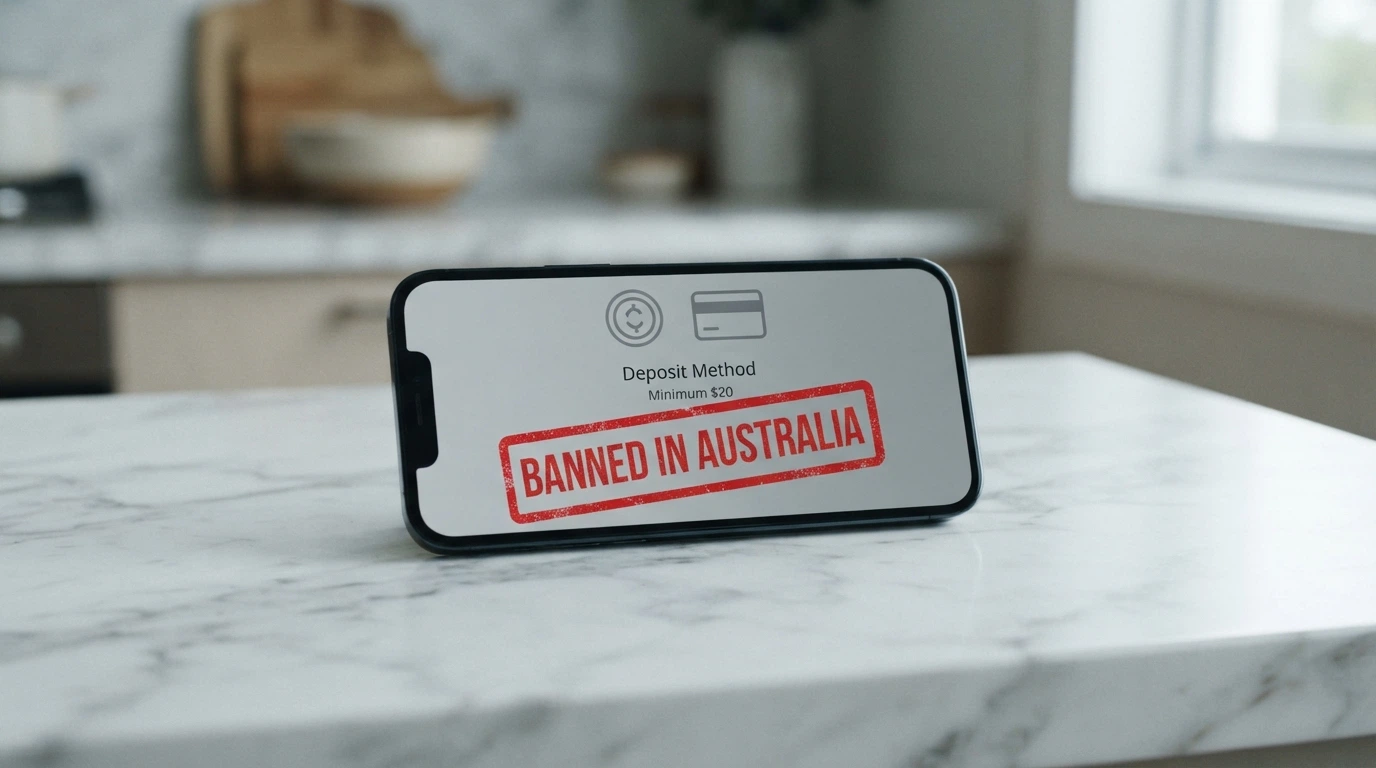
The Interactive Gambling Amendment (Credit and Other Measures) Act 2023 banned credit cards, credit-related products and digital currency (crypto) as payment methods for online wagering, commencing 11 June 2024. An operator that fails to enforce this faces penalties of up to AU$247,500. A punter asked to deposit by credit card or by Bitcoin at an online casino is being served by someone outside the Australian rules. The payment method itself proves it.
The legal deposit routes for an Australian-licensed wagering operator are the four above: debit card, bank transfer, PayID/Osko, BPAY. PayID is the Australian real-time payment rail that connects a bank account to a phone number or a business identifier; Osko is the underlying instant-payment service that powers PayID; BPAY is the bill-payment scheme that runs through most Australian online banking. None of these routes serve an offshore NDB casino natively.
Crypto Withdrawals: Speed vs. Protection
Crypto payouts from the featured set are fast. BitStarz recorded sub-10-minute crypto withdrawals in third-party testing. Skycrown recorded an AU$150 USDT withdrawal in 14 minutes. 7Bit’s BTC withdrawals run 1 to 3 hours. KatsuBet’s crypto payouts are near-instant. These are real benchmarks, verifiable from public testing, and the operators that run them deliver.
The protection cost is the trade. A crypto deposit carries no chargeback right — once the transaction is on the blockchain, the player’s bank cannot reverse it. There is no Australian Financial Complaints Authority jurisdiction over a crypto transaction to an offshore casino. The ACMA cannot compel a Curaçao-licensed operator to honour a withdrawal. If the operator refuses a withdrawal, voids a win or blocks the account, the player has the operator’s own customer support, the operator’s own internal dispute process, and — at most — the Curaçao master licence holder’s complaint channel. None of those is an Australian consumer-protection body.
The speed is real. The protection is absent. The two facts are not in tension; they describe the same transaction from two angles. A punter choosing a crypto payout at a sub-10-minute speed is choosing the speed and accepting the absence of protection.
Anonymity With NDBs: What Crypto Does and Doesn’t Hide
Crypto deposits do one thing well: they obscure the player’s identity from the casino. The wallet address is a string; the person behind it is not verified by a bank. Operators like Stake and the Bitcoin-friendly casinos in the featured set accept crypto without the same level of identity verification a debit-card deposit triggers.
Crypto does not make the transaction legal in Australia. The Interactive Gambling Act 2001 prohibits the supply of online casino games to a person physically in Australia; the payment method is irrelevant to the prohibition. A punter funding an NDB account from a Bitcoin wallet is still using a service the IGA makes illegal to supply here.
From 1 January 2027, the picture tightens further. The Interactive Gambling Amendment (Gambling Reform) Bill 2026, passed by Parliament on 19 August 2026, gives Australian banks and payment providers express authority to block transactions to illegal gambling operators. A punter funding an offshore casino from an Australian bank account — whether through a fiat on-ramp into crypto or through a direct transfer — runs the risk of the transaction being declined or the account being flagged. The anonymity from the casino’s side does not extend to the Australian banking side.
New NDB Casinos: Fresh Faces, Same Offshore Reality
New casinos launch every year with aggressive NDB offers — the welcome is fresh, the legal status is not. The offshore jurisdiction is the same. The IGA prohibition is the same. The consumer-protection gap is the same. The only thing new is the brand name and the licence number, and the licence number is the one piece of paperwork a new operator can use to distinguish itself from older operators whose licence dates are simply not disclosed.
Three operators in the featured set have launched since 2021: Mirax in 2022, Bizzo in 2021, and Royal Reels in 2021. All three are newer than Skycrown, BitStarz and 7Bit (operating since 2014). All three carry licence numbers that are traceable to the relevant master licence holder. The pattern matters: a newer operator with verifiable paperwork is, on the consumer-due-diligence axis, a stronger choice than an older operator with an unverifiable licence history.
Mirax and Bizzo: Two Newcomers With Traceable Paperwork
Mirax carries the Antillephone 8048/JAZ licence and was established in 2022. The licence number is verifiable through the Antillephone validation service; the year on the licence is the year the master licence holder was authorised, not the year Mirax itself launched. The NDB is 20 free spins at 45x wagering with a AU$100 cap, a 7-day expiry, and a 30+ provider library that covers Pragmatic Play, Evolution, NetEnt, Hacksaw Gaming, Nolimit City and others.
Bizzo carries the Curaçao Gaming Control Board 8048/JAZ2017-067 licence plus a Kahnawake Gaming Commission registration — the only dual licence in the featured set. The operator launched in 2021, supports AUD and PayID alongside 22+ cryptocurrencies, and runs 3,000+ games from 70+ providers. The dual licence is paperwork other operators in the table do not match.
A punter weighing Mirax against Bizzo is weighing an Antillephone licence against a Curaçao GCB + Kahnawake registration. The NDB at Mirax is confirmed at 20 free spins at 45x; the NDB at Bizzo is listed in some affiliate sources but not confirmed in operator-level data here. The dual licence at Bizzo is the clearest paperwork story; the spin offer at Mirax is the clearer product.
Fresh NDB Offers: What a Launch-Period Bonus Looks Like
New casinos use NDBs as a customer-acquisition tool. The economics are simple: an established operator has a customer base and a brand reputation; a new operator has neither. The NDB is the offer that closes the gap, and the terms can be better or worse than established operators carry.
Launch-period NDBs in the Australian-facing offshore market typically run higher spin counts than established-operator offers, paired with shorter validity windows. The pattern is rational: a new operator wants the player to engage quickly (a short window forces it) and to remember the brand (a high spin count helps). The cost of the offer is real — a new operator’s margin on a 100-free-spin NDB at 25x is tighter than an established operator’s margin on a 20-free-spin NDB at 40x.
A player evaluating a launch-period NDB checks the same three things as any other offer: wagering multiplier, max-cashout cap, validity window. The additional check on a new operator is paperwork: licence traceability, provider mix, payout history. Mirax’s Antillephone number and Bizzo’s dual Curaçao + Kahnawake registration are the kinds of details a launch-period operator can use to differentiate from an older brand with an unverifiable licence history.
New-casino offers change frequently. An NDB that is live this week may be retired the week after, replaced by a deposit-gated welcome package or a higher-spin NDB at a higher wagering multiplier. The verification step is direct: check the operator’s promo page at the moment of claiming.
Free Play vs. Real Money: The Moment You Deposit
Free-play mode is what an NDB operates in. The player is using the operator’s credit, the games are the operator’s games, the outcomes are the operator’s outcomes. The bonus terms cap the winnings (AU$20 to AU$100 on free spins, AU$50 to AU$200 on cash chips), limit the wagering window (typically 7 days), and force the wagering on games the operator’s terms prefer. Free-play mode is a real mode — the pokies are real, the spins are real, the outcomes are real — but the withdrawal rail is not.
The moment the player deposits, the mode switches. Real-money play runs against the operator’s standard terms, which carry different wagering requirements, different game contributions, and a different withdrawal process. A welcome package that offered 40x on bonus funds with a AU$5 maximum bet during wagering becomes the operative terms structure. Free-play wins are converted to bonus funds at the moment of deposit, and the new wagering applies to those funds.
The transition is also where the legal status of the player’s account changes in spirit. An NDB player has not paid the operator; the operator has credited a marketing bonus. A depositing player has paid an offshore operator whose product is illegal to supply in Australia. The player is not the target of the IGA; the payment is the moment the operator’s offence (supplying a prohibited interactive gambling service) is most clearly established.
The NDB is a real way to try real pokies without depositing. The deposit is the moment the player takes on the offshore risk.
The Legal Reality Australian NDB Guides Won’t Tell You
The Interactive Gambling Act 2001 prohibits the supply of online casino games, online pokies and in-play sports betting to a person in Australia. There is no online casino licence available in the country — not federally, not in any state or territory. A page promising “the best licensed online casinos in Australia” is describing something that does not exist, and writing one produces a factual lie on every screen.
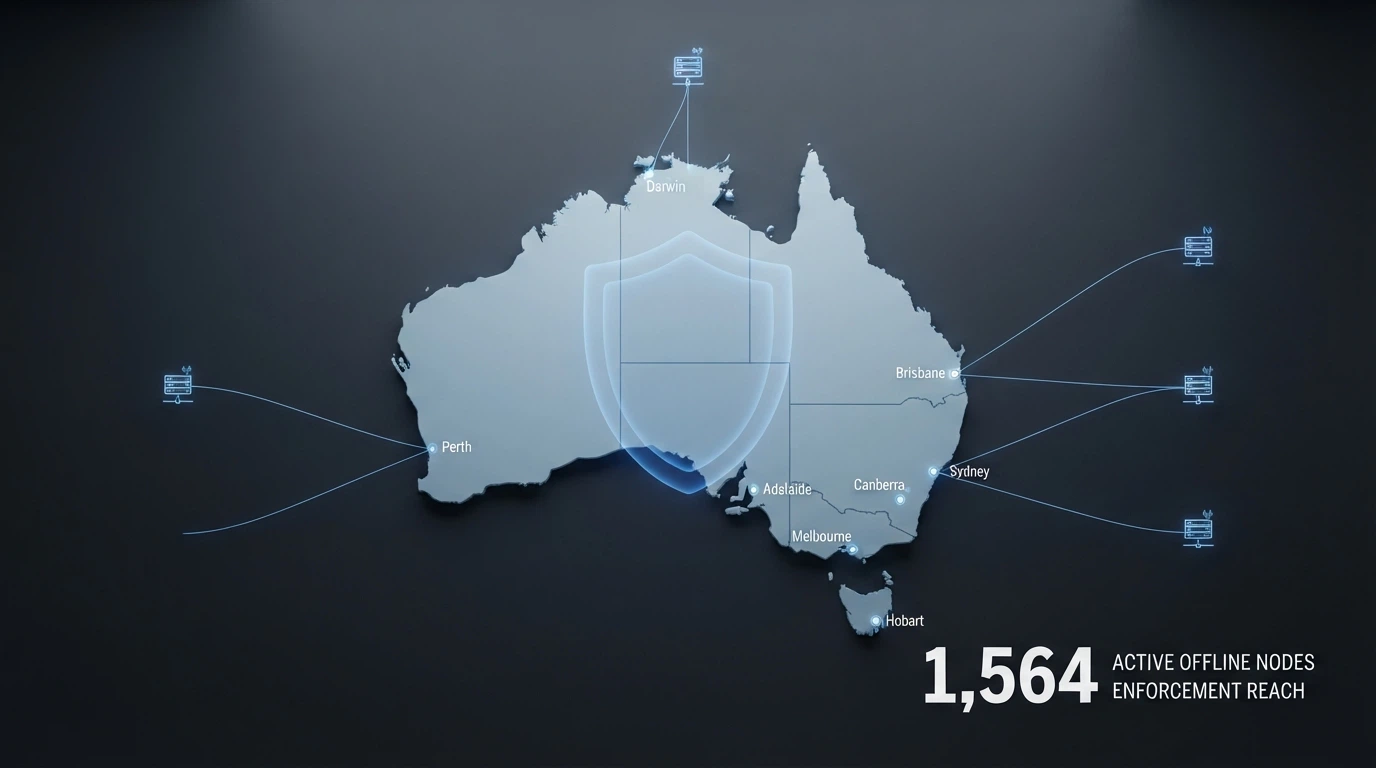
The Australian Communications and Media Authority (ACMA) is the federal regulator enforcing the prohibition. It investigates complaints, issues formal warnings, refers operators for civil penalty proceedings, and directs Australian internet service providers to block illegal sites. Since November 2019, the ACMA has had 1,564 illegal gambling and affiliate websites blocked. Since enforcement was strengthened in 2017, more than 225 illegal services have withdrawn from the Australian market.
The player is not the target. The IGA criminalises the provider, not the person using the service. An Australian punter who signs up at an offshore NDB casino has not committed an offence under the Act. The Act’s protections — and they are real protections in other contexts — do not extend to the offshore casino transaction. The punter has no ACMA complaint path, no AFCA jurisdiction, no Australian consumer-law recourse, and no chargeback on a crypto deposit.
BetStop Can’t Protect You Here
BetStop is the National Self-Exclusion Register, launched on 21 August 2023. It is the world-class self-exclusion infrastructure: one registration excludes the player from every Australian-licensed online and phone wagering service. As of 31 March 2026, 59,830 people had registered to self-exclude and 37,247 had active exclusions. The numbers reflect a real, functioning, Australian-built harm-reduction tool.
BetStop binds Australian-licensed wagering services only. An offshore NDB casino is not licensed in Australia, is not connected to BetStop, and is not required to honour a BetStop registration. A punter who has self-excluded through BetStop can still register, deposit, claim an NDB, and play at an offshore casino. The protection the punter thought they had does not reach the offshore operator.
The implication for a punter who has BetStop-excluded is direct. The offshore casino will accept them. The wagering maths will run. The losses will accumulate. BetStop is not a wall; it is a list, and the list applies to the Australian-licensed side of the market. The offshore side is not on the list.
The 2026 Gambling Reform: What Changes on 1 January 2027
The Interactive Gambling Amendment (Gambling Reform) Bill 2026 passed Parliament on 19 August 2026. The substantive provisions commence on 1 January 2027. The reform is law with a start date — not speculative, not yet binding, but enacted.
The reform’s headline provisions are these: AdStop, a national wagering advertising opt-out register administered by the ACMA, funded by a cost-recovery levy on wagering companies. Marketing inducements to new customers are prohibited for 14 days from account sign-up, and for 90 days to individuals who have come off the BetStop self-exclusion register. Providers must identify customers showing signs of problem gambling and cease sending them inducements. Wagering TV advertising is capped at no more than three ads per hour between 6:00 am and 8:30 pm, with a complete ban on wagering advertising during live sporting events from 15 minutes before until 5 minutes after.
The provision with the most direct effect on offshore NDB play is in Schedule 2. From 1 January 2027, banks and payment providers gain express authority to block transactions to illegal gambling operators. The punter funding an offshore casino from an Australian bank account — through a fiat on-ramp, a card, or a direct transfer — runs the risk of the transaction being declined, the account being flagged, or the relationship with the bank being reviewed. The offshore operator cannot solve this; the block sits on the Australian side.
ACMA-Investigated Operators: The Brands Australia Has Formally Flagged
The ACMA has formally investigated specific operators and found them in breach of subsection 15(2A) of the Interactive Gambling Act 2001. The list includes Fair Go Casino, Ozwin Casino, Uptown Pokies, Play Croco and Aussie Play, among others. The findings are not warnings; they are formal regulatory determinations that the named services have been contravening Australian law.
The thread connecting several of these operators is Proxous Advanced Solutions, the RTG software supplier. The ACMA found Proxous involved in contraventions across 13 online casino services through its production and sub-licensing of RTG branded software products. The implication is structural: the RTG supplier chain is the same one feeding Fair Go, Ozwin and the other named services, and the ACMA’s finding names the supplier as well as the operators.
A punter playing at one of these operators is using a service the Australian regulator has already named. The site can be blocked at any time. A balance on it can be lost. A withdrawal can be refused. None of those outcomes has an Australian remedy, because the operator is not an Australian licensee and the regulator’s reach stops at the border.
Your Rights (And Their Absence) at an Offshore NDB Casino
An Australian punter at a licensed Australian wagering operator has a stack of rights: a state-issued licence as the legal basis for the service, an Australian regulator to lodge a complaint with, an Australian Financial Complaints Authority to escalate to if the operator refuses a resolution, a chargeback right on a debit-card deposit, BetStop coverage for self-exclusion, and a national self-exclusion register that binds every Australian licensee.
At an offshore NDB casino, every one of those rights is absent. The licence is Curaçao or Kahnawake or another offshore jurisdiction, not Australia. The regulator is the master licence holder in that jurisdiction, not the ACMA. The complaint path is the operator’s own customer support, then the operator’s internal dispute process, then (at most) the offshore regulator. The chargeback right does not extend to crypto. BetStop does not bind the offshore operator. The national self-exclusion register is a list the operator is not on.
The operator can void a win, refuse a withdrawal, or block the account. The punter has the operator’s own terms and the operator’s own goodwill. The gap between what Australian consumer law would offer and what the offshore operator does offer is the cost no bonus advertisement mentions.
Playing Safely When the Australian Safety Net Isn’t There
The responsible-gambling infrastructure that exists in Australia is real, well-resourced, and entirely Australian-built. None of it reaches the offshore NDB casino.
About 2.1% of Australian adults — roughly 430,000 people — experience problem gambling, and the Australian Institute of Health and Welfare put high-risk gambling at 1.8% in 2022. Roy Morgan data from March 2026 shows 15.1% of the Australian adult population — an estimated 3.32 million people — are experiencing some level of harm from their own or another person’s gambling. Risky gambling on the PGSI 1+ measure rose from 13.7% in 2024 to 19.4% in 2025, almost doubling since the COVID-19 lockdowns. The annual health loss associated with gambling-related harm in Australian adults is over 400,000 Years Lived with Disability. The numbers are not abstract.
The infrastructure that exists to respond to those numbers is the National Gambling Helpline (1800 858 858), Gambling Help Online (gamblinghelponline.org.au), and BetStop. None of those tools sits at the offshore casino. A punter who feels the NDB is moving from curiosity to harm has to reach the help line themselves; the casino will not point them at it.
The Help That Is There: 1800 858 858
The National Gambling Helpline is 1800 858 858 — free, confidential, staffed 24 hours a day, 7 days a week. Online chat and counselling are available through Gambling Help Online at gamblinghelponline.org.au. The service is Australian-run and Australian-funded; the staff are trained for Australian conditions.
The phone number is the one resource every Australian player should know. An offshore casino will not display it. The bonus page will not link to it. The terms and conditions will not mention it. The punter has to know the number before they need it, because the moment they need it, the casino’s own responsible-gambling page (where one exists) will not be where the help actually lives.
Recognising when NDB play is moving from curiosity to harm is the work the player has to do themselves. The signs are familiar: chasing losses, hiding play, escalating deposits, sacrificing other activities. The infrastructure responds when the player reaches out. The infrastructure does not reach the player.
Setting Your Own Limits When the Platform Won’t
Offshore casinos rarely enforce deposit, loss or session limits because they have no legal obligation to. The Australian-licensed wagering operators must offer pre-commitment tools, activity statements, take-a-break functions and BetStop integration. The offshore NDB casino offers the bonus page and the cashier.
A punter who wants to play at an offshore operator has to set their own limits. The practical list is short: a time limit per session, a session budget that is paid in advance and not topped up, a cooling-off period between sessions, and a hard stop when the limit is reached. The ANU data shows that 56.1% of Australian gamblers who participated in the past 12 months mainly did so online — and the shift to online play is the shift to a venue where the limit-setting is the player’s job.
The Australian safety net is not at the offshore casino. The safety net is the helpline, the self-exclusion register (for the licensed side), and the player’s own discipline. The combination is imperfect. It is what exists.
How We Evaluated These NDB Casinos
The operators in this ranking were sourced from the ACMA enforcement record, affiliate listings of Australian-facing NDB offers, and direct checks of operator terms pages. Each operator was verified for: NDB offer size and type, wagering multiplier on the NDB, max-cashout cap, bonus validity, licence jurisdiction and number, game-provider mix, payout speed from third-party testing, and legal status under the Interactive Gambling Act 2001.
The ranking weights offer size against term fairness. A lower wagering multiplier is worth more than a higher spin count when the multiplier is the difference between clearing the bonus and forfeiting it. Skycrown’s 25x wagering on 20 free spins is the lowest barrier in the table; the ranking reflects that. Royal Reels’ AU$200 cap on a AU$10 chip is the most generous cap; the ranking reflects that. KatsuBet’s 50x wagering on 30 free spins is the steepest of the spin offers; the ranking reflects that. Every operator was ranked against the same criteria.
The legal-status check returned the same result for every operator: none hold an Australian casino licence, because none can. The offshore licence numbers in the table are the licences each operator actually holds. The ACMA breach findings on Fair Go and Ozwin are recorded as formal regulatory determinations, not as warnings. The Bizzo dual licence and the Mirax Antillephone number are recorded as the verifiable paperwork each operator carries.
The figures on this page trace to named sources: the ACMA register, the Interactive Gambling Act 2001, the IGA amendment bills, the AIHW and Roy Morgan prevalence data, the ANU POLIS Centre for Social Policy Research, the Curaçao Gaming Control Board master licence register, the Kahnawake Gaming Commission public registry, and third-party payout testing at specialist sites. Where a figure could not be confirmed (the Stake NDB, the Fair Go and Ozwin max cashout caps, the Bizzo NDB specifics), the gap is stated honestly.
What Your NDB Is Actually Worth
An NDB is a real way to try real pokies without depositing, and the marketing description is accurate that far. It is not accurate past that far. The terms make cashing out near-impossible for most players, the lack of Australian protection is the cost no bonus advertises, and the expected loss the wagering maths forces on the player is already priced into the operator’s margin before the bonus is offered.
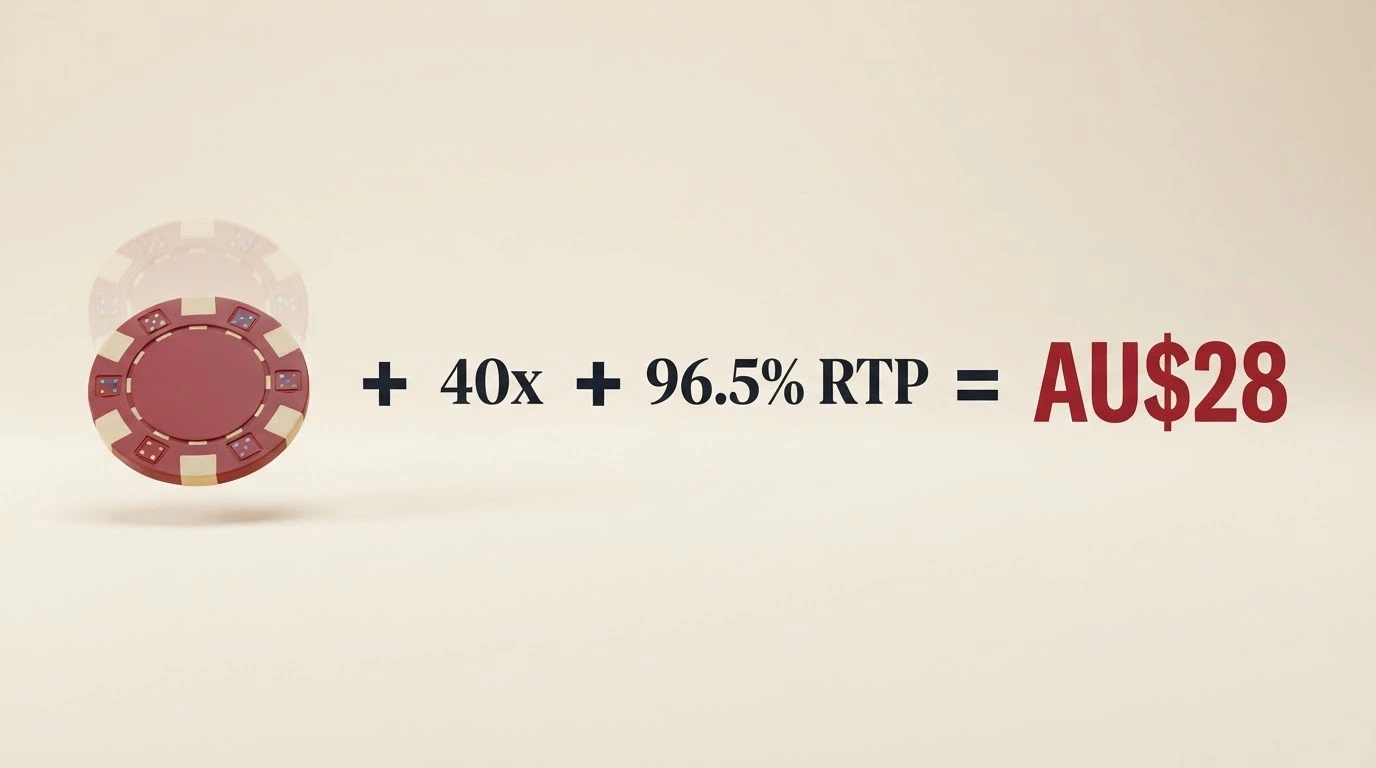
Run the maths once. A AU$20 free chip with a 40x wagering requirement forces AU$800 in bets on a 100%-contributing pokie at a standard RTP of 96.50%. The expected loss against the 3.5% house edge works out to AU$28. The chip is worth AU$20. The wagering is expected to cost AU$28 before the cap clips whatever survives on the screen. The chip, the wagering and the cap together produce a payout that, on average, comes in below the chip’s face value. That is the price of the offer.
The max-cashout cap is the second constraint. A lucky run during the wagering window can show a five-figure screen balance; the cap pays a fraction of it. AU$100 on a free-spin NDB, AU$200 on Royal Reels’ cash chip, AU$50 to AU$200 on most cash-chip offers. The cap is the operator’s exit from the bonus. A punter who reaches the cap takes the cap and walks; a punter who expects the cap to be lifted is reading a different bonus page from the one they were offered.
The offshore gap is the third constraint, and it is the one no bonus page mentions. No BetStop coverage. No ACMA complaint path. No Australian Financial Complaints Authority jurisdiction. No chargeback on a crypto deposit. An operator that voids a win, refuses a withdrawal or blocks the account leaves the player with the operator’s own terms and the operator’s own goodwill. There is no Australian remedy. The punter who treats an NDB as a free trial of the pokies — not as a path to a cashout, not as a stepping stone to a deposit, not as a way to chase a capped win — keeps the bonus for what it is. The punter who treats it as anything more is paying a price the marketing copy did not name.
Frequently Asked Questions About NDB Casinos in Australia
What does NDB stand for?
NDB stands for “no deposit bonus” — credit an online casino issues to a new account before any deposit. The format takes three shapes: free spins (20 to 100) on a named pokie, free chips (AU$5 to AU$20) and short-window free play. Every NDB carries a wagering requirement and a max-cashout cap.
Can Australian players legally claim a no deposit bonus at an online casino?
The player is not the target of the Interactive Gambling Act 2001 — the Act criminalises the provider, not the player. Providing online casino games to Australians is illegal; using one is not. That is the only protection. ACMA, AFCA, chargeback rights and BetStop all fall away the moment the player signs up offshore.
What is the difference between free spins and free chip no deposit bonuses?
Free spins credit a fixed number of spins on a named pokie, with wagering applied to the winnings rather than the spin value. Free chips credit bonus funds (AU$5 to AU$20) playable across the lobby, with wagering on the chip itself. Free-spin cashouts cap at AU$20 to AU$100; chip cashouts cap at AU$50 to AU$200.
How much can I actually withdraw from a no deposit bonus?
Whatever the max-cashout cap allows. Free-spin NDBs cap withdrawals at AU$20 to AU$100; cash-chip NDBs at AU$50 to AU$200, with Royal Reels the standout at AU$200. The cap applies to net winnings after wagering, not to the screen balance. A lucky run that shows a four-figure screen balance still pays out the cap.
Do I need a bonus code to claim a no deposit offer?
Activation method varies. Some operators auto-credit the NDB on registration or after phone verification — Skycrown’s 20 free spins and Royal Reels’ AU$10 chip are two examples. Other operators require an action at the cashier to release the offer, with the specific step detailed in the terms. Activation flows change often: an offer live one week may be retired the next.
Why don’t no deposit casinos appear on BetStop?
BetStop is the National Self-Exclusion Register and binds Australian-licensed wagering services only. An offshore NDB casino is not licensed in Australia, is not connected to BetStop, and is not required to honour a BetStop registration. A punter who has self-excluded through BetStop can still register, deposit, claim an NDB and play at an offshore casino.
Are crypto casinos legal in Australia for no deposit play?
Crypto is banned as a payment method for online wagering in Australia since 11 June 2024. An Australian asked to deposit by Bitcoin at an online casino is being served by an offshore operator outside the Australian rules. From 1 January 2027, banks gain express authority to block transactions to illegal operators.