
No Deposit Free Spins on Online Pokies in Australia: The 2026 Offshore Bonus Reality
An Australian who types “no deposit free spins” into a search engine is asking for something the country’s own licensing framework refuses to issue. The Interactive Gambling Act 2001 prohibits online casino games and online pokies to people in Australia. There is no licence for this product anywhere in the country — not federally, not in any state or territory. So every “no deposit free spins” offer an Australian player sees on a pokies site is coming from an offshore operator running a service the local regulator has been blocking for years.

Current as of 16 October 2026 and verified against the Australian Communications and Media Authority (ACMA) public register and the Interactive Gambling Act 2001 framework.
This page walks through what those offers actually are, what the bonus terms do to the headline number, where the licensed market stops, and what offshore play costs a player who cannot lean on Australian consumer protection.
Table of Contents
- What Online Pokies with Free Spins Actually Deliver — and What They Don’t
- Why Your 2026 No-Deposit Free Spins Bonus Is Smaller Than It Looks
- Free-Play Pokies — Every Feature, Zero Risk
- Where Australian Pokies Players Find Free Spins — The 2026 Operator Ranking
- Is It Legal? The Offshore Reality Every Australian Pokies Player Faces
- Staying in Control — Limits, Self-Exclusion and Real Help That Works
- How We Chose and Ranked These Free-Spins Pokies Operators
- What Australian Players Should Actually Do About Free-Spins Pokies Offers
- Frequently Asked Questions
What Online Pokies with Free Spins Actually Deliver — and What They Don’t
A page about “the best licensed online casinos in Australia” describes something that does not exist, and writing one produces a factual lie on every screen. The product Australians search for lives at the gap between the marketing headline and the statute book.
The Interactive Gambling Act 2001 makes it an offence to provide or advertise an online casino service — pokies included — to a person physically in Australia. The 2017 amendment closed the offshore loopholes and gave the ACMA enforcement and site-blocking powers. The product that the search results describe is the same product the ACMA has had blocked more than 1,500 times. Both statements are true at the same time, and the article that follows is the one that sits on the seam between them.
What an Online Pokie with Free Spins Actually Is
A pokie is a random-number-generator game of chance. Each spin is independent, weighted by a return-to-player percentage the operator publishes (or does not), and the house always carries an edge. A “free spin” is a turn at that RNG paid for by the operator rather than by the player’s deposit balance. Nothing about the underlying mathematics changes: the RNG runs the same way, the house edge is the same way, and the result is determined the same way.
What changes is who funds the spin. A free spin on a no-deposit bonus is the operator paying the $0.10 or $0.20 stake that the player would otherwise have paid out of their own wallet. That sounds like a gift, and at the moment of the spin it genuinely is one. The cost shifts to the back end, into the bonus terms the player agrees to when they click Claim.
There are two distinct meanings of “free spin” on an Australian search results page, and confusing them is the first way a reader loses money. A casino-promotion free spin is awarded by the operator as part of a bonus — it sits in a separate balance, carries wagering requirements, and may produce a cashout capped far below the headline. An in-game free-spin bonus round is triggered by scatter symbols during normal play of a pokie — it costs the player’s stake per spin to enter, pays out whatever the paytable says, and is subject to nothing more than the game’s own volatility. The term “free spins” mostly pulls the first meaning, which is the one that costs the player.
The Australian search volume clusters around no-deposit variants for an obvious reason. A bonus that requires the player to hand over a card number before the spins appear costs the player a deposit. A bonus that credits the spins on registration costs nothing at the moment of claim, and the player tells themselves the risk is zero. The risk is not zero. The risk is time spent in a session that the terms make hard to leave with money.
How Free Spins Are Credited — from Bonus Trigger to Playable Balance
The crediting pipeline for a no-deposit free-spins bonus follows a fairly standard shape across offshore platforms, even when the specific numbers behind each step vary. A new account is created. An email is verified. The bonus is claimed, either automatically on sign-up or through a button on the promotions page. The spins appear in one of two places: a separate “bonus balance” that the casino interface keeps distinct from the real-money wallet, or as in-game credit on a specific pokie the operator has chosen for the promotion.
From the moment the spins are credited, the wagering requirement clock starts. That requirement applies to the winnings, not to the spin stake itself. The displayed “balance” the player sees is mostly not their balance in any meaningful sense — it is a running total of what they would receive if they could withdraw right now, which they cannot, because the wagering requirement is unmet. The interface rarely makes this distinction loudly. A reader who treats the displayed balance as cash in hand has already misread the offer.
This is also the moment at which the reader who is comparing offers should notice something. If the bonus terms say the credited amount is “non-withdrawable” until wagering is complete, every dollar shown in the bonus wallet is contingent on the player turning over a multiple of that dollar before it becomes theirs. A $50 bonus wallet with a 40x requirement means $2,000 of turnover before the $50 can be withdrawn. The “bonus” is not $50 in that sense. The bonus is a chance to play for a $50 payout that the terms make hard to reach.
The exact operator-specific mechanics of this pipeline — whether the spins are dripped over three days, whether a verification step gates the credit, whether a single pokie or a list of eligible titles is opened up — were not confirmed this run. The general structure is consistent across the offshore market and is what every player should expect from any no-deposit free-spins offer they encounter.
Where Australian Players Collect Free-Spin Offers Today
Three discovery paths carry most of the traffic. Search engines rank affiliate comparison pages that list current offers with bonus counts and short-term promotional copy. Operator landing pages run their own promos that rotate by season — an offer visible in January is often different from the one a player sees in June, sometimes on the same operator. Affiliate portals aggregate both, and the better ones disclose their commercial relationship at the bottom of the page.
The thing none of these paths surface is the licence-status reality. Every one of them serves offers from offshore operators; the ACMA has had 1,564 illegal gambling and affiliate websites blocked by Australian ISPs as of March 2026. Affiliate pages have been among those blocked. The offers themselves keep rotating because the operators keep registering new domains. A reader using these pages is not browsing a licensed market. They are browsing a market the regulator is actively trying to shut.
Search results observation was not available this run to verify how the top-ranking affiliate pages frame their offers to Australian players. The discovery path itself is well documented and worth describing: the offer listings come from the offshore operators themselves, the comparison framing comes from affiliates paid on sign-up or deposit, and the player is the third party in a transaction the Australian regulator does not see.
Why Your 2026 No-Deposit Free Spins Bonus Is Smaller Than It Looks
A 25-free-spin offer looks like $2.50 of play. A 100-free-spin offer looks like $10–$20. Both of those numbers are right, and both of them are also wrong, because the dollar value of the spins is not the dollar value of what the player walks away with. The bonus terms screen is where the offer really lives, and the terms screen is where the headline figure shrinks.
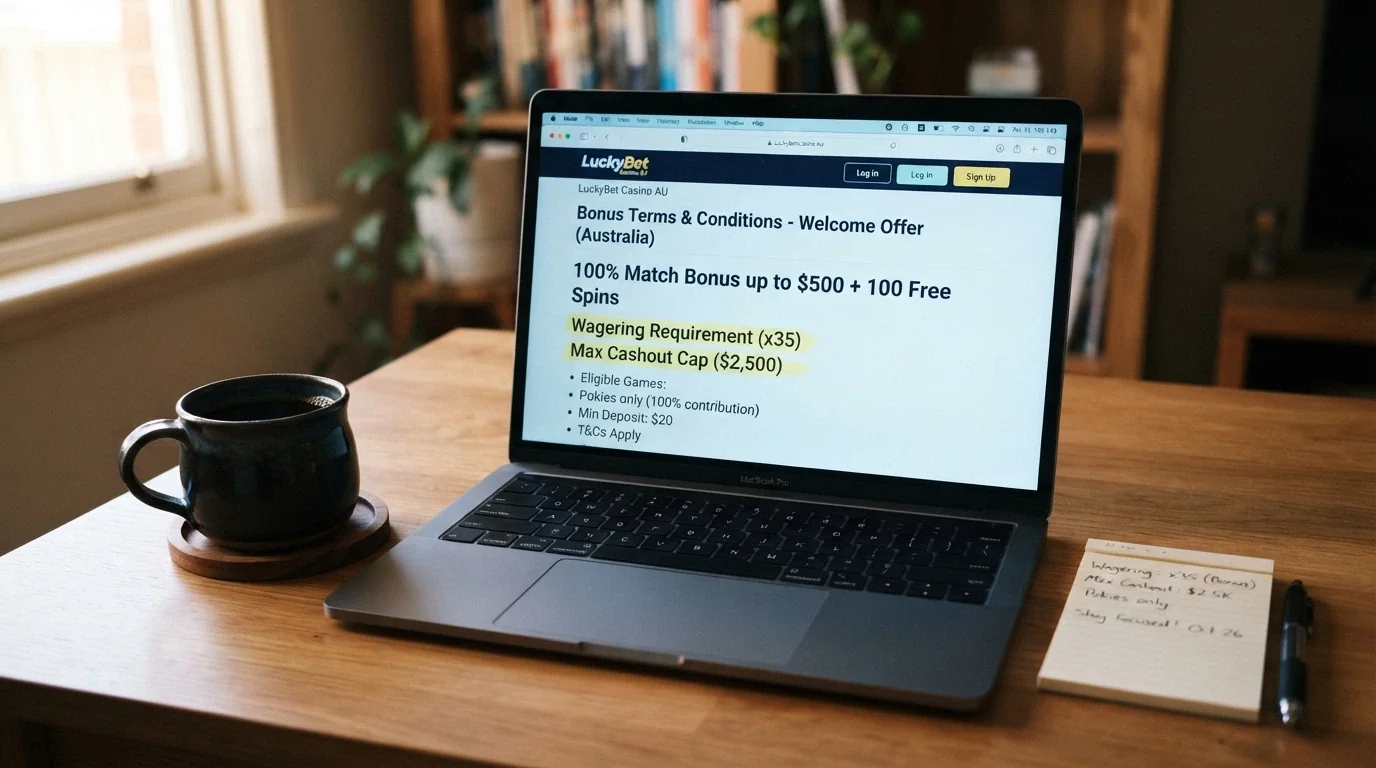
The mechanism that does the shrinking is not exotic. A wagering requirement takes the winnings from the free spins and demands they be played through a stated multiple of times before withdrawal. A max-cashout cap slices the balance above a stated ceiling regardless of how much was turned over. A validity window expires before most players complete the playthrough. Each of these is a lever the operator pulls to control how much of the bonus actually leaves the building. Together, they turn a generous-looking spin count into a small chance of a small payout.
No-Deposit Free Spins — What “No Deposit Required” Actually Means
“No deposit required” means exactly what it says at the moment of claim. The player does not hand over money to receive the spins. That is the genuine meaning of the phrase, and offshore operators who run these offers are at least honest on this single point.
What “no deposit” does not mean is that the offer is free in any larger sense. The operator is funding the spins because it wants the player’s account on file, the player’s email address for future marketing, and — if the player wins enough to consider continuing — a first deposit. No-deposit free spins are an acquisition cost for an unlicensed product. The operator writes the bonus off against the lifetime value of the player they convert. A player who reads “no deposit” as “no cost” has accepted the operator’s framing of the transaction.
The wagering requirement is where the real cost lives. The player pays in turnover volume, not in a deposit. Turnover is the total amount staked across every spin during the playthrough period, not the amount won or lost. A $5 win on free spins with a 40x requirement creates $200 of required turnover — forty times the win, not forty times the stake. The house edge sits inside that turnover, so the player is funding the bonus clearing through the standard expected loss on every spin, with the additional drag of the wagering loop dragging the bonus balance back to zero multiple times before it can be withdrawn.
The “no deposit” label is also stretched, in practice, to cover offers that look like no-deposit bonuses but are not. A deposit-gated package that includes a free-spins component is sometimes marketed as a “no deposit free spins bonus” in affiliate copy, even though the spins are only credited after the player has deposited. The practical filter is short and unambiguous: if the site asks for a card number or a PayID handle before the spins appear, the offer is not no-deposit.
Free Spins on Sign-Up — How the Welcome-Offer Pipeline Works
The welcome offer is the front door. A reader who signs up, verifies an email and clicks Claim moves through a fixed sequence: registration creates an account, verification confirms ownership of the email, the bonus trigger fires, and the spins appear. The pipeline is short, mostly automated, and designed to feel frictionless. The friction lives elsewhere.
The difference between spins awarded instantly and spins released in daily tranches is the first thing to look for. Instant credit means all 25 or 100 spins hit the bonus wallet the moment the offer is claimed. Dripped credit means 10 or 20 spins per day for three to five days, with the rest of the offer unlocked only if the player keeps coming back. The dripped structure is a retention device — it is harder to walk away from a bonus when there are spins waiting for you tomorrow. The headline spin count is the same, and the player’s actual control over the offer is much smaller.
The welcome offer is also front-loaded to look larger than the retention offers that follow. The first no-deposit free-spins bonus is the most generous promotion the operator is willing to run for a player who has not deposited. After the first deposit, the same player typically sees smaller free-spins bundles attached to reload bonuses, weekly promos and loyalty tiers. A reader who treats the welcome offer as a baseline for what the operator generally gives is overestimating what future play will look like.
The distinction between a genuine no-deposit welcome and a deposit-match welcome with free spins attached is the second thing to look for. Both are marketed under “welcome offer” headings. The first credits spins without a deposit. The second requires a deposit to unlock both the matched cash and the spins. They are not the same offer and they should not be compared as if they were.
What a 25- or 100-Free-Spin Deal Is Really Worth in Dollars
The raw turnover value of a free-spin bundle is straightforward arithmetic. Most free spins are set at or near the minimum stake for the pokie, which typically runs from $0.10 to $0.20 per spin. Twenty-five spins at $0.10 is $2.50 of stake. One hundred spins at $0.20 is $20 of stake. The headline number survives this calculation intact.
The wagering multiple is where the dollar figure transforms. The requirement applies to the winnings from the free spins, not to the stake, and the winnings depend on what the pokie’s paytable actually returns during the session. A modest $5 win on a 25-spin run, with a 40x wagering requirement, creates $200 of required turnover before withdrawal. A $10 win on a 100-spin run, with a 50x requirement, creates $500. The bonus has effectively asked the player to fund the playthrough out of further play, which means the house edge inside the playthrough is the player’s real cost.
The max-cashout cap is the second cut. A cap of $50 on a 100-spin bonus means that even if the player’s bonus wallet climbs to $300 during the playthrough, only $50 leaves the building. The cap is not negotiable, and it is rarely advertised on the headline. It sits in the terms. Every dollar above the cap is forfeited, regardless of how much turnover the player generated to reach it.
The combination is what shrinks the headline. A 100-spin offer with a 50x wagering multiple and a $50 max cashout has, on paper, a $20 raw stake value. In practice, it has the chance of a $50 payout that the player must fund $500 of turnover to reach, with a cap that confiscates everything above $50 even if the wagering is cleared. The headline “100 free spins” survives contact with the terms, but the dollar value the player walks away with does not.
Spin value is the third lever and the easiest to overlook. Minimum-stake spins ($0.10) produce smaller winnings and therefore a smaller wagering burden — but they also produce a smaller ceiling. Higher-stake spins ($0.20 or $0.50) raise the ceiling but raise the wagering burden proportionally. A player who values their time more than the headline count is usually better off with the smaller spin value; the wagering clears faster, the bonus balance clears faster, and the cap kicks in earlier. The headline number is rarely the number that matters most.
Free-Spin Offers at the Brand Names Australians Search Most
Search data surfaces a set of brand names that Australian players pair with free-spin intent: uptown, ace, golden, house-of, dinkum, pocket. These names are data signals, not confirmed operator profiles. They are the words Australians type into the search box, and they map to offshore operators whose bonus terms rotate by season.
The terms on the live promo page are the terms the player will be bound by, and they are not the same as the terms visible on an affiliate comparison page from last month. Seasonal rotation is the rule, not the exception. A bonus that was 50 free spins with a 30x requirement in February may be 25 free spins with a 50x requirement by June, or vice versa. The only version of the offer that matters is the one on the operator’s live page at the moment the player clicks Claim.
The universal checks before claiming are short and worth memorising. The licence jurisdiction — where the operator is actually licensed, and whether that jurisdiction offers any recourse the player can use. The wagering multiple on the free-spins winnings. The max-cashout cap on the bonus. The validity window — how many hours or days the player has to clear the playthrough. The eligible pokie or list of pokies, and the spin value attached to each free spin. None of these brands holds an Australian online-casino licence, as this product is prohibited under the Interactive Gambling Act 2001. The player is signing up with an offshore operator regardless of how Australian the brand name sounds.
Free Spins by PayID — Why the Payment Method Matters to the Offer
PayID is an Australian banking rail — the instant account-to-account payment system built into the New Payments Platform, sitting alongside Osko. It moves money between Australian bank accounts in seconds, using a phone number, email address or ABN as the address. Australian players search for PayID pokies because deposits clear instantly without a card.
The regulatory tell is sharp. PayID is a domestic rail. An offshore casino offering PayID as a deposit method has set up Australian banking infrastructure — a PayID handle, a settlement account at an Australian bank — despite having no Australian licence to offer the product that the deposit funds. The infrastructure is in plain sight. The licence to offer online pokies to Australian players is not, because no such licence exists.
The practical question for a player who has found a no-deposit free-spins offer at a PayID-accepting pokies site is whether the offer itself depends on the payment method. Some promos credit the no-deposit free spins on registration, before any deposit is needed at all; PayID is irrelevant to those. Other promos attach the free spins to a first deposit and limit the eligible payment methods — sometimes explicitly excluding PayID, sometimes explicitly including it. The terms screen tells the player which one they are looking at.
The credit card and crypto tells are even sharper. Credit cards, credit-related products and digital currency are banned as payment for online wagering in Australia, commencing 11 June 2024 under the Interactive Gambling Amendment (Credit and Other Measures) Act 2023. An operator that fails to enforce the ban faces penalties of up to $247,500. The legal deposit routes are debit card, bank transfer, PayID/Osko and BPAY. A site that asks for a credit card or crypto is, by that request alone, operating outside Australian rules. An Australian who is asked for a credit card or a crypto deposit by a gambling site is being served by someone outside the Australian rules. The payment method is itself a tell.
The No-Deposit, Bonus-Code-Free Offer — Separating the Real Deal from the Headline
The search term itself — “no deposit bonus free spins” — pulls two genuinely different products onto the same results page. The genuine version spins out of registration with zero financial commitment, no bonus code required, and a clearly stated wagering multiple and max cashout on the terms screen. The dressed-up version asks for a deposit, sometimes for a card number up front, and sometimes for a bonus code the player cannot see until after sign-up. Both are marketed as “no deposit free spins bonuses.” Only one of them is.
The practical filter is short. If the site asks for a card number before the spins appear, it is not no-deposit. If the bonus terms require a minimum deposit to unlock any of the advertised spins, it is not no-deposit. If the bonus code field is hidden behind a sign-up wall the player cannot read before registering, the offer is being dressed up to look more generous than it is. None of these tells requires reading past the first screen of the offer.
Inducements are also constrained at the state level. Inducements — sign-up offers, referral bonuses, the marketing layer that no-deposit free spins sit inside — are prohibited or tightly limited by several states. The rules differ by jurisdiction, which is why the offshore operators can run inducements freely: the rules apply to Australian-licensed operators, and these operators are not Australian-licensed. The asymmetry is one of the reasons the offers look so generous. The licensed market cannot match them because the licensed market is restricted in ways the unlicensed one is not.
Free-Play Pokies — Every Feature, Zero Risk
Free-play mode is the only genuinely free pokies experience available to an Australian player. It costs nothing. It pays nothing. And it is the closest a player can come to testing a pokie before committing real money.

Free-play pokies run on the same random-number-generator as their real-money counterparts on most platform configurations. The paytable is identical, the bonus rounds trigger under the same conditions, the volatility behaves the same way across hundreds of spins. A player who spends an hour in demo mode on a pokie is learning what the game actually does — how often the bonus round lands, what the free-spin feature pays out, whether the base game is dead between features. That information has real value, even when the winnings from demo play do not.
The limitation is what demo mode does not teach. It teaches the game. It does not teach the operator. A player who has tested a pokie in demo mode for an hour knows nothing about the casino’s withdrawal reliability, the customer support responsiveness, the bonus terms screen on a real-money offer, or the offshore licence behind the brand. Demo mode is a game-testing tool, not a casino-testing tool. A player who treats the two as the same is making a decision on evidence they do not have.
Free-Play Mode vs Real-Money Free Spins — Two Different Things
Free-play mode and real-money free spins are different products even when they share a search term. Free-play mode does not require an account on many platforms. The balance is play money. The balance cannot be withdrawn. There are no wagering requirements because there are no winnings.
Real-money free spins require full registration, often with identity verification. The winnings are real, in the sense that they sit in a bonus wallet that may eventually become withdrawable. They are not yet real in the sense that matters, because the wagering requirement and the max-cashout cap sit between the bonus wallet and the player’s bank account. The headline “real money free spins” is true at the level of the bonus wallet and false at the level of the player’s actual cash.
Some searches ask about “free pokies with free spins” in a way that conflates the two. A reader searching for play-money pokies with in-game bonus rounds is in demo mode territory, where everything is free and nothing is withdrawable. A reader searching for real-money no-deposit free spins is in offshore casino territory, where the spins are funded by an unlicensed operator and the winnings are bound by terms. The two searches look similar. The player experience could not be more different.
Instant-Play Pokies — No Download, No Registration, No Catch
Instant-play pokies are browser-based games that run without a downloadable casino client. They load in a tab, play in the browser, and close when the tab closes. No software installation, no app store download, no permissions requested. On mobile, they work the same way they work on desktop — a phone browser opens the game the same way a laptop browser does.
The overlap with demo mode is large. Many instant-play pokies are free-play versions accessible without an account, which is what most Australian players actually mean when they search for “no download” pokies. They want a game that opens in a browser, plays immediately and costs nothing. That is what instant-play delivers.
The catch, when there is one, is the real-money version. Instant-play does not mean no wagering requirements if the spins are part of a real-money bonus — it only means no software to install. A no-deposit free-spins bonus at an instant-play pokies site is still subject to the same terms as a downloaded-client casino: wagering multiple, max-cashout cap, validity window. The technology of delivery does not change the economics of the offer.
Free Spins Inside Free Games — How Demo Bonus Rounds Actually Work
A pokie’s in-game free-spin bonus round is triggered by scatter symbols landing in the right configuration during normal play. The round runs a fixed number of spins at the same stake as the triggering spin, pays out according to the paytable, and returns the player to the base game when the round ends. This is the same mechanic whether the player is in demo mode or playing for real money.
Demo mode lets a player trigger and replay bonus rounds repeatedly to understand their frequency and payout profile. A player who runs 400 demo spins on a pokie and watches the bonus round trigger once gets useful information about how often the feature lands. A player who runs 100 spins and sees two bonus rounds gets a sample, not a profile. The numbers will not match the long-run return-to-player percentage until the player has run thousands of spins.
The link between demo observation and real-money expectation is suggestive, not deterministic. A pokie whose bonus round triggers once in 400 spins in demo mode will behave similarly with real money in the long run — the RNG does not change between the two. In the short run, anything can happen. RTP is a long-run statistic. A session of 100 to 200 spins proves nothing about it. A player who uses demo mode to calibrate expectations is using it correctly. A player who uses demo mode to predict the next spin is using it for something it cannot deliver.
Where Australian Pokies Players Find Free Spins — The 2026 Operator Ranking
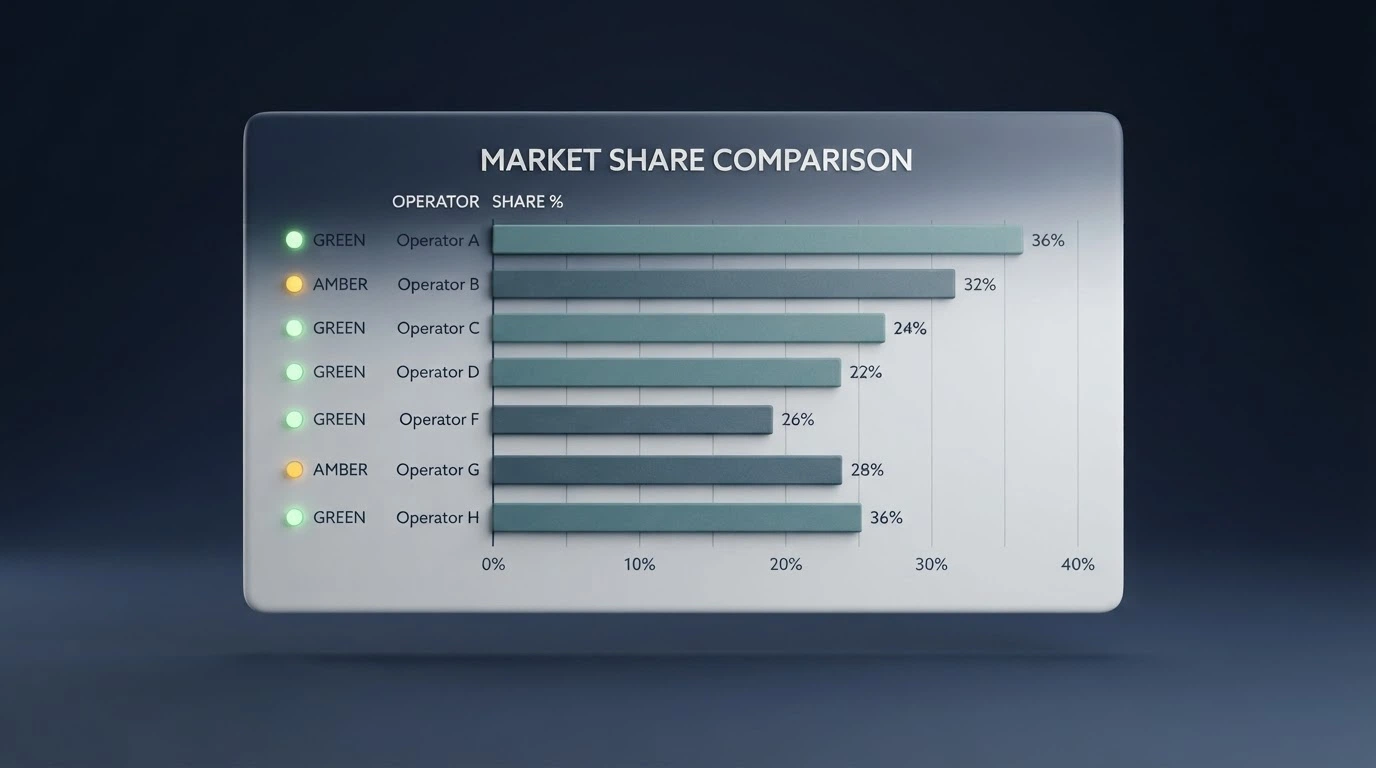
The table below lists the ten most-trafficked offshore pokies operators reaching Australian players, ranked by market share from tracked AU traffic data. Every operator in this table is offshore. No Australian online-casino licence is available, as the product is restricted under the Interactive Gambling Act 2001. The ranking reflects reach, not safety, and the individual profiles that follow describe what a player should verify on each operator’s current bonus page.
| Operator | AU Licence Status | Market Share (% of AU traffic) | Tracked Revenue ($M AUD) |
|---|---|---|---|
| Rocket Play | Offshore — not licensed in AU | 9.4 | $632.69M |
| Skycrown | Offshore — not licensed in AU | 8.55 | $436.07M |
| Royal Reels | Offshore — not licensed in AU | 2.51 | $243.99M |
| WinSpirit | Offshore — not licensed in AU | 1.55 | $110.3M |
| Stake | Offshore — not licensed in AU | 1.28 | $115.67M |
| Rainbet | Offshore — not licensed in AU | 1.28 | $83.13M |
| Scream Casino | Offshore — not licensed in AU | 0.99 | $94.87M |
| FairGO | Offshore — not licensed in AU | 0.8 | $69.11M |
| Bizzo Casino | Offshore — not licensed in AU | 0.57 | $51.38M |
| Rocket Casino | Offshore — not licensed in AU | 0.57 | $43.22M |
The market-share figures measure reach — the percentage of Australian player traffic each operator captures. They do not measure trustworthiness, payout speed, bonus generosity or customer support quality. The ACMA has blocked 1,564 illegal gambling and affiliate websites as of March 2026, and more than 225 illegal services have withdrawn from the Australian market entirely since 2017. The operators in this list are the ones that remain reachable.
How This Ranking Was Built — Data, Sources and What We Counted
The ranking is built on tracked Australian player traffic and revenue figures from BLASK BRANDS operator market-share data, not on editorial preference, user reviews or paid placement. Market share is the share of AU player traffic each operator captures. It measures reach, not quality.
What was not counted: bonus generosity, payout speed, customer support responsiveness, withdrawal reliability, game library depth or any other operator-quality measure that would normally order a casino review. Operator-specific data on these dimensions was not available this run, and the ranking is honest about that. The list is a reach ranking, and a reader who uses it as a quality ranking is misreading it.
The honest limitation is structural. Every operator here is offshore and unlicensed in Australia. The ranking describes who Australian players are using, not who is safest. The reach of an offshore operator is partly a function of how much it spends on affiliate marketing and how long it has kept a domain ahead of the ACMA’s blocking list, neither of which is a player-friendly signal. A reader who treats “most-trafficked” as “best” is making a conflation the data does not support.
What Separates a Strong Free-Spins Offer from a Weak One
Five terms decide whether a no-deposit free-spins offer is worth the player’s time. None of them is the headline spin count.
The wagering multiple is the first. Lower is better. A 20x requirement clears five times faster than a 50x one, because the turnover demanded is five times smaller for the same win. The faster the playthrough, the less house edge the player bleeds out of the bonus wallet during the clearing process.
The max cashout is the second. A $50 cap on a 100-spin bonus makes the headline count largely irrelevant beyond the first few winning spins — any balance above the cap is forfeited regardless of how much turnover the player generated to reach it. A higher cap is more player-friendly. A cap that is lower than the most likely bonus wallet ceiling is a marketing device, not a player-friendly offer.
The validity window is the third. A 24-hour expiry is effectively unplayable for most people, because the time required to clear the wagering on most bonus sizes exceeds the window. A 7-day window is the practical minimum. A 30-day window gives the player room to clear at their own pace without feeling rushed into a session.
The spin value is the fourth. Minimum-stake spins ($0.10) produce smaller winnings and a lower wagering burden, but also a lower ceiling. Higher-stake spins raise both. A player with limited time is usually better off with the smaller spin value, because the playthrough clears faster even though the headline ceiling is lower.
The interaction effect is the fifth and most easily missed. A generous spin count paired with a low max cashout is a marketing device. A high spin value paired with a high wagering multiple is a different marketing device. The five terms only make sense read together. A player who reads them one at a time, optimising each one in isolation, ends up with an offer that looks strong on every individual screen and is weak in the combination.
Licensed vs Offshore — Why Every Operator in This List Sits Outside Australia
The structural reason the ranking contains only offshore operators is that no Australian online-casino licence exists. The Interactive Gambling Act 2001 prohibits online casino games and online pokies to people in Australia. There is no licence to apply for, not federally and not in any state or territory. An operator cannot be Australian-licensed for this product because the product is prohibited.
The licensed Australian wagering operators — SportsBet, Tab, Bet365, Ladbrokes, TABtouch, PointsBet, Neds and others — offer sports and race betting, which is permitted under the IGA. They do not offer online pokies. They cannot offer online pokies without breaking the law they are licensed under. The distinction matters because the offshore pokies operators in this ranking are not the licensed wagering operators with an extended product line. They are a different industry entirely.
What the offshore status costs the player is real. No Australian consumer protection applies. There is no external complaints body an Australian player can approach. There is no guaranteed withdrawal recourse. BetStop does not cover offshore casinos — an offshore operator is not connected to the National Self-Exclusion Register, so self-excluding from licensed wagering does not block access to any operator in this ranking. The ACMA blocks sites, but a player with a balance on a blocked site has no Australian authority to appeal to for recovery. The individual player is not prosecuted — the IGA targets the provider — but the absence of prosecution is not the same thing as the presence of protection.
Rocket Play
Rocket Play holds the largest share of tracked Australian pokies traffic of any operator in this ranking — 9.4% of AU traffic, with $632.69M in tracked revenue. The scale is large enough that the operator’s marketing presence on affiliate pages and search results is unavoidable for an Australian player searching for no-deposit free spins.
The licence status is the same as every operator in this list: Rocket Play is offshore and lacks an Australian online-casino licence. The product offered — online pokies — falls under the Interactive Gambling Act 2001’s prohibition on gambling services, and the ACMA’s enforcement record (1,564 sites blocked as of March 2026) reflects this perimeter.
What to check on Rocket Play’s current bonus page before signing up: the wagering multiple on the free-spins winnings, the max-cashout cap, the validity window on the bonus, the spin value attached to each free spin, and the eligible pokie or list of pokies. Operator-specific terms on the live no-deposit free-spins offer were not confirmed this run and must be verified live. The headline spin count is not the figure the player should optimise on.
Verdict: Rocket Play is the largest offshore operator by Australian traffic and therefore the easiest to find and sign up with. That scale is not a safety signal. A player who treats the brand’s reach as endorsement is reading the ranking wrong.
Skycrown
Skycrown is the second-largest offshore pokies operator in this ranking by Australian traffic — 8.55% of AU traffic, with $436.07M in tracked revenue. The gap between Skycrown and Rocket Play is about 0.85 percentage points of market share, which is a meaningful gap but not the kind of gap that distinguishes one operator as safer than the other. Both sit at the top of an unlicensed market.
Skycrown follows the same model: offshore, not licensed in Australia, and offering a prohibited product under the Interactive Gambling Act 2001. Exposure to ACMA enforcement remains consistent with all other brands in this list.
What to check on Skycrown’s current bonus page: the standard four-term check — wagering requirements, cashout limits, validity periods, and spin stake values — applies. Operator-specific free-spins terms were not confirmed this run. The no-deposit free-spins terms that are live now may differ from what a competitor’s affiliate page lists, because seasonal rotation is the rule at this level of the offshore market.
Verdict: Skycrown and Rocket Play are the top two by traffic, and a player choosing between them on traffic grounds alone is choosing on reach rather than quality. The right question for either operator is the same: what does the current bonus terms screen actually say.
Royal Reels
Royal Reels holds 2.51% of tracked Australian pokies traffic with $243.99M in tracked revenue. The share is a significant drop from the top two, but the absolute revenue is still in the hundreds of millions, which means the operator has a real Australian player base even at the third position.
The name is worth flagging. “Royal Reels” sounds like a brand that could plausibly be Australian. It is not. Royal Reels is offshore, not licensed in Australia, and the branding is not licensing. The same point applies to every Australian-sounding brand name in the offshore market — branding is a marketing decision, licensing is a regulatory fact, and the two are independent.
What to check on Royal Reels’ current bonus terms: wagering multiple, max cashout cap, validity window and spin value. These operator-specific details were not available for confirmation during this analysis. The four-term check is the same as for every other operator in the list, because the mechanism is the same.
Verdict: Royal Reels is a mid-tier operator in this ranking with a brand name that may confuse Australian players about its licence status. The brand is offshore and unlicensed, like every other operator on this list. A player attracted to the name should verify the licence jurisdiction on the terms page before reading further.
WinSpirit
WinSpirit holds 1.55% of tracked Australian pokies traffic with $110.3M in tracked revenue. The smaller traffic share puts WinSpirit in the middle of the ranking rather than the top, but the absolute revenue is still material — over a hundred million in tracked volume from Australian players.
WinSpirit operates under the same offshore model as other brands listed here. Its service is illegal in Australia under federal law, and it is subject to standard ACMA enforcement measures.
What to check on WinSpirit’s current bonus page: wagering multiple, max cashout, validity and spin value. Operator-specific figures were not confirmed this run. The standard four-term verification applies because the mechanism is the same across the offshore market.
Verdict: WinSpirit is a smaller-scale operator with enough Australian traffic to be visible in search results. A player comparing offers across the list will encounter WinSpirit’s promo page, and the same four-term check applies as for every other brand.
Stake
Stake holds 1.28% of tracked Australian pokies traffic with $115.67M in tracked revenue. The traffic share is modest — level with Rainbet at 1.28% — but the revenue is higher than WinSpirit on a similar share, which suggests either higher deposit values or a more active player base per share point.
Stake is a globally recognised brand, which contributes to its Australian reach even at the modest traffic share. The global brand recognition is partly a function of Stake’s broader product line — sports betting and crypto-friendly wagering alongside the pokies offering — and partly a function of the marketing budget that accompanies a brand at that scale.
Stake’s licence status is the same as every other operator on this list. Offshore, not licensed in Australia. No online-casino licence exists in the country. Stake offers online pokies to Australian players from an offshore licence jurisdiction, and the product is prohibited under the Interactive Gambling Act 2001 regardless of how well-known the brand name is.
What to verify on Stake’s current AU-facing bonus terms: the wagering multiple, the max cashout, the validity window, and the spin value on any no-deposit free-spins offer. Operator-specific free-spins terms were not confirmed this run. The live promo page is the only version of the offer that binds the player.
Verdict: Stake is the brand Australian players may already know from sports betting or crypto wagering. The pokies product it offers to Australian players is offshore and unlicensed, like every other operator on this list. Brand familiarity is not a licence.
Rainbet
Rainbet holds 1.28% of tracked Australian pokies traffic — level with Stake — with $83.13M in tracked revenue. The traffic share is modest, but the position is the same: enough Australian reach to register on the market-share ranking, not enough to lead it.
Rainbet sits at the same horizontal position as Stake in the ranking, which is a useful reminder that two operators at the same share can have different revenue profiles. The revenue figure reflects deposit values and player activity, both of which vary across operators at the same traffic level. The market-share ranking is a reach ranking, not a deposit-volume ranking.
Rainbet matches the industry profile: offshore, unlicensed, and providing a prohibited service under the Interactive Gambling Act 2001. ACMA enforcement applies here as it does across the entire list.
What to check on Rainbet’s live bonus terms: key offer conditions such as playthrough requirements, limits on potential cashouts, expiry timeframes, and the value per spin. Operator-specific data was not confirmed this run. The pattern across the ranking is that operators at this share level rotate bonus terms seasonally, and the live promo page is the only version of the offer that binds the player.
Verdict: Rainbet is a smaller-scale operator with a real Australian footprint. A player evaluating offers across the ranking will encounter Rainbet’s promo page, and the four-term check applies in full.
Scream Casino
Scream Casino holds 0.99% of tracked Australian pokies traffic with $94.87M in tracked revenue. The share is below 1%, but the revenue is higher than several operators above it in the ranking — Rainbet, FairGO, Bizzo and Rocket Casino all have lower revenue despite the higher share, which suggests Scream Casino either has higher deposit values per player or a more active player base per share point.
The fragmentation signal is worth noticing. Scream Casino is the seventh-largest operator in this ranking by traffic and still has a sub-1% share. The top two — Rocket Play and Skycrown — together account for roughly 18% of tracked AU traffic, but the remaining 80-plus percent is split across many operators, none of which commands a double-digit share on their own. The Australian offshore pokies market is a fragmented market.
Scream Casino is also offshore and unlicensed. Its service violates Australian regulations regarding prohibited online gambling, and it is positioned within the same ACMA enforcement perimeter.
What to check on Scream Casino’s current bonus page: wagering multiple, max cashout, validity window and spin value. Data specific to the operator was not available this run. The live promo page is the version that binds the player.
Verdict: Scream Casino earns its position on the ranking by revenue per share point rather than share alone. The same four-term check applies as for every other operator, and the same offshore-licence caveat applies in full.
FairGO
FairGO holds 0.8% of tracked Australian pokies traffic with $69.11M in tracked revenue. The brand name is distinctly Australian — “fair go” is a phrase with local connotations — and the irony is sharp. The name markets fairness. The operator is offshore and unlicensed, like every other brand on this list. Branding is not licensing.
FairGO is similarly offshore and unlicensed. Its pokies offering is prohibited under the Interactive Gambling Act 2001, with ACMA enforcement applied consistently.
What to check on FairGO’s current bonus terms: wagering multiple, max cashout, validity and spin value. Specific terms for this operator were not confirmed during this review. The four-term verification applies because the mechanism is the same across the offshore market, regardless of how Australian the brand name sounds.
Verdict: FairGO’s name may make it the most searched operator on this list by Australian players, but the name is a marketing decision and the licence status is a regulatory fact. The two do not match.
Bizzo Casino
Bizzo Casino holds 0.57% of tracked Australian pokies traffic with $51.38M in tracked revenue. The share is small — at the bottom of the ranking — but the absolute revenue is still in the tens of millions. Operators below 1% share still move meaningful tracked revenue from Australian players, which is the long-tail signal in the offshore market.
The tail pattern is worth describing. The top two operators command roughly 18% of tracked AU traffic between them. The remaining eight operators in this ranking together hold roughly 17%. The Australian offshore pokies market is not concentrated — it is fragmented across many operators, each with a small share and a meaningful absolute revenue base. Bizzo is at the lower end of that fragment.
Bizzo Casino maintains the same offshore, unlicensed status. Its offering is considered an illegal service under Australian federal law, and it faces standard ACMA enforcement protocols.
What to check on Bizzo’s live bonus page: key offer conditions, including playthrough requirements, max cashout limits, expiry windows, and spin stake values. These operator terms were not verified for this run.
Verdict: Bizzo is at the tail of the top ten. A player evaluating offers across the ranking will encounter Bizzo’s promo page, and the four-term check applies in full.
Rocket Casino
Rocket Casino holds 0.57% of tracked Australian pokies traffic with $43.22M in tracked revenue — the same share as Bizzo but a lower absolute revenue. Rocket Casino and Rocket Play share part of a brand name, and they are separate operators with different market positions. The naming overlap is the only thing they have in common.
The confusion risk is real. A player searching for “Rocket Play free spins” and landing on Rocket Casino’s page would see a similar brand name and a different operator. The bonus terms, the player experience and the market position are not the same. A player who assumes they are the same brand on the basis of the name is making a decision on evidence the two operators do not support.
Rocket Casino also operates from offshore without an Australian licence. Its offering is prohibited under the Interactive Gambling Act 2001, falling under the same enforcement guidelines as the rest of the list.
What to check on Rocket Casino’s current bonus page: wagering multiple, max cashout, validity and spin value. Operator-specific free-spins terms were not confirmed this run. The four-term verification applies in full, and the live promo page is the only version of the offer that binds the player.
Verdict: Rocket Casino and Rocket Play are separate operators. The shared word in their names is a confusion risk, not a relationship, and the live terms screen on each operator’s own page is the only one that binds.
Is It Legal? The Offshore Reality Every Australian Pokies Player Faces
The legal position is clear-cut. Online casino games and online pokies are prohibited to people in Australia under the Interactive Gambling Act 2001. The 2017 amendment strengthened the prohibition and gave the ACMA enforcement and site-blocking powers. The 2026 Gambling Reform Bill passed Parliament on 19 August 2026 and its measures commence 1 January 2027. None of these developments creates an Australian online-casino licence. None of them legalises the offshore product.
What the Interactive Gambling Act 2001 Actually Bans
| Service | Regulatory Status |
|---|---|
| Online casino / Pokies | Prohibited under IGA 2001 |
| In-play sports betting | Prohibited under IGA 2001 |
| Pre-match sports betting | Permitted (licensed) |
| Lotteries and Keno | Permitted (licensed) |
The IGA’s enforcement target is the provider, not the player. It is an offence to provide or advertise a prohibited interactive gambling service to a person in Australia. The individual player is not prosecuted for using an offshore casino. The 1,564 sites blocked by ISPs as of March 2026 and the more than 225 services that have withdrawn from the Australian market since 2017 are enforcement actions against providers, not players.
The ACMA’s enforcement toolkit covers investigations, formal warnings, civil penalty proceedings, ISP-level site blocking and referrals for criminal prosecution in serious cases. The blocking is DNS-level and is not presented as unbeatable — operators respond by registering new domains, which is why the block count keeps climbing. The enforcement is real, but the market persists.
State and Territory Licensing — Why No Australian Online Pokies Licence Exists
The licensing architecture is split between federal prohibition and state-level permission. The IGA is a federal prohibition on online casino games. State and territory regulators license what the IGA permits — wagering, lotteries and keno. No state can issue an online pokies licence because the product is prohibited federally; a state licence for what the Commonwealth bans would not bind.
The Northern Territory Racing and Wagering Commission (NTRWC), administered through Licensing NT, is the de facto national licensor for online wagering. Wagering licences in the NT run for terms of up to 20 years. The NT regime was reformed in 2026 after criticism of the regulator’s structure — the reform tightened oversight but did not change the underlying prohibition on online casino games.
Land-based casinos — Crown, The Star and others — are state-licensed. Their state licence covers the physical premises and the table games and pokies operated within them. It does not extend to online casino games. A land-based casino licence is not an online casino licence, and the IGA prohibition applies to the online product regardless of what the operator’s physical-premises licence covers.
The 2026 Reform — What Changes on 1 January 2027
The Interactive Gambling Amendment (Gambling Reform) Bill 2026 passed Parliament on 19 August 2026 and its measures commence 1 January 2027. The reform tightens wagering advertising, restricts inducement marketing, and gives banks and payment providers express authority to block transactions to illegal gambling operators. It does not create an online-casino licence.
The advertising caps run from 1 January 2027: no more than three wagering ads per hour between 6:00 am and 8:30 pm, with a live-sport blackout from 15 minutes before a live event until 5 minutes after it ends. Athletes, celebrities and influencers are barred from promoting wagering products, and broadcasting sporting odds is banned outright. Radio wagering ads are barred during school drop-off and pick-up times. Online wagering ads may be shown only to a user who is logged in, confirmed over 18 and offered an opt-out. No wagering advertising is allowed inside sports venues or on the uniforms of players and officials.
The inducement marketing bans from 1 January 2027 sit alongside the advertising caps. Direct marketing of inducements is prohibited for 14 days after a customer signs up, for three months after a person deregisters from BetStop, and indefinitely for customers identified as at risk of gambling-related harm. Inducements are also constrained at the state level today — sign-up offers and referral bonuses are prohibited or tightly limited by several states — but the federal restrictions layer on top from 1 January 2027.
The payment-provider authority from 1 January 2027 is a meaningful change. Banks and payment providers gain express authority to block transactions to illegal gambling operators. Today, an Australian bank cannot easily refuse a transaction to an offshore pokies site on legal grounds alone — the bank’s general terms of service apply, but the IGA does not directly authorise a transaction block. From 1 January 2027, that authority is explicit.
What the reform does not change is the underlying prohibition. Online casino and pokies remain prohibited under the IGA. The 2026 reform tightens advertising, inducements and payment-provider authority around wagering. It does not open a door to an Australian-licensed online pokies product.
What a Player Gives Up Outside the Licensed Market
The practical cost of playing at an offshore pokies site is not legal risk — the player is not prosecuted under the IGA. The cost is consumer-protection risk, and the list is long.
No Australian consumer protection applies to an offshore operator. There is no external complaints body an Australian player can approach. There is no guaranteed withdrawal recourse. There is no statutory cooling-off period. There is no Australian dispute resolution service that binds an offshore operator. The player who has a complaint about an offshore casino has, in practice, the operator’s own customer support and whatever commercial pressure the operator feels from its payment processor and its licence jurisdiction (which is not Australia).
BetStop does not cover offshore casinos. BetStop is the National Self-Exclusion Register, live since August 2023, with 67,480 registrations as at 31 July 2026 and 41,290 exclusions still active. It binds every Australian-licensed online and phone wagering service in a single step. An offshore casino is not connected to the register. A player who has self-excluded from licensed wagering through BetStop can still access every operator in this article’s ranking, because none of them is bound by BetStop.
The payment-method tell is the most useful single signal. A site that asks for a credit card or a crypto deposit is asking for a payment method that is banned for Australian wagering as of 11 June 2024. The Interactive Gambling Amendment (Credit and Other Measures) Act 2023 banned credit cards, credit-related products and digital currency for online wagering in Australia, with penalties of up to $247,500 for operators that fail to enforce the ban. A site that asks for either payment method is, by that request alone, operating outside Australian rules.
The ACMA blocking risk is the operational consequence. 1,564 illegal gambling and affiliate websites have been blocked by Australian ISPs since November 2019, as of March 2026. If the site a player is on is blocked, the player with a balance still on it has no Australian authority to appeal to for recovery. The offshore operator’s own terms apply, and the player’s practical recourse is whatever the operator’s licence jurisdiction (which is not Australia) offers.
The tax position is a separate question. Gambling winnings are not assessable income for the individual player under section 6-5 of the ITAA 1997, and losses are not deductible under section 8-1, unless the person is carrying on a business of betting or gambling. The tax treatment is the same whether the gambling happens on a licensed wagering platform or an offshore pokies site. The tax falls on operators, not players — the Northern Territory levies a 5% wagering tax on wagers minus payouts plus a 0.05% racing levy, and each state sets its own point-of-consumption tax, typically 10–15% of net wagering revenue.
Staying in Control — Limits, Self-Exclusion and Real Help That Works
Free-spins promotions are designed to extend play. The absence of a financial outlay at the moment of claim creates the illusion of zero-cost play, but the session cost is real — in time, in turnover, and in any deposit the player makes to keep playing after the free spins run out. The Australian help infrastructure exists, and offshore pokies sites sit outside most of it.
About 2.1% of Australian adults — roughly 430,000 people — experience problem gambling, with high-risk gambling at 1.8% (Australian Institute of Health and Welfare, 2022). The numbers describe a population, not an individual. A reader who recognises themselves in the patterns below has help available regardless of where the gambling happens.
Setting a Spend and Time Limit Before You Open a Pokie
The most effective responsible-gambling tool is the one set before the session starts. A limit set before play is a decision made by a clear-headed version of the player. A limit set mid-session is a decision negotiated by someone already inside the game, and the negotiation almost always loosens the limit.
For a no-deposit free-spins player, the cash cost is zero at entry but becomes real if the player deposits to continue after the spins run out. The pre-commitment question is not “how much am I willing to deposit today?” but “how much am I willing to deposit across this session if the free spins lead to a deposit decision?” A player who has answered that question before opening the pokie has set a guardrail. A player who answers it after the bonus balance has moved is negotiating with themselves under conditions designed to make the negotiation go one way.
A time limit works the same way. A 30-minute session cap, set before the first spin, is a decision. A “let me just clear the wagering” extension, set after the bonus is partway through clearing, is a different kind of decision — one made by someone whose incentive structure is now to keep playing. The pre-commitment limit is the one that survives contact with the bonus mechanics.
The licensed Australian wagering platforms offer customer-set deposit limits under state conditions, and these are genuinely enforceable. Offshore pokies sites do not offer the same enforceable framework. The player’s own pre-commitment limits are the only guardrail that applies regardless of where the session happens.
BetStop and the National Help Network — What They Cover and What They Do Not
BetStop is Australia’s single strongest player-protection tool. One registration excludes a person from every Australian-licensed online and phone wagering service in a single step. The scale is large — 67,480 registrations in three years as at 31 July 2026, of which 41,290 exclusions are still active. More than 60% of everyone who ever registered is still on the register. Seventy-eight percent of registrants were under 40 at the time of registration. Thirty-eight percent chose lifetime exclusion.
The BetStop limitation is the part that matters for this page. BetStop binds only Australian-licensed wagering services. An offshore casino is not connected to the register. A player who self-excludes from licensed wagering through BetStop can still access every operator in this article’s ranking, because none of them is bound by BetStop. The exclusion is real where it applies and silent where it does not.
The National Gambling Helpline is 1800 858 858 — free, confidential, staffed 24 hours a day, 7 days a week, with online chat and counselling through Gambling Help Online at gamblinghelponline.org.au. The helpline is available regardless of where the gambling happened, whether on a licensed wagering platform or an offshore pokies site. The service does not require the caller to be a BetStop registrant. The service does not require the caller to identify the operator.
Spotting a Chase Pattern — When Free Spins Stop Being Free
The chase pattern that no-deposit free spins are most likely to trigger has a recognisable shape. The free spins produce a small win. The wagering requirement makes withdrawal unlikely. The player deposits to keep playing, in the hope of clearing the playthrough. The session cost exceeds what the player intended to spend, and the bonus is the proximate cause.
The red flags are behavioural, not arithmetic. A player depositing to extend a session that started with a no-deposit bonus is in a chase. A player chasing a wagering requirement that is mathematically unlikely to clear within the validity window is in a chase. A player playing past a pre-set time limit because the bonus is “nearly cleared” is in a chase. The sunk-cost feeling attaches to the time invested in clearing the wagering, not to a deposit the player can see leaving their account — and that is what makes the pattern hard to recognise from the inside.
Where to get help is the same regardless of which red flag triggered the recognition. The National Gambling Helpline at 1800 858 858 is free, confidential and available 24/7. Gambling Help Online at gamblinghelponline.org.au offers online chat and counselling. Both are available whether the gambling happened on a licensed wagering platform or an offshore pokies site. BetStop covers Australian-licensed wagering only — offshore pokies sites are not connected to the register — but the helpline and online counselling work for everyone.
How We Chose and Ranked These Free-Spins Pokies Operators
The ranking is built on tracked Australian player traffic and revenue figures from the BLASK BRANDS operator market-share data. It is not built on editorial preference, user reviews or paid placement. The licence-status check ran against the ACMA register and the Interactive Gambling Act 2001 framework; no operator on the list holds an Australian online-casino licence.

The bonus-term limitation is the honest gap in the ranking. Operator-specific free-spins terms — spin count, wagering multiple, max cashout, validity window, spin value and eligible titles — were not confirmed this run, because live web data was not available. The ranking orders operators by market share only, not by bonus quality. The individual operator profiles describe what a player should verify on each operator’s current bonus page, because the live terms are the terms that bind.
The criteria that ordered the list were market share (percentage of Australian player traffic), presented in descending order. The criteria that did not order the list were bonus generosity, payout speed, customer support responsiveness, withdrawal reliability or any operator-quality measure. Operator-specific data on these dimensions was not available, and the ranking does not pretend otherwise.
The operators excluded from the ranking are the Australian-licensed wagering operators — SportsBet, Tab, Bet365, Ladbrokes, TABtouch, PointsBet, Neds and others. They are licensed wagering operators offering sports and race betting, not online pokies, which is the product this page covers. Their inclusion would have been a category error: licensed wagering operators do not offer the prohibited product, and the prohibited product is what the page describes.
What Australian Players Should Actually Do About Free-Spins Pokies Offers
The honest take is short. No-deposit free spins at offshore pokies sites are real offers with real terms, and a player who reads the terms screen carefully can decide whether the wagering burden and the max-cashout cap make the offer worth the time. Most of the time, the answer is that the offer is worth what it costs at the moment of claim — which is nothing — and not what the headline suggests it is worth — which is the dollar value of the spin count.

The safety floor is the same on every site. Never deposit more than you are prepared to lose. Never give a credit card or crypto, both of which are banned for Australian wagering as of 11 June 2024 and both of which are tells that the operator is outside Australian rules. Set a time limit and a spend limit before opening the first pokie, and stop when either limit is reached regardless of how close the wagering requirement is to clearing.
The facts to verify on any operator’s live bonus page before claiming are the four terms that decide whether the offer is worth the time: the wagering multiple, the max-cashout cap, the validity window, and the spin value. Add the eligible pokie or list of pokies, and the published RTP if the operator makes it available. The five terms together are the offer; any one of them read in isolation is a marketing line.
BetStop will not block access to offshore pokies sites, so the player’s own pre-commitment limits are the only guardrail that applies. The National Gambling Helpline at 1800 858 858 and Gambling Help Online at gamblinghelponline.org.au are free, confidential and available 24/7 regardless of where the gambling happens — licensed wagering platform or offshore pokies site.
The closing judgement is the one the rest of the page has been building toward. Free-spins offers are a marketing cost for offshore operators, and the terms are set so that most players either do not clear the wagering requirement or hit the max-cashout cap before withdrawing. The right way to play them is for entertainment value, not as a wealth strategy. The wrong way to play them is to chase a wagering requirement with your own deposit. The arithmetic is the same on every site.
Frequently Asked Questions
What are the wagering requirements for free spins no deposit bonuses at Australian pokies?
Wagering requirements on no-deposit free spins apply to the winnings from the spins, not to the spin stake itself, and they are typically expressed as a multiplier — a 40x requirement on a $5 win means $200 of turnover before that $5 can be withdrawn. Operator-specific wagering multiples were not confirmed this run, and the live bonus terms screen is the only version of the requirement that binds. No Australian-licensed operator offers these bonuses, because the product is prohibited under the Interactive Gambling Act 2001.
What is the maximum I can cash out from a no deposit free spins bonus?
Most offshore no-deposit free-spins bonuses carry a max-cashout cap that slices the bonus wallet above a stated ceiling — commonly $50 to $100 — regardless of how much turnover the player generated to reach it. The cap is not negotiable and rarely appears in the headline offer copy; it sits in the terms. Above the cap, the balance is forfeited, even if the wagering requirement has been cleared. The exact cap is set on each operator’s live bonus page.
What payment methods can I use at online pokies sites from Australia?
Credit cards, credit-related products and digital currency (crypto) are banned as payment for online wagering in Australia, commencing 11 June 2024, with penalties of up to $247,500 for operators that fail to enforce the ban. A site asking for either is, by that request alone, operating outside Australian rules. The legal deposit routes for licensed wagering are debit card, bank transfer, PayID/Osko and BPAY. From 1 January 2027, banks and payment providers gain express authority to block transactions to illegal gambling operators under the 2026 reform.
What happens to my money if an offshore pokies site is blocked by the ACMA?
The ACMA has had 1,564 illegal gambling and affiliate websites blocked by Australian ISPs since November 2019, as of March 2026. A player with a balance on a blocked site has no Australian authority to appeal to for recovery, because the operator is offshore and unlicensed in Australia. The player’s recourse is whatever the operator’s own licence jurisdiction (which is not Australia) provides. BetStop does not cover offshore casinos, so self-exclusion from licensed wagering does not block access to a blocked site. The block is DNS-level and operators respond by registering new domains.
Do free spins bonuses have a time limit or expiry date?
Yes. No-deposit free-spins bonuses carry a validity window — typically 24 hours to 7 days — within which the wagering requirement must be cleared. A 24-hour window is effectively unplayable for most players, because the turnover required on a moderate bonus size exceeds the time available. A 7-day window is the practical minimum. Beyond the window, the bonus balance is forfeited regardless of how close the playthrough is to clearing. The exact window is set on each operator’s live terms page.
Can I win real money from free spins no deposit bonuses on pokies in Australia?
Yes, in the sense that the winnings from the free spins sit in a bonus wallet that may eventually become withdrawable after the wagering requirement is cleared and the max-cashout cap is respected. No, in the sense that the bonus wallet is not cash in hand until those two conditions are met — the displayed balance is contingent, not realised. Most players who claim no-deposit free spins at offshore pokies sites either do not clear the wagering requirement or hit the max-cashout cap before the playthrough ends. The IGA targets the provider, not the player, so using an offshore casino is not a criminal offence for the individual.