
What 2026 No-Deposit Free Spins Are Really Worth to Australians
A fifty-free-spin offer reads like value until the contract reaches the wagering clause, the cashout cap and the seven-day expiry that drains the bonus back to zero. The gap between the headline and what an Australian player actually withdraws is the gap this page sets out to measure — across ten offshore brands accepting Australians, with the wagering maths worked through to the last cent and the legal position set out plainly.

Data current as of 16 October 2026; offer terms verified against operator bonus pages and bonus-aggregator listings, and licence claims checked against the ACMA register.
Table of Contents
- Why Your 2026 No-Deposit Free Spins Are Smaller Than They Look
- How No-Deposit Free Spins Work at an Australian Online Casino
- Every Free-Spin Casino Australian Players Can Access — Compared
- The Pokies Your Free Spins Actually Land On
- Free-Play vs Real-Money Spins: What Changes When You Switch
- Crypto Casinos and Free Spins: What the Payment Method Tells You
- Getting Your Winnings Out: PayID, Caps and the Withdrawal Reality
- The Legal Reality: No Online Casino Is Licensed in Australia
- When the Spins Stop: Limits, Harm and Where to Get Help
- How We Evaluated These Free-Spin Offers
- Should You Claim a No-Deposit Free-Spin Offer? The Real Answer
- Frequently Asked Questions
Why Your 2026 No-Deposit Free Spins Are Smaller Than They Look
The marketing says fifty free spins. The contract says something else. The typical no-deposit free-spin offer published to Australian players in 2026 runs from 20 to 50 spins, sometimes as many as 100, with a withdrawal ceiling of AU$50 to AU$100. Before any of that matters, the player has to clear the wagering requirement — usually applied to the winnings, not the spin value, often at 40× or 50×, on a seven-day clock that expires whether the player is ready or not.
The bonus-cost arithmetic for a typical no-deposit offer runs like this. Royal Reels credits AU$10 in free cash on registration, with 40× wagering on the bonus. AU$10 × 40 = AU$400 of total bets before the bonus converts to withdrawable cash. At a five-second spin, the time to clear that turnover depends entirely on stake size. Betting the smallest practical stake of AU$0.05 per spin, the AU$400 needs 8,000 spins — roughly eleven hours of play. At AU$0.25 a spin, the same AU$400 turnover needs 1,600 spins — about two hours. Pushing up to the maximum allowed AU$7.50 per spin during wagering, the same turnover clears in around 54 spins — under five minutes of button-pushing. This is an estimate under those stake assumptions, not a guaranteed outcome.
Three offer structures dominate the market, and each carries a different shape of cost.
| Offer Type | What You Get Up Front | Typical Wagering | Typical Cashout Cap | Typical Validity | Real Example From the Featured Set |
|---|---|---|---|---|---|
| No-deposit free spins | 10–200 spins on a single pokie | 20×–60× on winnings | AU$50–AU$200 | 3–10 days | 7Bit Casino: 30 FS, 45×, AU$100 cap, 7 days |
| Deposit-match free spins | 50–400 spins split across multiple days | 35×–40× on winnings | Up to AU$5,000 | 14 days or more | SkyCrown welcome tier: 400 FS across four deposits, 30× on FS winnings |
| Free-cash chip | AU$5–AU$10 credited as bonus money | 40×–60× on the bonus | AU$50 | 7 days | Royal Reels: AU$10 free cash, 40×, AU$50 cap, 7 days |
The spread is the story. A no-deposit free-spin offer is the smallest gift and the most generous-sounding; a deposit-match free-spin offer is the largest grant but locked behind the player’s own money; a free-cash chip sits in the middle and is the most flexible. The wagering burden and the cashout cap move in roughly opposite directions across the three: no-deposit spins carry the heaviest caps as a proportion of the headline value, deposit-match spins carry lighter caps but lock the player into a larger turnover, and free-cash chips carry both a small gift and a small cap.
No-Deposit vs Deposit-Required Free Spins: What Each One Actually Costs You
A no-deposit free spin is credited on sign-up. The player does not pay anything first. The casino absorbs the spin cost. The catch — and there is always one — is that the offer is shaped to look generous while costing the operator as little as possible.
A deposit-required free spin is different. The player makes a qualifying deposit first (RocketPlay asks for AU$25, SkyCrown for A$20). The casino then credits free spins on top, often split across multiple days (RocketPlay credits 20 per day for five days). The deposit itself is the player’s money, not bonus money — but the winnings from the spins usually are, and the wagering requirement applies to those.
The structural difference is who is on the hook for the spin cost. No deposit means the casino pays. Deposit-gated means the player pays first and gets a spin grant as a sweetener. The wagering burden, the cashout cap and the spin lock-in are usually heavier on the deposit-gated version because the casino has already taken the player’s money and is using the spin grant as a retention tool. Across the featured set, free-spin counts range from 10 to 200, with 50 the median and Pragmatic Play, NetEnt, BGaming and Hacksaw providing the majority of eligible pokies. Most operators anchor their terms around 35×–40× wagering on winnings with three-to-ten-day expiry.
Spin Count Is a Distraction — Per-Spin Value Matters More
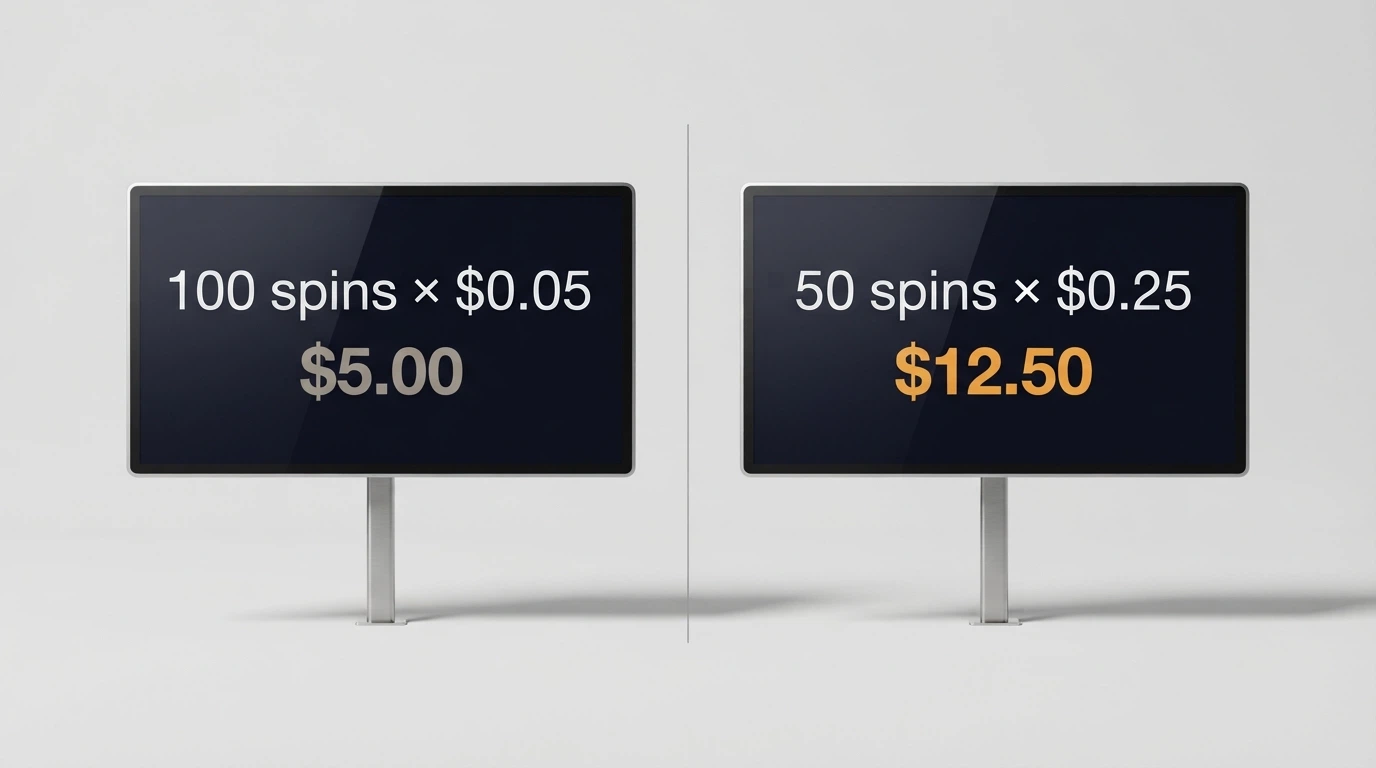
A hundred free spins at AU$0.05 each is worth AU$5 in spin value. Fifty free spins at AU$0.25 each is worth AU$12.50. The second offer hands out fewer spins at a higher per-spin stake and is worth two and a half times more.
This is the arithmetic the marketing hides. Operators publicise the spin count because a bigger number reads as a bigger gift. The per-spin value is what determines whether the bonus is worth the time. Compare two offers: 100 spins at AU$0.05 versus 50 spins at AU$0.25. The first is a five-dollar spin grant. The second is a twelve-fifty spin grant. Same headline category — “free spins” — entirely different value.
Maximum bets during wagering sit at AU$5 to AU$7.50 per spin at most AU-facing casinos. That is the ceiling. The floor is usually the pokie’s minimum stake, often AU$0.05 or AU$0.10. A player who bets AU$5 per spin during wagering is clearing the bonus faster; a player who bets AU$0.10 is taking fifty times as long to clear the same turnover. The per-spin stake and the per-spin count are not interchangeable; one drives the time cost, the other drives the headline.
The Wagering Multiplier: How Many Times Your Winnings Must Be Turned Over
Wagering applies to winnings from free spins, not to the value of the spins themselves. If a player wins AU$8 from forty free spins and the wagering requirement is 35×, that AU$8 must be turned over AU$280 before it converts to withdrawable cash. At a five-second spin and a AU$0.10 stake, that is 2,800 spins — roughly three hours and fifty-three minutes of play. At a AU$0.25 stake, it is 1,120 spins — about one and a half hours.
The Australian market has settled around 40×–60× wagering for no-deposit free spins, with pokies contributing 100% towards the requirement and table games, crash titles and live casino contributing between 0% and 20%. Most live-casino games contribute nothing. A player who tries to clear a pokie-only wagering requirement by playing blackjack is watching the bonus balance drain while the wagering meter barely moves.
What does the multiplier actually mean in practical terms? Reasonable wagering, by the standards of the market, is 30×–35× — a sharp player can clear it inside a session. Forty times is acceptable. Forty-five to fifty is steep; the player is starting to bet against their own time. Anything above 50× is, for most players, effectively unclearable inside the seven-day window. The multiplier is the line where the offer stops being a gift and becomes a grind.
The Myth of the Wager-Free Spin
Wager-free spins exist. They are rare, and the ones that do exist are usually deposit-triggered. Jackpot Jill, for example, runs 20 wager-free spins on Dragon Pearls per A$20 deposit, with winnings converting to instant withdrawable cash capped at A$200 across a 100-spin package. There is no wagering multiplier. What the player wins, the player keeps.
The catch is elsewhere. The deposit trigger converts the offer from “no-deposit” into “deposit-gated”, and the A$200 cap is roughly the same as the no-deposit ceiling at most offshore brands. The player has paid A$20 to access a wager-free path to roughly the same ceiling as a no-deposit offer would have given them with a 40× grind. Whether that is a good trade depends on the player’s read of the no-deposit terms they are comparing against, and on whether the player values the absence of the wagering clock more than the absence of the deposit cost.
The deeper point is that wager-free is not the same as cap-free. The cap still applies, and the deposit still extracts its price. Wager-free is a real benefit — measured against alternatives, not absolute.
Withdrawal Caps: The Ceiling on Your Free-Spin Winnings
No-deposit offers in Australia in 2026 carry cashout caps of AU$50 to AU$200. Deposit-match offers can climb to AU$5,000. The cap is the second filter, after wagering, and it is the one most players notice last.
The mechanics are simple. The player clears the wagering requirement. The balance reads, say, AU$247. The cap is AU$100. The player withdraws AU$100, and the rest is forfeited. Most operators state the forfeiture explicitly in the bonus terms; the rest leave it implicit. Either way, the cap is the ceiling.
Why do caps exist? Because the casino is offering something at no cost to the player — the spin value, the wagering grant, the credit risk on the time spent clearing — and the cap is the ceiling on how much that exposure can run. A no-deposit offer without a cap would let one lucky player walk away with a five-figure win the casino never priced for. The cap is the offer’s stop-loss. On the deposit side, the higher caps reflect the player’s own money at risk; a AU$5,000 cap on a deposit-match offer is the cap on bonus winnings, not on the player’s deposit, which the player can withdraw whenever they like.
How No-Deposit Free Spins Work at an Australian Online Casino
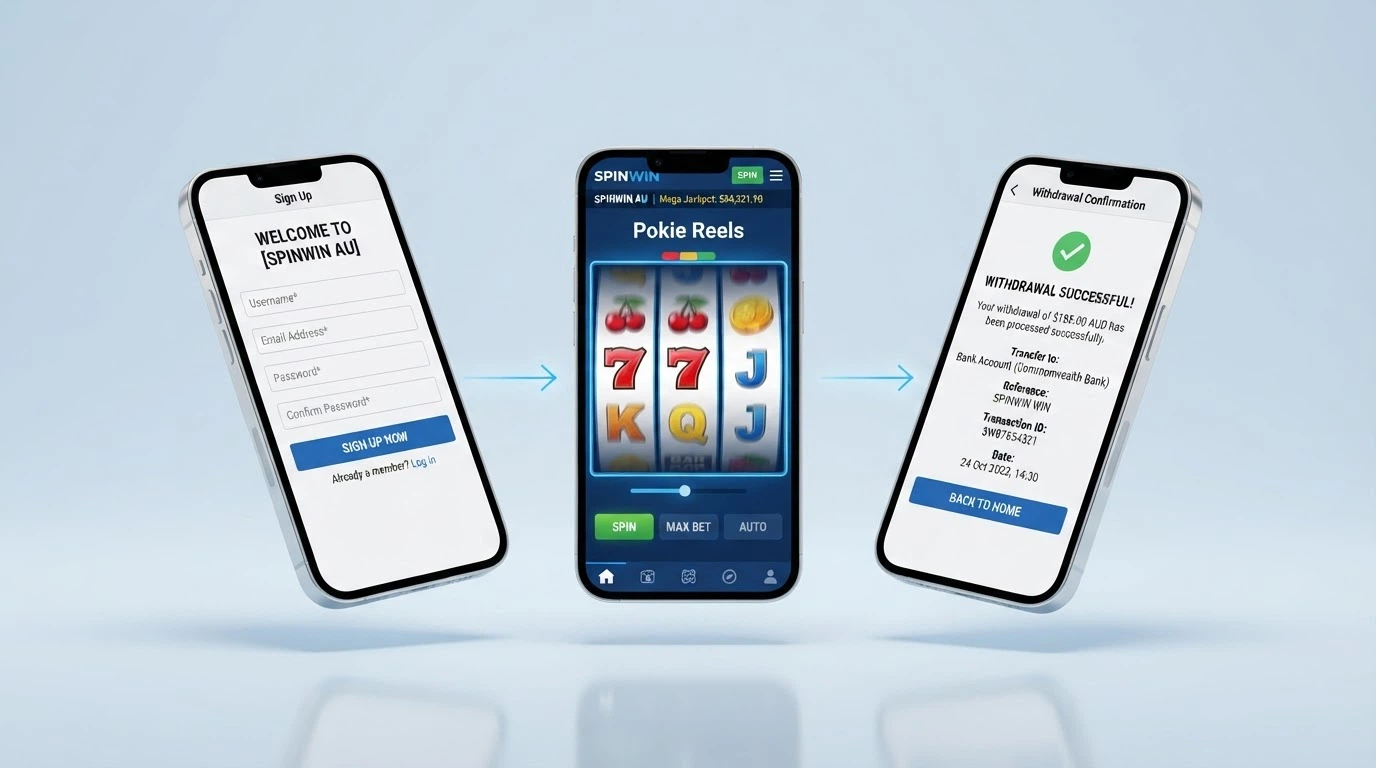
The mechanics are simple in outline and expensive in detail. A player signs up. The casino verifies an email or phone number — no payment details required for a no-deposit offer. The spins appear, either automatically or via a bonus code. The player spins. Whatever wins accumulate sits in the bonus balance, locked behind the wagering requirement. Once wagering is cleared, the cap kicks in. Whatever remains under the cap is the player’s to withdraw.
What You Actually Get on Registration
Royal Reels credits AU$10 in free cash on email verification. No deposit. No payment details. The player types in an email, confirms it, and the bonus appears. The wagering on the bonus is 40×, the cap is AU$50, the validity is seven days, and the bonus is not locked to a specific pokie — pokies contribute 100% towards wagering, table games 5–10%, live casino excluded.
BitStarz runs a no-deposit free-spin offer on registration, also with 40× wagering on winnings, a AU$100 max cashout and a seven-day expiry. The exact spin count varies by listing. Some aggregators list it as 20 spins, others higher; the operator does not publish a single canonical number.
Across the offshore market, the sign-up path is the same: email verification, then a bonus credit. The differences are in the spin count, the per-spin stake, the wagering multiplier and the cap. The underlying mechanics are uniform. The variation is in the numbers attached to them, and that is where the player should look first.
How Winnings Turn Into Withdrawable Cash
Say a player wins AU$8 from forty free spins, and the wagering requirement is 35×. They must wager AU$280 before the AU$8 becomes withdrawable. If the wagering carries a cap of AU$100, the player clears AU$280 in turnover and then attempts to withdraw — and the AU$100 cap limits them to AU$100, even if the balance shows AU$280 or more.
PayID withdrawals at Australian-facing casinos clear in minutes once the account is verified. PayID is the fastest route out — same-day in nearly every case, often instant via Osko real-time settlement. The cap, however, is what the player actually withdraws, not what they won. A win of AU$247 turns into AU$100 the moment the player clears the wagering, regardless of how much the bonus balance accumulated.
The pipeline is: spin → winnings → wagering turnover → remaining balance → cashout cap → withdrawal method. Each step trims the value. The marketing shows the winnings. The cap is what arrives in the bank account.
Every Free-Spin Casino Australian Players Can Access — Compared
Ten operators currently publish no-deposit free-spin offers to Australian players. None of them is licensed in Australia — online casino cannot be licensed here, and every brand on this list operates offshore (mostly Curaçao). What varies is the shape of the offer, the size of the cap, the size of the wagering, and the reliability of the published terms.
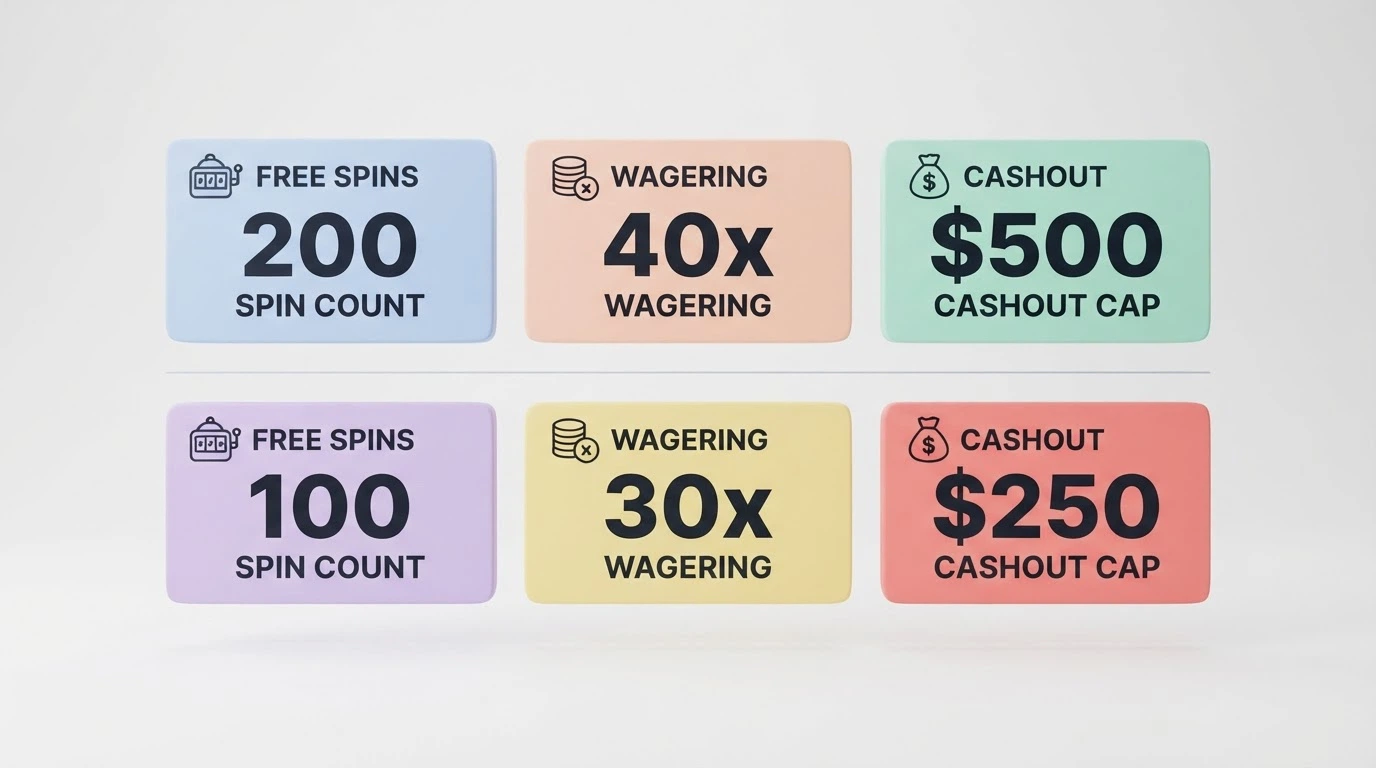
A “Licensed in Australia?” column would read “No” down the page, since online casino cannot be licensed in this country — the legal section addresses that fact in full. What follows is the published no-deposit bonus at each brand, the wagering burden on winnings, the maximum cashout, and the validity window. Cells research did not confirm are marked with an em dash.
| Casino | No-Deposit Offer | Wagering on Winnings | Max Cashout | Offer Validity |
|---|---|---|---|---|
| Royal Reels | AU$10 free cash on registration | 40× | AU$50 | 7 days |
| RocketPlay | No-deposit FS | 40× | AUD 75 | 5 days |
| SkyCrown | 20 free spins | 50× | A$750 | — |
| BitStarz | No-deposit FS | 40× | AU$100 | 7 days |
| 7Bit Casino | 30 free spins | 45× | AU$100 | 7 days |
| KatsuBet | No-deposit FS | 30×–45× | AU$100 | 7 days |
| Mirax Casino | 20 free spins | 35×–45× | AU$100 | 7 days |
| Stake | Not confirmed this run | — | — | — |
| Fair Go Casino | AU$5 no-deposit chip | 60× | — | — |
| Bizzo Casino | Not confirmed this run | — | — | — |
Royal Reels
Royal Reels is the cleanest offer in the set, partly because it is not technically a free-spin offer. The no-deposit bonus is AU$10 in free cash, credited on email verification. Wagering on the bonus is 40× — AU$400 of turnover — with a AU$50 cashout cap and seven-day expiry. Pokies contribute 100% towards the requirement; table games 5–10%; live casino excluded.
The AU$10 free cash skips the spin-value problem entirely. There is no per-spin stake to calculate; there is no spin lock-in to negotiate. The bonus goes onto a pokie of the player’s choosing, and the player bets it however they like within the AU$5–AU$7.50 max-bet rule during wagering. The cap is the tightest in the set, but the terms are the most legible.
Verdict: the smallest cash gift and the tightest cap in the set, but also the most transparent terms. Worth claiming if a player is comfortable with the AU$50 ceiling and the seven-day clock.
RocketPlay
RocketPlay runs a 200% deposit match up to AU$200 with a minimum deposit of AU$25, plus 100 welcome free spins credited 20 per day over five days on Aztec Magic (BGaming). The deposit-match bonus carries 40× wagering on the bonus amount, valid for fourteen days. The 100 welcome spins carry a separate 40× on winnings. A separate no-deposit free-spin offer exists with its own terms.
RocketPlay’s bonus terms specify a maximum bet of AUD 7.50 during wagering and a maximum withdrawal of AUD 75 from no-deposit bonus winnings. The five-day bonus validity is one of the tighter clocks in the set, and bonus money plus winnings are void if the wagering requirement is not met inside the bonus period.
Verdict: if the player can fund the AU$25 minimum deposit, the welcome tier is the better track; the no-deposit AUD 75 cap is the lowest in the set.
SkyCrown
SkyCrown’s headline welcome package runs up to A$8,000 + 400 free spins across four deposit tiers, with 40× wagering on bonus funds and 30× on free-spin winnings, minimum qualifying deposit A$20. The deposit-side offer is one of the larger packages accessible to Australians.
The no-deposit track is different. Twenty free spins, 50× wagering on winnings, maximum withdrawal A$750 after wagering, maximum bet AU$0.10 per spin or A$1 per hand. The 50× wagering sits in the steep band; the AU$0.10 max-bet per spin effectively forces low-stake play and a long clearing time. One aggregator source lists the no-deposit terms at 25× wagering — the discrepancy is real, and the operator’s own page should be checked at the point of claim.
Verdict: SkyCrown’s no-deposit track is the hardest to clear in the set. The welcome package is the reason to consider the brand; the no-deposit tier is not.
BitStarz
BitStarz is one of the longer-established offshore brands accepting Australians. The offer is published on multiple aggregator listings with standard terms: 40× wagering, a AU$100 limit on withdrawals, and a one-week bonus period. The exact spin count varies by listing and was not confirmed against a single canonical operator page during this evaluation.
The terms sit in the middle of the set — 40× is the standard, the AU$100 cap is the typical ceiling, and seven days is the common clock. There is nothing distinctive about the offer, but there is nothing broken about it either. The brand has been around long enough that the published terms have stabilised; the risk profile is the standard offshore profile.
Verdict: a reliable standard offer, with all the caveats that apply to every offshore casino on this page. Worth considering alongside 7Bit, Mirax and KatsuBet if a player wants a typical no-deposit free-spin experience without the steepest or the lightest terms.
7Bit Casino
7Bit Casino credits 30 no-deposit free spins, applying 45× wagering to winnings with a AU$100 withdrawal limit and a seven-day window. The 30-spin count is on the lower end of the published range, and the 45× wagering sits in the steep band.
Forty-five times means a player has to turn over winnings almost fourteen times what a 35× offer would require. On a typical win of AU$10 from thirty spins at AU$0.05, that is AU$450 of turnover. At AU$0.25 per spin, it is 1,800 spins — about two and a half hours of continuous play. Doable, but heavier than most competitors.
Verdict: the 45× wagering places 7Bit in the steep band; the 30-spin count is on the lower end of what is on offer at offshore brands. The AU$100 cap is the standard ceiling.
KatsuBet
KatsuBet runs a no-deposit free-spin offer with 30× wagering on winnings per one published source and 45× per another, a AU$100 max cashout and a seven-day expiry. The discrepancy is real: aggregator listings do not always agree on the published multiplier, and the operator’s own bonus page should be checked at the point of claim.
Thirty times would make it the lowest wagering requirement in the set — sharp players could clear it inside a session. Forty-five times would put it in the steep band alongside 7Bit. The lower figure is the more favourable reading; the higher figure is the conservative one to plan for.
Verdict: the lowest published multiplier in the set, contingent on the operator’s bonus page confirming 30× rather than 45×.
Mirax Casino
Mirax runs 20 no-deposit free spins with 35× wagering on winnings per one source and 45× per another, a AU$100 max cashout and a seven-day expiry. Twenty spins is the smallest spin count among the offers confirmed at this wagering level, and the 35× is on the lighter end of the standard band.
The lower multiplier would make the bonus comparatively quick to clear. On a typical AU$5 win from twenty spins, 35× is AU$175 of turnover — about 700 spins at AU$0.25, or forty-six minutes of play. Forty-five times would push that to AU$225, or roughly an hour.
Verdict: relatively player-friendly if the 35× figure holds at the operator’s bonus page. Confirm the multiplier before claiming.
Stake
Stake is one of the larger offshore brands reaching Australian players, with a reported 1.28% share of Australian-facing casino traffic. The brand operates under a Curaçao licence (not verified against the register this run) and accepts Australian players on a global platform.
Specific no-deposit free-spin terms were not confirmed at time of writing. Aggregator listings reference a no-deposit FS offer, but the wagering, cap and validity were not verifiable against a single canonical source during this evaluation.
Verdict: a recognised brand with a real Australian audience, but the specific no-deposit terms a player would need to evaluate this offer could not be verified.
Fair Go Casino
Fair Go Casino runs an AU$5 no-deposit chip with 60× wagering on the bonus. Sixty times is the steepest multiplier in the set, and the AU$5 chip is the smallest upfront value — meaning a player would need to wager AU$300 inside the validity window to convert the AU$5 to withdrawable cash. The exact cashout cap and validity were not confirmed in this run.
The bonus is chip-based, not spin-based. It is not locked to a specific pokie, so a player can use it on any eligible game. The chip-vs-spin distinction matters because chips are credited as a fixed amount of bonus money, while spins are credited at a fixed per-spin stake against a chosen pokie.
Verdict: the 60× multiplier is the heaviest in the set; the AU$5 chip is the smallest upfront gift. Suitable for a player testing the platform who is comfortable giving up most of an hour to clear a small balance.
Bizzo Casino
Bizzo Casino is listed on bonus-aggregator sites with a reported 0.57% share of Australian-facing casino traffic. The operator holds a Curaçao licence (not verified against the register this run).
Specific no-deposit free-spin terms were not confirmed at time of writing. Aggregator listings reference the brand, but the wagering, cap and validity were not verifiable against a single canonical source during this evaluation.
Verdict: Bizzo’s terms are not verifiable at time of writing. The brand has a modest Australian audience; the offer itself is not what can be evaluated here.
The Pokies Your Free Spins Actually Land On
Free spins are only as good as the game they unlock. Across the featured set, the same titles keep surfacing — Big Bass Bonanza (Pragmatic Play), Aztec Magic (BGaming), Starburst (NetEnt). These are the pokies most commonly tied to free-spin offers at Australian-facing casinos.

The Slot Titles That Keep Appearing in Free-Spin Offers
Three titles dominate the recurring mentions. Big Bass Bonanza is a Pragmatic Play fishing-themed pokie with a high-volatility profile and bonus-buy mechanics. Aztec Magic is a BGaming title with a moderate-volatility profile and a straightforward free-spin round. Starburst is a NetEnt classic — low-to-medium volatility, with a long history of being attached to casino bonuses because of its mass-market recognition.
Why do operators lock spins to these titles? Because they are the games a player is most likely to have heard of, and they are the games a player is most likely to return to. A free-spin lock-in to Big Bass Bonanza is partly a marketing choice — players recognise the name — and partly a return-on-bonus choice. A high-volatility pokie like Big Bass Bonanza produces big wins and long dry spells; from the casino’s perspective, the long dry spells are when the wagering requirement quietly drains the bonus balance.
The trade-off for the player is between familiarity and return profile. Big Bass Bonanza is known. Starburst is known. Aztec Magic is somewhat known. None of these titles are the highest-return games in any operator’s lobby, but none of them are unusually low either. Specific return-to-player figures for these titles were not confirmed against a single canonical operator source during this evaluation.
Game-Locked Spins vs Flexible Spins
A game-locked spin is credited to one specific pokie. The player cannot use it on any other game. A flexible spin is credited to the player’s bonus balance, which can be used on any eligible pokie (subject to game-weighting rules).
Game-locked spins are more common in no-deposit offers because the casino can predict the cost more precisely. A flexible-spin bonus carries more uncertainty for the operator. The trade-off for the player is straightforward: a flexible spin is worth more in player choice, but a locked spin is sometimes accompanied by a higher spin count or a slightly better per-spin stake to compensate.
RocketPlay locks the welcome spins to Aztec Magic. RooSpin locks its welcome spins to Big Bass Bonanza. Royal Reels’ AU$10 free cash is not locked to a specific pokie — the player chooses where to spend it. The free-cash structure is the most flexible offer on this page, and it is also one of the smaller ones. The lock-in is a hidden cost on top of the wagering and the cap; a player who would have spent the spin on a higher-return pokie is paying for the operator’s brand recognition.
Provider Mix: Pragmatic Play, NetEnt, BGaming and What Each Brings
Four providers dominate the free-spin-eligible pokies at Australian-facing offshore casinos: Pragmatic Play, NetEnt, BGaming and Hacksaw. Each has a different signature.
Pragmatic Play is the largest of the four by game count and is the studio behind Big Bass Bonanza, Sweet Bonanza, and the John Hunter series. Its pokies tend toward high volatility, with bonus-buy mechanics and feature-rich free-spin rounds. Pragmatic is the most-recurring provider across the free-spin offers on this page.
NetEnt is the legacy provider behind Starburst and Gonzo’s Quest. Its pokies tend toward lower volatility, with simpler mechanics and longer play sessions. NetEnt is the provider most often attached to deposit-side welcome packages.
BGaming is a smaller studio with a strong presence in crypto-friendly offshore casinos. Aztec Magic is its most commonly free-spin-locked title. BGaming pokies sit in the moderate-volatility band.
Hacksaw Gaming is the newest of the four, with a high-volatility profile and scratch-card-influenced mechanics. Hacksaw is the least-recurring provider on this page.
Specific per-provider return-to-player ranges were not confirmed during this evaluation. The provider reputation is qualitative, drawn from the games themselves and from the studios’ standard industry positioning.
Free-Play vs Real-Money Spins: What Changes When You Switch
Demo-mode spins and real-money free spins look identical to the eye and behave nothing alike to the wallet. The reels spin the same way. The bonus features trigger the same way. The only difference is what the spin costs and what the winnings become.
Demo-Mode Spins: How They Work and What They Cannot Tell You
Demo spins are unlimited and risk-free. The player loads a pokie, presses spin, and the game responds exactly as it would in real-money mode. There is no registration required. There is no deposit. There is no wagering requirement. There is no cashout cap.
Demo mode teaches the player the game’s mechanics — what the bonus round triggers, what the scatter symbol pays, what the high-paying combinations look like. It does not teach the player the cost of the game. A pokie with a 96% return-to-player pays back AU$96 on every AU$100 wagered over the long run. A player in demo mode never sees that figure because they never wager any real money. A player in real-money mode feels it across the session.
The real-money free-spin offer adds three things demo mode cannot simulate: the wagering requirement on winnings, the cashout cap, and the seven-day clock. Demo mode has none of those. A player who learns a pokie in demo mode and then claims a real-money free-spin offer on the same title is encountering a different game in practice — one with a multiplier, a ceiling and an expiry.
The Psychology of Playing With House Money
A no-deposit spin feels free. It is not. The wagering requirement turns it into a commitment.
A player who wins AU$8 from forty free spins faces AU$280 of turnover before that AU$8 is theirs. The AU$8 is the casino’s; the AU$280 is the player’s time. The cashout cap then trims what arrives. A win of AU$247 against a AU$100 cap arrives as AU$100. The remainder is forfeit.
The trap is the endowment effect. Once the spins have been credited and the player has begun to play, the bonus balance starts to feel like the player’s money. It is not. It is the casino’s money, dressed up as a balance, and every spin costs the player time. A player who treats a no-deposit bonus as free money has already absorbed the marketing. A player who treats it as a time-limited commitment with a capped payout is reading the contract.
The deeper arithmetic is the one the marketing does not show. A player who claims a no-deposit bonus at 40× wagering and a AU$100 cap has, on average, accepted a contract that will return them a fraction of what they would have earned by simply depositing AU$20 and pocketing the welcome match. The bonus looks bigger than the deposit-match because the headline says fifty free spins. The economics often favour the deposit-match once wagering and cap are accounted for.
Crypto Casinos and Free Spins: What the Payment Method Tells You
A casino that asks for crypto is signalling its regulatory status. Credit cards and digital currencies have been banned as payment for online wagering in Australia since 11 June 2024. Penalties for an operator that fails to enforce the ban are up to AU$247,500. The ban applies to operators licensed in Australia. An operator that accepts credit cards or crypto from an Australian customer is, by definition, not licensed in Australia.
Bitcoin and Crypto Free-Spin Casinos: The Offer Is Real, the Protection Is Not
Bitcoin, Ethereum and USDT deposits are common at offshore casinos accepting Australian players. The offers on those platforms look like the offers everywhere else: free spins on sign-up, deposit matches on first deposit, wagering requirements in the 30×–60× band.
What crypto acceptance signals is straightforward. The payment method is itself a tell. An Australian who is asked for a credit card or a crypto deposit by a gambling site is being served by someone outside the Australian rules. The licensed Australian wagering operators — Sportsbet, bet365, Ladbrokes — accept PayID, BPAY and debit cards only. Anything else is an offshore route.
What the player gives up in exchange is the consumer protection framework. There is no ACMA complaints recourse for a player whose offshore operator refuses a withdrawal. There is no BetStop coverage to block the player’s account. There is no Australian regulator to escalate to. The player has the operator’s terms page and whatever dispute process the operator publishes — which, at offshore brands, is usually limited to internal review.
The individual player is not prosecuted under the IGA — the Act targets the provider. The player’s recourse against an offshore operator that fails to pay is effectively zero. The crypto casino offer is real. The protection is not.
Getting Your Winnings Out: PayID, Caps and the Withdrawal Reality
The fastest payout route from an Australian-facing casino is PayID. Most other methods trail it by one to five business days. The catch is the cashout cap, which can shrink a five-figure balance into a three-figure withdrawal.

PayID: How It Works and Why It Is the Fastest Route
PayID links a bank account to a mobile number or email address. Osko, the real-time settlement layer that runs on PayID, processes transfers in minutes once both ends are verified. For an Australian-facing casino player, that means a withdrawal approved in the morning can land in the bank account by the afternoon, rather than waiting two to five business days for a traditional bank transfer.
PayID deposits are similarly fast. Verification is the bottleneck on the casino’s side, not PayID’s. Once the casino has verified the player’s identity — typically a one-time process involving a driver’s licence or passport and a recent utility bill — subsequent PayID withdrawals clear in minutes. Without verification, the casino will not process the withdrawal at all.
Operator-imposed caps apply. Many casinos cap PayID withdrawals at AU$5,000 or AU$10,000 per week. Some operators set a minimum withdrawal of AU$50; others have no minimum but cap the daily limit at AU$5,000. These are operator rules, not PayID rules — PayID itself can move any amount the bank account will allow.
Why You Cannot Withdraw Everything You Win
Three filters stack on top of each other: the wagering requirement, the cashout cap, and the max-bet rule. Each one trims what an Australian player actually withdraws.
Consider a worked example. A player claims a no-deposit free-spin offer with 40× wagering on winnings, a AU$100 cashout cap, and a AU$7.50 maximum bet during wagering. The player wins AU$8 from forty free spins. They must wager AU$280 at the eligible games before that AU$8 converts to withdrawable cash. At the maximum bet, that is 38 spins — about three minutes of play. At a more cautious AU$0.25 per spin, that is 1,120 spins — about one and a half hours.
Once wagering clears, the cap kicks in. Suppose the player’s balance reads AU$247. The AU$100 cap trims the withdrawal to AU$100. The remainder is forfeit under the operator’s terms.
Now suppose the player has bet AU$8 per spin during wagering in violation of the AU$7.50 max-bet rule. The operator can void the bonus and the winnings. The cap, the wagering and the max-bet rule together define what the player actually walks away with. The displayed balance is the most generous possible reading. The contract is the binding one.
The Legal Reality: No Online Casino Is Licensed in Australia
This is the foundational fact and everything else follows from it: online casino is illegal in Australia. The Interactive Gambling Act 2001 makes it an offence to provide online casino games, online pokies or in-play sports betting to a person physically in Australia. There is no Australian licence — federal, state or territory — for online casino. None can be issued.

The Interactive Gambling Act 2001: What It Actually Prohibits
Section 15 of the IGA prohibits the provision of online casino games to Australians. The offence is provider-targeted. The individual player is not prosecuted under the Act — the law targets the operator supplying the service, not the person using it.
The 2017 amendment to the IGA closed loopholes that offshore operators had been using, gave the ACMA enforcement powers, and authorised site-blocking requests to Australian ISPs. Before 2017, an offshore operator could argue that the prohibition applied only to Australian-based services. After 2017, the prohibition applies to any operator providing a prohibited service to a person in Australia, regardless of where the operator is incorporated.
What is permitted and licensable under Australian law is wagering on sports and racing placed before the event begins, plus lotteries and keno, through operators licensed by a state or territory. The Northern Territory Racing and Wagering Commission, administered through Licensing NT, is the de facto national licensor for large online bookmakers. Online casino games and online pokies are not in the licensed category.
The ACMA Enforcement Record: 1,564 Sites Blocked and Counting
The Australian Communications and Media Authority is the federal regulator enforcing the prohibition. Its enforcement record is substantial.
Since the ACMA’s first site-blocking request in November 2019, 1,564 illegal gambling and affiliate websites have been blocked by Australian ISPs. Over 225 illegal services have voluntarily withdrawn from the Australian market since the ACMA began enforcing the new rules in 2017. In the October-to-December 2025 quarter alone, the ACMA completed 23 investigations into 45 gambling sites, found 69 breaches of the IGA, issued 10 formal warnings, and blocked 133 websites.
The Q4 2025 breakdown of breaches is telling: 38 were for providing a prohibited interactive gambling service to Australian customers, and 26 were for providing an unlicensed regulated interactive gambling service. Both are provider offences. The regulator’s enforcement is consistent, ongoing, and aimed at the operator side of the market.
What this enforcement record does not do is protect a player whose balance sits on a blocked site. If an operator’s site is blocked mid-session, the player has lost access to their account and any withdrawal request is at the operator’s discretion. The block protects future Australian customers; it does not unwind the existing exposure.
What You Give Up Playing Outside the Australian Licensed Market
Four concrete losses follow from playing at an offshore casino instead of a licensed Australian wagering operator.
No BetStop coverage. The national self-exclusion register applies only to Australian-licensed wagering services. An offshore casino is not connected. A player who has self-excluded from every licensed operator can still deposit, play and lose at an offshore casino. The exclusion does not extend.
No ACMA complaints recourse. The ACMA accepts complaints about licensed operators. It does not mediate disputes with offshore casinos. A player whose offshore operator refuses a withdrawal has, in practice, no Australian regulator to escalate to.
No consumer protection framework. Australian Consumer Law applies to licensed operators. It does not apply to an offshore casino that has no Australian presence, no Australian entity, and no obligation to honour the Australian Competition and Consumer Commission’s rulings.
No withdrawal protection. The site can be blocked at any time. If it is blocked mid-session, the player has lost access to the account and the operator holds the balance. The 1,564-site block list includes dozens of brands that were popular with Australian players before they were added.
Credit cards and crypto are banned as payment for licensed Australian wagering. An operator that accepts either from an Australian customer is, by definition, outside the licensed regime. The payment method is the tell. The protections are absent.
The 2026 Reform: What Changes on 1 January 2027
The Interactive Gambling Amendment (Gambling Reform) Bill 2026 passed Parliament on 19 August 2026. Its measures commence on 1 January 2027. The reform tightens the advertising and inducement rules around licensed wagering, and gives banks and payment providers express authority to block transactions to illegal operators.
Part 7C of the reformed IGA imposes restrictions on wagering advertising: no more than three wagering ads per hour between 6:00 am and 8:30 pm, a live-sport blackout from fifteen minutes before to five minutes after an event, no radio wagering ads during school hours, no broadcasting of odds, online ads only to logged-in age-verified users with an opt-out, no ads in sports venues or on uniforms, and a ban on athletes, celebrities and influencers promoting wagering.
Part 7D restricts inducements and commissions. Direct marketing of inducements is prohibited for 14 days after a customer signs up, for three months after a person deregisters from BetStop, and indefinitely for customers identified as at risk of gambling-related harm.
Part 7E introduces a cost recovery levy on licensed interactive wagering providers to fund ACMA enforcement.
From 1 January 2027, banks and payment providers also gain express authority to block transactions to illegal gambling operators. This is the enforcement mechanism that reaches the offshore casino at the payment layer. A bank that declines to process a deposit to an unlicensed operator has a statutory defence.
The reform is aimed at the licensed market. Its effect on offshore operators is indirect — by tightening the licensed regime and giving banks blocking authority, it makes the offshore route harder to fund. It does not legalise online casino in Australia. Nothing in the 2026 reform changes that.
When the Spins Stop: Limits, Harm and Where to Get Help
Risky gambling in Australia almost doubled between 2024 and 2025, from 13.7% to 19.4% of the adult population. More than half of Australian gamblers — 56.1% — now gamble mainly online. About 2.1% of Australian adults, roughly 430,000 people, experience problem gambling. Approximately 5.9% of adults report being harmed by another person’s gambling in the past 12 months.
These figures are not the marketing. They are the human reality that sits behind the no-deposit spin offer.
BetStop, Deposit Limits and Self-Exclusion: The Tools That Exist
BetStop applies to every Australian-licensed online and phone wagering service. One registration excludes a person from every licensed operator in a single step. Self-exclusion runs from three months to a lifetime.
As at 31 July 2026, BetStop had 67,480 registrations in three years of operation, of which 41,290 exclusions were still active — more than 60% of everyone who ever registered. 78% of registrants were under 40, and 38% chose lifetime exclusion. The skew toward younger registrants is consistent with the 56.1% online-participation figure. The skew toward lifetime exclusion suggests the people who reach for the register have already decided to stop.
BetStop applies to Australian-licensed operators only. Offshore casinos are not connected to the national register. A person who has self-excluded from every Australian-licensed operator can still deposit at an offshore casino, still claim a no-deposit free-spin offer, still play. The register is real. It does not reach the offshore market.
The same gap applies to deposit-limit tools. Licensed Australian operators offer customer-set deposit limits, take-a-break options and activity statements under state and territory conditions. Offshore operators publish similar tools in their responsible-gambling pages; their enforcement, when the offshore operator is the only entity the player can hold accountable, is at the operator’s discretion.
Where to Get Help
The National Gambling Helpline is 1800 858 858 — free, confidential, staffed 24 hours a day, nationwide. Online chat and professional counselling are available through Gambling Help Online. BetStop registration is at the BetStop portal. The National Debt Helpline is 1800 007 007 for financial difficulties linked to gambling. Healthdirect, the national health information service, carries a gambling-addiction information page.
If a person has self-excluded through BetStop and is still being approached by an offshore casino, that is information worth bringing to the helpline. If a person has hit the cashout cap and feels the urge to deposit more to chase the loss, that is information worth bringing to the helpline. The support infrastructure is free, confidential and available around the clock.
How We Evaluated These Free-Spin Offers
The ranking and the verdicts on this page were produced by checking published bonus terms against operator bonus pages and bonus-aggregator listings, and by checking offshore licence claims against the ACMA register. Where two aggregator sources disagreed on a wagering multiplier or a cap, the more conservative figure was carried forward, and the discrepancy is noted in the operator write-up.
Operator terms were taken from operator bonus pages and confirmed, where possible, against aggregator listings at PokiesAustralia, Gambling Insider, CrazyVegas and Best Australian Pokies. Where terms could not be confirmed against a single canonical source, that fact is stated in the operator write-up. The page does not invent terms, weights or rankings. What research did not confirm is labelled as such — the table shows em dashes where the published terms could not be verified, and the operator write-ups say so.
The licence check confirmed that no online casino operator reviewed on this page holds an Australian licence — none can. The offshore licence claim is the only licence claim, and where research could not verify it against the relevant register, that is stated in the operator write-up. Two of the ten operators (Stake and Bizzo) had no specific no-deposit free-spin terms verifiable at time of writing; their write-ups say so rather than fabricate a number, and the table reflects the same gap.
Should You Claim a No-Deposit Free-Spin Offer? The Real Answer
The honest verdict is the one the marketing does not print. A no-deposit free-spin offer costs the player nothing to claim. It also delivers, on average, far less than the headline suggests. The arithmetic across the featured set is consistent: wagering in the 30×–60× band, cashout caps of AU$50 to AU$200, validity of three to ten days. The realistic payout for a player who claims a typical offer and clears the wagering is a small fraction of what they would earn by simply depositing AU$20 and pocketing a welcome match.
The legal position is the larger trade-off. Every operator on this list is offshore. None is licensed in Australia. None is bound by BetStop. None is reachable through ACMA complaints. The player has the operator’s terms page and whatever dispute process the operator chooses to honour. The player has no statutory protection if the site is blocked mid-session with a balance on it. The player has no Australian consumer law to fall back on.
Claiming a no-deposit offer is a reasonable choice for a player who understands the contract and accepts the terms. The contract is the offer. The terms are the wagering multiplier, the cashout cap, the validity window, the max-bet rule and the game weighting. A player who reads those five numbers before claiming is making an informed choice. A player who reads the spin count alone has read the marketing.
The other side of the choice is the one the marketing does not address. A no-deposit offer is a chance to play with the casino’s money. The same AU$20 that triggers a deposit-match at a licensed offshore casino could also be set aside as a session budget at a regulated Australian wagering platform. The licensed route has the consumer protection framework. The offshore route has the bigger bonus. The reader’s decision is which of those matters more, and what the trade-off is worth in their own circumstances.
Frequently Asked Questions
Are no-deposit free spins really free, or is there a catch?
A no-deposit free spin costs nothing to claim. Once credited, it carries a wagering requirement (typically 30×–60× on winnings), a cashout cap (usually AU$50–AU$200), and a short validity window (often seven days). The catch is the contract, not the credit.
How do wagering requirements work on free spins winnings?
Wagering applies to the winnings from free spins, not to the spin value itself. A player who wins AU$8 from forty spins at 35× wagering must turn over AU$280 before that AU$8 becomes withdrawable cash. Pokies contribute 100% of each bet.
Can I win real money from no-deposit free spins in Australia?
Yes, subject to the cashout cap. A player who wins AU$200 from a no-deposit free-spin offer can withdraw the full AU$200, provided the cap is at or above that figure and the wagering requirement is cleared inside the validity window.
What is the maximum amount I can cash out from a no-deposit free spins bonus?
No-deposit offers in Australia in 2026 typically cap withdrawals at AU$50–AU$200. Deposit-match offers can climb higher, up to AU$5,000 in some packages, because the player has funded the bonus with their own deposit and the casino extends the ceiling.
Do I need a bonus code to claim free spins in Australia?
Most no-deposit free-spin offers at the operators reviewed here are credited automatically on registration or email verification, with no bonus code required. Aggregator listings sometimes publish a code, but the code is usually optional at the operator’s own bonus page.
Does BetStop cover offshore casinos?
No. BetStop applies only to Australian-licensed wagering services. An offshore casino is not connected to the national register, and will keep accepting deposits, play and bonus claims from a self-excluded person’s account — which is the largest single harm of the offshore route.