
Reload Bonuses for Australian Players: The Offer, the Cost, and the Offshore Reality
A reload bonus is the closest thing an online casino has to a loyalty perk — a recurring deposit match (or free-spin drop) aimed at players who have already made their first deposit and need a reason to come back. The mechanics are simple, the marketing is loud, and the actual cost to the player depends on a handful of fine-print figures that most readers never read. This page works through what a reload bonus is, what it really costs to clear, which ten offshore casinos serving Australian players run reload promotions worth comparing, and — the part every competing page skips — the legal reality that every one of these offers is being made from outside Australia and that every protection Australian players are used to stops at the border.
Current as of 16 October 2026 and cross-checked against the ACMA’s Interactive Gambling Act register and the 2026 reform Bills Digest.
Table of Contents
- What a Casino Reload Bonus Actually Is (and Isn’t)
- How Much a Reload Bonus Really Costs You
- PayID and Crypto: Funding a Reload from Australia
- Offshore Casinos and Australian Law: What the IGA Means for Your Reload Bonus
- Playing Safely: Responsible Gambling Tools and Offshore Reality
- Reload Bonuses Compared: 10 Offshore Casinos Ranked for Australian Players
- Frequently Asked Questions
What a Casino Reload Bonus Actually Is (and Isn’t)
A reload bonus is a promotion offered to existing players — anyone who has already made at least one deposit at the casino — on a subsequent deposit. It is the follow-up to a welcome bonus, and it runs on a similar structure: the casino adds a percentage of the player’s deposit as bonus funds, sometimes bundled with free spins, and the combined amount is then locked behind a wagering requirement before it can be withdrawn.
The reload sits in a specific slot in an online casino’s promotional calendar. Welcome bonuses are one-time acquisition tools aimed at new sign-ups, sized to look spectacular on the affiliate comparison page. Reloads are smaller, repeatable, and built for the player who is already on file. Across the Australian-facing offshore market, reload match rates typically land between 25% and 75% of the deposit, with cashback versions returning 5% to 20% of net losses on a weekly basis. Welcome bonuses, by contrast, often advertise 100% matches or higher on the first deposit alone.
The basic cycle is identical to a welcome bonus, just smaller and recurring. A player deposits, opts in if the offer requires it, and the casino credits a matched portion — say 50% of a A$100 deposit as A$50 in bonus funds. The bonus funds are then locked until the player has wagered a multiple of the bonus (or the bonus plus the deposit) through eligible games. Once the wagering target is met, the bonus funds convert to withdrawable cash according to the promotion’s rules, and the cycle resets on the next reload window.
For an Australian player, the wrinkle is structural: every operator offering a reload bonus to an Australian player is doing so from outside Australia. The Interactive Gambling Act 2001 prohibits the provision of online casino games to people in Australia, so there is no licensed Australian online casino to claim a reload at. The reloads on offer come from Curaçao-licensed operators, Malta-licensed operators, and others that target Australia from offshore. The bonuses themselves are real money, paid in real currency. The framework around them is not Australian.
The Basic Mechanics: Deposit, Match, Play
The reload cycle has four moving parts: the minimum deposit that triggers the offer, the match percentage the casino applies, the wagering requirement that must be cleared before withdrawal, and the validity window in which the clearing has to happen.
The minimum deposit is the floor — the smallest amount the player has to put in to qualify. At AU-facing offshore casinos, the typical reload floor is between A$20 and A$50, though some operators drop it as low as A$10 to keep the offer accessible. Below the floor, no bonus is credited, and the deposit plays as cash without the matched funds.
The match percentage is the number most readers will see first. A 50% reload on a A$100 deposit adds A$50 in bonus funds; a 100% reload on the same A$100 deposit adds A$100; a 25% reload adds A$25. The percentage is always applied to the deposit, not the other way around, and most reloads carry a cap — the maximum bonus amount the casino will credit, regardless of how much the player deposits.
Once the bonus lands, the wagering requirement takes over. This is the multiplier applied to the bonus (or to the bonus plus the deposit) that determines how much the player has to wager before the bonus converts to withdrawable cash. Across the Australian-facing market, the 2026 industry standard sits between 30x and 40x on the bonus amount. The wagering has to happen on eligible games — almost always pokies at 100% contribution, with table games contributing a fraction (or nothing at all), as the section on game contribution walks through in detail.
The validity window is the silent killer. Reload bonuses typically carry between 24 hours and 30 days to clear the wagering, depending on the operator. A 24-hour window is short enough to lose the bonus if the player has a bad first session; a 30-day window is generous by industry standards. Most reloads land somewhere between five and fourteen days.
Why a Reload Bonus Is Not a Welcome Bonus
The structural differences between welcome and reload bonuses matter because the two are often marketed side by side, and a player who reads only the headline numbers will not understand why a welcome offer can be both bigger and worse than the reload sitting underneath it.

| Feature | Welcome Bonus | Reload Bonus |
|---|---|---|
| Eligibility | New players, first deposit (or first few deposits) only | Existing players, often any subsequent deposit |
| Frequency | Once per player, per casino | Weekly, monthly, or on a rolling cycle |
| Typical match | 100%–300% on the first deposit | 25%–75% on subsequent deposits |
| Wagering | Often higher (35x–40x) to offset larger match | Often lower (30x–40x) because match is smaller |
| Free spins | Bundled in large quantities on the welcome tier | Bundled in smaller drops, weekly cadence |
| Validity | Shorter (5–14 days per stage is common) | Varies widely; reloads can run 24 hours to 30 days |
| Marketing logic | Acquisition — competing for sign-ups | Retention — keeping the existing player depositing |
| Cap on winnings | Free spin winnings often capped (e.g. A$300) | Free spin caps still apply; match bonuses usually uncapped |
A welcome bonus at an offshore casino serving Australian players will typically advertise something like 100% up to A$1,000 plus 100 free spins at 40x wagering on the bonus, or a multi-deposit package reaching A$8,000 plus 400 free spins across the first four deposits with a 14-day window per stage. The reload sitting underneath is a 50% match up to A$300 on a Sunday, or a free-spin drop scaled to deposit size on a Friday. The welcome is bigger. The reload is more flexible, recurring, and often — though not always — has a friendlier wagering structure.
The wagering difference matters most. A welcome bonus often carries the heaviest wagering requirement the casino will ever impose, because the player is being acquired and the casino is willing to spend more on the bet. A reload’s wagering is typically lower because the player is already in the door and the casino is protecting margin, not buying a sign-up. The two bonuses exist at different points in the player lifecycle and are priced accordingly.
Free spins are bundled more aggressively with welcome offers. A welcome tier can drop 100 spins over five days at 20 per day, locked to a specific game. A reload’s free-spin drop is smaller — 20 to 50 spins at a time, often with a cap on the maximum win the spins can produce. Rocket Play’s Friday Reload, for example, caps the maximum win from the free spins at A$3,000, and the operator’s registered free-spin maximum win is A$300. SkyCrown’s Sunday Reload caps free-spin winnings at 10x the bonus value. These caps are the kind of fine print that turns a headline bonus into a modest payout.
When Reload Offers Land and Who Gets Them
Reloads follow a calendar, and the calendar is consistent enough that a player can plan around it. Most AU-facing offshore casinos run reload promotions on specific days of the week — Friday, Sunday, and Wednesday are the most common landing slots — with the largest offers reserved for the weekend.
Rocket Play splits its reload across two weekly windows: a Friday free-spin drop scaled by deposit size (A$30 unlocks 20 spins, A$75 unlocks 50 spins, A$150 or more unlocks 100 spins), and a Sunday 50% match up to A$300 on a minimum A$30 deposit, valid for two days. SkyCrown runs its Sunday Reload — 100% up to A$300 plus 50 free spins — on Sundays only, with a separate Highroller Reload (50% up to A$2,500) on a 21-day window. Bizzo Casino runs its Wednesday Reload — 50% up to A$500 — on a Wednesday cadence and explicitly requires the player to opt in via the promotions page before depositing. Royal Reels runs a weekly reload up to 50% that resets every seven days from the player’s last claim.
The opt-in requirement is the detail players miss most often. At Bizzo, the Wednesday Reload does not credit automatically: the player has to tick the offer in the promotions tab before making the qualifying deposit, and missing the opt-in means the bonus is not applied even if every other condition is met. Other operators — Rocket Play, SkyCrown, Royal Reels — credit the bonus automatically once the deposit clears the threshold, though they may require a bonus code that is sent by email or posted in the player’s account inbox.
Some reloads are gated behind VIP or loyalty tier rather than a minimum deposit. At operators with a multi-level loyalty programme, higher tiers receive higher-percentage matches, larger caps, and faster cashback cycles. The standard weekly reload is the floor; the highroller reload is the ceiling; and the difference between the two is what a player can negotiate up to by demonstrating consistent play.
How Much a Reload Bonus Really Costs You
The headline match percentage is the number the operator wants the player to remember. The number that actually decides whether the player keeps anything is the wagering requirement — and the way the requirement is defined. A 50% reload bonus with a 30x wagering multiplier on the bonus amount is a fundamentally different offer from a 50% reload bonus with a 40x wagering multiplier on the bonus plus the deposit, even though both advertise the same match.
The wagering requirement multiplies the bonus into a turnover figure — the total amount the player has to bet before the bonus funds convert to withdrawable cash. The formula is straightforward: required turnover equals the bonus amount multiplied by the wagering multiplier. On a A$100 bonus with 30x wagering, the turnover is A$3,000. On a A$100 bonus with 40x wagering, it is A$4,000. The math is not complicated; the marketing tends to obscure it.
Game contribution is the hidden multiplier that most readers miss. Pokies almost always contribute 100% of every bet toward the wagering target, so a A$5 spin counts as A$5 of turnover. Table games typically contribute 10% to 20% — a A$5 blackjack bet counts as A$0.50 to A$1.00 of turnover — and progressive jackpots often contribute nothing at all. The choice of game is not cosmetic; it changes the effective cost of clearing the bonus by a factor of five to ten.
The max-bet cap during wagering is the third constraint. While a bonus is active, the per-spin bet is typically capped at A$5 to A$8. The cap is there to stop a player from clearing a bonus in two spins at A$1,000 a pop, but it also stretches the time required to clear the wagering at the lower end. At A$5 a spin, A$4,000 in turnover requires 800 spins, which at a five-second interval works out to roughly 67 minutes of continuous play — under an hour and a quarter, if nothing is won or lost. In practice, the play time stretches considerably because the wagering is funded from the combined cash-and-bonus balance, and the balance rises and falls as the player wins and loses.
The validity window adds pressure. A reload that offers 14 days to clear a 40x wagering requirement on a A$100 bonus gives the player reasonable room. A reload that offers 24 hours to clear the same requirement, on a bonus the player might not have known was active, is a different story. Rocket Play’s Friday free-spin reload is valid for 24 hours from the time the spins are credited; the Sunday Bonus runs for two days. Some SkyCrown bonuses run 14 days per tier; the Highroller Reload runs 21 days. The window is set by the operator and rarely negotiated.
The sticky-versus-non-sticky distinction is the last layer. A sticky bonus (also called “non-cashable”) cannot be withdrawn at all — it stays as bonus funds until it is either wagered through or lost, and only the winnings generated from it are withdrawable. A non-sticky bonus (also called “parachute” or “cashable”) allows the player to forfeit the bonus and withdraw their own deposit plus any winnings if they decide the wagering requirement is not worth clearing. Most AU-facing offshore casinos run sticky reloads, which means the bonus funds are not directly withdrawable regardless of how the player plays.
Match Rates, Caps and No-Deposit Reloads: Three Shapes of the Same Offer
Not every reload takes the same shape. The three most common forms are the percentage-match reload (the standard deposit-gated offer), the free-spin reload (a bundle of spins credited on a qualifying deposit), and the no-deposit reload (a small bonus credited without a deposit, usually as a loyalty reward or a reactivation offer).
The percentage-match reload is the one most readers picture. The casino matches a percentage of the deposit up to a cap, and the player wagers the bonus (or the bonus plus the deposit) according to the terms. Royal Reels’ weekly reload of up to 50% on a A$20 minimum, 30x wagering on the bonus amount, pokies only, fits this shape. SkyCrown’s Sunday Reload — 100% up to A$300 plus 50 free spins — is a percentage match bundled with a free-spin drop. SkyCrown’s Highroller Reload — 50% up to A$2,500 at 35x wagering over 21 days — is a percentage match aimed at a different deposit size.
The free-spin reload is the spin-only version. The player deposits and receives a bundle of free spins on a nominated game, with the winnings from the spins treated as bonus funds subject to wagering. Rocket Play’s Friday Reload is the cleanest example: deposit A$30 to get 20 spins, A$75 to get 50, or A$150 or more to get 100 spins, with 40x wagering on the spin winnings and a maximum win cap of A$3,000. The free spins expire 24 hours after they are credited, and any winnings above the cap are removed when the wagering is complete.
The no-deposit reload is the rarest and the most expensive in terms of fine print. Fair Go Casino, which runs on the RTG (RealTime Gaming) platform, offers no-deposit bonuses with a 60x playthrough on winnings — meaning a A$10 no-deposit bonus that produces A$50 in winnings requires A$3,000 in wagering before the winnings are withdrawable. The 60x figure is roughly double the standard reload wagering, and no-deposit bonuses at Fair Go also cap the maximum winable amount, often in the A$50 to A$180 range. The economic logic is straightforward: the casino is offering something for free, and the steep playthrough and win cap are the price of that free.
Which shape gives the player the better deal depends on the specific terms, but the broad ranking is consistent. A 50% match reload with 30x bonus-only wagering, a reasonable cap, and a two-week validity is almost always a better deal than a no-deposit bonus with 60x playthrough and a A$180 cap, because the player is putting up their own deposit on the match reload and getting a wagering multiple that is half the no-deposit figure. The free-spin reload sits in the middle: it is cheaper than a no-deposit bonus because the player has deposited, but the win cap on the spins is the operator’s way of limiting the upside.
The Wagering Multiplier That Decides Whether You Keep Anything
The single most important number on a reload bonus is the wagering multiplier, and the single most important clarification on that multiplier is what it is applied to. Two casinos can both advertise “40x wagering” and mean very different things.
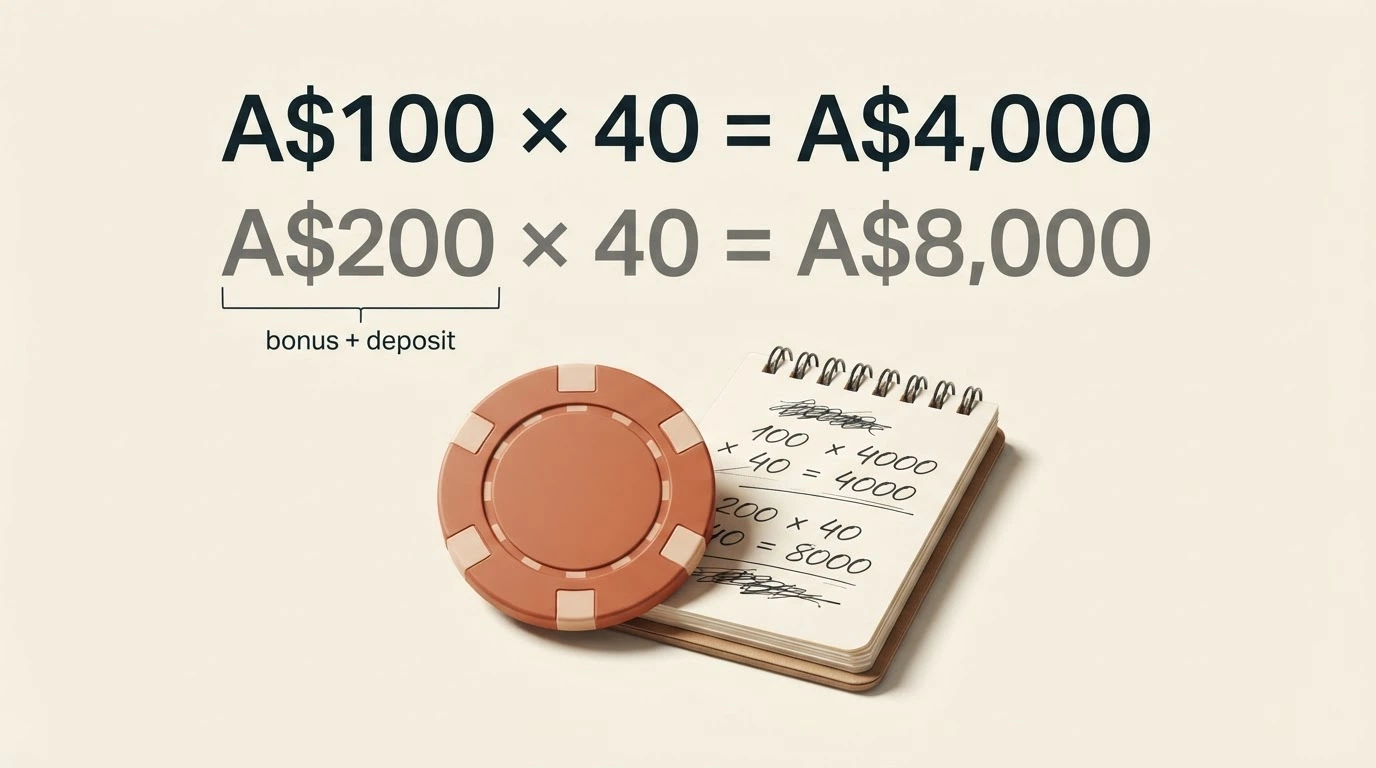
The canonical example, and the one that should be tattooed on the back of every reload bonus reader’s hand, is this. A A$100 bonus at 40x wagering on the bonus only requires A$4,000 in total bets. A A$100 bonus at 40x wagering on the bonus plus the deposit — where the player’s qualifying deposit was also A$100 — requires A$8,000 in total bets, because the wagering target is now 40x on A$200. Same headline. Same match percentage. Double the playthrough. The difference is buried in the wording, and the wording is what the marketing copy does not repeat.
The 2026 industry standard for reload bonus wagering sits between 30x and 40x. Operators at the lower end — Royal Reels runs 30x on its weekly reload — give the player a shorter path to withdrawable funds. Operators at the upper end — Rocket Play’s Friday Reload runs 40x on the spin winnings, Bizzo’s welcome runs 35x on the deposit plus the bonus — sit at or beyond the standard ceiling. SkyCrown’s Highroller Reload runs 35x on the bonus only, which is the friendlier structure even though the multiplier number looks comparable to Bizzo’s.
The max-bet cap stretches the time required. At Rocket Play’s A$7.50 max bet, clearing A$4,000 in turnover requires 534 spins. At a five-second interval, that is roughly 45 minutes of play, which is fast by any standard. But the A$4,000 turnover is the requirement, not the spend — the player’s actual loss depends on the return-to-player (RTP) of the games played, not on the turnover itself. A 96% RTP pokie means A$160 of expected loss on A$4,000 of turnover. A 94% pokie means A$240. The number that matters for the player’s wallet is the expected loss, not the turnover.
Validity windows, when they are short, also stretch the effective cost. A reload bonus that has to be cleared in 24 hours forces concentrated play, which on a pokie with high variance can blow through the bonus before any of the wagering is completed. A reload with 14 or 21 days lets the player spread the wagering across multiple sessions, reducing the variance hit.
The practical implication: a lower match percentage with lower wagering can beat a higher match percentage with higher wagering. A 25% reload at 30x bonus-only wagering on a A$100 deposit (bonus A$25, turnover A$750) is a much friendlier offer than a 100% reload at 40x on bonus plus deposit (bonus A$100, turnover A$8,000), even though the second offer looks more than three times as generous on the headline. The wagering structure, not the match percentage, is the figure that decides what the player actually pays.
Pokies vs Table Games: Where Your Bonus Actually Works
The reload bonus is designed for pokies. That is not a value judgement — it is a fact of how the bonus terms are written. Pokies almost universally contribute 100% of every bet toward the wagering target, while table games contribute a fraction, and progressive jackpots often contribute nothing at all. Playing the wrong game with a reload bonus active is the single fastest way to make the bonus unworkable.
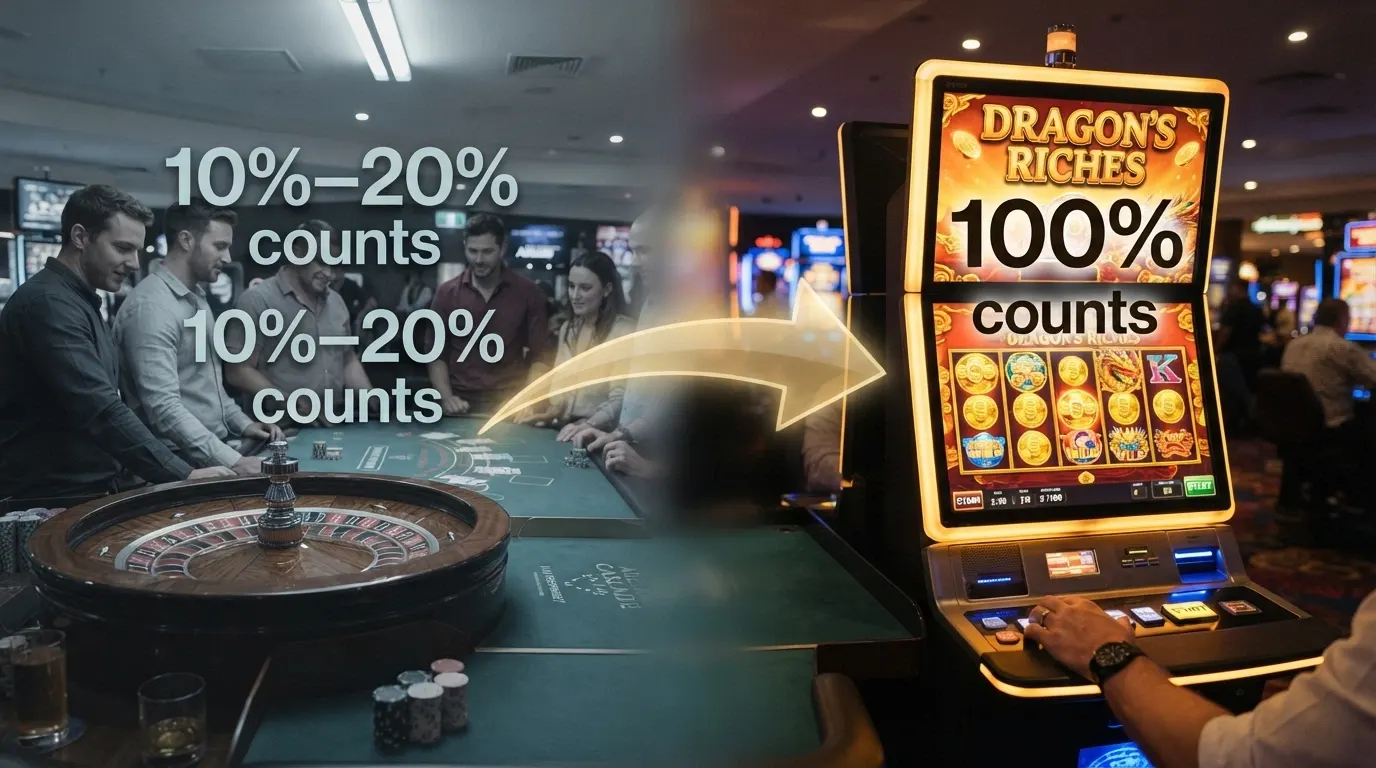
At AU-facing offshore casinos, the standard game contribution schedule runs along these lines. Pokies contribute 100% — a A$5 spin counts as A$5 of wagering. Table games (roulette, blackjack, baccarat, video poker) contribute 10% to 20% — a A$5 blackjack bet counts as A$0.50 to A$1.00. Progressive jackpots typically contribute 0% — every bet on a progressive pokie does not count toward wagering at all. Live dealer games, depending on the operator, contribute 0% to 10%, and many reload bonuses explicitly exclude them from wagering entirely.
The effect on clearing time is dramatic. A A$4,000 wagering target on pokies at 100% contribution can be cleared in roughly 800 spins at A$5 a pop. The same A$4,000 target cleared on a table game at 10% contribution requires 8,000 spins at A$5 a pop, because only A$0.50 of every A$5 bet counts. The bonus does not change. The game choice has multiplied the work by a factor of ten.
Fair Go’s terms state this most directly: pokies count in full toward wagering while table games do not count at all. The 100% figure for pokies and 0% for tables is the cleanest split, and it leaves no room for the player to think the contribution gap is small enough to ignore. Other operators soften the split to 100% pokies and 10% to 20% tables, but the underlying signal is the same: the bonus is built for the pokies, and the tables are decoration.
The steering effect on player behaviour is deliberate. Pokies have a higher house edge than most table games — a 96% RTP pokie has a 4% house edge, while a blackjack game with basic strategy can run at under 1% — which means the casino recoups a larger cut of the wagering turnover on pokies than on tables. Restricting the contribution rate to 100% on pokies and a fraction on tables is the operator’s way of ensuring the bonus clears on the games that pay the casino the best margin.
For the player, the consequence is a choice: either play pokies with the bonus active, or accept that the bonus will take ten times as long to clear. There is no clever workaround. Playing blackjack with a reload bonus active is a deliberate decision to spend more time and more money for the same outcome.
Reload Tiers, Frequency and VIP Loyalty Structures
The standard weekly reload is the floor of what an offshore casino offers a returning player. Above it sits a stack of tiered offers — highroller reloads with higher caps, cashback programmes that return a percentage of net losses, and loyalty ladder rewards that escalate with the player’s deposit history.
The highroller reload is the obvious next step. SkyCrown’s Highroller Reload — 50% up to A$2,500 at 35x wagering with a 21-day validity — is the largest reload cap among the operators reviewed on this page, and it is aimed at players who are depositing enough to clear the cap. A A$2,500 bonus on a A$5,000 deposit at 50% match requires A$87,500 in turnover to clear, which is a substantial playthrough and not the kind of offer a casual player would chase.
Cashback is the reload-adjacent offer that does not look like a reload but functions like one. SkyCrown’s Weekly Cashback returns 10% of net losses up to A$500 every Monday, with no wagering requirement on the cashback amount — the cashback is credited as withdrawable cash, not bonus funds. Across the Australian-facing market, cashback rates typically sit between 5% and 20% of net losses, paid weekly. The cashback is the operator’s way of softening the loss without changing the wagering structure, and for a player who has had a bad week, the cashback is often the only portion of the week’s play that converts to withdrawable funds.
Loyalty programmes add another layer. Jackpot Jill’s Quest loyalty programme, for instance, layers reload-style rewards (cashback, free spins, deposit matches) on top of the standard promotion calendar, with the rewards escalating as the player moves up the loyalty tiers. The specifics of the Quest reload structure vary by tier, so players should verify terms directly on the operator’s site.
Royal Reels rounds out the tier set with a weekly reload (up to 50% match, 30x bonus, pokies only, resets every seven days) layered alongside a Free Spin Friday and a cashback offer up to 15% — the Free Spin Friday and the cashback specifics were not confirmed this run, but the weekly reload terms are documented at the operator site.
The monthly reload is the slowest of the tiered offers, but it carries the longest validity window and the largest caps. SkyCrown’s monthly reload — 75% up to A$750 — runs on a calendar-month basis, and the 21-day validity on the highroller tier means a player does not have to clear the bonus in a single week.
The practical structure for a returning player looks like this: deposit on a Wednesday, Friday, Sunday or whenever the operator’s reload window opens; claim the reload and clear the wagering within the validity window; take any cashback credited at the start of the following week; and let the loyalty programme layer additional reload value on top as the player’s tier increases. The reload calendar is the spine of the retention offer, and the tiers are the muscle.
PayID and Crypto: Funding a Reload from Australia
The reload bonus is only as useful as the deposit that funds it, and for Australian players the deposit question is shaped by what is allowed under Australian rules. Credit cards and crypto are banned as payment for online wagering in Australia, a prohibition that commenced on 11 June 2024 and applies to every Australian-licensed operator. For offshore casinos — which are outside the Australian regulatory perimeter — the ban does not directly apply, but the practical effect is that an Australian funding a reload at an offshore casino with a credit card or crypto is being served by an operator outside Australian rules, with the consumer protections that implies.
The two deposit routes Australian players actually use at AU-facing offshore casinos are PayID (and its Osko rail) and cryptocurrency. Each route has its own mechanics, its own deposit floors, and its own quirks around reload bonus eligibility.
PayID is the AU-native instant payment system that links a bank account to a mobile number or email address. Deposits via PayID at AU-facing offshore casinos are fee-free, with minimums typically in the A$10 to A$30 range. The transfer clears in seconds via the Osko rail, which is the underlying real-time payment infrastructure operated by the New Payments Platform. For a player chasing a Friday reload window, PayID is the fastest fiat route available: the deposit is in the casino account before the reload offer can expire.
The catch with PayID is on the way out. PayID withdrawals are rarely supported at offshore casinos. The deposit is instant and fee-free, but the player is then forced to withdraw via bank transfer, an e-wallet, or a different method entirely. The asymmetry — fast in, slow out — is the operational reality of PayID at the offshore end of the market.
Crypto is the other major route. Bitcoin deposits at AU-facing offshore casinos typically require a A$20 to A$30 equivalent minimum for bonus activation, and the exchange-to-casino transfer takes between 1 and 15 minutes depending on the chosen coin and the network congestion. Bitcoin is the most common; Ethereum, Litecoin, and USDT are accepted at some operators. For an Australian player, crypto deposits are technically outside the Australian prohibition on crypto for licensed wagering — but the prohibition only applies to Australian-licensed operators, and the offshore casino accepting the deposit is not licensed in Australia in any case.
Bitcoin and Crypto Reload Bonuses at Offshore Casinos
Crypto reloads at offshore casinos mirror fiat reloads in structure, with two practical differences. The deposit minimum is stated in the coin’s currency rather than in Australian dollars, and the bonus eligibility sometimes — though not always — treats crypto deposits differently from fiat deposits. Some operators offer a higher match percentage on crypto deposits, or a separate crypto-only reload that does not appear in the fiat promotion calendar. Other operators treat crypto and fiat deposits identically for reload bonus purposes.
Bitcoin is the most commonly accepted coin, and the most commonly used by Australian players. The exchange-to-casino step is the bottleneck: the player buys Bitcoin on a CoinSpot, Swyftx, or similar AUSTRAC-registered Australian exchange, withdraws to a personal wallet, and then sends from the wallet to the casino’s deposit address. The exchange-to-wallet step can take 10 to 60 minutes depending on the exchange and the network. The wallet-to-casino step typically takes 1 to 15 minutes. The total time from “I want to deposit” to “the casino has the funds” is generally under 90 minutes for a player who has already bought Bitcoin and is sending from a funded wallet.
Altcoin deposits (Ethereum, Litecoin, USDT) are faster on the network side — Ethereum confirms in roughly 15 seconds to a few minutes, USDT on Tron is near-instant — but require the player to hold the altcoin in the first place. Australian exchanges support BTC, ETH, LTC, and a range of other coins, and the altcoin route is faster for an experienced crypto user. For a first-time crypto depositor, Bitcoin is the simplest path because every AU-facing offshore casino accepts it.
The reload bonus terms on crypto deposits are, at the operators reviewed on this page, the same as the fiat terms. The player deposits crypto, the deposit is converted to AUD or USD on the casino’s books at the prevailing rate, and the reload bonus is calculated on the AUD-equivalent deposit. The wagering requirement, the cap, and the validity window are the same whether the player funded the deposit in Bitcoin or in Australian dollars. The exceptions — operators that offer crypto-specific reloads with different terms — exist but are not the norm in the set reviewed here.
PayID: The AU-Native Deposit Route for Reloads
PayID is the deposit route most Australian players will reach for first, and it is the one the offshore casinos have spent the last two years integrating. The mechanics are the same as a PayID transfer to any other recipient: the player opens the casino’s deposit page, selects PayID, copies the casino’s PayID (a mobile number, email, or ABN), opens their banking app, enters the PayID, types the deposit amount, and confirms. The transfer arrives in the casino’s account within seconds, and the reload bonus is credited immediately if the deposit cleared the threshold.
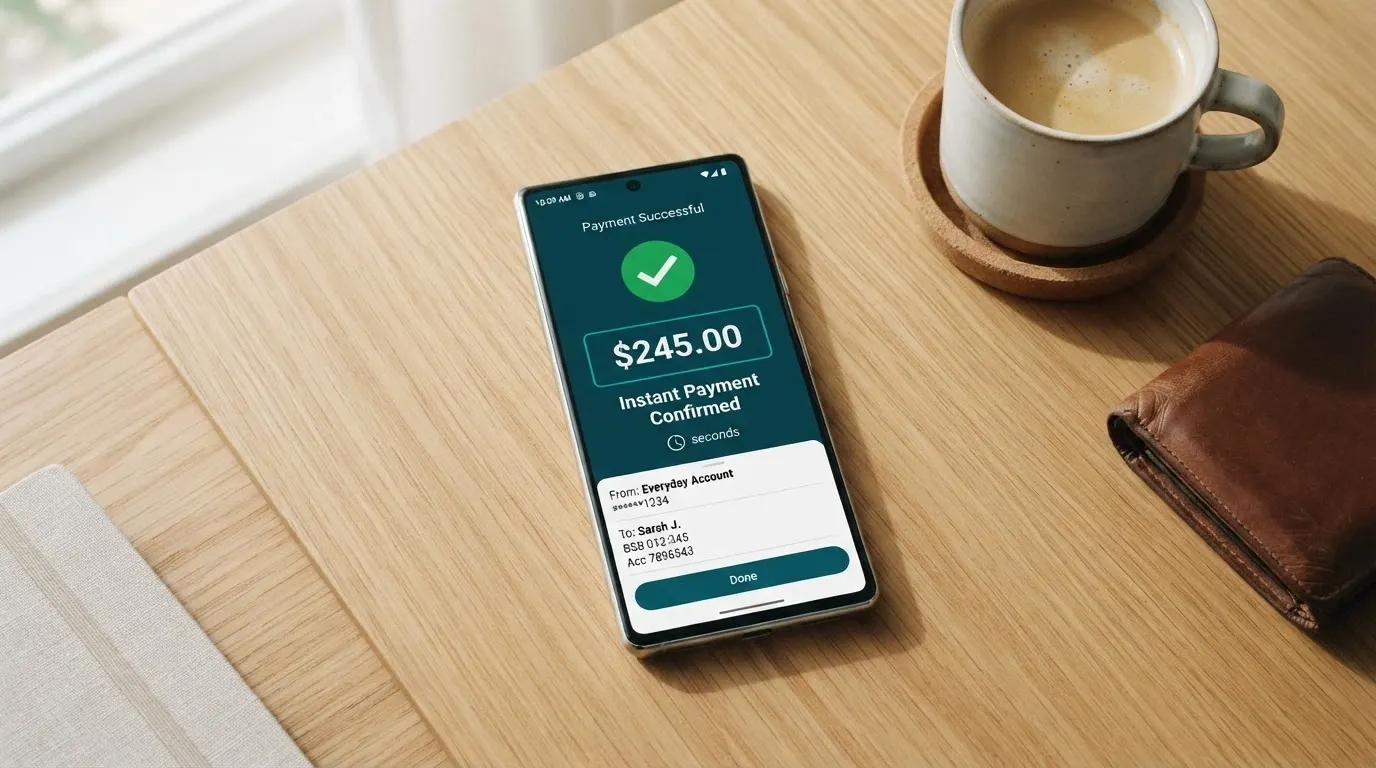
The deposit minimum is set by the casino, not by PayID. Most AU-facing offshore casinos set a A$10 to A$30 minimum for reload bonus eligibility, which sits comfortably above PayID’s own low-value transfer limits. There is no fee on the PayID side — the New Payments Platform does not charge for Osko transfers — and the offshore casino does not pass on a deposit fee.
Reload bonus eligibility with PayID is treated the same as any other fiat deposit at the operators reviewed. The casino does not differentiate between a PayID deposit, a bank transfer, or a debit card deposit for the purpose of qualifying a reload. The deposit method does not change the match percentage, the cap, or the wagering requirement. Where the casino has a deposit-method-specific restriction (rare for fiat, more common for Skrill and Neteller e-wallet deposits), PayID is usually on the eligible list.
The withdrawal asymmetry is the one to plan around. The player deposits via PayID in seconds. The player then requests a withdrawal, and the casino offers bank transfer, e-wallet, or — at a small number of operators — PayID withdrawal. Bank transfer withdrawals can take one to five business days; e-wallet withdrawals are faster but require the player to have set up an e-wallet account first. The PayID deposit is not a round-trip option. A player who wants the money out the same day it went in needs to fund the deposit by some method that also supports fast withdrawal — and at most AU-facing offshore casinos, that method is a cryptocurrency, not PayID.
Offshore Casinos and Australian Law: What the IGA Means for Your Reload Bonus
Every online casino offering a reload bonus to an Australian player is operating outside Australian law. The Interactive Gambling Act 2001 prohibits the provision of online casino games to people physically in Australia. There is no Australian licence for online casino, and there has never been one. The reload bonuses on this page are real offers, paid in real currency, by real operators — but the operators are Curaçao-licensed, Malta-licensed, or licensed in other offshore jurisdictions, and the activity of providing the reload bonus to an Australian is, on the Australian side of the transaction, illegal.
The Australian Communications and Media Authority (ACMA) is the federal regulator that enforces this prohibition. The ACMA investigates complaints about illegal online gambling services, issues formal warnings, refers operators for civil penalty proceedings, and — most visibly — directs Australian internet service providers to block illegal gambling and affiliate websites at the DNS level. Since the first blocking request in November 2019, the ACMA has had 1,564 illegal gambling and affiliate websites blocked, and more than 225 illegal services have voluntarily withdrawn from the Australian market. Between October and December 2025 alone, the ACMA blocked 133 websites, including alternate sites set up to evade earlier blocks.
The 2026 reform tightens the regulatory net further. The Interactive Gambling Amendment (Gambling Reform) Bill 2026 passed Parliament on 19 August 2026, and its measures commence on 1 January 2027. From that date, banks and payment providers gain express statutory authority to block transactions to illegal gambling operators — meaning an Australian depositing at an offshore casino may find the transaction declined by their bank, even if the offshore casino’s own processing would have allowed it. The reform also restricts wagering advertising (no more than three wagering ads per hour between 6:00 am and 8:30 pm, no wagering advertising from 15 minutes before a live sporting event until 5 minutes after it ends, no inducement marketing for 14 days after a customer signs up, three months after BetStop deregistration, and indefinitely for at-risk customers) and establishes a national wagering advertising opt-out register known as AdStop.
For the player, the IGA does not criminalise the act of placing a bet. The Act targets the provider of the prohibited interactive gambling service, not the individual customer. There is no prosecution risk for the Australian player. The risk the player carries is the one the Act does not address: the absence of every Australian safeguard that applies to licensed wagering.
There Is No Australian Online Casino Licence — and What That Means
Australia does not license online casino. There is no state, no territory, no federal authority that issues a licence to provide online casino games, online pokies, or in-play sports betting to people in Australia. The Interactive Gambling Act 2001 prohibits the provision of these services; the Interactive Gambling Amendment Act 2017 closed the loopholes offshore operators had used; the ACMA enforces the prohibition through site blocking, civil penalties, and formal warnings.

This means a page that ranks “the best licensed online casinos in Australia” is describing something that does not exist. The subject of the ranking is real — Australians do play at offshore casinos, and the reload bonuses are real offers — but the licensing is not Australian, because Australian licensing for this product is not available.
The operators that reach Australian players are Curaçao-licensed, Malta-licensed, or licensed by other offshore regulators. The Curaçao Gaming Control Board is the most common issuer across the set reviewed on this page: Rocket Play, SkyCrown, Stake, BitStarz, and Fair Go all hold or claim Curaçao licences. Curaçao licensing is a real regulatory framework — the GCB issues licences, monitors operators, and can revoke them — but it is not Australian, and an Australian consumer protection that depends on Australian law does not reach a Curaçao-licensed operator.
DNS-level site blocking is the ACMA’s primary enforcement mechanism against the offshore operators. When the ACMA issues a blocking request to an Australian ISP, the ISP adds the operator’s domain (and any associated mirror domains) to a block list, and Australian customers trying to access the site receive an error page or a redirect to an ACMA information page. The blocks are not unbeatable — VPNs and mirror sites can route around them — but they are the visible, daily friction that offshore operators face in the Australian market.
The practical effect on a player claiming a reload bonus is that the casino’s site may be intermittently inaccessible from an Australian IP address, and the player may need to use a mirror URL or alternate access method to reach the operator during a reload window. The bonus itself is unaffected by the block — it is credited and cleared on the operator’s platform, not on the player’s network — but the access friction is real.
The ACMA, Site Blocking and the 1,564 Sites Already Shut Down
The scale of the ACMA’s blocking activity is the most concrete evidence of the prohibition’s reach. The 1,564 blocked sites, accumulated over six years of enforcement, include both casino operator domains and affiliate sites that promoted them. The 225-plus services that have voluntarily withdrawn from the Australian market since 2017 are the quieter statistic: operators who, faced with the prospect of formal ACMA action, simply stopped serving Australian customers rather than fight the regulator.
The Q4 2025 blocking figure — 133 websites between October and December 2025, including mirror sites set up to evade earlier blocks — shows the enforcement is accelerating, not slowing. The ACMA’s blocking list updates monthly, and the operator’s mirror domains are added as they appear.
The 2026 reform changes the enforcement toolkit. From 1 January 2027, banks and payment providers gain express authority to block transactions to illegal gambling operators, which means the ACMA can target the financial pipeline rather than just the website. An Australian player whose bank declines a transaction to a known offshore casino will not be able to fund the reload through that bank, and the operator’s deposit-processing partners may face liability for processing the transaction. The reform does not make the player a target — the IGA still targets the provider — but it does add a new enforcement vector that the offshore operators will have to navigate.
The 2026 reform’s advertising and inducement restrictions are aimed at licensed Australian wagering operators and at offshore operators marketing to Australians. The ban on inducement marketing — 14 days after sign-up, three months after BetStop deregistration, and indefinitely for at-risk customers — applies to the marketing activity, not to the bonus itself. An offshore casino offering a 50% Sunday reload to existing players is, on the terms of the reform, marketing an inducement to an Australian and is in scope of the restriction. Whether the restriction will be enforced against an offshore operator is a question the ACMA and the courts will work out from 2027 onwards.
The AdStop register — the national wagering advertising opt-out register enacted in the 2026 reform — gives Australian consumers a single mechanism to opt out of wagering advertising across all licensed platforms. AdStop is administered by the ACMA and funded by a cost-recovery levy on wagering companies. It is not expected to be operational by 1 January 2027 and is likely to commence on a later day fixed by proclamation.
What Protections You Give Up Playing Outside the Licensed Market
An offshore casino reload bonus sits outside every Australian safeguard. The list of what the player gives up is the list of what an Australian-licensed wagering operator must provide — and the offshore casino is not required to provide any of it.
No BetStop coverage. BetStop, the National Self-Exclusion Register, launched in August 2023 and lets a person self-exclude from every Australian-licensed wagering service in a single step. The register covers approximately 150 licensed wagering providers. It does not cover a single offshore casino. A player who has registered with BetStop and self-excluded for the minimum three months will still be able to open an account at an offshore casino, deposit funds, claim a reload bonus, and play. The offshore casino is not connected to the register, has no obligation to check it, and will continue accepting a self-excluded person’s money.
No Australian consumer protection or complaints body. An Australian-licensed wagering operator is subject to Australian Consumer Law, to state and territory gambling regulator oversight, and to dispute resolution through bodies like the Australian Financial Complaints Authority (for financial disputes) and the relevant state gambling commissioner. An offshore casino is subject to the consumer protection regime of its licensing jurisdiction, which is typically Curaçao, Malta, or another offshore regulator. An Australian player with a complaint about a refused withdrawal, a voided win, or an unfair term has no Australian body to escalate to. The dispute resolution process runs through the offshore licensing authority, and the time, cost, and language of that process is outside the Australian framework.
No mandatory deposit limits or activity statements. Australian-licensed wagering operators must offer customer-set deposit limits and activity statements under their state or territory conditions. The deposit limit is a tool the player can set, and the activity statement is a regular summary of the player’s gambling activity sent to the player by the operator. Offshore casinos may offer these features voluntarily, but they are not required to, and the operator is not subject to Australian enforcement if it does not.
Withdrawal risk. The most common complaint at offshore casinos is a refused or delayed withdrawal. The operator may require additional verification (proof of address, source of funds, photos of the credit card used to deposit) before releasing funds, and the verification process can stretch over weeks. The player has no Australian complaints body to escalate to if the operator refuses to release the funds. The bonus terms may include clauses that allow the operator to void winnings if the player breaches a max-bet cap or plays a restricted game — and the player may not realise they have breached the cap until the withdrawal is declined.
Site-blocking risk with a balance still on the account. If the ACMA blocks the operator’s domain while the player has an active balance, the player can no longer access the account to withdraw. The player will need to reach the operator through a mirror URL, a VPN, or a customer support channel — and if the operator has effectively withdrawn from the Australian market, the player may find that none of those routes work. The 225-plus services that have voluntarily withdrawn from the Australian market since 2017 are the precedent: an operator that decides the Australian market is no longer worth the regulatory pressure simply stops serving Australian customers, and the balances on Australian accounts are part of what the operator walks away from.
Playing Safely: Responsible Gambling Tools and Offshore Reality
The responsible-gambling framework that protects Australian players at licensed wagering operators does not travel offshore. BetStop, deposit limits, take-a-break features, and activity statements are mandatory at Australian-licensed operators. At offshore casinos, every one of these is voluntary — offered by some operators, not by others, and enforceable by no Australian authority.
The Australian harm picture is the reason this section exists. As of March 2026, 13.0% of the Australian population — an estimated 2,857,000 people — were experiencing some form of gambling harm from their own gambling behaviours. A model-based estimate published in the Journal of Gambling Studies puts the broader figure at approximately 3.29 million Australians aged five and over affected annually, including approximately 1.97 million adults classified as having at-risk or problem gambling. A separate Roy Morgan figure reports 15.1% of Australian adults — 3.32 million people — experiencing some level of gambling harm from their own or others’ gambling. Whichever figure is cited, the order of magnitude is the same: gambling harm in Australia is measured in millions of people, not thousands.
The reload bonus is, by design, a tool that brings players back. The line between a recurring entertainment expense and a problem sits in behaviour patterns, not in deposit amounts. The pattern to watch is chasing losses through reloads, depositing more than planned to hit a reload threshold, hiding play from family or friends, neglecting other spending to fund a reload, and using gambling to escape stress. None of these is a deposit figure; all of them are signals.
BetStop and Self-Exclusion: What Actually Reaches an Offshore Casino
BetStop is the single biggest protection Australian players give up when they move offshore. Launched on 21 August 2023, the register lets a person self-exclude from every Australian-licensed online and phone wagering service in a single step, for a minimum of three months up to a lifetime. The registration process takes minutes, the exclusion takes effect across all approximately 150 licensed wagering providers simultaneously, and the operator is legally required to refuse the person’s deposits, close any existing accounts, and not market to the person for the duration of the exclusion.

The catch is the word “licensed.” An offshore casino is not licensed in Australia and is not connected to the BetStop register. The BetStop exclusion will close every Australian-licensed account the player has, but the offshore casino account remains open. A self-excluded player can still deposit at the offshore casino, claim a reload bonus, and play. The offshore casino is not required to check BetStop, has no obligation to honour the exclusion, and is not subject to Australian enforcement if it ignores the exclusion.
As of 31 December 2025, 54,859 people had registered with BetStop, of whom 35,135 had active exclusions. The figures are reported by the ACMA quarterly. The exclusions run for a minimum of three months, with longer periods (one year, five years, lifetime) available. Deregistration after the minimum exclusion period involves a 24-hour cooling-off period, and the person is then allowed to open new accounts at licensed operators.
The offshore gap is the practical harm. A player who recognises a problem and registers with BetStop has taken the strongest available step to stop wagering with Australian-licensed operators — but the offshore casinos are still accepting their money, and the reload bonus is the mechanism that brings them back. The 2026 reform’s three-month post-deregistration ban on inducement marketing is aimed at this exact problem on the licensed side, but the offshore side is outside the reform’s reach.
Deposit Limits, Take-a-Break and Activity Statements
Australian-licensed wagering operators are required to offer customer-set deposit limits and activity statements under their state or territory conditions. The conditions differ between jurisdictions — the Northern Territory, New South Wales, Victoria, and other states each set their own requirements — but the broad features are consistent.
A deposit limit is a tool the player sets themselves: a daily, weekly, or monthly ceiling on the amount the player can deposit, which the operator must enforce. The player can lower the limit immediately and can raise it only after a 24-hour or 7-day cooling-off period (depending on the jurisdiction), which is designed to prevent a player from raising the limit on impulse during a losing session.
A take-a-break feature lets the player suspend their account for a short period — typically 24 hours to 90 days — without going through the full BetStop exclusion process. The account is locked, no deposits can be made, and the player cannot log in for the duration of the break.
An activity statement is a regular summary of the player’s gambling activity: deposits, withdrawals, net position, time spent on the site. The statement is sent to the player on a monthly or quarterly basis and is intended to give the player a clear picture of their own gambling behaviour over time.
At an offshore casino, none of these tools is mandatory. Some operators offer deposit limits and take-a-break features voluntarily; others do not. The activity statement is even rarer. And the enforcement is absent — if an offshore casino fails to honour a deposit limit a player has set, the player has no Australian body to escalate to. The player is relying on the operator’s own willingness to enforce the limit, which is the same entity that profits from the deposit.
Spotting Problem-Play Signs Before a Reload Becomes a Habit
The behavioural signs of problem gambling are well-documented, and they apply as much to a player claiming a weekly reload as to a player at a land-based casino. The reload bonus is designed to keep the player depositing; the line between entertainment and problem sits in whether the player can stop.
The patterns to watch:
- Chasing losses by claiming reload bonuses specifically to recover a previous session’s losses. The reload becomes a tool for trying to win back money already lost, not a perk for an entertainment session the player was going to have anyway.
- Depositing more than the planned amount to hit a reload threshold. A player who decides to deposit A$300 instead of A$100 because the reload threshold is A$200 has let the bonus structure drive the deposit, not the player’s own budget.
- Hiding reload play from family or friends. A player who does not mention the Sunday reload, or who clears browser history after a session, is signalling that they know the play is outside what the people around them would consider reasonable.
- Neglecting other spending to fund a reload. A player who skips a bill, delays a purchase, or borrows to fund a reload deposit has moved from entertainment to financial pressure.
- Using gambling to escape stress, boredom, or negative emotion. The reload becomes a coping mechanism rather than a leisure activity.
The 2,857,000 Australians experiencing gambling harm from their own gambling are not a separate population from the people claiming reload bonuses — they overlap heavily. The reload bonus does not cause problem gambling, but it is a mechanism that the problem gambler will use more intensively than the casual player.
Where to Get Help: 1800 858 858, Counselling and Support
Australia’s gambling-help infrastructure is free, confidential, and available 24/7. The resources are concrete and staffed by professionals, not footnotes.
The National Gambling Helpline is 1800 858 858. It is free, confidential, and staffed 24 hours a day, 7 days a week. The helpline offers immediate counselling, crisis support, and referral to ongoing services. It is the single most direct route to help for a person who recognises their own gambling is becoming a problem.
Gambling Help Online (gamblinghelponline.org.au) provides live chat, email counselling, and self-help resources. The online service is operated by the Department of Social Services and is staffed by professional counsellors. The self-help modules cover budgeting, identifying triggers, and building a recovery plan.
BetStop (betstop.gov.au) is the National Self-Exclusion Register. Registration takes minutes, and the exclusion runs from a minimum of three months to a lifetime. The exclusion covers every Australian-licensed wagering service — approximately 150 operators — and takes effect across all of them simultaneously.
Financial counselling is available through DSS-funded services for people affected by gambling harm. A financial counsellor can help with debt restructuring, budgeting, and negotiating with creditors. The service is free and confidential.
The scale of harm in Australia is the context for why these resources exist and why the offshore gap matters. The 1.97 million adults classified as at-risk or problem gambling are not abstract figures — they are the people who will find the offshore casinos easiest to access and the hardest to escape.
Reload Bonuses Compared: 10 Offshore Casinos Ranked for Australian Players
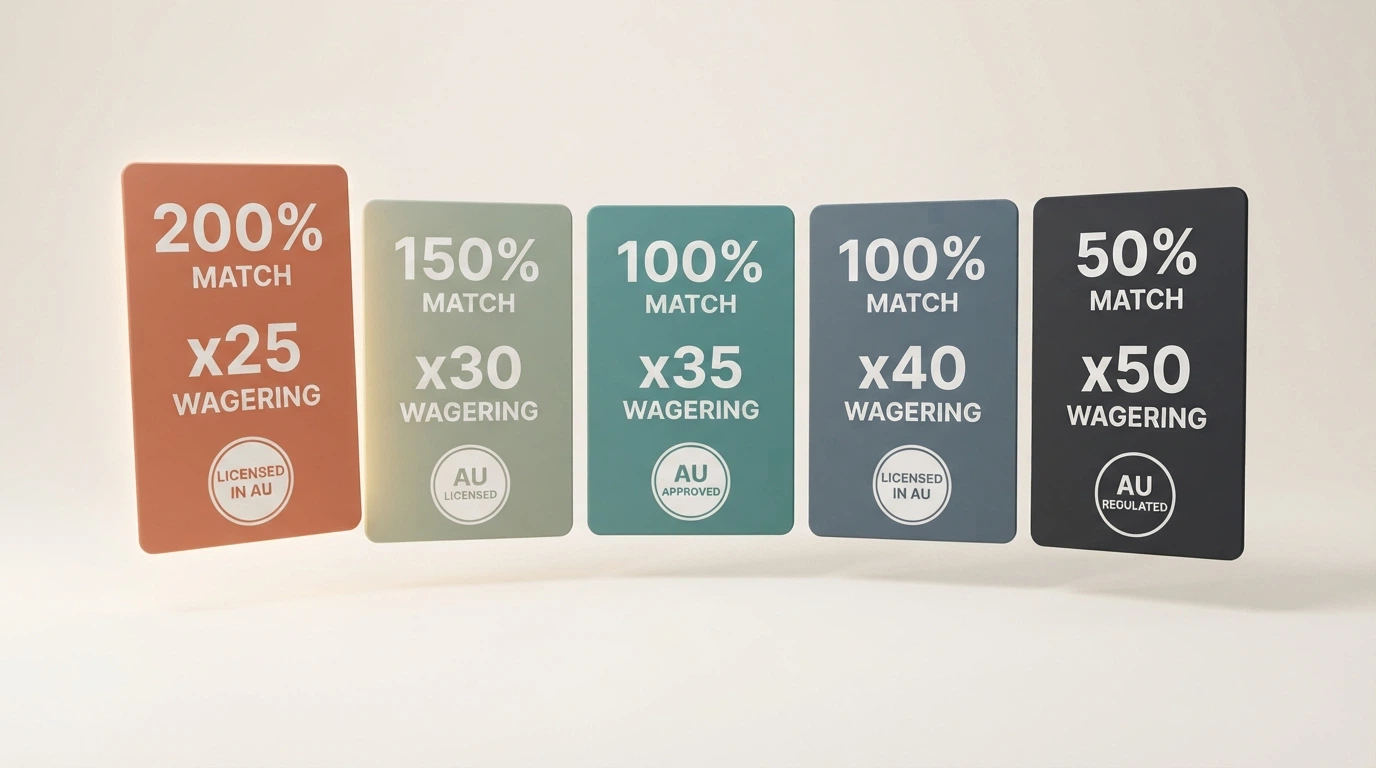
The table below ranks ten offshore casinos offering reload bonuses to Australian players. The ranking is by reload bonus value, weighted toward the wagering structure rather than the match percentage — a 30x bonus-only wagering beats a 50% match with 40x deposit-plus-bonus, every time. All ten operators are offshore, and none holds an Australian licence. The “Licence / Status” column reflects the operator’s own claims and the licensing data available this review.
| Operator | Licence / Status | Reload Bonus | Wagering on Reload | Free Spins on Reload | Bonus Validity |
|---|---|---|---|---|---|
| Rocket Play | Offshore — Curaçao GCB OGL/2024/1307/0748. NOT licensed in Australia. | Friday Reload (20/50/100 spins for A$30/75/150+); Sunday Bonus 50% up to A$300 | 40x | 20–100 spins (Friday) | 24 hours (Friday); 2 days (Sunday) |
| SkyCrown | Offshore — Curaçao-licensed. NOT licensed in Australia. | Sunday Reload 100% up to A$300 + 50 FS; Highroller 50% up to A$2,500 | 40x (Sunday); 35x (Highroller) | 50 FS (Sunday) | Sundays only (Sunday); 21 days (Highroller) |
| Royal Reels | Offshore — licence not confirmed from operator site this run. NOT licensed in Australia. | Weekly Reload up to 50% match | 30x bonus (pokies only) | — | 7-day reset |
| Bizzo Casino | Offshore — licence not confirmed from operator site this run. NOT licensed in Australia. | Wednesday Reload 50% up to A$500 (opt-in required) | 35x deposit + bonus | 25 FS every Monday (A$200+ wagered previous week) | 21 days |
| Fair Go | Offshore — Curaçao-licensed (RTG platform). NOT licensed in Australia. | 50%–125% match reload bonuses | 30x deposit + bonus (deposit); 60x (no-deposit) | Varies | 24 hours to 30 days |
| Jackpot Jill | Offshore — licence not confirmed from operator site this run. NOT licensed in Australia. | Cashback, reload offers, Quest loyalty rewards | 35x bonus (welcome context) | — | 7 days per stage (welcome) |
| Stake | Offshore — Curaçao-licensed. NOT licensed in Australia. | Ongoing reload and cashback promotions | — | — | — |
| WinSpirit | Offshore — licence not confirmed from operator site this run. NOT licensed in Australia. | Reload bonus terms to be verified | — | — | — |
| Scream Casino | Offshore — licence not confirmed from operator site this run. NOT licensed in Australia. | Reload bonus terms to be verified | — | — | — |
| BitStarz | Offshore — Curaçao-licensed. NOT licensed in Australia. | Weekly reload promos and tournaments | 40x | — | 7 days |
The columns reflect only what was confirmed from operator-site or third-party review sources this review. The em-dash entries are fields where specific reload terms were not confirmed and the operator should be verified directly. No invented figures have been added to fill the gaps.
Rocket Play: Curaçao-Licensed with a Friday Free-Spin Reload and Sunday Match
Rocket Play is operated by Scores55 Tech B.V., a company registered in Curaçao under registration number 162990 and licensed by the Curaçao Gaming Control Board under licence number OGL/2024/1307/0748. The operator is not licensed in Australia, because no such licence is available. Rocket Play’s game library runs across 100-plus providers, with BGaming and Pragmatic Play among the studio names in the catalogue.
The reload structure splits across two weekly windows. The Friday Reload is a free-spin drop scaled by deposit size: A$30 unlocks 20 spins, A$75 unlocks 50 spins, and A$150 or more unlocks 100 spins. The spins are valid for 24 hours from the time they are credited, the wagering on spin winnings is 40x, and the maximum win from the spins is capped at A$3,000. The operator’s general maximum win from registered free spins is A$300, and the Friday Reload’s higher cap is a specific feature of this offer.
The Sunday Bonus is a 50% match up to A$300 on a minimum deposit of A$30. The bonus is valid for two days and carries 40x wagering on the bonus amount. Rocket Play’s default max bet during wagering is A$7.50, and the operator’s default bonus validity is five days from receipt unless otherwise indicated.
The wagering on both offers is 40x, which is at the upper end of the industry standard. The 24-hour window on the Friday free spins is short enough that a player who claims the spins on Friday evening and does not play until Saturday will lose them. The Sunday Bonus’s two-day window is more forgiving but still requires concentrated play. For a player who wants a lower-friction reload, the wagering and the validity windows are the reasons Rocket Play does not sit at the top of the ranking.
SkyCrown: The Highest Reload Ceiling with a Highroller Tier
SkyCrown’s welcome package is the largest on the page — up to A$8,000 plus 400 free spins across four deposits, with 40x wagering on the bonus amount only, 30x on free spin winnings, a minimum deposit of A$20, a max bet of A$5 per spin or hand, and 14-day validity per tier. The welcome is generous, but the reload structure is where SkyCrown differentiates.
The Sunday Reload is 100% up to A$300 plus 50 free spins, available on Sundays only, with 40x wagering on the bonus and 30x on free spin winnings. The 100% match is double Rocket Play’s Sunday match, and the A$5 max bet is lower than Rocket Play’s A$7.50, which means more spins are required to clear the same turnover but the per-spin cap is tighter. The free-spin winnings are capped at 10x the bonus value, which is a higher cap than Rocket Play’s A$300 default but lower than the Friday Reload’s A$3,000.
The Highroller Reload is the standout offer. 50% up to A$2,500 at 35x wagering with a 21-day validity is the largest reload cap and the longest validity window in the set. The 35x wagering is lower than the Sunday Reload’s 40x, and the 21-day window is long enough to spread the playthrough across multiple sessions. For a player depositing enough to clear the A$2,500 cap — a A$5,000 deposit at 50% match — the A$87,500 in required turnover is substantial, but the per-spin A$5 max bet and the 21-day window make the playthrough workable.
The Weekly Cashback is the reload-adjacent offer: 10% of net losses up to A$500, credited every Monday, with no wagering requirement. The cashback is real withdrawable cash, not bonus funds, and it is the friendliest term in SkyCrown’s reload structure. A player who has a bad week can recover up to A$500 of it the following Monday without further wagering.
SkyCrown sits near the top of the ranking because of the highroller reload’s combination of high cap, lower wagering, and long validity, and because the weekly cashback gives the player a second reload-adjacent offer with no wagering attached. The 40x on the standard Sunday Reload is the reason it is not at the very top — Royal Reels’ 30x on the weekly reload is a more accessible playthrough.
Royal Reels: A 50% Weekly Reload at 30x — the Lowest Wagering in the Set
Royal Reels runs a weekly reload of up to 50% match on a minimum A$20 deposit, with 30x wagering on the bonus amount, pokies only, resetting every seven days from the player’s last claim. The 30x is the lowest reload wagering multiplier among the operators with confirmed terms on this page, and the combination of 30x on the bonus only (not on the bonus plus the deposit) and the pokies-only restriction gives the player a clear, achievable path through the wagering.
The welcome bonus context is a 100% match up to A$500 on a minimum A$10 deposit, with 35x wagering on the bonus amount, valid on pokies. The lower welcome wagering than the reload’s 30x is unusual — most operators stack the wagering the other way — but the reload’s 30x is the figure that matters for this ranking. Royal Reels’ average wagering across all bonuses is 31x, which is consistent with the 30x reload and 35x welcome averaging out.
The Free Spin Friday and the cashback up to 15% are part of Royal Reels’ reload structure, though the specific terms of those offers were not confirmed from operator-site sources this review. Players should verify the Free Spin Friday’s spin count, game, wagering, and max win directly on the Royal Reels site before claiming.
The 30x reload wagering is the reason Royal Reels sits near the top of the ranking. A A$100 deposit at 50% match (A$50 bonus) at 30x bonus-only requires A$1,500 in turnover, which at A$5 a spin on a pokie is 300 spins — roughly 25 minutes of continuous play. The same A$100 bonus at 40x on bonus plus deposit would require A$8,000 in turnover, which is more than five times the work. The lower wagering multiplier is the single most useful figure on the reload page, and Royal Reels has the lowest one in the set.
Bizzo Casino: Wednesday Opt-In Reload with a Monday Free-Spin Reward
Bizzo Casino runs a Wednesday Reload of 50% up to A$500, and the offer requires the player to opt in via the promotions page before depositing. The opt-in requirement is the most-missed step in any reload offer, and at Bizzo the consequence of missing it is that the bonus is not credited, even if every other condition is met. A player who deposits on Wednesday without first ticking the offer in the promotions tab will play the deposit as cash and forfeit the reload.
The wagering on the welcome package is 35x on the deposit plus the bonus, with a 21-day bonus expiry and a A$0.20 free-spin value. The reload’s wagering was not separately specified in the operator’s confirmed terms, and the 35x deposit-plus-bonus figure from the welcome is the closest reference point. The default max bet during wagering is A$5, which is the lower end of the A$5 to A$8 industry range.
The Monday free-spin reward is the reload-adjacent offer: 25 free spins every Monday if the player wagered A$200 or more in the previous week. The spins are credited to a nominated game, and the winnings are subject to the standard wagering. The structure rewards consistent play — the player who wagers A$200 or more in a week gets 25 free spins the following Monday, and the cycle repeats. A player who deposits on a Wednesday and plays through the week will hit the Monday free-spin target if the play is active enough.
Bizzo sits in the middle of the ranking because the opt-in requirement and the 35x deposit-plus-bonus wagering make the Wednesday Reload more work to claim and to clear than Royal Reels’ 30x. The Monday free spins are a useful retention mechanism, but they are an additional reward for play rather than a standalone reload.
Fair Go: RTG-Powered with 50%–125% Reload Matches and 30x Wagering
Fair Go runs on the RealTime Gaming (RTG) platform, which is a different software stack from the multi-provider aggregators that power most of the other operators on this page. RTG’s game library is smaller and more focused on pokies, and the bonus terms at Fair Go are written specifically for that library.
The reload match range — 50% to 125% — is the highest in the set. A 125% reload on a A$100 deposit credits A$125 in bonus funds, which is more than the 100% matches at SkyCrown and BitStarz. The wagering on deposit bonus coupons is 30x on the deposit plus the bonus, which is a heavier structure than Royal Reels’ 30x on the bonus only but lighter than Bizzo’s 35x. The no-deposit bonus carries 60x playthrough on winnings, which is roughly double the standard reload wagering.
Game contribution at Fair Go is the cleanest split on the page: pokies count in full toward wagering, and table games do not count at all. The 100% / 0% split leaves no room for a player to think the contribution gap is small enough to ignore. If the bonus is active, the player is on the pokies.
The reload validity window runs from 24 hours to 30 days depending on the specific offer. A 24-hour reload at 30x on deposit plus bonus forces concentrated play, which on a pokie with high variance can be costly. A 30-day reload gives the player a full month to spread the wagering, which is the most generous validity window in the set.
The specific reload match tiers — the deposit sizes that trigger the 50% versus the 75% versus the 125% — were not confirmed from operator-site sources this review, and the range figure is the best available. Players should verify the specific match tier for their intended deposit size directly on the Fair Go site.
Jackpot Jill: Five-Stage Welcome, Cashback Reloads and a Quest Loyalty Ladder
Jackpot Jill’s reload value sits in its cashback offers and the Quest loyalty programme rather than a fixed weekly match. The welcome package reaches up to A$7,500 plus 100 free spins across five deposit stages, with 35x wagering applied to the bonus amount only and a 7-day window per stage. The welcome is substantial, but the reload structure is where a returning player finds ongoing value.
The cashback reloads and the Quest loyalty rewards were not confirmed at specific match rates or wagering terms this review. The Quest loyalty programme is structured as a tiered ladder, with the rewards escalating as the player moves up the tiers, and the cashback offers are layered on top of the standard promotion calendar. A player who has reached a higher Quest tier will see larger reload matches, faster cashback cycles, and additional free-spin drops.
The 7-day window per welcome stage is the shortest validity in the set. A player who claims the first welcome stage and does not return within seven days forfeits the bonus funds. The 35x bonus-only wagering is the friendlier structure — bonus-only is half the playthrough of bonus-plus-deposit at the same multiplier — but the 7-day window is tight.
Jackpot Jill sits in the middle of the ranking because the reload structure is real but the specific terms are less documented than the reload-heavy operators. A player who values the cashback-and-loyalty model over a fixed weekly match will find the structure suits them; a player who wants a clearly specified weekly reload percentage should look at Royal Reels or SkyCrown.
Stake: Crypto-First Reload and Cashback Promotions
Stake operates a crypto-first platform under a Curaçao licence, and the reload model is built around ongoing crypto promotions rather than a fixed weekly match. The platform’s Australian-facing reload structure runs through a combination of deposit-match reloads, cashback offers, and tournament-based promotions, with specific match rates and wagering varying by region and by the player’s deposit history.
The Australian-market reload terms were not confirmed at specific figures this review. The operator’s general reload structure is documented at the operator site, and players should verify the current Australian-specific reload match, wagering, and free-spin terms directly on Stake before claiming.
The crypto-native deposit and withdrawal flow is the practical advantage. Bitcoin, Ethereum, Litecoin, and USDT are all supported, and withdrawals are typically processed within minutes to a few hours depending on the coin and the network. For a player funding a reload with Bitcoin, the deposit is in the account within 1 to 15 minutes, and the reload bonus is credited on the AUD-equivalent deposit. The wagering and the cap are calculated in the same currency as the deposit.
Stake sits in the lower half of the ranking for the specific reason that the reload terms are not confirmed for the Australian market at the specificity of the operators above it. The platform is real, the AU player traffic is real, and the reload model is real — but the specific match rate and wagering for an Australian player claiming a reload this month were not surfaced in search results this run.
WinSpirit: Offshore Casino with AU Market Presence
WinSpirit reaches Australian players with real traffic, and the operator’s reload bonus structure is part of its Australian-facing promotion calendar. The specific reload match rates, wagering multipliers, and free-spin terms were not confirmed from operator-site sources this review, and players should verify the current terms directly on the WinSpirit site.
The inclusion in the ranking is based on confirmed Australian market presence — the operator is reaching Australian players with real deposits — rather than on confirmed reload terms. A player evaluating WinSpirit against the other operators on this page should treat the reload terms as “to be verified” until the operator’s site is consulted directly.
Scream Casino: Offshore Operator with Unconfirmed Reload Terms
Scream Casino is included on the strength of its Australian player traffic, and the specific reload bonus figures were not surfaced in search results this run. The operator’s reload structure requires direct verification on the Scream Casino site, and the specific match rates, wagering, and free-spin terms should not be assumed from the ranking position alone.
The ranking position — near the bottom — reflects the documentation gap, not a judgement that the reload terms are worse than the operators above. A player who has already deposited at Scream Casino and wants to know whether the reload is worth claiming should check the operator’s promotions page directly.
BitStarz: Multi-Crypto Reload Promos and Weekly Tournaments
BitStarz runs weekly reload promotions and tournaments under a Curaçao licence, with the welcome package reaching up to 5 BTC plus 180 free spins across four deposits at 40x wagering and 7-day bonus validity. The reload value sits in the ongoing promotions and the tournament structure rather than a fixed weekly match.
The weekly reload promos and the tournament prizes vary by week and by the operator’s current promotion calendar. The 40x wagering on the welcome is at the upper end of the industry standard, and the 7-day validity is short. The reload’s specific terms were not confirmed at a fixed match rate this review, and the ongoing nature of the reload promos means the player should check the BitStarz promotions page for the current week’s offer.
The multi-crypto support (Bitcoin, Ethereum, Litecoin, Bitcoin Cash, Dogecoin, and USDT) is the practical advantage for a player funding reloads with cryptocurrency. The exchange-to-casino transfer takes 1 to 15 minutes, and the reload bonus is calculated on the AUD-equivalent deposit at the prevailing rate. For a player who already holds crypto, the reload funding is fast and the bonus is credited in the same currency-equivalent.
How We Evaluated These Reload Bonuses
The ranking is built from three sources: the operators’ own bonus terms pages, third-party casino-review data (CasinoAudit, SlotsPeak, AustraliaPokies, and similar), and the ACMA’s public enforcement record. The operator selection is the set of offshore casinos from the operators skill that serve Australian players with real traffic, capped at ten operators for the ranking.
The evaluation criteria, in order of weight:
- Wagering structure (bonus-only vs bonus-plus-deposit, and the multiplier itself). A 30x bonus-only wagering beats a 50% match with 40x deposit-plus-bonus.
- Bonus validity window. A 21-day window is more forgiving than a 24-hour window, and the window is what determines whether the player can clear the bonus without concentrated play.
- Free-spin terms on the reload (max win cap, wagering on spin winnings, eligible games).
- Reload match percentage and cap, as a tiebreaker.
- Licence transparency (whether the operator’s licence number and licensing body are confirmed from the operator site).
The criteria are not weighted in percentages — no operator gets a numeric “score” — and the ranking is the editorial call based on the criteria above. Operators whose reload terms were not confirmed at the same level of specificity as the others are ranked below the operators with confirmed terms, with the documentation gap noted rather than filled in.
The ACMA’s public record is the relevant reference for the licence-status column, not a separate licence register — because no Australian online casino register exists. The 1,564 blocked sites and the 225-plus withdrawn services are the ACMA’s enforcement footprint, and the licence-status column reflects the operator’s own claims about its licensing jurisdiction, not an Australian authorisation.
What Your Reload Bonus Decision Comes Down To
The decision between two reload offers is not a decision about match percentages. It is a decision about wagering structure.
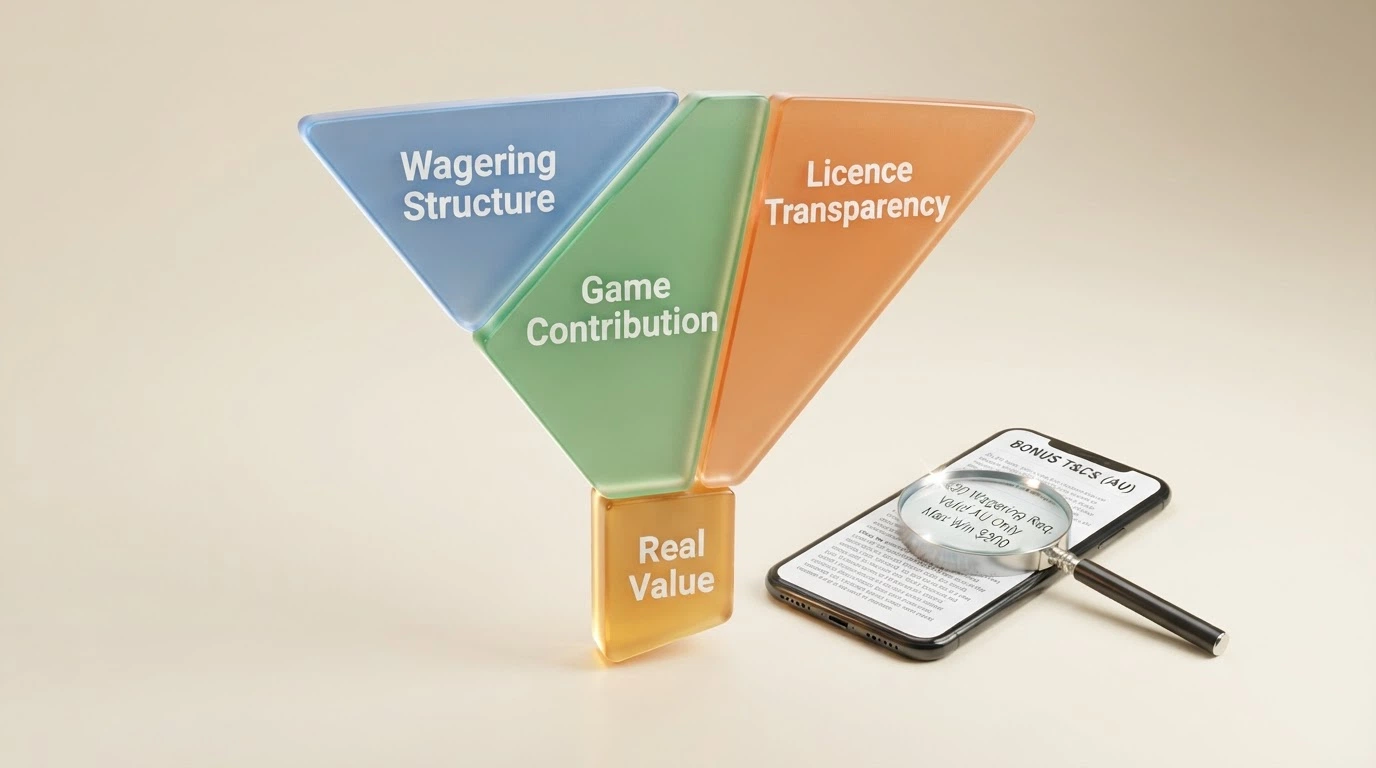
A 50% match with 30x bonus-only wagering and a 7-day validity beats a 100% match with 40x deposit-plus-bonus and a 24-hour validity on every dimension that matters to a player’s wallet. The 50% match bonus is smaller in headline terms but requires half the turnover to clear, plays on bonus funds only rather than the deposit too, and gives the player six days instead of one to spread the wagering. The 100% match looks more generous and is in fact more expensive.
The bonus-only-versus-bonus-plus-deposit fork is the single most important decision point. A 40x wagering on the bonus means A$4,000 in turnover on a A$100 bonus. A 40x wagering on the bonus plus the deposit means A$8,000 in turnover on the same A$100 bonus, because the qualifying deposit was also A$100. Same multiplier. Double the playthrough. Most players do not spot the difference until they try to withdraw.
Game contribution is the hidden multiplier. A A$4,000 turnover target on pokies at 100% contribution is roughly 800 spins at A$5 a pop. The same target on a table game at 10% contribution is 8,000 spins. The bonus does not change. The game choice has multiplied the work by a factor of ten. A player who claims a reload and then plays blackjack with the bonus active has made the bonus unworkable without realising it.
Validity pressure is the third leg. A 24-hour reload forces concentrated play, which on a high-variance pokie can blow through the bonus before any of the wagering is completed. A 14-day or 21-day reload lets the player spread the wagering, reducing the variance hit and giving the player time to read the bonus terms, claim cashback, and decide whether to forfeit the bonus if the wagering is not worth clearing.
The licence and support infrastructure matter more than the headline number because they are the only protection the player has if something goes wrong. A reload bonus at a Curaçao-licensed operator with a published licence number, a working complaints process, and a withdrawal history is a different offer from a reload bonus at an unlicensed operator with no published terms and no complaints process. The difference is not visible in the bonus terms. The difference shows up the first time a withdrawal is delayed, a win is voided, or a bonus term is enforced in a way the player did not expect.
The one action the reader should take before claiming any reload is to read the bonus terms. Every figure on this page — the match percentage, the wagering multiplier, the max bet, the validity window, the free-spin cap, the game contribution — is in the operator’s bonus terms. The reload is worth the cost the player has calculated, not the cost the marketing headline implies. The arithmetic is not difficult. The point is to do it before the deposit, not after.
Frequently Asked Questions
What wagering requirements do reload bonuses typically have for Australian players?
The 2026 industry standard for reload bonus wagering requirements sits between 30x and 40x on the bonus amount, with the lower end of the range offering a friendlier playthrough. Some operators apply the multiplier to the bonus only, while others apply it to the bonus plus the deposit — a distinction that doubles the required turnover at the same multiplier number. A 30x bonus-only reload is the friendliest structure commonly available, and Royal Reels’ weekly reload is an example of that tier. Operators at the upper end run 40x on bonus plus deposit, which on a A$100 bonus means A$8,000 in required turnover.
What happens if an offshore casino blocks my account while I have an active reload bonus?
An offshore casino may block a player’s account for a range of reasons: a verification check (proof of address, source of funds), a suspected breach of bonus terms (a max-bet cap violation, a restricted-game violation), or a decision to withdraw from the Australian market. If the account is blocked with an active bonus, the player cannot complete the wagering, and the bonus funds are typically forfeited. The player has no Australian complaints body to escalate to and no Australian regulator to appeal to. The dispute resolution runs through the operator’s licensing jurisdiction, which is typically Curaçao. The practical risk is that the bonus funds, plus any winnings tied to the bonus, are lost.
Are reload bonus winnings taxable in Australia?
No. Betting and gambling winnings are not assessable income for the individual player under section 6-5 of the ITAA 1997, and gambling losses are not deductible under section 8-1 — unless the person is carrying on a business of betting or gambling. A casual player at an offshore casino who claims a reload bonus and withdraws winnings does not owe Australian tax on the winnings and cannot claim the losses against other income. The wagering requirement and the bonus terms determine how much the player can withdraw; the Australian tax system does not take a further cut. The operator side is different: wagering operators pay tax where the customer is, with the Northern Territory levying a 5% wagering tax on wagers minus payouts and each state setting its own point-of-consumption tax, typically 10% to 15% of net wagering revenue.
What is the maximum I can win from a reload bonus free spins offer?
It depends on the operator. Rocket Play’s Friday Reload caps the maximum win from the free spins at A$3,000, while the operator’s general maximum win from registered free spins is A$300. SkyCrown’s Sunday Reload caps free-spin winnings at 10x the bonus value. Fair Go’s no-deposit bonuses typically cap the maximum winable amount in the A$50 to A$180 range. The cap is part of the operator’s bonus terms, and the figure is the maximum amount the player can withdraw from the spin winnings regardless of what the spins actually produce. Any winnings above the cap are removed when the wagering is complete.
How often can I claim a reload bonus at Australian online casinos?
Most AU-facing offshore casinos run reload promotions on a fixed weekly or monthly cycle. Rocket Play’s reload structure splits across Friday and Sunday, giving players two reload windows per week. SkyCrown’s Sunday Reload runs on Sundays only, with a separate Highroller Reload and monthly reload on longer cycles. Bizzo’s Wednesday Reload runs weekly, with an opt-in requirement. Royal Reels’ weekly reload resets every seven days from the player’s last claim. Some operators run reloads on a rolling cadence rather than a fixed day — BitStarz’s weekly promos vary by week, and Stake’s reload model is ongoing rather than fixed. The exact cadence is set by the operator, and players should check the promotions page for the current schedule before each deposit.