
What a $1 deposit really gets you at an Australian-facing casino in 2026
 Available in AU
Data current as of 18 October 2026 and verified against the ACMA register of blocked sites.

The phrase “$1 minimum deposit casino Australia” promises a starting point almost anyone can afford. The reality is that almost no Australian-facing casino will let a punter put a dollar through the door using a normal Australian payment rail. The dollar lives on crypto, and even there it dies at the network fee. Beneath the headline, every casino on this page is an offshore operator running outside Australian law, with no Australian consumer protection to fall back on when something goes wrong.
This is the page that walks the gap between the marketing line and the deposit screen. It covers what a dollar actually buys in 2026, how each payment rail sets its own floor, the ten offshore operators that dominate this corner of the search results, the pokies a $1 bankroll will fund, and the legal and harm realities competing pages leave out. The reader who finishes it will know which offer is worth considering and for whom, and which is a trap dressed up as a bargain.
Table of Contents
- The $1 deposit casino promise — and what it actually delivers in 2026
- Why your $1 lands differently on PayID, crypto and card
- The offshore casinos that take Australian players from a dollar
- Real-money pokies you can spin from a $1 stake in 2026
- New 2026 casinos — why fresh platforms court the dollar depositor
- Playing for a dollar on your phone
- The legal reality — every $1 deposit casino is offshore
- Staying in control when the deposit barrier disappears
- How we chose and reviewed these $1 deposit casinos
- Your dollar, your decision — what a $1 deposit really costs
- FAQ: Your $1 deposit casino questions answered
The $1 deposit casino promise — and what it actually delivers in 2026
The “$1 deposit casino” label is one of the most aggressively marketed corners of the AU-facing offshore market. It works because the number reads like a clearance rack: almost no commitment, almost no risk, almost anyone can try. The label promises a starting point so low it barely registers as gambling.

The promise is mostly fiction for Australian players. A genuine $1 deposit is a rare edge case — it shows up only on a narrow band of crypto or specific card and e-wallet segments, never broadly through PayID or Neosurf. The realistic deposit floor for most Australian players at offshore casinos sits at A$5–A$10 via PayID or standard bank rails. Even that floor is dramatically lower than the $50 or $100 minimums at Australian land-based venues, which is part of why the offshore $1 marketing has any traction in the first place. The comparison lands because the Australian alternative is so much higher.
The gap between the marketing claim and the deposit-floor reality is the entire story of this page. The dollar survives on a single rail and dies on every other. A punter who turns up with a PayID account and a $1 note will not get to play for a dollar at almost any operator on this list. A punter who turns up with a Litecoin wallet and twenty seconds of patience might. The difference is not the casino; it is the rail.
What a dollar actually buys you at an Australian-facing casino in 2026
The bankroll math starts the moment the deposit clears. A $1 deposit that arrives as $0.96 after a network fee is not the same starting point as $1.00. A $1 deposit that arrives as $1.00 but cannot trigger a welcome bonus is not the same offer as $30.
Cryptocurrency is the only reliable path to a true $1 deposit at AU-facing casinos, and even there the practical floor sits higher than a dollar once fees are paid. A Bitcoin transaction fee in May 2026 averages around $1.50–$3.00, which means sending $1 in BTC costs more in fees than the deposit itself. Litecoin fees run under $0.05. Tether on the Tron network costs about $1.00 flat. The three operators with the lowest published floors — Stake at AU$0.10 BTC-equivalent, BC.Game at approximately AU$1 USDT, and Bitcasino.io near zero — are all crypto-only. That is the rail that holds the dollar up.
The withdrawal floor is where the entry cost actually lives. A punter who deposits $1, plays for fifteen minutes and wins $4 has not won $4. They have won $4 minus the minimum withdrawal, which at most offshore casinos sits at A$10, A$20 or higher. The “minimum deposit” advertised on a casino’s banking page is rarely the full picture. The minimum withdrawal is the second number, and it is the one that traps the small depositor. A page that lists only the deposit minimum has not finished telling the story.
Why your $1 lands differently on PayID, crypto and card
The payment rail is the gatekeeper, not the casino. Every deposit method carries its own floor, its own fee structure, and its own refund mechanics. A casino that advertises a $1 minimum deposit has, in most cases, written a marketing line about the rail with the lowest ceiling, while its actual deposit methods are gated much higher. Three rails matter for Australian players in 2026: PayID, crypto, and debit card and voucher.
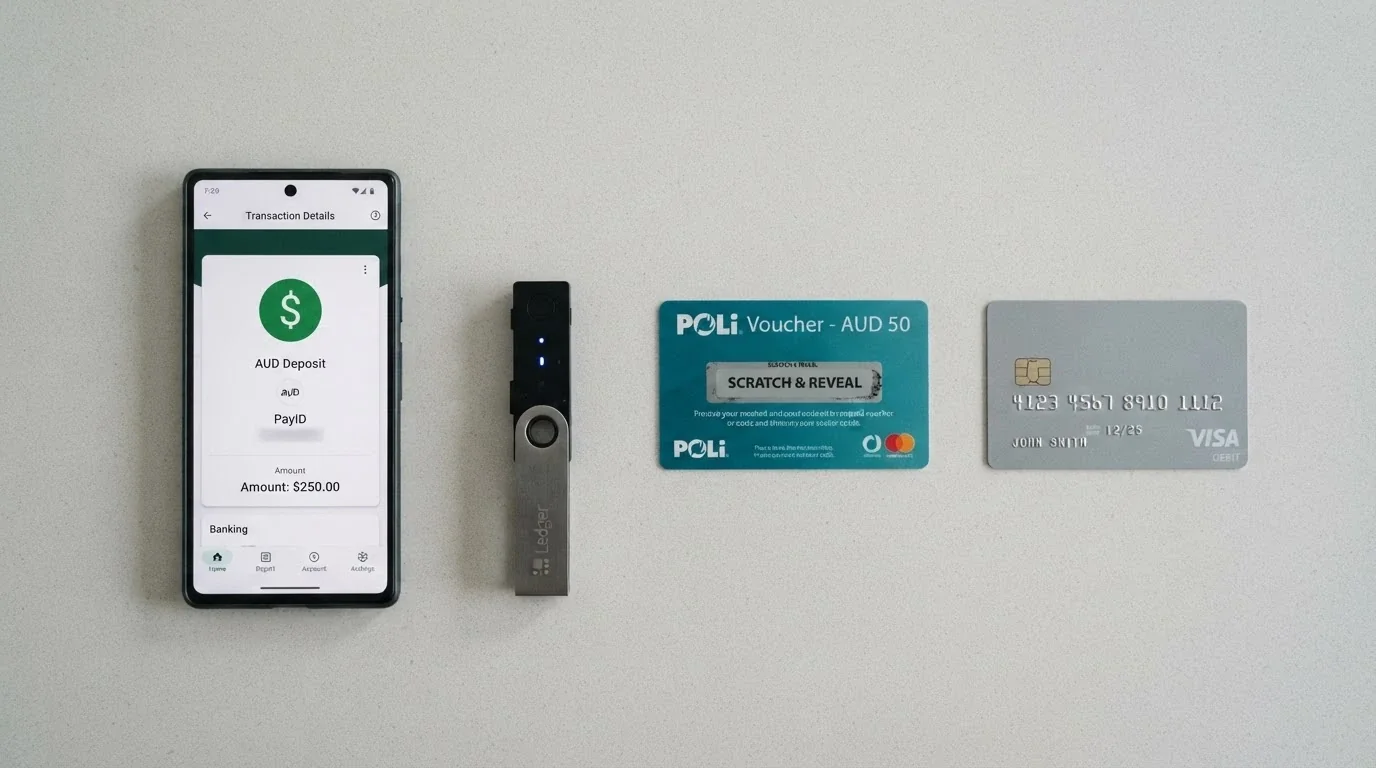
PayID and Osko — the Australian rail that rarely reaches a dollar
PayID is the AU-native instant rail most Australians use to send money to a phone number or email in seconds, free of charge. There is no technical floor on PayID — the rail itself will carry a one-cent payment without complaint. The floor comes from the receiving end.
PayID minimum deposits at AU-facing offshore casinos are typically gated at A$10–A$30, because the payment service providers that sit between the punter’s bank and the casino run anti-fraud monitoring on inbound micro-deposits. A pattern of small, frequent deposits to a gambling merchant looks like card-testing fraud or money-laundering layering to that monitoring. The PSP rejects or holds the payment. The casino never sees it. The result is that the rail the punter thinks should carry a dollar cannot, because the layer above the rail treats a dollar as suspicious.
For a punter who wants to deposit A$10 or more, PayID works well — it is fast, it is Australian, and the funds clear in seconds. For a punter who wants to deposit a dollar, PayID is the wrong tool. The rail is free and instant at the protocol level, but the fraud-monitoring layer above it prices micro-deposits out of reach.
Cryptocurrency — the only reliable path to a genuine $1 deposit
Cryptocurrency is the only rail where the $1 marketing claim actually survives the trip from landing page to wallet. The reason is simple: there is no PSP sitting between the punter’s wallet and the casino wallet, and no card network issuing a chargeback. The punter sends crypto; the casino credits it; the rail neither raises nor lowers the casino’s published minimum in the way a PSP might.
The trade-off is the network fee. Bitcoin, the most familiar crypto rail, charges roughly $1.50–$3.00 per transaction in mid-2026, which means sending $1 in BTC costs more than the deposit. The fee is paid by the punter and is non-refundable, so a Bitcoin deposit of “A$1 worth” arrives with the casino at a net of less than nothing. Litecoin, by contrast, runs transaction fees under $0.05 and clears quickly. Tether on the Tron network (USDT-TRC20) costs about $1.00 flat regardless of the deposit size, which makes it workable for $5–A$10 deposits and unworkable for $1.
Three operators sit at the genuine micro-deposit tier on crypto: Stake at AU$0.10 BTC-equivalent, BC.Game at approximately AU$1 USDT, and Bitcasino.io at near zero. None of those floors would survive a PayID deposit; none of them are advertised on PayID. The crypto rail is what makes the $1–$5 deposit conversation honest.
Debit cards, Neosurf and the credit-card ban Australians need to know about
Debit cards — Visa Debit and Mastercard Debit — are the third rail. Minimum deposits at AU-facing casinos are typically A$10–A$20, with the exact floor set by the card issuer and the casino’s own gateway. The deposits clear fast; withdrawals back to a debit card work at most operators but may take three to five business days.
Neosurf and paysafecard vouchers impose a minimum of approximately A$10 and are one-way. A punter can fund an account with a voucher but cannot withdraw to one. The voucher is a deposit-only instrument, which makes it useful for a punter who does not want to share card details but unhelpful for anyone planning to cash out.
Credit cards are banned outright as a payment for online wagering from 11 June 2024, under the Interactive Gambling Amendment (Credit and Other Measures) Act 2023. The ban covers credit cards, credit-related products and digital currency used for wagering with licensed operators. Penalties for an operator that fails to enforce the ban reach up to $247,500. The practical effect is that any casino still accepting a credit-card deposit from an Australian is operating outside the rules the Australian regulator can enforce, and the credit-card payment itself is a yellow flag. A debit card is the only card-based option that does not breach the rules.
The offshore casinos that take Australian players from a dollar
Every operator below runs offshore. None holds an Australian online-casino licence because no Australian online-casino licence exists. The Interactive Gambling Act 2001 makes the provision of online casino games to a person in Australia an offence, and no state or territory issues a licence for the product. The “licence” column in the table is the Curaçao Gaming Control Board for the four operators whose licence research surfaced, and an unverified line for the others. An unverified licence is not the same as an unlicensed operator — it is a licence whose details were not surfaced by the sources consulted this round.

How the ten operators compare at a glance
| Casino | Licence |
|---|---|
| Stake | Curaçao — offshore, no Australian licence |
| Royal Reels | Curaçao — offshore, no Australian licence |
| Skycrown | Curaçao — offshore, no Australian licence |
| RocketPlay | Curaçao — offshore, no Australian licence |
| WinSpirit | Curaçao — offshore, no Australian licence |
| Rainbet | Not confirmed — offshore, no Australian licence |
| Scream Casino | Not confirmed — offshore, no Australian licence |
| FairGO | Not confirmed — offshore, no Australian licence |
| Bizzo Casino | Not confirmed — offshore, no Australian licence |
| Rocket Casino | Not confirmed — offshore, no Australian licence |
What the table does not show is the column a punter usually wants: bonus terms, deposit minimums, payment methods, withdrawal floors, or game-library scope for most of the operators below the top four. Research surfaced detailed terms for Stake, Royal Reels, Skycrown and RocketPlay; the remaining six sit in this ranking because they surface in the AU-facing low-deposit search results, but their bonus and deposit specifics were not confirmed this round. A punter comparing options should read the individual write-ups that follow, treat anything beyond the licence line above as unconfirmed until the operator’s own terms page says otherwise, and resist any operator whose own terms page cannot be reached at all.
Stake — the crypto-only operator with a ten-cent floor
Stake is the only operator in this ranking where a sub-$1 deposit is genuinely possible. Its published floor sits at AU$0.10 BTC-equivalent — a tenth of the dollar the page is built around. The catch is that Stake is crypto-only. There is no PayID button, no debit-card deposit, no Neosurf voucher. The punter walks in with a crypto wallet and walks out the same way.
The offer beyond the floor is harder to characterise. Research did not surface a welcome bonus for Australian sign-ups this round; the operator’s bonus and game-library terms were not in the sources consulted. What is confirmed is the floor, the Curaçao licence, and the offshore status that follows from it. A punter who already holds crypto and is testing a new platform with the smallest possible stake has, in Stake, the cleanest entry point in the ranking — cleanest in the sense of lowest-cost-to-try, not cleanest in the sense of safest. The legal-reality section below covers the consumer-protection gap that applies to every operator on this page. BetStop does not cover Stake.
Royal Reels — the no-deposit bonus that costs nothing to try
Royal Reels is the only featured operator with a genuine no-deposit bonus: A$10 credited to a new sign-up before the first deposit. The welcome package adds a 100% match up to A$500 at a A$30 minimum deposit, with 30–40× wagering across the package. The bonus structure makes Royal Reels the closest thing to a zero-cost entry on this page — the punter can sign up, claim the A$10, and play without ever funding the account.
The library is broad: more than 2,000 games from 30+ providers, including Pragmatic Play, Evolution Gaming, Yggdrasil and Hacksaw Gaming. That breadth matters at the no-deposit tier because the punter is not locked into one or two titles with the bonus — there is enough depth to try a pokie or two before deciding whether to fund. The wagering multiplier sits in the 30–40× range; specific terms on the no-deposit bonus were not confirmed this round. Royal Reels holds a Curaçao licence and is offshore. The A$10 no-deposit is a useful trial. The wagering that follows is the cost.
Skycrown — the 450% match that dwarfs the dollar-deposit field
Skycrown’s headline number is the largest in the ranking: a 450% welcome package up to A$8,000 plus 400 free spins distributed across four deposits. The first deposit alone is 120% up to A$1,200 plus 125 free spins on Wolf Treasure by IGTech. The package is designed to look enormous against the page’s $1 deposit context, which is partly the point — Skycrown is not built for the dollar depositor, and the welcome offer will not trigger below A$20.
The minimum real-money deposit at Skycrown is A$20 across every payment method. The wagering requirement is 40× on both the bonus and the free-spin winnings. The bonus validity is 14 days for standard bonuses and 5 days for high-roller tiers. The maximum conversion from a welcome bonus to real withdrawable money is A$5,000; the conversion cap on regular bonuses is A$750. The free-spin winnings carry the same 40× wagering as the deposit bonus. The combination — large headline number, high conversion cap, short validity — rewards a punter who plans to play heavily across the four deposits and penalises one who treats the bonus as a casual add-on. Skycrown is a Curaçao licensee; it is offshore.
RocketPlay — 100 free spins dripped across five days
RocketPlay takes a different shape: 100% up to A$1,000 plus 100 free spins, delivered 20 per day over five days. The minimum deposit to trigger the welcome bonus is A$35. Wagering is 40× on both the cash bonus and the free-spin winnings. The free-spin max win is capped at A$300, which is the operator’s way of saying a hot streak on the spins does not pay out beyond that ceiling.
The drip structure is the trade. A punter who claims the welcome offer has to come back for five consecutive days to use the spins — a small commitment that builds the kind of session rhythm the casino wants. The Friday Reload bonus offers a similar pattern at smaller scale: a A$30 deposit earns 20 spins, A$75 earns 50, A$150 earns 100, all at 40× wagering on winnings. RocketPlay’s library is the largest in the ranking at 9,000+ pokies, with Pragmatic Play, BGaming and Nolimit City among the providers. The Curaçao licence makes it offshore.
WinSpirit
WinSpirit appears in the AU-facing low-deposit search results and holds a Curaçao licence. The library sits at 1,000+ games, which puts it in the middle of the ranking’s range. Beyond those two data points, research did not confirm WinSpirit’s bonus terms, its actual deposit minimum, or its supported payment methods this round. A punter considering WinSpirit should treat the welcome offer as unconfirmed until the operator’s own terms page is opened, and should weight the absence of confirmed data against the larger libraries and clearer terms available higher in this ranking.
Rainbet
Rainbet appears in the same competitive set as the rest of this ranking but did not surface any confirmed details this round. The licence, the bonus terms, the deposit methods and the game library are all unconfirmed. What can be said is that Rainbet operates offshore from Australia — there is no Australian online-casino licence for it to hold — and that an operator without verifiable terms is one to approach cautiously. Checking Rainbet’s licence, bonus terms or payment methods on its own site is a necessary step; the absence of these details in current sources leaves a punter with significantly fewer verification options than the top-tier operators on this list provide.
Scream Casino
Scream Casino surfaces in the AU-facing low-deposit listings without a confirmed licence, bonus structure, deposit floor or game-provider list this round. As with the other unconfirmed entries, the offshore status is the only firm data point — there is no Australian licence for Scream Casino because there is no Australian online-casino licence to hold. Shortlisting Scream Casino without first confirming these details is a risk; verifying the terms independently on the operator’s site is the only way to avoid making assumptions about the service.
FairGO
FairGO carries an Australia-facing brand name, which is what surfaces it in this corner of the search results. The name signals AU targeting; it does not confirm an Australian licence, because none exists for online casino. Licence, bonus, deposit and game-library data were not confirmed this round. A punter drawn to FairGO because of the Australian branding should weigh that branding against the verified terms and Curaçao licences on offer from the top of this ranking, and should confirm the operator’s own terms page before committing funds.
Bizzo Casino
Bizzo Casino appears in the AU-facing low-deposit search results without confirmed licence, bonus, deposit or game-library data this round. The offshore status is the only firm point. Any interest in Bizzo Casino should start with a visit to the operator’s own terms page, weighing the current lack of confirmed data against the verified options available elsewhere in this ranking.
Rocket Casino
Research did not confirm Rocket Casino’s licence, bonus terms, deposit floor or game library this round. The only firm data point is the offshore status: there is no Australian licence for any online casino, and Rocket Casino is not an exception. A punter should verify each one’s terms independently.
Real-money pokies you can spin from a $1 stake in 2026
A $1 bankroll is small enough that stake size and game choice both matter. Most online pokies accept a minimum spin of A$0.10 to A$0.20, which means a $1 deposit will fund somewhere between five and ten spins on a single title. The session is short, the variance is high, and the house edge runs between 3.3% and 3.5% on the titles whose RTPs have been published.

The five Pragmatic Play pokies with published RTPs — and what those numbers mean for a dollar
| Slot title | Provider | RTP | Volatility |
|---|---|---|---|
| Sweet Bonanza | Pragmatic Play | 96.48% | High |
| Gates of Olympus | Pragmatic Play | 96.50% | High |
| Big Bass Bonanza | Pragmatic Play | 96.71% | High |
| Sugar Rush | Pragmatic Play | 96.50% | High |
| The Dog House | Pragmatic Play | 96.51% | High |
Five Pragmatic Play titles carry published RTPs in the 96.48%–96.71% range, which translates to a house edge of roughly 3.3%–3.5% per spin. On a $1 stake, that means the casino keeps about three and a half cents of every dollar wagered, on average, over a long session. At a single spin, the outcome is binary — the punter either wins a multiple of the stake or loses it, with no middle ground.
The cluster is uniformly high volatility, which on a $1 bankroll is the more important number than the RTP. High volatility means long losing streaks punctuated by occasional large wins; on a micro-bankroll, the losing streak usually arrives first and ends the session before the large win has a chance to land. A $1 deposit at Big Bass Bonanza will not behave like a $100 deposit at Big Bass Bonanza. The math is the same, but the bankroll is too short to absorb the variance. The expected loss formula assumes many spins, not the five or ten a $1 deposit will fund.
A worked example at Gates of Olympus, with a $1 stake per spin across a 100-spin illustrative session and assuming only the stake is wagered and not the bonus, gives an expected loss of 100 × A$1 × (1 − 0.9650) = A$3.50. That figure is an average across many such sessions, not a prediction of any single spin — and a punter with a $1 bankroll will not reach 100 spins at $1 per spin, because the bankroll runs out in fewer than ten spins on a high-volatility title. The 3.5% house edge is real; it is also slow. The volatility is fast.
Funding a spin — PayID, crypto and card as pokies deposit rails
The choice of deposit rail determines whether the $1 makes it to the pokie reel at all. PayID’s A$10–A$30 minimum precludes a dollar deposit. Crypto’s fee structure makes a single dollar workable on Litecoin or near-workable on USDT-TRC20, and prohibitive on Bitcoin. Debit card’s A$10–A$20 minimum closes off the dollar. A punter who wants to spin on a $1 bankroll is choosing crypto by default, and the choice of network — Bitcoin, Litecoin, Tron USDT — is the second decision.
Most of the pokies that ship with the offshore platforms accepting Australians run on a minimum spin of A$0.10 to A$0.20, with a max bet that scales upward from there. The pokies accept the small stake because the software is built for global minimums that are usually below A$0.20. The constraint is upstream, at the deposit rail, not at the spin button.
New 2026 casinos — why fresh platforms court the dollar depositor
A new casino enters the AU-facing offshore market by cutting the deposit floor. The dynamic is the same one a new café uses with a $5 coffee: the entry price is the loss leader that pulls the customer in, and the operator makes its money on the follow-on deposits. New entrants in the offshore space often advertise $1 or A$5 deposits for the first month, then drift back toward A$10–A$20 once the marketing cycle ends.
The trade-off for the punter is the standard one with any new platform: an unproven track record. The licence, if Curaçao, may be brand new; the bonus terms may be generous because the operator needs volume; the withdrawal times may be untested. None of this is a reason to avoid a new entrant, but it is a reason to check the licence number on the regulator’s register and to make the first deposit, if any, the smallest the rail allows. A punter who treats a new operator’s dollar-deposit offer as a chance to test the platform rather than as a chance to win is using the offer correctly.
New-player offers at the dollar threshold — what to check before signing up
The welcome bonus is governed by a different floor than the deposit floor. The casino may accept a A$1 deposit but require A$10, A$20 or A$30 to unlock the welcome offer. Skycrown’s welcome bonus triggers only at A$20 even though the deposit minimum is the same A$20; RocketPlay’s bonus triggers at A$35; Royal Reels’ bonus triggers at A$30. A punter depositing $1 is depositing into the real-money wallet and is not eligible for the welcome bonus on most platforms.
The pattern holds across the ranking: bonus activation minimums are typically A$10 or higher, and the welcome offer is a separate threshold from the deposit. The wagering multiplier is usually 30×–40× on both the bonus and any free-spin winnings; the validity window is typically 7–14 days; the max-bet rule during bonus play usually caps single wagers at A$5–A$10. A punter who claims a welcome bonus should read the bonus terms in full before depositing, because the wagering requirement, the max bet, the game-weighting table and the conversion cap together decide whether the bonus is worth more than its face value.
Playing for a dollar on your phone
The mobile experience at AU-facing offshore casinos is functionally identical to the desktop experience at the game-mechanics level. The same pokies run on the same RNG; the same deposit rails fund the account; the same wagering rules apply. The differences are in the chrome — the way the lobby lays out on a smaller screen, the way the cashier fits a PayID flow into a mobile browser, the way a session is interrupted by an incoming call.

PayID and Osko were designed for the mobile banking app, which is where most Australian players will trigger a deposit from. The transfer is a few taps in the bank app, the funds land at the casino in seconds, and the punter returns to the pokies without breaking the session. Crypto wallets live on the phone too, and a punter who has set up a wallet already can scan a casino deposit address and confirm in the same flow. The mobile rail is, in many ways, cleaner than the desktop rail because the bank app is the screen the punter is already looking at.
App availability is inconsistent across the offshore set. Some operators ship a downloadable app through their own site; others rely on the mobile browser; a few maintain both. The mobile browser path is usually the smoother one — apps from offshore operators sometimes lag behind the web build in updates, and the browser does not need to be re-installed every time the lobby changes. The session length on a $1 bankroll is short enough that the choice of app or browser is not what determines the outcome. The volatility of the pokie is.
The legal reality — every $1 deposit casino is offshore
Online casino is prohibited in Australia under the Interactive Gambling Act 2001. The prohibition is not a grey area. There is no licence for online casino in the country, federally or in any state or territory. The ACMA is the federal regulator that enforces the prohibition, and the enforcement record runs into four figures: 1,564 illegal gambling and affiliate websites have been blocked at ISP level since November 2019, and 225+ services have withdrawn from the Australian market since enforcement was strengthened in 2017. The individual player is not prosecuted; the Act targets the provider, not the person using the service. The cost of that distinction is paid in consumer protection: an Australian punter at an offshore casino has no BetStop coverage, no Australian complaints body, and no guarantee the site will remain unblocked tomorrow.
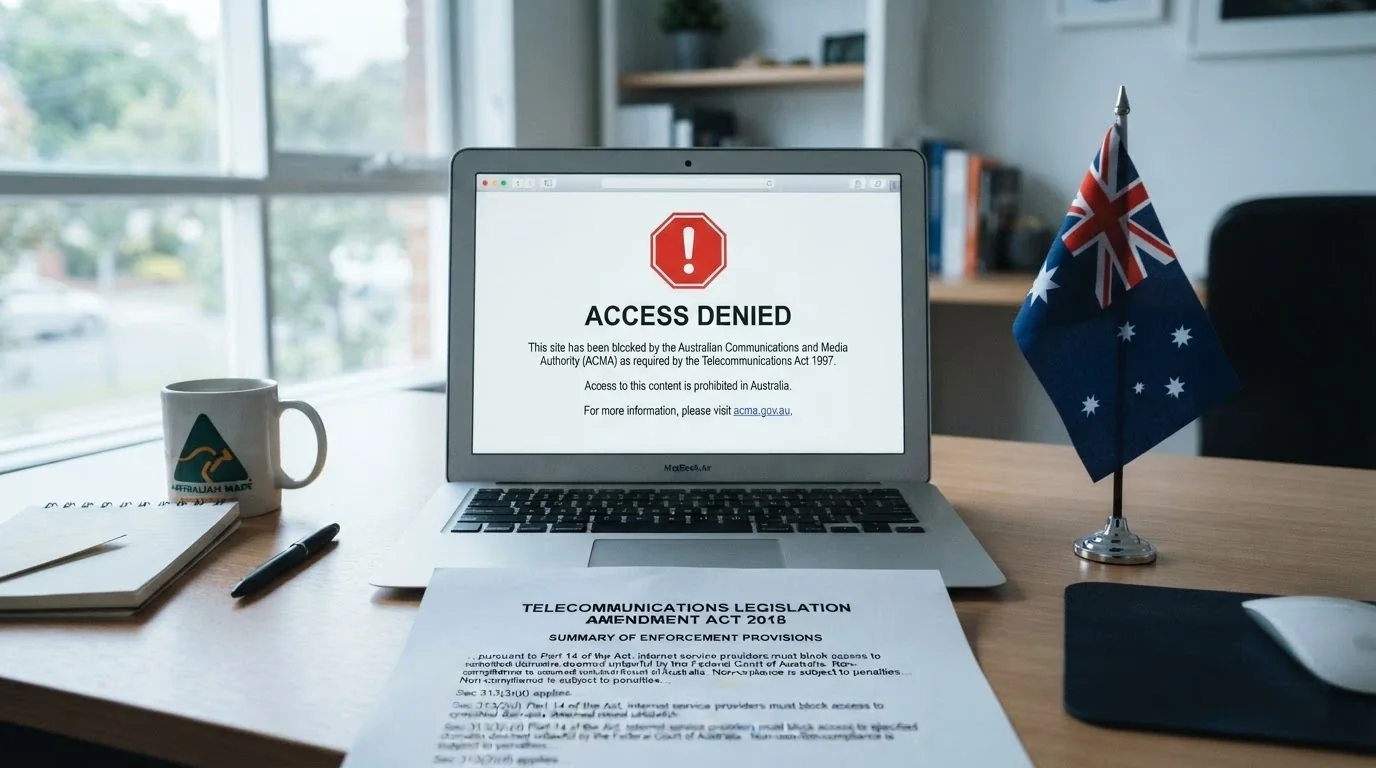
The ACMA’s blocking action is the practical risk most visible to a player. A site that is reachable today can be on the blocked list next month, and a balance sitting in the account at that moment becomes harder to recover. The casino is, from the ACMA’s perspective, an illegal service that should never have been accessible in the first place. The punter’s claim on the balance is a private contractual claim against an offshore entity, not a regulatory one.
What the 2026 gambling reform changes for Australian players from January 2027
The Interactive Gambling Amendment (Gambling Reform) Bill 2026 passed Parliament on 19 August 2026. Its measures commence 1 January 2027. Three changes directly affect a punter using an offshore casino:
Banks and payment providers gain express authority to block transactions to illegal gambling operators. The change makes a debit-card or PayID deposit to a blocked operator a transaction the bank can refuse at the protocol layer, before the funds leave the punter’s account.
Wagering advertising on TV is capped at three ads per hour between 6:00 am and 8:30 pm, with a live-sport blackout from 15 minutes before until 5 minutes after a live sporting event. Athletes, celebrities and influencers are barred from promoting wagering products. Broadcasting of sporting odds is banned outright. Venue and uniform advertising is prohibited. The change reshapes what a punter sees during a football broadcast, even if it does not directly affect the offshore casino’s deposit screen.
Direct marketing of inducements is prohibited for 14 days after a customer signs up and for three months after a person deregisters from BetStop. Online keno is banned. Foreign-matched lotteries are banned. A national wagering advertising opt-out register, AdStop, will be administered by the ACMA.
The reform targets the licensed market and the advertising around it. The offshore casino the punter is using sits outside the new rules; the bank-blocking provision is the closest the reform comes to touching the offshore player directly, and even there the block is on the licensed-wagering side rather than on offshore casino transactions per se.
What protection an Australian player actually has — and what they do not
The protection an Australian player has at an offshore casino is the protection every other consumer has at a foreign retailer: the operator’s own terms, the operator’s own licence regulator, and the operator’s own willingness to pay out. There is no Australian complaints body for offshore casino disputes; there is no BetStop coverage; the ACMA blocks sites but does not arbitrate player balances; and the site can be added to the blocked list at any time with funds still in the account.
On the tax side, the news is more favourable. Betting and gambling winnings are not assessable income for ordinary Australian punters under section 6-5 of the ITAA 1997, and gambling losses are not deductible under section 8-1 — unless the punter is carrying on a business of betting or gambling. A casual $1-deposit punter is not carrying on a business; the winnings are tax-free, and the ATO will not be asking about the source of a $200 pokie payout.
The asymmetry is the shape to remember. The punter gets no Australian protection on the way in and no Australian tax on the way out. Both are consequences of the offshore status, and both are part of what the punter is accepting when they choose to play on a site the ACMA classifies as illegal.
Staying in control when the deposit barrier disappears
The argument for a low deposit minimum is that it lets a punter try the platform with little commitment. The argument against is that a deposit barrier set at A$1 is functionally no barrier at all — the friction that a $50 minimum imposes, the cooling-off moment when a punter has to find a card and type an amount, vanishes at a dollar. The punter can keep depositing with no pause between sessions, and the platform can keep marketing to them with no buffer.
BetStop — the National Self-Exclusion Register — launched on 21 August 2023 and reached 59,830 registrations with 37,247 active exclusions by 31 March 2026. Registrants skew young: 78% are under 40, and 38% have chosen lifetime exclusion. The register is administered by the ACMA and binds every Australian-licensed online and phone wagering service in a single registration. The limitation that matters for this page is the one the legal-reality section touched on: BetStop does not cover offshore casinos. An Australian punter who has self-excluded can still open an account at any operator on this page, deposit $1 in crypto, and play. The register is a fence around the licensed market, not around the internet.
The numbers behind low-stakes gambling harm in Australia
Gambling participation in Australia rose from 57% of adults in 2019 to 65% in 2024. Fifteen per cent of Australian adults experienced gambling harm in the past 12 months, up from 11% in 2019 — equivalent to roughly 3 million people. Among regular monthly gamblers, 7.7% are classified as high risk. Approximately 3.29 million Australians are affected annually by their own or another person’s gambling. The annual health loss associated with gambling-related harm in Australian adults is estimated at over 400,000 Years Lived with Disability.
The numbers are not all about high-roller behaviour. An estimated 5 million wagerers are active nationwide, including 400,000 high-risk gamblers, but just 30,000 individuals have active exclusions through BetStop — only 7.5% of those experiencing severe harm. Suicide rates among people experiencing problem gambling are 15-fold higher than in the general population. The harm is broad, the help-seeking is narrow, and the gap between the two is where the offshore operators sit.
BetStop, self-exclusion and the offshore blind spot
BetStop works as designed for the Australian-licensed market: one registration excludes a person from every Australian-licensed online and phone wagering service. Surveyed outcomes are strongly positive — 77% of registrants reported a better overall quality of life after self-exclusion, 79% experienced improved mental health, and 96% had either completely stopped or decreased their betting.
The blind spot is awareness and reach. Only about 26.5% of Australian adults know that BetStop exists; younger adults are less likely to be aware of it than those aged 55 and older. And the register binds Australian-licensed services only. An offshore casino is not a participant; a self-excluded Australian can still register, deposit and play at any operator on this page. For a punter who has decided to step back, BetStop is necessary but not sufficient; the offshore half of the market needs separate action, and the available action is a hard one — to stop.
Help exists outside BetStop. The National Gambling Helpline (1800 858 858) is free, confidential and staffed 24 hours a day, 7 days a week, with online chat and counselling through Gambling Help Online. The line is not offshore-aware in the sense of routing calls to offshore-specific services, but the counsellors are trained in gambling harm and can work with a caller regardless of which platform the gambling happened on.
How we chose and reviewed these $1 deposit casinos
The ranking draws on the ACMA’s register of blocked sites as the licensing reference point, on the operators’ own published terms pages for bonus and deposit data, and on cross-references from Australian-facing comparison sites for the payment-method floors and the bonus structures where research surfaced them. The featured set was ordered by deposit floor first (Stake at AU$0.10 BTC-equivalent first, Royal Reels with its no-deposit bonus second), then by the breadth of confirmed bonus and game-library data (Skycrown and RocketPlay, where terms were fully surfaced), then by position in the AU-facing search results for the remaining six operators whose bonus and deposit specifics were not confirmed this round.
No numerical weightings were assigned. The ranking reflects editorial judgement on which operator a punter should weigh most heavily, given the $1-deposit frame and the offshore-status reality that applies to every operator on the page. The criteria that ordered the ranking were: the lowest published deposit floor, the broadest set of confirmed bonus and game-library data, and the reputation signal from operator-skill traffic data on the offshore set. None of these criteria is precise enough to be turned into a percentage score, and the absence of a numerical weighting is itself the honest answer.
The licence check used the ACMA’s register to confirm that none of the featured operators holds an Australian online-casino licence, and the Curaçao Gaming Control Board’s public register to confirm the Curaçao licences held by Stake, Royal Reels, Skycrown and RocketPlay. The licence lines for the remaining six operators are marked “not confirmed” because the sources consulted this round did not surface them. A punter considering one of those six should verify the licence independently before depositing.
Your dollar, your decision — what a $1 deposit really costs
A $1 deposit is real, but it lives on one rail. Crypto on Litecoin or USDT-TRC20 is the only payment method that reliably carries a dollar from a punter’s wallet to a casino’s balance. PayID closes off at A$10–A$30; debit cards at A$10–A$20; Neosurf at A$10; Bitcoin in mid-2026 charges more in fees than the deposit itself. The “$1 deposit casino Australia” headline is true for a narrow band of operators and a narrower band of rails.
The cost of the dollar is not the dollar. The cost is the offshore status that follows every operator on this page — no Australian licence, no Australian consumer protection, no BetStop coverage, no Australian complaints body, and a real chance the site is added to the ACMA’s blocked list while a balance sits in the account. The withdrawal floor is the second cost: most operators will not let a punter cash out at A$5 or A$10, which means the punter has to keep playing until the balance clears the threshold or deposit again. The variance is the third cost: high-volatility pokies on a $1 bankroll will end the session before the house edge has had time to manifest, which means the punter usually leaves with zero or with a multiple of the stake, not with a slow drip of three-and-a-half cents per spin.
The punter who treats a $1 deposit as a test drive is using the offer correctly. The punter who treats it as a bargain is misreading the marketing. Stake is the cheapest way to find out whether an offshore crypto casino is for the punter at all; Royal Reels’ no-deposit bonus is the cheapest way to find out whether a particular platform’s library is worth funding; Skycrown and RocketPlay are for the punter who has decided to fund and wants the largest bonus structure to chase. The remaining six operators are options only if the punter has verified their terms independently and is comfortable with what is not confirmed.
A punter who has decided to play at any of these operators should set a budget, choose the rail with the lowest fee for the deposit size, read the bonus terms before claiming, and decide in advance what balance will trigger a withdrawal request. The $1 deposit is the cheapest part of the transaction. The rest of it costs more than the dollar suggests.
FAQ: Your $1 deposit casino questions answered
Can you really deposit $1 at an Australian online casino?
A genuine $1 deposit is a crypto-only edge case in Australia. Stake’s published floor is AU$0.10 BTC-equivalent, BC.Game’s is approximately AU$1 in USDT, and Bitcasino.io is near zero. PayID closes off at A$10–A$30, debit cards at A$10–A$20, and Neosurf at A$10. The “$1 deposit” headline is true on a narrow rail and false on the rails most Australian players already have set up.
What is the minimum withdrawal at a $1 deposit casino?
The minimum withdrawal is the number most operators do not advertise prominently. At most AU-facing offshore casinos, the floor sits between A$10 and A$50, which is 10–50× the deposit minimum that does the marketing. A punter who deposits $1 and wins A$4 cannot cash out until the balance crosses the withdrawal threshold, which usually means depositing again and playing through the combined balance.
Can I get a welcome bonus with a $1 deposit?
Almost never. Welcome bonuses at AU-facing offshore casinos activate at A$10 or higher, and the triggers in this ranking run from A$20 at Skycrown to A$35 at RocketPlay. A $1 deposit lands in the real-money wallet and is not eligible for the welcome package. Royal Reels’ A$10 no-deposit bonus is the closest a punter gets to a bonus without a deposit, and it triggers on sign-up rather than on a deposit.
Why do most $1 deposit casinos only accept cryptocurrency?
Cryptocurrency is the only rail where a $1 deposit survives the trip from wallet to casino. PayID’s PSP layer treats micro-deposits as fraud-suspicious and blocks them; debit cards and Neosurf carry minimums that exclude a dollar. Crypto has no PSP sitting above it, no chargeback layer, and no fraud-monitoring rule that turns a dollar away. The trade-off is the network fee — Bitcoin costs more than the deposit, Litecoin runs under $0.05, USDT-TRC20 about A$1.00 flat.
Does BetStop cover $1 deposit casinos?
No. BetStop binds Australian-licensed online and phone wagering services. Offshore casinos are not participants in the register; a self-excluded Australian can still open an account, deposit and play at any operator on this page. The fence is around the licensed market. The offshore market is outside it.
What happens if an offshore casino blocks my withdrawal in Australia?
The punter is dealing with an offshore entity under the operator’s own terms and the operator’s own licence regulator. There is no Australian complaints body for offshore casino disputes. The ACMA can block the site but does not arbitrate balances. The punter’s recourse is the operator’s own customer-service channel, the licence regulator in the operator’s jurisdiction (Curaçao for the confirmed licences in this ranking), and any chargeback rights the deposit rail provides — though chargebacks on crypto deposits are not available. Prevention is the stronger strategy: a punter who verifies the licence, reads the withdrawal terms, and avoids depositing more than they can afford to leave in the account has fewer problems to solve.
Created by the ”Casino Apps Australia” editorial team.