Best Keno Online Casino Australia 2026: Licensed Sites, Offshore Realities, and the Maths Between Them
 Available in AU
Keno has been part of Australian life for decades. From the screens in the local pub to the displays running in clubs from Cairns to Canberra, it is a game Australians know by sight and by habit. The online version is newer, and it sits on top of a legal split most players have never had explained to them. This guide covers that split first, then ranks every site that matters, then works through the variants, the bonuses, the mobile experience, and the responsible gambling tools every Australian keno player should know about.
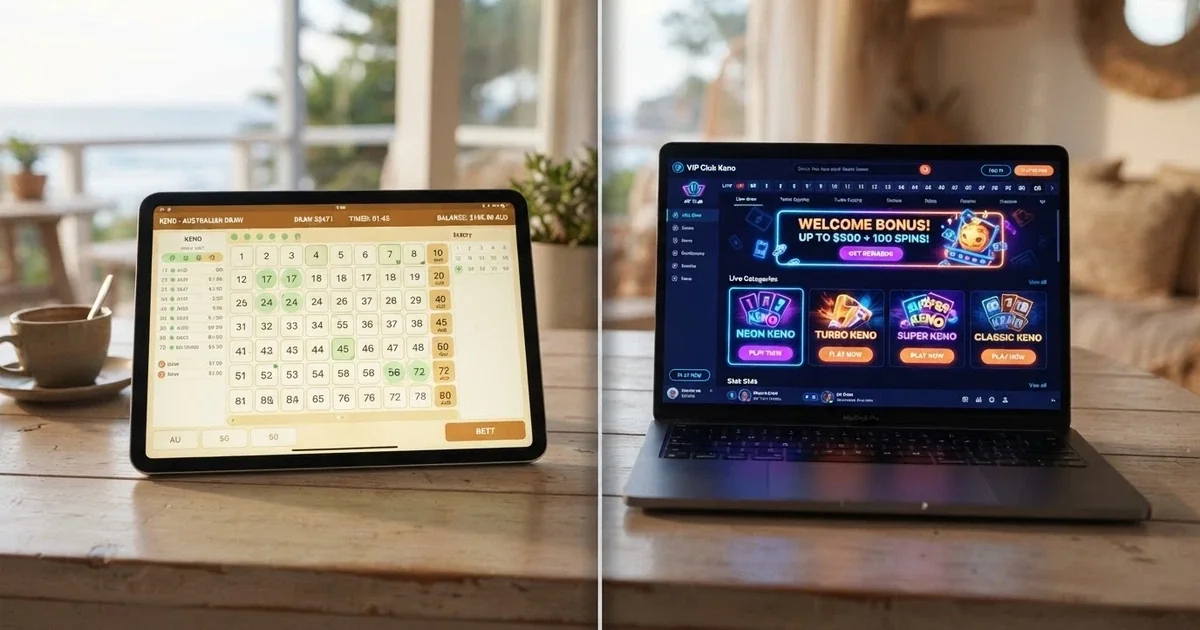
Current as of 18 October 2026 and verified against the Victorian Gambling and Casino Control Commission register and the Australian Communications and Media Authority (ACMA) public register.
Table of Contents
- Why “Online Keno” in Australia Means Two Completely Different Things
- The 2026 Keno Site Landscape: Licensed Locals vs Offshore Heavyweights
- Every Keno Variant Worth Knowing in 2026
- Try Before You Bet: Where Free Keno Actually Teaches You the Game
- Keno for Real Stakes in 2026: Payouts, Limits and What to Expect
- Why Most Keno Bonuses Cost More Than They Are Worth
- Crypto Keno: The Anonymity Trade-Off Australian Players Do Not See Coming
- The Keno Strategy Myth: What RTP Really Tells You
- Keno in Your Pocket: Mobile Play That Actually Works in 2026
- Australia’s Keno Laws in 2026: What the IGA Actually Prohibits
- Playing Safe: Responsible Gambling Tools Every Keno Player Should Know
- How We Evaluated Every Keno Site on This List
- Your 2026 Keno Game Plan: Licensed, Offshore or a Bit of Both?
- Frequently Asked Questions About Online Keno in Australia
Why “Online Keno” in Australia Means Two Completely Different Things
The single most important distinction in Australian online keno is also the easiest to miss: there is a legal, regulated version of the game and there is an offshore casino version that operates outside Australian law. The Interactive Gambling Act 2001, strengthened by amendments in 2017, prohibits the provision of online casino games and online pokies to people in Australia. Keno is classified differently: it sits alongside lotteries and pre-event wagering as a permitted product, licensed at the state and territory level. Each Australian state and territory has its own keno licensing framework — the Victorian Gambling Regulation Act 2003 (sections 6A.3.8 and 6A.3.10) and the Queensland Keno Rule 2010 are two examples of how the licensing is structured at state level.
The split matters in four practical ways. First, game access: AU-licensed keno runs on state-approved platforms with a small but reliable catalogue of formats. Offshore casinos carry thousands of titles, including dozens of keno variants, but the operation is outside Australian law. Second, payment safety: licensed Australian keno accepts debit cards, bank transfer, PayID/Osko and BPAY, while offshore casinos can still accept credit cards and crypto. Third, legal protection: an AU-licensed operator is answerable to a state regulator; an offshore casino is not. Fourth, responsible gambling: BetStop, the National Self-Exclusion Register, binds AU-licensed services only. An offshore casino is not connected to BetStop at all.
The Interactive Gambling Act targets the provider, not the player — no Australian has been prosecuted for playing at an offshore casino. But the practical consequence of the offshore route is straightforward: no Australian consumer protection, no BetStop coverage, and the site can be blocked at any time with a balance still on it.
Online Keno vs Pub Keno: What Changed When the Game Went Digital
The traditional pub and club keno experience is built around the screen in the corner and the rhythms of the local. Draws happen on a schedule tied to the venue’s broadcast — typically every three to five minutes during peak hours. A punter marks a paper ticket or tells the operator their numbers, the draw runs on screen, and the result is settled at the counter.
The online version changes almost everything about that cadence. Standard keno uses a grid of 80 numbers, from which 20 are drawn per game. Players select between 1 and 10 spots per ticket. Online, draws can run on demand — KenoGO runs a live draw every three minutes — and multi-card keno lets a single player run up to 20 tickets per draw. The bet range stays narrow (A$1 minimum at the licensed operators), but the volume of play per session is dramatically higher than what a pub visit typically produces.
The trade-off is social. Pub keno carries a particular atmosphere: the screen on the wall, the conversation in the background, the collective groan or cheer when a number lands. Online keno strips all of that away. What it adds is convenience, game variety, and the ability to play in shorter or longer bursts than a venue visit allows. A player valuing social interaction may feel something is missing, whereas one focused on at-home variety will find the digital version superior.
Where Australians Actually Play: The Three Types of Keno Sites
Every keno destination an Australian can access falls into one of three tiers. The first is AU-licensed online keno — KenoGO and The Lott — legal, regulated, and covered by Australian consumer protection law. These platforms carry three core formats: Classic spot keno, Keno Coin Toss, and Keno Combo. The minimum entry is A$1 per draw. State-level licensing provides the legal foundation: in Victoria, the keno licence commenced on 15 April 2022 for a 20-year term under the Gambling Regulation Act 2003.
The second tier is offshore casino keno. These sites carry thousands of games including dozens of keno variants — but they hold no Australian licence, are not connected to BetStop, do not enforce the Australian credit card or crypto payment ban, and provide no Australian complaints body. They are operating outside Australian law. The ACMA has had 1,564 illegal gambling and affiliate websites blocked by Australian ISPs since November 2019, with more than 225 illegal services withdrawing from the Australian market since enforcement was strengthened in 2017. A site available today can be blocked tomorrow, with a player balance still on it.
The third tier is land-based keno — pubs, clubs, TABs, and casino floors. This is still the most visible form of the game for many Australians, and it is also the only tier fully under Australian regulatory supervision. Land-based keno carries the social context the online version loses and the same legal protections the AU-licensed platforms offer.
The 2026 Keno Site Landscape: Licensed Locals vs Offshore Heavyweights
The ranking below puts every operator that matters to an Australian keno player on one page, sorted first by licence status — because that single fact changes everything about the protection, payment and recourse available. The criteria used are: Australian licence status (verified against state registers), keno format count (number of distinct keno variants available), game providers (proprietary or third-party studios), and welcome-offer terms (what the operator advertises, or the explicit absence of one).
The reason AU-licensed operators lead despite offering fewer games is not aesthetic preference. It is that every alternative on this list sits in a different legal category, and a player choosing between them is choosing between two very different sets of protections. The offshore reality below that lead is stated plainly: these sites carry more variants and bigger bonuses, and they carry none of the Australian safety net.
Operator Comparison at a Glance
| Operator | AU Licence Status | Keno Formats Available | Game Providers | Welcome Offer |
|---|---|---|---|---|
| KenoGO | Yes — Victorian keno licence (Gambling Regulation Act 2003) | 3 (Classic, Coin Toss, Combo) | Proprietary | None — lottery/keno product |
| The Lott | Yes — state/territory lottery/keno licences | 3 (Classic, Coin Toss, Combo) | Proprietary | None — lottery/keno product |
| Neospin | No — Curacao | 14 (Book of Keno, Keno 10, Across the Universe Keno, etc.) | Multiple (5,800+ games) | 300% match up to A$11,000 + 300 free spins |
| SkyCrown | No — Curacao (OGL/2023/176/0095) | 9 (Classic, Super, Sweet Keno) | Multiple (7,000+ games) | 450% up to A$8,000 + 400 free spins (four deposits) |
| Golden Crown | No — Curacao | 9 (Magic Keno, Amaterasu Keno, Keno Goldencrown) | Multiple | 100% up to A$15,000 + 300 free spins |
| Wild Tokyo | No — Curacao | 23 (widest selection among tested sites) | Multiple | 260% up to A$5,300 + 620 free spins |
| Stake | No — Curacao | Provably fair keno + third-party titles | Proprietary (Stake Originals) + third-party | — |
| Rocket Play | No — offshore | — | Multiple | — |
| Royal Reels | No — offshore | — | Multiple | — |
| FairGO | No — offshore | RTG keno titles | Realtime Gaming (RTG) | — |
A dash in the table means research did not confirm a specific figure, not that the offer or feature is absent. Where the welcome-offer column shows “None”, the operator is a lottery/keno product and does not run a casino-style bonus. Where the column shows a dash, the offer is genuinely unconfirmed this run and any claim about its size would be invented.
KenoGO: Australia’s Only Nationwide Licensed Online Keno Platform
KenoGO is the only AU-licensed online keno platform with a nationwide presence. The legal foundation is the Victorian keno licence under the Gambling Regulation Act 2003, sections 6A.3.8 and 6A.3.10, commencing 15 April 2022 for a 20-year term. The operator also holds keno licences in other states and territories. On 9 September 2025, the corporate entity was renamed from Lottoland Australia Pty Ltd to KenoGo Pty Ltd.
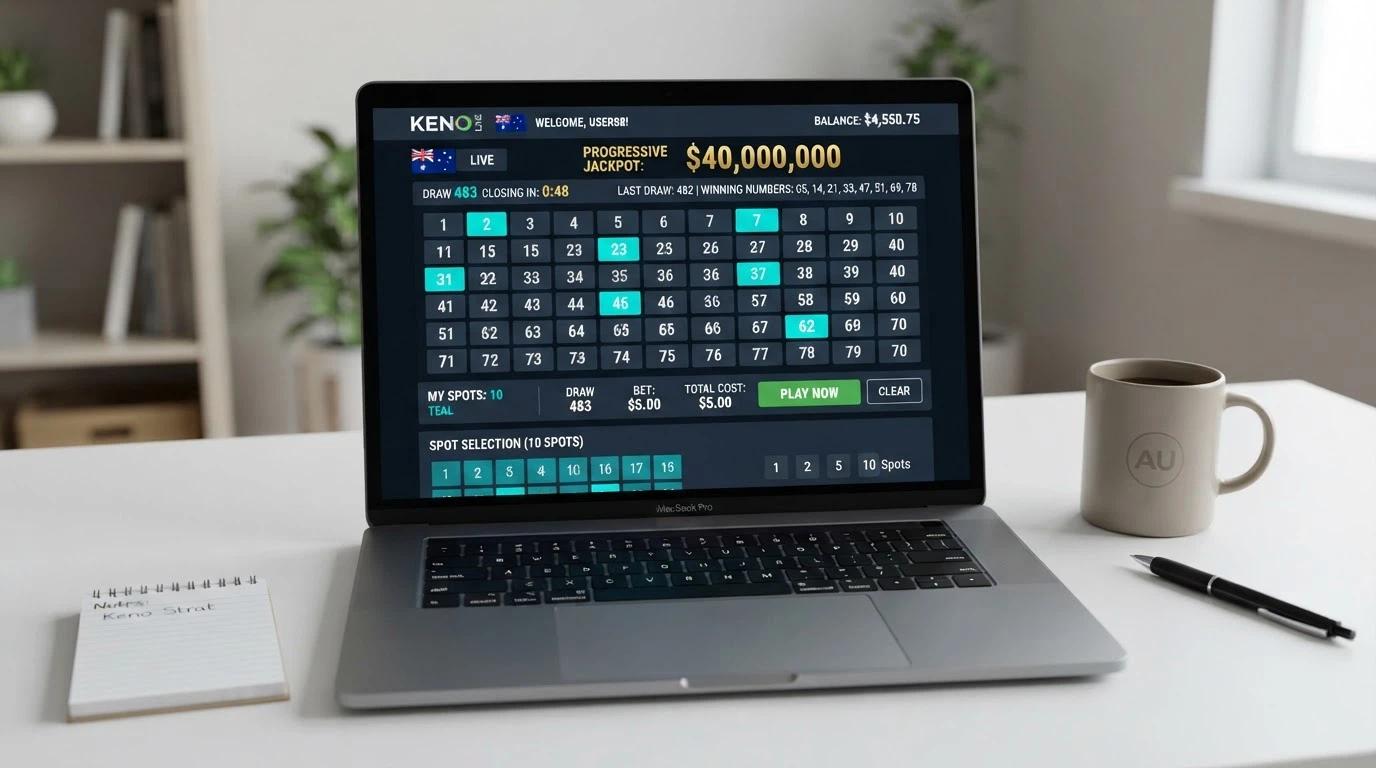
The platform runs three keno formats: Classic spot keno (1–10 spots on an 80-number grid), Keno Coin Toss, and Keno Combo. Live draws run every three minutes. The headline differentiator is the A$40 million progressive jackpot — described by KenoGO as the largest keno jackpot in Australia and the most obvious point of difference against any other AU-licensed platform. Minimum entry is A$1 per draw.
There is no welcome bonus. KenoGO is a lottery and keno product, not a casino, and Australian state-licensed lottery products do not run deposit-match promotions. The platform’s pitch is the jackpot and the regulatory standing, not a signup bonus. A player choosing KenoGO over an offshore casino is choosing legal protection and the A$40 million ceiling over a 300% deposit match and a few hundred free spins.
The Lott: Official State-Backed Keno, Online and In-Venue
The Lott is the state-backed incumbent — Tabcorp’s Tatts Group operates official state lotteries and keno across Australia. The same three core keno formats run here as on KenoGO: Classic spot keno (1–10 spots on the standard 80-number grid), Keno Coin Toss, and Keno Combo. Minimum entry is A$1 per draw. There is no welcome bonus for the same reason KenoGO does not offer one: this is a lottery and keno product, not a casino.
The hybrid advantage is the in-venue integration. The same keno game that runs online at The Lott runs on screens in pubs, clubs and TABs across the states where Tabcorp holds the licence. For a player who splits time between online sessions and venue visits, The Lott offers a continuity that offshore casinos cannot match. The legal protection is identical to KenoGO’s: state-licensed, BetStop-connected, payment-ban-compliant.
Neospin: The Offshore Casino with 14 Keno Formats (But No AU Licence)
Neospin runs 14 keno formats — the highest variety among the offshore sites tested — including Book of Keno, Keno 10 (1 Minute), Across the Universe Keno, Classic keno, Super keno, Turbo keno, and Video keno. The total game library sits above 5,800 titles, supplied across multiple providers including Playtech, NetEnt, Kiron Interactive, Realtime Gaming, 1x2gaming, BetSoft and Rival. The headline RTP across the broader catalogue sits at 96.9%.
The welcome offer is 300% deposit match up to A$11,000, plus 300 free spins. The size of the match is significant — but it is bound by keno-specific wagering requirements that, averaged across audited Australian casinos, sit at 30.3x. The licence is Curacao. There is no Australian licence, no BetStop connection, no Australian consumer protection, and the site can be blocked by Australian ISPs at any time.
The reader Neospin suits is one chasing variant variety and willing to accept the offshore trade-off in full. The reader it does not suit is anyone who values BetStop coverage or who wants the guarantee that a withdrawal dispute can be escalated to an Australian regulator.
SkyCrown: 7,000+ Games Where Keno Is One of Many
SkyCrown runs 7,000+ games, the largest overall library on this list, with keno as one category among many. Nine keno formats are available, including Classic keno, Super keno and Sweet Keno. The welcome offer is the steepest multistage package on the featured set: 450% up to A$8,000, plus 400 free spins, spread across four deposits. Each deposit carries its own bonus and its own wagering requirement.
The licence is Curacao — number OGL/2023/176/0095 on the Curacao Gaming Control Board register. No Australian licence. No BetStop coverage. No Australian consumer recourse. SkyCrown is suited to a player who treats keno as one game among many and who is comfortable navigating offshore terms.
Golden Crown: VIP Perks That Target Keno Players at an Unlicensed Casino
Golden Crown carries nine keno formats including Magic Keno, Amaterasu Keno, and Keno Goldencrown. The welcome offer is a 100% deposit match up to A$15,000 plus 300 free spins — the largest single-stage match on the featured list. A VIP rewards program is structured to highlight keno play, which makes it a notable choice for a keno-focused player who plans to play regularly.
The licence is Curacao. There is no Australian licence. The keno-targeting VIP structure is a marketing choice — the same offshore caveats apply here as on every other Curacao-licensed entry.
Wild Tokyo: 23 Keno Formats — The Widest Selection Among Checked Sites
Wild Tokyo runs 23 keno formats — the widest selection among all tested sites in this audit. The welcome offer is 260% up to A$5,300 plus 620 free spins, the largest spin count on the list. Multiple game providers feed the library.
The licence is Curacao. No Australian licence. The 23-format count is the clearest argument Wild Tokyo has for a keno-focused player; everything else about it is the same offshore trade-off as the rest of the list.
Stake: Provably Fair Keno on a Crypto-First Platform
Stake’s keno runs through Stake Originals — a proprietary product with provably fair cryptographic verification. Every draw is independently checkable against the server seed and the client seed, which is a different trust model from both RNG keno and live-dealer keno. Third-party keno titles are also available. The welcome bonus was not specified in the search results reviewed this run.
The platform is crypto-focused and Curacao-licensed. No Australian licence. The Australian crypto payment ban that took effect on 11 June 2024 applies to AU-licensed wagering — Stake is not bound by it because it is not AU-licensed, but the very fact that a casino accepts crypto is itself a signal that the operator is operating outside the Australian regime. A player who values the provably fair verification model and is comfortable with the offshore trade-off will find something genuinely different here; a player who needs BetStop coverage or Australian complaints recourse will find nothing.
Rocket Play: Heavy AU Traffic, No Australian Licence
Rocket Play holds 9.4% of tracked Australian gambling traffic — the highest market share among the offshore casinos on this list. Multiple game providers feed the library. Keno is available among other games. The welcome bonus was not confirmed in the search results reviewed this run, so the size and structure of any promotion cannot be stated here without invention.
The licence is offshore. There is no Australian licence. The traffic share tells a player that many Australians are using the site, not that the site is safe or legal under Australian law. High market share at an unlicensed casino is exactly what the IGA was enacted to address.
Royal Reels: An Australia-Facing Offshore Brand with Keno in the Mix
Royal Reels holds 2.51% of tracked Australian gambling traffic. Keno is available among other casino games. The welcome bonus was not confirmed in the search results reviewed this run.
The licence is offshore. No Australian licence. The “Australia-facing” positioning does not equate to Australian licensing — the two are different things, and Royal Reels sits in the same offshore category as every other entry below KenoGO and The Lott.
FairGO: RTG-Powered Keno at an Australia-Targeted Offshore Casino
FairGO runs on Realtime Gaming (RTG) as the primary game provider, and positions itself as an Australia-focused offshore casino. RTG keno titles form part of the catalogue. The welcome bonus was not confirmed in the search results reviewed this run.
The licence is offshore. No Australian licence. RTG is one of the well-known providers of online keno titles, alongside Playtech, NetEnt, Kiron Interactive, 1x2gaming, BetSoft and Rival — but the provider choice does not change the legal status. An RTG keno game at an offshore casino remains an offshore keno game.
Every Keno Variant Worth Knowing in 2026
The variants below are the ones a player will actually encounter at AU-licensed platforms and offshore casinos alike. Each one modifies the base game in a way that changes the maths, the pace, or the production values.
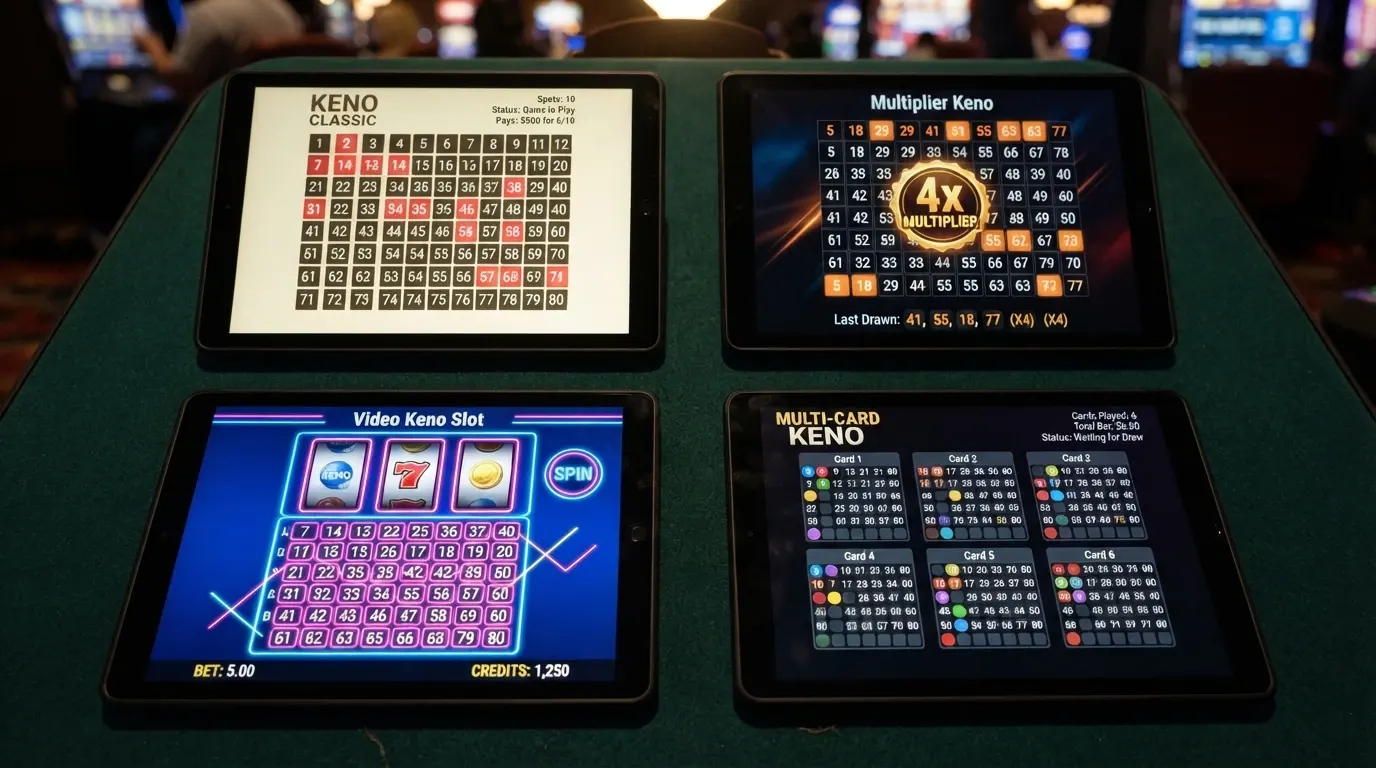
The foundation every variant builds on is the classic spot-keno format: an 80-number grid, 20 numbers drawn per game, the player marks 1 to 10 spots and is paid on how many of their picks match the draw. The Queensland Keno Rule 2010 defines the wager types formally — spot wagers (selecting a certain number of spots) and way wagers (grouping spots on a single ticket across multiple combinations). Most Australians playing pub keno are running spot wagers without realising there is a formal legal category behind it.
The main variant families: Classic keno (the base game), Power keno (an Australian-origin variant that multiplies all winnings by 4x if the player’s pick matches the final number drawn), Super keno (higher payouts on a 7-of-7 or similar catch, usually at a steeper wagering cost), Way keno (grouping multiple spot combinations on a single ticket), Combination keno (running spot wagers and way wagers together), Progressive keno (jackpot-linked), and Video keno (slot-style production with keno maths underneath).
Classic Spot Keno vs Video Keno: The Format Split That Changes Everything
Classic spot keno and video keno share a name and almost nothing else. Classic spot keno is the deliberate game: pick numbers off the 80-number grid, wait for the draw, check your catches. Video keno is the slot-machine product — reels, animations, sound effects, bonus rounds — with keno mathematics underneath. Cleopatra Keno, one of the most popular video keno titles, awards 12 doubled free games when triggered.
The RTP gap between the two is significant. Standard spot keno presents a house edge of roughly 25%, regardless of numbers selected. Video keno machines vary wildly: favourable pay tables can reduce the house edge to around 8%, while poorly configured machines push it to around 30%. A player who picks a video keno game without checking the pay table is taking worse odds than at a pub keno screen.
The pace gap is just as significant. Classic spot keno runs on the draw schedule — every three minutes at KenoGO, on a venue’s broadcast at a pub. Video keno runs at the player’s own speed, with draws as fast as every few seconds. The faster pace compounds the house edge: a player who runs 200 spins an hour at video keno is feeding the house edge 200 times in an hour, where a classic spot keno player runs 20.
Live Dealer Keno vs RNG Keno: Trust, Pace, and the Social Layer
Live dealer keno streams a physical ball draw with a host on camera. The pace is slower, the randomness is visibly physical, and the social layer is closer to a pub keno screen. RNG keno is algorithm-driven — draws happen at the player’s own speed, the game runs 24/7, and no waiting for a scheduled draw is required.
A third model exists: provably fair keno (as run by Stake Originals), where cryptographic verification lets a player check every draw against the published seeds. This is a different trust mechanism again — neither the visible ball draw of live dealer nor the algorithmic black box of standard RNG.
KenoGO runs live draws every three minutes, which sits between the two extremes. The player gets a scheduled draw and a visible result, but no human host and no chat. For an Australian player, the closest analogue to the pub keno experience is the licensed platform with a short, fixed draw interval.
Try Before You Bet: Where Free Keno Actually Teaches You the Game
Free-play keno is not a marketing gimmick. It is the only way to learn how multi-card layouts, way wagers, and variant-specific pay tables work before real money is on the line. Offshore casino keno lobbies typically offer demo modes for most keno titles. Free-to-play keno apps exist outside the licensed Australian market and can be useful for learning the rhythm of the game.
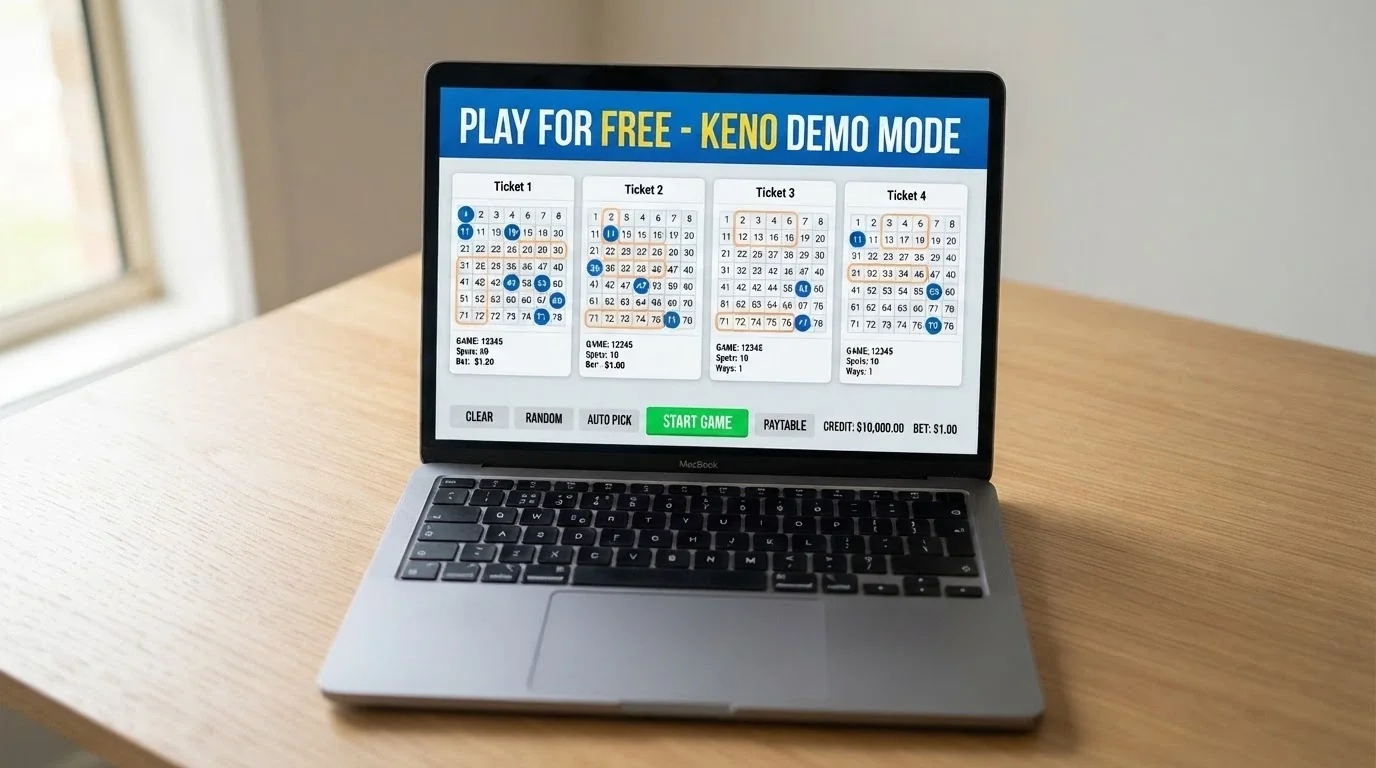
What free keno teaches is real: spot selection, way-wager grouping, the pace of the variant, the structure of bonus rounds in video keno. What free keno does not teach is just as important: real-money bankroll pressure, the tilt that follows a losing streak, and the discipline required to stop after a session. A player who has mastered free keno still faces a different game the moment a deposit lands.
Free Keno Slots vs Free Keno Games: They Are Not the Same Thing
Search results freely mix “free keno slots” and “free keno games” — and the distinction matters. Free keno slots are slot machines with a keno theme: reels, paylines, bonus rounds, and a slot-style house edge typically in the 4-8% range. Free keno games are the actual number-picking draw game: an 80-number grid, 20 numbers drawn, a payout structure tied to how many picks the player catches.
A player practising free keno slots learns nothing about spot selection or way wagers. The two game types share a word and almost no other mechanics. Treating them as interchangeable wastes the practice session.
From Demo Mode to Real Money: When to Make the Switch
The signal that a player is ready to move from demo mode to real money is not a number of practice sessions. It is familiarity: comfortable with spot selection, comfortable with the way-wager grouping they plan to use, and comfortable with the pace of the variant they have chosen. A player who cannot articulate what they are doing and why is not ready.
What changes at the moment of deposit is psychological. The weight of a losing streak is different when real money is on the line. The temptation to chase losses appears where it did not exist in demo mode. The discipline to stick to a per-draw budget becomes the actual test, not a theoretical one.
Demo mode stays useful after the switch. Testing a new variant on a new site in demo mode before committing cash is sound practice, and the offshore casino lobbies that offer free-play keno make this possible. The mistake is treating demo-mode confidence as real-money skill. It is preparation, not performance.
Keno for Real Stakes in 2026: Payouts, Limits and What to Expect
Playing keno for real money in Australia splits into two paths. The AU-licensed route runs at A$1 minimum entry per draw, with draws every three minutes at KenoGO and a regulated payout structure under state law. The offshore casino route offers wider bet ranges, higher jackpots, and dozens of variants — and no Australian consumer protection if a withdrawal is refused.
The RTP reality sits between the two paths but applies to both. Documented keno returns span 82.39% to 95.36% across variants, per Wizard of Odds pay-table analyses. Standard spot keno carries a house edge near 25% regardless of how many numbers the player marks. The variant with the best documented returns is favourable-pay-table video keno at around 8% house edge; the worst is poorly configured video keno at around 30%. A player choosing the variant is choosing where in this 82-95% RTP band their session sits.
Payout Expectations: What a Keno Win Actually Pays in 2026
Keno payouts scale in two directions. Fewer spots picked means a higher hit frequency and a lower payout per hit. More spots picked means a lower hit frequency and a higher ceiling. The 4-to-6-spot sweet spot is where most payout structures give the least unfavourable ratio, not where the math flips in the player’s favour — at 25% house edge on standard keno, the math does not flip.
The ceiling is the KenoGO A$40 million progressive jackpot, the largest keno jackpot in Australia. The floor is a 1-spot catch, where the player picked a single number and that number was drawn. Power keno adds a different dimension: an Australian-origin variant where hitting the final number drawn multiplies all winnings by 4x. The multiplier is the entire mechanism of the variant — without it, Power keno reduces to standard keno with a different payout table.
A session at standard keno with 25% house edge will, on average, cost the player 25 cents for every dollar turned over. Most sessions end in the red. That is not a strategy failure — it is the design of the game. Keno is paid entertainment with a known cost, and the cost is steeper than it is for most casino products.
Why Most Keno Bonuses Cost More Than They Are Worth
A welcome bonus looks like free money. The wagering mathematics say otherwise, and for keno the numbers are steeper than for slots. The average keno wagering requirement across audited Australian casinos sits at 30.3x. That figure means a A$100 bonus obliges the player to turn over A$3,030 in qualifying wagers before a single dollar can be withdrawn.
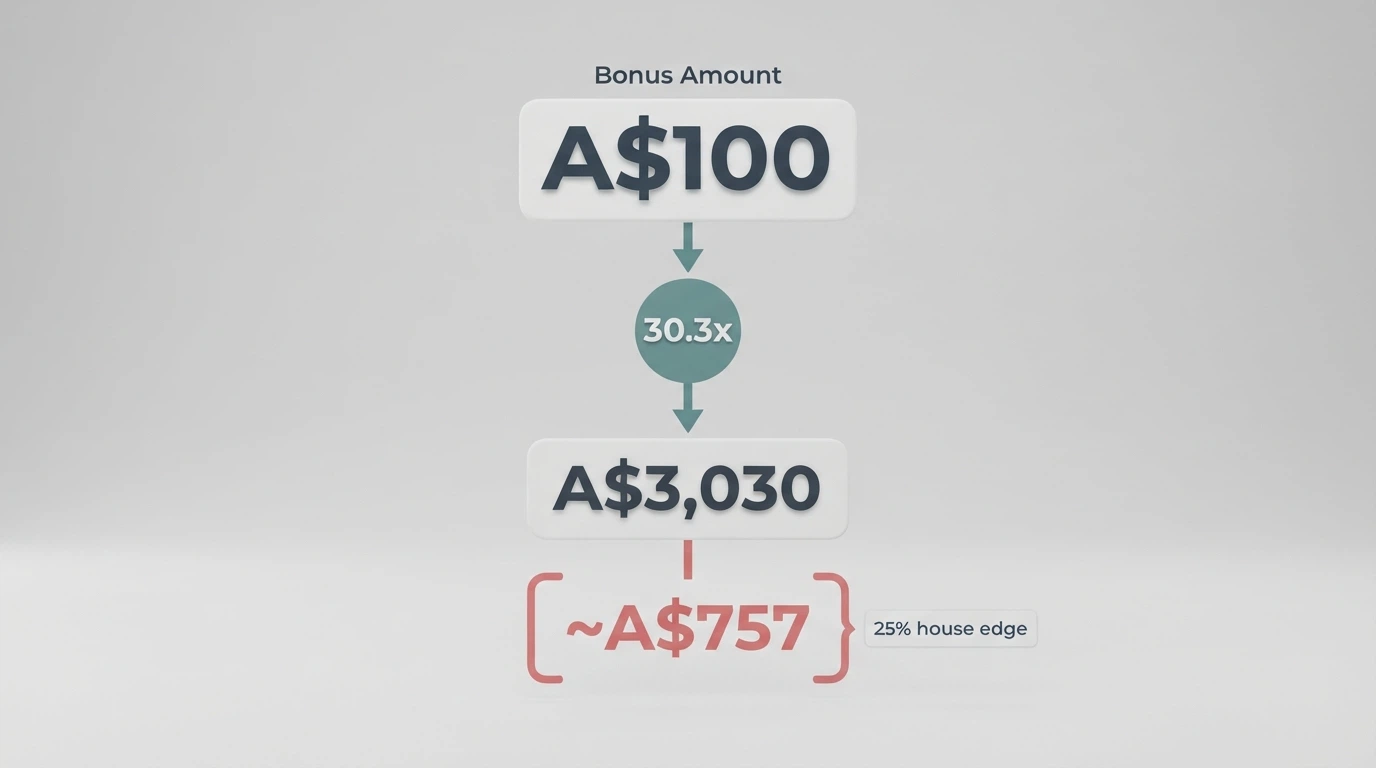
The mechanism is straightforward: the player bets the bonus amount multiplied by the wagering factor, the house edge takes its cut on every spin, and whatever remains after the full turnover requirement is met becomes withdrawable. The expected cost of clearing the bonus can be estimated: at standard keno’s ~25% house edge, a 30.3x wagering requirement on a A$100 bonus means the player is expected to lose roughly A$757 of the A$3,030 turnover before completing the requirement. The “free” A$100 bonus carries an expected cost of around A$757 in additional losses before it is unlocked.
These figures are statistical estimates, not guaranteed outcomes. They describe the average across many spins under the stated assumptions. No individual session will produce exactly these numbers — variance is real and can cut either way. The point is that the average cost of clearing the bonus exceeds the bonus itself for any standard keno game, which makes the “free money” framing a marketing construction rather than a financial reality.
No-Deposit Keno Bonuses vs Deposit Match Offers: What the Wagering Multiples Actually Mean
The two bonus structures a keno player will encounter most often are no-deposit bonuses and deposit-match offers. Both come with wagering requirements; both apply those requirements to any winnings.
No-deposit bonuses offer free play without an upfront deposit. The wagering requirement still applies to any winnings the bonus generates. A small no-deposit bonus carries a smaller absolute turnover obligation — but the wagering multiple can be just as steep as on a deposit match.
Deposit-match bonuses are the 100% to 450% offers on the offshore list. Each has its own wagering hurdle. The 300% match at Neospin, the 450% multistage offer at SkyCrown, the 100% match at Golden Crown, and the 260% match at Wild Tokyo each carry their own turnover requirement at the average 30.3x level for keno. At a typical spin interval, clearing a 30.3x wagering requirement on a A$100 bonus takes hours — and the ~25% house edge on standard keno eats into the balance the entire time.
The trade-off between no-deposit and deposit-match is not what it looks like at first glance. A no-deposit bonus avoids the upfront cash commitment but locks the player into a wagering requirement on a smaller bonus. A deposit match requires real money up front and multiplies the bonus size — and the turnover. Neither structure is “free” once the wagering requirement is priced in.
Crypto Keno: The Anonymity Trade-Off Australian Players Do Not See Coming
Crypto keno promises privacy and fast settlements. For Australian players, the reality is more complicated. Credit cards, credit-related products and digital currency (crypto) have been banned as payment for online wagering in Australia since 11 June 2024, under the Interactive Gambling Amendment (Credit and Other Measures) Act 2023. An AU-licensed operator that accepts crypto faces penalties of up to A$247,500.
The offshore casinos on this list are not bound by the ban. Stake is the most prominent crypto-focused entry, with provably fair keno and the broader crypto-gambling ecosystem it sits inside. Other offshore operators on the list accept crypto deposits as a standard option. The ability to deposit in crypto is not a feature; it is a signal that the operator is operating outside the Australian regime.
The anonymity illusion deserves a clear framing. “No KYC” sounds like privacy, but no KYC also means no identity verification, no dispute resolution, and no Australian legal recourse if a withdrawal is refused. A player whose crypto deposit lands at an offshore casino has no Australian complaints body to appeal to and no Australian consumer protection framework to fall back on. From 1 January 2027, banks and payment providers gain express authority to block transactions to illegal gambling operators — which means even the crypto route may face friction at the banking layer, even if the offshore operator itself is unaffected.
The audience for crypto keno is a player who has weighed the offshore trade-off and decided the variant variety and provably fair verification are worth the loss of Australian protection. That is a real audience, and the audit found provably fair keno at Stake genuinely offers something different. It is not an audience that should be told the trade-off does not exist.
The Keno Strategy Myth: What RTP Really Tells You
Every keno strategy article promises an edge. The mathematics say the house always wins over volume. Standard spot keno carries a house edge near 25%, one of the highest in the gambling world. No spot-selection strategy changes that figure, because the house edge is a property of the payout structure, not of the numbers the player picks.
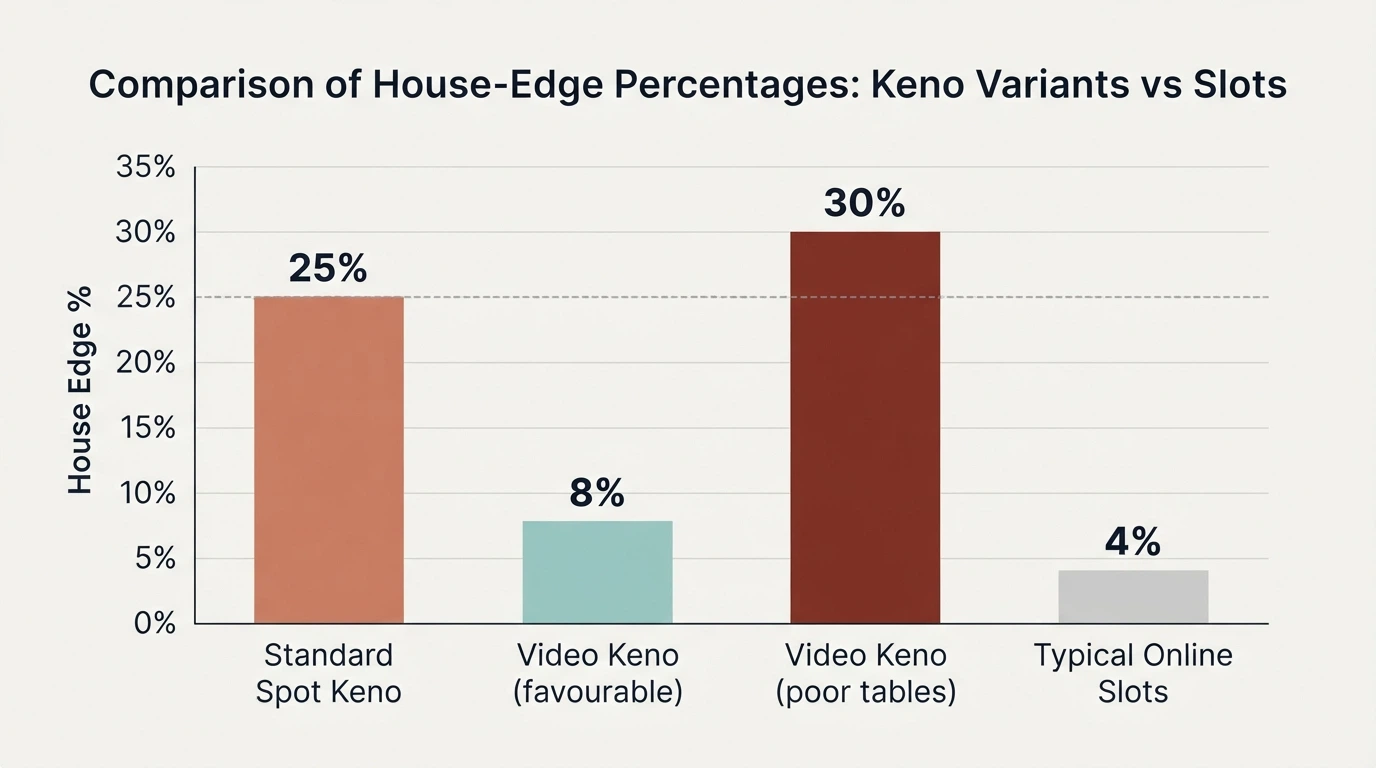
What variant selection changes is real. Video keno with favourable pay tables can reduce the house edge to around 8%, compared to around 30% for poorly configured machines. A player who picks the favourable video keno game over standard spot keno has moved the house edge from 25% to 8% — which is the single largest strategic lever in the game. But 8% is still a house edge. The game is still designed for the player to lose over volume.
Spot-count strategy is a smaller lever. Selecting 4 to 6 spots gives the most balanced combination of hit frequency and payout potential, per the casino strategy literature. But the balance is between two kinds of losing outcomes — frequent small losses and infrequent large ones — not between losing and winning. A player at 4 spots and a player at 10 spots will both lose over time; the 4-spot player loses in smaller chunks more often.
The honest framing is that keno is paid entertainment with a known cost. The cost ranges from 8% to 30% of turnover depending on the variant, and the player’s only real levers are variant selection and bankroll discipline. No strategy article can change that.
How to Play Keno: Rules Every Australian Should Know Before Their First Game
The rules are simple. The terminology and the bet types are where new players stumble.
The basic sequence: an 80-number grid sits on the screen, 20 numbers are drawn per game, the player marks 1 to 10 spots, and the payout is calculated on how many of the player’s picks match the draw. A 1-spot catch pays one rate, a 10-spot catch pays another, and the payout table is published on the game screen.
Spot wagers vs way wagers is the bet-type distinction that matters. The Queensland Keno Rule 2010 defines spot wagers (a single selection of a certain number of spots) and way wagers (grouping spots on a keno ticket so that multiple combinations are covered by one ticket). A 4-spot way wager, for example, can be structured to cover all combinations of subsets of those 4 spots, which increases hit frequency at the cost of multiplying the total stake.
Quickpick is the random-number-selection option most platforms offer — the system picks the player’s spots instead of the player choosing them. Heads/tails, coin toss and keno combo are variant-specific bet types offered at AU-licensed operators. A punter walking into a pub or logging into KenoGO for the first time should know these terms before they sit down.
The Software Behind the Numbers: Who Builds Online Keno Games
A small number of studios supply nearly every online keno game. The major providers, in alphabetical order: Playtech, NetEnt, Kiron Interactive, Realtime Gaming (RTG), 1x2gaming, BetSoft, and Rival. The same titles often appear across multiple offshore casinos because the providers license the same games to many operators.
Provider choice affects game quality, RTP transparency, and variant availability. A casino running Playtech and NetEnt will carry different keno titles than one running RTG. A casino that discloses the RTP of each keno title gives the player more information than one that does not.
Proprietary keno is a different category. KenoGO runs its own platform with its own draw engine, which is part of why it holds the A$40 million progressive jackpot — the platform is closed, the pool is internal, and the jackpot ceiling is set by the operator rather than the provider. Stake Originals runs a proprietary provably fair keno engine, with cryptographic verification as the trust model. FairGO runs primarily on RTG, which means it carries RTG’s keno catalogue but not its own proprietary product.
Keno in Your Pocket: Mobile Play That Actually Works in 2026
Most keno sites work in a mobile browser. The real question is which ones offer a dedicated app, and whether the app adds anything the browser version does not. For AU-licensed platforms, mobile-optimised web play is the standard — KenoGO and The Lott run through mobile browsers without requiring a separate download. For offshore casinos, browser-based play is universal, with dedicated apps varying by operator.
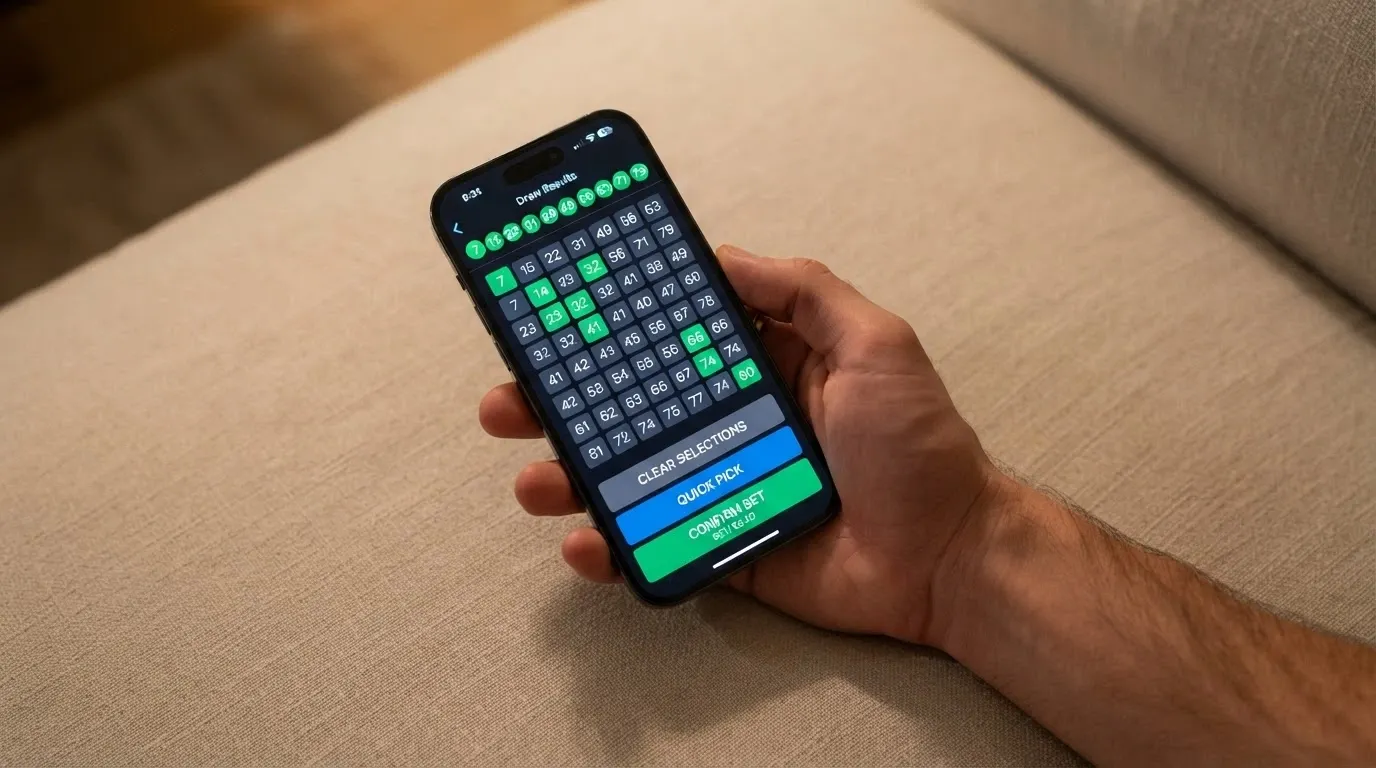
The mobile experience changes one thing about keno: the screen size. The 80-number grid is harder to read on a phone than on a desktop, and multi-card layouts with 20 tickets become a navigation challenge rather than a one-screen view. Most platforms solve this with simplified mobile layouts — larger touch targets, fewer simultaneous cards, sequential card selection rather than parallel. The core game is unchanged; the interface is compressed.
The dedicated-app question comes down to whether the app offers something the browser does not: push notifications for draw results, biometric login, or offline play. For most keno players, the mobile browser is sufficient, and a dedicated app is not a deciding factor. Where a platform does offer a dedicated app, it is usually listed in the standard app stores rather than as a direct download.
Australia’s Keno Laws in 2026: What the IGA Actually Prohibits
The Interactive Gambling Act 2001, strengthened by the 2017 amendments, draws a bright line through Australian online gambling. Online casino games and online pokies are prohibited; keno, lotteries, and pre-event wagering are permitted. The line is simple to state and loaded with consequences.
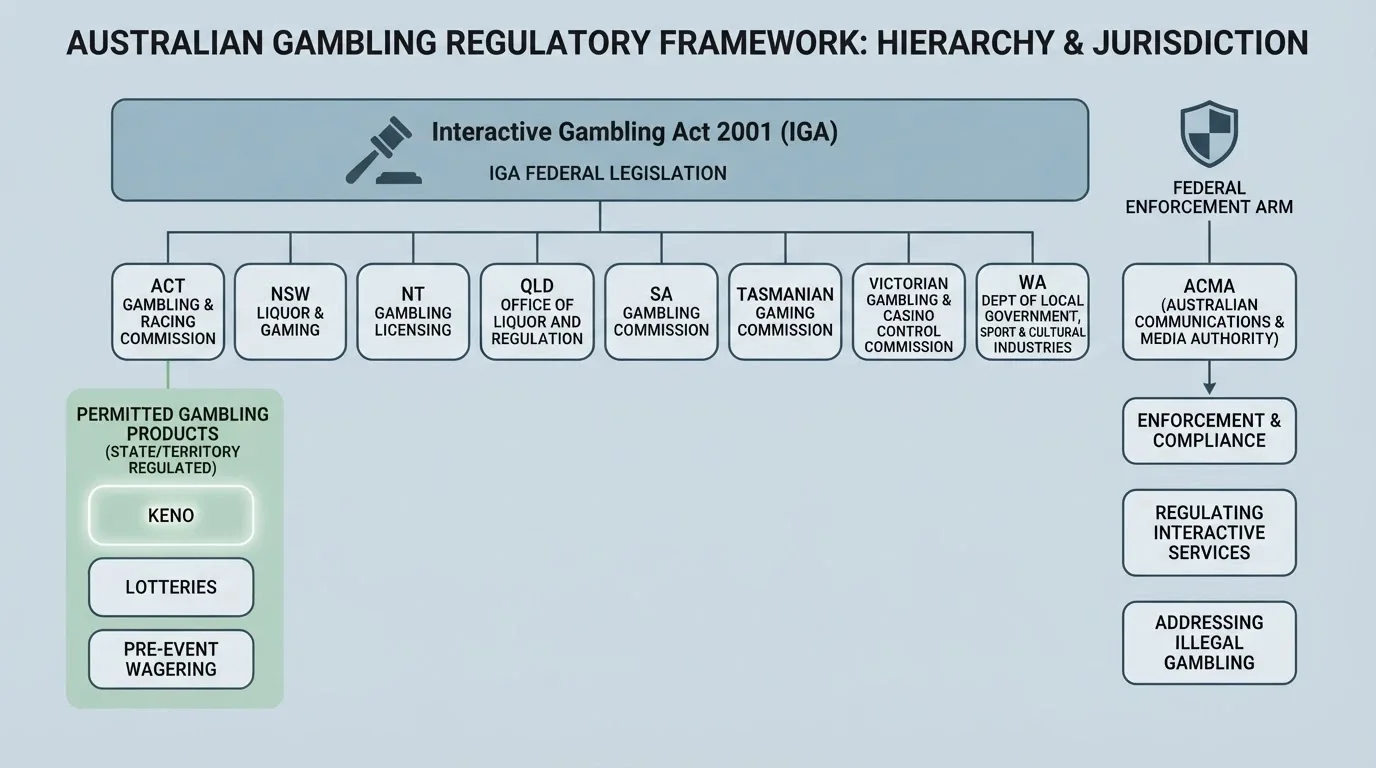
State-level keno licensing fills the permitted-product space. Victoria issues keno licences under sections 6A.3.8 and 6A.3.10 of the Gambling Regulation Act 2003 — the Victorian keno licence commenced on 15 April 2022 for a 20-year term. Queensland operates under the Keno Rule 2010. Each state and territory has its own framework, and the AU-licensed operators hold licences across multiple jurisdictions to deliver a nationwide service.
The ACMA is the federal regulator. It investigates complaints, issues formal warnings, brings civil penalty proceedings, refers operators for enforcement, and directs ISPs to block illegal sites. Since November 2019, the ACMA has had 1,564 illegal gambling and affiliate websites blocked by Australian ISPs, with more than 225 illegal services withdrawing from the Australian market since enforcement was strengthened in 2017. The blocking regime is ongoing; a site available today can be blocked tomorrow.
The 2026 reform package sits on top of this framework. The Interactive Gambling Amendment (Gambling Reform) Bill 2026 passed Parliament on 19 August 2026; its measures commence on 1 January 2027. The headline provisions: a cap of three wagering ads per hour between 6:00 am and 8:30 pm; a live-sport blackout on wagering advertising from 15 minutes before an event until 5 minutes after; radio wagering ads barred during school drop-off and pick-up times; broadcasting of sporting odds banned outright; online wagering ads shown only to logged-in, age-confirmed users with opt-out; no wagering advertising inside sports venues or on player and official uniforms; athletes, celebrities and influencers barred from promoting wagering products.
The payment-blocking reform is the most consequential provision for an offshore keno player. From 1 January 2027, banks and payment providers gain express authority to block transactions to illegal gambling operators. A player using an offshore casino today faces a real prospect of their bank declining the transaction from the start of 2027.
AU-Licensed Keno vs Offshore Casino Keno: The Legal Protections You Lose
| Feature | AU-Licensed Keno (KenoGO, The Lott) | Offshore Casino Keno |
|---|---|---|
| Australian licence | Yes — state/territory keno licence | No — Curacao or other offshore licence |
| BetStop coverage | Yes — bound by National Self-Exclusion Register | No — not connected, will keep accepting deposits from self-excluded persons |
| Payment methods | Debit card, bank transfer, PayID/Osko, BPAY | Includes credit cards and crypto (banned for AU-licensed wagering) |
| Consumer recourse | State regulator (e.g. VGCCC), federal ACMA complaints | No Australian complaints body |
| Site blocking risk | None | ACMA has blocked 1,564 sites since 2019; ongoing risk |
| IGA status | Permitted product | Provider committing an offence; player not prosecuted |
| Bonus structure | No welcome bonus (lottery/keno product) | Deposit-match and free-spin packages |
The single fact that determines which column a player belongs in is the licence. Everything else flows from it. An offshore casino can carry more variants and bigger bonuses and still offer nothing an Australian can rely on if a withdrawal is refused or the site disappears mid-session.
The Payment Rules: What You Can and Cannot Use to Fund Keno Play in Australia
The credit card and crypto ban for AU-licensed wagering commenced on 11 June 2024. The Interactive Gambling Amendment (Credit and Other Measures) Act 2023 made it an offence for an AU-licensed operator to accept credit cards, credit-related products, or digital currency (crypto) as payment. The penalty for non-compliance is up to A$247,500.
The legal deposit routes are debit card, bank transfer, PayID/Osko, and BPAY. These are the payment methods available at KenoGO and The Lott. Each one is auditable through the Australian banking system, which is part of why it is the licensed set that runs on these methods and not the offshore set.
Offshore casinos are not bound by the ban and continue to accept credit cards and crypto. The payment method itself is a signal of licence status. A casino that takes credit cards is, by definition, not an AU-licensed operator. A player who deposits by credit card at an offshore casino has confirmed, by their payment choice, that they are playing outside the Australian regime.
From 1 January 2027, banks gain authority to block transactions to illegal operators. The mechanism is straightforward: a bank identifies a transaction bound for an illegal gambling operator and declines it. The practical effect on an offshore keno player is that their bank may refuse deposits or withdrawals, even if the offshore casino itself is unaffected by the change.
Playing Safe: Responsible Gambling Tools Every Keno Player Should Know
Responsible gambling is not a footnote. About 2.1% of Australian adults — roughly 430,000 people — experience problem gambling, per the Australian Institute of Health and Welfare. Online gamblers are nearly five times more likely to experience moderate-to-high-risk gambling than other gamblers. The infrastructure built to address this is substantial, and it only works on the licensed side of the line.
BetStop, the National Self-Exclusion Register, is the centrepiece. One registration excludes a person from every Australian-licensed online and phone wagering service. As at 31 July 2026, BetStop had 67,480 registrations, of which 41,290 exclusions were still active. 78% of registrants were under 40, and 38% had chosen lifetime exclusion. The register binds AU-licensed operators only — an offshore casino is not connected to it and will continue to accept deposits from a self-excluded person.
The other standard tools — deposit limits, session timers, reality checks — are required at AU-licensed operators under state and territory conditions. The specifics vary by jurisdiction, but the framework is consistent: a player can set a daily, weekly, or monthly deposit cap, can be reminded of session length, and can be flagged by the operator’s monitoring systems. None of these tools exist at an unlicensed casino. A player who needs them has chosen the wrong side of the line.
Self-Exclusion in Practice: How BetStop Works (and Where It Stops Working)
Registering with BetStop takes minutes and covers every Australian-licensed online and phone wagering service. The exclusion periods range from three months to a lifetime. The registration is confidential, and the operator is notified to close the player’s account and refuse further deposits.
The hard limit is offshore. BetStop does not reach Curacao-licensed casinos, crypto-first platforms, or any operator outside the Australian regulatory framework. A self-excluded person who moves to an offshore casino will find that the casino accepts their deposits, accepts their bets, and offers no Australian complaints body if a withdrawal is refused. The protection is real on the licensed side and absent on the offshore side.
The 2026 reform adds a layer. From 1 January 2027, direct marketing of inducements is prohibited for 14 days after a customer signs up, for three months after a person deregisters from BetStop, and indefinitely for customers identified as at risk of gambling-related harm. The intent is to close the gap where a player deregisters from BetStop and immediately receives a wave of bonus offers from AU-licensed operators trying to win them back.
Where to Get Help: Helplines, Chat Services and the Safety Net Beyond BetStop
The National Gambling Helpline — 1800 858 858 — is free, confidential, and staffed 24/7. Gambling Help Online at gamblinghelponline.org.au provides 24/7 online chat and counselling. The National Debt Helpline at 1800 007 007 supports gambling-related financial difficulty. All three services are free and available immediately.
The help-seeking gap is real. Only 13.5% of those engaged in moderate-risk and high-risk gambling report seeking help for gambling-related issues, per the NSW Gambling Survey 2024. The services exist; the uptake is low. A player who recognises the signs in themselves — chasing losses, hiding play from family, borrowing to fund sessions — has access to professional support at no cost and at any hour.
How We Evaluated Every Keno Site on This List
The source basis for this ranking is Australian regulation, operator audits, and direct review of operator terms. The Australian regulatory framework — the IGA 2001, ACMA enforcement data, state and territory keno licensing registers, and BetStop statistics — defines the legal status of every operator. CasinoAudit.net provided keno coverage data: 62.4% of all 274 audited Australian casinos offer keno games, and the average keno wagering requirement across audited casinos sits at 30.3x.
Every operator was checked against the official Australian regulatory framework. State and territory keno licences were confirmed for KenoGO and The Lott. Offshore licences were identified and labelled for the remaining operators — Curacao for Neospin, SkyCrown, Golden Crown, Wild Tokyo and Stake, with the Curacao licence number OGL/2023/176/0095 confirmed for SkyCrown. Rocket Play, Royal Reels and FairGO were identified as offshore-licensed without a specific jurisdiction confirmed this run.
The ranking criteria, applied in order: Australian licence status as the primary sort, then keno format count, then game provider quality, then welcome-offer transparency. No fabricated weightings or percentages were assigned. The AU-licensed-first principle is editorial rather than mathematical: operators holding a valid Australian state or territory keno licence rank ahead of all offshore casinos regardless of game count or bonus size, because the licence status determines the protection framework the player sits inside.
The welcome-offer data is incomplete for some operators. Where research did not confirm a specific offer, this guide states that absence rather than guessing. A dash in the table means a figure was not confirmed this run, not that the offer is absent. A casino audit that invents a bonus size to fill a table cell produces a page that is worse than a page with honest gaps.
Your 2026 Keno Game Plan: Licensed, Offshore or a Bit of Both?
The article has covered the landscape, the maths, and the law. What remains is the practical question: what does a sensible Australian keno player actually do with this information?
The case for staying AU-licensed is straightforward. Legal protection under state law. BetStop coverage if self-exclusion becomes necessary. Payouts are overseen by state regulators, providing a consistent mechanism for claims. The A$40 million KenoGO jackpot as the ceiling. The licensed platforms cover most of what most players actually need — variant familiarity, reliable draws, secure payment methods. The lack of a welcome bonus is a structural feature of the lottery/keno product category, not a competitive weakness.
The offshore case is equally straightforward, and equally qualified. More variants, bigger bonus offers, crypto deposits, provably fair verification at Stake. The risks that come with each are: no Australian consumer protection, no BetStop coverage, ACMA blocking at any time, payment-method signals that confirm the unlicensed status, and from 1 January 2027, banks gaining authority to block transactions to illegal operators.
The hybrid approach is the practical middle ground. A player can use free-play demo modes at offshore casinos to learn new variants and familiarise themselves with unfamiliar keno formats. They can then play for real money at AU-licensed platforms only, where the protection framework applies. The learning is real; the real-money play stays inside the law.
The takeaway that applies to every reader: the house edge on standard keno sits near 25%. No operator — licensed or offshore — turns keno into a reliable income. The game is paid entertainment with a known cost, and the player who treats it that way is the player who enjoys it most and worries least. The A$40 million jackpot at KenoGO is the ceiling, the variants at Wild Tokyo are the variety, the provably fair model at Stake is the trust innovation, and the licensed platforms are the legal foundation. What the player does with those facts is the only thing left.
Frequently Asked Questions About Online Keno in Australia
Is online keno legal in Australia?
Online keno is legal in Australia when played through an operator licensed by a state or territory — KenoGO and The Lott are the primary AU-licensed platforms. Online casino keno at offshore operators is prohibited under the Interactive Gambling Act 2001, though the Act targets the provider rather than the player.
What is the difference between Australian-licensed keno and offshore casino keno?
AU-licensed keno (KenoGO, The Lott) is regulated under state and territory law, connected to BetStop, and accepts debit card, bank transfer, PayID/Osko and BPAY only. Offshore casino keno operates outside Australian law, is not connected to BetStop, accepts credit cards and crypto, and provides no Australian consumer recourse.
Can I play keno for real money in Australia?
Yes, at AU-licensed operators such as KenoGO and The Lott, with A$1 minimum entry per draw. Offshore casino keno is also available but operates outside Australian law, with no Australian consumer protection and no BetStop coverage.
What is the RTP of online keno games?
Documented keno returns span 82.39% to 95.36% across variants per Wizard of Odds analyses. Standard spot keno carries a house edge near 25%. Video keno with favourable pay tables can reduce the house edge to around 8%, while poorly configured video keno machines push it to around 30%.
Are keno winnings taxable in Australia?
No, gambling winnings are not assessable income under section 6-5 of the ITAA 1997 for individuals, and gambling losses are not deductible under section 8-1 — unless the person is carrying on a business of betting or gambling.
Can I self-exclude from online keno in Australia via BetStop?
Yes, for AU-licensed keno. One BetStop registration excludes a person from every Australian-licensed online and phone wagering service. BetStop does not bind offshore casinos — they will continue to accept deposits from a self-excluded person.
Single-Card vs Multi-Card Keno: How Many Tickets Should You Run?
Single-card keno is one ticket per draw. The pace is slower, the bankroll drain is linear, and tracking catches across rounds is straightforward. Multi-card keno lets a player run up to 20 tickets per draw — more action, faster drain, more frequent hits.
The right number of cards depends on bankroll and discipline, not on any mathematical edge. A player running 20 cards per draw is not improving their odds — every ticket is independent, and the house edge applies to each one separately. What multi-card play does is increase variance: more hits per draw, but more losses per draw too.
The widely cited sweet spot for spot selection is 4 to 6 spots per ticket, where the balance between hit frequency and payout potential sits. Below 4 spots, wins are frequent but small. Above 6, wins are rarer but larger. The 4-to-6 band is not a profitable strategy — it is the band where the payout structure gives the least unfavourable ratio relative to the base house edge of around 25%.
Created by the ”Casino Apps Australia” editorial team.