
The 3-Reel Pokies Worth a Real Comparison in 2026 Australia
 Available in AU
Online casino is prohibited in Australia under the Interactive Gambling Act 2001, and no licence for online pokies exists anywhere in the country. Every real-money 3-reel pokie an Australian player can spin in 2026 lives on an offshore site the ACMA could block at any time. That single fact reframes every figure on this page: the RTPs that follow are honest, the bonuses are large on the surface, and the consumer-protection layer underneath is essentially absent. This page ranks the games on what they actually pay back, lays out the bonus maths in real terms, and shows where the AU player sits under the IGA, the ACMA’s block list and the 2026 reform that takes effect 1 January 2027.

Pokie and bonus data current as of 18 October 2026 and verified against the ACMA enforcement register, the BetStop quarterly statistics and the ATO guidance on gambling income.
Table of Contents
- Why 3-Reel Pokies Still Hold Their Own in 2026
- Offshore Pokie Sites Australians Actually Use: Bonus Terms, Risk and the Real Cost
- Are Online Pokies Legal in Australia? The Law in Black and White
- Staying in Control: Responsible Gambling Tools, Limits and Support
- How We Researched and Ranked These 3-Reel Pokies and Casinos
- What You Should Actually Do With This 3-Reel Pokie Guide
- Frequently Asked Questions
Why 3-Reel Pokies Still Hold Their Own in 2026
A three-reel pokie is the closest thing the modern online casino has to the original one-armed bandit. Three vertical reels, a small symbol set, one or a handful of paylines, and a spin that resolves in a few seconds rather than a feature sequence. The format has been around since the mechanical Liberty Bell of the late 1800s, and in Australian slang the entire class of slot machines is called pokies — a word that covers everything from the club carpet of a suburban RSL to the offshore casino lobby on a phone screen. Three-reel pokies sit at the older, simpler end of that range.
That simplicity is the point. A player who wants a feature buy, a cascading grid, or a free-spin round stacked four high finds that in 5-reel video slots. A player who wants to drop a credit, watch three reels turn, and see what lines up, plays a 3-reel pokie. The trade is a smaller game surface for a faster, less cluttered spin. A typical 3-reel spin takes about 3–4 seconds against 8–12 seconds on a video slot with animations and bonus sequences. Over an hour the gap compounds: the classic format runs roughly twice as many spins in the same window, which is part of why bankroll-conscious Australian punters keep drifting back to it.
The other half of the trade is in the numbers. Classic 3-reel pokies often carry RTP figures closer to 97% or 98%, while video slots typically run around 96%. That gap looks small, but it is what makes a classic pokie a competitive bet on returns — the games the maths actually favours, rather than the games a developer spent a marketing budget on.
Three Reels, Millions of Combinations: The Maths That Separates Classic From Video
The structural difference is a grid. A 3-reel slot uses three vertical reels with one symbol per row, producing a 3×3 grid of nine positions per spin. With 8 to 22 symbols available per reel, the number of distinct outcomes lands in the hundreds to low thousands. A 5-reel slot runs five reels with three rows each — 15 positions, 30 to 40 symbols per reel, and tens of millions of possible combinations.
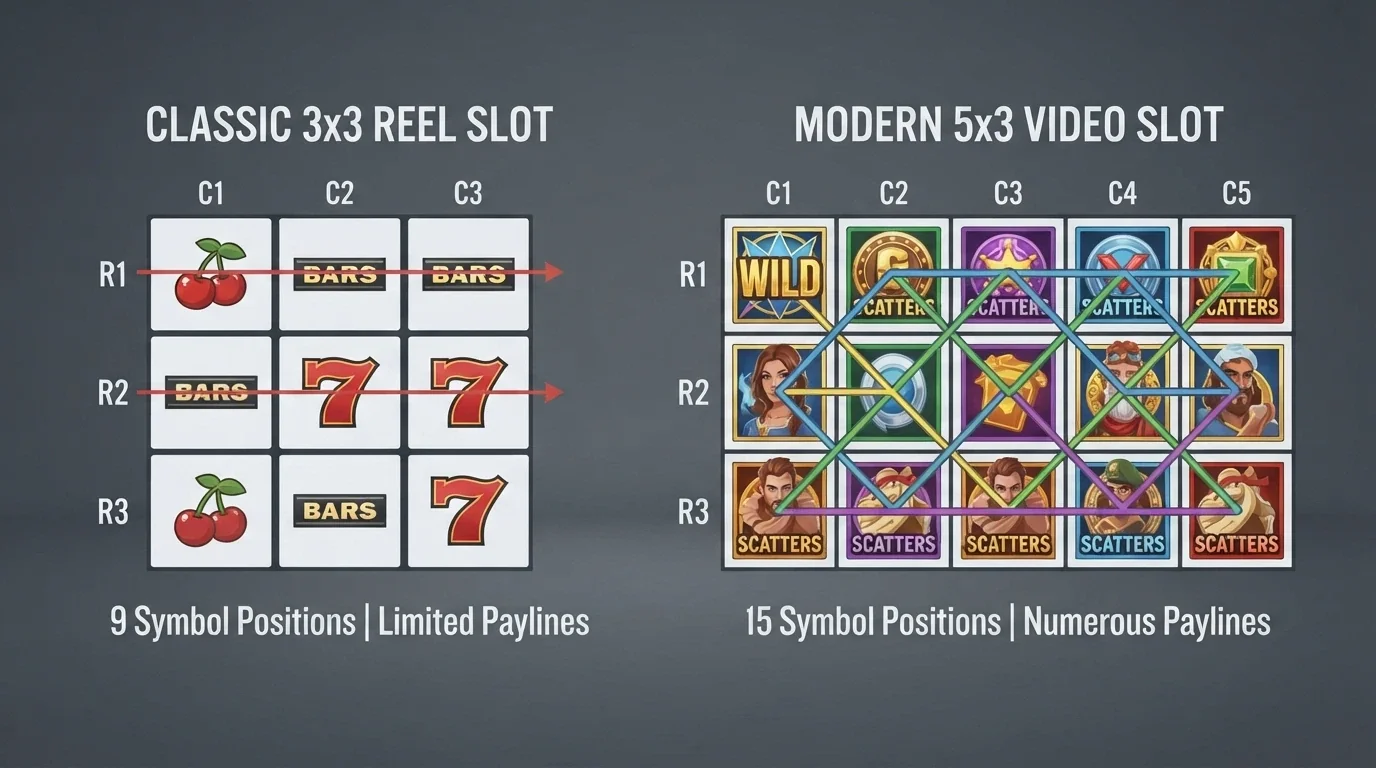
That difference in combination space is what produces the feature gap. A 5-reel game has room to encode a free-spin round, a scatter pay, a cascading reel, a hold-and-respin and a bonus buy inside the symbol set without crowding the screen. A 3-reel game does not. Anything a 3-reel pokie offers beyond a straight payline — a Supermeter mode, a hold-and-spin bonus, a progressive jackpot — has to fit inside the small format, which is why so few do. The result is a sharper split between payline play and bonus play on a 3-reel pokie than on a 5-reel slot, and why the bonus features that do exist on the format stand out.
The combination count also shapes variance. With hundreds or low thousands of outcomes, a 3-reel pokie hits its symbol weights more often, line combinations resolve more frequently, and the play feels tighter. A 5-reel slot’s tens of millions of outcomes distribute those weights across far more combinations — the bonus features land less often per spin, but pay more when they do. The 3-reel pokie is the lower-volatility format on average, even when individual titles sit at the high end of the volatility spectrum.
RTP is the third leg. The classic 3-reel figure often runs at 97% or 98%, against the typical 96% for video slots. That 1-to-2-point gap compounds over thousands of spins. That gap compounds over thousands of spins. The difference looks tiny in a single session and meaningful at the end of a year.
The Best 3-Reel Pokies Worth Your Credits: RTP and Volatility Compared
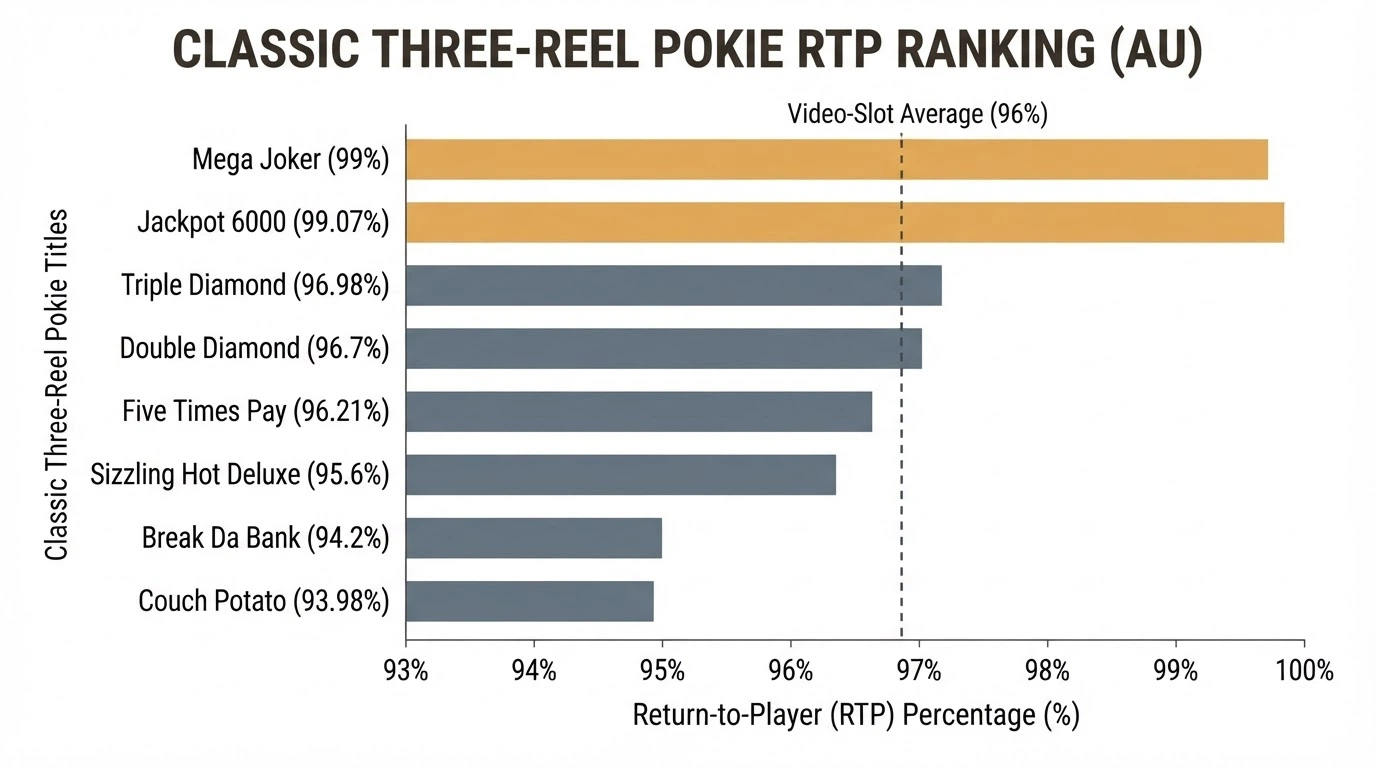
The set below is built from titles with at least one confirmed RTP or volatility figure from a published source, plus one progressive outlier that is included for the jackpot mechanic rather than the headline RTP. Where a column is not confirmed, the row carries an em dash rather than a guess.
| Title | Provider | RTP | Volatility | Max Win |
|---|---|---|---|---|
| Mega Joker | NetEnt | 99% (Supermeter mode) | High | Progressive jackpot |
| Ugga Bugga | Playtech | ~99.07% | — | — |
| Piggy Bank Hold & Win | BGaming | 96.98% | Low-to-medium | 2,500× bet |
| Ultra Hot and Spin | Pragmatic Play | 96.7% | Medium | 500× bet |
| Burning Wins | Playson | 96.21% | Medium | 60× bet |
| Triple Diamond | IGT | 95.6% | — | 1,199× line bet |
| Fire Joker Freeze | Play’n GO | 94.2% | Medium | 1,000× bet |
| Red, White and Blue | IGT | 93.98% | Medium-high | 2,500 credits |
| Fruit Fiesta | Microgaming | — | — | Progressive (starts AU$800) |
Two titles push the RTP above 99%, and both reach that figure only under conditions. Mega Joker’s 99% lives in Supermeter mode — the higher-stake mode entered after a base-game win — not in the base game itself, and the title is high-volatility with a progressive jackpot attached. Ugga Bugga sits at approximately 99.07% with a hold mechanic across 10 individual paylines, which lets a player lock symbols across multiple rows; the ceiling is generous, but the layout is unusual enough that first-time players tend to underuse it. Both numbers are real and confirmed; both come with the warning that the headline figure describes a specific play mode, not the title’s average.
The middle of the table is where the format is most competitive. Piggy Bank Hold & Win at 96.98% (BGaming, released 2026) and Ultra Hot and Spin at 96.7% (Pragmatic Play) sit comfortably above the 96% video-slot average and combine that RTP with a moderate-volatility profile and a max win that does not require a feature buy. Burning Wins at 96.21% from Playson is the lower-variance option — its 60× max win caps the upside, but the maths underneath is steady. Triple Diamond at 95.6% (IGT) is the IGT classic, with a 1,199× top win for three Triple Diamond symbols and a layout a player can read in one glance.
Fire Joker Freeze (94.2%, Play’n GO) and Red, White and Blue (93.98%, IGT) sit below the 96% video-slot average and earn their place on a max-win table rather than an RTP table. Fire Joker Freeze reaches 1,000× through the Freeze respin mechanic; Red, White and Blue pays up to 2,500 credits on a single payline at medium-high volatility. The 2,500-credit cap on a single-line max bet of a few cents makes the dollar upside modest, but the volatility profile is the kind of shape a player chasing a single big hit prefers.
Fruit Fiesta (Microgaming) is in the table for a different reason. It is a 15-line progressive 3-reel pokie with a starting jackpot of AU$800 and a maximum bet of AU$0.75 required to qualify for the jackpot. No RTP figure is published for the base game in the sources used here; the title earns its position because progressive jackpots are part of what makes the 3-reel format distinct, and Fruit Fiesta is one of the few class-of-format progressives still running.
Free Play and Demo Mode: Try 3-Reel Pokies Without Risking a Cent
Almost every offshore casino that lists a 3-reel pokie also runs a demo mode for it. The typical path is to load the game in a browser, watch for the play-money balance to load (usually a five-figure fake credit number), and spin. No deposit is required for the demo balance, and on most sites no registration is required to reach the demo at all — though some operators gate demo play behind an email sign-up to comply with the regulator’s age-verification expectation. Either way, the demo is a free test of the game’s pace, symbol weights and feature triggers.

What the demo teaches a player is mostly rhythm. The first session is the spin pace — at 3–4 seconds per spin the speed is faster than most newcomers expect, and the demo is the right place to confirm that the title moves at the pace the player wants before committing real money. The second thing is volatility — the demo balance will run hot and cold the same way the real-money balance does, and a short demo session can mislead on either direction. The honest reading is that demo mode shows what the maths does on average; it does not predict the next ten minutes of play.
What the demo does not teach is RTP in the way players sometimes expect. The RTP figure is built into the symbol weighting, and a demo runs the same maths as a real-money session, so a player who hits the demo’s spin button a few hundred times gets a fair sample of the title’s distribution. A 3-reel pokie is small enough that the sample stabilises faster than on a 5-reel slot — but no number of demo spins converts the figure into a prediction of the next real-money session.
The harder limit is jurisdictional. A demo on a Curacao-licensed offshore site is the operator’s choice, not an Australian-licensed product. The demo does not carry the IGA’s protection, and any balance a player builds in demo mode is play money, not a real withdrawal. For players who want to compare titles before staking, demo mode is the right tool; for the bonus maths that follows, only real-money wagering terms apply.
Bonus Features on Classic 3-Reel Machines: Hold & Spin, Supermeter and Progressives
The 3-reel format has less room for features than a 5-reel slot, and what features exist tend to be the older mechanics — Supermeter, hold-and-spin and progressive jackpots — rather than the layered free-spin rounds of newer video slots. The handful of 3-reel pokies that pack a genuine mechanic tend to use it as the title’s whole reason for being.
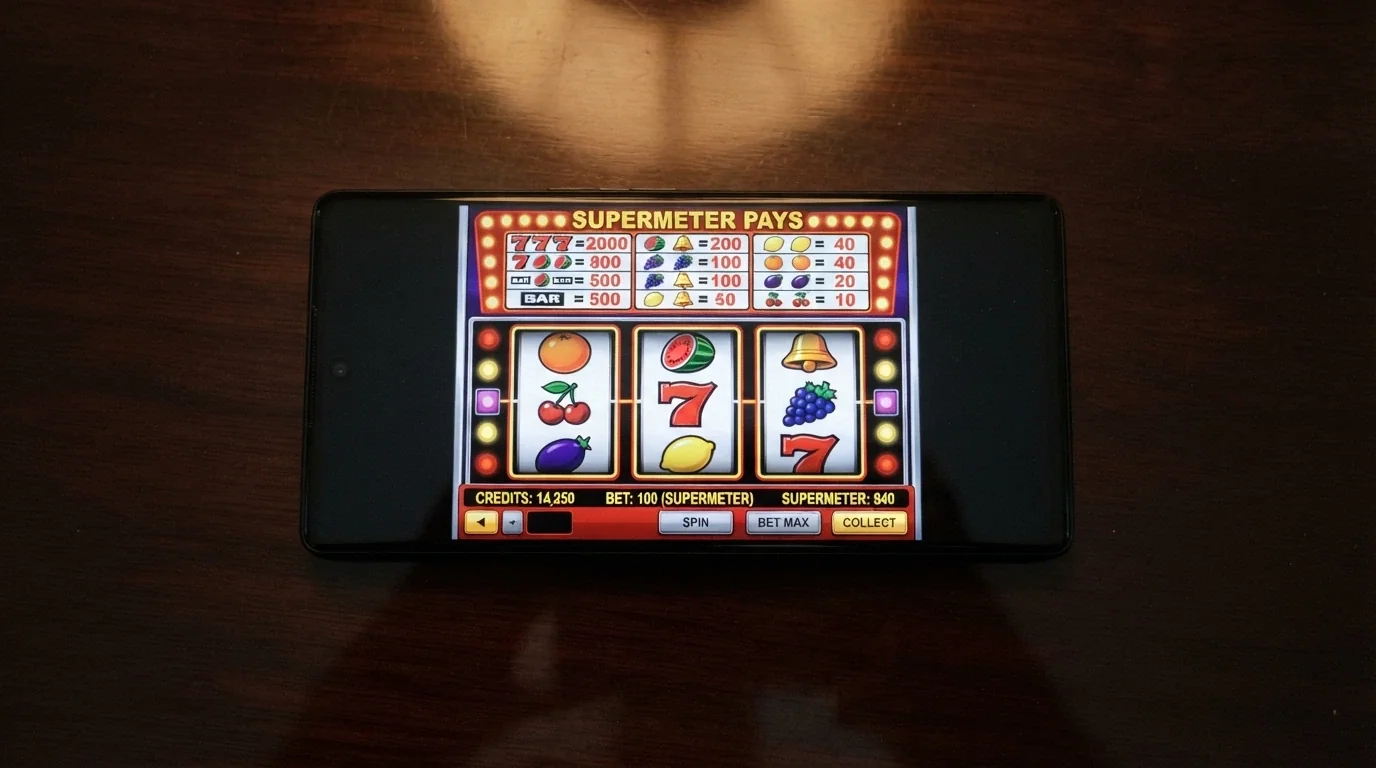
Mega Joker (NetEnt) is the Supermeter-mode outlier. The base game runs at a lower RTP; after any base-game win, the player can choose to collect the win or enter Supermeter mode by pressing a higher stake. Supermeter mode pushes the RTP up to 99% — the highest confirmed figure on a 3-reel pokie in this set — at the cost of a higher per-spin stake. The game is high-volatility with a progressive jackpot attached, so the 99% RTP is a long-run average across very wide swings. A player who wants the 99% number has to play the higher stake; a player who stays at the base-game bet plays a different mathematical game.
Piggy Bank Hold & Win (BGaming, released 2026) is the modern hold-and-spin entry. The title runs at 96.98% RTP, low-to-medium volatility, and a 2,500× max win — the largest non-progressive multiplier on the table. The hold-and-spin mechanic locks a set of bonus symbols in place while the remaining reels re-spin, and a full screen of bonus symbols pays the cap. The format stays a 3×3 grid, which is part of the appeal: the feature runs inside the small surface rather than replacing it.
Fruit Fiesta (Microgaming) is the progressive outlier. It is a 15-line 3-reel pokie with a maximum bet of AU$0.75 required to qualify for the jackpot, and a starting progressive of AU$800. The progressive is small by modern standards, but the AU$0.75 max-bet qualification is unusually low for the format and keeps the title accessible at minimum-stake play. No RTP figure is confirmed for the base game; the title earns its place because progressive jackpots are how the 3-reel format occasionally competes on top-end upside.
Break Da Bank (Microgaming) sits at the other end of the spectrum. It is a classic 3-reel, 5-payline vault theme with high volatility and no confirmed RTP in the sources used here. Its reputation rests on the volatility profile — the kind of game where a session can pay very little or very much — and the vault-money visual identity that has carried it through two decades of online casino lobbies.
Real-Money 3-Reel Play: What an Australian Punter Needs to Know
Every real-money 3-reel pokie available to an Australian player is on an offshore site. The Interactive Gambling Act 2001 prohibits online casino games, online pokies and in-play betting in Australia, and no licence exists for online casino anywhere in the country. The Act targets the provider, not the individual player — there is no prosecution pathway against a person who plays at an offshore site — but the prohibition is what creates every other constraint on this page.
The practical shape of that constraint is that the bonus terms, the withdrawal rules, the complaint path and the player-protection regime at any of these operators are defined by the operator’s own jurisdiction, not by Australian law. Curacao, Anjouan and the Maltese Gaming Authority all license offshore brands that reach Australian players, and each one applies its own rule set under its own statute. None of them bind the operator to the Australian Consumer Law, the ACMA’s enforcement actions, or the BetStop register. A player who deposits at an offshore site has, in practice, whatever dispute mechanism the operator’s terms page describes — and that is the entire consumer-protection layer.
The stake ranges on 3-reel pokies themselves are wide. Triple Diamond at IGT is a nine-payline slot; Mega Joker’s Supermeter mode is entered after a base-game win; Burning Wins and Ultra Hot and Spin both run five-payline layouts. Max-win caps range from 60× the bet on Burning Wins to 2,500× on Piggy Bank Hold & Win, with the progressive on Fruit Fiesta outside that frame entirely. The minimum-stake floor on most titles is well under one Australian cent per line, which is why the format is the one bankroll-conscious Australian punters keep returning to — and why offshore casinos keep listing the format at the top of their lobby.
Offshore Pokie Sites Australians Actually Use: Bonus Terms, Risk and the Real Cost
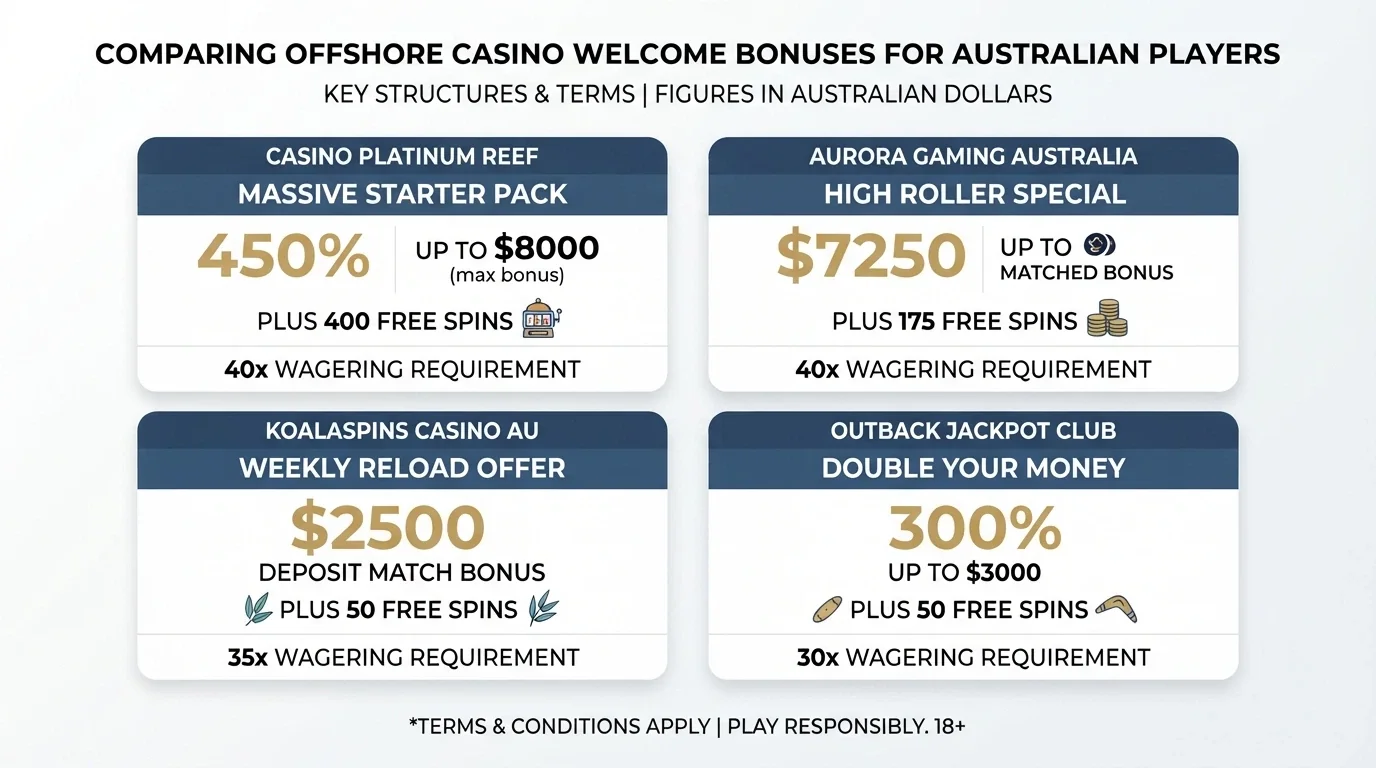
The operator set below covers the offshore brands that reach Australian players based on tracked market presence, ranked by 3-reel pokie availability and bonus relevance rather than by market share. Every entry below is unlicensed in Australia under the Interactive Gambling Act 2001. None of the figures in the welcome-bonus column survive the wagering requirement intact, and the cost of clearing that bonus is calculated further down.
| Operator | Licence | Welcome Bonus | Free Spins | Wagering |
|---|---|---|---|---|
| SkyCrown | Curacao (offshore) | 450% up to A$8,000 across 4 deposits | 400 FS | 40× (bonus + FS winnings) |
| Bizzo Casino | Curacao (offshore) | Up to A$7,250 across 4 deposits | 175 FS | 40× (bonus) |
| Royal Reels | Curacao (Digibrite S.R.L.) | A$2,500 across 3 deposits | 50 FS | 35× (bonus only) |
| Fair Go Casino | Curacao (offshore) | 300% up to A$3,000 or 100% × 5 to A$1,000 total | 50 FS | 30× (deposit + bonus) |
| RocketPlay | Curacao (offshore) | 300% up to AU$6,000 + 100% up to AU$1,000 first deposit | 300 FS | — |
| Rainbet | Anjouan (offshore) | 250% up to $2,100 across 3 deposits | 60 FS | 40× (Wager Lock) |
| Stake | Curacao (offshore) | — | — | — |
| WinSpirit | Curacao (Antillephone N.V.) | — | — | 40× (bonus only) |
| Scream Casino | Not confirmed | — | — | — |
| Rocket Casino | Not confirmed | — | — | — |
The wagering multiples are the part that flattens the headline numbers. SkyCrown’s A$8,000 ceiling is reached across four deposits and requires 40× playthrough on the bonus plus the free-spin winnings — a substantial volume against the bonus before a cent is withdrawable. Royal Reels applies a lower 35× multiple on bonus only and adds a A$5 per-spin cap during wagering, which the operator enforces to stop high-denomination spins clearing the requirement fast. Fair Go’s 30× on deposit plus bonus is the lowest in the set; Bizzo and Rainbet both sit at 40×.
The real cost of the SkyCrown A$8,000 bonus in numbers. Clearing the full bonus requires A$320,000 of wagering — A$8,000 multiplied by the 40× multiple — across the 14-day window. Run that volume through a classic 3-reel pokie at 97% RTP and the house edge of 3% produces an expected loss of A$9,600 over the playthrough. The bonus pays A$8,000 in playable credit; the maths says the bonus costs more than it pays out, leaving the player roughly A$1,600 lighter than they started once the requirement clears. The figure is a long-run average across many spins, not a guarantee for any single session — but it is the right number to hold against the headline match rate.
SkyCrown
SkyCrown is a Curacao-licensed offshore operator running the largest welcome package in the featured set: 450% up to A$8,000 across four deposits, plus 400 free spins spread across Wolf Treasure, Coin Volcano, 15 Dragon Pearls and Mighty Wild: Panther. The minimum deposit is A$30, and the bonus validity is 14 days — short enough that a player who delays the playthrough loses the bonus. The wagering is 40× on bonus plus free-spin winnings, which is where the headline figure meets its real cost.
The 400 free spins come with their own cap: maximum win from free-spin winnings is A$300 per welcome-bonus part. Across four bonus parts the cap compounds to roughly A$1,200 of max-withdrawable free-spin value, against a bonus amount that requires A$320,000 in playthrough to clear. SkyCrown’s per-bonus-part max cashout on the matched bonus is A$5,000; that is the ceiling on what a player can actually withdraw from the matched deposit once wagering clears.
SkyCrown’s value sits in the headline match rate. For a player who plans to deposit across all four parts and play a high-volume 3-reel session inside the 14-day window, the headline figure is reachable. For a player who deposits once, claims part one and walks away, the wagering volume against A$30 in real money at 40× is small enough that the bonus is more theoretical than real.
Bizzo Casino
Bizzo Casino is an 8,000-title offshore casino running a four-deposit welcome package worth up to A$7,250 plus 175 free spins. The first-deposit match rate is tiered: 50% on smaller deposits, scaling to 125% on deposits of A$250 and above. Wagering is 40× on bonus, which sits in line with the wider Curacao market. The game library runs Pragmatic Play and several other providers, which is what places the title in the 3-reel ranking — Pragmatic Play’s Ultra Hot and Spin is one of the confirmed 3-reel RTPs on this page.
Bizzo’s tiered match rate is the operator’s main product-design lever. A deposit of A$20 to A$250 lands a 50% match, a deposit in the next band lands higher, and a deposit above A$250 lands the 125% ceiling on the first part. Across the four parts the total ceiling requires four separate deposits and four separate wagering runs, which is why the bonus is described as A$7,250 rather than a single headline figure.
Compared with SkyCrown’s flat 40× on bonus plus free-spin winnings, Bizzo’s 40× on bonus only is structurally lighter on the bonus side, though the headline match rate is harder to claim in full because the band tiers require the larger deposit to unlock. The 8,000-title library is the part that gives a 3-reel player more room to find the format than on operators with a single-provider lobby.
Royal Reels
Royal Reels runs under a Curacao licence held by Digibrite S.R.L., with a three-deposit welcome pack worth A$2,500 plus 50 free spins. The deposit structure is 100% up to A$500 on the first deposit, 75% up to A$750 on the second, and 100% up to A$1,250 on the third. Wagering is 35× on bonus only, which is the second-lowest multiple in the featured set behind Fair Go. The free spins land at a fixed A$0.20 stake on a featured pokie, with winnings subject to the same 35× multiple.
The operator also enforces a A$5 per-spin cap during wagering. That cap matters: a 3-reel pokie at A$1 a line on nine lines would normally spin at A$9, and a player trying to clear 35× against a A$1,250 bonus would burn through the volume at that stake. The A$5 cap forces the volume into smaller spins, which slows the wagering clock and means the bonus takes longer to clear — but it also caps the rate at which the bankroll can drain against variance.
The A$5 per-spin cap is the operator’s main risk control, and the trade is longer clearance time against faster variance exposure. The 35× on bonus only is the part that keeps the maths less unfavourable than SkyCrown’s structure, and the three-deposit pack is small enough that a single deposit at A$500 with a 100% match carries A$17,500 of wagering — heavy but reachable inside the standard validity window.
Fair Go Casino
Fair Go Casino is an RTG-powered Curacao-licensed operator running two distinct welcome offers. The headline offer is 300% up to A$3,000 plus 50 free spins; the alternative offer is 100% up to A$200 on each of the first five deposits, totalling A$1,000 in matched bonus. The wagering on the alternative offer is 30× on deposit plus bonus — the lowest multiple in the featured set.
The 30× on deposit plus bonus is unusual. Most operators in the set wager on bonus only at 35× or 40×, which is roughly equivalent to 70× on deposit only at a 1:1 match — Fair Go’s structure sits at a true 30× against the full amount. A player depositing A$200 and claiming the 100% match carries a A$400 bonus-plus-deposit total subject to A$12,000 in wagering at 30×. The lower multiple is what makes the bonus cheaper to clear than the same effective bonus would be at the wider 35× or 40× standard.
The RTG software library is the trade-off. RealTime Gaming has a smaller 3-reel catalogue than the multi-provider operators, and the format availability is concentrated in the studio’s classic titles rather than spread across a wider market. The 50 free spins on the headline offer do not have a published wagering multiple in the sources used here; players should check the operator’s terms page before claiming.
For a player who wants the lightest wagering burden in the set and does not need a 5,000-title library, Fair Go is the operator the maths points to. For a player who wants the wider 3-reel selection, the multi-provider operators carry more.
RocketPlay
RocketPlay runs a multi-tier welcome package worth 300% up to AU$6,000 plus 300 free spins. The first-deposit part is 100% up to AU$1,000 plus 100 free spins, delivered in daily batches of 20 on Aztec Magic by BGaming. The full package spans multiple deposit tiers, with the 300 free spins distributed across the welcome period.
RocketPlay’s differentiator is the free-spin volume. 300 free spins is the highest count in the featured set, delivered as five sets of 20 on Aztec Magic across the first five days after the first deposit. The structure rewards a player who logs in daily rather than one who clears the bonus in a single session, which is part of why the operator fits the 3-reel player specifically — a 3-reel spin takes 3–4 seconds, and a daily batch of 20 spins at that pace is roughly a minute of play per day.
The 300 free spins in daily batches is the structural choice that suits the 3-reel format specifically. The wagering on RocketPlay’s welcome was not detailed in the sources available for this page, which the table above reflects. A player claiming the headline match should check the bonus terms on the operator’s site before depositing. The BGaming library is the 3-reel hook: Piggy Bank Hold & Win is a BGaming title and runs at 96.98% RTP.
Rainbet
Rainbet is an Anjouan-licensed hybrid casino and sportsbook running 7,000+ games with 25+ supported cryptocurrencies. The welcome package is 250% up to $2,100 plus 60 free spins across three deposits, with a 40× wagering requirement on the Wager Lock path. The operator also runs a rakeback system that pays every 15 minutes — a structural feature that returns a percentage of the house edge to active players rather than front-loading the value into the welcome bonus.
The crypto focus is the operator’s defining product choice. 25+ supported cryptocurrencies is a wide rail, and the Anjouan licence means the operator is not subject to the credit-card ban that binds Australian-licensed wagering under the 11 June 2024 rule. A player funding from a crypto wallet does so outside the Australian retail banking system, which is the practical reason offshore crypto-friendly brands like Rainbet exist as a category.
The rakeback is what gives Rainbet a structural edge over operators without one; the crypto focus is what makes it exist as a category. A 3-reel player running a long session at classic 97% RTP gets back a percentage of the house edge in 15-minute intervals rather than only at withdrawal, which compounds against the wagering requirement in a way a flat bonus does not.
Stake
Stake holds a Curacao licence, carries a large multi-provider game library, and reaches Australian players at scale. Beyond those confirmed points, the verified welcome-bonus terms for Australian-facing accounts are not in the sources used for this page. Stake’s general market presence is established, and the operator’s game library is large enough that 3-reel titles are available — but specific bonus figures, free-spin counts and the wagering multiple on any welcome offer could not be confirmed this run.
Stake’s Curacao licence is the verifiable fact; the welcome-bonus terms for Australian accounts are not. A player considering Stake should treat any externally advertised offer as unverified until it is confirmed on the operator’s own terms page. The Curacao licence is a fact about the operator’s jurisdiction, not about the consumer-protection layer an Australian player can rely on. For bonus-comparison purposes, Stake is a presence rather than a confirmed offer.
WinSpirit
WinSpirit operates under a Curacao licence held by Antillephone N.V., with 40× wagering on bonus only confirmed. Welcome bonus size, free-spin counts, and the max-cashout cap on bonus winnings were not confirmed in the sources used for this page. The Curacao licence structure via Antillephone is a known licence path, but the specific welcome-package figures for Australian-facing accounts are not in the verified set.
WinSpirit is the only operator in this set whose licence holder (Antillephone N.V.) is named in the verified data; the welcome package behind the 40× is not. For the operator write-up, the honest version is: WinSpirit carries the 40× bonus wagering, runs under a known licence holder, and reaches Australian players. Specifics on the welcome bonus are unverified and should be confirmed on the operator’s own terms page before claiming.
Scream Casino
Scream Casino reaches Australian players at a level that warrants inclusion in the ranking on tracked market presence, but verified data on the operator is thin. Licence jurisdiction, welcome bonus terms, wagering requirements, game-library specifics and 3-reel title availability were not confirmed in the sources used for this page. Any externally advertised welcome offer should be treated as unverified until confirmed on the operator’s own terms page.
Scream Casino is a presence in the AU-facing offshore market, not a confirmed offer. The operator earns a place in the ranking on market-presence grounds, but the comparison columns in the table above carry em dashes rather than figures. The honest read is that Scream Casino reaches Australian players, and the offer behind the ranking is not verified.
Rocket Casino
Rocket Casino is in the ranking on the basis of tracked Australian market presence, with almost no verified specifics to back the comparison columns. Licence jurisdiction, welcome bonus terms, wagering requirements, and game-library composition were not confirmed in the sources used for this page. The operator’s place in the ranking reflects the fact that it reaches Australian players, not that its offer is verified.
Rocket Casino’s place in this ranking is based on tracked market presence; everything else is unverified. A player who sees Rocket Casino advertised alongside the other operators in this set should treat any advertised offer as unverified. Market presence is evidence of traffic, not of licence or offer quality.
Are Online Pokies Legal in Australia? The Law in Black and White
The legal answer is the same in 2026 as it has been since 2001, and as it will be until the Interactive Gambling Amendment (Gambling Reform) Bill 2026 takes effect on 1 January 2027: online casino games, online pokies and in-play betting are prohibited under the Interactive Gambling Act 2001. There is no licence for online casino anywhere in Australia, and there is no carve-out for the 3-reel format. The reform bill does not legalise online casino — it tightens advertising, inducements and payment-blocking around wagering.
What the federal framework actually permits is wagering on racing and sport placed before the event begins, lotteries and keno. Those products are licensable through state and territory regulators — and in practice, the Northern Territory Racing and Wagering Commission, administered through Licensing NT, is the de facto national licensor for online wagering. Licences run up to 20 years, and the minimum age is 18 for all commercial gambling.
This is the frame every figure on this page sits inside. The 3-reel pokies are real games with real RTPs; the operators that carry them are real businesses with real licences in their own jurisdictions; and the entire market exists because the prohibition in Australia leaves a gap that offshore operators fill. The next sections walk through what the prohibition actually prohibits, how the ACMA enforces it, and where the consumer sits inside it.
What the Interactive Gambling Act Actually Prohibits
The Interactive Gambling Act 2001 prohibits the provision of online casino games, online pokies and in-play betting to people in Australia. The 2017 amendments strengthened the prohibition and gave the ACMA its enforcement powers. In-play betting means a wager placed on a sporting event after it has started — pre-event wagering on the same event remains permitted.
The product set inside the prohibition is specific. Online casino games covers table games (blackjack, roulette, baccarat), online slots or pokies of any format including the 3-reel and 5-reel variety, and live-dealer casino products. Online pokies and online slots are the same product under the Act. In-play betting covers any wager on a sporting event after the event has commenced; the same wager placed before kick-off or tip-off is permitted and licensable.
What sits outside the prohibition is the wagering product: pre-event betting on horse racing, harness racing, greyhound racing, and on sporting events before they start. Lotteries and keno are also outside the prohibition and are operated by state and territory lottery operators. The distinction matters because every Australian-licensed online operator is a wagering operator or a lottery operator — not a casino or pokie operator. There is no “Australian-licensed online casino” because the licence category does not exist.
Licensing for the wagering product sits with the state and territory regulators. In practice the Northern Territory Racing and Wagering Commission, administered through Licensing NT, is the de facto national licensor — the major Australian-facing online bookmakers hold NT licences. State regulators (NSW, Victoria, Queensland, Western Australia, South Australia, Tasmania, ACT) license land-based wagering and lottery operations and set point-of-consumption tax. The framework is state-and-territory federated under a federal prohibition.
ACMA Enforcement: 1,564 Sites Blocked and Counting
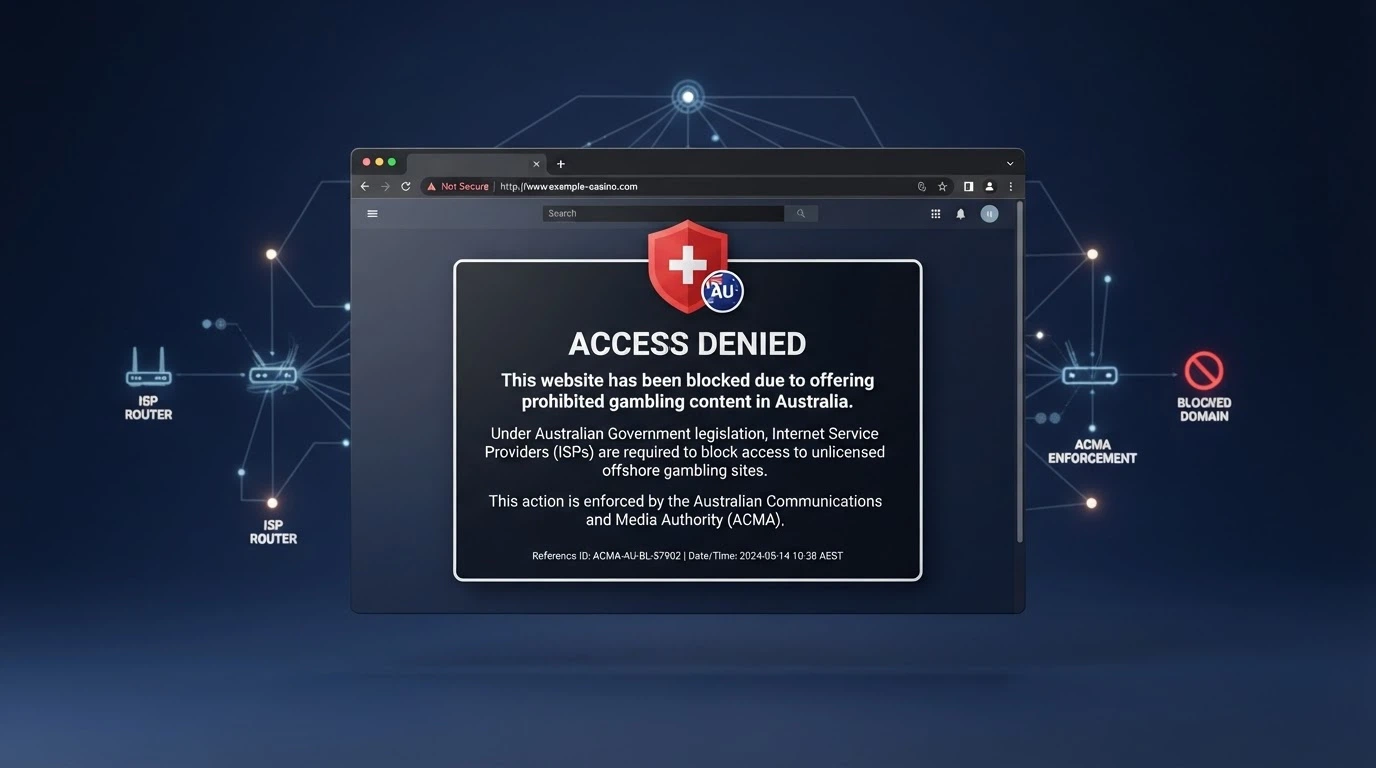
The ACMA’s enforcement mechanism against offshore operators is DNS-level ISP blocking. Since November 2019, the ACMA has had 1,564 illegal gambling and affiliate websites blocked by Australian ISPs. The mechanism works by instructing the major Australian ISPs to block DNS resolution for the listed domains, which prevents Australian customers from reaching the site through the standard browser path. The mechanism is enforceable against the provider, not the player.
The scale of the enforcement matters. More than 225 illegal services have withdrawn from the Australian market since enforcement was strengthened in 2017 — operators have decided the Australian market is not worth the regulatory pressure and have stopped accepting Australian customers rather than face the block list. The withdrawals are voluntary from the operator’s side but coercive in effect: the ACMA does not need to block a site that has already decided to leave.
Affiliate blocking is part of the picture. Many of the 1,564 blocked sites are affiliate marketers — sites that promote offshore casinos through SEO and paid traffic rather than the casinos themselves. The ACMA treats affiliate traffic as part of the supply chain and blocks accordingly. A player who searches for an offshore casino may find the affiliate site blocked before reaching the operator, which is part of why the marketing-side enforcement is heavy.
The mechanism does have a rough edge. DNS-level blocking cuts the site off at the ISP level, which means an Australian player with a balance on the site loses access to that balance with the site still holding the funds. There is no automatic withdrawal process, no ACMA complaint pathway for the recovery, and no consumer-law right of access. The blocking protects Australian residents from the supply of the product; it does not protect the funds of an Australian customer who deposited before the block.
Offshore Casino Risks: No Consumer Protection, No Recourse
The practical risks of using an offshore casino go beyond the legal status. The IGA prohibits the provider; it does not give the player any recourse against an offshore operator that refuses a withdrawal, voids a win, or simply stops answering support emails. The consumer-protection layer that an Australian-licensed wagering operator sits inside — Australian Consumer Law, the ACMA complaint mechanism, the state gambling regulator’s dispute process, the BetStop register — does not extend to an offshore casino. The offshore operator’s terms page is the entire contract.
The withdrawal risk is the most concrete. An offshore casino can refuse a withdrawal, apply a max-cashout clause, void winnings for “irregular play” reasons the operator defines itself, or simply delay payment past its own stated timeframe. In any of those cases the Australian player has no external dispute resolution to appeal to: the operator’s licence jurisdiction (Curacao, Anjouan, Malta) is the only path, and that path is slow, expensive, and conducted in the operator’s own legal system. Australian courts have no jurisdiction over a Curacao-licensed operator’s decision under the operator’s own terms.
BetStop’s gap is the specific risk for players with a gambling-harm history. BetStop binds only Australian-licensed wagering services, and an offshore casino is not connected to the register. A player who has self-excluded through BetStop and then signs up at an offshore casino has done exactly what BetStop was supposed to prevent — but the register has no power to block the offshore account, no mechanism to enforce the exclusion, and no notification path to the offshore operator. The exclusion is binding on Australian-licensed wagering services and on those services alone.
The DNS-blocking risk cuts both ways. A player with funds on an offshore site that the ACMA adds to the block list loses access to the site through the standard ISP path. The funds remain on the operator’s books; the player has no access to them and no complaint pathway through the ACMA to recover them. A player who evades the block through a VPN or alternative DNS resolves the access problem but not the funds recovery — and the operator may treat the VPN use as a breach of its own terms, voiding the account.
The one protection the IGA does give the player is the absence of personal prosecution. The Act targets the provider, and an individual Australian player using an offshore site is not prosecuted under the Act. That is not the same as protection of funds, fairness of games, or right of withdrawal; it is protection from criminal liability for placing the bet. Players reading the law for reassurance should read past that line.
The 2026 Gambling Reform Bill: What Changes on 1 January 2027
The Interactive Gambling Amendment (Gambling Reform) Bill 2026 passed Parliament on 19 August 2026, and its measures commence on 1 January 2027. The bill does not legalise online casino or pokies; it tightens the advertising and inducement rules around wagering and gives banks and payment providers express authority to block transactions to illegal gambling operators.
The new advertising framework is the central change. From 1 January 2027, direct marketing of inducements is prohibited for 14 days after a customer signs up with a wagering operator, and for 90 days after a person deregisters from BetStop. The 14-day window means a new wagering customer cannot be marketed to with bonus offers, free bets or similar inducements for the first fortnight. The 90-day BetStop window means a person who comes off the self-exclusion register cannot be marketed to for three months — designed to prevent operators from immediately re-acquiring a customer who has just come off the register.
The advertising blackouts have been extended. The live-sport blackout now begins at least 15 minutes before a game, up from the previous 5 minutes. Hourly wagering-ad limits of 3 per hour apply between 6:00 am and 8:30 pm. Radio wagering ads are barred during school commute times. Broadcasting of wagering odds is banned. Online wagering ads only reach logged-in, age-verified users with an opt-out. No wagering ads inside sports venues or on uniforms. Athletes, celebrities and influencers are barred from promoting wagering. The aggregate effect is to compress the surface area on which wagering advertising can reach a viewer.
The new payment-blocking authority is the piece that reaches offshore operators most directly. Banks and payment providers are now expressly authorised to block transactions to illegal gambling operators. The mechanism is not automatic — the bank has discretion — but the legal authority is now explicit. For an Australian player funding an offshore casino through a debit card, the bank can refuse the transaction; for an offshore operator receiving those funds, the receiving bank can refuse the deposit. The mechanism targets the payment rails rather than the consumer.
AdStop is the opt-out register for wagering advertising. AdStop is a national wagering-advertising opt-out register administered by the ACMA, funded by a cost-recovery levy on wagering companies. Australians can register for AdStop and be excluded from receiving wagering marketing — distinct from BetStop, which excludes from wagering itself. The two registers cover different mechanisms: BetStop blocks play, AdStop blocks the marketing that reaches a player who has not yet blocked play.
For an Australian player using an offshore casino, the 1 January 2027 changes do not directly legalise or further prohibit their play. The bank-blocking authority is the indirect reach — the rails an Australian player uses to fund an offshore deposit may stop working. Players funding from crypto sit outside the bank-blocking mechanism but inside other enforcement paths.
Payment Methods: Credit Cards, Crypto and What the Law Allows
Since 11 June 2024, credit cards, credit-related products and digital currency (cryptocurrency) have been banned as payment for online wagering in Australia. The penalty for operators breaching the ban is up to A$247,500. The ban covers the wagering product — the licensed product that Australian-licensed wagering operators offer — and applies at the operator level rather than the consumer level. An Australian customer using a credit card at an Australian-licensed wagering operator will be declined by the operator.
The ban does not directly reach an offshore casino. The offshore casino is not subject to the Australian statute; the credit card network or the issuing bank is the layer at which the prohibition is enforced, and that enforcement depends on the network’s own policies and the bank’s discretion. In practice, the major Australian banks block credit-card transactions to a wide range of gambling merchants, including offshore ones, under their own merchant-category policies rather than under the IGA. The IGA formalises the prohibition; the banks apply it through their own rails.
Legal deposit routes for Australian-licensed wagering operators include debit card, bank transfer, PayID/Osko and BPAY. Those routes are open at the licensed operator; at an offshore casino, the operator’s own cashier page determines what it accepts. Offshore crypto-friendly operators like Rainbet are funded in cryptocurrencies; offshore Curacao operators typically accept debit cards, e-wallets, and a range of cryptocurrencies; the credit-card ban does not stop the transaction at the operator but stops it at the bank rail.
Australia caps the payment method, not the deposit. There is no federal deposit, loss or stake ceiling for online gambling, because the product those limits would govern — online casino and online pokies — is banned outright. The credit-card ban is a payment-method prohibition rather than a deposit-cap policy; a licensed wagering operator can still accept unlimited debit-card deposits from a customer who passes the operator’s affordability checks, and the IGA does not impose a federal ceiling on those deposits. The point is structural rather than quantitative: Australia controls online casino by banning the product and controls the wagering payment rails by banning the credit instrument.
Pokie Winnings and Your Tax Return: What the ATO Says
Pokie winnings for an Australian player are not assessable income, and losses are not deductible, unless the player is carrying on a business of betting. The relevant authority is section 6-5 of the Income Tax Assessment Act 1997 for income, section 8-1 for deductions, and ATO ruling IT 2655 for the business-of-betting exception. For a casual player — the vast majority of Australian pokie players — the tax treatment is straightforward: winnings are tax-free, losses cannot be offset against other income, and there is no obligation to declare pokie results on a tax return.
The business-of-betting exception is the small print. A person who runs a betting operation as a business — a professional punter, a syndicate operator, a player whose gambling activity is structured as a trade — is treated differently. For a casual player the line does not apply: a few hours a week at a 3-reel pokie is recreational gambling, not a business. The ATO’s ruling on the distinction is IT 2655, which sets out the criteria the ATO uses to identify when a gambling activity crosses into a business. Most players never come close.
The tax treatment does not interact with the offshore status of the operator. An Australian player winning at a Curacao-licensed offshore casino pays no Australian tax on the win, and the winnings do not need to be declared. The operator’s tax position is the operator’s concern: NT-licensed wagering operators pay 5% wagering tax plus 0.05% racing levy, and states set point-of-consumption tax typically at 10–15% of net wagering revenue. None of that flows through to the player’s tax return.
For a casual player, the practical advice is to keep the winnings out of the tax conversation. The gambling-harm and bankroll-management concerns the rest of this page addresses are larger than any tax issue. The ATO ruling is the rule; the tax treatment is settled; the more important conversations are about RTP, wagering requirements and player protection.
Staying in Control: Responsible Gambling Tools, Limits and Support
The harm-minimisation infrastructure that exists for Australian wagering — BetStop, deposit limits, reality checks, the National Gambling Helpline — was built around the licensed product. The offshore casinos that carry the 3-reel pokies on this page sit outside that infrastructure. An Australian player who funds an offshore casino account has no Australian-licensed framework to fall back on, no register to self-exclude through, no deposit-limit obligation binding the operator, and no helpline funded by the operator’s levy. The harm data below sets the scale of why the gap matters; the tools section describes what does exist and where the gap is.
The numbers below are from the Australian Gambling Research Centre at the Australian Institute of Family Studies (AIFS), Roy Morgan Research, and the POLIS Centre for Social Policy Research at ANU. They are the most recent confirmed figures on gambling harm in Australia, and they are the basis for the rest of this section’s framing.
BetStop: The National Self-Exclusion Register and Its Offshore Blind Spot
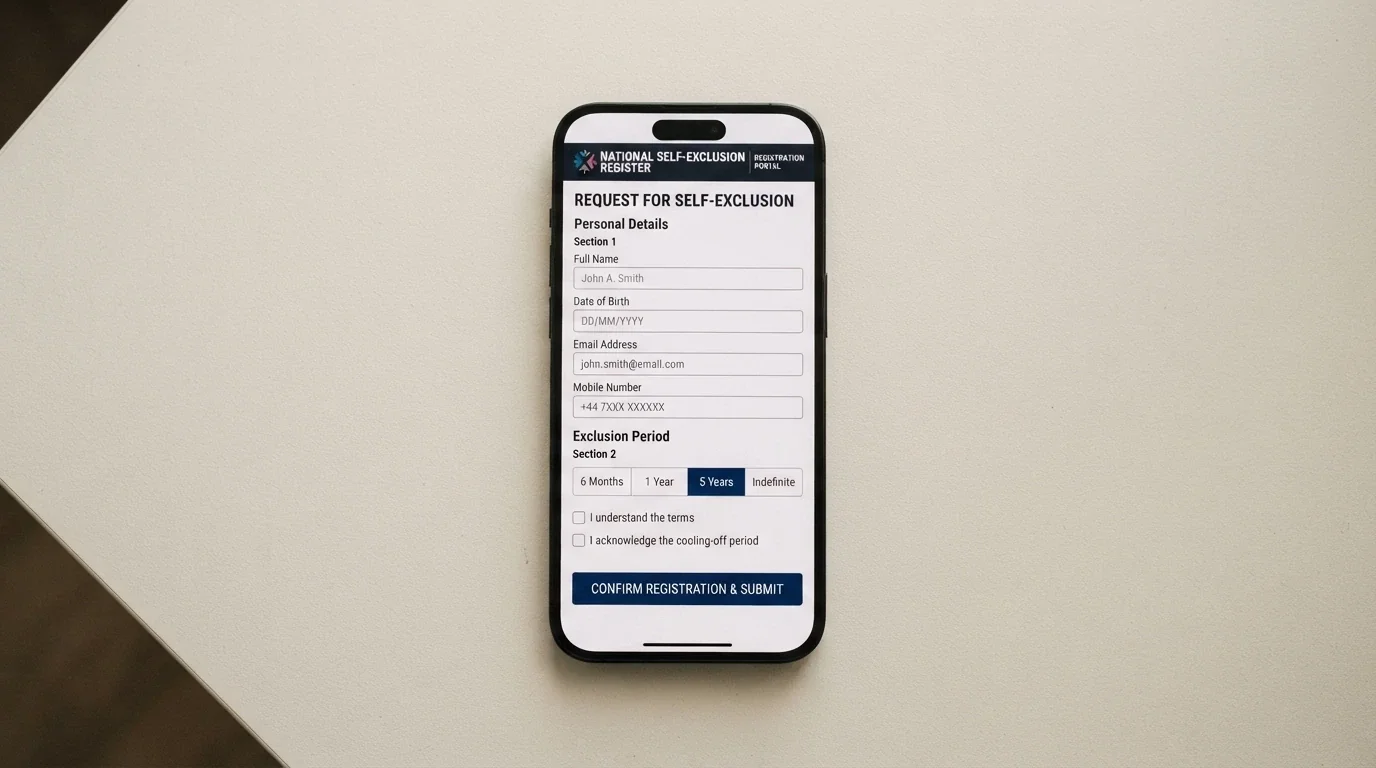
BetStop is the National Self-Exclusion Register, launched on 21 August 2023 and administered by the ACMA. A single BetStop registration excludes a person from every Australian-licensed online and phone wagering service — bookmaker, totalisator and racing wagering operator. The exclusion has a minimum period of three months and can be set for up to five years. By Q3 FY 2025–2026 (31 March 2026), 59,830 people had registered to self-exclude, and 37,247 had active exclusions.
The active-exclusion figure is the one to hold against the registration figure. The gap between 59,830 registrations and 37,247 active exclusions reflects registrations that have lapsed — minimum periods that expired, deregistrations, exclusions that ended under the registered term. The 37,247 active exclusions represent Australians currently blocked from licensed wagering under their own registered request. That is a real number, and it is the floor of how many Australians have committed to a self-exclusion pathway that has not yet ended.
The awareness gap is the harder problem. Only one in three wagerers (33.5%) are aware BetStop exists, and only 26.5% of Australian adults overall know about it. The Australian Gambling Research Centre puts the wagerer population at approximately five million, with around 400,000 high-risk gamblers among them. Dr Kei Sakata, Executive Manager of the AGRC at AIFS, has noted that despite those numbers, only around 30,000 individuals currently have active exclusions through BetStop. The ratio of high-risk gamblers to active exclusions is the gap: roughly 13 high-risk gamblers for every active exclusion.
The offshore blind spot is the part that reaches the 3-reel player on this page. BetStop binds only Australian-licensed wagering services — an offshore casino is not connected to the register. A player who self-excludes through BetStop and then opens an account at an offshore casino has done exactly what the exclusion was meant to prevent, but the register has no power over the offshore operator. The exclusion is binding on the licensed side and silent on the offshore side. The protection stops where the IGA stops.
For an Australian player using an offshore casino, the practical alternative to BetStop is operator-level self-exclusion at the specific offshore brand, if the brand offers it. The operator’s own self-exclusion mechanism is the only binding tool, and the operator’s compliance with its own self-exclusion is the only enforcement. None of that is an Australian-licensed pathway; all of it sits inside the offshore operator’s terms.
Deposit Limits, Reality Checks and the Controls That Work
The player-control tools that exist on Australian-licensed wagering operators are built into the operator’s licence obligations. The same obligations do not bind offshore operators. A player choosing where to play should know the difference, and the difference is part of what the offshore status costs.
- Deposit limits — daily, weekly or monthly ceiling; lowering applies immediately; raising carries a cooling-off period (typically 7 days).
- Reality-check timers — session-length prompts at intervals (commonly 30, 60 or 120 minutes), showing session duration and net position.
- Take-a-break and cooling-off — short self-exclusions (24 hours to 90 days) and a reversal window for account decisions.
- Activity statements — monthly deposit, withdrawal, net position and session duration summary; preserved across account changes.
- Operator-level self-exclusion — the offshore equivalent of BetStop, governed by the operator’s own terms.
The honest version of the controls story is: licensed Australian wagering operators are required to offer deposit limits, reality checks, take-a-break and activity statements, and BetStop is the cross-operator exclusion. Offshore operators are not required to offer any of those tools. Where an offshore operator does offer them, the operator’s terms are the only contract, and the player has no external regulator to appeal to if the operator does not honour its own controls.
Gambling Harm in Australia: 3.32 Million Affected and Where to Get Help
The Roy Morgan Gambling Harm Index (March 2026) shows 15.1% of Australian adults — 3,320,000 people — are experiencing some form of gambling harm. Of those, 13.0% of the Australian population (2,857,000 people) are experiencing harm from their own gambling behaviour rather than from someone else’s. The harm index covers financial harm, relationship harm, health harm and work-or-study harm, with the headline figure aggregating across all four.
The trend is the part that makes the numbers matter. Risky gambling (measured on the PGSI scale) increased from 13.7% in 2024 to 19.4% in 2025 — more than five percentage points, almost doubling since the COVID-19 lockdowns of 2020–2021. The trend is sharp enough that the ANU POLIS Centre for Social Policy Research, which published the 2025 figure, has called it out specifically. Problem gambling rates have moved from 1.9% (July 2022 to June 2023) to 2.9% (July 2024 to June 2025) — an increase of one percentage point in two years. Both indicators are moving in the wrong direction.
The participation base is shifting. Gambling participation in Australia declined to 58.8% in 2025, continuing a long-term downward trend, while online gambling increased within that base — 56.1% of gamblers are now mainly participating online. The pattern is fewer Australians gambling, but a higher proportion of those who do gamble are gambling online, which is the channel the offshore 3-reel pokies on this page operate in. The shift moves the player base toward the part of the market with the thinnest player-protection framework.
The Aboriginal and Torres Strait Islander disparity is the harder number. 27.1% of Aboriginal and Torres Strait Islander peoples are at risk of gambling harm, compared to 14.6% of non-Indigenous Australians — a gap of 12.5 percentage points. The Australian Gambling Research Centre’s 2026 figure is the most recent confirmed measure. The model-based national estimate from Browne et al. (2026) puts 3.29 million Australians aged 5+ as affected annually by gambling, with 1.97 million adults at-risk or problem gambling, and an annual health loss of over 400,000 Years Lived with Disability. The scale is large enough that the harm-minimisation infrastructure is not optional — it is the difference between an industry that includes its own protection layer and one that does not.
The help resources are these. The National Gambling Helpline is 1800 858 858 — free, confidential, staffed 24/7. Gambling Help Online at gamblinghelponline.org.au provides online chat and counselling. BetStop is the National Self-Exclusion Register for licensed wagering services. The three resources together cover the phone, the web and the self-exclusion pathways, and they are the Australian-licensed response to the harm data above. They do not cover offshore operators, which is why the gap matters.
How We Researched and Ranked These 3-Reel Pokies and Casinos
The titles and operators on this page were selected from a verified set of sources. Pokie data was drawn from title-specific pages at the relevant providers, established casino-review sites, and the combination-maths analysis behind the 3-reel versus 5-reel comparison. Operator data was drawn from operator terms pages, established review aggregators and the ACMA’s enforcement register for AU-jurisdiction facts. Every RTP and volatility figure on the title table traces to a published source, and every operator fact in the table and write-ups carries a source. Where a figure could not be confirmed, the row or column carries an em dash rather than a guess.
The operator ranking reflects fit to this page’s topic — 3-reel pokie availability and bonus relevance — not market share. Operators were assessed on tracked Australian market presence and on whether the game library includes the 3-reel format. The ranking is descriptive of the market the page covers, not a recommendation. Several of the operators in the ranking carry unverified or minimal verified data (Stake, WinSpirit, Scream Casino, Rocket Casino), and those operators are written up with that gap named in the prose rather than dressed up as confirmed offers.
The ACMA register and the BetStop quarterly statistics are the licence-verification benchmark for Australian-relevant facts. The BetStop figures, the ACMA block count, the AGRC awareness numbers, the Roy Morgan Gambling Harm Index, and the ANU POLIS participation data are all sourced from the relevant regulator or research body, and all carry the year of publication. The IGA prohibition, the 2024 credit-card ban, the 2026 reform bill and the ATO IT 2655 ruling are all sourced from the relevant statute or ruling, and the dates are the dates those instruments were enacted or took effect.
The pokie ranking reflects three criteria: confirmed RTP, provider pedigree and max-win potential. The table is not exhaustive — there are several thousand 3-reel pokies in circulation — but the titles included are the ones a player choosing where to start would compare first. The 3-reel format is small enough that the comparison carries through most of the available titles.
The gaps in the research are stated rather than papered over. Where an operator’s welcome-bonus terms could not be confirmed (Stake, WinSpirit, Scream Casino, Rocket Casino), the table column carries an em dash and the write-up names the gap. Where a title’s volatility is not published (Ugga Bugga, Triple Diamond, Fruit Fiesta), the volatility column carries an em dash. The page is honest about what is verified and what is not, because a reader acting on the figures deserves to know which ones have a source behind them.
What You Should Actually Do With This 3-Reel Pokie Guide
The RTP table is the place to start. Two titles push above 99% RTP — Mega Joker in Supermeter mode and Ugga Bugga — and both reach that figure under specific play conditions. The 96% to 97% middle of the table (Piggy Bank Hold & Win, Ultra Hot and Spin, Burning Wins) is where the format is most competitive on returns without the conditional play modes. Triple Diamond, Fire Joker Freeze and Red, White and Blue sit lower on RTP and earn their position on max-win or volatility grounds rather than on return.
The bonus maths is the second thing to read. A 40× wagering requirement on an A$8,000 bonus against a 97% RTP title produces an A$9,600 expected loss — more than the bonus pays. The same calculation against a 30× wagering requirement on Fair Go’s deposit-plus-bonus structure costs less in volume; a 35× on bonus only (Royal Reels) sits between. The headline match rate is the smallest part of the bonus. The wagering multiple is the part that determines the real cost.
The offshore status is the third thing to read. Every operator on this page is unlicensed in Australia. The IGA does not prosecute the player; the ACMA does not recover funds; the BetStop register does not cover the offshore site; the Australian Consumer Law does not reach the Curacao licence. The protection layer an Australian player relies on at a licensed wagering operator does not exist at an offshore casino. The expected-loss calculation above is what the bonus costs in expected play value; the offshore status is what it costs in recourse.
The responsible-gambling layer is the part that does not depend on which operator a player chooses. The National Gambling Helpline (1800 858 858) is free, confidential and 24/7. Gambling Help Online (gamblinghelponline.org.au) provides online chat and counselling. BetStop is the licensed-side exclusion register. A player who reads this page and does not set a deposit limit, who does not know the helpline number, who does not know that BetStop does not reach the offshore casino, has read the wrong part of the page first.
The operator ranking on this page is not a recommendation. It is a description of the offshore operators reaching Australian players, ordered by 3-reel pokie availability and bonus relevance, with the gaps stated and the maths done. The decision of where to play, and whether to play at all, sits with the player. The arithmetic on this page is the player’s defence against the marketing.
Frequently Asked Questions
What are 3-reel pokies and how do they differ from 5-reel video slots?
A 3-reel pokie uses three vertical reels and a 3×3 grid of nine positions per spin. With 8 to 22 symbols per reel, the combinations run in the hundreds to low thousands — against tens of millions on a 5-reel slot’s 15 positions and 30 to 40 symbols per reel. Classic 3-reel RTP often sits at 97% to 98% versus roughly 96% on video slots, and spins resolve in 3 to 4 seconds rather than 8 to 12.
What is the highest RTP 3-reel pokie available to Australian players?
Two titles push above 99% RTP. Mega Joker (NetEnt) reaches 99% in Supermeter mode, the higher-stake mode entered after a base-game win. Ugga Bugga (Playtech) sits at approximately 99.07% using a hold mechanic across 10 paylines. Both figures are confirmed; both require specific play conditions. Below those two, the format’s competitive middle sits at 96% to 97%.
What happens to my money if an offshore casino blocks my account or refuses a withdrawal?
No Australian consumer-law protection reaches an offshore casino, and no ACMA complaint pathway allows recovery. The operator’s terms page is the entire contract. ACMA DNS-level blocking can also cut a player off from a site with funds still on it; the ACMA does not recover those funds. The risk is structural and is part of what offshore status costs.
How does BetStop protect me if I play at an offshore casino?
BetStop does not protect a player at an offshore casino. The register binds only Australian-licensed wagering services — bookmakers, totalisators and racing operators licensed here. An offshore casino is not connected, has no obligation to check the register, and has no obligation to honour an exclusion. The exclusion is real on the licensed side and silent on the offshore.
Which 3-reel pokies have the biggest maximum win potential?
Piggy Bank Hold & Win (BGaming) carries the largest non-progressive multiplier at 2,500× the bet at 96.98% RTP and low-to-medium volatility. Triple Diamond (IGT) pays 1,199× the line bet for three Triple Diamond symbols. Fire Joker Freeze (Play’n GO) reaches 1,000× at 94.2% RTP through the Freeze respin. Fruit Fiesta (Microgaming) is the progressive outlier, requiring a maximum bet of AU$0.75 to qualify for an AU$800 starting jackpot.
Where can I get help if I think I have a gambling problem in Australia?
The National Gambling Helpline is 1800 858 858 — free, confidential and 24/7. Gambling Help Online at gamblinghelponline.org.au provides online chat and counselling. BetStop is the National Self-Exclusion Register; one registration excludes a person from every Australian-licensed wagering service. The three cover the phone, the web and self-exclusion. None reach an offshore casino — that gap is what offshore status costs.
Published by the Casino Apps Australia team.