
Best 7-Reel Slots in Australia: The Format, the Operators and What the Bonus Actually Costs
 Available in AU
Online pokies are prohibited in Australia under the Interactive Gambling Act 2001, and every 7-reel slot an Australian player reaches is delivered by an offshore operator outside Australian law. This page covers the 7×7 cluster-pays format the market calls 7-reel, the titles Australians actually search for, the offshore casinos that host them, and the arithmetic that turns a headline bonus into something smaller than it looks. The legal reality, the responsible-gambling infrastructure that reaches a player in this market, and the bonus maths that decides what each offer is actually worth are laid out beside the catalogue — not as a disclaimer, but as the operating conditions of the choice.
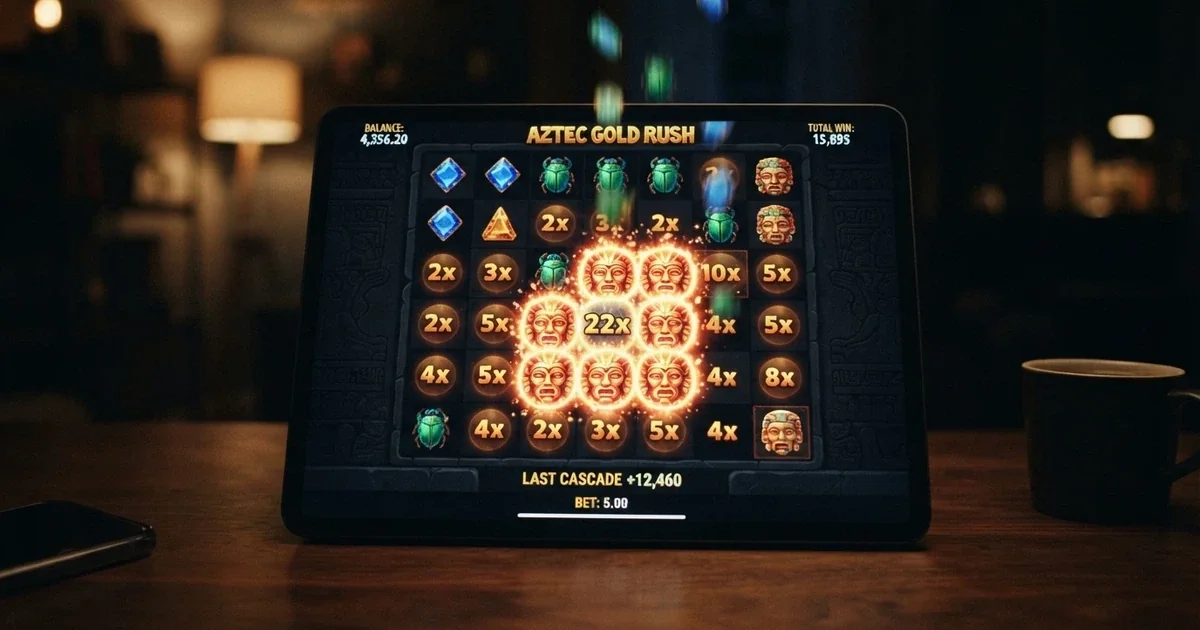
Data current as of 18 October 2026. Licence and blocklist status verified against the Australian Communications and Media Authority’s enforcement register; bonus terms verified against each operator’s published terms page.
Table of Contents
- Why a 7-Reel Pokie Plays Nothing Like a 5-Reeler
- The Best 7-Reel Slot Titles Available to Australians
- Why Your 7-Reel Bonus Is Smaller Than It Looks
- Playing 7-Reel Pokies for Free — No Deposit, No Registration
- The Legal Reality Australians Need to Know Before Playing
- Staying Safe — Tools and Limits That Actually Work
- Where Australians Find 7-Reel Pokies — Offshore Casinos Compared
- How We Selected and Ranked These Operators
- What to Do Next — Our Verdict on 7-Reel Pokies in Australia
- Frequently Asked Questions
Why a 7-Reel Pokie Plays Nothing Like a 5-Reeler
What a 7-Reel Slot Actually Is
A “7-reel” pokie, in the form most Australians encounter it, is not a slot with seven horizontal reels spinning side-by-side like the pub machines of the 1990s. The seven reels are stacked into a square — a 7×7 grid, forty-nine symbol positions at any one moment, and the wins are not read across paylines. They are read in clusters: groups of five or more matching symbols that touch each other horizontally or vertically. The grid is the format, and the cluster-pays engine is what makes the format work.
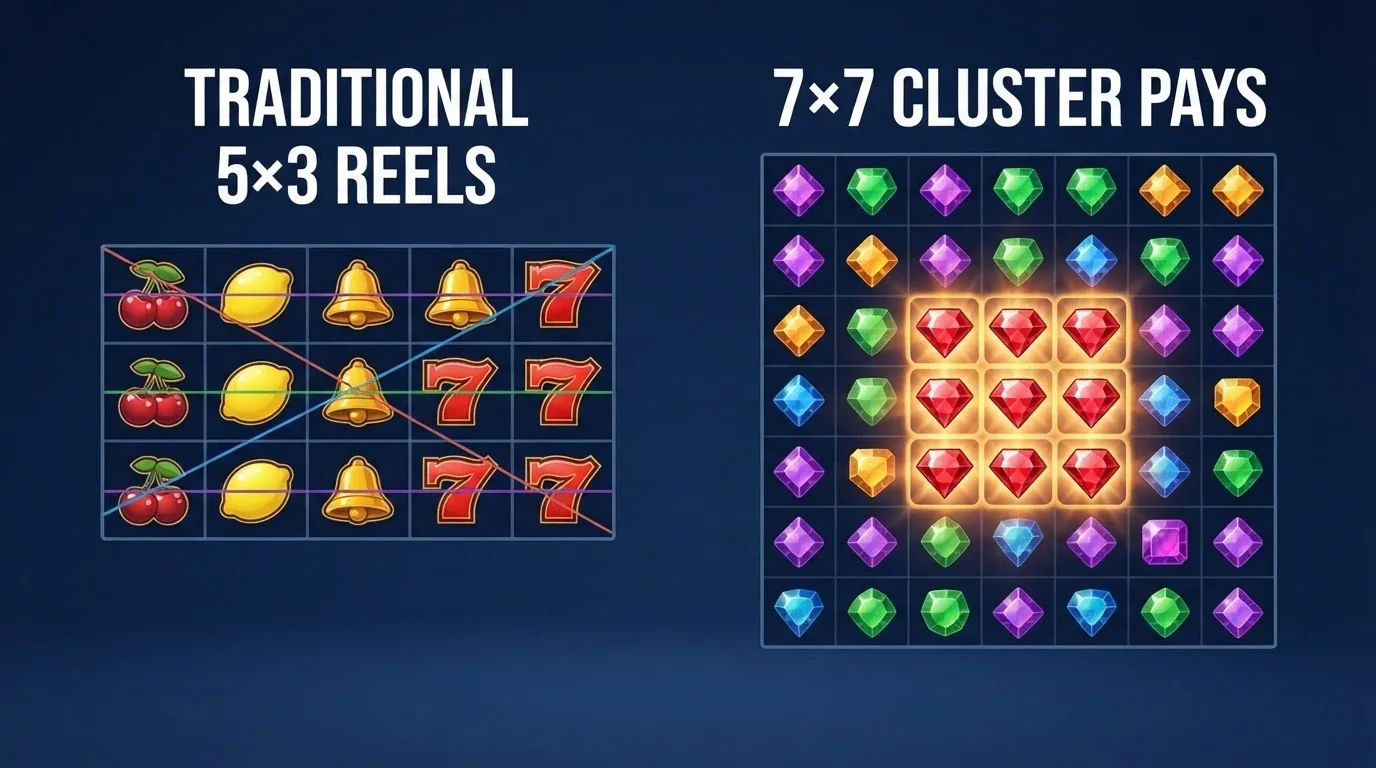
What most readers call “7-reel” is therefore almost always a 7×7 grid slot under the cluster-pays umbrella. The terminology has drifted. The physical reel analogy no longer applies — there are no spinning reels in the mechanical sense, just a square playfield that refreshes symbol-by-symbol after every cascade.
Cluster Pays — The Engine Behind 7×7 Grids
Cluster pays is a simple idea with deep consequences. A player does not match symbols across a fixed payline. They match them wherever they touch — five or more in a connected group, horizontally or vertically. When the cluster pays, the symbols in it disappear. New symbols tumble down from above to fill the gaps, and a fresh cluster can form from the tumble. The same spin can therefore produce three, four, five winning clusters in sequence, each one paid out before the cascade resets.

Sugar Rush is the canonical illustration. Its multiplier spots start at x2 and double each time a winning symbol detonates on the same position — up to x128. The spots do not vanish between cascades; they persist through the free-spins bonus and accumulate as long as new winning clusters hit them. That is why a single spin on Sugar Rush can quietly run into a six-figure payout without the player pressing anything again.
A 7×7 grid with cluster pays also shifts the volatility profile. Most 7-reel slots lean toward high volatility — wins less frequent, but larger when they hit. The maths is geometric: a 5×3 slot has 243 ways to evaluate a win, a 7×7 grid has thousands of cluster configurations, and the engine rarely pays out on the cheap spins. The format is built for the bonus round and the cascade chain, not the steady small return.
The contrast with scatter pays matters here. Scatter pays pay anywhere on the grid regardless of adjacency — usually a fixed number of matching symbols, anywhere, triggers a win. Cluster pays require touching symbols, which is harder to form but tends to chain more dramatic cascades. The mechanics look similar from a distance; they are not the same under load.
7-Reel vs 5-Reel: More Reels, Less Familiar
A traditional 5×3 pokie has three rows, five reels and somewhere between ten and 243 paylines. The player picks a bet, hits spin, and the engine evaluates each payline for a left-to-right match. The maths is well understood; the volatility is the studio’s choice. A 5-reel pokie can be low, medium or high volatility, and the player picks the band that fits their bankroll.
The 7-reel category does not offer that choice. Almost every title in the cluster-pays 7×7 niche runs high volatility by design. The grid is large, the cluster is harder to hit, and the bonus round carries most of the payout. The few lower-volatility titles that exist — Culinary Clash at medium volatility is one — are the exceptions rather than the rule.
The win-frequency difference is what a player feels first. A 5-reel medium-volatility pokie pays out something on roughly a third of spins. A 7-reel high-volatility grid can run twenty, thirty spins without a meaningful cluster, then deliver a cascade sequence that returns a hundred times the stake in a single bonus round. Bankroll management on the 7×7 grid is a different problem from bankroll management on a 5×3 line slot, and the marketing rarely explains why.
7-Reel Pokies Terminology for Australian Players
The terms below are the ones an Australian punter will meet in any review or game-info panel. They are the working vocabulary of the format.
- Pokies — the Australian word for slot machines, both physical and online. Every “pokie” referenced in this article is an online slot.
- Tumbling reels / cascading wins — the mechanic where winning symbols disappear and new ones fall into their place, allowing consecutive wins on a single paid spin.
- Cluster pays — wins formed by groups of five or more matching symbols touching horizontally or vertically, rather than across paylines.
- RTP (return to player) — the percentage of all wagered money a slot returns to players over the long run; a 96.50% RTP returns A$96.50 per A$100 wagered across millions of spins.
- Volatility — how often a slot pays out and how large those payouts tend to be. High volatility means infrequent wins but bigger payouts when they hit.
- Max win — the highest payout a single spin can deliver, expressed as a multiple of the bet (a 5,000x max win on a A$1 spin returns A$5,000).
The Best 7-Reel Slot Titles Available to Australians
| Title | Provider | RTP | Volatility | Max Win |
|---|---|---|---|---|
| Sugar Rush | Pragmatic Play | 96.50% | High | 5,000x |
| Reactoonz | Play’n GO | 96.51% | High | 4,570x |
| Fruit Party | Pragmatic Play | 96.50% | High | 5,000x |
| Sugar Rush 1000 | Pragmatic Play | 97.50% | High | 25,000x |
| Viking Runecraft | Play’n GO | 96.70% | High | 5,000x |
| Mummyland Treasures | — | 96.36% | High | 25,000x |
| Pearl Harbor | — | 94.10% | High | 41,127x |
| King Carrot | Hacksaw Gaming | 96.24% | Medium-high | 15,000x |
| Desert Temple | — | 96.29% | High | 10,000x |
| Wild Frames | Play’n GO | 96.50% | High | 7,000x |
| Culinary Clash | — | 94.51% | Medium | 10,000x |
Sugar Rush 1000 leads the set on return at 97.50% RTP, the only title above 97%. Pearl Harbor carries the highest max win at 41,127x the bet, more than four times the next-highest ceiling in the table. Most of the cluster sits in a tight 96.0–96.7% RTP band with 5,000–25,000x max wins and high volatility. Two titles break the high-volatility pattern — King Carrot at medium-high and Culinary Clash at medium — and they are the ones a smaller bankroll should look at first.
The provider mix is narrow: Pragmatic Play and Play’n GO carry most of the set, with Hacksaw Gaming and 4ThePlayer contributing. The same studios dominate offshore casino libraries in Australia, so the titles in this table are the ones an Australian player will actually find when filtering by “7-reel” on an offshore site.
What Makes a 7-Reel Title Worth Playing
RTP is the headline figure and the only one most reviews carry, but it is not the one to optimise for in this format. Two titles at 96.50% RTP can pay out at completely different rates across a session because the volatility profile sits underneath. A high-volatility 96.50% RTP slot eats bankroll in long dry stretches and pays it back in the bonus round; a medium-volatility 96.50% RTP slot pays smaller amounts more often. The RTP is the long-run number. The session-feel is the volatility.
Max win is the next signal to read. A 5,000x ceiling like Sugar Rush or Viking Runecraft is a respectable number on a A$1 spin. A 25,000x ceiling like Sugar Rush 1000 or Mummyland Treasures is what makes a session worth chasing. Pearl Harbor’s 41,127x ceiling is the outlier in the set — it is the title whose marketing promises the most, and it is also the title at 94.10% RTP, the lowest in the table. The trade-off is structural: a higher max win usually means a lower RTP.
Bonus-round depth is the third criterion and the easiest to underweight from a review. Sugar Rush’s persistent multiplier spots, Slushie Party’s random multipliers up to 256x, 7 Piggies’ pick bonuses — these are the mechanics that turn a session around. A 7-reel pokie with a flat base game and a flat free-spin round is a worse bet than a 7-reel pokie where the bonus round chains wins on its own. Reviews list bonus features; they rarely explain whether the feature actually changes the volatility feel.
Provider reputation is the last filter. Pragmatic Play, Play’n GO and Hacksaw Gaming are audited studios with consistent RTP disclosures. A 7-reel pokie from an unknown studio with a higher headline RTP and no published audit is not necessarily a better game — it is a less verifiable one.
Why Your 7-Reel Bonus Is Smaller Than It Looks
The bonus is the first number a casino page prints. The wagering requirement is the second, and it is the one that determines whether the bonus is worth taking. SkyCrown, the largest welcome package in the operator set at A$8,000, asks for 40x wagering on the bonus and 30x on free-spins winnings — with 14 days to clear each tier. Royal Reels asks for 30x on the bonus only. WinSpirit asks for 40x with a 5-day validity window and a A$3,000 combined max-win cap. The numbers are not interchangeable. They describe fundamentally different deals.
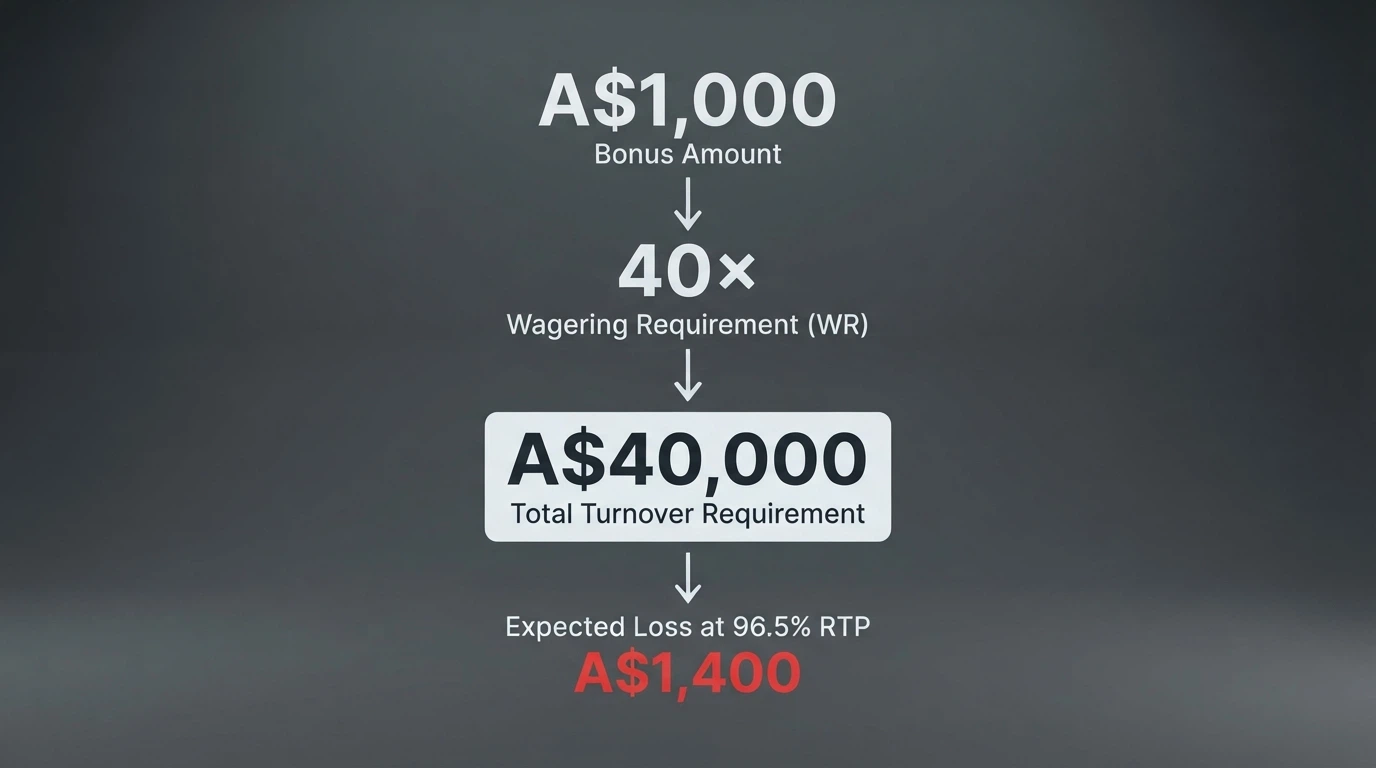
A “40x” wagering requirement on a A$1,000 bonus means the player has to wager A$40,000 in real money before the bonus and any winnings from it become withdrawable. That is the turnover, not the bonus. The bonus is the multiplier; the turnover is the product.
The expected cost of clearing that bonus is what the maths actually says. Take SkyCrown’s welcome package at the maximum A$8,000 bonus, the 40x wagering multiple and a representative 7×7 grid slot at 96.50% RTP — the published figure on Sugar Rush. Assume the player wagers only the bonus amount, never adds their own funds, and the math runs over millions of spins rather than any single session. Required turnover comes to A$320,000. The house edge at 96.50% RTP is 3.5%. Across A$320,000 of turnover, the expected loss is A$11,200 — more than the headline bonus itself. That is the price of the A$8,000 figure; nothing in the marketing explains it.
Max-cashout caps are the second layer. SkyCrown caps the welcome bonus at A$5,000 of withdrawable winnings. WinSpirit caps combined wins from the bonus and free spins at A$3,000. Royal Reels shows the cap on activation. Fair Go is the exception — its 300% match to A$3,000 carries no maximum cashout, the only offer in the set without a ceiling on what the bonus can convert to.
Validity windows are the third. WinSpirit’s 5-day window means the player has 5 days to clear the wagering requirement on the bonus and free-spin winnings combined. The bonus at 40x on A$2,000 requires A$80,000 of turnover in 120 hours. That is roughly A$667 of turnover per hour around the clock, or A$13,340 per day at a casual pace. Casino Rocket’s 45x wagering on A$1,575 full package requires A$70,875 in turnover, with no published validity window. Rainbet gives 7 days at 40x wagering. The validity window is the deadline a player runs into first when the maths is tight.
The gap between the headline bonus figure and the take-home value is therefore not a marketing exaggeration. It is the arithmetic of wagering, validity and cashout caps acting in series. A A$1,000 bonus at 40x with a 7-day window and a A$3,000 cashout cap is not worth A$1,000. It is worth whatever the player can clear in 7 days, capped at A$3,000, minus the expected loss on the turnover. That number is rarely the headline.
Bonus Features Built Into 7-Reel Pokies
The bonus features that come baked into the games are different from the welcome offer at the cashier. Sugar Rush’s multiplier spots, Slushie Party’s random multipliers up to 256x, 7 Piggies’ free-spin pick bonuses — these are in-game mechanics, triggered by symbol combinations on the grid, paid in real-money wins that count against the wagering requirement. They are the engine of the 7×7 grid format.
Multiplier spots that persist through cascades are the most distinctive mechanic in the format. Sugar Rush places a multiplier on any position where a winning symbol detonates. The first time, the multiplier is x2. The second detonation on the same spot doubles it to x4. It keeps doubling — x2, x4, x8, x16, x32, x64, x128 — and the spot stays on the grid as long as winning clusters continue to hit it. In the free-spins round, the multipliers persist across all spins, which is why a single bonus round can climb into the thousands of times the bet.
Random multipliers in the bonus round are the other variant. Slushie Party lands multipliers of up to 256x on random symbols in the free-spin feature. 7×7 Zeus runs a progressive multiplier that builds across the bonus round. These mechanics are not upgrades of the base game; they are where the 7-reel format actually pays.
Pick bonuses add a third layer. 7 Piggies’ bonus round lets the player pick barns to reveal extra free spins and multiplier upgrades — up to 10 extra spins and a 5x multiplier on top of the 5 free games awarded by the scatter trigger. The pick mechanic is a vestige of the 5-reel era, transplanted onto the 7×7 grid, and it adds player choice to a format otherwise driven by the random tumble.
Cascading chains are the bonus engine nobody talks about because they are the base game. A single paid spin that lands three consecutive winning clusters is, mechanically, three bonuses paid out in sequence. The cluster-pays engine makes every spin a possible chain, which is why the 7-reel format does not need a separate bonus round to be volatile — the base game is volatile.
Free Spins That Come With the Game vs Those That Come With a Deposit
A “free spins” label appears in two places that do not refer to the same thing. The first is the in-game free-spin round, triggered by three or more scatter symbols on the grid. The bonus round pays out in real money, governed by the game’s RTP and volatility, and counts against any active wagering requirement. The second is the casino’s welcome offer: SkyCrown’s 400 free spins across four deposits, Royal Reels’ 50 free spins at A$0.20 per spin, Rocket Play’s 300 free spins across four deposits. These are marketing instruments, paid by the casino, attached to a deposit and a wagering requirement.
The two types share a name and almost nothing else. In-game free spins cost the player nothing beyond their normal bet and pay out at the game’s published RTP. Welcome-offer free spins cost the player a deposit, the wagering multiple on the winnings and the validity window. A welcome-offer free spin at A$0.20/spin over 50 spins is A$10 of slot play funded by the casino. The winnings from those 50 spins carry the 30x wagering requirement at Royal Reels, meaning A$100 of winnings becomes A$3,000 of turnover before it is withdrawable. The spin was free; the winnings are not.
The conflation between the two is the lever the marketing pulls. A welcome page can advertise “400 free spins” next to a Sugar Rush review that promises “free spins with persisting multipliers up to x128”, and a reader assumes they describe the same thing. They do not. The first is a deposit-gated promotion with a wagering burden; the second is an in-game bonus round paid at the game’s full RTP.
The value difference at a typical session is also large. A 50-free-spin welcome offer at A$0.20/spin over a 96.50% RTP slot has an expected return of A$9.65 — that is the maximum the bonus can cost the casino before the wagering cuts in. The in-game free-spin round on the same slot has no upper limit and pays out whatever the random number generator lands. The welcome offer is small. The in-game bonus round is the format.
Playing 7-Reel Pokies for Free — No Deposit, No Registration
Demo mode loads the full slot in a browser window with a play-money balance. No deposit, no registration, no email address, no age verification. The reels spin, the cascades tumble, the bonus rounds trigger exactly as they would on real money. The only thing missing from the screen is the cashier button.

This is not a stripped-back version of the slot. The random number generator, the bonus-round frequency, the volatility profile — all of these are the production code path that the real-money game uses. The studio ships one build and toggles between play-money and real-money modes; the maths is identical. The 96.50% RTP, the high volatility, the multiplier spots — every mechanic behaves the same way with A$1,000 of play money as it does with A$1,000 of real money.
What demo cannot replicate is the surrounding context. There is no deposit to lose, no withdrawal to wait for, no KYC document to upload, no wagering requirement to clear. The psychology of a play-money spin is different from a real-money spin: the player who is not risking their own bankroll does not feel a dry stretch the same way. A 7-reel slot can run twenty spins without a meaningful cluster in demo mode and feel like an interesting lull. The same twenty spins on real money is a session a player aborts.
Demo Mode: The Full Game, Real Mechanics, Zero Risk
Demo mode is the only risk-free way to learn a 7-reel slot. Every studio that produces the titles in this guide — Pragmatic Play, Play’n GO, Hacksaw Gaming — publishes a demo build on its website, and most offshore casino sites run the same demo without requiring an account. The player opens the page, the slot loads, the spin button works.
The mechanics that demo reveals are the ones reviews describe but do not show. The cluster-pays engine on Sugar Rush does not visibly differ from a scatter-pays engine until the first cascade. A multiplier spot landing at x8 and persisting into the next spin does not read on a static screenshot. A 7×7 grid filling with two dozen matching symbols at once is a different visual experience from a 5×3 line hit. The format has to be played to be read.
The volatility feel is the second thing demo reveals. A medium-volatility 5-reel slot pays out roughly every third spin. A high-volatility 7×7 slot can run fifteen spins without paying out, then deliver a cascade sequence that returns twenty times the bet in three tumbles. The bankroll curve is different, and a player who has only ever played 5-reel pokies will misread the first fifteen spins as a bad game. Demo mode is the way to learn the curve before committing money.
The bonus-round trigger frequency is the third. Sugar Rush’s free-spin round triggers on three or more scatter symbols anywhere on the grid. In demo mode the player can run enough spins to see how often it actually triggers, how the multiplier spots persist, and how the round typically plays out. A review can describe the mechanic. Demo mode is the only way to feel whether the mechanic is worth chasing.
No-Registration Free Play vs Sign-Up Free Spins
Two paths to playing 7-reel pokies without spending money exist, and they carry different trade-offs. No-registration demo play needs nothing: an internet connection, a browser, a click on the slot. The data the player gives up is whatever the slot provider’s analytics capture — an IP address, a referrer, the country the request originates from. There is no account, no email, no name. The player is not on a casino’s marketing list.
Sign-up free spins need an account, an email address, usually a phone verification, and a deposit before any winnings convert to withdrawable cash. Royal Reels offers a no-deposit A$10 free chip on sign-up, the closest the operator set comes to a zero-deposit offer; every other sign-up free spin is gated on a deposit and a wagering requirement. The data the player gives up is everything: name, email, phone, payment method. The casino keeps it and uses it.
The trade-off is reach versus commitment. No-registration demo play reaches every 7-reel slot the studio publishes, with no commitment, and the player can switch titles without any friction. Sign-up free spins reach one slot, on one casino, with a wagering requirement that may or may not be winnable, and the player is now on a marketing list for that brand. The data-collection trade-off favours the demo. The “real money” upside favours the sign-up offer, and that upside is the wagering requirement that eats most of it.
The Legal Reality Australians Need to Know Before Playing
There is no Australian-licensed online pokies operator. None. The Interactive Gambling Act 2001 prohibits online casino games and online pokies outright, and the 2017 amendment closed the loopholes offshore operators used to reach Australian customers. The Australian Communications and Media Authority enforces the prohibition; since November 2019, the ACMA has had 1,564 illegal gambling and affiliate websites blocked at the ISP level. More than 225 illegal services have withdrawn from the Australian market since 2017.
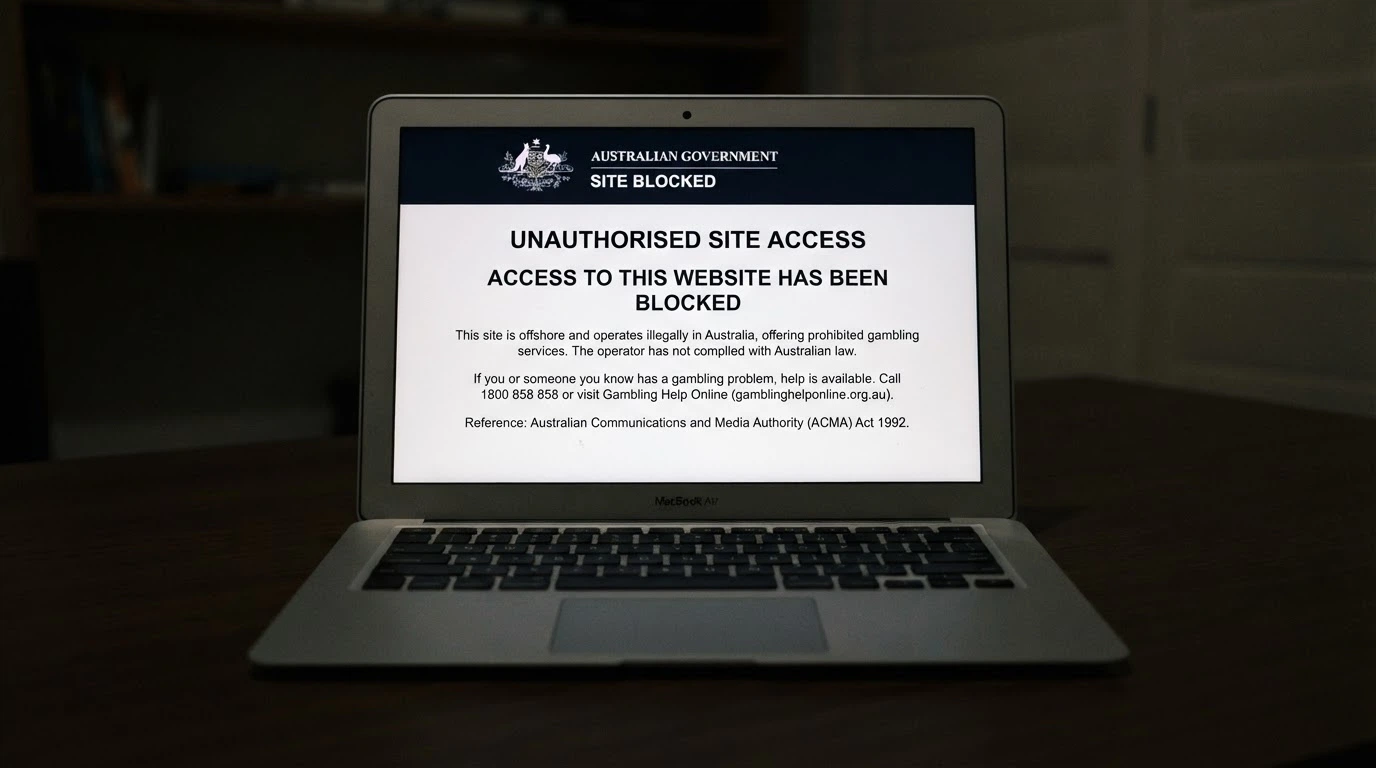
The prohibition is on the provider, not the player. The IGA targets the company offering the prohibited interactive gambling service to a person physically in Australia; the individual punter is not prosecuted. The personal exposure is not legal but financial: an offshore casino is outside Australian law, and an Australian who has money on that site has no Australian consumer protection, no Australian dispute resolution, no Australian regulator to complain to, and no BetStop coverage. The site can be blocked at any time, with a balance on it.
The 2026 reform does not change the prohibition. The Interactive Gambling Amendment (Gambling Reform) Bill 2026 passed Parliament on 19 August 2026, and its measures commence on 1 January 2026. The reform tightens advertising rules for licensed wagering operators, introduces a national wagering advertising opt-out register (AdStop) administered by the ACMA, and grants banks express authority to block transactions to illegal gambling operators. The reform does not legalise online pokies, does not licence an offshore casino, and does not bring any 7-reel pokie inside the Australian regulatory perimeter.
Offshore vs Licensed: What the Difference Means for Your Money
An Australian-licensed wagering operator holds a Northern Territory Racing and Wagering Commission licence (or its state equivalent), offers sports and racing wagering only, and is connected to BetStop, the National Gambling Helpline (1800 858 858) and the Australian Financial Complaints Authority. A deposit limit is customer-set, activity statements are mandatory, and the operator answers to an Australian regulator if a dispute arises. There are roughly 150 of these operators.
An offshore casino offers online pokies, online table games, sometimes live casino, to any country that reaches it. It is not connected to BetStop. A self-exclusion on BetStop does not reach it. The Australian Financial Complaints Authority does not have jurisdiction. The ACMA can have the site blocked at any time. The credit-card and crypto ban that took effect on 11 June 2024 was passed specifically because credit cards and crypto were the payment rails that offshore operators relied on; a casino that asks an Australian for a credit card or Bitcoin is, by definition, outside the Australian ruleset.
The difference for the player is the difference between a regulated product and an unregulated one. A withdrawal dispute at a licensed operator can be escalated to AFCA. A withdrawal dispute at an offshore casino can be escalated to the operator’s own customer-service team, and that is the end of the line. A site blocked by the ACMA can strand a balance; the player has no Australian recourse to recover it.
The 2026 Reform and What Changes for Australian Punters
The Interactive Gambling Amendment (Gambling Reform) Bill 2026 passed Parliament on 19 August 2026, and its measures take effect on 1 January 2026. The reform is the most significant change to Australian gambling advertising since the original IGA, and it does not touch the prohibition on online pokies — it tightens the rules around the licensed wagering operators that are already legal.
For licensed wagering operators — sportsbooks, racing operators, the lot — the reform caps wagering advertising on television at three ads per hour between 6:00 am and 8:30 pm, with a live-sport blackout from 15 minutes before a scheduled event to 5 minutes after. Online wagering ads are restricted to logged-in, age-verified users. Radio ads during school times are banned. Athlete, celebrity and influencer endorsements are prohibited. The AdStop register, administered by the ACMA, lets Australians opt out of wagering advertising.
Inducement marketing — the bonus offers, the deposit matches, the “free bet if you sign up” emails — is prohibited for 14 days after a customer signs up and for 3 months after a person deregisters from BetStop. The intent is to break the welcome-bonus churn that licensed operators used to retain customers through their first weeks. Inducement bans are not new in Australia; several state regulators already had them. The reform harmonises them federally and lifts the period from state-level variations to a flat 14-day / 3-month window.
For the offshore casino an Australian reaches by typing the URL directly, the relevant 2026 change is the bank-blocking authority. From 1 January 2026, banks and payment providers gain express statutory authority to block transactions to illegal gambling operators. The mechanism has not been tested at scale, but the legal pathway is now clear: a bank can refuse a transfer to an offshore casino without the customer having recourse. This is the lever the reform installs against the offshore market that the original IGA could not fully reach.
The reform does not legalise anything. The reform does not licence an offshore casino. The reform does not bring 7-reel pokies inside Australian law. The 2026 package is about licensed wagering operators and the people who use them; for the Australian punter considering an offshore site, the prohibition is exactly what it was on 1 January 2026.
What Licensed Wagering Actually Looks Like in Australia
Australian-licensed wagering exists. It is licensed by state and territory regulators — the Northern Territory Racing and Wagering Commission is the de facto national licensor for online wagering, with about fifty operators holding NT licences and the rest licensed in other states — and it covers sports betting (before the event begins) and racing. It does not cover online pokies, online casino games or in-play sports betting. Those three product categories are prohibited under the IGA.
What the licensed wagering product does include is consumer protection that the offshore market does not. Customer-set deposit limits are mandatory, with no federal ceiling because the ceiling is the customer’s own choice and the operator’s compliance regime. Activity statements are issued, summarising deposits, wagers, wins and losses over a period. The licensed operator pays point-of-consumption tax to the state in which the customer is located — typically 10–15% of net wagering revenue — and an NT wagering tax of 5% on wagers minus payouts plus a 0.05% racing levy. The tax regime is the price of legal operation; it is also the proof that the operator is on the inside of the regulatory system, not outside it.
The minimum gambling age is 18 for all commercial gambling in Australia. Australians’ gambling winnings are not assessable income under section 6-5 of the ITAA 1997, and losses are not deductible under section 8-1, unless the person is carrying on a business of betting. A casual punter who wins A$5,000 on the Melbourne Cup does not declare it; a casual punter who loses A$5,000 on the same race cannot claim it against taxable income. The tax treatment is symmetrical in its indifference.
The licensed product is shaped around sports and racing for a reason. Australia has had legal sports and racing wagering since well before the IGA; the prohibition in 2001 was added on top of an existing licensed system, not built from scratch. Online pokies were never part of that licensed system. There is no licensed 7-reel pokie anywhere in Australia because the format is the prohibited product, not because the regulator has not got around to it.
Staying Safe — Tools and Limits That Actually Work
The responsible-gambling infrastructure in Australia is built for the licensed wagering product. BetStop, the National Gambling Helpline and Gambling Help Online reach licensed operators directly. Offshore casinos sit outside that infrastructure, and a player using an offshore site is using it without the safety net the rest of the Australian system provides.
BetStop — the National Self-Exclusion Register — launched on 21 August 2023 and covers roughly 150 licensed Australian wagering providers in a single registration. As at 31 March 2026, 59,830 people had registered, with 37,247 active exclusions. Self-exclusion periods run from a minimum of three months to a lifetime. 78% of registrants were under 40 at the most recent reporting period; 38% chose lifetime exclusion. BetStop does not reach a single offshore casino.
How Big Is Gambling Harm in Australia — The Numbers
The prevalence data is not abstract. The Roy Morgan Gambling Harm Index for March 2026 reported 2,857,000 Australians — 13.0% of the adult population — experiencing gambling harm from their own gambling behaviours. Including harm from others’ gambling, the figure rises to 3,320,000 Australians — 15.1% of the adult population. The Australian Institute of Health and Welfare reported high-risk gambling at 1.8% of Australian adults in 2022, with about 2.1% — roughly 430,000 people — experiencing problem gambling.
The licensed wagering system is designed to catch this population: deposit limits, activity statements, BetStop self-exclusion, mandatory age verification. The offshore market an Australian reaches for 7-reel pokies has none of it. A player who would set a deposit limit at a licensed operator has to set their own limit at an offshore site, with no operator enforcement, no activity-statement reminder and no regulator to escalate to if the limit is ignored.
Where to Get Help — Numbers, Counselling and Support
The help lines below are free, confidential and Australian. Every one operates outside the casino; nothing the player says reaches an operator.
- National Gambling Helpline: 1800 858 858 — free, confidential, available 24 hours a day, 7 days a week.
- Gambling Help Online: gamblinghelponline.org.au — free online counselling including live chat, email support and self-help tools.
- BetStop: betstop.gov.au — the National Self-Exclusion Register for licensed wagering providers; minimum 3-month exclusion, maximum lifetime.
- National Debt Helpline: 1800 007 007 — financial counselling for gambling-related debt.
- SHARC: 1300 660 068 — support for friends and family affected by someone’s gambling.
- Healthdirect: healthdirect.gov.au/gambling-addiction — symptoms and support information.
Where Australians Find 7-Reel Pokies — Offshore Casinos Compared
| Operator | Licence Status in Australia | Welcome Bonus | Wagering | Free Spins | Game Providers | Bonus Slot RTP |
|---|---|---|---|---|---|---|
| SkyCrown | Offshore — not licensed in AU | 450% up to A$8,000 (4 deposits) | 40x bonus / 30x FS winnings | 400 FS (4 deposits) | Pragmatic Play, Play’n GO | Book of Dead 96.21% on 1st deposit FS |
| Royal Reels | Offshore — not licensed in AU | 100% up to A$500 + 50 FS | 30x bonus only | 50 FS at A$0.20/spin | Pragmatic Play, Play’n GO, Nolimit City, Hacksaw Gaming | — |
| Rocket Play | Offshore — not licensed in AU | 100% up to A$1,000 + 100 FS (1st); total 300% up to A$6,000 + 300 FS (4 deposits) | 30x–40x bonus | 300 FS (25/day for 4 days on 1st dep) | — | — |
| WinSpirit | Offshore — not licensed in AU | 100% up to A$1,000 + 200% up to A$1,000 = A$2,000 total | 40x bonus + FS winnings | 100 FS on Elvis Frog in Vegas | Evolution, Pragmatic Play | Elvis Frog in Vegas ~96.00% |
| Fair Go | Offshore — not licensed in AU | 300% up to A$3,000 + 50 FS | 30x bonus | 50 FS on Cash Bandits 2 | RTG | Cash Bandits 2 ~96.00% |
| Rainbet | Offshore — not licensed in AU | 250% up to A$2,100 (3 deposits) + 60 FS | 40x or no-wager gradual release | 60 FS on Sweet Bonanza | Pragmatic Play | Sweet Bonanza 96.51% |
| Casino Rocket | Offshore — not licensed in AU | 100% up to A$525 + 50 FS (1st); 150% up to A$1,575 + 150 FS (full) | 45x bonus | 50 FS on Big Bass Splash (1st); 150 FS total | Pragmatic Play | Big Bass Splash 96.71% |
| Stake | Offshore — not licensed in AU | — | — | — | — | — |
| Bizzo Casino | Offshore — not licensed in AU | — | — | — | — | — |
| Scream Casino | Offshore — not licensed in AU | — | — | — | — | — |
Every operator in this table is offshore. None holds an Australian licence for online casino or online pokies because no such licence exists. The column “Licence Status in Australia” is uniform for a reason: the legal status is the same across the set, and the table would not be honest if it suggested otherwise.
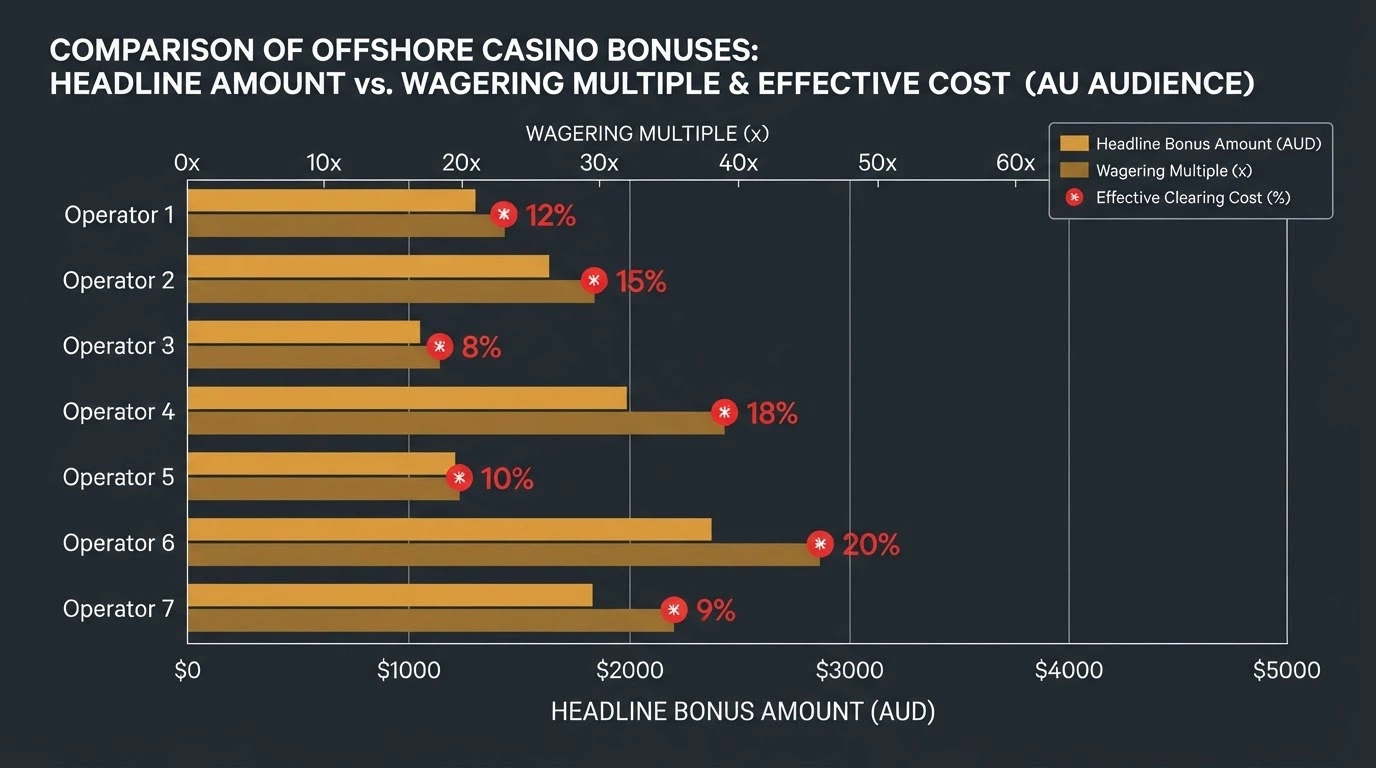
The two highest headline bonuses — SkyCrown at A$8,000 and Rocket Play at A$6,000 — both carry the highest wagering multiples in the table. The two lowest wagering multiples — Royal Reels and Fair Go at 30x — sit on the smallest headline bonuses. The correlation is not a coincidence: the operator that pays the largest headline bonus extracts the largest turnover in return. The headline figure is the lever; the wagering multiple is the cost.
SkyCrown
SkyCrown’s welcome package is the largest in the set: 450% across four deposits reaching A$8,000, plus 400 free spins distributed across the tiers. The structure is engineered to maximise the headline figure while spreading the wagering cost across four deposits. The first deposit pays out a 100% match with 100 free spins; the second through fourth deposits stack the rest.
The wagering burden is steep. 40x on the bonus, 30x on free-spins winnings, 14 days to clear each tier. A player who takes the maximum A$8,000 bonus owes A$320,000 of turnover before the bonus and any winnings become withdrawable — the expected loss on that turnover at 96.50% RTP runs A$11,200, more than the headline figure. The max-cashout ceiling sits at A$5,000 per welcome bonus; the bonus is generous, the ceiling is the cap. Max bet during the bonus is A$7.50 per spin.
The free-spin allocation runs across all four deposits: 100 free spins on the first deposit, distributed across subsequent tiers to bring the total to 400. Game providers include Pragmatic Play and Play’n GO — the two studios that produce most of the 7×7 grid titles in this guide. A player filtering by 7-reel pokies on SkyCrown will reach Sugar Rush, Fruit Party and the Play’n GO cluster without difficulty.
SkyCrown’s offer is large; the maths costs more than the headline. For a player running a tighter bankroll or a longer session, the 30x wagering on Royal Reels or Fair Go is the better fit.
Royal Reels
Royal Reels is the lowest-friction entry in the set: a 100% match up to A$500 plus 50 free spins at A$0.20 per spin, with 30x wagering on the bonus only. The bonus is small; the wagering is the lightest in the comparison. A A$500 bonus at 30x requires A$15,000 of turnover, against A$320,000 at SkyCrown. The bonus cap is A$500, the wagering multiple is 30x, the maths is small enough that a player can clear it on a moderate session.
The no-deposit A$10 free chip is the second point. A player who creates an account at Royal Reels receives A$10 in bonus money without making a deposit, with 30x wagering on the chip. The chip is small, but it is the only zero-deposit offer in the operator set and the only way to try a 7-reel slot on the operator’s own balance without committing a card.
The game library is the third differentiator: roughly 1,800 total games, around 1,400 of them pokies, with Pragmatic Play, Play’n GO, Nolimit City and Hacksaw Gaming on the provider list. That is the deepest 7-reel catalogue in the set. A player looking for King Carrot (Hacksaw Gaming) or Viking Runecraft (Play’n GO) is more likely to find it here than at Fair Go’s RTG-only library of ~280 games.
Royal Reels is for a player who wants the lowest wagering burden in the set and the deepest pokie catalogue; the small deposit and the light multiplier make this the right entry point for someone testing the 7-reel format for the first time.
Rocket Play
Rocket Play runs a four-deposit welcome package reaching A$6,000 + 300 free spins. The first deposit is 100% up to A$1,000 with 100 free spins distributed at 25 per day for four days. The total package stacks the next three deposits to bring the bonus to A$6,000 and the free spins to 300.
The wagering range is 30x to 40x depending on tier. A player who reads the terms will find the 30x on the first deposit and the 40x on subsequent tiers; the table above carries the range, not a single number, because Rocket Play varies the multiplier by deposit. The high-roller tier — a A$300+ first deposit — opens a 50% match up to A$2,500 with the same structure. Minimum deposit is A$30.
The free-spin delivery is the unusual mechanic: 25 per day for four days on the first deposit. A player who finishes day-one’s spins and does not return loses them. The format incentivises daily return over a four-day window; it is not a one-shot bonus.
Neither headline-grabbing nor bargain-bin; the four-deposit daily-return rhythm is the only thing that sets Rocket Play apart from the rest of the comparison set.
WinSpirit
WinSpirit’s package is the tightest in the set. 100% up to A$1,000 on the first deposit, 200% up to A$1,000 on the second — A$2,000 total — plus 100 free spins on Elvis Frog in Vegas at A$0.20 per spin. The wagering is 40x on both the bonus and the free-spin winnings. The validity window is 5 days. The combined max-win cap is A$3,000.
The 5-day window is the constraint. A$2,000 bonus at 40x means A$80,000 of turnover; A$3,000 cap on combined wins means the bonus cannot pay out more than that. A player who runs the clock without clearing forfeits the bonus; a player who clears it in 5 days faces the cashout cap. There is no scenario in which the bonus exceeds its headline number — the cap bites first or the clock bites first.
The game library is roughly 2,500 titles, the deepest in the set, with Evolution and Pragmatic Play as providers. The Elvis Frog in Vegas free spins ride on a 96% RTP slot, so the expected return on the free-spin allocation is small — 100 × A$0.20 × 0.96 = A$19.20. The free spins are window-dressing; the bonus is the deposit match.
The 5-day window and the A$3,000 cap together make this the worst-value offer in the set for a player without a high-volume session ready to clear A$80,000 of turnover in 120 hours.
Fair Go
Fair Go runs on Realtime Gaming (RTG) software with a 300% match to A$3,000 plus 50 free spins on Cash Bandits 2. The wagering is 30x on the bonus. There is no maximum cashout. AUD is accepted natively. The game library is roughly 280 titles — the smallest in the set — because RTG is a single-provider ecosystem.
The 300% match is the highest percentage in the comparison. A player who deposits A$1,000 receives A$3,000 in bonus money, and the A$3,000 carries 30x wagering = A$90,000 of turnover. The library is small, but the percentage is generous, the wagering is at the floor of the set, and the absence of a cashout cap is the one feature none of the other operators offer.
The trade-off is catalogue. RTG produces a constrained list; Cash Bandits 2 is the free-spin allocation and is a 5-reel game, not a 7-reel pokie. A player who wants Sugar Rush or Reactoonz will not find them here. The format-specific selection at Fair Go is thin; the bonus terms are the best in the set.
Fair Go’s 300% match at 30x with no cap is the best bonus maths in the comparison; the 280-game RTG-only catalogue is what you give up to take it.
Rainbet
Rainbet offers a 250% match up to A$2,100 across three deposits plus 60 free spins on Sweet Bonanza. The wagering path is a choice: 40x wager-locked, or no-wager gradual release. Validity is 7 days. Min deposit is A$30. Max bet on the wager-locked path is 2% of the deposit.
The choice between 40x wagering and no-wager gradual release is the differentiator. A player who takes the 40x path can withdraw the bonus + winnings after clearing A$84,000 of turnover in 7 days. A player who takes the no-wager path withdraws winnings as they accumulate, with no playthrough, but the bonus amount itself releases gradually as the player wagers. The gradual-release path pays out smaller amounts sooner; the wager-locked path holds the bonus hostage until the full turnover is met.
Sweet Bonanza at 96.51% RTP is one of the higher-RTP slots in the set of free-spin allocations, behind Big Bass Splash at 96.71%. Pragmatic Play is the primary provider; the player who wants Sugar Rush, Fruit Party or Sweet Bonanza on a 7×7 grid will find them on Rainbet.
Rainbet’s offer suits a player who likes the choice between clearing paths — the gradual-release option pays out smaller amounts sooner, the wager-locked option holds the bonus hostage until turnover is met. Either way, the bonus is on the smaller side of the set.
Casino Rocket
Casino Rocket runs the highest wagering multiple in the set: 45x. The first-deposit bonus is 100% up to A$525 plus 50 free spins on Big Bass Splash. The full package — first through fourth deposits — reaches 150% up to A$1,575 plus 150 free spins. Min deposit is A$30. A weekend reload of 50% up to A$150 is available beyond the welcome.
A$1,575 bonus at 45x means A$70,875 of turnover. There is no published validity window, which means the operator’s standard timer applies. The 45x multiple is the cost of the higher percentage match on the full package.
Big Bass Splash at 96.71% RTP is the highest-RTP free-spin allocation in the set. Pragmatic Play is the primary provider, and the 7-reel catalogue includes Sugar Rush and Fruit Party. The free-spin value is stronger than most of the comparison; the bonus-value maths is weaker because of the 45x multiple.
45x wagering is the highest in the set; Big Bass Splash at 96.71% RTP is the highest-RTP free-spin allocation. Take the trade-off or skip the casino.
Stake
Stake is a crypto-only casino with significant Australian market share — roughly 1.28% of the AU online gambling market — and a brand recognition that exceeds most of the comparison set. Specific welcome-bonus terms for Australian players were not confirmed in this round; the platform runs on a different model from the deposit-match casinos above, with a sportsbook-style rakeback and a VIP programme rather than a traditional welcome package.
The crypto model is the structural difference. Stake accepts Bitcoin, Ethereum, Litecoin and other cryptocurrencies; it does not process Australian dollar deposits through conventional rails. The credit-card and crypto ban for online wagering that took effect on 11 June 2024 in Australia applies to operators licensed in Australia; Stake is not. A player funding a Stake account with crypto is operating outside the Australian payment ruleset by design.
The game-provider reach is broad — Pragmatic Play, Play’n GO, Hacksaw Gaming and many others — and the 7×7 grid titles are available. A player who reaches Stake for 7-reel pokies will find the catalogue; the bonus structure is not what the comparison set offers, and a player who arrives expecting a deposit-match welcome will not find one.
Stake is the crypto-native option in the comparison; the legal status of crypto-funded play in Australia is the structural caveat a player funds with.
Bizzo Casino
Bizzo Casino differentiates on tournaments rather than welcome bonuses. The platform runs daily slot races and provider-led tournaments with prize pools that vary by event. Specific AU welcome-bonus terms were not confirmed in this round; the marketing emphasis is on the recurring tournament structure.
A player who reaches Bizzo for 7-reel pokies gets the same provider catalogue as elsewhere — Pragmatic Play, Play’n GO and the other studios in this guide — with the addition of a tournament layer. A slot race pays a fixed prize pool across the highest-volume players in a window; a provider tournament pays leaderboard positions on a single title. The value of either depends on the player’s volume on the qualifying slot.
The comparison set above does not capture tournament value cleanly because tournaments vary by day and by operator. A player who wants tournament structure should look at Bizzo; a player who wants a deposit-match welcome should look elsewhere.
Bizzo’s edge is the tournament layer rather than the welcome bonus — a player who plays volume on the qualifying slots gets the value.
Scream Casino
Scream Casino holds roughly 0.99% of the Australian online gambling market — the smallest share in this comparison — and specific AU welcome-bonus terms were not confirmed in this round. The platform is a smaller operator with a narrower catalogue than SkyCrown or Royal Reels.
The small market share is the constraint. A player who reaches Scream for 7-reel pokies will find a subset of the catalogue available at larger operators; the bonus terms, where they exist, are not on the public surface in a way this round confirmed. A player who arrives at Scream has usually been referred by an affiliate rather than sought the operator out directly.
Scream Casino is the smallest player in the comparison by market share; the catalogue is a subset of what the larger operators offer, and the bonus terms are the question a player needs answered before depositing.
How We Selected and Ranked These Operators
The ranking draws on three sources: the ACMA’s enforcement record against illegal services, the BetStop register of licensed wagering providers, and the public terms pages and provider catalogues of the operators themselves. Every operator in this guide is offshore; the legal status is uniform because no Australian online casino licence exists. The ranking orders operators by fit to the 7-reel-pokies topic — library depth, provider access, bonus terms — and not by any licensed-recommendation claim, because no such claim is possible in Australia.
The criteria, in order of weight: availability of 7-reel and 7×7 grid titles from the studios named earlier, the wagering burden relative to the headline bonus, the validity window and max-cashout cap, and AU market presence as a rough proxy for how many Australian players the operator is reaching. The legal status is the same across the set; the ranking does not promote one unlicensed operator over another on licensing grounds.
What the ranking does not do: it does not promote any operator as a recommended place to play, because every operator is providing a prohibited interactive gambling service to Australian customers. A reader who has read this far should treat the comparison as a description of what is reachable, not a list of where to go. The verdict at the close of this page says the same thing in plainer terms.
What to Do Next — Our Verdict on 7-Reel Pokies in Australia
There is no licensed 7-reel pokie in Australia. The Interactive Gambling Act 2001 prohibits the product outright; the ACMA enforces the prohibition; the offshore casinos that Australians reach are outside Australian law. The 7-reel format itself is real, the titles in this guide are playable, the maths on the bonus terms is what the maths says. None of that changes the legal status, and the legal status is the first fact a reader needs to hold.
The harm data is not a footnote. 13.0% of Australian adults — 2,857,000 people — are experiencing gambling harm from their own gambling behaviours. The offshore market an Australian reaches for 7-reel pokies has no deposit limit, no activity statement, no BetStop coverage, no AFCA recourse and no guarantee the site is reachable tomorrow. The reform that took effect in 2026 hands banks the authority to block transactions to illegal operators from 1 January 2026; the offshore market an Australian uses today may not be the same market in a year.
Demo mode is the risk-free path through the format. The random number generator, the bonus-round frequency and the volatility profile in demo are the production game. A player who wants to know what a 7×7 grid slot actually plays like can open a studio’s demo, run a few hundred spins, watch the cascade sequence and the multiplier spots, and learn the curve without spending a dollar. The format does not require real money to be understood.
For a player who has decided to proceed offshore despite the legal reality, the comparison in this guide is the operating manual. Read the wagering multiple first. Read the validity window second. Read the max-cashout cap third. The headline bonus figure is the lever the marketing uses; the three numbers underneath it are the ones that determine what the bonus is actually worth. The player who reads those numbers before depositing is the player who can decide whether the offer fits their session.
For a player who is finding it harder to stop than to start, the help lines in this guide are free, confidential and Australian. The National Gambling Helpline (1800 858 858) is 24/7. Gambling Help Online (gamblinghelponline.org.au) has live chat and email counselling. BetStop (betstop.gov.au) self-excludes from every licensed wagering operator in Australia in a single registration. The system works for the licensed market. For the offshore market, it does not reach — and that is the cost of the choice.
Frequently Asked Questions
How many of the slots called “7-reel” actually use 7×7 cluster-pays grids instead of traditional reels?
Almost all of them. The “7-reel” label in Australia covers cluster-pays games on a 7×7 grid — Sugar Rush, Reactoonz, Fruit Party and most of the titles in this guide — rather than slots with seven spinning reels in a row. Cluster pays evaluate wins by touching symbols, not by paylines.
Which 7-reel pokie title carries the highest return-to-player percentage?
Sugar Rush 1000 by Pragmatic Play, at 97.50% RTP. It is the only title in the 7×7 grid set that breaks 97%; the cluster around 96.50% — Sugar Rush, Reactoonz, Fruit Party, Wild Frames — is more typical. Pearl Harbor carries the highest max win at 41,127x but the lowest RTP at 94.10%.
What is the biggest maximum win available on a single 7-reel slot spin?
Pearl Harbor at 41,127x the bet. Sugar Rush 1000 and Mummyland Treasures both reach 25,000x; Sugar Rush, Viking Runecraft and Fruit Party sit at 5,000x. The max-win figure is the ceiling the game is designed around, not the figure a session will land on — most do not approach it.
Can the ACMA block an offshore casino site while I still have money in my account?
Yes. The ACMA has had 1,564 illegal gambling and affiliate websites blocked at the ISP level since November 2019. A blocked site is unreachable from Australia; a player with a balance on the blocked site has no Australian recourse to recover the funds. Site blocking is the ACMA’s main enforcement tool.
What happens if an offshore casino refuses to pay out a withdrawal — do I have any legal path in Australia?
No. Offshore casinos are outside Australian jurisdiction. The Australian Financial Complaints Authority has no authority over them; the ACMA enforces the IGA prohibition but does not arbitrate disputes; the operator’s own customer-service team is the end of the line. Funds are not recoverable through an Australian body.
Do any Australian-licensed wagering operators offer pokies or 7-reel slots?
No. Australian-licensed wagering operators — Sportsbet, bet365, Ladbrokes and roughly 150 others — hold state or territory licences for sports and racing wagering only. Online pokies, online casino games and in-play sports betting are prohibited products under the Interactive Gambling Act 2001; no licence exists for any of them.
Written by the editors at Casino Apps Australia.