
The Fast Withdrawal Casino Australia Question: What the Speed Numbers Hide
“Fast withdrawal” in the Australian market covers everything from a two-minute crypto cash-out to a five-day bank transfer. The label flattens them into one promise. The reality is wider, and the legal ground beneath every site the term returns is narrower than the marketing suggests.

This page works through what those numbers actually mean, which offshore casinos tested fastest in the current cycle, and why every one of them sits outside Australian licensing. The speed data is real. The product those speeds apply to is prohibited under the Interactive Gambling Act 2001, and the only licensed online wagering available to an Australian is pre-event racing and sport. There is no licence for online casino anywhere in the country.
Data current as of 3 November 2026, verified against Curaçao Gaming Authority register entries, ACMA enforcement statistics, the Interactive Gambling Act 2001, and the Gambling Help Online service register.
Table of Contents
- What “Fast Withdrawal” Actually Means at an Australian Online Casino in 2026
- Why Australian Players Chase Speed: The PayID Revolution in 2026
- The Reality Check Every AU Player Skips: These Casinos Are All Offshore
- How Your Money Actually Leaves an Australian Casino Account in 2026
- PayID: The Dominant Australian Cash-Out Method in 2026
- Crypto Payouts: Minutes to Your Wallet, but the Clock Is Ticking
- E-Wallets and Bank Cards: The Slower but Steady Lanes
- The Two-Stage Withdrawal: Why “Instant” Never Means Instant
- Ranked by the Clock: Which Casino Gets Your Money to Your Account First in 2026
- SkyCrown: The PayID Speed Benchmark
- RocketPlay: Sub-Hour PayID With a Curaçao Backing
- Royal Reels: 5,400+ Pokies and a Tested 4-Hour PayID
- WinSpirit: 6,000+ Games and Sub-2-Hour Crypto
- Bizzo Casino: E-Wallet Withdrawals Under One Hour
- FairGO: The Low-Minimum, No-Crypto Option
- Stake: Crypto-First With No Confirmed AU PayID
- Rocket Casino: 24-48 Hours With a 45x Wagering Hurdle
- Neospin: 35x Wagering but Instant-Win Games Are Excluded
- Joe Fortune: The A$5,000 Welcome With Unconfirmed Speed Data
- What You Play Determines When You Get Paid: Pokies, Tables and Withdrawal Speed
- Pokies With Fast-Withdrawal Casino Support in 2026
- Live Casino Tables and Payout Speed: The Overlooked Pairing
- Slot RTP and the Hidden Maths That Control Your Cash-Out
- Why Your Bonus Is the Biggest Obstacle to a Fast Cash-Out
- No-Deposit Bonuses at Fast-Payout Casinos: Free Spins That Rarely Pay Out
- Welcome-Package Wagering: The Real Wait Nobody Advertises
- Crypto Payouts: The Fastest Lane With the Biggest Legal Blind Spot
- Which Crypto Networks Deliver the Fastest Casino Cash-Outs
- The Crypto Paradox in Australia: Fastest Method, Blocked for Licensed Wagering
- Every Fast-Payout Casino Australians Use Is Offshore — Here Is What That Means
- The IGA Prohibition: Why There Is No Licensed Online Casino in Australia
- ACMA Enforcement: 1,564 Sites Blocked and More Than 225 Services Withdrawn
- BetStop and the Self-Exclusion Gap: Offshore Casinos Are Not Connected
- When the Fast Cash-Out Does Not Come: Responsible Gambling and the Offshore Gap
- Why Offshore Casinos Are Disconnected From Australia’s Help Infrastructure
- Where to Get Help in Australia: Helplines, Self-Exclusion and Harm Data
- How We Selected and Ranked These Fast-Payout Casinos
- What Australian Players Should Actually Do About Fast Withdrawals in 2026
- Frequently Asked Questions
What “Fast Withdrawal” Actually Means at an Australian Online Casino in 2026
Three speed tiers sit under the label. A standard payout runs three to five business days through a bank transfer, which is the legacy baseline most operators still default to. A same-day payout clears in under twenty-four hours, usually through an e-wallet such as Skrill, Neteller or MiFinity. An instant payout lands in under one hour, and only crypto and PayID routinely deliver it.
The same phrase therefore covers a 120-second USDT transfer and a 96-hour bank wire, and affiliate pages that promise “fast withdrawals” without naming a method are usually pointing at the slower end of that range. Gambling Insider’s working definition — under twenty-four hours is fast, under one hour is instant — is the cleanest split, and it tracks the payment rail rather than the marketing copy.
The reason one label covers a two-minute and a two-day payout is that the casino is only one of the two queues your money passes through. The other queue is the payment rail, and that is where most of the variance lives.
Why Australian Players Chase Speed: The PayID Revolution in 2026
PayID displaced every other AU casino method in the last few years. The rails underneath it — the New Payments Platform and Osko — made near-real-time settlement a default rather than a premium, and Australian players adapted quickly. Deposits are instant. Withdrawals at well-run operators average between nine and forty minutes; at the slow end, twenty-four to forty-eight.
Two things keep PayID at the top of the list. First, every major Australian bank supports it as a receiving method, and most process incoming PayID in a sub-hour window. Second, the rails handle the settlement; the casino’s job is to release the funds, and an automated approval queue can compress that release to a few minutes. POLi used to fill this slot, but POLi shut down on 30 September 2023 after BPay withdrew support. Any operator still advertising POLi withdrawals in 2026 is running payment documentation that is roughly two and a half years out of date.
The shift in expectation is the point. Before PayID, an Australian player tolerated a three-day bank transfer as the cost of playing. After PayID, a withdrawal that takes more than an hour feels like a failure of the operator.
The Reality Check Every AU Player Skips: These Casinos Are All Offshore
The search term “fast withdrawal casino australia” reads like a product category. It is not. The Interactive Gambling Act 2001, strengthened by the 2017 amendment, makes it illegal to provide online casino games — pokies, table games, live dealer — to a person physically in Australia. There is no licence for online casino anywhere in the country, and no state-level carve-out changes that.
Every operator ranked on this page is offshore. They hold Curaçao Gaming Authority licences, sometimes Malta Gaming Authority, occasionally Anjouan — none hold an Australian casino licence because none can. The ACMA has been blocking offshore gambling sites since November 2019 and has now had 1,564 sites blocked by Australian ISPs, with 225 or more services withdrawing from the market entirely since enforcement was strengthened in 2017. The offshore route is not a grey area; it is the only route, and it is one the regulator has spent the last seven years narrowing.
The reason competitors avoid this framing is obvious — it makes the recommendation harder to give. The reason this page does not avoid it is that the legal context changes what a player is deciding: not just which offshore site pays fastest, but whether the speed is worth the gap in consumer protection that comes with it.
How Your Money Actually Leaves an Australian Casino Account in 2026
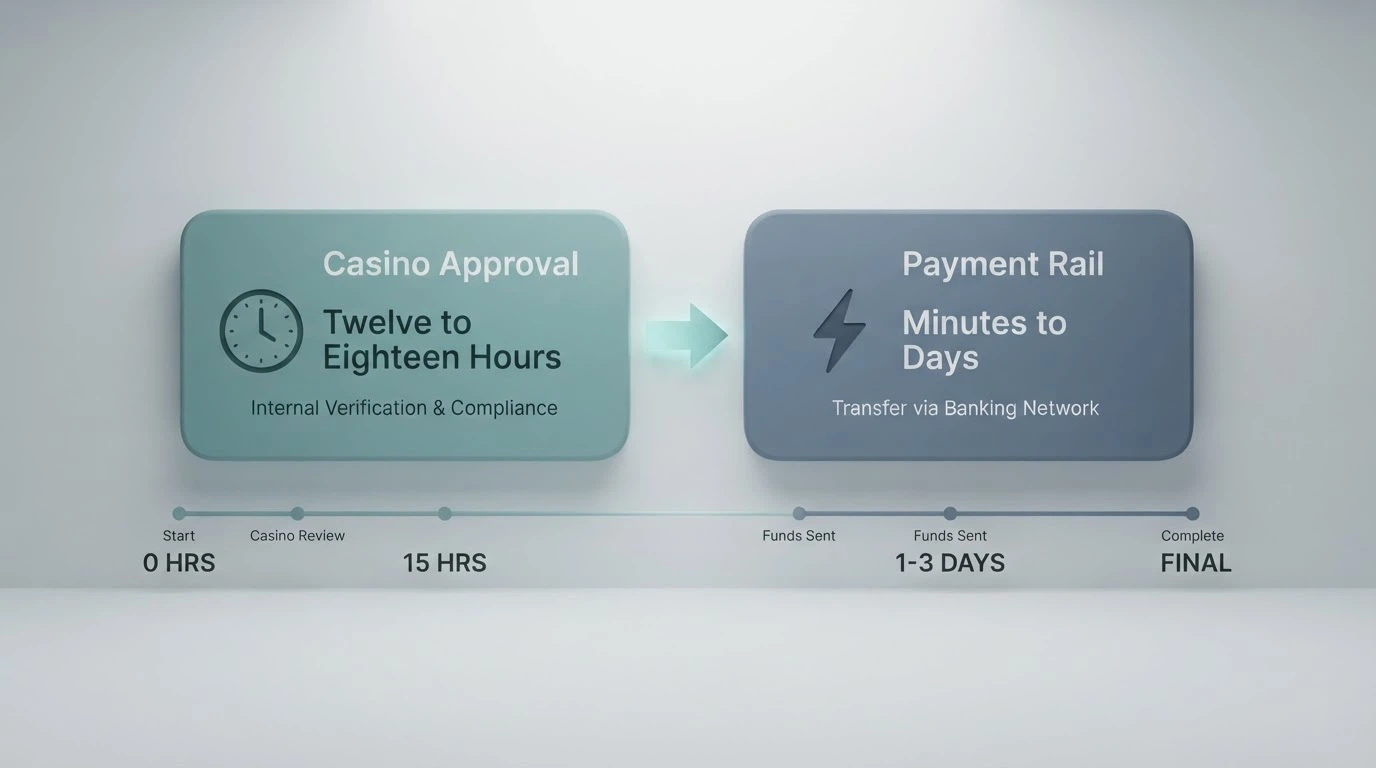
Every withdrawal runs through two separate queues, and the wait is whatever the slower queue takes.
The first queue is the casino’s own approval desk. At well-run operators this stage takes twelve to eighteen hours, dominated by KYC document review on a first withdrawal and by automated approval on subsequent ones. The second queue is the payment rail — PayID, crypto, e-wallet or bank transfer — and the rail’s own transfer window runs from seconds to business days.
Tested cashouts show PayID at twenty-four to forty-eight hours end-to-end at most operators. About twelve to eighteen hours of that is operator-side processing; the remaining twelve to thirty is the receiving bank’s PayID batch window. The split matters because a player can only meaningfully influence the first queue (by completing verification before requesting a cash-out) and not the second.
PayID: The Dominant Australian Cash-Out Method in 2026
PayID sits at the top of the method ranking because the speed ceiling is operator-side rather than rail-side. Once a casino releases the funds, the money is in the bank within minutes.
Tested medians put SkyCrown at a nine-minute PayID cash-out across fourteen timed withdrawals, with the fastest single one clearing in two minutes ten seconds and the slowest in twenty-eight minutes. VegasNow sits at a twelve-minute median, the second-fastest in the tested set. Both operators run automated approval queues that bypass manual review on cash-outs under A$2,000 to verified accounts, which is the mechanism doing most of the work — a queue that does not need a human to release small verified amounts collapses the operator-side leg of the pipeline.
Bank-specific friction still applies. ANZ tends to add roughly four hours on a first-receive PayID from a new payee as the bank’s fraud system warms up to the counterparty. Commonwealth Bank and Westpac process incoming PayID cleanly. The takeaway is that PayID speed is a property of the operator and the bank jointly, and a player who has not received a PayID from a particular operator before should expect the first withdrawal to be slower than the median.
Crypto Payouts: Minutes to Your Wallet, but the Clock Is Ticking
Crypto is the fastest payout rail in the market. USDT-TRC20 averaged four minutes at SkyCrown. CardPlayer’s cross-network test put USDT-TRC20 and Solana both inside five minutes, Ethereum and Litecoin between five and thirty minutes, and Bitcoin between thirty and sixty.
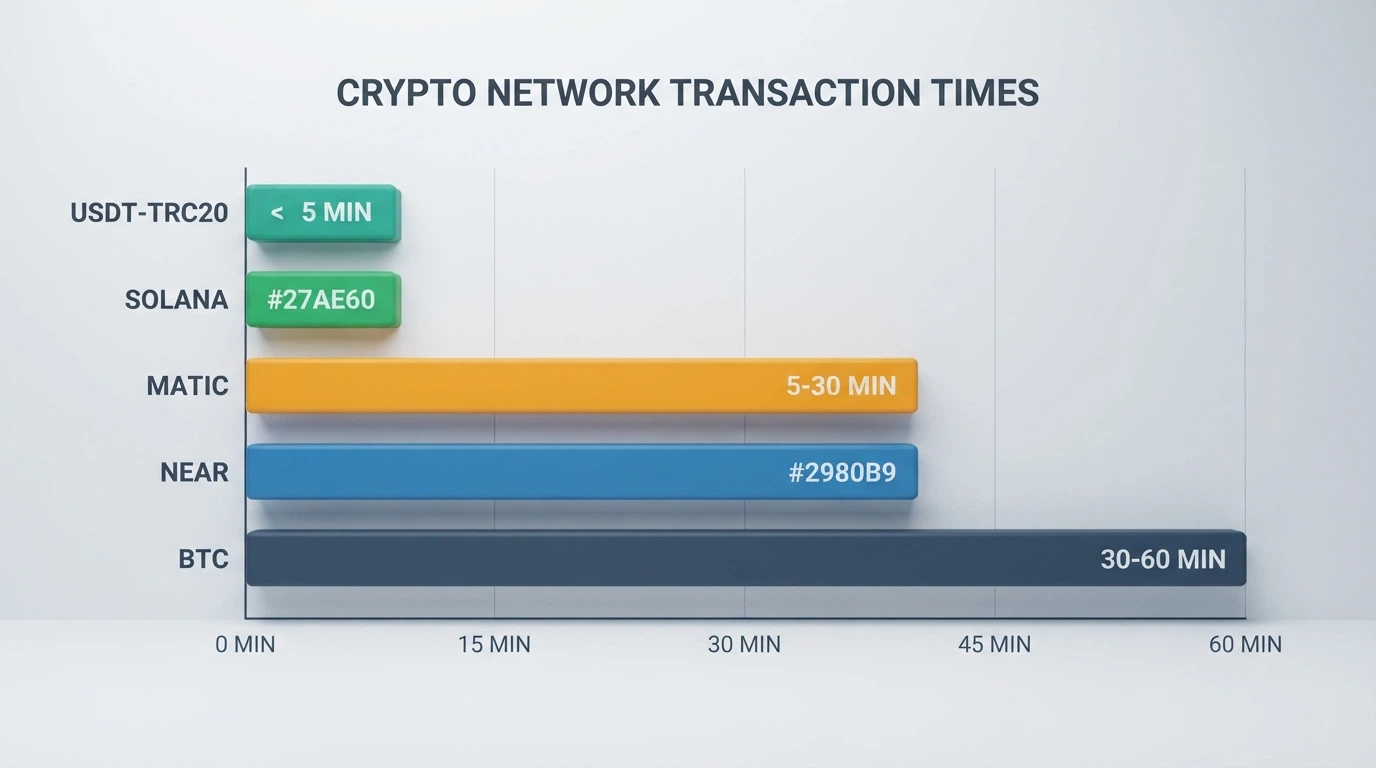
The speed ceiling on crypto is the network, not the casino. Once the operator releases the funds, settlement is the network’s job, and that is why the same operator can deliver a four-minute USDT withdrawal and a forty-five-minute Bitcoin one. Royal Reels lists Bitcoin, Litecoin, Ethereum and USDT all under one hour. WinSpirit clears crypto inside two hours across its supported networks.
The clock on this rail is regulatory rather than technical. Credit cards, credit-related products and digital currency (crypto) have been banned as payment for online wagering in Australia since 11 June 2024, and the Interactive Gambling Amendment (Gambling Reform) Bill 2026 — passed on 19 August 2026 — gives banks and payment providers express authority to block transactions to illegal gambling operators from 1 January 2027. Crypto is the fastest lane right now, and it is also the lane Australian law has most aggressively restricted. An offshore casino still accepts it; whether an Australian bank routes the inbound transaction is a separate question, and one that gets harder to answer yes after the start of 2026’s successor year.
E-Wallets and Bank Cards: The Slower but Steady Lanes
E-wallets sit between PayID and bank transfer on the speed ladder. Bizzo clears e-wallet withdrawals in under one hour. FairGO processes them in 12–24 hours. SkyCrown’s published e-wallet window is zero to one hour. E-wallets are the dependable second choice for a player whose bank batch window is the slow link.
Debit card withdrawals are slower, typically one to three business days, and most operators route them through a card network rather than a fast-payment rail. Bank transfer sits at the bottom, three to five business days at most operators, and that is the baseline “fast withdrawal” affiliate pages quietly mean when they are not naming a method. BPAY remains a deposit option for licensed wagering but does not appear in the tested fast-payout set for casino withdrawals.
The practical order for an Australian player choosing a rail is: PayID or crypto for sub-hour delivery, e-wallet for sub-four-hour, debit card for one to three days, bank transfer for anything else.
The Two-Stage Withdrawal: Why “Instant” Never Means Instant
A casino saying it offers “instant withdrawals” is describing only the second queue — the one it controls. The payment rail is the first queue, and the whole cash-out takes as long as the slower of the two.
Casino-side processing breaks down by account status. A first withdrawal on a fresh account almost always triggers manual KYC review, which is the single most common cause of a multi-day hold. Once documents are cleared, subsequent withdrawals under A$2,000 at operators running automated approval — SkyCrown, VegasNow — skip the manual review entirely and process in minutes. Above that threshold, or at operators without the queue, the cash-out sits in a pending state until a human releases it.
The payment-rail stage is outside the casino’s control. PayID delivers in minutes once released. Crypto delivers in minutes once broadcast, modulo the network. E-wallets deliver in hours. Bank transfers deliver in business days. The label on the lobby says “instant” because the casino can be instant; the label does not account for the rail.
A player can shorten the operator-side queue by completing verification before requesting a first withdrawal, choosing a payment rail that clears in minutes rather than days, and staying under the automated approval threshold where one exists. None of those moves the payment rail.
Ranked by the Clock: Which Casino Gets Your Money to Your Account First in 2026
Ten offshore casinos, all offering a prohibited product in Australia, tested and ranked by payout speed and the terms that determine whether the speed actually means something.

| Operator | Licence | Welcome Bonus | Wagering Requirement | Weekly Withdrawal Cap | Crypto Withdrawal Speed |
|---|---|---|---|---|---|
| SkyCrown | Curaçao (8048/JAZ2019-015) | A$4,000 + 400 FS (1st: 100% up to A$300 + 100 FS) | 40x bonus only | A$10,000 | USDT-TRC20 ~4 min |
| RocketPlay | Curaçao Gaming Authority | — | — | EUR 5,000 (~A$8,500) | Immediate |
| Royal Reels | Likely Curaçao | A$2,500 across 3 deposits (1st: 100% up to A$500) | 35x bonus only, A$5 max bet | A$10,000 (A$25,000–A$50,000 higher tiers) | Under 1 hour (BTC, LTC, ETH, USDT) |
| WinSpirit | Curaçao | AU$4,500 + 425 FS | — | — | Under 2 hours |
| Bizzo Casino | Likely Curaçao | 150% up to A$750 | 35x | A$10,000 | Under 1 hour (e-wallet) |
| FairGO | Likely Curaçao | 100% up to A$500 | 30x (pokies) | A$5,000 | — |
| Stake | Curaçao | — | — | — | Under 1 hour |
| Rocket Casino | Likely Curaçao | — | 45x, A$5 max bet | A$5,000 | — |
| Neospin | Likely Curaçao | — | 35x (excludes instant win) | — | — |
| Joe Fortune | Likely Curaçao | A$5,000 | — | — | — |
Em-dashes mark fields research could not verify from a non-affiliate source in this cycle. The gaps are the point of an honest table: a casino whose speed and cap are not published in verifiable terms is a casino that needs more checking before money goes in.
The speed spread from first to tenth runs from a roughly four-minute crypto or nine-minute PayID at the top end to a forty-eight-hour e-wallet at the bottom. The gap between the fastest and slowest tested PayID cash-out in this set is over four hours. The gap between crypto and bank transfer is measured in days, not hours, and the bank transfer option does not appear in any of the ten tested operators as a speed-tier feature.
SkyCrown: The PayID Speed Benchmark
SkyCrown set the test-cycle benchmark with a nine-minute PayID median across fourteen timed cash-outs, and the fastest single one cleared in two minutes ten seconds. USDT-TRC20 ran a four-minute median on the crypto rail. The mechanism doing the work is the automated approval queue, which bypasses manual review on withdrawals under A$2,000 to verified accounts; KYC documents cleared in four hours on the first withdrawal in the test sample.
The licence is Curaçao 8048/JAZ2019-015. The welcome package is up to A$4,000 plus 400 free spins across five deposits, with the first deposit matched 100% up to A$300 plus 100 free spins. Wagering runs at 40x on bonus only. The published maximum is A$7,500 per transaction, and the weekly cap is A$10,000. E-wallet withdrawals run zero to one hour, crypto is processed instantly once approved, and bank transfers take three days.
SkyCrown is the speed benchmark and the right answer for a player whose priority is how fast the money lands. The trade-off is the rest of the package: a 40x bonus-only wagering figure that takes serious play to clear, and an offshore licence that leaves the player outside Australian consumer law.
RocketPlay: Sub-Hour PayID With a Curaçao Backing
RocketPlay’s PayID cash-outs process in under an hour at most Australian banks, and the daily withdrawal limit sits at A$5,000 unless higher-tier verification has been completed. The licence is Curaçao Gaming Authority, and the Safety Index on casino.guru reads 9.8 out of 10 — the highest in the set. The weekly withdrawal limit is EUR 5,000 (roughly A$8,500) with a monthly cap of EUR 15,000, and there is no win cap attached.
The game library runs to 900-plus pokies from NoLimit City, Thunderkick, Pragmatic Play and others. Welcome-bonus terms remain unverified by independent sources this cycle.
RocketPlay is the strongest safety-rated option in the set and a clean second on speed. A player prioritising operator trustworthiness over absolute speed should look here first.
Royal Reels: 5,400+ Pokies and a Tested 4-Hour PayID
Royal Reels carries the biggest library in the featured set: 5,400-plus pokies from forty or more providers. The tested weekday PayID cash-out ran four hours and twelve minutes — slower than SkyCrown but still well inside the same-day tier. Crypto clears inside one hour across Bitcoin, Litecoin, Ethereum and USDT.
The welcome package is up to A$2,500 across three deposits (first deposit matched 100% to A$500), with a 35x bonus-only wagering requirement and a A$5 per-spin cap during clear-down. The published weekly cap is A$10,000 at the standard tier, scaling to A$25,000 and A$50,000 at the higher VIP tiers. An A$10 no-deposit bonus is available after phone verification, the lowest no-deposit entry point in the set. The operator’s licensing is currently unverified, though it likely operates under a Curaçao permit.
Royal Reels is the library pick. A player who wants 5,400-plus pokies and a tiered withdrawal ceiling that scales with VIP status gets the most headroom here, at the cost of a slower PayID than the top two.
WinSpirit: 6,000+ Games and Sub-2-Hour Crypto
WinSpirit runs the largest game count of any featured operator at 6,000-plus pokies, with crypto withdrawals clearing inside two hours across the supported networks. The welcome package runs up to AU$4,500 plus 425 free spins, the largest spin count in the set. A ten-free-spin no-deposit bonus is available at 40x wagering. The licence is Curaçao.
Bonus wagering and withdrawal caps are subject to operator-site data, which independent sources have not yet validated. The crypto speed is the verified headline.
WinSpirit is the choice for a player who wants the biggest free-spin bundle and a crypto-first cash-out. The 40x no-deposit wagering is industry-standard for the offer type and steep against a small spin count, which is the trade the headline spins obscure.
Bizzo Casino: E-Wallet Withdrawals Under One Hour
Bizzo delivers e-wallet withdrawals inside one hour with a A$20 minimum, and 1,500-plus pokies from Pragmatic Play, Hacksaw and others. The welcome bonus is 150% up to A$750 at 35x wagering, and the weekly cap is A$10,000. Licensing data is not yet independently verified, though the operator appears to hold a Curaçao licence.
Bizzo is the low-friction pick. A player who wants a sub-hour e-wallet cash-out and a A$20 minimum rather than a A$30 one gets the cleanest terms in the set, with a smaller library than the volume operators above it.
FairGO: The Low-Minimum, No-Crypto Option
FairGO runs a A$10 minimum withdrawal with no fees, the lowest in the set, and processes e-wallet cash-outs inside four hours. The welcome bonus is 100% up to A$500 at 30x wagering on pokies, with a 30-free-spin no-deposit bonus also at 30x. The weekly cap is A$5,000 and the bonus is valid through November 2026.
The critical limitation: FairGO does not support crypto withdrawals. It runs on bank transfers and e-wallets. For a player with no crypto wallet and a small bankroll, that exclusion is irrelevant; for a player whose speed ceiling is the network, it is a dealbreaker.
FairGO is the minimum-stake choice. A player depositing A$20 at a time and cashing out small balances has the lowest cost of entry in the set, and the absence of crypto is a feature for them rather than a gap.
Stake: Crypto-First With No Confirmed AU PayID
Stake clears crypto withdrawals inside an hour and runs a Curaçao licence, with a provider lineup of Pragmatic Play, Evolution, Hacksaw Gaming, NoLimit City and others. The platform is crypto-native and has no confirmed PayID withdrawal data for Australian players this run.
Bonus, wagering, and cap details currently lack independent verification. The speed ceiling is the network, and Stake is built around it.
Stake is the pure-crypto pick. A player whose entire flow is Bitcoin, Ethereum or USDT gets the operator designed for that flow, and the absence of PayID is a trade for the platform’s depth on the rail that does work.
Rocket Casino: 24-48 Hours With a 45x Wagering Hurdle
Rocket Casino processes withdrawals in twenty-four to forty-eight hours, the slowest window in the featured set, with a A$30 minimum and a A$5,000 weekly cap. Wagering runs at 45x with a A$5 maximum bet, the highest multiple in the set. The no-deposit offer is up to 125 free spins at 45x wagering. Licensing remains unconfirmed by independent sources, and the operator likely operates under Curaçao authority.
The 45x wagering figure is the load-bearing number here. Combined with a 24–48-hour withdrawal window and a A$30 minimum, the operator is built around clearing bonuses slowly. A player who values bonus size over cash-out speed gets a larger headline offer; a player who values cash-out speed gets the slowest option in the set.
Neospin: 35x Wagering but Instant-Win Games Are Excluded
Neospin runs a 35x wagering requirement, but instant-win games are carved out of wagering contributions, which is the qualifier that turns the headline number into a meaningful restriction. The withdrawal window is twenty-four to forty-eight hours, and the minimum is A$20. The no-deposit offer is 100 free spins at 40x wagering. The operator’s licence is currently pending independent validation, with Curaçao as the likely jurisdiction.
The instant-win exclusion is the kind of clause that does not appear in a banner. A player who treats scratch cards, Plinko or similar instant-win titles as a quicker route to clearing a bonus will find those wagers do not count, and the bonus remains locked. Neospin is a standard-clearing pick on the surface, with a sharp edge buried in the terms.
Joe Fortune: The A$5,000 Welcome With Unconfirmed Speed Data
Joe Fortune carries the largest welcome package dollar figure in the set at A$5,000. Bonus structure, wagering terms, and withdrawal data remain unverified by independent sources this cycle.
A player attracted by the A$5,000 headline should verify four things before depositing: the wagering multiple on the bonus, the maximum cashout from the offer, the supported withdrawal methods and the typical end-to-end cash-out time. None of those are in the verified set for this operator, and the headline number is the only figure that is. The bonus size is the largest in the ranking; the verification depth is the thinnest.
What You Play Determines When You Get Paid: Pokies, Tables and Withdrawal Speed
Game choice affects payout speed through three channels: wagering contribution rates, bonus eligibility rules, and operator processing rules that vary by category. A player who knows how those channels work can structure play to clear a bonus faster, or to avoid clearing it at all.
Pokies are the default fast-withdrawal game category. Almost every operator applies 100% wagering contribution to pokies, and the libraries at the featured operators are sized accordingly. Live dealer and table games typically contribute at a reduced rate, often 5% to 20%, which extends the time and turnover needed to clear a bonus. A no-deposit offer restricted to live dealer play is a long grind, and a player chasing the fastest cash-out path should weight their play toward pokies until the bonus is cleared.
Pokies With Fast-Withdrawal Casino Support in 2026
The provider landscape across the featured operators is concentrated but deep. Pragmatic Play, Hacksaw, NoLimit City, Play’n GO, NetEnt, Evolution, Microgaming, Relax Gaming and BGaming appear across the set, and the library sizes range from FairGO’s 800 to WinSpirit’s 6,000-plus and Rainbet’s 8,000-plus (cited as the AU-audience benchmark rather than a featured operator).

Royal Reels carries 5,400-plus pokies from forty or more providers. WinSpirit runs 6,000-plus. Bizzo lists 1,500-plus from Pragmatic Play and Hacksaw. FairGO runs 800-plus from Playtech and Betsoft. The library size correlates with provider count, and a player who has a preferred studio will usually find it at the volume operators and may not at the smaller ones.
Pokies clear wagering faster than tables for two reasons. The 100% contribution rate is the obvious one. The other is variance: a high-volatility slot produces large but rare wins, and a bonus cleared in a long flat run on low-volatility titles often takes longer in real time than a bonus cleared through a few high-volatility hits. The trade is variance risk: a high-volatility session can clear a bonus in minutes or burn through it in the same minutes.
Live Casino Tables and Payout Speed: The Overlooked Pairing
Live dealer games are available at most featured operators, and Evolution is the dominant provider across the set. They are also the game category most often carved out of bonus wagering contributions.
A live-dealer session can delay a cash-out timeline in two ways. First, if the operator applies a reduced contribution rate — 10% is common, sometimes 5% — a player betting A$10 per hand on blackjack is contributing A$1 per hand against the wagering requirement, and a A$12,000 turnover requirement becomes a A$120,000 playthrough at live tables. Second, some operators exclude live dealer play from bonus play entirely, in which case a single live-dealer hand while a bonus is active can void the bonus and the winnings.
A player who wants to play live dealer while clearing a bonus should check the contribution rate in the bonus terms before placing a bet. A live-dealer session on a bonus with restricted contribution is a long way from a fast cash-out.
Slot RTP and the Hidden Maths That Control Your Cash-Out
Slot RTP directly shapes how much of a wagering requirement survives the clear-down. Higher RTP means a smaller house edge, which means more of every dollar wagered comes back to the balance and is available for the next wager, which means less of the bonus is consumed by the house before the requirement is met.
| Slot Title | RTP | Provider | Volatility | Max Win |
|---|---|---|---|---|
| Sweet Bonanza | 96.51% | Pragmatic Play | Very high | 21,100x |
| Gates of Olympus | 96.50% | Pragmatic Play | High | 5,000x |
| Big Bass Bonanza | 96.71% | Pragmatic Play | High | 2,100x |
| Immortal Romance | 96.86% | Microgaming | High | 12,150x |
| Book of Dead | 96.21% | Play’n GO | Very high | 5,000x |
| Blood Suckers | 98.00% | NetEnt | Low | 300x |
Blood Suckers at 98.00% RTP is the outlier that proves the rule. A bonus cleared on a 98% slot loses 2% of every wager to the house; the same bonus cleared on a 96% slot loses 4%. Over a multi-thousand-dollar turnover, the difference is a real dollar amount, and it comes out of the player’s balance before the bonus is unlocked.
The volatility column is the trade. Blood Suckers’ 98% RTP is paired with a 300x max win, which caps the upside. Sweet Bonanza’s 96.51% RTP is paired with a 21,100x max win, which is the reason a player chooses a higher-volatility title. A player clearing a bonus who wants to preserve balance should weight toward the higher-RTP, lower-volatility end of the table; a player who wants variance upside should accept the lower RTP and the higher max win.
Why Your Bonus Is the Biggest Obstacle to a Fast Cash-Out
A welcome bonus is a contract that locks the bonus balance behind a wagering wall. The headline dollar figure is the lure; the wagering multiple is the actual cost; the max-cashout cap is the ceiling on what the bonus can pay out; and the expiry is the clock on the whole arrangement. Every one of those numbers extends the time between deposit and a withdrawable balance, which is exactly the time the speed labels on the lobby are not measuring.

The calculation below works through what a SkyCrown first-deposit bonus actually costs in time, given the verified 40x bonus-only wagering and a representative pokies RTP of 96.51% (Sweet Bonanza, Pragmatic Play).
The SkyCrown first-deposit bonus matches 100% up to A$300, so a player depositing A$300 receives A$300 in bonus funds on top. At 40x wagering on bonus only, the required turnover is A$300 multiplied by 40, which is A$12,000 in total wagers. Assuming a A$1 stake per spin, the number of spins is 12,000, and at five seconds per spin the play time is 60,000 seconds, which is 16.7 hours of continuous play. The expected loss over that turnover, applying a 1 minus RTP of 3.49% (the house edge on a 96.51% RTP slot), is A$12,000 multiplied by 0.0349, which is approximately A$419. That is the bonus’s real cost in expected house edge alone, before any spin-level variance.
These are statistical estimates. They describe an average over many spins under the stated assumptions, not a guaranteed outcome. A single session will land somewhere on either side of the expected loss, and a high-volatility slot can compress sixteen hours of play into a handful of large hits or stretch it into a much longer grind.
The point is that a “fast” cash-out at SkyCrown — nine minutes PayID, four minutes USDT — is the speed of the rail, not the speed of the bonus. The rail is fast. The bonus, by design, is not.
No-Deposit Bonuses at Fast-Payout Casinos: Free Spins That Rarely Pay Out
A no-deposit bonus promises risk-free play. The terms deliver something closer to risk-free sign-up. Across the AU-facing market, the typical no-deposit offer is 20 to 100 free spins, a wagering multiple of 40x to 60x applied to bonus winnings or bonus plus winnings, a maximum cashout between A$20 and A$100 from free-spin winnings, and a cash chip no-deposit offer with a A$50 to A$200 max cashout. Expiry runs seven to fourteen days on cash chips and 48 to 72 hours on free spins.
Royal Reels offers an A$10 no-deposit bonus after phone verification. WinSpirit offers ten free spins at 40x wagering. FairGO runs thirty free spins at 30x wagering. Rocket Casino runs up to 125 free spins at 45x wagering. Neospin runs 100 free spins at 40x wagering.
The math on a free-spin no-deposit offer is the load-bearing detail. A player who claims twenty free spins at 60x wagering with an A$20 max cashout has, in expectation, a small chance of converting those spins to a withdrawable balance, and a strong chance of the bonus expiring before the requirement is met. The headline reads “free”. The terms read “almost certainly not worth cashing out”.
Welcome-Package Wagering: The Real Wait Nobody Advertises
Welcome-bonus wagering is where the speed labels fall apart. A 100% match up to A$300 at 40x bonus only means A$12,000 in required turnover before a single bonus dollar can leave the account. The SkyCrown calculation above runs through what that turnover costs in spins and in expected house-edge loss.
Royal Reels runs 35x bonus only with a A$5 per-spin cap during clear-down, which is a different trade: a lower multiple but a tight per-spin ceiling that prevents a high-stakes player from clearing the bonus in a few large bets. Bizzo runs 35x. Rocket Casino runs 45x with a A$5 max bet, the steepest in the set. FairGO runs 30x on pokies with no maximum bet rule, the friendliest in the set.
Bonus-only wagering applies the multiple to the bonus amount only. Bonus-plus-deposit wagering applies it to the sum, which doubles the turnover requirement. The headline number alone does not tell a player which they have. The terms page does, and it is the part of the page that decides how long the cash-out actually takes.
Crypto Payouts: The Fastest Lane With the Biggest Legal Blind Spot
Crypto is the fastest payout rail in the market and the one most aggressively restricted by Australian law. The two facts sit beside each other because the offshore casino model depends on the second one not yet reaching the first.
Credit cards, credit-related products and digital currency have been banned as payment for online wagering in Australia since 11 June 2024 under the Interactive Gambling Amendment (Credit and Other Measures) Act 2023, with penalties for non-compliance reaching A$247,500. The Interactive Gambling Amendment (Gambling Reform) Bill 2026 passed Parliament on 19 August 2026 and commences on 1 January 2027, giving banks and payment providers express authority to block transactions to illegal gambling operators. The 2027 commencement is the moment the rail itself becomes a legal target, and offshore casinos that route crypto through Australian banks are the first to feel it.
The Crypto Paradox is structural. An Australian player using an offshore casino is not protected by Australian consumer law, ACMA complaint mechanisms, or BetStop. The same player using crypto is using a payment method the Australian government has explicitly banned for wagering, and which Australian banks will have express authority to block from January 2027. The fastest method and the most legally exposed method are the same method.
Which Crypto Networks Deliver the Fastest Casino Cash-Outs
Network speed is the only variable that matters once the casino releases the funds. CardPlayer testing put USDT-TRC20 and Solana both inside five minutes, Ethereum and Litecoin between five and thirty minutes, and Bitcoin between thirty and sixty. SkyCrown’s USDT-TRC20 median of four minutes matches the test ceiling. Royal Reels lists Bitcoin, Litecoin, Ethereum and USDT all inside one hour. WinSpirit clears crypto inside two hours across the supported networks.
The network the operator supports determines the speed ceiling. A player who wants sub-five-minute crypto needs USDT-TRC20 or Solana, and a player at an operator that supports only Bitcoin should expect a thirty-to-sixty-minute rail. The same operator can deliver a five-minute USDT cash-out and a forty-five-minute Bitcoin cash-out on the same afternoon, and the difference is the network, not the casino.
The Crypto Paradox in Australia: Fastest Method, Blocked for Licensed Wagering
Crypto is the payment method the Interactive Gambling Amendment (Credit and Other Measures) Act 2023 banned for online wagering in Australia, effective 11 June 2024. Penalties for an operator accepting crypto from an Australian customer reach A$247,500 — but that penalty applies to licensed operators, and offshore casinos are not licensed in Australia, which is the mechanism that lets them keep accepting it.
The 2027 reform changes the pressure point. From 1 January 2027, banks and payment providers can block transactions to illegal gambling operators as a matter of express authority rather than discretionary policy. An Australian player who uses crypto to deposit or withdraw at an offshore casino in late 2026 is using a method that the licensed market has banned and that the next reform cycle has put directly in the sights of Australian banks. The offshore casino still accepts the deposit. The Australian bank may not route the withdrawal.
The player risk here is asymmetric. A blocked inbound transaction is the player’s problem, not the casino’s. The balance is on the offshore side, the routing is on the Australian side, and the law has been rewritten to put the bank between them.
Every Fast-Payout Casino Australians Use Is Offshore — Here Is What That Means
The Interactive Gambling Act 2001 makes providing online casino to Australians illegal, the ACMA has been enforcing that prohibition since 2017, and every fast-payout casino a player encounters through an Australian-facing search is operating outside the prohibition by virtue of being based outside Australian jurisdiction. The product is prohibited. The market is real. The gap between the two is where every withdrawal speed on this page sits.
The player-protection consequences are not theoretical. A player at an offshore casino has no Australian consumer law behind them. The ACMA cannot recover a disputed balance. BetStop cannot block an offshore casino. An Australian court cannot enforce a Curaçao Gaming Authority ruling at domestic-law cost. If the casino refuses to pay out, the player’s recourse is whatever complaint mechanism the licence register provides, plus the cost of pursuing it in the licence jurisdiction.
The IGA Prohibition: Why There Is No Licensed Online Casino in Australia
The Interactive Gambling Act 2001, strengthened by the Interactive Gambling Amendment Act 2017, makes it illegal to provide online casino games — pokies, blackjack, roulette, live dealer — to a person physically in Australia. The prohibition is provider-facing: the IGA targets the operator, not the player. There is no licence for online casino anywhere in the country, not federally and not in any state or territory.
What is licensed is pre-event wagering on racing and sport, lotteries and keno. The Northern Territory Racing and Wagering Commission, administered through Licensing NT, is the de facto national licensor for online wagering, and operators such as Sportsbet, bet365 and Ladbrokes hold NT licences. Those licences cover wagering, not casino. A search for an “Australian online casino” returns a contradiction in terms under current law, and the contradiction is the structure of the market, not a gap that someone will close.
ACMA Enforcement: 1,564 Sites Blocked and More Than 225 Services Withdrawn
The ACMA has had 1,564 illegal gambling and affiliate websites blocked by Australian ISPs since the first blocking request in November 2019. More than 225 illegal services have withdrawn from the Australian market since enforcement was strengthened in 2017. The blocking programme is the regulator’s primary lever, and the lever has been used steadily for seven years.
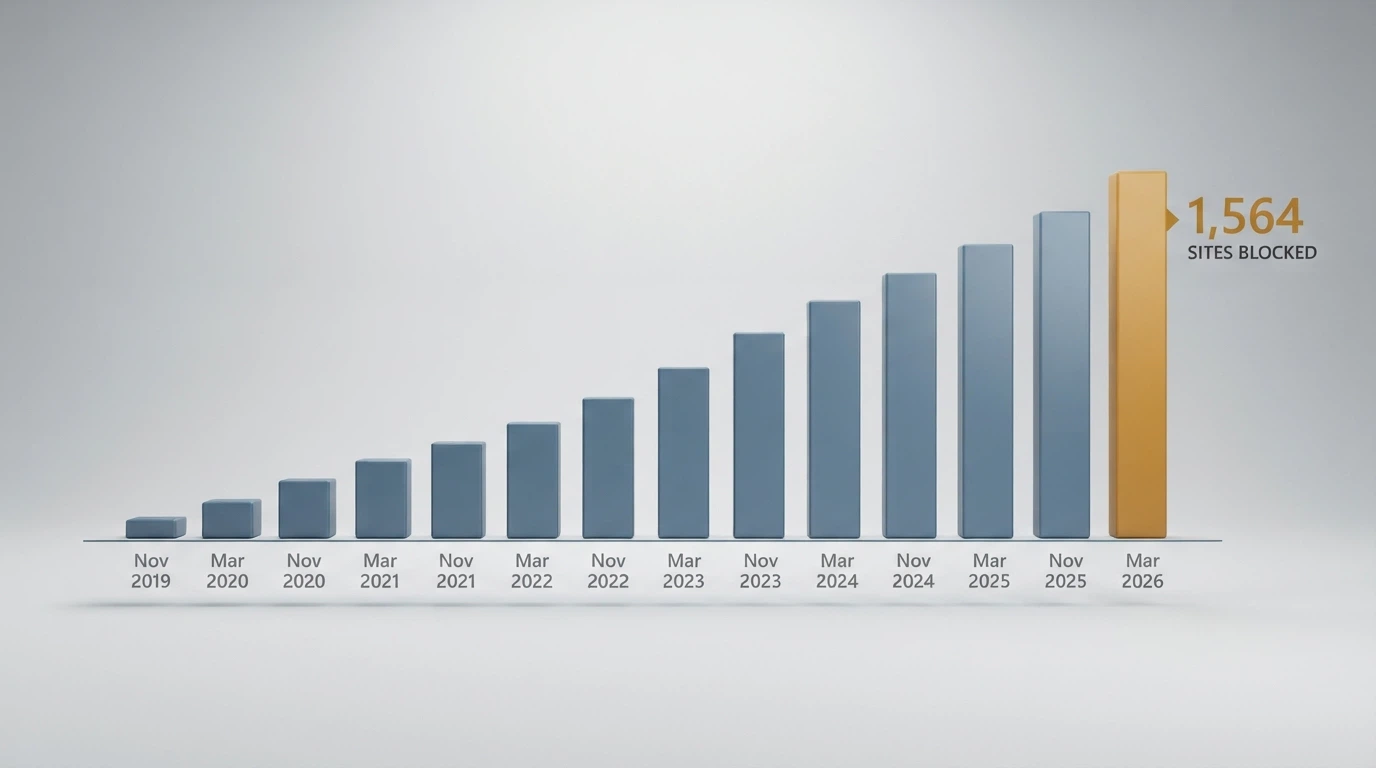
A blocked site is a real cost to a player with money on it. A casino whose domain is on the ACMA list stops being reachable through Australian ISPs; existing balances, pending withdrawals and bonus funds sit on a domain the player can no longer access without a VPN. The casino still operates, and the player’s account still exists, but the front door from Australia is closed. The blocking list grows. The 1,564 figure is a snapshot, not a ceiling.
BetStop and the Self-Exclusion Gap: Offshore Casinos Are Not Connected
BetStop — the National Self-Exclusion Register — launched on 21 August 2023. To the end of Q3 FY 2025–2026, 59,830 people had registered to self-exclude from all licensed online and phone wagering providers in Australia. As of 31 March 2026, 37,247 people had active exclusions. BetStop binds roughly 150 licensed wagering providers, and registration takes a single step.
The gap is total. An offshore casino is not licensed in Australia, is not connected to BetStop, and will keep accepting a self-excluded person’s money. The 59,830 people who registered to exclude themselves did so from the licensed market. The offshore market is not part of that exclusion, and the 150-provider coverage stops where the offshore sites begin. A player who self-excludes through BetStop and then plays at an offshore casino has self-excluded from a system the offshore operator is not part of.
When the Fast Cash-Out Does Not Come: Responsible Gambling and the Offshore Gap
Australia built a responsible-gambling infrastructure for the licensed market it has, not the offshore market it does not. The infrastructure is real: helplines staffed twenty-four hours a day, a national self-exclusion register, mandatory deposit limits and activity statements at licensed operators. The infrastructure is also bounded by the same line as everything else — it reaches the licensed market and stops at the offshore one.
The harm data gives the scale. As of March 2026, 15.1% of the Australian adult population — an estimated 3.32 million people — are experiencing some form of gambling harm. About 2.1% of Australian adults — roughly 430,000 people — experience problem gambling. The Australian Institute of Health and Welfare put high-risk gambling at 1.8% in 2022. These are licensed-market figures for the harm behaviour the data tracks; the offshore share is not separately measured.
Why Offshore Casinos Are Disconnected From Australia’s Help Infrastructure
The responsible-gambling tools Australian-licensed operators must offer — customer-set deposit limits, activity statements, take-a-break nudges, BetStop registration — are mandatory under the licence conditions. Offshore casinos are not licensed in Australia, are not bound by the conditions, and carry none of the tools. A player who chases a fast cash-out at an offshore casino has no deposit limit, no activity statement, no take-a-break prompt, and no self-exclusion reach.
This is the most concrete harm of the offshore route. A player who recognises a problem and self-excludes through BetStop has excluded themselves from the licensed market only. The offshore market remains open, the offshore casino will keep accepting deposits, and the same player’s balance will keep growing on a platform that has no obligation to notice. The licensed market’s safeguards are real, and they are bounded.
Where to Get Help in Australia: Helplines, Self-Exclusion and Harm Data
Help is available regardless of where a person played. The National Gambling Helpline is 1800 858 858 — free, confidential, staffed twenty-four hours a day, seven days a week, Australia-wide. Gambling Help Online, at gamblinghelponline.org.au, provides online chat with professional counsellors, also twenty-four-seven. BetStop, at betstop.gov.au, is the National Self-Exclusion Register, and a single registration excludes a person from roughly 150 licensed wagering providers at once. The 59,830 registrations and 37,247 active exclusions as of Q3 FY 2025–2026 are the scale of the register, and the register is open to any Australian.
The 15.1% adult harm prevalence figure and the 2.1% problem-gambling figure are the context for why these resources sit on a page about casino withdrawal speed. A reader is reading this page because they are considering playing. The resources are here because some of those readers will need them.
How We Selected and Ranked These Fast-Payout Casinos
The ten operators in the ranking are the result of two passes through the Australian-facing fast-payout casino market. The evaluation criteria were tested PayID and crypto withdrawal times, published weekly withdrawal caps, wagering multiples on welcome offers, no-deposit bonus terms where applicable, licence verification against the Curaçao Gaming Authority register and equivalent registers for other jurisdictions, and the verification depth of each data point against a non-affiliate source.
The sources used were Slotspeak.net for tested PayID and crypto median times, casino.guru for Safety Index and licence data, Payoutverdict.com for the two-stage withdrawal pipeline timing, watchMynumbers.com for minimums and wagering, the ACMA for enforcement and BetStop statistics, Gambling Insider for the speed-tier definitions, and the operators’ own terms pages for welcome-bonus structure. Where a figure could not be verified from a non-affiliate source in the current cycle, the table shows an em-dash rather than a guessed number. The gaps are the honest answer, and the ranking is built on the figures that cleared the verification step.
The structural limitation is the one this page returns to. Every operator listed is offshore, because no licensed Australian online casino exists. The ranking orders offshore operators by payout speed and the terms that affect whether the speed is meaningful. It is not a ranking of licensed options, because there are no licensed options to rank.
What Australian Players Should Actually Do About Fast Withdrawals in 2026
The speed numbers on this page are real. SkyCrown delivers a nine-minute PayID cash-out on the median. USDT-TRC20 settles in four. The product those numbers apply to is prohibited under the Interactive Gambling Act 2001, every operator carrying the speed is offshore, and the consumer protection that comes with an Australian-licensed market is not part of the deal.
The trade-off is the one an Australian player makes knowingly or not. Speed and game library depth at an offshore casino, on one side. No Australian consumer law, no ACMA complaint body that can recover a balance, no BetStop coverage, and a regulator that has blocked 1,564 sites and counting, on the other. A player who reads both sides and decides to play anyway is making a decision the page does not endorse and does not pretend to make for them. A player who reads both sides and decides the legal context is the deciding factor is making the same kind of decision, in the other direction.
The concrete steps that reduce risk if a player chooses to play at an offshore casino: verify the licence against the Curaçao Gaming Authority register (or the equivalent) before depositing; complete KYC verification before requesting a first withdrawal to avoid the multi-day hold; test a small withdrawal before committing a larger balance, because the test is the only way to confirm the speed the operator advertises; read the bonus terms page, not the lobby banner, before claiming an offer; and never deposit more than the player is willing to lose on a site with no Australian consumer recourse.
The responsible-gambling resources apply regardless of where the player chose to play. The National Gambling Helpline is 1800 858 858. Gambling Help Online is gamblinghelponline.org.au. BetStop is betstop.gov.au, and the 59,830 people who have already registered are the size of the system that is not reaching the offshore market. The fastest cash-out in the world is not faster than a phone call, and the help is free, confidential and open around the clock.
Frequently Asked Questions
Why is my casino withdrawal taking so long and how can I speed it up?
Casino withdrawals run through two queues — the casino’s approval desk and the payment rail — and the cash-out takes as long as the slower one. Operator-side processing runs twelve to eighteen hours on average, dominated by KYC document review on a first withdrawal; the payment rail adds twelve to thirty hours on a bank-side PayID batch. Completing verification before requesting a first cash-out is the single biggest player-controlled speed-up, because it removes the manual review from the operator side of the pipeline.
Do all fast payout casinos support PayID for withdrawals or only deposits?
Not all featured operators support PayID for withdrawals, and the support that does exist varies by bank. SkyCrown, RocketPlay and Royal Reels have tested PayID cash-outs; Stake and others are crypto-first with no confirmed PayID support for Australian players this run. ANZ tends to add roughly four hours on a first-receive PayID from a new payee; Commonwealth Bank and Westpac process incoming PayID cleanly. A player who has not received a PayID from a particular operator before should expect the first withdrawal to be slower than the median.
What is the minimum withdrawal amount at fast payout casinos in Australia?
The minimums in the featured set range from A$10 at FairGO (no fees) to A$20 at Bizzo and Neospin to A$30 at Rocket Casino. SkyCrown, RocketPlay, Royal Reels and WinSpirit did not confirm a specific minimum from a non-affiliate source this run. The A$10 floor at FairGO is the lowest in the set, and the A$30 floor at Rocket Casino is the highest. E-wallet minimums often sit below bank-transfer minimums at the same operator.
Do fast withdrawal casinos have no deposit bonuses?
Several do, and the terms decide whether the bonus is worth claiming. Royal Reels offers an A$10 no-deposit bonus after phone verification. WinSpirit offers ten free spins at 40x wagering. FairGO runs thirty free spins at 30x. Rocket Casino runs up to 125 free spins at 45x. Neospin runs 100 free spins at 40x. Maximum cashout from free-spin no-deposit winnings typically runs A$20 to A$100, and free-spin bonuses usually expire inside 48 to 72 hours. A no-deposit bonus is a marketing offer, not a withdrawal, and the wagering multiple decides whether any winnings survive the clear-down.
What happens if an offshore casino refuses to pay out my winnings in Australia?
An Australian player at an offshore casino has no Australian consumer law behind them, no ACMA complaint body that can recover a disputed balance, and no Australian court that will enforce a Curaçao Gaming Authority ruling at domestic-law cost. The available recourse is the licence register’s complaint mechanism — the Curaçao Gaming Authority for Curaçao-licensed operators — and the cost of pursuing the complaint in the licence jurisdiction. The site itself can be blocked by the ACMA at any time, with any balance on it. This is the most concrete gap between the licensed and offshore markets, and it is the gap a player accepts by playing at the offshore end of the comparison.