
Highest Payout Online Casino Australia in 2026: The Honest Numbers Behind the Hype
Every casino bonus page in Australia opens with a promise — a percentage figure, a payout rate, a number that looks like science. The same number then attaches itself to wildly different products, and a punter reading two of those pages back to back can be forgiven for thinking the answer is simple. It is not. “Highest payout” is a phrase the industry has loaded with so much ambiguity that a player who does not unpack it ends up comparing apples with machinery. This page is the unpacking.
The work below is a practical one. It walks through what return-to-player (RTP) actually means, which pokies genuinely return the most in 2026, how table games stack up against each other, and which offshore casinos serving Australian players publish the kind of payout data that can be checked. It also walks through what every other page in this niche fails to mention: that online casino games are prohibited to provide in Australia under the Interactive Gambling Act 2001, and that the offshore operator a player signs up with this week can be blocked at the DNS level next month. Both halves of that picture are part of the same decision.
Current as of 3 November 2026 against the Australian Communications and Media Authority’s public register and enforcement record.
Table of Contents
- Why “Highest Payout” Is a Number Most Players Misread
- The Pokies That Actually Return the Most in 2026 — Ranked by RTP
- Not All Casino Games Are Equal — What Really Returns the Most
- The Highest-Payout Online Casinos Available to Australians — 2026 Ranking
- Online Casinos Are Illegal to Provide in Australia — Here’s What That Means for You
- Staying in Control — How Australian Punters Can Limit the Damage
- How We Selected and Ranked Every Casino on This Page
- What Australian Players Should Actually Do in 2026
- Frequently Asked Questions
Why “Highest Payout” Is a Number Most Players Misread
The phrase “highest payout” sounds like a single figure attached to a casino. It is not. Every number a casino advertises is an average over a volume of play that no individual session reaches, and the RTP that applies to blackjack is not the RTP that applies to the pokies lobby. The phrase survives because a punter in a hurry treats it as comparable across products. The industry, which has every interest in keeping that haze, is happy to let them.
RTP and House Edge — Two Sides of the Same Coin
RTP is the percentage of all wagered money that a game is mathematically designed to return to players over a very large number of plays. The industry average for online pokies is approximately 95.7%, and across tested AU-facing operators, site-wide RTP averaged 95.8%, with table games averaging 98–99%+. House edge is the same number from the other side of the table — the slice the operator keeps. A pokie with a 95.7% RTP carries a 4.3% house edge; a blackjack table at 99.5% RTP carries a 0.5% edge.
The two figures always add to 100%, and the gap between them decides almost everything on a casino’s marketing page. A title at 99% RTP keeps A$1 of every A$100 wagered; a title at 95% keeps A$5. The difference looks small on a single spin. Over the thousands of spins that make up a serious session, the compound effect is what makes one game cheap to play and another one quietly expensive. The “payout” a casino advertises is a long-run average, not what any session will return — and the longer the session, the more the actual return converges on the published number, as described by Payout Verdict’s 2026 ranking.
The framing matters because a marketing claim like “97% payout” is a percentage of money returned, not a percentage of spins won, and it never inverts into a guarantee. A player who hits 50 spins on a 97% pokie and finishes A$20 down has not been cheated; the math simply has not had room to express itself. Volume is what activates the average. The two figures also do not cancel each other out across games — losing A$50 on a 95% pokie and winning A$30 on a 99% blackjack hand does not average out to a fair outcome, because the volumes are not equal. The arithmetic only works on the same quantity of money through the same game.
Why One Casino’s “Highest Payout” Claim Depends on What You Play
The site-wide RTP a casino publishes is an average across thousands of games. A punter who plays only pokies — the default at most offshore sites — sits in a band of approximately 95.2%, while a punter who plays table games sits in a band of 98–99%+. The site-wide figure that flatters a casino is therefore not the figure a single punter experiences. A player who logs in, opens one pokie, and spins for an hour is in the 95% band, regardless of what the homepage claims.
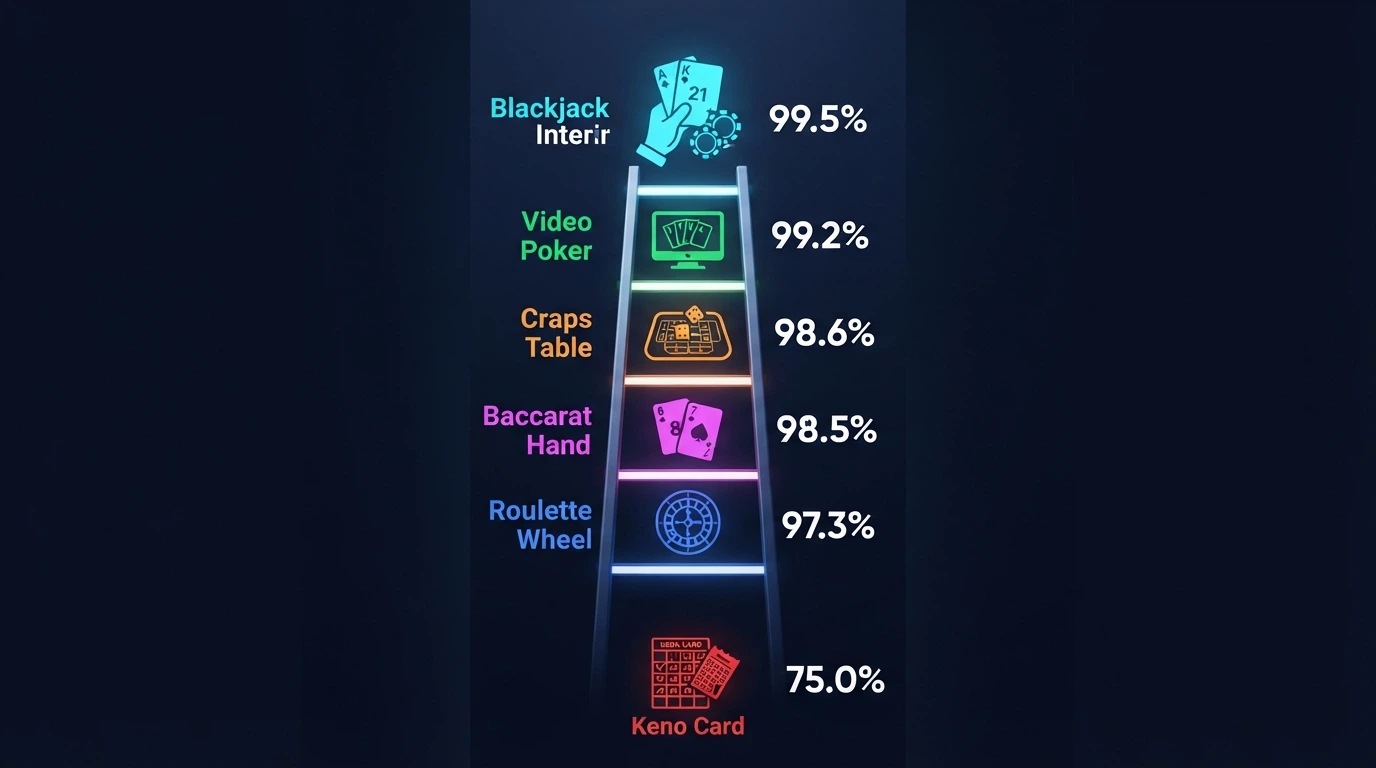
The contrast between game types is large enough to be a strategy in its own right. Classic blackjack with basic strategy returns 99.5%, the baccarat banker bet returns 98.94%, European roulette returns 97.30%, and keno sits around 75%. The spread between blackjack and keno is roughly 25 percentage points — a quarter of every dollar wagered, simply by switching game. Most players default to pokies because the lobby is colourful and the buttons are simple. The table-games section, where the math is friendlier, is one tab away on the same site.
That gap is also why an “average” payout figure is the worst possible number for a player to optimise against. A punter who wants the highest return should optimise for the game they will actually play, not for the figure a casino chose to highlight. The site-wide average exists to flatter the operator, and the player has to walk past it to find the relevant one.
Audited RTP Reports Vs Provider Claims — How to Tell the Difference
A published RTP figure on a casino’s site can come from one of two places. It can be the game provider’s stated RTP — a number the developer publishes and that the operator chooses to run. Or it can come from an independently audited payout report, where a third party has measured what the operator actually returned over a defined period. The difference between the two is the difference between a claim and a measurement.
The data on this is unflattering to the industry. Across AU-facing operators tested, only 8 of 23 published monthly audited RTP reports; the remaining 15 relied on provider-stated figures. That means a player picking an offshore casino at random is more likely to be reading the developer’s marketing than an auditor’s measurement. A 97% site-wide RTP claim built on provider-stated figures is not a guarantee of anything — it is a repetition of a number the operator could be running at a lower setting.
The operator-version trap is real and worth understanding in detail. NetEnt’s Starburst ships in four RTP versions — 92%, 94%, 96.1% and 99% — and the operator decides which one to run. The same is true of Big Bass Bonanza, where the default is 96.71% but some operators run reduced versions at 95.67% or 94.79%. The same title, at the same provider, can therefore pay a player nearly seven percentage points less at one casino than at another. A punter who picked a casino because its homepage said “97% payout” can be playing a 94% pokie without ever knowing. Reputable offshore sites usually run the standard version, but “usually” is not the same as “always,” and the audit report is the only way to verify which one is in use.
Independent testing bodies in this market include eCOGRA, iTech Labs and GLI. An audit published on the operator’s site, dated within the last six months, covering site-wide or game-category RTP, and signed by one of those names, is the strongest available signal. A page that says “RTP audited” without naming the body or showing the report is a marketing line, not a verification.
The Pokies That Actually Return the Most in 2026 — Ranked by RTP
The most practical test of a “highest payout” claim is the game-level data. Pokies carry published RTPs from their developers, and a player who sticks to the top of that leaderboard is doing the most basic thing the math allows. The ranking below starts at 99.00% and works downward, with the volatility and max-win figures that turn a percentage into a session you can actually plan for.
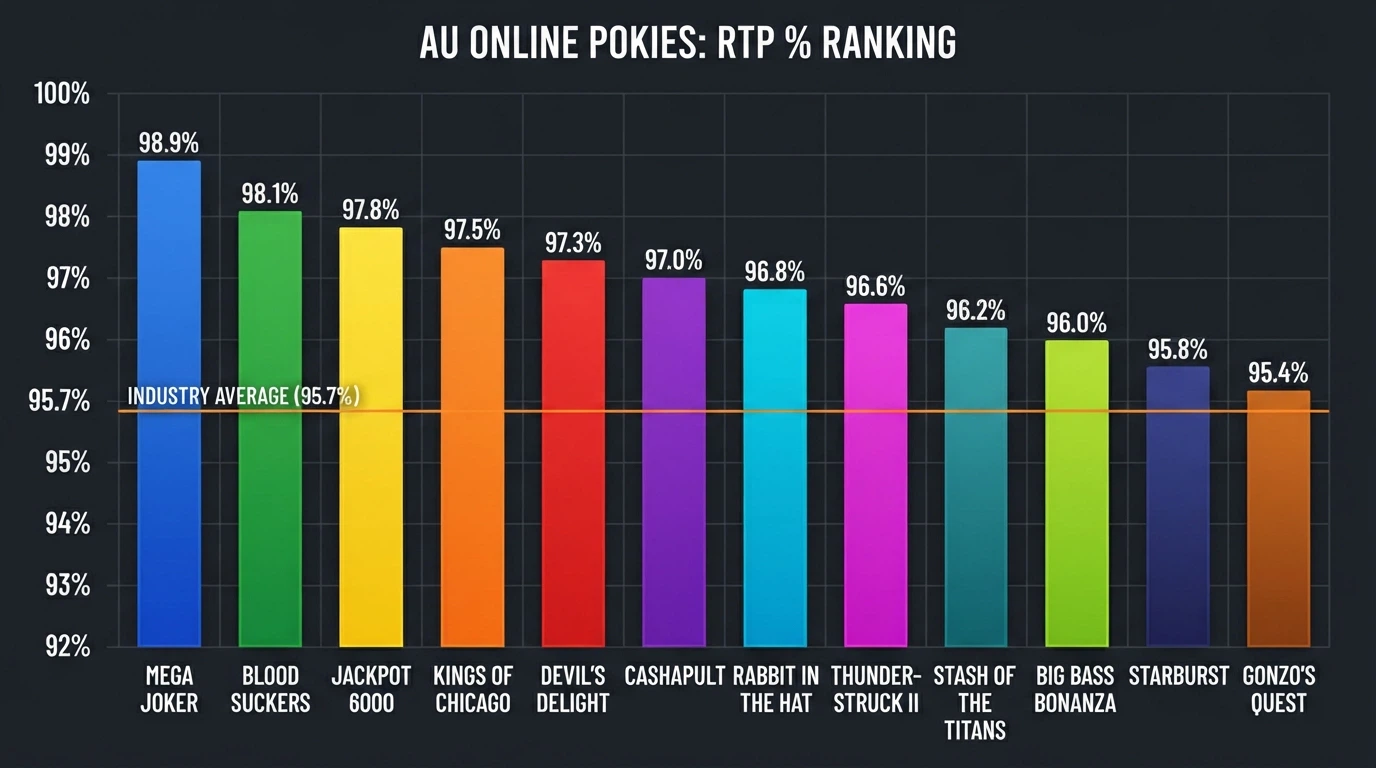
The Top-Ranked Pokies by RTP — From Mega Joker to Mental
| Pokie Title | RTP | Provider | Volatility | Max Win |
|---|---|---|---|---|
| Mega Joker (Supermeter mode) | 99.00% | NetEnt | Medium | 2,000x |
| Book of 99 | 99.00% | Relax Gaming | High | 12,075x |
| Jackpot 6000 (Supermeter mode) | 98.86% | NetEnt | Low–Medium | — |
| 1429 Uncharted Seas | 98.60% | Thunderkick | Low | — |
| Blood Suckers | 98.00% | NetEnt | Low | 35%+ hit frequency |
| Starmania | 97.87% | NextGen | Low | — |
| White Rabbit Megaways | 97.77% | Big Time Gaming | High | — |
| Big Red | 97.04% | Aristocrat Gaming | Medium | A$125,000 |
| Big Bass Bonanza (full version) | 96.71% | Pragmatic Play / Reel Kingdom | High | 2,100x |
| Razor Shark (top setting) | 96.70% | Push Gaming | Extremely high | 50,000x |
| Gates of Olympus (full version) | 96.50% | Pragmatic Play | Maximum | 5,000x |
| Sweet Bonanza (full version) | 96.48% | Pragmatic Play | High | 21,175x |
| Wanted Dead or a Wild | 96.38% | Hacksaw Gaming | Extreme | 12,500x |
| Mental | 96.08% | Nolimit City | Extreme | 66,666x |
Two titles sit at the very top with identical 99.00% RTPs, and the comparison between them is the most useful in the table. Mega Joker only reaches 99% in its Supermeter mode at maximum bet — base play returns somewhere between 76.9% and 85.1%. Book of 99 carries 99.00% without a mode switch, but it does so as a high-volatility title. Same headline number, very different ride. Mega Joker in base mode is one of the worst-paying pokies on the market; the 99% is a setting the player has to actively choose. Book of 99 charges 99% on every spin, but those spins come with long dry spells.
Blood Suckers and 1429 Uncharted Seas are the standout low-volatility picks at the top of the table. Both deliver 98%+ RTP and hit with enough frequency that a small bankroll survives long enough for the average to express itself. They are the practical choice for a player who wants the highest theoretical return without managing a balance through a feature-round drought. The 35%+ hit frequency on Blood Suckers is unusually high for a pokie of its RTP, and a session there feels qualitatively different from a session on Razor Shark, which is at 96.70% on the top setting but rated “extremely high” volatility. Same RTP band, opposite experience.
The floor at which a pokie still beats the industry average is roughly 97%. Games above 97% RTP have been measured returning measurably more over 10,000-spin test sessions. The titles in the table that sit between 96% and 97% — Big Bass Bonanza, Razor Shark, Gates of Olympus, Sweet Bonanza, Wanted Dead or a Wild, Mental — are below that line on RTP, which is why their inclusion depends on what the player values beyond the percentage. Razor Shark and Mental both offer headline max wins above 12,000x; that is the trade a player accepts by stepping below the 97% line.
Why the Same Pokie Can Pay a Different RTP at Different Casinos
The provider publishes one RTP per game. The operator decides which version to run. The player assumes the headline number and often has no way to verify the setting without an audit report or an in-game inspection.
Starburst is the clearest example. It ships at 92%, 94%, 96.1% and 99%, and which of those four is running is the operator’s choice. The same game can therefore offer a player a 99% return at one casino and a 92% return at another — a seven-point spread on a single title, with no visual change between the two lobbies. Reputable offshore sites usually run the standard 96.1% version, but the operative word is “usually.” Without an audit or a published RTP-per-game table, a player cannot confirm which setting is live.
Big Bass Bonanza tells the same story. The default is 96.71% on the full version, but operators can run it at 95.67% or 94.79%. A player who opens the game and looks at the in-game help or paytable is sometimes able to identify the version; the version number is usually displayed in small print at the bottom of the rules screen. That detail is the difference between playing a 96.71% pokie and a 94.79% pokie, and a serious player learns to check it before committing a bankroll. Across 23 AU-facing operators tested, only 8 published monthly audited RTP reports — meaning a majority of casinos give the player no audit-level proof of which version is being run. The check is therefore the player’s own responsibility, and the version of a game can change without notice when an operator updates its lobby configuration.
High RTP Vs High Volatility — Which One Actually Protects Your Bankroll
A 99% RTP pokie can drain a balance faster than a 96% low-volatility title. The percentage is only half the story, and the other half is variance.
Volatility describes how the returns arrive. A low-volatility pokie pays out smaller wins more often — Blood Suckers’ 35%+ hit frequency is the upper end of this — and a high-volatility pokie pays out less often but in larger bursts when it does. A 99% RTP pokie with extreme volatility is mathematically generous in the long run but capable of producing 100 dead spins in a row on the way there. A 96% low-volatility pokie is less generous in theory but produces a session the player can actually feel. The two experiences produce very different bankroll curves, and the choice between them is a choice about what kind of session the player wants to have.
Mega Joker and Book of 99 are the textbook comparison: identical 99.00% RTP, very different volatility, very different required bankroll. A player who wants to approach Mega Joker’s theoretical return has to bet maximum and play Supermeter mode — a high-stakes-per-spin path that demands a larger balance than the 99% figure might suggest. Book of 99 charges the same long-run rate on every spin but does so with the long dry spells that high volatility brings. Razor Shark sits at 96.70% RTP with extremely high volatility and a 50,000x max win — generous in theory, brutal in practice for a player whose bankroll is sized for a 96% low-volatility session. The optimal pairing depends on the bankroll: small balance, low volatility; large balance, high volatility. A player who cannot afford a 200-spin drought should not be playing a 96.70% extremely-high-volatility title, no matter how attractive the RTP looks next to a competitor’s 95% offering.
Trying High-RTP Pokies Risk-Free with Demo Mode
Every pokie in the ranking can be played in demo or fun-play mode at most offshore casinos before a single dollar is deposited. That test drive is worth more than the RTP figure it sits beside, because the figure says nothing about how a game feels in motion.
Demo mode at offshore casinos is usually accessed without registration, and the play-money balance is unlimited for the purpose of testing. What a player learns in a demo session is not the RTP — that number is the same in real play. It is the hit frequency, the bonus-round cadence, the gap between the longest dry spell and the average, and the way the game’s features are paced. A 35%+ hit frequency pokie like Blood Suckers is qualitatively different from a 96.70% extremely-high-volatility title like Razor Shark, and that difference is felt in the first 100 spins, not in the first 10,000. Demo mode is the only way to feel it before committing a real bankroll.
The gap between demo impressions and real-money variance is also worth taking seriously. Real-money play adds the weight of money — the same game feels different when each spin costs something — and a 200-spin drought that felt manageable in demo can produce a different reaction when there is a balance behind it. Demo is a tool for testing the game’s mechanics, not for predicting the emotional shape of a real session. The responsible use of it is to learn the features, then move to real play with a deposit the player is prepared to lose entirely.
Not All Casino Games Are Equal — What Really Returns the Most
The RTP gap between the best and worst casino games is roughly 25 percentage points. The games that sit at the top of that range are not the ones most players open first, and the games that sit at the bottom are not always obvious as expensive.
Blackjack, Video Poker and the Games Where Skill Shrinks the House Edge
Two casino games let a player turn a small house edge into something even smaller — and both demand more than just pressing a button.
Classic blackjack with basic strategy returns 99.5%, a 0.5% house edge. The figure is conditional on the player making the mathematically correct decision on every hand — hit, stand, double, split, surrender — which is what a basic-strategy chart is for. A player who guesses instead of following the chart moves the house edge higher, often well above 1%, and the 99.5% advantage disappears. The skill is not the entertainment; the discipline is. A player who does not want to learn the chart is better off at a different game, because the 99.5% return on blackjack assumes the chart is being followed.
Video poker, specifically a full-pay 9/6 Jacks or Better machine, returns 99.54% with optimal play. “Full-pay” and “9/6” describe the paytable — a full house pays 9x and a flush pays 6x, which is the highest-paying standard Jacks or Better variant. A video poker game with a lower paytable (8/5 or worse) returns several percentage points less, and “Jacks or Better” alone does not guarantee the 99.54% return. The player has to read the paytable before playing. Optimal play on Jacks or Better is closer to a chess problem than a pokie spin — every hand has a single best decision, and the math rewards getting it right. A casual player pressing buttons will not reach 99.54%; the 0.46% house edge is for the player who has memorised the strategy chart and applies it on every hand.
These two games appear less often in the “highest payout” conversation because the marketing material is harder. A 99.5% blackjack game does not photograph as well as a 99% pokie, and a 9/6 Jacks or Better paytable does not fit a casino’s homepage banner. They are, by a measurable margin, the highest-return games in any casino lobby, and the gap between them and the next tier is larger than the gap between most of the pokie tiers below.
Baccarat, Roulette and Craps — the Table-Game RTP Ladder
Three table games, three very different returns, and one variant choice that nearly doubles the house edge.
Baccarat is a simple game with three bets, and the banker bet is the one to make. It returns 98.94% after the 5% commission on winning banker bets. The player bet is slightly worse at 98.76%, and the tie bet sits well below both at roughly 85% — the worst standard bet on a baccarat table. A punter who plays baccarat at all should be on the banker bet, every hand, and should not touch the tie bet regardless of the table’s history. The commission is what makes the banker bet the cheaper of the two playable options, and the tie bet exists for players who do not know better.
Craps, played on the pass line with full 3x/4x/5x odds, returns 99.59% — the highest single-bet return in any standard casino game. The catch is that craps is the most intimidating table game on most floors: a layout with more betting options than any other game, and a vocabulary (“snake eyes,” “hard way,” “horn bet”) that puts off players who would otherwise play it. The pass line alone returns 98.59%, and the “free odds” bet behind it is the only bet in the casino with zero house edge. The combined wager is what gets to 99.59%, and it requires understanding the difference between the pass line and the dozens of proposition bets on the same table. A player who treats craps as a guessing game ends up on the proposition bets, which carry house edges above 10%.
Roulette is the game where one variant choice matters more than any other decision at the table. European roulette, with a single zero, returns 97.30%. American roulette, with both a single zero and a double zero, returns 94.74%. The difference is a single extra pocket — 38 instead of 37 — and the house edge jumps from 2.70% to 5.26%. A player who sits at an American roulette table when a European one is available is paying the casino nearly twice the cost per spin for no reason. French roulette with the la partage rule cuts the even-money house edge to 1.35%, which is the closest a roulette variant gets to a “fair” game. A punter who plays roulette should specifically seek out French or European tables and avoid American ones entirely.
The Highest-Payout Online Casinos Available to Australians — 2026 Ranking
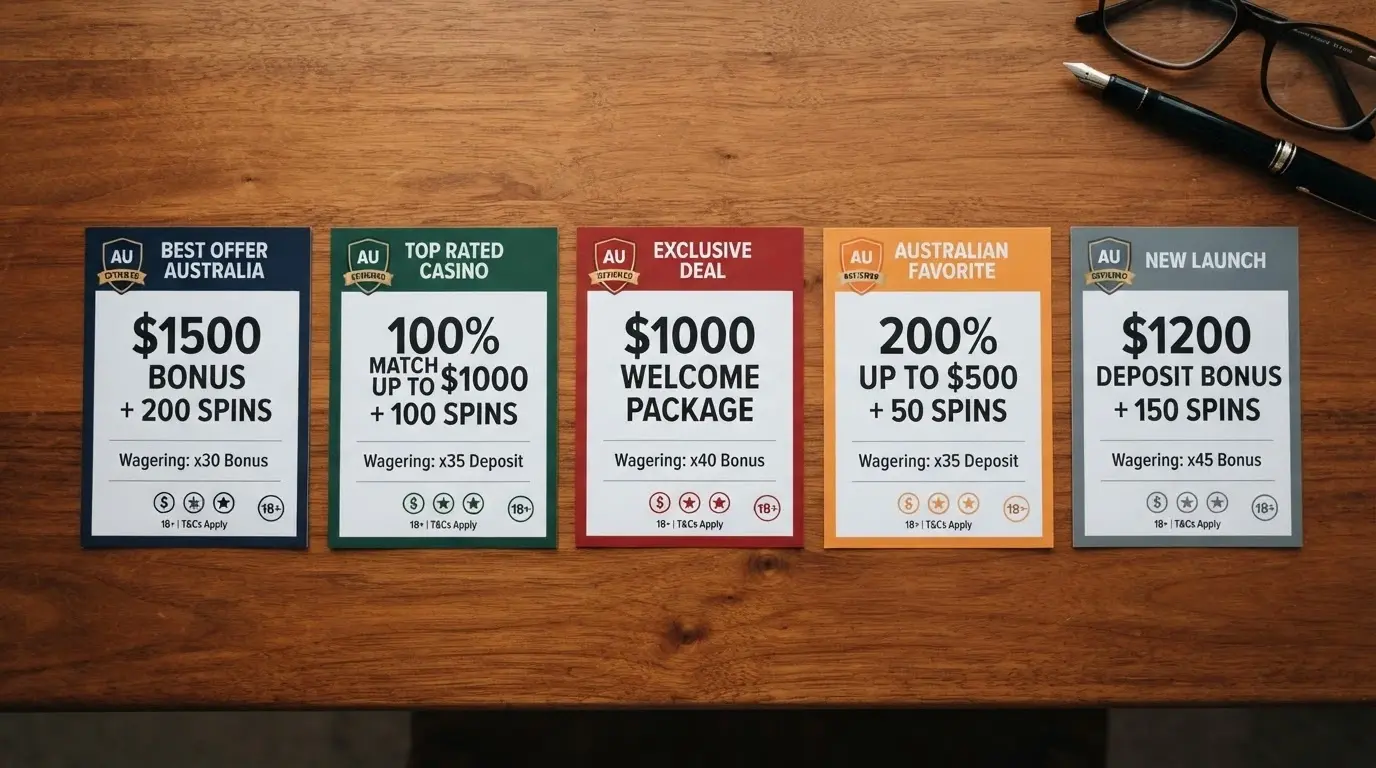
The table below ranks the offshore casinos accessible to Australian players in 2026 by the payout data they publish, the bonus terms they offer, and the game libraries they support. Every operator is offshore, and none holds an Australian licence because no such licence exists under the Interactive Gambling Act 2001. The IGA prohibits the provision of online casino games, online pokies and in-play sports betting to people in Australia; the players are not prosecuted, but they have no Australian consumer protection, no ACMA dispute resolution and no BetStop coverage at any of these sites.
| Casino | Licence / Jurisdiction | Welcome Bonus | Wagering Requirement |
|---|---|---|---|
| Rocket Play | Curacao (date not confirmed) | 100% up to A$1,000 + 100 FS | 30x–40x |
| Skycrown | Curacao (date not confirmed) | Up to A$8,000 + 400 FS (4 deposits) | 40x bonus / 30x FS winnings |
| Royal Reels | Not confirmed | A$2,500 + 50 FS (3 deposits) | 35x bonus only |
| Winshark | Not confirmed | A$4,150 + 300 FS | — |
| Fair Go Casino | Not confirmed | 300% up to A$3,000 + 50 FS (Cash Bandits 2) | 30x |
| Rainbet | Anjouan (ALSI-152406029-FI2) | 250% up to $2,100 + 60 FS | 40x |
| Stake | Curacao (date not confirmed) | No structured welcome bonus (rakeback/VIP) | — |
| Bizzo Casino | Curacao (date not confirmed) | — | — |
| Hell Spin | Not confirmed | Up to A$5,200 + 150 FS | — |
| Scream Casino | Not confirmed | — | — |
The table is not a recommendation to play at any of these operators. It is a record of what they offer and what they ask in return. Several gaps in the wagering column are deliberate: where data could not be confirmed, the cell carries the article-language no-data marker rather than an invented figure. A player considering any of these operators should check the operator’s own terms page before depositing, because a bonus term that changes between the time this page was written and the time a player signs up is the operator’s version, not this one.
How We Compared Payout Rates Across Every Operator
The ranking is built on published RTP claims where they exist, on the breadth of the game library, on the provider roster and on the bonus terms that change the real cost of playing. No single number was used in isolation, because no single number on a casino’s homepage tells the truth on its own.
A small set of operators publishes a site-wide RTP claim. Winshark claims 97.2% across 10,000+ games, Hell Spin claims 96.9% across 2,900+ pokies, Bruce Bet claims 97.60% across 5,000+ games, and Fastpay claims 98% across 4,000+ games. These figures should be read with the caveat from the section on audited RTP reports: only 8 of 23 tested AU-facing operators publish independent monthly audit reports. The other 15 rely on provider-stated figures, and a claim of 97.2% on an unaudited site is a marketing number, not a measured one.
Where no site-wide RTP is published, the ranking falls back on three supplementary signals. Game-count breadth is the first — a 10,000-game lobby has more room for high-RTP titles than a 1,000-game lobby, all else equal. The provider roster is the second — a 90+ provider casino offers games from NetEnt, Pragmatic Play, Push Gaming and the rest of the high-RTP developer set, which a casino running three providers does not. Bonus fairness is the third — a 35x wagering rate on the bonus only is materially cheaper to clear than a 40x rate on bonus plus deposit. The ranking blends these signals in a qualitative way rather than weighting them as a score; the table above shows what was found, not a calculated score.
The table reflects published operator data and third-party testing where available. The legal status disclosure is a baseline that applies to every row, and the offshore jurisdiction column is the closest the table gets to a regulatory indicator.
Skycrown — Up to A$8,000 in Bonus Funds with the Broadest Provider Roster
Skycrown’s welcome package is the largest in the featured set: up to A$8,000 plus 400 free spins spread across four deposits, with a minimum deposit of A$20 per tier. The headline number is real but the structure matters — the A$8,000 is reached only by completing all four deposits, and the free spins arrive in tranches.
Wagering is split: 40x on the bonus funds, 30x on free spin winnings. The split is more player-friendly than a flat rate, because free-spin winnings clear faster than the deposit match. The A$5 maximum bet per spin during wagering limits the rate at which a player can grind through the requirement, and a 14-day validity per tier means the player has roughly two weeks to clear each deposit’s bonus before it expires. The free spins carry a maximum win cap of 10x the bonus value — a ceiling on what a free-spin feature can pay out regardless of how it lands. That cap is the kind of term that quietly defines an offer’s real value.
The provider roster of 90+ studios is the broadest in the set, and it is Skycrown’s strongest structural argument: a 90+ provider casino offers more high-RTP titles than any narrower lobby. A player who cares about being able to play Mega Joker, Blood Suckers, Book of 99 and 1429 Uncharted Seas on the same site is well served here. The bonus is large; the terms are standard for the market; the library is the differentiator.
Rocket Play — A$1,000 Matched with Free Spins and a No-Deposit Option
Rocket Play is the only featured operator carrying both a deposit-match welcome package and a no-deposit bonus, and the 5-day bonus validity is one of the shortest windows in the set.
The first-deposit offer is 100% up to A$1,000 plus 100 free spins delivered 25 per day over four days, with a 30x–40x wagering band and a maximum bet of A$7.50 during wagering. The 5-day validity means a player who takes the offer has just over four full days to clear the requirement, which is tighter than the 14-day window Skycrown offers per tier. The wagering maths on a A$1,000 bonus at 40x means A$40,000 of qualifying turnover before withdrawal — a meaningful volume of play to fit into five days, and a player who does not move quickly loses the bonus. A no-deposit bonus is also available, with a maximum cashout of A$75. The cap is the offer’s defining feature: a player can win something on the no-deposit route, but never more than A$75 from it.
The combination is unusual. Most offshore casinos run either a deposit match or a no-deposit route, not both. A player who wants to test a casino without committing money can take the A$75-cap no-deposit offer; a player who is ready to deposit gets a matched bonus with tight terms. The 5-day window is the trade, and a player who cannot commit serious session time in that period should not take the offer at the maximum value.
To give the cost of clearing that bonus a concrete shape: A$1,000 of bonus funds at the 40x wagering rate means A$40,000 of qualifying turnover. Applied against the 95.8% site-wide RTP that tested AU-facing operators averaged, the expected house take across that turnover is A$40,000 × (1 − 0.958) = A$1,680. That figure is a statistical estimate — an average over many spins under the stated assumption that only the bonus amount is wagered — not a guaranteed outcome for any single player. The bonus is worth A$1,000 in matched funds; it is expected to cost roughly A$1,680 to clear at that RTP. The maths has the player net negative before any session volatility is considered, and the 5-day window is the constraint that makes the cost concrete rather than theoretical.
Royal Reels — Three-Deposit Bonus with a No-Deposit Free Chip
Royal Reels offers A$2,500 across three deposits plus a rare no-deposit free chip, and a 35x wagering rate on the bonus only that is among the lower multiples in the set.
The welcome structure is tiered: 100% up to A$500 on the first deposit, 75% up to A$750 on the second, and 100% up to A$1,250 on the third, plus 50 free spins at A$0.20 per spin. The 35x wagering rate is on the bonus amount only — the player’s own deposit is not subject to wagering, which means A$500 of personal money plus the matched bonus is what the player can withdraw at any time, regardless of where they are in the bonus. That structure is materially more player-friendly than a 40x bonus-plus-deposit rate.
A no-deposit free chip of A$10 is available with 30x wagering, and a separate 100% up to A$500 plus 50 free spins offer carries a A$30 minimum deposit and 30x wagering on the bonus amount. The A$10 free chip is one of the smaller no-deposit offers in the set, but the 30x wagering is light enough that converting it to a withdrawal is achievable on a short session. The A$5 per-spin cap during wagering is the standard ceiling for this market.
Royal Reels is the operator to look at for a player who values lower wagering rates over larger headline bonuses. A 35x bonus-only rate is a real difference compared to a 40x bonus-plus-deposit rate, and the A$10 free chip gives the casino a risk-free test before any deposit. Specifics regarding the game library and provider roster were not surfaced for this operator.
Winshark — A$4,150 Welcome Package and a Claimed 97.2% Site-Wide RTP
Winshark’s headline figures are the largest in the set — A$4,150 plus 300 free spins — paired with a claimed 97.2% site-wide RTP across 10,000+ games and 90+ providers. The combination of a large bonus and a published site-wide RTP is unusual among the featured operators, but the absence of confirmed wagering terms, validity windows and cashout caps is the corresponding weakness.
The 97.2% site-wide RTP claim is one of only two published site-wide figures in the set (the other being Fastpay at 98%), and the 10,000+ game library is the largest. Both figures should be read alongside the audit caveat: a 97.2% claim without a published monthly audit is a marketing number, and only 8 of 23 AU-facing operators publish those audits. Winshark’s wagering multiplier, bonus validity and maximum cashout from the welcome offer remain unconfirmed; evaluating players should check the operator’s T&C page directly.
The bonus size and the library size both argue for Winshark on a quantitative basis, but the data gaps argue for caution. A player who is comfortable digging into a casino’s terms page before depositing can pursue the offer with eyes open. A player who wants every number in front of them at the point of comparison is better served by an operator whose bonus terms are fully published.
Hell Spin — 96.9% Slot RTP Across 2,900+ Pokies
Hell Spin claims a 96.9% slot-specific RTP across 2,900+ pokies, paired with an A$5,200 plus 150 free spins welcome offer. The slot-specific figure is the second published slot-RTP claim in the set, and it measures against the 95.7% industry average for online pokies. A 1.2-percentage-point lead over the industry average is meaningful over the volumes a serious slot session produces.
The wagering multiplier, bonus validity and maximum cashout from the welcome offer are not confirmed in the data this review worked from. The 2,900+ pokie library is smaller than Winshark’s 10,000+ but is still broad enough to cover the high-RTP titles most players look for. The lack of confirmed bonus terms is the same caveat as Winshark’s: a player who is comparing operators on bonus cost has to read Hell Spin’s own T&C page to fill the gap.
For a player whose priority is the slot-specific RTP figure rather than the headline bonus size, Hell Spin is one of the two operators in the set publishing a number for it. The 96.9% claim is the strongest published slot-RTP figure among the featured operators, and the absence of a monthly audit report is the standard caveat that attaches to any such claim in this market.
Fair Go Casino — 300% Match and RTG-Powered with No Maximum Cashout
Fair Go is the only RTG-exclusive operator in the set, and the 300% welcome match is the highest percentage multiplier among the featured casinos. The package is 300% up to A$3,000 plus 50 free spins on Cash Bandits 2, with a 30x wagering rate, a A$20 minimum deposit and no stated maximum cashout.
The 300% match means a A$1,000 deposit is converted to A$4,000 in playable balance — a fourfold increase that is the largest in the set on a percentage basis. The 30x wagering is a competitive rate for the market. The absence of a maximum cashout on the welcome bonus is unusual — most operators cap winnings from a bonus, and Fair Go’s structure lets a player withdraw the full amount of any winning session.
The RTG exclusivity is the trade. A RealTime Gaming-only casino offers a narrower game library than a 90+ provider site, and the high-RTP titles from NetEnt and Pragmatic Play are not part of the catalogue. The 300% match and the no-cashout-cap structure are the offsets, and a player who values a percentage boost over a deep library has a clear case for Fair Go.
Stake — Crypto-Focused Casino with a Rakeback Model and No Structured Welcome Bonus
Stake is the only operator in the set without a traditional welcome package. The model is a rakeback and VIP structure, where a share of the house edge is returned to the player over time, rather than a front-loaded matched-deposit offer. The crypto-only deposit and withdrawal infrastructure sets it apart from every other featured casino, and a player without a crypto wallet cannot deposit at all.
The absence of a structured welcome bonus is the defining feature when comparing against the rest of the set. A player who weighs operators on the size of their first-deposit match will read Stake’s lack of one as a missing feature. A player who weighs operators on the long-term return on volume played will read the rakeback model as a fundamentally different proposition — a percentage of every bet returned, regardless of whether that bet is a winner. The two models are not directly comparable on a single number, and a player choosing between them is choosing between an upfront bonus and a structural return.
The licence, provider count and game library for Stake were not confirmed in the data this review worked from. The crypto-only deposit model is the clearest practical fact: a player who is set up for it is in a different category of operation than a player using a debit card at a fiat casino. The comparison to make against a fiat operator is on the rakeback terms themselves, not on a bonus headline.
Rainbet — Anjouan-Licensed Operator That Explicitly Restricts Australian Players
Rainbet is the only operator in the set whose own terms and conditions prohibit Australian players from registering. The 250% welcome package — up to $2,100 plus 60 free spins across three deposits, with 40x wagering — sits behind a jurisdiction gate the casino enforces.
The Anjouan licence (ALSI-152406029-FI2) and the RBGAMING N.V. registration (Company Reg. 16077) are confirmed in the operator’s own data. The T&C’s Australian restriction is also explicit: players from Australia are not accepted, and VPN or proxy use to circumvent the restriction can result in account closure and fund confiscation. A player who accesses Rainbet from an Australian IP through a VPN is not in a grey area — they are in violation of the casino’s own terms, and the casino’s stated response is to close the account and withhold the balance. The 47+ provider roster and 7,000+ game count are broad by industry standards, but they are not accessible to a player who follows the operator’s rules.
Rainbet is included in this ranking for completeness rather than as a viable option for the page’s intended reader. A player who arrives at the site from an Australian IP will be declined. A player who arrives through a VPN is accepting the operator’s stated right to close the account and confiscate the funds. The package itself is competitive on a percentage basis, and the Wager Lock / No Wager Lock structure is an unusual feature, but neither matters to an Australian player who cannot legitimately open an account. The Ad Standards breach finding from June 2025 — for influencer advertising targeting young male audiences, allegedly paying upwards of $50,000 for three Instagram stories — is the kind of context a player should be aware of when evaluating any operator from this market, and Rainbet is the only one in the set with that finding on the public record.
Bizzo Casino — ACMA-Formally-Warned Operator with an Active Enforcement Record
Bizzo Casino is the only operator in the featured set with a named ACMA enforcement action on the public record. Its operator, Consolutetish SRL, received a formal ACMA warning during the July to September 2025 enforcement quarter for providing prohibited interactive gambling services to Australian customers.
The formal warning is a specific step in the ACMA’s enforcement toolkit, distinct from a blocking request or a civil penalty proceeding. The ACMA’s quarterly action for that period included 29 investigations into 30 sites, finding 44 breaches of the Interactive Gambling Act and issuing 20 formal warnings — Consolutetish SRL was among the recipients for both National Casino and Bizzo Casino. A formal warning is not a fine and not a block; it is a public regulatory step that places the operator on the record as a recipient of regulator correspondence. Operators do not always treat a formal warning as a reason to stop serving Australian customers, and the warning itself does not prevent a player from accessing the site.
Bizzo is included in this ranking for the same reason any other operator is included — it is an offshore casino that serves Australian players and appears in the search results for this topic. The warning is the distinguishing fact. A player who is choosing between offshore operators has a reason to weigh the ACMA’s public record, and Bizzo is the only entry in the set with that record attached. The welcome bonus terms, provider roster and game specifics were not confirmed in the data this review worked from.
Scream Casino — Offshore Operator with Minimal Surfaced Data This Review
Scream Casino is the operator in the set for which the least data was surfaced. The welcome bonus, free spins, wagering requirements, provider count, cashout cap and licence details were not confirmed in the research for this page. The only confirmed fact is that the casino is offshore and not licensed in Australia, which is the same baseline fact that applies to every other operator on this page.
The practical implication is that a player cannot compare Scream to the other nine operators on the same criteria. There is no bonus to evaluate, no wagering rate to clear, no library size to weigh. The operator’s own website is the only source for current terms, and a player considering it should treat it as a site that requires direct verification before any deposit. A player who prefers the operators where the terms are published and confirmed — even with their gaps — has clearer comparison points in the rest of the set.
Including Scream in the ranking is a matter of completeness. A page that ranks nine offshore casinos serving Australian players and omits a tenth that appears in the topic’s search results is a page that has chosen its own sample, and a reader cannot tell whether the omission was editorial or accidental. Scream is here so the reader knows it exists, what could not be confirmed about it, and what they would need to verify themselves before any deposit.
Online Casinos Are Illegal to Provide in Australia — Here’s What That Means for You
Every casino on this page operates outside Australian law. The framing is not a “grey area” or a “loophole” — it is a direct prohibition with named statute, named regulator, and a public enforcement record. The player who uses one of these casinos gives up every protection Australian regulation provides. The rest of this section walks through what that means in detail, because a comparison whose reader cannot tell whether the option is legal is a comparison they cannot use.

What the Interactive Gambling Act Actually Says
The Interactive Gambling Act 2001 (IGA) makes it an offence to provide online casino games, online pokies and in-play sports betting to people in Australia. The service is prohibited to provide, not to use — the IGA targets the operator, not the player, and no Australian has been prosecuted for placing a bet at an offshore casino. The distinction matters: the law does not put the punter in the dock, but it does put the operator outside the protection of Australian regulation.
The IGA does not prohibit wagering on races or sport placed before the event begins. That product is licensed through state and territory regulators, with the Northern Territory Racing and Wagering Commission (NTRWC) and Licensing NT functioning as the de facto national licensor for online wagering. The licensed bookmakers — Sportsbet, bet365, Ladbrokes and roughly 50 others — hold NT licences running for terms of up to 20 years. Lotteries and keno are also licensed, through state regimes. What is not licensed anywhere in Australia is online casino games and online pokies, because no such licence category exists. The IGA closes the door at the federal level, and the state and territory regimes do not open a window for it. A page promising “the best licensed online casinos in Australia” describes a product the statute has removed from the market.
The minimum age for all commercial gambling in Australia is 18. The minimum age is not a contested figure, and the offshore casinos that serve Australian players are nominally bound by it through their own terms, though enforcement is the operator’s responsibility and is not subject to Australian verification.
ACMA Enforcement — Blocking, Warnings and Why Offshore Sites Keep Operating
The ACMA’s enforcement toolkit is built for an industry that lives in jurisdictions it cannot reach. The regulator cannot send inspectors to Curaçao or Anjouan, and it cannot compel an offshore operator to appear before an Australian court. What it can do is block the website at the DNS level in Australia, issue formal warnings, pursue civil penalty proceedings against local representatives and direct ISPs to refuse the traffic.
The blocking regime is the ACMA’s most-used tool. Since its first blocking request in November 2019, the ACMA has had 1,564 illegal gambling and affiliate websites blocked by Australian ISPs, as of March 2026. More than 225 illegal gambling services have withdrawn from the Australian market since enforcement was strengthened in 2017. A blocked site is unreachable through standard Australian internet connections, and a player who knows the site exists but cannot reach it has effectively lost access. The block is reversible when the operator’s circumstances change, but it is also repeatable, and the same operator can be blocked multiple times under different domain names.
The ACMA’s own statement on the limits of its enforcement is worth quoting directly. As the regulator’s spokesperson put it in 2025: “Illegal offshore gambling services can pose significant risks to Australians. Many operate from overseas and outside Australian jurisdiction, which means some enforcement options available against Australian-based businesses — such as formal warnings, infringement notices or court action — may not be available against offshore entities. The most effective tool that we use is to request internet service providers to block illegal gambling websites.” As the regulator’s spokesperson stated in 2025, these offshore services pose significant risks because they operate outside Australian jurisdiction, making enforcement options like formal warnings or court action unavailable. The quote is not a complaint; it is a description of how the regulator sees its own job. Blocking is the lever that works; the levers that work on Australian-domiciled businesses do not.
The July to September 2025 enforcement quarter is the most recent published data point. The ACMA completed 29 investigations into 30 gambling sites, found 44 breaches of the Interactive Gambling Act and issued 20 formal warnings — including to Consolutetish SRL for National Casino and Bizzo Casino. A formal warning is the regulator’s first step before civil penalty proceedings, and it is the public record a player can use to identify operators the ACMA has actively pursued. The data also notes the ACMA’s own headline: “Since the ACMA made its first blocking request in November 2019, more than 1,560 illegal gambling and affiliate websites have been blocked.” This cumulative total highlights the scope of the regulator’s ongoing enforcement efforts. The two figures — 1,560+ sites blocked and 225+ services withdrawn — describe a regulator that has been working this file for six years and has removed more than a thousand services from Australian reach.
What Australian Players Give Up When They Use an Offshore Casino
An Australian who bets with a licensed bookmaker — a Sportsbet, a bet365, a Ladbrokes — has access to a defined set of protections. An Australian who bets with an offshore casino gives every one of them up.
The first is dispute resolution. A licensed Australian wagering operator is subject to state and territory complaint processes, with external adjudication available through the relevant regulator. An offshore casino is not. If the operator refuses a withdrawal, voids a winning bet or closes an account without explanation, the Australian player has no regulator to contact. The operator’s own terms govern, and the operator’s own dispute process is the only process.
The second is BetStop coverage. BetStop — the National Self-Exclusion Register — launched on 21 August 2023 and covers all approximately 150 licensed online and phone wagering providers. One registration excludes a person from every Australian-licensed wagering service. As of 31 March 2026, 59,830 people had registered, with 37,247 active exclusions. An offshore casino is not connected to BetStop. A person who has self-excluded through BetStop and then deposits at an offshore casino has not breached the BetStop terms — there is no BetStop coverage of an offshore site to breach. They have, however, defeated the only mechanism that was designed to stop them. BetStop is a one-jurisdiction tool, and the offshore operators that take Australian customers exist outside that jurisdiction.
The third is consumer law. The Australian Consumer Law applies to goods and services supplied in Australia or to Australian consumers by Australian-domiciled businesses. An offshore casino, incorporated in Curaçao or Anjouan and serving Australian players from servers in other jurisdictions, is outside the reach of the ACCC and the Australian courts in any practical sense. A player who is defrauded by an Australian-licensed operator can lodge a complaint; a player who is defrauded by an offshore operator has the operator’s own terms and the operator’s own jurisdiction.
The fourth is the payment layer. Credit cards, credit-related products and digital currency (crypto) are banned as payment for online wagering in Australia, effective 11 June 2024. The penalty for a licensed operator accepting either is up to A$247,500. An offshore casino that asks for a credit card deposit or a crypto transfer is asking for a payment method the Australian rules have ruled out, and that is itself a tell. The licensed bookmakers will not accept those methods; the offshore casinos will. The choice of payment method a casino accepts is part of the picture of which rules it is following.
The fifth is access. The ACMA can block the offshore casino at any time. The blocking happens at the DNS level — the site simply does not resolve in Australia — and a player with a balance on the site at the moment of the block has no path to a withdrawal. The balance is held by an operator outside Australian jurisdiction, on a domain the player can no longer reach. The 1,564 blocked sites include both the operators themselves and their affiliate marketing pages. The risk is not theoretical; it is a feature of how the Australian enforcement regime works.
A related practical concern is the withdrawal limit structure on offshore sites. Across 23 tested AU-facing operators, 14 imposed weekly withdrawal limits between A$5,000 and A$15,000. A high-volume player who has had a winning session can find themselves queued for weeks of withdrawal before the full amount is paid out, with the operator’s own processing schedule and the credit-card or crypto rails the only available channels. The licensed Australian bookmakers do not operate the same withdrawal limits for the same reason: they have a regulator that has reviewed and approved the limits.
The 2026 Gambling Reforms — What Changes on 1 January 2027
The Interactive Gambling Amendment (Gambling Reform) Bill 2026 passed Parliament on 19 August 2026, and its measures commence on 1 January 2027. The reforms are the largest tightening of Australian gambling regulation in two decades, and they touch advertising, inducements, payments and the role of athletes and influencers. None of it licenses online casinos, because the underlying prohibition remains. What the reforms do is tighten the rules around the wagering that is licensed and increase the pressure on the wagering that is not.
On advertising, the bill caps wagering advertising on broadcast television at no more than three ads per hour between 6:00 am and 8:30 pm, introduces a live-sport blackout from 15 minutes before until 5 minutes after a live sporting event, bars wagering advertising inside sports venues and on player and official uniforms, and bars athletes, celebrities and influencers from promoting wagering products. Radio wagering ads are barred during school drop-off and pick-up times (8 am to 9 am and 3 pm to 4 pm), and broadcasting of sporting odds is banned outright. The aim is to reduce the volume and visibility of wagering messaging, particularly during sports broadcasts and around children.
On inducements, direct marketing of inducements is prohibited for 14 days after a customer signs up, for three months after a person deregisters from BetStop, and indefinitely for customers identified as at risk of gambling-related harm. A licensed operator that sends a “come back, here’s a bonus” email to a recently signed-up customer or to a BetStop deregister is in breach of the new rules. The 14-day post-sign-up window is the operator’s chance to convert a new customer before inducement marketing is restricted, and the indefinite ban for at-risk customers is the recognition that some marketing has no place at all.
On payments, banks and payment providers gain express authority to block transactions to illegal gambling operators from 1 January 2027. An Australian bank can refuse to process a transfer to a known offshore casino on a customer’s behalf, and the bank has the statute behind it. The current state of affairs — a customer whose bank declines a transfer to a particular merchant on a case-by-case basis — becomes a regulated power, and the offshore operators that rely on Australian-issued cards or bank rails will see those rails close. Crypto remains an option, but the credit/crypto ban for licensed wagering already signals the direction, and the new payment-blocking authority closes a parallel gap for the illegal operators.
What does not change is the underlying prohibition. Online casino games and online pokies remain prohibited to provide to people in Australia after 1 January 2027, exactly as they were before. The reforms tighten what is licensed and tighten the pressure on what is not, but they do not legalise a market the IGA has closed. A reader of this page in 2026 is reading it under the rules that have been in place since 2001, and the only date that changes between now and the next year is the date the new enforcement levers come online.
Staying in Control — How Australian Punters Can Limit the Damage
Gambling harm in Australia is measured by the Roy Morgan Gambling Harm Index, and the most recent figure puts 13.0% of the adult population — 2,857,000 people — as experiencing some form of harm from their own gambling behaviours, with 15.1% (3,320,000 people) experiencing harm including from others’ gambling. The figure is for harm, not for problem gambling, and it includes financial strain, relationship damage and mental health impact. A separate estimate puts the proportion of adults experiencing problem gambling at approximately 2.1% — around 430,000 people. The two figures describe different severities of the same underlying problem, and the larger one is the one that frames what “responsible gambling” means at a population level.

The National Self-Exclusion Register — How BetStop Protects Australian Punters
BetStop is the National Self-Exclusion Register, and it is the most consequential single tool the Australian wagering system offers to a person who has decided to stop. Launched on 21 August 2023, it lets a person register once and be excluded from every licensed online and phone wagering provider in Australia — approximately 150 services, in a single step. The exclusion periods range from a minimum of three months to a lifetime, and a person cannot apply to be removed in the first three months. Any application to lift an exclusion early must include a statutory declaration confirming the person has received counselling from a qualified counsellor, psychologist or doctor.
The figures on BetStop use show what the system is doing. As of 31 March 2026, 59,830 people had registered, with 37,247 active exclusions at that date and 22,583 who had either completed their exclusion or cancelled early. A 62% active-exclusion rate at any given point reflects a system that holds: most people who register do not attempt to come off the register early. The 38% who have either completed or cancelled is the share who did, and the system has a counselling requirement built around that pathway.
The hard limit is the one the section on offshore casinos already described. BetStop covers Australian-licensed wagering services only. An offshore casino is not connected, and a self-excluded person who deposits at one has not breached the BetStop terms — there is no BetStop coverage to breach — but has defeated the mechanism that was designed to stop them. The exclusion is enforced by the licensed operators, who check the register before allowing play. Offshore operators do not check BetStop, because they have no obligation to and no integration with the system. A person who needs the protection of self-exclusion needs it to extend to every site they might play at, and the offshore market is a hole in the BetStop perimeter by design.
Deposit Limits, Activity Statements and the 24/7 Helpline
The licensed Australian wagering operators offer customer-set deposit limits and activity statements under state and territory conditions. A deposit limit is a hard ceiling the player sets on themselves — a daily, weekly or monthly cap that the operator will not allow the player to exceed. An activity statement is a regular summary of what the player has wagered, won and lost, sent to the player on a schedule. Both tools are voluntary in the sense that the player chooses the limit, but mandatory in the sense that a licensed operator must offer them.
Neither tool exists at an offshore casino in the same form. An offshore operator may offer a deposit limit feature, but it is not bound by Australian state or territory conditions, and the limit is the operator’s own product rather than a regulatory requirement. A player who relies on a deposit limit to control their spending needs the limit to be enforced consistently across every site they play at; an offshore casino’s voluntary limit is one the operator can change or remove on its own terms. The same applies to activity statements. The tool is a feature at a licensed bookmaker and a marketing copy point at an offshore casino.
What does work for any Australian, regardless of where they gamble, is the National Gambling Helpline. The number is 1800 858 858, and it is free, confidential and staffed 24 hours a day, 7 days a week, with online chat and email counselling available through Gambling Help Online. The helpline is not a gambling-industry service; it is a government-funded counselling service, and the people staffing it have no commercial relationship with any operator. A punter who is concerned about their own play, or about someone else’s, can call the number at any hour without giving their name. The service exists to be used, and the data on gambling harm in Australia suggests the number of people who could use it is larger than the number who do.
How Big Is the Problem? Gambling Harm in Australia by the Numbers
The 2,857,000 figure from the Roy Morgan Gambling Harm Index is the headline number for gambling harm in Australia. It is the count of adults who reported harm from their own gambling, and it includes everything from financial strain to relationship damage to mental health impact. The broader figure of 3,320,000 — 15.1% of adults — adds the people harmed by someone else’s gambling, which is most often a family member’s. The 2,857,000 figure is the one that maps most directly to a player reading this page; the 3,320,000 figure is the one that maps to the people around them.
A separate datapoint is the share of Australians gambling online. In 2022, 11% of Australians reported gambling online in the previous six months, up from 8% in 2020. The 11% figure is the one the offshore casino industry reads as its addressable market in Australia, and the rising trajectory between 2020 and 2022 is the one its marketers use to justify the spend on Australian-targeted advertising. The number of Australians experiencing harm from their own gambling is roughly 13% of the adult population, and the number gambling online is roughly 11% — the two figures are not the same population, but the overlap is large enough to say that the online channel is where a substantial share of the harm is concentrated.
A problem-gambling figure of approximately 2.1% of adults — around 430,000 people — sits underneath the broader harm number. It is the count of people whose gambling has crossed from behaviour into disorder, and it is the population BetStop and the helpline were designed to reach. The 430,000 figure is a subset of the 2,857,000, and the gap between them is the population that is experiencing harm but has not crossed the clinical threshold — the financial strain, the relationship damage, the anxiety — that is real but has not yet become a diagnosable condition. Both populations matter, and the help available is the same in both cases.
The numbers are larger than most readers assume. A punter who treats their own gambling as a leisure expense is unlikely to think of themselves as part of a 2,857,000-person cohort, and a family member of a punter is unlikely to think of themselves as one of a further 463,000. The figures exist to put the activity in proportion, and they describe a real cost that sits alongside the house-edge math on every other page of this analysis.
How We Selected and Ranked Every Casino on This Page
The ranking on this page is built on the data sources the research pulled together and the criteria the page is designed to address. What follows is the methodology — what was checked, how the ranking was built, and what the evaluation did not do.
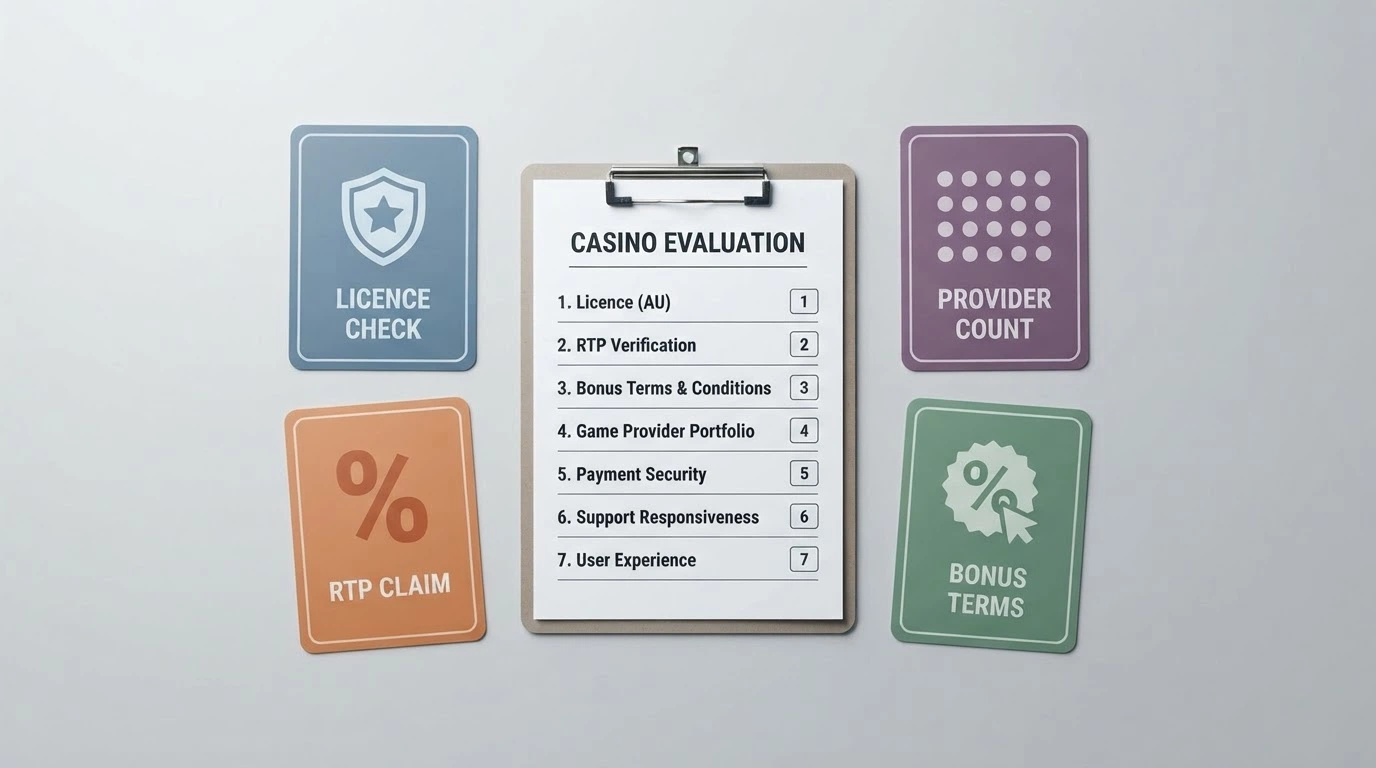
The source set included operator websites, published bonus terms and conditions, the ACMA’s public enforcement record and blocking register, independent payout-testing sources, and the research literature on the IGA and the licensed wagering system. No deposits were placed, no accounts were opened, no bonus was played through, and no claimed RTP was independently verified. The figures a casino publishes are the figures the page carries, with the audit caveat applied throughout.
The operator set was 10 offshore casinos actively serving Australian players, chosen on the basis of their appearance in the topic’s search results and their stated availability to Australian customers. The order is by relevance to the page’s subject (payout rate and RTP), not by market share, and the order is not a recommendation. Bizzo Casino is in the set despite the ACMA formal warning; Rainbet is in the set despite the explicit Australian restriction in its T&C. The page includes the operators a reader is most likely to encounter, and the editorial decision was to include them with their problems stated rather than to omit them on the basis of those problems.
The ranking criteria, in order of weight, were: published RTP claims and audit status, bonus fairness measured by wagering multiples and validity windows, game-count breadth and provider roster, transparency of terms, and the legal-status disclosure as a baseline. The criteria were applied qualitatively, not as a weighted score. A casino with a published audit and a 35x bonus-only wagering rate was ranked above one without an audit and a 40x bonus-plus-deposit rate; the comparison was made on the combination of attributes rather than on a calculated score. The legal-status disclosure is a floor, not a differentiator — every operator in the set is offshore and not licensed in Australia, and the column is the same for every row.
The evaluation did not extend to testing the operators in play. The figures on the page are the operators’ own published data and the third-party measurements the research consulted, and a player who wants to verify any of them has the operator’s own T&C page as the next step. The page’s role is to organise the published data into a comparison the player can act on; the player’s role is to verify what matters to them at the point of decision.
What Australian Players Should Actually Do in 2026
The page has walked through what “highest payout” means, which pokies and games return the most, which offshore casinos Australians can access and what the law says about all of it. The conclusion is that the RTP advantage of the highest-return titles is real and measurable, and that the legal and practical costs of accessing it are equally real and equally measurable. A player who chases the highest payout has to weigh both.
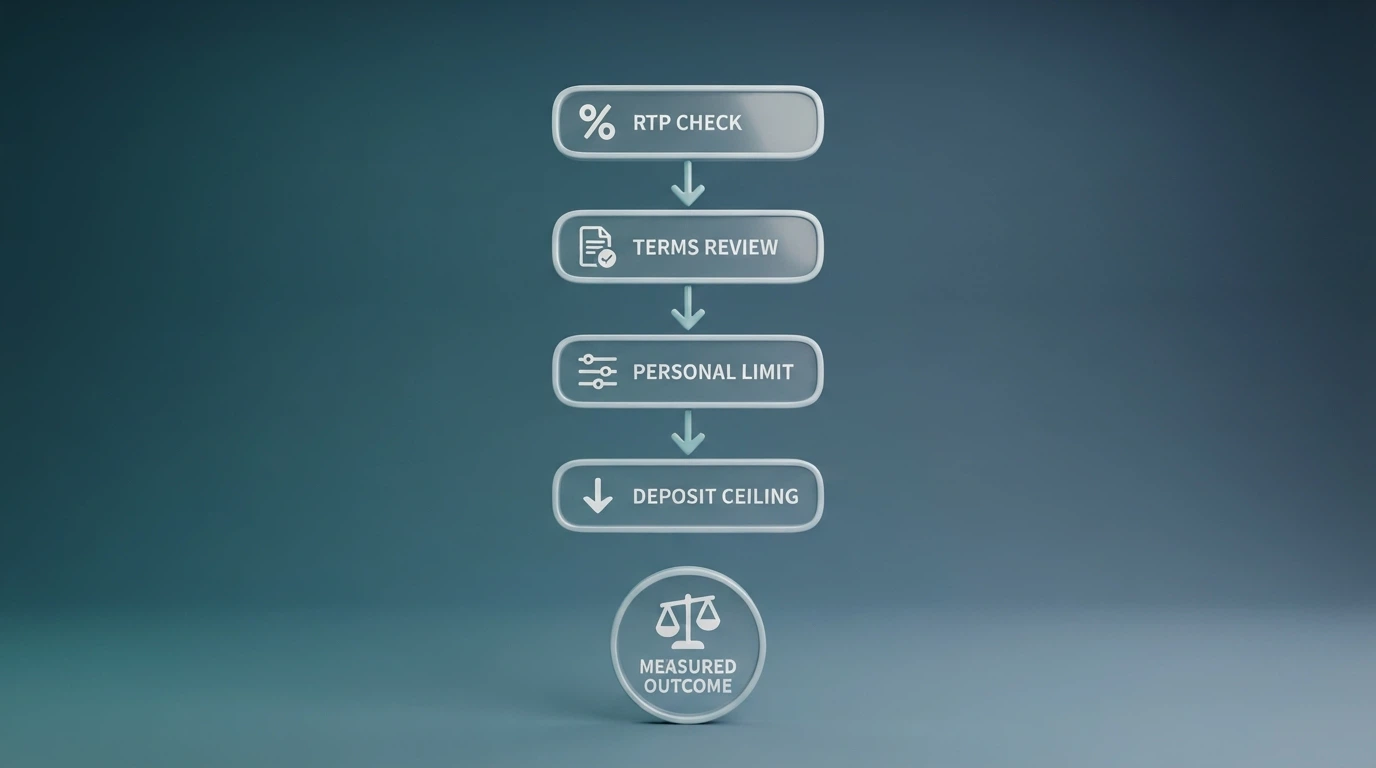
The RTP gain is concrete. A 99% RTP pokie returns nearly A$4 more per A$100 wagered than a 95% pokie, and that compounds over a session. The shift from a 95% pokie to a 99% blackjack hand is a larger gain again, because blackjack at 99.5% is the highest-return standard game in the casino. Choosing a 98%+ pokie over a 95% pokie, and choosing blackjack over keno, are the two single decisions a player can make that have the largest measured effect on their long-run return. They are not glamorous decisions, and they are not the marketing message, but they are the ones the math supports.
The offset is the legal and practical reality. Every dollar played at an offshore casino sits outside Australian consumer law, with no dispute resolution, no BetStop coverage, and the constant risk of a DNS-level block that closes the site while a balance sits on it. The licensed wagering alternative is real for racing and sport — Australian-licensed bookmakers offer full consumer protection, BetStop coverage and deposit limits, and they are the right venue for those products. They do not offer online casino games or pokies, because those products are prohibited. A player who wants the highest-payout pokie is not in a market where that product is licensed, and that is the constraint the page has been working within.
For a player who chooses to use an offshore casino despite the risks set out above, the actionable steps are: check the operator’s published RTP version for the specific game, because a 96.71% pokie at one casino can be a 94.79% pokie at another; read the bonus T&C for wagering multiples and validity windows, because a 40x bonus-plus-deposit at 5-day validity costs more than the same headline figure at 30x bonus-only at 14-day validity; set a personal deposit and loss limit before opening the session, because the operator’s voluntary limit is not the same as a hard cap; and never deposit more than the player is prepared to lose to a DNS block, because the site can be unreachable tomorrow and the balance is in a jurisdiction the Australian courts cannot easily reach. The highest payout is academic if the operator will not release the withdrawal, and the practical steps above are the ones that affect whether the player ever sees their money again.
A final thought, in case the headline on the page is the only line a reader remembers. “Highest payout” in this market is a comparison between two things the IGA has not legalised, served by operators the ACMA is actively trying to block, and measured by RTPs the operators themselves publish. The honest number is the one the page has carried. The honest framing is the one the page has set out. The choice of what to do with both is the reader’s, and the page is built to make that choice with eyes open.
Frequently Asked Questions
Can Australian players use PayID and crypto to deposit at online casinos?
Crypto and credit cards are banned as payment for licensed online wagering in Australia, effective 11 June 2024. Offshore casinos serving Australian players generally accept crypto and sometimes PayID, and PayID deposits at one tested operator cleared in 11 minutes. The acceptance of crypto is a tell that the operator is outside Australian rules, not within them.
What happens if an offshore casino refuses to pay out my winnings — is there any Australian protection?
There is no Australian regulator an offshore casino is required to answer to. The ACMA can block the site, but it cannot compel a withdrawal. The operator’s own terms govern, and the operator’s own jurisdiction is where the dispute has to be pursued. The licensed alternative — Australian-licensed bookmakers — has state and territory complaint processes, which is why the legal-status difference matters beyond the prohibition itself.
What is the average RTP of online pokies compared to land-based pokies in Australia?
The industry average RTP for online pokies is approximately 95.7%, with table games averaging 98–99%+ across tested AU-facing operators. Land-based pokies in Australia are state-regulated and typically return 87–92%, depending on the jurisdiction and venue. Online titles in the highest-RTP band return measurably more over volume, though they are reached through operators the IGA prohibits from serving Australian customers.
Are casino winnings taxable in Australia?
Gambling winnings are not assessable income for an ordinary player under section 6-5 of the ITAA 1997, and gambling losses are not deductible. The exception is a person carrying on a business of betting or gambling, where the ATO’s criteria (IT 2655) apply. No Australian case has held an ordinary punter’s casino winnings assessable, and the operator pays the relevant state and territory wagering taxes on the platform side.
Which casino game gives the best odds of winning for a typical Australian punter?
Classic blackjack with basic strategy returns 99.5%, full-pay 9/6 Jacks or Better video poker returns 99.54% with optimal play, and craps on the pass line with full odds returns 99.59%. All three require a chart or a strategy, and the 99%+ figure is conditional on the player following it. The best-returning game the typical player will open without a chart is European roulette at 97.30%, well above the 95.7% online pokies average and far above keno at around 75%.
How does BetStop work, and does it cover offshore casino sites?
BetStop is the National Self-Exclusion Register, launched on 21 August 2023. One registration excludes a person from every Australian-licensed online and phone wagering service, with periods from three months to lifetime. BetStop does not cover offshore casinos — an offshore operator is not connected to the register, and a self-excluded person who deposits at one has not breached BetStop but has defeated the only mechanism designed to stop them. The 59,830 registrations and 37,247 active exclusions as of 31 March 2026 describe a system that works for the wagering market it covers, and a clear gap where it does not reach.