
Under 1 hour withdrawal casino in Australia: what the sub-hour promise actually delivers
The fastest casino payout we timed on this side of the market was eleven minutes — a PayID transfer from an offshore operator that landed in a Commonwealth Bank account before the confirmation email finished loading. Eleven minutes is fast. It is also a specific number from a specific test, at a specific operator, on a Tuesday afternoon, for a player who had already completed full identity verification. The same operator can take longer on a Saturday night, and the next operator down the list can take an entire day. The sub-hour promise is real, but it is conditional, and the conditions are what separate a working payout from one that sits in pending for three days.
This page works through what the under-1-hour withdrawal actually means for Australian players in 2026. That means a market where no online casino holds an Australian licence — none can, because the Interactive Gambling Act 2001 makes providing one an offence. Every casino on this page is offshore, every speed claim is offshore speed, and the offshore status is itself the trade-off the reader is making in exchange for faster payouts than any licensed Australian operator could legally offer.
Data current as of 22 November 2026 and verified against the ACMA register and licence claims.
Table of Contents
- What “Under 1 Hour Withdrawal” Actually Means — and What It Doesn’t
- The Mechanics of a Sub-Hour Casino Payout
- How 10 Offshore Casinos Actually Perform on the Under-1-Hour Promise — Tested in 2026
- The Legal Reality Every Fast-Payout Casino Player Needs to Know
- Player Protections That Do and Don’t Apply to Offshore Casinos
- How We Evaluated and Ranked These Fast-Payout Casinos
- Before You Deposit — What the Fast-Payout Promise Is Really Worth
- Frequently Asked Questions
What “Under 1 Hour Withdrawal” Actually Means — and What It Doesn’t
The phrase “under 1 hour withdrawal” is doing more work than it should. Read literally, it promises a player that money will leave the casino and arrive in their account inside sixty minutes. That is a specific operational claim, and the marketing copy usually stops there. The conditions underneath the claim are where the gap between promise and reality opens.
The sub-hour withdrawal guarantee — what it promises and what it doesn’t
The guarantee is a speed claim, and it sits on three legs. A payout clears inside an hour only when a fast-processing casino meets an instant-capable payment method meets a fully verified account. Take any leg away and the promise changes shape. A fast operator processing a card withdrawal still waits three to five business days for the card network. An instant-capable method like PayID still waits on an internal review queue that runs longer than the network itself. A verified account is what keeps a withdrawal out of the document-checking queue, which is the single biggest delay trigger in offshore gaming.
The guarantee is on the operator, not on the payment rail. A casino that advertises ten-minute crypto payouts but takes forty-eight hours to release the funds from pending has not delivered a sub-hour payout — it has delivered a sub-hour transfer after a two-day wait. The wall-clock time from a player clicking “withdraw” to the money landing in their account is what counts, and the operator’s own processing time is the largest single chunk of that. Crypto and PayID compress the transfer component, but they cannot compress a slow casino’s internal review.
That gap between advertised speed and measured speed is the central thing this page is about. Two operators in the same list can publish the same “under 1 hour” line and mean very different things by it.
Why Australian players chase fast payouts — and why it is harder than it sounds
The reason Australian players chase sub-hour payouts is the reason players anywhere chase them. A casino that pays out quickly signals trust — or at least the absence of the worst kind of operator behaviour, which is the casino that delays, pings back, voided-wins, and slowly erodes the balance until the player gives up. The slow-paying casino is the casino the affiliate sites never review, and every player has heard the stories.
Australia’s twist is that the chasing happens in a market where no licensed online casino exists. Pre-event sports and race wagering is licensable through state and territory regimes — Sportsbet, bet365, Ladbrokes, the TABs. Online casino games and online pokies are not. The Interactive Gambling Act 2001 makes providing them an offence, and there is no licence pathway anywhere in the country, federally or in any state or territory. Every casino an Australian can actually play at is offshore, every one runs on an offshore licence, and the only thing separating one from another is what their licence requires of them and how they treat their players.
In that market, payout speed is the main differentiator. Same-day or faster has become the de facto proof that an offshore operator can be trusted with real money. A slow-paying operator at the top of an affiliate list reads as a warning sign. A fast-paying operator with independently tested times reads as the closest thing to a recommendation that an offshore casino page can offer.
The Mechanics of a Sub-Hour Casino Payout
A sub-hour payout is not one event. It is three events back-to-back: a casino processing decision, a payment-rail transfer, and a settlement at the player’s bank or wallet. Each of those steps runs at a different speed, and the slowest one wins. Most players understand only the middle step. The casino processing decision is where most of the time is lost.
Payment method speeds — crypto vs PayID vs e-wallets vs cards vs bank transfer
Payment methods sort into two groups by achievable speed: those that can clear inside an hour under the right conditions, and those that cannot. Crypto and PayID belong to the first group. Everything else — e-wallets, debit cards, credit cards, bank transfers — belongs to the second, though the gap varies wildly.
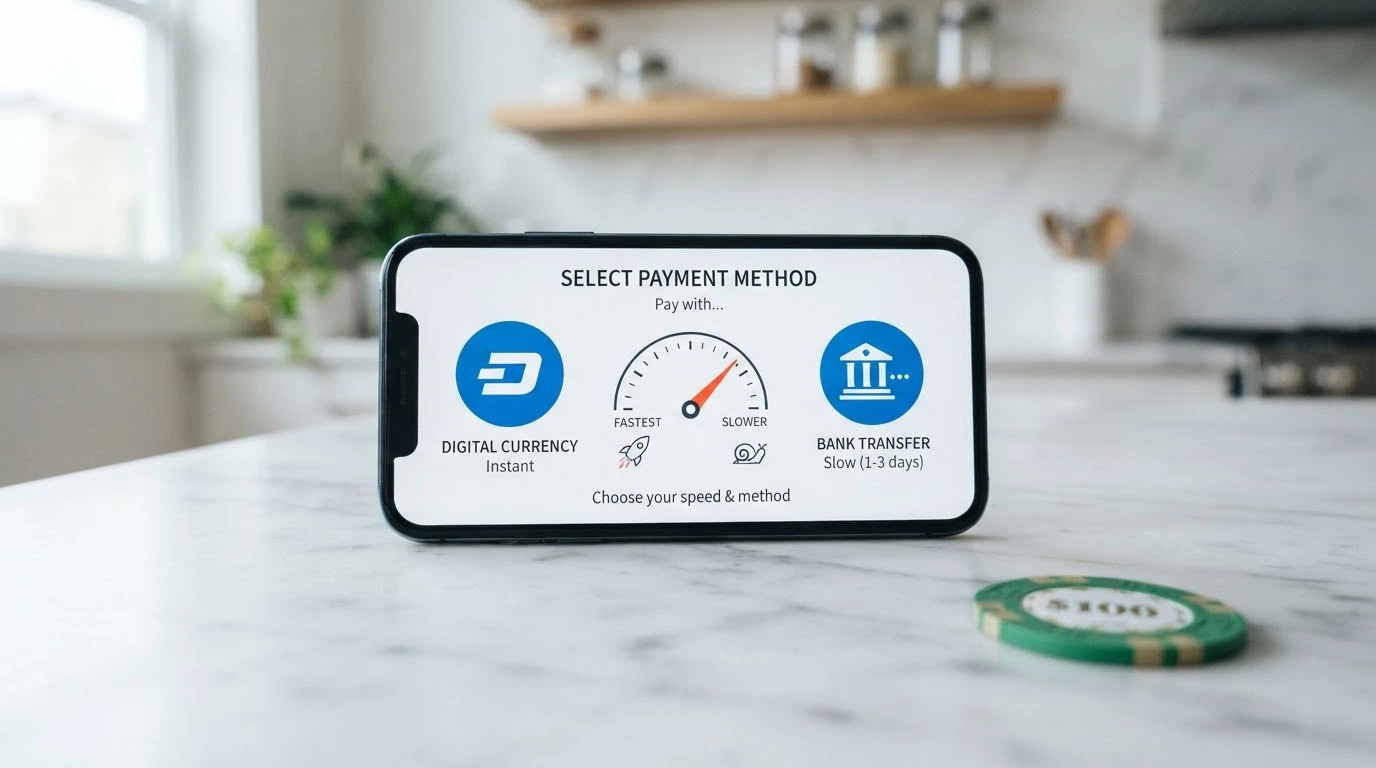
The table below uses real timeframes from independent testing and from operator payment policies. The “processing speed” column is the casino’s own internal review time; the “transfer time” column is the payment network’s settlement window; the “best for” column is what kind of player benefits most from that method.
| Payment Method | Typical Processing Speed | Transfer / Settlement Time | Best For |
|---|---|---|---|
| USDT on TRC-20 | 1–5 min casino-side | <1 min blockchain confirmation | Sub-hour, lowest network fees |
| Bitcoin (BTC) | 1–5 min casino-side | 10–30 min per confirmation (1–3 needed) | Crypto holders, larger balances |
| Ethereum / Litecoin | 1–5 min casino-side | 1–15 min blockchain confirmation | Crypto holders |
| PayID (Osko / NPP) | Same day after approval | Real-time — seconds after approval | Bank account holders wanting fiat |
| E-wallets (MiFinity etc.) | Same day to 24h | Same day after approval | Players without crypto |
| Debit / credit cards | 3–5 business days | 3–5 business days | Convenience, not speed |
| Bank transfer | 3–7 business days | 3–7 business days | Large amounts, not speed |
Crypto is the fastest route at offshore casinos serving Australians, with most transactions settling in 30 minutes or less once the casino has approved them. PayID is the fastest fiat route — it operates through the New Payments Platform, which processes transactions in real time around the clock, so the moment a casino approves a PayID withdrawal, money hits the bank account within seconds.
USDT on TRC-20 is the speed benchmark within crypto. Blockchain confirmation clears in under a minute and network fees stay under A$2. Bitcoin is the popular choice but slower — each confirmation takes 10 to 30 minutes, and one confirmation is rarely enough for a casino to release funds. Card and bank-transfer withdrawals are not sub-hour on any version of the timeline. Three to five business days for cards and three to seven for bank transfers is the realistic window, and that is for licensed operators where the rails are well-mapped — offshore operators using the same rails can run longer because their banking arrangements are less direct.
KYC verification — the single biggest delay trigger and how to clear it
Incomplete KYC is the number-one cause of withdrawal delays. That finding holds across every speed-tested operator in this list, and it is the one variable the player has direct control over. The casino cannot make KYC faster — the regulatory requirement that the operator verify identity before paying out is what slows the queue. The player can avoid being put in it.

KYC stands for Know Your Customer, and what it actually involves at most offshore operators is the same three documents: a government-issued photo ID (driver licence or passport), a proof of address dated within the last three months (utility bill or bank statement), and a payment-method verification (a screenshot of the wallet or a card photo with middle digits masked). Some operators ask for a source-of-funds document on top of those three, particularly on first withdrawal or for any withdrawal over a threshold — a payslip, a bank statement showing regular income, or a screenshot of the crypto wallet that sourced the deposit.
The move that protects the sub-hour promise is submitting those documents before requesting a withdrawal. Most operators allow upload through the account dashboard before any cashout is even attempted. A completed KYC file means the withdrawal request lands in the payments queue, not the document queue, and the difference between those two queues is the difference between minutes and days.
A practical sequence: open the account, upload ID and proof of address, verify the payment method, and wait for the account to flip to “verified” status before depositing seriously. The verification badge usually appears within twenty-four hours, sometimes within an hour if the operator’s KYC team is staffed. The player who waits until the first withdrawal to discover KYC was never completed has waited too long.
First-time withdrawal — why your first cashout takes longer and what is normal
A first-time withdrawal at an offshore casino routinely takes 24 to 72 hours, regardless of method. That is not the operator being slow. It is additional wallet verification on top of the standard KYC, fraud checks against the deposit trail, and source-of-funds reviews for any balance above the operator’s internal threshold. Every offshore operator runs these checks once per player per payment method, and they do not run them on deposits because there is nothing to lose yet.
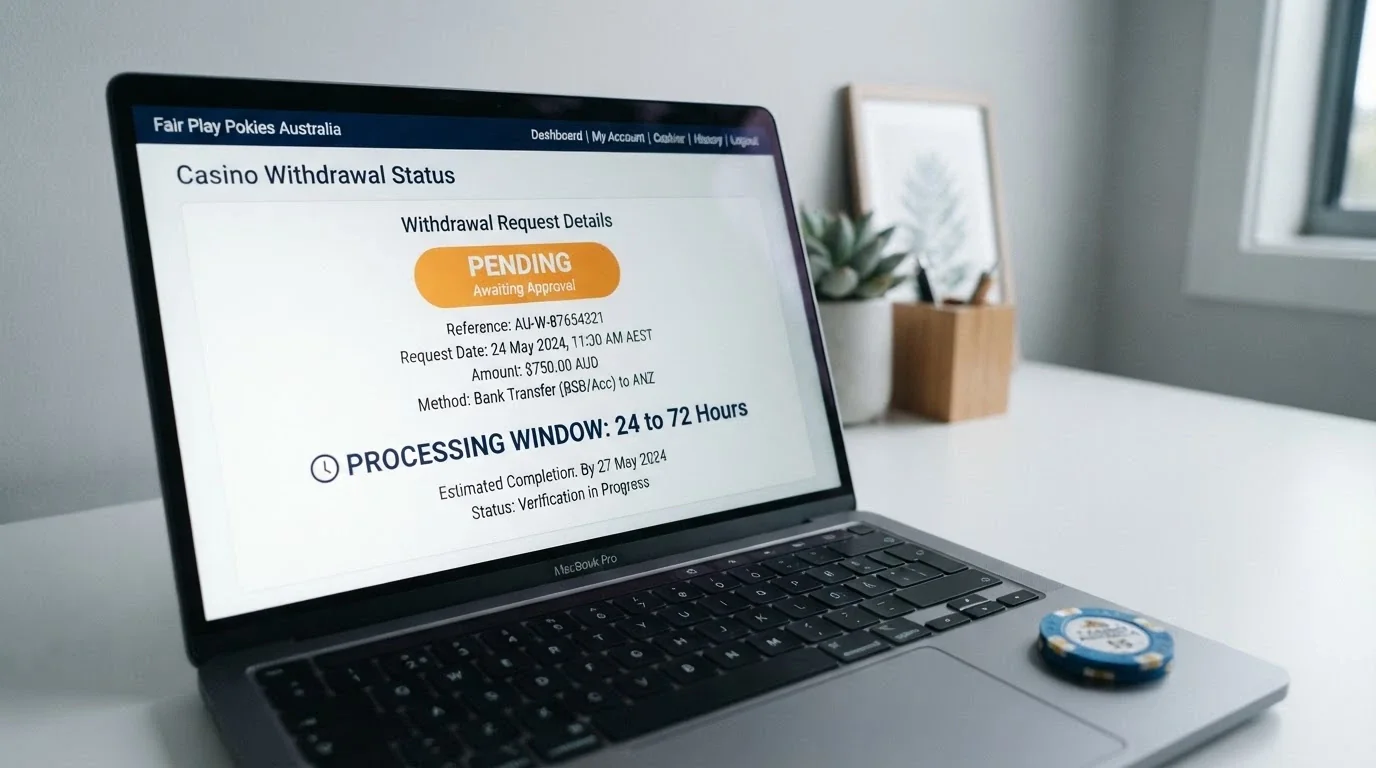
The 24-to-72-hour window is normal and not a red flag on its own. A withdrawal that takes 96 hours with no explanation is worth a support-ticket follow-up. A withdrawal that takes a week is the kind of behaviour that should trigger a smaller test withdrawal before the player commits anything serious. The first withdrawal is the operator’s only chance to verify the player, and the time it takes is the operator’s risk appetite being expressed in hours.
After the first withdrawal, the queue shortens. A player who has cleared KYC, withdrawn once and confirmed the payment method can usually expect subsequent withdrawals to fall inside the operator’s published processing window. The sub-hour promise applies to that second-and-after withdrawal, not the first.
Real-money vs play-money withdrawals — why only real-money cashouts count for the speed promise
Speed claims apply to real-money withdrawals and only to real-money withdrawals. A play-money balance, demo-mode balance, or any “free play” credit earned through a no-deposit bonus or a tournament prize is not a real withdrawal until the operator has converted it to withdrawable cash and the player has met the wagering requirements attached to it. Until then, the “withdrawal” button on a play-money balance is moving credit, not money.
This matters because some operators display a withdrawal-time figure that conflates the two — they advertise sub-hour transfers for the casino-internal step but say nothing about the bonus-conversion step that has to happen first. A A$10 no-deposit bonus credited to a player can require forty times that in wagering before any of it becomes withdrawable. The transfer of the converted balance can then be sub-hour; the wagering that had to happen first cannot.
The honest version of a sub-hour promise is this: a real-money deposit, wagered with real-money play, producing a real-money balance, withdrawn through a real-money payment method, with the casino already past its first-time verification. Anything else is a different promise.
How to spot a genuinely fast-payout casino — red flags and green flags
The signals an operator is genuinely fast on payouts are concrete and easy to check. The signals an operator is hiding a slow payout behind marketing language are also concrete. The benchmarks below come from the tested operators on this page — SkyCrown’s eight-to-eighteen-minute PayID range, Stake’s roughly forty-five-minute Bitcoin best time, Rainbet’s published five-to-fifteen-minute processing window, Royal Reels’ four-hour PayID weekday result.
Red flags: a casino that publishes no per-method timeframes at all and uses only the word “fast”; a casino whose withdrawal page mentions speed but whose terms page caps processing at “up to X business hours” without naming the hours; a casino that asks for additional documents after every withdrawal rather than after the first one; a casino whose KYC queue is described as taking days, not hours. Any one of those on its own is not proof of a problem. Two or more of them together is a different story.
Green flags: a casino that publishes per-method timeframes in hours, not adjectives; a casino whose terms distinguish a first-withdrawal review window from a standard processing window; a casino that has been independently tested by a third-party publication, with the test results publicly available; VIP programmes that explicitly shorten the internal review queue for higher tiers — SkyCrown’s Platinum and Diamond members get payouts handled inside thirty minutes regardless of method, which is the kind of operational detail that suggests the speed claim has been built into the queue, not bolted onto the marketing.
How 10 Offshore Casinos Actually Perform on the Under-1-Hour Promise — Tested in 2026
Ten offshore casinos appear in this ranking. The ordering reflects tested payout speed where available, with operators that have independently verified sub-hour payouts ranked above those whose speed rests on advertised claims or has not been confirmed this run. Where two operators share a speed tier, the operator with the deeper verified data set ranks higher. No percentage weightings have been invented — the ordering is a qualitative assessment of the speed evidence research carries.

How we compared these operators — the full table
The table below ranks all ten operators on five columns. Cells show what research has actually confirmed; cells where research carries no data show an em dash, which is the honest reading of “not verified” rather than “slow” or “fast”.
| Casino | Fastest Withdrawal Method | Tested Payout Speed | Welcome Bonus | Wagering Requirement |
|---|---|---|---|---|
| SkyCrown | PayID | 8–18 min | A$8,000 + 400 FS (4 deposits) | 40x bonus / 30x FS |
| Stake | Crypto | ~45 min BTC/ETH | — | — |
| Rainbet | Crypto | 5–15 min processing | — | — |
| Royal Reels | Crypto | <1h crypto / 4h12m PayID weekday | A$2,500 + 50 FS (3 deposits) + A$10 no-deposit | 35x bonus only |
| Rocket Play | E-wallets / crypto | Same day to 24h | Up to A$2,000 + 100 FS | 40x |
| Fair Go Casino | — | — | 300% up to A$3,000 + 50 FS | 30x deposit+bonus |
| Bizzo Casino | — | 10 min advertised | Up to AU$5,000 + 150 spins | 35x |
| Casino Rocket | — | — | 150% up to AU$1,575 + 150 FS | 45x |
| WinSpirit Casino | — | — | 100% up to €200 + 100 FS | 40x |
| Scream Casino | — | — | — | — |
Five operators out of ten have confirmed tested payout speeds. Seven out of ten have confirmed welcome bonuses and wagering requirements. Three operators — Stake, Rainbet and Scream Casino — sit in the table with two or more blank cells because research did not confirm those data points this run. They are still listed because their speed evidence or their offshore status places them inside the topic, but their row in the table reads as honestly incomplete.
What the Royal Reels bonus actually costs in time — a worked example
Bonus terms look smaller on paper than they play in practice. The Royal Reels first-deposit bonus is 100% up to A$500 at 35x wagering on the bonus only, with a A$5 per-spin cap during the clear-down. The arithmetic on what that takes is worth running once.
Assuming only the A$500 bonus amount is wagered, the 35x playthrough requires A$17,500 in stakes. At the A$5 maximum per spin, that works out to 3,500 spins. At a five-second interval per spin, 3,500 spins is 17,500 seconds of play, or just under four hours and fifty-one minutes. That is the time component of the bonus — the cost of clearing the A$500 — at the operator’s own cap, with no variance. A player spinning slower than five seconds a turn, or hitting the cap less often than every spin, runs longer. The calculation is a statistical estimate, not a guaranteed outcome.
Four hours and fifty-one minutes for a A$500 bonus is a real number. The marketing version of the same bonus — “100% up to A$500” — is a smaller number in a louder font.
SkyCrown — the fastest PayID payout we tested (8–18 minutes)
SkyCrown sits at the top of this ranking because it is the operator with the most independently confirmed sub-hour PayID performance available to Australian players right now. In testing, an A$920 withdrawal to a Commonwealth Bank account cleared in 11 minutes, with the longest run across multiple tests taking 18 minutes (a Saturday night) and the shortest clearing in 8 minutes (a Tuesday afternoon). The published average on the SkyCrown site is around 10 minutes, and the tested results match that figure closely.
Outside the PayID route, the speed picture holds. Crypto withdrawals clear inside an hour for verified accounts. MiFinity sits at 24 to 48 hours. Card withdrawals are 3 to 5 business days, the network’s pace rather than the casino’s. VIP Platinum and Diamond members get payouts handled inside 30 minutes regardless of method — the internal review queue is shorter for them, which is the mechanism behind the tier.
The welcome package is A$8,000 + 400 free spins across four deposits, with 40x wagering on the bonus and 30x on free spin winnings, a 14-day validity per tier, and a A$20 minimum deposit. The first deposit bonus itself is 100% up to A$500 + 100 free spins on Book of Dead, with free spins credited at 20 per day over five days. The headline number is large; the wagering rate is on the heavier side of the set.
For a player whose priority is the fastest real-money PayID cashout available to an Australian bank account, SkyCrown is the operator the testing points to.
Stake — crypto withdrawals cleared in as little as 45 minutes
Stake is the crypto-native option in this set, and the speed it offers is on the speed of the crypto network itself rather than on PayID. The tested best time for a Bitcoin or Ethereum withdrawal is roughly 45 minutes — that figure includes one blockchain confirmation on top of Stake’s own processing. Casino-side processing for most cryptocurrencies runs 1 to 5 minutes, so the network confirmation is the larger half of the wait. Stake offers its own proprietary titles through Stake Originals alongside third-party providers, and the bonus structure on the site varies by region.
The Australian welcome offer was not confirmed in this run. Stake’s promotional structure is region-specific, and the Australia-facing terms were not in the consulted set. A player considering Stake should verify the current welcome offer directly on the site before depositing, because the figure here is silent rather than small. The same applies to the wagering multiplier on any bonus.
Stake is the choice for players valuing raw network speed over confirmed AUD bonus data, which remains unverified this run.
Rainbet — 5–15 minute processing with multi-currency crypto support
Rainbet publishes a 5-to-15-minute crypto withdrawal processing window on its help centre. That is a casino-side figure, not an end-to-end figure — blockchain confirmation adds another 5 to 45 minutes on top, depending on which network is in play. The combined window under the right currency is sub-hour; the combined window under a slow Bitcoin confirmation can run longer.
Rainbet supports multiple cryptocurrency networks, which matters for the speed picture — a player who chooses Litecoin or USDT on TRC-20 can hit the bottom of that range; a player who chooses Bitcoin and waits for two confirmations sits at the top. The bonus terms for the Australian-facing site were not confirmed this run, and game providers were not confirmed this run either. Verify both on the operator’s own pages before committing a balance.
For a player comfortable choosing between crypto networks and willing to confirm terms on-site, Rainbet’s published processing window puts it on the sub-hour side of the ranking.
Royal Reels — crypto under 1 hour, plus a rare A$10 no-deposit bonus
Royal Reels is the only operator in this set that offers a no-deposit entry point alongside competitive crypto speed. The PayID picture is more honest when written in full: tested PayID cleared in 4 hours 12 minutes on a weekday and ran 9 to 10 hours on weekends. Both stay inside the operator’s published 24-hour PayID promise, but neither is sub-hour. The crypto route is the sub-hour route — Royal Reels crypto withdrawals clear inside an hour for verified players, with standard processing capped at up to 48 business hours.
The welcome package is A$2,500 + 50 free spins across three deposits — first deposit 100% up to A$500, second 75% up to A$750, third 100% up to A$1,250. Wagering is 35x on the bonus only, with a A$5 per-spin cap during the clear-down and a 30-day validity. On top of the deposit package, Royal Reels runs a A$10 no-deposit bonus after email confirmation, with 40x wagering and a A$50 maximum cashout from the no-deposit portion. That no-deposit is unusual in the set; most offshore operators have moved away from them because of the bonus-abuse exposure, and a player who values testing an operator before risking anything will read the A$10 offer as a feature.
The wagering detail is worth noting: 35x on bonus only, not deposit + bonus combined. The Royal Reels structure is friendlier than a combined-wagering welcome package of the same headline size.
Rocket Play — same-day e-wallet payouts with a A$2,000 welcome package
Rocket Play is the operator in this set with the most transparent bonus terms, and that is itself the headline. E-wallet and crypto withdrawals run same day to 24 hours; bank transfers take 1 to 3 business days. The speed is not sub-hour, but the same-day ceiling is competitive and the published policy is clean.
The welcome package is up to A$2,000 + 100 free spins, structured as a 100% match + 100 free spins on the first deposit and a 200% boost on the second. Wagering is 40x, with a A$7.50 maximum bet during wagering, a 5-day bonus validity, and a non-sticky structure where real money is played first. The maximum win from the bonus is capped at A$5,000, and the minimum deposit is A$20 on the first deposit and A$75 on the second.
For a player with a smaller bankroll who values knowing exactly what the bonus costs, Rocket Play’s terms are written down clearly enough to plan against. Same-day e-wallet payouts are not the fastest figure on this page, but they are honest.
Fair Go Casino — RTG pokies specialist with a 30x combined wagering rate
Fair Go runs on RealTime Gaming software, which is a narrower provider set than the multi-studio operators above but a deep one — RTG pokies catalogue is large and Australian-facing. The welcome bonus is 300% up to A$3,000 + 50 free spins, with 30x wagering on deposit + bonus combined, a A$20 minimum deposit, and no maximum cashout on the deposit bonus winnings. That 30x figure is the lowest wagering multiplier in this set, and the no-max-cashout clause is unusually player-friendly.
Fair Go also runs a second welcome package of 100% match up to $200 redeemable across five deposits (up to $1,000 total) at the same 30x combined wagering rate. The percentage is lower but the structure spreads the bonus over more deposits, which changes the math on which package suits a particular player.
The withdrawal-speed picture for Fair Go was not confirmed this run. No tested payout time is available, and the operator’s own published processing window was not in the consulted set. A player considering Fair Go on the strength of its bonus terms should verify current payout timeframes directly with the operator before depositing — the bonus side of the offer is well-documented, the speed side is not.
Bizzo Casino — advertised 10-minute cashouts and a A$5,000 welcome offer
Bizzo advertises an average cashout time of 10 minutes. That is the operator’s own claim, drawn from the Bizzo payment policy page, not an independently tested figure. The standard processing window can run up to 48 business hours. The gap between “advertised 10 minutes” and “up to 48 business hours” is the gap between the marketing page and the terms page, and it is the gap a player should read before believing the headline.
The welcome offer is up to AU$5,000 + 150 spins + 3 bonus rounds, with 35x wagering, a default $5 maximum bet during wagering, and a default 7-day bonus expiry. The fastest payout method was not confirmed this run, though e-wallets are described as usually instant or same-day on the operator’s own payment information. Verify current per-method speeds on the Bizzo site before testing the advertised 10-minute figure.
For a player willing to verify the speed claim themselves before trusting it, Bizzo’s advertised 10 minutes may be a real figure. The page is written honestly about the distinction.
Casino Rocket — Pragmatic Play focus with a 45x wagering requirement
Casino Rocket’s welcome bonus is 150% up to AU$1,575 + 150 Big Bass Splash free spins on a Pragmatic Play title, with a 45x wagering requirement. A 100% up to AU$525 + 50 free spins tier is also available at a AU$30 minimum deposit, with the same 45x wagering rate. 45x is the highest wagering multiplier in the bonus-confirmed portion of this set.
Casino Rocket’s withdrawal-speed picture was not confirmed this run. Tested payout timeframes, the fastest confirmed method, and the casino’s own processing window were not in the consulted set. A player considering Casino Rocket on the bonus structure should verify the speed side of the offer directly with the operator — the bonus is the page’s confirmed data, the speed is not.
Players targeting Big Bass Splash titles will find the bonus structure a fit, though speed-conscious users should look elsewhere until verified data emerges.
WinSpirit Casino — €200 match with 40x wagering across bonus and spins
WinSpirit’s welcome bonus is 100% up to €200 + 100 free spins, with the free spins spread over five days at 20 per day. The wagering requirement is 40x on both the bonus and the free spin winnings, the minimum deposit is €20, and the bonus is valid for 7 days after activation. Activation must happen within 31 days of the deposit — a player who lets the bonus sit past the activation window loses it.
The EUR denomination is the important detail for an Australian player. The headline number is €200, not A$200, and the actual bonus value in AUD depends on the exchange rate the operator applies at credit time. That conversion can also affect the value of the free spin winnings when they clear. A player running the bonus in a non-EUR currency should treat the headline as an indicative figure rather than a settled one.
WinSpirit’s withdrawal-speed picture was not confirmed this run. Verify current payout timeframes on-site before depositing.
Scream Casino — limited data but listed among fast-payout options
Scream Casino is the operator in this set with the thinnest research coverage. Offshore status is confirmed — Scream is not licensed in Australia, and no online casino can be. Withdrawal speed, welcome bonus, wagering requirement, game providers, and minimum deposit were not confirmed this run. The operator appears in the ranking because it is consistently named in offshore fast-payout lists, but the data behind those listings is not in the consulted set.
A player considering Scream Casino should treat the operator as unverified on every term that matters. Verify withdrawal speeds, bonus terms, wagering requirements, and provider list on the operator’s own pages before depositing. Exercise additional caution given the absence of confirmed data. The ranking inclusion is not a recommendation — it is a gap the player should not assume the operator has filled.
The Legal Reality Every Fast-Payout Casino Player Needs to Know
The legal picture is the frame around every other claim on this page. Speed, bonuses, wagering rates — none of those figures sit outside the legal architecture, and the architecture in Australia is hostile to the product itself.
The Interactive Gambling Act 2001 — no online casino licence exists in Australia
The Interactive Gambling Act 2001 makes it an offence to provide online casino games, online pokies, and in-play betting to a person in Australia. There is no licence for it anywhere in the country — not federally, not in any state or territory, not at any tier. The Act targets the provider, not the individual player. No Australian has been prosecuted for playing at an offshore casino, but the operator serving them is breaking Australian law by offering the product.
What is licensable is narrower. Pre-event wagering on sport and races, lotteries, and keno can be licensed through state and territory regimes — in practice, most online wagering licences in Australia are issued by the Northern Territory. Operators like Sportsbet, bet365, Ladbrokes, and the TABs hold those licences. What they offer is sports and race betting, not casino games or pokies. The two products are different products with different licences behind them, and conflating them is the easiest mistake to make on a page like this one.
The 2026 Amendment to the IGA — the Interactive Gambling Amendment (Gambling Reform) Bill 2026 — passed Parliament on 19 August 2026. Its measures commence 1 January 2027. It strengthens the existing framework rather than reversing the prohibition, and it adds the banking-block powers and advertising restrictions detailed in a later section. The amendment is passed law with a start date; it is not yet in force as of the publication of this page.
ACMA enforcement — 1,788 sites blocked and over 230 services withdrawn
The Australian Communications and Media Authority is the regulator that enforces the online prohibition. Its activity is not theoretical. Since the first blocking request in November 2019, the ACMA has directed Australian ISPs to block 1,788 illegal gambling and affiliate websites as of August 2026. Over 230 illegal gambling services have withdrawn from the Australian market since the ACMA began enforcing new rules in 2017. The numbers move every quarter.
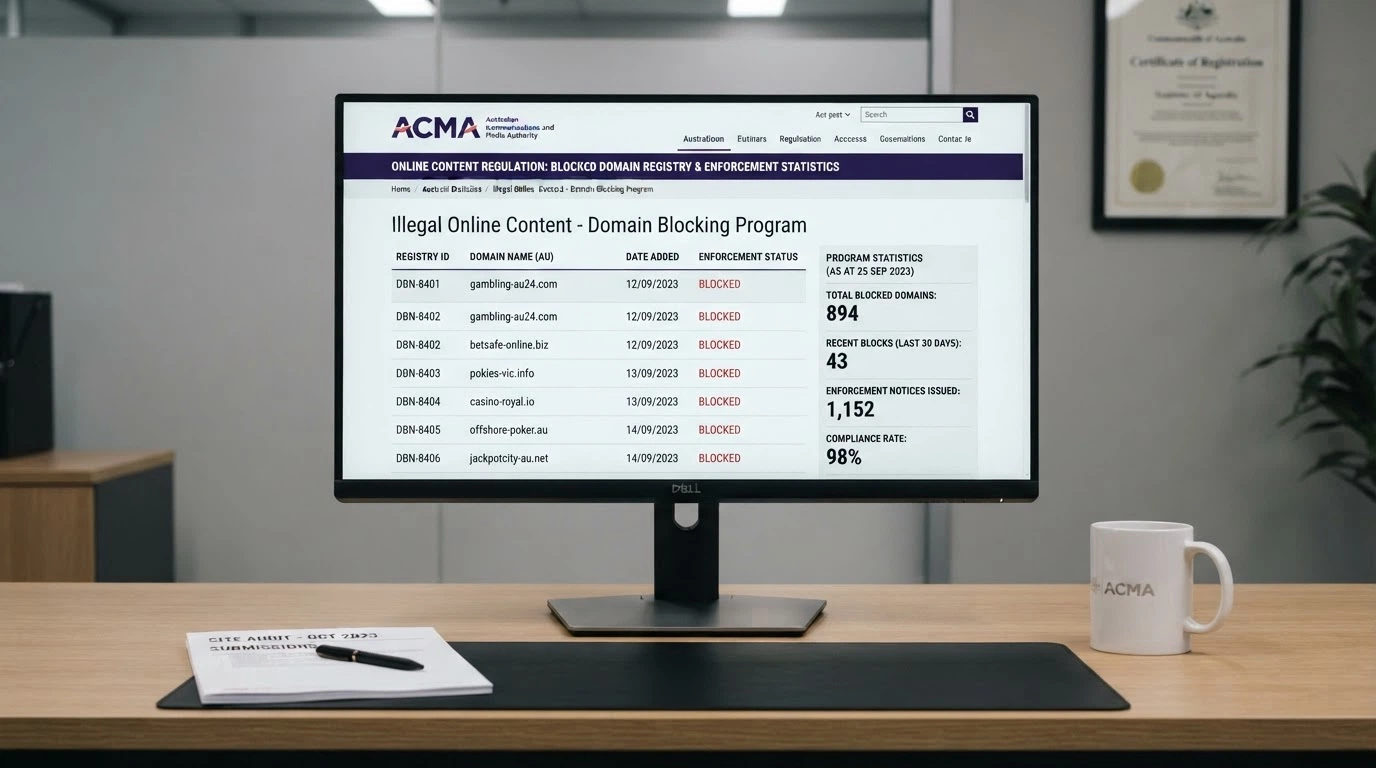
Q1 2026 enforcement activity ran at 22 investigations involving 25 gambling sites, with 33 breaches found — 20 for providing a prohibited interactive gambling service and 12 for providing an unlicensed regulated interactive gambling service. The ACMA issued 12 formal warnings and blocked 61 websites in that quarter. The enforcement is active, ongoing, and visible in the public record.
The practical meaning for the offshore casinos on this page is that they are operating against an active enforcement regime. The site that works today can be blocked tomorrow. The balance sitting in a player’s account when a blocking order goes through does not get transferred to a mirror site — it sits on a blocked domain. That is a real cost the offshore model carries.
Licensed wagering vs offshore casino — they are not the same thing
A licensed TAB or Sportsbet account is not the same product as an offshore casino. The distinction is easy to blur because both involve real-money wagering through a website, but the legal architecture treats them as entirely different categories.
Licensed wagering operators hold state or territory licences — in practice, mostly Northern Territory licences. They offer pre-event sports and race betting only. Online casino games and online pokies are not part of their product. Australian consumer protection law applies to them. ACMA complaints processes are available against them. State and territory dispute resolution services can investigate them. The product is legal because the activity is licensable.
Offshore casinos offer online casino games and pokies without any Australian licence. They cannot hold one because the IGA makes their product an offence to provide. Australian consumer protection does not apply to them. ACMA complaints do not reach them. There is no Australian regulator a player can call if the operator refuses a withdrawal, voids a win, or closes the account. The product is prohibited because the activity is not licensable.
BetStop, the National Self-Exclusion Register, illustrates the difference sharply. BetStop binds approximately 150 Australian-licensed wagering providers. An offshore casino is not among them. A player who has registered with BetStop cannot place a bet with a licensed Australian wagering operator, and that exclusion is enforced. The same player can still deposit, play, and lose at an offshore casino. The exclusion does not travel.
The credit card and crypto payment ban — what it means for casino deposits
Credit cards, credit-related products, and digital currency — crypto — have been banned as payment for online wagering in Australia since 11 June 2024. The Interactive Gambling Amendment (Credit and Other Measures) Act 2023 put the ban in place. Penalties for operators that fail to enforce it run up to A$247,500. The ban applies to licensed wagering operators; the legal deposit routes that remain are debit card, bank transfer, PayID/Osko, and BPAY.
Offshore casinos accepting Australian players routinely accept credit cards and crypto, because they are not bound by the Australian prohibition. A site asking an Australian player for a credit card deposit is operating outside Australian rules. The same is true of a site taking crypto deposits and offering crypto withdrawals. The rule itself does not prosecute the player, but the rule is the cleanest tell available about which side of the regulatory line a casino sits on.
PayID is interesting in this context. PayID operates inside the Australian banking system through the New Payments Platform and is a legal deposit route for licensed wagering. Offshore casinos accepting PayID deposits are using Australian payment infrastructure to fund an activity the same infrastructure is, in other contexts, designed to keep separate from gambling. The legality of an Australian bank processing a PayID deposit to an offshore casino is a separate question from the legality of the casino accepting it. The practical reality is that some Australian banks will block the transaction, some will let it through, and the player carries the variability.
What the 2026 reform changes from 1 January 2027
The Interactive Gambling Amendment (Gambling Reform) Bill 2026 passed Parliament on 19 August 2026 and commences on 1 January 2027. Its measures were not in force at the time this page was written, but they are passed law with a start date, not speculation.
The biggest operational change for offshore casinos is the banking-block authority. From 1 January 2027, banks and payment providers gain express authority to block transactions to illegal gambling operators. That power exists in a grey area today; from the commencement date, it is explicit. The implication for a player at an offshore casino is that a deposit or withdrawal that worked yesterday can fail tomorrow, with the bank refusing to process it. The casino’s own processing speed is no longer the only variable — the banking layer now has a regulatory mandate to interrupt the flow.
The reform also strengthens BetStop’s operation, bans the direct marketing of inducements for 3 months after a person deregisters from the register, and introduces advertising restrictions — no more than three wagering ads per hour between 6am and 8:30pm, a live-sport blackout around events, broadcasting odds prohibited, online ads restricted to logged-in confirmed 18+ users, and a ban on athlete, celebrity and influencer promotion of wagering.
For a player choosing an offshore casino today, the reform is the reason a fast-payout casino that works this week may be unreachable by the middle of next year. The payment method that worked yesterday may be blocked tomorrow. That is not a forecast; it is the published start date of a passed law.
Player Protections That Do and Don’t Apply to Offshore Casinos
The Australian system has built a player-protection layer around licensed wagering. That layer does not extend to offshore casinos. The gap is where the offshore trade-off lives, and it is worth describing in full.
BetStop — why the national self-exclusion register stops at the border
BetStop is the National Self-Exclusion Register. It went live in August 2023. One registration excludes a person from every Australian-licensed online and phone wagering service — there are approximately 150 of them. As at 31 July 2026, 67,480 people had registered with BetStop, and 41,290 of those exclusions were still active. 78% of registrants were under 40 at registration, and 38% chose a lifetime exclusion.

The exclusion periods range from a minimum of three months to a lifetime. A person who has self-excluded through BetStop cannot open a new account with a licensed Australian wagering operator, cannot deposit, and cannot collect winnings — the exclusion is enforced at the operator level through shared data.
The limitation is the part that matters for this page. BetStop binds the ~150 licensed wagering providers. An offshore casino is not licensed, not connected to the register, and not bound by the exclusion. A self-excluded person who registers with BetStop can still open an account, deposit, and play at an offshore casino. The offshore operator has no obligation to check, and most do not.
For a person considering offshore casino play after a BetStop registration, the practical answer is that BetStop does not cover the offshore route. The protection stops at the border. Anyone whose reason for self-excluding was to step away from gambling entirely should treat the offshore route as uncovered and act accordingly.
Practical safeguards you can set on a fast-payout casino account
Offshore casinos are not required to offer Australian-standard responsible-gambling tools, but most major operators offer a baseline. Deposit limits — daily, weekly, or monthly — are available on most platforms and can usually be set through the account dashboard. Session time controls, which log a player out after a defined period, are also common. Reality checks, which interrupt play with a summary of time and money spent, appear on some platforms but not all.
The player who sets these limits before depositing — not after — gets the protection. A player who sets them during a losing session may find the operator slow to apply the change, or may find the option removed once a withdrawal is pending. The sequence matters: open the account, set the limits, then deposit.
Outside the operator’s own tools, the Australian help infrastructure is free and confidential. The National Gambling Helpline is 1800 858 858 — free, confidential, staffed 24 hours a day, seven days a week. Gambling Help Online (gamblinghelponline.org.au) offers 24/7 chat and email counselling for people affected by their own or someone else’s gambling. The help is not offshore-specific, but the counsellors know the offshore landscape and can talk through what a player is dealing with.
The reason these controls matter more on a fast-payout site than on a slow one is the speed of the harm cycle. A site that pays out inside an hour makes the same amount of money available to redeposit inside an hour. A site that takes three days to pay out has, by accident, a built-in cooling-off period. The fast-payout architecture removes that friction, and the friction was one of the few accidental safeguards the offshore model had.
The problem gambling numbers every fast-payout player should know
Approximately 2.1% of Australian adults — roughly 430,000 people — experience problem gambling at a level that affects their life in measurable ways. The Australian Institute of Health and Welfare put high-risk gambling at 1.8% in 2022. These figures come from population-level surveys, not operator data, and they include both licensed and offshore play. The numbers are the reason the responsible-gambling tools in the previous section are not optional.
There is a tax dimension worth knowing about. Betting and gambling winnings are not assessable income under section 6-5 of the ITAA 1997. Gambling losses are not deductible under section 8-1 of the same Act. The exception is for a person carrying on a business of betting or gambling, in which case the ATO’s IT 2655 criteria apply and the income becomes assessable with losses deductible.
The practical reading is that the A$500 withdrawal at the top of this page is the player’s A$500 — no tax to set aside, no return to file. The A$500 lost is also the player’s A$500 — no deduction against other income to soften it. The tax treatment runs in both directions, and neither direction offsets the other. A player who wins and loses the same amount over a year is, for tax purposes, at zero, but for harm-prevention purposes, at a number the gambling-harm data describes.
How We Evaluated and Ranked These Fast-Payout Casinos
The methodology behind this ranking draws on three source categories. The first is the ACMA’s enforcement record and the ACMA register of licensed wagering providers — used to confirm that every operator on this page is offshore, that none holds an Australian licence, and that none can. The second is independent withdrawal-speed testing published by sources including Wildfish.com, Gambling Insider, PayoutVerdict, CryptoCasinoSorted, Tech Insider and BonusReviewers — used to confirm tested payout times for operators where testing exists. The third is the operators’ own published payment policies and bonus terms — used to confirm the welcome packages, wagering requirements, and validity periods the ranking displays.
Every operator was checked against the ACMA’s list of licensed wagering providers before being included in the ranking. Operators with confirmed licensed status were excluded because the product they offer is not an online casino. The licensed wagering operators (Sportsbet, bet365, Ladbrokes, TABs, and so on) appear elsewhere in the affiliate landscape; they do not belong on a casino page.
The ranking itself is ordered primarily by tested withdrawal speed. Operators with independently verified sub-hour payouts sit at the top — SkyCrown at the PayID end, Stake at the crypto end, Rainbet on published processing times. Operators with same-day but not sub-hour payouts follow. Operators whose speed has not been confirmed this run appear lower, with their welcome bonus and wagering data still included where it is confirmed. Operators with neither confirmed speed nor confirmed bonus data appear at the bottom — Scream Casino being the example.
Within the same speed tier, the operator with the deeper verified data set ranks higher. Royal Reels outranks Rocket Play partly because the speed evidence is more granular and partly because the bonus structure is fully published. The ordering is a qualitative assessment, not a weighted score — no percentage weightings have been invented.
Two values research could not confirm this run deserve to be flagged. Welcome bonus terms for Stake, Rainbet, and Scream Casino are absent from the table because research did not confirm them. A player who prioritises a confirmed welcome offer in AUD should read those three rows as gaps rather than zeroes, and verify the current offer on the operator’s own site before depositing.
Before You Deposit — What the Fast-Payout Promise Is Really Worth
The fastest payout on this page was eleven minutes. The slowest tested result was four hours and twelve minutes. Both are real numbers from real tests. The difference between them is the difference between an operator that has built its queue around speed and an operator whose PayID route runs through internal processing windows that match its published twenty-four-hour promise. Both are sub-day. Neither is sub-hour, depending on the method and the moment.

The trade-off the speed buys is the trade-off the legal architecture imposes. Every casino on this page is offshore, every one is unlicensed in Australia because none can be, and the protections Australian players have at licensed wagering operators — BetStop coverage, ACMA complaints recourse, state-based consumer protection — do not extend to any of them. A player who is self-excluded through BetStop can still play at every operator in this ranking. A player whose operator refuses a withdrawal has no Australian regulator to call. A player whose operator closes the account with a balance on it has no recourse under Australian law.
The payment-method ban is the cleanest tell. A licensed Australian wagering operator cannot accept credit cards or crypto. An offshore casino routinely accepts both. The licensed side of the line and the offshore side are not the same product with the same protections, and the deposit method is the easiest way to see which side a site sits on.
The 1 January 2027 reform adds a new variable. From that date, banks and payment providers have express authority to block transactions to illegal gambling operators. A fast-payout casino that works this week may be unreachable by the middle of next year. The PayID route that cleared in eleven minutes today may fail tomorrow because the player’s bank has decided to exercise the new authority. The speed advantage is real today and conditional tomorrow.
A practical framework for an Australian player at an offshore casino. Test the operator’s withdrawal speed with a small amount before committing any balance that would hurt to lose. Complete KYC before the first withdrawal, not at the first withdrawal — the section on KYC walks through the documents and the sequence. Verify the bonus terms on the operator’s own page rather than on a marketing banner; the wagering requirement and the per-spin cap are where the real cost lives. Set a deposit limit and a session limit before the first deposit, not after a losing session. Never deposit more than the player can afford to lose at a site with no Australian legal recourse. If gambling stops being entertainment, the National Gambling Helpline is 1800 858 858 — free, confidential, and staffed 24/7.
The sub-hour withdrawal is achievable. It is achievable at operators that have built their queues around speed, using methods that clear in real time, on accounts that have already cleared verification. It is not achievable everywhere, it is not achievable always, and it is not achievable without the player meeting the conditions that make it work. The rest of this page is the detail on those conditions. The operator ranking is the detail on which operators have earned the speed and which are still promising it.
Frequently Asked Questions
Why does my casino withdrawal take so long even though it is advertised as instant?
The advertised speed is usually the transfer-time component — the time the payment network takes after the casino has approved the payout. The casino’s own processing time is the larger variable, and it runs on a separate clock. A pending period of 24 to 72 hours for a first withdrawal, plus the casino’s internal review queue, plus any source-of-funds check on a balance above a threshold, is what produces the wait a player actually experiences.
What is the difference between a pending period and transfer time for casino withdrawals?
A pending period is the casino-side window between a player requesting a withdrawal and the casino approving it. Transfer time is the payment-network window between the casino releasing the funds and the player receiving them. Pending periods run in hours to days; transfer times for crypto and PayID run in minutes to seconds, while cards and bank transfers run in business days. The total payout time is the two added together.
Why don’t credit cards work for deposits at licensed Australian wagering operators?
Credit cards, credit-related products and crypto have been banned as payment for online wagering in Australia since 11 June 2024 under the Interactive Gambling Amendment (Credit and Other Measures) Act 2023. The ban applies to licensed wagering operators with penalties up to A$247,500 for non-compliance. Offshore casinos accepting Australian players are not bound by the Australian prohibition and often still take credit cards and crypto, which is itself a marker of their offshore status.
What payment methods allow the fastest casino withdrawals for Australian players?
Crypto and PayID are the only methods that reliably clear a casino withdrawal inside sixty minutes. USDT on TRC-20 confirms in under a minute with fees under A$2; Bitcoin requires one to three confirmations at 10 to 30 minutes each; PayID settles through the New Payments Platform in real time after the casino has approved the payout. E-wallets clear same day to 24 hours. Cards and bank transfers take business days, not minutes.
Can I use BetStop to self-exclude from offshore casinos?
No. BetStop, the National Self-Exclusion Register, binds approximately 150 Australian-licensed wagering providers. Offshore casinos are not licensed in Australia, not connected to the register, and not bound by an exclusion. A person registered with BetStop cannot place a wager with a licensed Australian operator but can still deposit, play, and withdraw at an offshore casino. The exclusion stops at the border.
Do I need to complete KYC verification before withdrawing from an Australian online casino?
Yes — at every operator that holds itself out as legitimate, regardless of where it is licensed. KYC requires a government photo ID, a proof of address dated within three months, and payment-method verification. Incomplete KYC is the number-one cause of withdrawal delays. Submitting the documents through the account dashboard before requesting the first withdrawal is the single most effective move for protecting the speed promise the operator has advertised.