
Same-Day Payout Casinos in Australia: What the Marketing Skips, the Law Says, and the Tested Numbers Show
Current as of 22 November 2026 · verified against the ACMA register, operator terms pages, and the independent payout testing published by Wildfish.com, Payoutverdict.com, Betsquare.org and CardPlayer AU

The promise is simple. You win, you click withdraw, the money lands today — not Thursday, not after the long weekend, today. The reality is messier. “Same day” in this market is a label that splits into at least three different experiences depending on which day you ask, which payment method you use, and which offshore operator you happen to be sitting with. And every site an Australian player can actually deposit at is offshore, because no online casino holds an Australian licence and cannot.
This page is built on one bet: that the reader who lands here is better served by honesty about the legal gap and the tested numbers than by another top-ten list that flatters the marketing. The casino review pages dominating the search results for this topic treat offshore sites as a normal category. They are not. They are the only category, and a player deserves to know that before they put A$20 in.
Table of Contents
- Why “Same Day Payout” Means More Than Fast Banking
- Ten Offshore Casinos Australians Turn to for Same-Day Payouts in 2026
- Playing From Australia: What the Local Reality Looks Like in 2026
- Not All Games Clear at the Same Speed
- Real Money Play: The Only Route to a Same-Day Cashout
- The Payment Method That Decides Whether You Wait Minutes or Days
- The Legal Reality: No Online Casino Holds an Australian Licence in 2026
- Playing Safely: Limits, Help and the Real Cost of Problem Gambling
- How We Evaluated These Same-Day Payout Casinos
- What Australian Players Should Actually Do About Same-Day Payouts
- Frequently Asked Questions
Why “Same Day Payout” Means More Than Fast Banking
“Same-day payout” in an Australian player’s inbox usually means one of three things, and the difference between them is the difference between money at 11:47 AM and money never. The first is T+0 settlement: the operator’s payment system releases the funds and the rail they’re on (PayID on the New Payments Platform, USDT on TRC20, Litecoin on its own chain) carries them in real time. The second is the same calendar day but with internal review in front: you click withdraw at 9:14 AM on a Tuesday, the operator’s risk team approves it by 11 AM, and the rail settles it before 4 PM AEST. The third is the one that quietly becomes the next business day — the request sits in “pending” until the next weekday morning, when a human looks at it. None of this is the operator lying. It is the operator using a phrase that means different things in different months.
The single most useful sentence on this page is probably this: a same-day payout is a floor, not a guarantee. The fastest tested PayID withdrawal across the operators reviewed here was eleven minutes. The slowest was thirty-eight hours. Both happened at licensed-and-running casinos. The label tells you what the operator can do; it does not tell you what it will do on the day you ask.
What Counts as Same-Day: T+0 vs the Next Business Day
A payout clock has two gears. The first is the rail — the payment system carrying the money. PayID on Australia’s New Payments Platform settles in real time between Australian banks; PayID is the only fiat rail an Australian player can realistically call instant. USDT on TRC20 and Solana settle in single blocks; Ethereum and Litecoin typically within thirty minutes; Bitcoin needs three to six confirmations, which is a half-hour to an hour. The second gear is the operator side — KYC, fraud review, manual approval, the take-a-break audit that has to clear before the payment queue releases the request. The second gear is the one most players do not know is there, and it is the one that turns “instant” into Thursday.
The pattern that came out of every independent test is that weekday withdrawals between 9 AM and 4 PM AEST were consistently faster. The reason is mundane and worth saying plainly: even automated systems have human oversight components, and staffing levels peak during business hours. A withdrawal requested at 11 PM Friday is not processed by an empty office. A withdrawal requested at 11 PM Tuesday may be, depending on the operator’s automation. The same rail, the same method, the same account, the same person. Different day, different wait.
Payout, Cash Out, Withdrawal: Why the Label Matters Less Than the Clock
Three words, one question. Search data for the Australian market shows players typing “same day payout”, “same day cashout”, and “same day withdrawal” with roughly even distribution, and the casino sites have caught on: they use the words interchangeably. The real distinction that actually matters is the difference between “instant” and “same-day” as terms of art. Instant at most casinos means under one hour, and it only applies where the platform is fully automated and the player has a crypto or PayID rail available. Same-day means within twenty-four hours, which is a band that includes every rail from crypto on the fast end to e-wallets on a slow Friday. The one-word hyphenated versions — instant-pay, instant-payout, instant-withdrawal — all point at the same intent: how many minutes until the money is mine.
What the words do not point at is the legal status of the operator taking the deposit. That is the part of the question the marketing never answers, and it is the part that has to come from outside the marketing. Every casino an Australian player can deposit at in 2026 is offshore. Not one of them is licensed in Australia. The Interactive Gambling Act 2001 prohibits the provision of online casino games to a person physically in Australia; the 2017 Amendment closed the offshore loopholes and gave the ACMA enforcement powers. The player is not prosecuted — the law targets the provider — but no Australian consumer protection, no Australian complaints body, and no BetStop coverage apply to a deposit at any of these sites. That is the floor under the floor, and the rest of this page is built on it.
Ten Offshore Casinos Australians Turn to for Same-Day Payouts in 2026
Every operator in the table below is offshore. None is licensed in Australia. None is connected to BetStop. None offers Australian consumer protection if something goes wrong. The data is the tested withdrawal data published by independent AU-facing review sites, with bonus terms verified against the operators’ own pages where available. Where a column is empty, it is empty on purpose — research did not surface a tested figure, and guessing would do the reader a disservice.
| Operator | Licence | Welcome Bonus (AUD) | Wagering | Fastest Tested Withdrawal | Payment Methods |
|---|---|---|---|---|---|
| SkyCrown | Curaçao | 450% up to A$8,000 + 400 FS (4 deposits; 1st 120% to A$1,200 + 125 FS) | 40x bonus / 30x FS | PayID A$920 in 11 min; BTC A$1,100 in 34 min | PayID, MiFinity, Neosurf, CashtoCode, crypto, bank transfer |
| RocketPlay | Curaçao | 100% up to A$1,000 + 100 FS (1st deposit) | 40x bonus; 35x FS winnings | PayID under 1 hour | PayID, Neosurf, crypto, bank transfer |
| Stake | Curaçao (Medium Rare N.V.) | None | N/A | Litecoin A$525 in 8 min | Crypto only — BTC, ETH, LTC, USDT, DOGE, XRP, TRX, BNB |
| Wild Fortune | Tobique #0000064 (Metlait SRL) | 0x wagering on 250 welcome FS | 0x on FS | PayID 11 min; crypto avg 5h 24m | PayID, crypto, bank transfer, card |
| BitStarz | Curaçao | 125% up to A$1,500 + 180 FS | 40x bonus | Crypto avg 4h 18m; PayID avg 38h | PayID, crypto, bank transfer, card |
| King Billy | Anjouan | Up to A$2,500 + 250 FS (4 deposits) | 30x bonus only | Crypto avg 6h 40m; PayID avg 28h | PayID, e-wallets, crypto, bank transfer |
| Bizzo Casino | Curaçao | A$5,000 + 150 FS (1st 125% to A$2,500 + 125 FS) | 40x bonus | BTC and Neteller 0–24h | PayID, crypto, Neteller, bank transfer, card |
| Royal Reels | Curaçao | A$2,500 + 50 FS (3 deposits; 1st 100% to A$500 + 50 FS) | 35x bonus only; A$5/spin cap | — | PayID, crypto, bank transfer, card |
| FairGo Casino | Curaçao | Up to A$200 × several deposits | 30x (lowest tested) | 2–5 days bank transfer; no crypto withdrawal | Bank transfer, card |
| WinSpirit | Curaçao | Two-deposit package | — | Reported 3–5 days manual | PayID, crypto, Neosurf (deposit only), bank transfer |
The spread across the right-hand column is the most useful thing the table shows. Eleven minutes on one end of the PayID band, thirty-eight hours on the other — at two operators that both run an automated PayID queue on the same Australian real-time rail. The difference is not the rail. It is the operator’s internal review process, the KYC state of the account at the moment of withdrawal, and the day of the week. Picking the right operator moves the floor. Picking the right method moves the ceiling.
SkyCrown
SkyCrown is the operator that posted the fastest tested PayID time in the published AU testing this year: A$920 cleared in eleven minutes on a Tuesday afternoon, and a separate A$450 in eighteen minutes on a Saturday evening. The welcome package is on the larger end of what offshore sites will advertise — 450% up to A$8,000 plus 400 free spins across four deposits, with the first deposit at 120% up to A$1,200 plus 125 free spins on Wolf Treasure. Wagering is 40x on the bonus and 30x on free spin winnings, with a A$7.50 max bet during the bonus period and fourteen days per tier to clear. Minimum deposit is A$20; minimum withdrawal for bank transfer is A$100, for MiFinity A$30; daily max withdrawal is A$7,500.
What SkyCrown is worth depends on what the player is optimising for. The PayID times put it at the top of the speed table, and the bonus size is large enough that the headline number reads as a serious offer. Two things to know before taking it. The first is that the bonus is tilted toward fiat deposits; players funding with crypto may find better value at operators that price their promos for the crypto side. The second is that a 40x bonus multiple with a fourteen-day window is a tight clear for anyone not playing daily, and the A$7.50 max bet cap means the bonus does not work as a high-roller’s bankroll stretcher. For a player who is going to play pokies steadily for two weeks and wants their first withdrawal to clear in minutes rather than days, SkyCrown earns its spot at the top of the speed list.
RocketPlay
RocketPlay is a Curaçao-licensed operator running approximately 3,900 titles from studios including Pragmatic Play, Play’n GO, NetEnt and BGaming. The first-deposit bonus is 100% up to A$1,000 plus 100 free spins, with 40x wagering on the bonus, 35x on the free spin winnings, an A$7.50 max bet during the wagering period, and a five-day bonus validity — among the tighter windows on the list. Free spin winnings are capped at 10x the deposit sum. Tested PayID withdrawals cleared in under an hour across the published sessions.
The five-day validity is the part of RocketPlay’s terms that needs to be on the page. A 40x bonus with five days to clear is a sprint, not a project, and a player who treats it as a project loses the bonus. On the other hand, the library is wide, the providers are recognisable, and PayID under an hour is exactly the speed the page is about. The verdict: RocketPlay is the right fit for a player who plays concentrated sessions and wants a single deposit to clear and convert quickly, not the right fit for a slow weekend stroller who will not hit the wagering target in time.
Stake
Stake is the crypto-only end of the market. The operator is Medium Rare N.V., Curaçao-licensed, founded in 2017 by Australian entrepreneurs Ed Craven and Bijan Tehrani. There is no PayID, no AUD account, no traditional welcome match, no fiat rails of any kind — the cashier accepts BTC, ETH, LTC, USDT, DOGE, XRP, TRX and BNB. The fastest tested withdrawal in the published data is A$525 worth of Litecoin cleared in eight minutes, with KYC completed at signup rather than at cashout.
The shape of Stake is unusual enough to be worth spelling out. A player who keeps a balance in AUD elsewhere and wants to deposit a flat A$50 has to convert to crypto first, then deposit, then play, then withdraw back to crypto, then convert to AUD. Each conversion is a fee and a price move. The upside is that the same rail — Litecoin in this case, USDT on TRC20 in others — runs the same speed at every other crypto-accepting site on this list. The downside is the friction and the absence of a welcome match. Stake is the right pick for a player who already holds crypto and is happy to keep balances in crypto. It is the wrong pick for a player who thinks in dollars and wants a first-deposit bonus.
Wild Fortune
Wild Fortune runs 3,800-plus pokies from 90-plus providers under a Tobique Gaming Commission licence (#0000064), operated by Metlait SRL. Two things set it apart on the speed list. The first is the welcome free spins: 250 of them at 0x wagering, which is the only entry on the table where the free-spin winnings are withdrawable as cash without a playthrough target. The second is the spread of PayID times — eleven minutes at the fastest end, but an average that drifts well above that, with crypto averaging 5 hours 24 minutes across the published tests.
The 0x wagering on the welcome free spins is the part that matters, and it is genuinely unusual. A free spin win is not a withdrawable thing at most offshore sites until the player has run a 30x or 40x playthrough on it; here it is. For a player who is going to play the free spins and walk, Wild Fortune is a clean offer. A player intending to deposit and play through a longer session, however, should factor in the crypto wait — over five hours on average — before making their choice.
BitStarz
BitStarz is a Curaçao-licensed operator that has been running since 2014, with 3,500-plus pokies and a 125% up to A$1,500 plus 180 free spins welcome package at 40x wagering. The tested payout picture is the most split on the list: crypto averaged 4 hours 18 minutes, which is competitive; PayID averaged 38 hours, which is the slowest PayID time in the table and not a small gap. A player depositing via PayID and withdrawing via PayID should not be picking BitStarz for the speed.
What BitStarz is worth is the longevity and the library. Twelve years of operation, a Pragmatic Play and Evolution live-dealer setup, and a pokies catalogue wide enough to keep a regular player away from the “I have nothing to play” problem. The verdict: a player who is happy to fund in crypto and withdraw in crypto gets a reasonable wait; a player locked to PayID should not be reading this paragraph and expecting same-day.
King Billy
King Billy is the Anjouan-licensed entry on the list, with 3,000-plus pokies from 50-plus providers and a four-deposit welcome package that totals up to A$2,500 plus 250 free spins, with 30x wagering on the bonus only. That 30x is the lowest bonus-only multiple at this bonus size across the featured set, and the wagering term runs for thirty days rather than five or fourteen. Tested crypto averaged 6 hours 40 minutes; PayID averaged 28 hours.
The shape of the offer is what makes King Billy worth a look. A 30x bonus-only multiple with thirty days to clear is the kind of term that lets a steady player actually finish the playthrough without making the bonus the whole session. The crypto and PayID times are mid-pack — neither fastest nor slowest — and the minimum deposit is A$30, which is on the higher end of the table. The verdict: a player who wants a serious bonus on a sane wagering multiple, with the time to clear it, gets more value here than at sites that pair a big headline with a 40x and a 14-day window. A player chasing the absolute fastest PayID is reading the wrong row.
Bizzo Casino
Bizzo runs a 100-plus provider catalogue with 1,500-plus pokies under a Curaçao licence, and a welcome package of A$5,000 plus 150 free spins across the deposit structure, with the first deposit at 125% up to A$2,500 plus 125 free spins. Wagering is 40x on the bonus, with a fourteen-day validity per tier. Bitcoin and Neteller are listed at 0–24 hours on the cashier, which is the broad band “same-day” tends to cover, not the tight sub-hour band the top of the speed table hits.
The package is large; the wagering window is short. The two are the trade-off in a single offer, and the operator has priced the second to push the player through the first. For a player with a bankroll that can sustain the wagering target in two weeks of steady play, the headline is real. For a player who is going to play on weekends only, the bonus will expire before the playthrough is finished. The verdict: Bizzo is for the daily player who treats the bonus as a real campaign, not for the casual visitor.
Royal Reels
Royal Reels is the only operator on the list offering a no-deposit free chip — A$10, with 30x wagering — alongside a three-deposit welcome package totalling A$2,500 plus 50 free spins. The first deposit is 100% up to A$500 plus 50 free spins at A$0.20 per spin, with A$30 minimum deposit and 30x wagering on the bonus; the package as a whole runs 35x on the bonus only, with a A$5 per-spin cap during the clear-down.
The A$10 no-deposit chip is genuinely unusual in this market and worth naming as the specific thing it is: a way to play a real-money game without funding the account, on a tight 30x playthrough. It is not a way to win real money for free; the math of 30x on a A$10 chip is not generous, and the per-spin cap is the cap. But it is a legitimate test of the platform before committing a deposit. The chip itself is a solid way to test the lobby before loading A$30, but those ready to deposit will find more competitive bonus packages elsewhere on this list.
FairGo Casino
FairGo runs RealTime Gaming exclusive — no other provider on the platform — under a Curaçao licence. The welcome is up to A$200 across several deposits with 30x wagering, which is the lowest bonus multiple among the tested AU operators, and the payout picture is the slowest on the list: 2 to 5 days by bank transfer, with no crypto withdrawal support. This is the row of the table for a player who has decided to play RTG specifically, not for a player chasing speed.
The choice here is a catalogue-versus-rail trade. A long-time RTG player who has favourite titles at FairGo is not going to find them at SkyCrown, and the 30x wagering is the best on the page. But the same player’s fastest withdrawal is two to five days. The verdict: FairGo is the right pick when the game library is the deciding factor and the wait is not. It is the wrong pick when same-day is the deciding factor and the wait is.
WinSpirit
WinSpirit is a Curaçao-licensed multi-provider site with a two-deposit welcome structure and a Neosurf minimum of A$10, which is the lowest on the list for triggering the bonus. PayID and crypto are both supported on the deposit side, but the published payout speed is 3 to 5 days by manual processing, which is the slowest in the table and not the same kind of wait as the operators running an automated PayID queue.
The trade is the deposit flexibility against the wait. A player who has a A$10 Neosurf voucher and wants to start small can do that here; a player who is loading A$200 to clear a bonus and wants the same money out the same week should be reading a different row. The verdict: WinSpirit is for the player who values being able to start at A$10, not for the player who values the speed the page is named after.
Playing From Australia: What the Local Reality Looks Like in 2026
The thing the comparison sites tend to flatten is that an Australian player is not in a normal gambling market. The country has a federal prohibition on the product the offshore sites sell, an enforcement body with a real blocking record, a national self-exclusion register that does not reach offshore sites, and a payment-method ban that makes the legitimate and the illegitimate routes look different at the cashier. Knowing which rail, which method and which offshore site is one layer of the question. Knowing that the layer sits on top of a prohibition is the layer the rest of the page is about.

Offshore Sites and the Australian Licensing Gap
There is no online casino licence in Australia. Not federally, not in any state, not in any territory. The Interactive Gambling Act 2001 prohibits the provision of online casino games — and online pokies, and in-play sports betting — to a person physically in Australia. The 2017 Amendment closed the offshore loopholes the industry had been using. What is licensed is wagering on races and sport placed before the event, plus lotteries and keno, through state and territory-licensed operators; the Northern Territory Racing and Wagering Commission, administered through Licensing NT, is the de facto national licensor for online wagering, with licences running for terms of up to twenty years.
This is why a “licensed Australian online casino” does not exist as a thing. A page that promises one is describing something that does not exist. The licensed Australian operators at the top of the AU market — Sportsbet, bet365, Ladbrokes, the rest of the NTRWC cohort — offer wagering, not casino. They do not host pokies, blackjack or roulette. The casino product Australians actually play lives at offshore sites that have chosen to take the Australian traffic despite the prohibition, and the prohibition is the reason those sites are not subject to Australian consumer protection, complaints processes, or BetStop.
AU Pokies and Deposit Methods That Actually Work
Pokies are the game the offshore catalogue is built around. Pragmatic Play, Play’n GO, NetEnt, BGaming, IGTech — the providers named on the operator pages reviewed here are the providers the AU-facing search traffic is asking for. RTG remains a separate cluster with its own audience at FairGo and a handful of other sites. The game the player wants to play is almost certainly available at one of the ten operators in the table; the question is which one and at what wagering weight.
Deposit and payout methods are where the AU-specific reality gets concrete. For licensed wagering, the legal deposit routes are debit card, bank transfer, PayID/Osko, and BPAY; credit cards, credit-related products and cryptocurrency have been banned as payment for online wagering since 11 June 2024, with penalties of up to A$247,500 for operators that fail to enforce the ban. PayID runs on the New Payments Platform, which settles between Australian banks in real time, and it is the only fiat rail an Australian player can realistically call instant. Neosurf is deposit-only and cannot be used for withdrawals, so a player who funds with Neosurf has to set up a separate payout method — usually crypto or bank transfer — before they can cash out.
The credit card and crypto ban is also a tell. A gambling site that asks an Australian player for a credit card or a crypto deposit is operating outside Australian rules, and the payment method itself signals the operator’s regulatory status. That is a useful one-sentence filter the next section’s table is built on top of.
Not All Games Clear at the Same Speed
A bonus and a withdrawal are not the same event, even when the same game is on the screen for both. A welcome bonus is a playthrough target; the operator has set a number — 30x, 35x, 40x — that has to be reached before any of the bonus money is withdrawable. The game the player uses to reach it is the part that decides how fast the bonus clears, because not every game type counts the same way toward the target. Pokies almost always contribute 100% of the wagered amount. Table games and live dealer games typically contribute a fraction of that — sometimes 10%, sometimes nothing — and the difference is the difference between a bonus that clears in a focused week of pokies and a bonus that never clears because the player is at the blackjack table.

Pokies vs Table Games: Which Cash Out Faster
Pokies dominate the fast-payout conversation because they are the game the bonus is built around. A 100% contribution rate means every A$1 wagered on a pokie is A$1 toward the wagering target, which is why a 40x bonus can clear in a single long session at the right stake. Table games and live dealer — the blackjack, roulette and baccarat titles that are also on the operator’s lobby — are part of what makes the operator look like a casino and not a pokies-only site, but they are usually discounted on the wagering contribution or excluded entirely. The math consequence is that a player who splits their session between pokies and live dealer may be playing a game that does not move the bonus bar at all, and finding that out at withdrawal time is the worst place to learn it.
The practical upshot is simple. If the goal is to clear a bonus and reach a same-day PayID or crypto withdrawal, the fastest path is concentrated pokies play. The game library is wide — Pragmatic Play and Play’n GO alone run into the thousands of titles across the operators reviewed here — and the playthrough is short. The same bankroll at the live dealer tables is entertainment first and playthrough work a distant second.
Wagering Requirements: What You Must Play Through Before You Can Withdraw
The wagering range across the featured operators is 30x to 40x, and the difference between the bottom and the top of that range is the difference between a bonus the player can realistically clear and a bonus the player will most likely forfeit. Two specific shapes recur. The first is 40x on the bonus, with a A$7.50 max bet and a five-to-fourteen-day validity, at RocketPlay, SkyCrown, BitStarz and Bizzo. The second is 30x to 35x on the bonus only, with a higher max bet or a longer validity, at King Billy, Royal Reels and FairGo. The 30x bonus-only term is the cheaper of the two to clear because the deposit amount is not part of the playthrough — only the bonus is. A 40x bonus-and-deposit term at the same headline number is harder work for the same dollar.
The per-spin cap during clear-down is the second lever. A A$5 per-spin cap at Royal Reels or a A$7.50 cap at SkyCrown and RocketPlay is the operator’s way of preventing a high-roller from sprinting through the wagering target in a single session. For a player on a smaller bankroll, the cap is rarely the binding constraint. For a player who would otherwise be wagering A$20 a spin, the cap extends the clear-down from days into weeks, which is its own kind of risk. The free-spin wagering multiple is a separate term: 30x at SkyCrown, 35x at RocketPlay, 40x at Bizzo. Lower is better, and the only entry on the list at 0x is Wild Fortune’s 250 welcome free spins.
What a SkyCrown Bonus Actually Costs to Clear
To ground the wagering question in a number: take SkyCrown’s first-deposit match at full value, A$1,200, with 40x wagering on the bonus and a A$7.50 max bet. The required turnover is A$1,200 multiplied by 40, which is A$48,000 of qualifying wagers. At a A$7.50 stake per spin, that works out to 6,400 spins. A typical online pokie runs a spin in roughly five seconds, which puts the clear-down at around 8.9 hours of continuous play. Two weeks at an hour a day is enough to clear it; a weekend-only schedule is not.
This is the part the headline number skips. A 120% match up to A$1,200 sounds like free money; A$48,000 in qualifying wagers is what the player is actually signing up to do. The bonus is not a gift, it is a contract, and the contract has a price in time and a price in expected loss. The arithmetic is the same arithmetic as any other playthrough: a statistical estimate, not a guarantee, and one that says nothing about any individual session. The average online pokie sits somewhere in the mid-90s for return to player, which means an expected loss on the playthrough in the low single-digit thousands, depending on the title. The bonus has a real cost, and the cost is what it costs the player to convert the offer into a withdrawable balance.
Real Money Play: The Only Route to a Same-Day Cashout
A same-day payout requires real money, both ways. The deposit has to clear the cashier, the play has to count toward any active bonus, and the withdrawal has to come from a balance built by real-money wagering. Demo play and bonus-only play produce no withdrawable balance, however long the player spends on them. The minimum deposits across the featured operators are A$20 at SkyCrown, A$30 at Royal Reels and A$30 at King Billy — the entry points are low, but they are real. The no-deposit free chip at Royal Reels (A$10, 30x) is the only exception, and it is small on purpose: it is a way to test the lobby, not a way to build a balance.
The other side of the same point is what happens at the cashier. An Australian player who funds with a debit card is on the legal deposit rail, but the offshore operator is not required to honour the credit-card-and-crypto ban and many do not. The same player can fund with PayID, which is the fastest fiat rail and the one the speed table is built on. Funding with crypto is the fastest path to a withdrawal but a path that exists outside the Australian rules, with all that implies for consumer protection. Each method is a different trade, and the trade is the player’s, not the operator’s.
The Payment Method That Decides Whether You Wait Minutes or Days
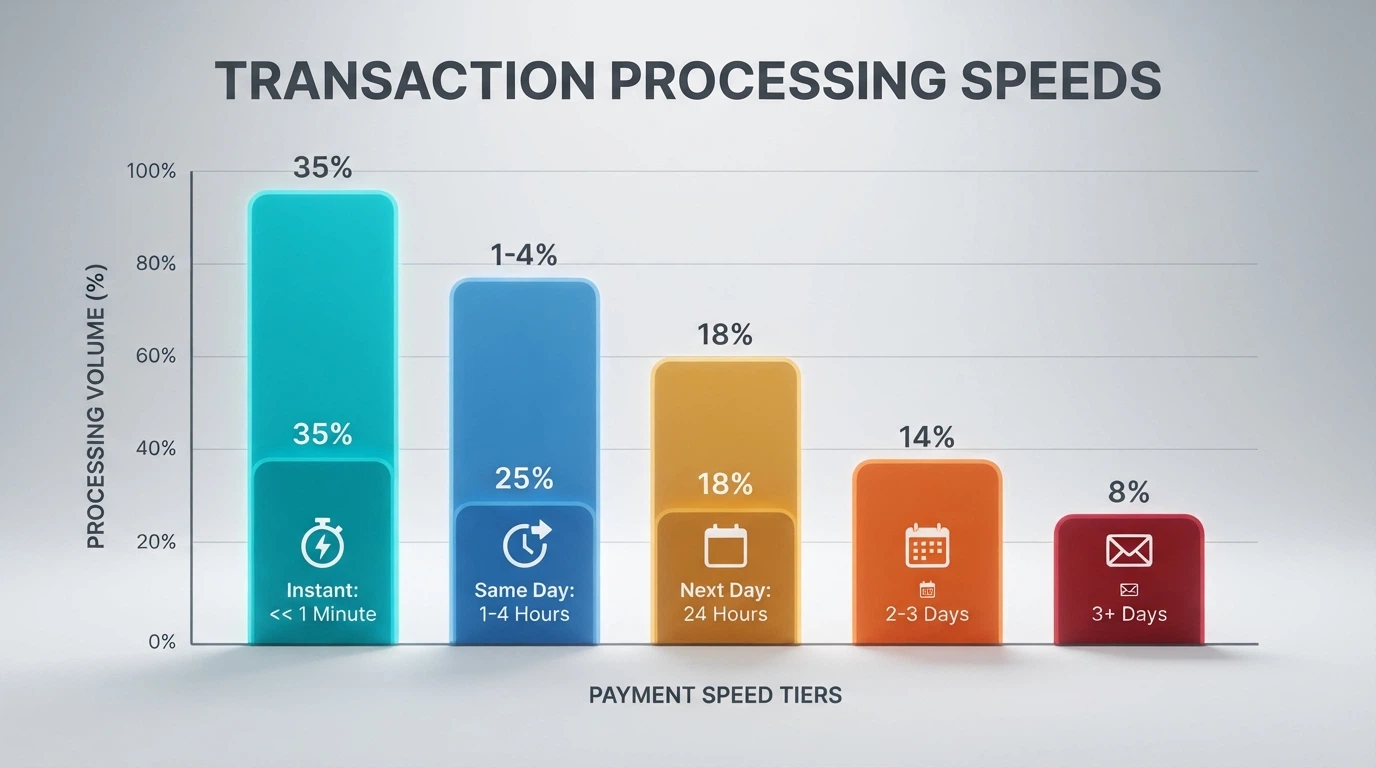
Across the published AU testing, the median crypto payout time was 42 minutes with a worst case of 4 hours. The median PayID payout was 2 hours with a worst case of 8. E-wallets — Skrill, Neteller, eZeeWallet — sat at 6 hours median, 18 hours worst case. Cards took 2 working days median and 5 worst case; bank transfer took 3 working days median and 7 worst case. The spread is wide enough to be the deciding factor on the page.
| Method | Median Time | Worst Case | Availability at Featured Operators |
|---|---|---|---|
| Crypto (BTC, ETH, LTC, USDT) | 42 min | 4 h | 9 of 10 (Stake crypto-only) |
| PayID | 2 h | 8 h | 8 of 10 (Stake and FairGo do not support) |
| E-wallet (Skrill, Neteller, MiFinity) | 6 h | 18 h | 5 of 10 (SkyCrown, King Billy, Bizzo, others) |
| Debit/credit card | 2 working days | 5 working days | 5 of 10 (FairGo card-primary, plus BitStarz, Wild Fortune, Bizzo, Royal Reels) |
| Bank transfer | 3 working days | 7 working days | 8 of 10 (Stake and Royal Reels as primary are exceptions) |
The most useful sentence in this table is that crypto is faster than everything else at every single site. The reason is that crypto does not have an interbank settlement step and does not have a fraud-review human in the loop. The withdrawal is a blockchain transaction; the operator broadcasts it, the player waits for confirmations, the money lands. The same site on a bank transfer is three working days because the bank transfer has both.
Method availability is the second lever. A player whose only deposit method is Neosurf is deposit-only and has to set up a separate payout rail. A player whose only deposit method is PayID cannot withdraw to Stake, because Stake does not run PayID. A player who wants the speed the page is named after has to be on a method that supports the speed, at an operator that supports the method, on a day and hour when the queue is being worked.
Processing vs Arrival: Why the Clock Starts Before You Hit Withdraw
A payout has two stages, and the difference between them is the difference between an eleven-minute PayID and a thirty-eight-hour PayID at the same site. The first stage is the operator’s internal review — KYC check, fraud check, bonus-abuse check, the take-a-break audit, the manual approval that the operator’s risk team may or may not have automated. The second stage is the payment rail — the actual movement of money from the operator’s account to the player’s. “Instant” at the operator side can still mean hours on the rail, and “instant” on the rail can still mean a day in the operator’s review queue.
The KYC state of the account is the variable that decides which stage the withdrawal is going to stall at. A player who completed identity verification at signup, before any withdrawal was requested, skips the document-check stage entirely. A player who waits until the first withdrawal to upload a driver’s licence and a utility bill is the player who finds the withdrawal in pending for twenty-four hours while the documents are reviewed. The “instant” the marketing promises assumes the first kind of account. The reality for the second kind is the median the table shows.
KYC Verification: The One Hold Every Player Hits
Incomplete KYC is the number one cause of withdrawal delays at Australian online casinos. That is the finding from the published AU testing, and it is the single most useful operational fact on this page: complete KYC at signup, not at cashout. The documents requested are usually the same across offshore sites — government-issued photo ID, proof of address dated within the last three months, and a payment-method confirmation. Submitting them before requesting the first withdrawal is the difference between a same-day payout and a same-week investigation.
A pre-verified account does not bypass the review stage entirely. Fraud review and bonus-abuse checks still run, and a withdrawal that looks unusual to the operator’s automated system can still land in a human reviewer’s queue. But the wait is hours, not days, and the documents have already been seen. The cleanest path to a same-day payout is: verify the account at signup, deposit, play, withdraw to a method that has been used to deposit (many operators require this), and request the withdrawal on a weekday between 9 AM and 4 PM AEST.
The Legal Reality: No Online Casino Holds an Australian Licence in 2026
The clearest way to read the offshore casino market from inside Australia is that the product being sold is illegal to provide, that the enforcement body has been blocking sites since November 2019, that the legal deposit rails are not the rails the offshore sites ask for, and that the national self-exclusion register does not reach the operators on this page. None of that is a reason not to use an offshore site — the IGA targets the provider, not the individual player — but it is the reason the player gets no Australian consumer protection when they do.

The Interactive Gambling Act 2001: What It Actually Prohibits
The Interactive Gambling Act 2001 prohibits the provision of online casino games, online pokies and in-play sports betting to a person in Australia. The 2017 Amendment closed the loopholes the offshore industry had been using, gave the ACMA its enforcement and blocking powers, and made it clear that the law applies to any operator taking Australian traffic, not just to operators with a physical presence in the country. The minimum age for any commercial gambling in Australia is 18. The individual player is not prosecuted under the IGA — the Act targets the provider, not the customer.
What the IGA permits is wagering on races and sport placed before the event, plus lotteries and keno, through state and territory-licensed operators. The Northern Territory Racing and Wagering Commission is the de facto national licensor for online wagering, with licences running up to twenty years. Wagering and casino are different products under Australian law, and the licensed operators in the wagering category do not offer casino games. A page that lists “licensed Australian online casinos” is listing something that does not exist.
How the ACMA Blocks Offshore Sites (and Why More Keep Appearing)
The ACMA has had 1,564 illegal gambling and affiliate websites blocked by Australian internet service providers since its first blocking request in November 2019, as at March 2026. More than 225 illegal services have withdrawn from the Australian market since 2017. The numbers are not the end of the story, because the offshore catalogue turns over — sites that get blocked are replaced by sites that have not yet been blocked, and the ACMA’s list is a moving target. A player who has a balance on a blocked site is not necessarily out of pocket, because most operators continue to honour balances after a block, but the experience of trying to log in to a blacklisted domain is the experience the ACMA’s enforcement creates.
The other side of the dynamic is that the operators that do continue to take Australian traffic have decided to absorb the enforcement risk. They are typically Curaçao-licensed or licensed by one of the smaller jurisdictions (Anjouan, Tobique) that have structured their regimes around offshore-friendly operation. The licence on the footer of the operator’s homepage is the licence the operator is operating under, and the licence is the one that determines which consumer-protection regime applies when something goes wrong — which, with offshore operators, is none that an Australian player can reach.
BetStop: The Self-Exclusion Register Offshore Casinos Ignore
BetStop — the National Self-Exclusion Register — launched on 21 August 2023. One registration excludes a person from every Australian-licensed online and phone wagering service in a single step. As at 31 July 2026, the register had 67,480 registrations in three years of operation, of which 41,290 exclusions were still active — more than sixty per cent of everyone who has ever signed up. Seventy-eight per cent of registrants were under 40, and thirty-eight per cent chose lifetime exclusion. Self-exclusion terms run from a minimum of three months to lifetime, with removal requiring a statutory declaration confirming counselling from a qualified counsellor, psychologist or doctor.
BetStop binds Australian-licensed wagering services only. An offshore casino is not connected to the register, and an offshore casino will keep taking a self-excluded person’s money if that person opens an account and deposits. This is the most concrete harm of the offshore route for anyone who has decided to stop gambling. The register exists, the register is effective at the licensed operators, and the register does not reach the operators on this page. A player who is self-excluded and using an offshore site is bypassing the only national tool designed to make the bypass harder.
The 2026 Reform: What Changes on 1 January 2027
The Interactive Gambling Amendment (Gambling Reform) Bill 2026 passed Parliament on 19 August 2026. Its measures commence on 1 January 2027, and they change the licensed side of the market more than the offshore side — but the offshore side will feel the second-order effects. From 1 January 2027, wagering advertising on broadcast television is capped at no more than three ads per hour between 6:00 AM and 8:30 PM, with a complete blackout during live sport broadcasts within those hours. Athletes, celebrities and influencers are barred from promoting wagering products. Direct marketing of inducements is prohibited for fourteen days after a customer signs up and for three months after a person deregisters from BetStop.
The change that reaches the offshore cashier is the payment-provider authority. From 1 January 2027, banks and payment providers gain express authority to block transactions to illegal gambling operators. The exact shape of that blocking is the part the regulations will need to settle, but the direction is clear: a debit card transaction or a PayID transfer to a known offshore operator is a transaction an Australian bank will be able to refuse. Players who currently fund with PayID may find their deposits rejected. Players who fund with crypto will not, which is the second-order effect the offshore crypto-only sites are quietly built for.
What You Give Up When You Play Offshore
A deposit at an offshore casino forfeits a set of protections that an Australian player might otherwise assume are baseline. There is no Australian consumer protection: if the operator refuses a withdrawal, voids a win on a bonus-abuse reading of the terms, or closes the account with a balance on it, the player has no AU complaints body to take the complaint to. There is no BetStop coverage: a self-excluded person who opens an offshore account is still on BetStop at the licensed operators, and is also playing at the offshore ones, with no register to stop them. There is no recourse if the site is blocked by the ACMA mid-session: the balance may still be honoured by the operator, but the player is now depositing and withdrawing through a different route.
The credit card and crypto ban is also a tell that runs the other way. An Australian player who is asked for a credit card or crypto deposit at a gambling site is being served by an operator outside the Australian rules, and the payment method is itself the signal. The site may be reputable. The site may pay out on time. The site is, by the payment method it accepts, an offshore site, and the protection regime that follows from that is the offshore one.
Playing Safely: Limits, Help and the Real Cost of Problem Gambling
The reason the legal section and the help section sit on the same page is that the harm the offshore market is most likely to cause is the one the licensed market is most designed to prevent. About 2.1% of Australian adults — roughly 430,000 people — experience problem gambling, with the Australian Institute of Health and Welfare putting high-risk gambling at 1.8% in 2022. A 2026 model published in the Journal of Gambling Studies estimates approximately 3.29 million Australians aged five and over are affected annually by their own or another person’s gambling, with the annual health loss estimated at over 400,000 Years Lived with Disability. These are not small numbers, and they are the numbers the offshore route does not help.

Setting a Budget and Time Limit Before You Deposit
The National Consumer Protection Framework for Online Wagering, which applies to all licensed online wagering service providers in Australia, includes ten measures covering no line of credit, identity verification, restricted incentives, deposit limits, monthly activity statements, and a National Self-Exclusion Register. The offshore sites are not part of the framework, but the discipline it describes is the discipline a player is best off imposing on themselves: a deposit limit set before the session, a session time limit, a take-a-break function used actively, an activity statement reviewed monthly. A limit set before the session holds better than a limit set mid-session, because the mid-session version is the version made by the person who has already decided the limit is too low.
The practical version of this is unromantic and worth saying straight. Decide, before logging in, what the session budget is. Decide the time the session will end. Stop at whichever comes first. The point of a limit is not to be impressive; it is to be the thing the player does not negotiate with at 11 PM.
Where to Get Help: 1800 858 858, Gambling Help Online and BetStop
The National Gambling Helpline is 1800 858 858, free, confidential, and staffed 24 hours a day, 7 days a week. Gambling Help Online, at gamblinghelponline.org.au, provides free 24/7 chat and email counselling and support. BetStop, at betstop.gov.au, is the National Self-Exclusion Register, free, and excludes a person from approximately 150 licensed wagering providers in a single step, with a self-exclusion term of three months to lifetime. The 2026 reform expanded specialised financial counselling services for people experiencing gambling-related financial difficulty.
For an Australian player who has decided to use an offshore site, the help infrastructure still applies. A self-excluded person who has registered on BetStop and is still playing offshore is not a person the register has failed; the register has worked exactly as designed, and the offshore site is the part that has not. The free, confidential, 24/7 line at 1800 858 858 is the line that does not require the offshore site to be in the picture.
How We Evaluated These Same-Day Payout Casinos
The ranking on this page is qualitative, not numerical. There is no score, no weighted rubric, no leaderboard that the operators are trying to top. What the page does have is a set of published, independent tests of withdrawal times, and a set of bonus terms verified against the operators’ own pages, and a set of licence facts verified against the relevant public registers. Where a figure is on the page, it traces back to one of those sources.

The tested withdrawal data came from Wildfish.com, Payoutverdict.com, Betsquare.org, CardPlayer AU and Offshoreonlinecasinos.com, each of which publishes hands-on tests rather than operator-claimed times. The licence facts came from the Curaçao Gaming Control Board, the Tobique Gaming Commission’s public register, and the Anjouan regulator’s licence lookup. The bonus terms came from the operators’ own bonus terms pages, cross-checked where the published AU reviews had a different number, with the operators’ own page given the final word. The legality material came from the ACMA’s published guidance, the Department of Social Services, and the Prime Minister’s office statements on the 2026 reform.
The criteria that separate one operator from another on this page are: tested payout speed, licence transparency, bonus fairness (wagering multiple, validity, max bet, free-spin wagering), payment-method range, and game-provider breadth. None of those criteria is decisive on its own. A fast-payout operator with a 40x bonus and a 14-day window is not necessarily a better pick than a slow-payout operator with a 30x bonus and a 30-day window; it depends on what the player is optimising for. The point of the evaluation is to put the numbers on the page so the player can decide for themselves.
What Australian Players Should Actually Do About Same-Day Payouts
The honest summary is that same-day payouts are real at the operators reviewed here, and the legal situation is also real, and the two are not the same kind of real. A player can have a PayID withdrawal clear in eleven minutes and a balance stuck at an offshore site that the ACMA blocked the next morning. A player can claim a 450% welcome package and clear the wagering target and withdraw the winnings to PayID in under an hour, and a self-excluded person can do the same thing at the same site because BetStop does not reach it. The page has spent a lot of words on both, and the reason is that a player who is deciding whether to use these sites is best served by knowing which trade-off they are making.
The practical version of the trade is six steps. First, complete KYC at signup rather than at cashout; the difference between an eleven-minute withdrawal and a thirty-eight-hour one often comes down to whether the documents have been seen. Second, pick a method that supports the speed the player wants — crypto for sub-hour, PayID for sub-day, e-wallet for same-day at the faster operators, card or bank transfer for the players who do not need the speed. Third, pick a method and a day of the week that the table rewards — weekday between 9 AM and 4 PM AEST is the band the testing came back to. Fourth, read the bonus terms before claiming, with particular attention to the wagering multiple, the per-spin cap and the validity window, because the headline number is the smallest part of the offer. Fifth, set a deposit limit and a session time before logging in, and stick to them. Sixth, know the help lines — 1800 858 858, gamblinghelponline.org.au, betstop.gov.au — before they are needed, because the moment they are needed is not the moment to be looking them up.
The Australian market does not currently have a licensed online casino option, and the 2026 reform does not create one. Offshore same-day payouts exist, they are fast, and the player is the one choosing whether to use them. The arithmetic of the wagering requirement, the speed of the payment rail, the licence on the operator’s footer, and the help line on the back of the player’s wallet are all on the page. The rest of the decision is the player’s.
Frequently Asked Questions
Does the national self-exclusion register work at these casinos?
No. BetStop binds the approximately 150 Australian-licensed online and phone wagering providers, and offshore casinos are not connected to the register. A person who has registered for BetStop and then opens an account at an offshore casino will still be able to deposit, play, and withdraw at that offshore site. The register is effective at the operators it covers, and the operators on this page are not among them.
What actually slows a cashout from hours to days?
Incomplete KYC is the number one cause. Beyond that, the two main levers are the payment method (crypto fastest, then PayID, then e-wallet, then card and bank transfer slowest) and the day of the week the request is submitted (weekday business hours consistently faster). Manual approval queues at the operator are the third variable, and they are the one a player cannot predict from the outside.
Can I use a credit card to deposit at an online casino in Australia?
Credit cards and credit-related products have been banned as a payment method for online wagering in Australia since 11 June 2024. Operators that fail to enforce the ban face penalties of up to A$247,500. An offshore casino that accepts a credit card from an Australian player is operating outside the Australian rules, and the payment method is itself a signal of the operator’s regulatory status. Cryptocurrency is also banned as a payment method for licensed wagering, with the same penalty for non-compliance.
What does “instant withdrawal” actually mean at an online casino?
Most casinos use “instant” to mean under one hour, and the term only really applies where the platform is fully automated and the player has a crypto or PayID rail available. “Same-day” means within twenty-four hours, which is a wider band covering crypto, PayID and the faster e-wallet operators. Neither term is a guarantee — both are floors, and the actual wait depends on the operator’s internal review, the payment method, and the day of the week the request is submitted.
Do welcome bonuses make financial sense once you factor in the playthrough?
A welcome bonus is a contract with a price in time and a price in expected loss. A 40x wagering requirement on a A$1,200 bonus, with a A$7.50 max bet and a fourteen-day window, means roughly A$48,000 of qualifying wagers and around 6,400 spins of clear-down work. The expected loss is the turnover multiplied by the house edge on the games played. The bonus is not free money; it is a tradeoff between a larger headline and the time and risk required to convert it into a withdrawable balance.
How long do crypto and PayID withdrawals actually take at Australian online casinos?
Across the published testing, the median crypto payout was 42 minutes with a worst case of 4 hours; the median PayID payout was 2 hours with a worst case of 8. USDT on TRC20 and Solana settled in under 5 minutes; Ethereum and Litecoin in 5 to 30 minutes; Bitcoin in 30 to 60 minutes once confirmations are counted. The fastest single PayID withdrawal on record across the operators reviewed was 11 minutes. The slowest was 38 hours.