
Live Blackjack Online Casino Australia: What Offshore Play Actually Costs You in 2026
Data current as of 22 November 2026 · verified against the ACMA’s public register of blocked services and the Interactive Gambling Act 2001 as published on the federal legislation register.

Online casino is prohibited in Australia. The Interactive Gambling Act 2001 makes it an offence to provide online casino games, online pokies or in-play sports betting to a person physically in this country. No licence for online casino exists anywhere — not federally, not in any state, not in the Northern Territory. Every site offering live dealer blackjack to an Australian player is, by definition, an offshore operator sitting outside Australian law.
That is the first sentence this page has to carry because it is the first sentence a reader of a “best live blackjack Australia” page needs. The standard affiliate listicle buries the offshore status in a footer caveat. The standard comparison page treats the IGA as a footnote. The honest framing is to lead with it and let everything else — the providers, the table limits, the bonus maths, the protection gaps — sit on top of that foundation.
What follows is an analysis of what live dealer blackjack looks like from Australia in 2026: how the stream actually works, which studios produce it, what the ten most-trafficked offshore platforms on offer do and do not deliver, why the bonus headline never survives contact with the wagering requirement on a blackjack table, and what protection a player leaves behind the moment they sign up to one of these sites. The page takes a position. The arithmetic earns it.
Table of Contents
- What Live Dealer Blackjack Means for Australian Players in 2026
- Inside the Live Dealer Blackjack Studio
- Top Live Blackjack Casinos for Australian Players: 2026 Comparison
- The Legal Reality: Why Every Live Blackjack Site Australians Use Is Offshore
- Real Money Live Blackjack: What’s Actually at Stake
- Getting Money In and Out: Payment Methods That Work from Australia
- Why Your 2026 Live Blackjack Bonus Is Harder to Clear Than It Looks
- How to Play Blackjack: The Rules That Shape Your Odds
- Why the Casino Wins at Blackjack — and How to Close the Gap
- The Blackjack Table: Layout, Dealer and Chips Explained
- Blackjack Variants at Offshore Casinos: Switch, Slots and More
- Staying in Control: Responsible Gambling Tools for Australian Players
- How We Selected and Ranked These Live Blackjack Casinos
- So, Should You Play Live Blackjack at an Offshore Casino?
- Frequently Asked Questions
What Live Dealer Blackjack Means for Australian Players in 2026
Live dealer blackjack is the closest thing online casino has ever come to the floor of a real casino — a human dealer, a physical shoe, cards turned face-up on a felt, decisions made in real time and streamed over the internet to a player’s screen. The category exists because a generation of online players grew up trusting the algorithm that drives the RNG version less than they trust a card they can watch being dealt.
Australia is a live-dealer market by necessity rather than by design. Land-based casinos — Crown Melbourne, The Star Sydney — operate under state licences and offer live tables in the physical sense, but their online arms do not. The Interactive Gambling Act closes that door. The offshore sites have walked through it from the other side: studios in Latvia, Malta, Romania and the Philippines deal the cards, the studio streams the result, and the Australian player places chips from a kitchen table in Brisbane or Perth.
The split that matters for the player is between live dealer and RNG. RNG blackjack is software: an algorithm decides which card comes next, the result is generated before the player clicks, and the experience is essentially a slot machine wearing a blackjack costume. Live dealer blackjack is broadcast: a real shoe, a real hand, a real outcome that the player sees land on the felt. Both versions are offered at offshore casinos targeting Australian players, but the live product is what these sites compete on — and it is the reason the “best live blackjack Australia” search exists at all.
Live Dealer Blackjack: How It Actually Works
A live dealer blackjack table is a small television production. A studio somewhere in Europe houses a semicircular felt with up to seven betting positions, a chip rack, an eight-deck shoe and a dealer trained to run the game at a pace that suits a stream. Cameras — typically three or four — capture the dealer, the shoe and the betting interface from angles chosen to make every action legible on a phone screen. The audio runs through a small condenser mic near the dealer; chat from players appears in a sidebar.
Evolution Gaming, the dominant provider on the Australian-facing offshore market, runs the table on an eight-deck manual shoe with the dealer required to stand on all 17s. Perfect Pairs, Bet Behind and 21+3 are the side bets that ride alongside the main hand. Pragmatic Play Live and Ezugi run similar setups with their own rule variations. The dealer is paid to be personable; the game runs at roughly one hand every 15 to 20 seconds, slower than a real casino floor and slower than RNG.
The player interacts through the on-screen overlay: chip denominations along the bottom, a betting window of roughly 12 seconds, hit/stand/double/split buttons that appear once cards land. Side bets get their own clickable areas. The dealer cannot see the chat — they respond to game actions, not to messages — but a moderator handles player-facing disputes at the studio level. The stream quality observed on one reviewed platform ran at 1080p and 60 frames per second with no buffering on the test connection. That is the ceiling; some platforms deliver less.
Live Dealer vs RNG Blackjack: The Split That Matters
RNG blackjack is fast, anonymous and provably-or-not fair depending on whose audit you trust. A hand takes three seconds. The player can run a thousand hands in an hour. The house edge is the same as live dealer under equivalent rules — the mathematics of blackjack does not change because the cards are software rather than cardboard — but the perceived randomness is different. There is no shoe to watch, no shuffle to time, no dealer to read. The algorithm produces the next card, and the player either trusts the certificate or doesn’t.
Live dealer blackjack is slower, social and visually verifiable. A hand takes 15 to 20 seconds. An hour might see 150 hands. The player can see the shuffle, watch the cut card go in, observe the dealer’s procedural rhythm. There is a real person standing behind the table. The social element is muted — the dealer does not engage with chat beyond scripted courtesy — but the visual trust is real, and for players who came up on land-based casino floors, that visual trust is the entire point.
The penalty for Australian players is latency. Connecting to a European studio from Sydney adds roughly 1.5 to 3 seconds of stream delay Compared to sub-1-second for players closer to the studio. The betting window has to absorb that lag, and the player’s decisions arrive at the dealer a beat after they click. It is not unusable, but it shifts the rhythm of the table. A player who has played live dealer blackjack from Europe will feel the difference; a player who has only ever played from Australia will not know what they are missing.
Inside the Live Dealer Blackjack Studio
The studio is the product. The casino brand that fronts the offshore site — Rocket Play, Skycrown, Stake — is essentially a marketing layer over a small number of live dealer providers. The dealer, the shoe, the camera angles, the side bets and the stream quality all come from the studio operator. When a player compares live blackjack casinos, what they are really comparing is which providers the casino has integrated and how wide a table range that integration exposes.
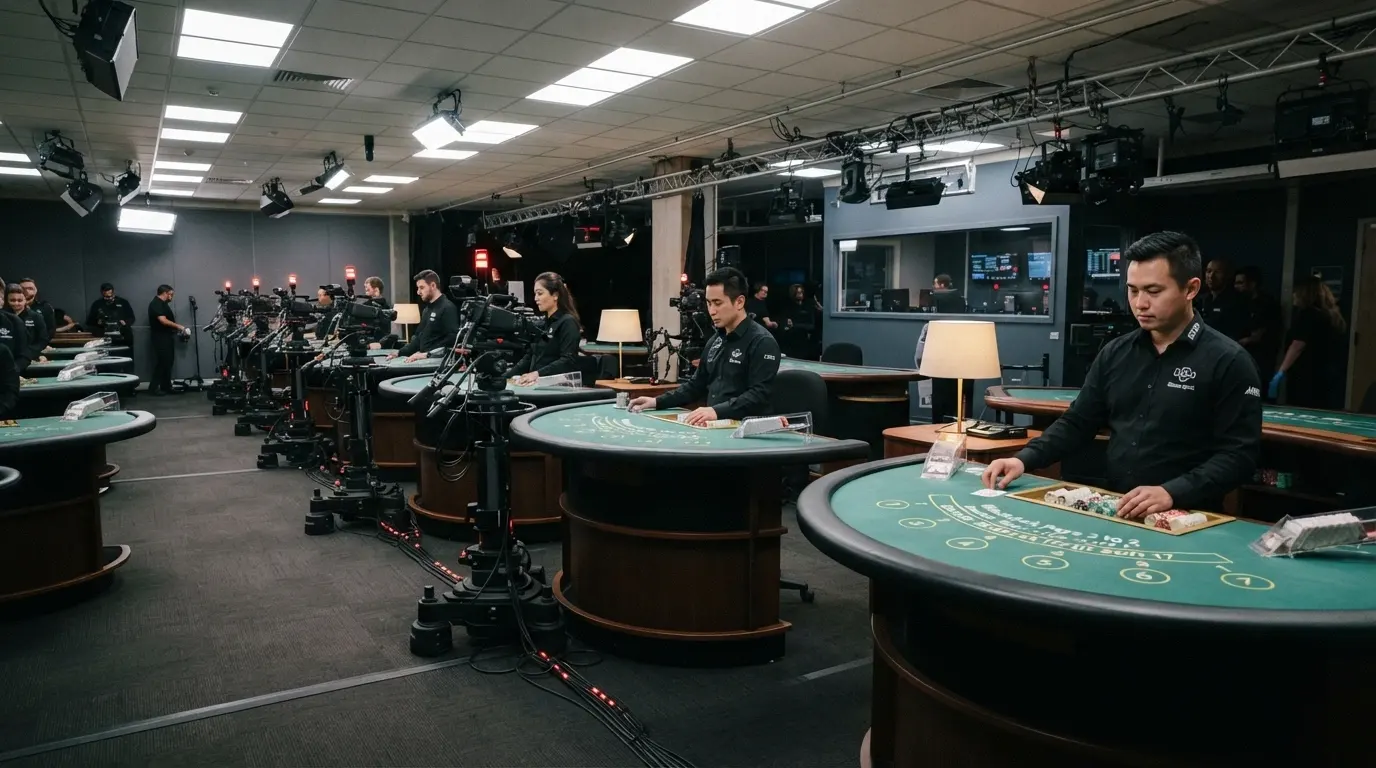
Three providers serve the Australian-facing offshore market in meaningful volume. Evolution Gaming is the market leader — the company that defined what a live casino studio looks like in the modern era and still sets the technical standard. Pragmatic Play Live has expanded its footprint rapidly and competes on volume and on a tighter game format. Ezugi occupies a niche position with regional studios and a slightly different rule set on some tables. Every offshore casino in the ranking below integrates at least Evolution; some integrate all three.
The studio environment itself is functional rather than glamorous — bright lighting, no windows, acoustic tiles on the ceiling to keep the dealer’s voice clean for the stream. The cameras are fixed and the angles are limited. A high-quality stream reads clearly on a phone screen in sunlight; a mediocre one turns the dealer’s face into a soft blur and makes the cards hard to read when the felt is busy. The difference between a A$10 stake at a well-lit table and the same stake at a poorly-lit one is real, and it shows up in how many hands a player misreads per session.
The Providers Behind the Stream: Evolution, Pragmatic Play Live and Ezugi
Evolution Gaming is the default. Eight decks in a manual shoe, dealer standing on all 17s, Perfect Pairs and 21+3 side bets available on the main table — that is the Evolution baseline, and it is the configuration the Australian-facing offshore market overwhelmingly runs. Evolution’s catalogue also includes Infinite Blackjack (one dealer, unlimited players, decisions made on individual terminals), Speed Blackjack (faster deal, lower commission on the slowest decisions), VIP tables for high-roller stakes and the Diamond and Grand Bonus variants that pay enhanced multiples on side bets. One reviewed offshore site exposed more than 80 live dealer blackjack tables through its Evolution integration.
Pragmatic Play Live entered the market later but has built out a competitive catalogue, with a particular focus on speed-format tables and lower studio overhead. Ezugi operates from regional studios — including a Latin American operation that occasionally turns up on AU-facing platforms — and runs a slightly different rule set on some tables, including dealer-hit-soft-17 variants that change the house edge marginally. The provider mix on a given offshore site shapes table choice more than any branding decision the casino makes: a casino with all three providers offers more variety than a casino with only Evolution, but a casino with only Evolution still covers the main formats the Australian player actually uses.
What Separates a Good Live Blackjack Casino from the Rest
Four filters matter, and the research cycle for this page could only verify some of them on a per-operator basis. The honest ranking therefore lives as much on qualitative judgement as on hard numbers.
Table limits. The range across the offshore market runs from A$1 minimum bets at the low end to A$10,000+ at the VIP tables on the most expansive sites. A player with a A$100 bankroll needs the A$1 floor; a player with a A$5,000 bankroll needs the table to stretch high enough that a single bad run does not cap their session. One reviewed platform exposed the full range including VIP and Grand Bonus tables at A$10,000. Most cover the A$1 to A$5,000 band adequately and leave the high-roller ceiling thinner.
Stream quality and latency. Latency from Australia sits at 1.5 to 3 seconds on a stable connection, and it is the player-side reality regardless of which studio or which casino is fronting the stream. Stream quality varies more: the 1080p/60fps ceiling observed on one platform is the best the market currently delivers; other platforms run lower resolutions with occasional buffering. A player should expect to see what they see in the casino’s promotional screenshots before depositing, not after.
Provider mix and table count. One reviewed platform offered more than 80 live dealer blackjack tables with VIP, Speed, Golden and Grand Bonus variants; another carried 45+ blackjack titles across Evolution, Pragmatic Play Live and Ezugi. The breadth is what gives a player the choice between formats, rule variations and stake levels. A casino with five live blackjack tables is functioning as a slot site that happens to have a live tab.
Bonus terms. This is the one that hurts. Live blackjack typically contributes only 10% toward wagering requirements at most offshore casinos targeting Australian players. A welcome bonus with a 35x wagering multiple — which counts as reasonable in this market — becomes an effective 350x on blackjack play. The bonus looks competitive on the landing page. The maths underneath it is something else entirely.
Top Live Blackjack Casinos for Australian Players: 2026 Comparison
The table below ranks the ten offshore casinos most frequently cited in the Australian-facing live blackjack market, in descending order of traffic share among the operators tracked. Every one of them is offshore. None holds an Australian online casino licence because none exists. The traffic figures are selection snapshots, not endorsements; the ranking reflects the comparative visibility of these brands to Australian players searching for live blackjack, not a judgement of which one is safest to use.

| Operator | AU Legal Status | Licence Jurisdiction |
|---|---|---|
| Rocket Play | Offshore — no Australian licence | — |
| Skycrown | Offshore — no Australian licence | — |
| Royal Reels | Offshore — no Australian licence | — |
| WinSpirit | Offshore — no Australian licence | — |
| Stake | Offshore — no Australian licence | Curaçao (widely known, not confirmed from a direct snippet this cycle) |
| Rainbet | Offshore — no Australian licence | — |
| Scream Casino | Offshore — no Australian licence | — |
| FairGO | Offshore — no Australian licence | — |
| Bizzo Casino | Offshore — no Australian licence | — |
| Rocket Casino | Offshore — no Australian licence | — |
What the table cannot say, and what the operator write-ups below carry: each of these brands exists in an environment where per-operator specifics — bonus amounts, wagering terms, licence confirmations, payment methods, game-provider counts — could not be independently verified in the research cycle behind this page. Where research did not supply a figure, the write-up is qualitative. Where a figure is on the page, it carries the source’s qualifier.
Rocket Play
Rocket Play sits at the top of the Australian-facing offshore live blackjack traffic snapshot, which is a measure of visibility rather than quality. The platform offers live dealer blackjack through the standard provider mix; the table range and stake levels follow the market norm of A$1 to A$5,000+ across Evolution’s catalogue. The research cycle for this page did not surface independently verified per-operator data on Rocket Play’s bonus structure, game-provider count or licence jurisdiction beyond the offshore status it shares with every other brand on this list.
For an Australian player, what Rocket Play represents is the top of a traffic-ranked list of platforms that are, by definition, outside Australian law. The site can offer live dealer blackjack because the operator is based offshore; the player can reach it because Australian ISPs have not blocked it yet — though the ACMA’s blocking list has reached 1,564 illegal sites and counting, and any offshore casino can be added to it without notice. A balance sitting at Rocket Play the morning an ACMA blocking request lands at an Australian ISP is a balance the player cannot reach.
The verdict on Rocket Play is honest by necessity: it is the most-visible option in a market defined by its legal ambiguity, not its player protections.
Skycrown
Skycrown is the second-most-visible brand on the Australian-facing offshore traffic snapshot and the one with a documented bonus term that matters for blackjack players: a 40x wagering multiple on its welcome offer. On slots and on most RNG games, a 40x requirement sits in the middle of what the offshore market considers reasonable — between 30x at the disciplined end and 50x+ at the punitive end. On live blackjack, the same 40x is something else entirely.
Live blackjack contributes only 10% toward wagering at most offshore casinos in this market. Skycrown’s 40x, applied at 10% contribution, becomes an effective 400x on blackjack play. The player who thinks they are clearing a 40x bonus is, on the live tables, clearing 400x. The headline number does the marketing work; the game-weighting table in the bonus terms does the arithmetic.
Other specifics for Skycrown — welcome bonus amount, licence jurisdiction, payment methods, game-provider count — were not independently confirmed this research cycle and are therefore not stated on this page. What the page does carry is the one term the research surfaced, because that term is the one that turns a welcome offer into a trap for a blackjack player.
Royal Reels
Royal Reels sits in the middle of the traffic snapshot, between the more-visible names above it and the niche players below. The brand operates as an offshore casino offering live dealer blackjack through the standard provider integration; the specifics of its bonus structure, licence jurisdiction and payment method mix were not independently verified this research cycle.
Royal Reels occupies the same offshore regulatory position as every other brand on this list: unlicensed in Australia, outside BetStop, and outside the ACMA’s consumer-protection framework. A player comparing Royal Reels to other brands is comparing platforms that are equivalent on the dimensions that matter legally, even if they differ on dimensions — bonus size, stream quality — that the research could not confirm.
The honest verdict on Royal Reels is the honest verdict on this whole category: it is one of several offshore platforms offering a product Australians cannot access through any licensed channel, and choosing between them is a choice the player makes without the protection an Australian licence would provide.
WinSpirit
WinSpirit is the fourth brand on the traffic snapshot and the one whose profile most closely tracks the smaller-scale offshore operators serving the Australian live blackjack market. What the brand offers is a live dealer blackjack lobby integrated through the standard provider catalogue and pitched at the same stake range the rest of the market runs. Because specific data on its bonus structure and provider mix remained unverified this research cycle, the verdict for WinSpirit rests on the structural reality of the offshore market rather than a specific competitive advantage.
Stake
Stake is the high-profile outlier on this list. The brand is widely associated with a Curaçao licence and a crypto-native banking model — neither of which could be confirmed from a direct snippet in the research cycle for this page, though both are broadly known across the affiliate-review landscape. What makes Stake worth singling out is not its licence but its payment positioning.
Australia banned credit cards, credit-related products and digital currency as payment for licensed online wagering from 11 June 2024, under the Interactive Gambling Amendment (Credit and Other Measures) Act 2023. An operator that asks an Australian player for a Bitcoin or Ethereum deposit is, by definition, not a licensed Australian wagering provider — licensed wagering in this country cannot accept crypto. Stake’s crypto-first model is therefore not just a banking preference; it is a structural signal that the operator sits outside the Australian regulatory perimeter.
The crypto-friendly positioning is also why an Australian player choosing Stake is making a different choice from an Australian player choosing a platform that runs debit cards and PayID. Both are offshore. One operates in a banking ecosystem that is explicitly banned under Australian law for any licensed equivalent. The verdict on Stake is that it is a well-known offshore casino whose banking model is itself a marker of how far outside Australian rules the platform sits.
Rainbet
Rainbet sits in the middle of the traffic snapshot, with a profile that tracks the smaller offshore operators serving the Australian live blackjack market. The research cycle did not confirm Rainbet’s bonus structure, licence jurisdiction, payment methods or provider mix from independently verified snippets, and the write-up is therefore qualitative on what is publicly observable and silent on what is not.
The honest verdict on Rainbet follows the pattern set by the brands above and below it: an offshore casino outside Australian law, outside BetStop, outside the ACMA’s consumer-protection framework, and offering a live dealer blackjack product the Australian licensed market cannot supply. A player considering Rainbet is considering one option in a market where every option shares the same legal exposure.
Scream Casino
Scream Casino is the seventh brand on the traffic snapshot. Data on its bonus structure, licence jurisdiction and provider mix remained unverified this research cycle. The brand operates as an offshore platform offering live dealer blackjack to Australian players, sharing the regulatory exposure of every brand on this list.
The honest verdict is simple: the platform is offshore and outside Australian law, offering no consumer protections, no BetStop coverage, and no recourse if the operator delays or refuses a withdrawal. Without a specific differentiator in the research, the verdict rests on the platform’s unlicensed status.
FairGO
FairGO is an Australian-facing brand name in the offshore space — the name signals a domestic-market focus that the licensing reality does not support. FairGO is an offshore casino, not an Australian-licensed wagering provider; the research cycle did not confirm its licence jurisdiction, bonus structure, payment methods or provider mix from independently verified snippets.
What FairGO illustrates, and what makes it worth a short write-up despite the lack of verified specifics, is the branding gap that runs through the offshore market. A name like FairGO reads to an Australian player as a brand that knows the local market. The legal reality is that the brand is offshore, the protections it offers are not Australian, and a player choosing FairGO over an Australian-licensed wagering operator is choosing an offshore platform dressed in local branding. The verdict is structural, and the structure is the same as for every brand on this list.
Bizzo Casino
Bizzo Casino sits near the bottom of the traffic snapshot. Detailed bonus and licence data for the platform were not independently verified this research cycle. The brand functions as an offshore casino integration, subject to the same regulatory risks as its peers.
The verdict follows the pattern of the market: it is an offshore casino outside Australian law, and a player choosing it is choosing one option in a market where every option shares identical legal exposure. No competitive differentiator surfaced for the brand, so the assessment remains neutral.
Rocket Casino
Rocket Casino closes the traffic snapshot — tenth on the list, sharing the position with Bizzo Casino. Independent verification of its specifics was not completed this research cycle. The brand offers live dealer blackjack to Australian players, but operates without a licence or any Australian consumer protection.
The verdict is consistent with the rest of the category: it is an offshore casino outside Australian law. The player’s decision to use it is a decision to accept the structural exposure inherent in offshore play, as no specific advantages could be verified for the platform.
The Legal Reality: Why Every Live Blackjack Site Australians Use Is Offshore
The Interactive Gambling Act 2001 is the statute that defines the offshore reality. It prohibits the provision of online casino games — including live dealer blackjack — to a person in Australia. It does not prohibit the player from accessing these sites; it prohibits the operator from offering them. The penalty structure runs against the provider, not the punter.

The Australian Communications and Media Authority is the federal regulator that enforces the prohibition. ACMA investigates complaints, issues formal warnings, refers operators for civil penalty proceedings and — most visibly — directs Australian internet service providers to block illegal sites. Since November 2019, ACMA has had 1,564 illegal gambling and affiliate websites blocked by Australian ISPs. More than 225 illegal services have withdrawn from the Australian market entirely since enforcement was strengthened in 2017. The blocking list is the most public expression of the prohibition’s reach; it is not the only one.
The 2026 reform tightens what is already tight. The Interactive Gambling Amendment (Gambling Reform) Bill 2026 passed both Houses of Parliament on 19 August 2026. From 1 January 2027, direct marketing of inducements is prohibited for 14 days after sign-up and for 90 days after a BetStop deregistration; the live-sport advertising blackout extends to 15 minutes before a game from five minutes previously; athletes, celebrities and influencers are barred from promoting wagering products. Banks and payment providers gain express authority to block transactions to illegal gambling operators from the same date.
None of this changes the offshore status of the live blackjack sites Australians use today. The reform is a tightening of what was already a ban, not a legalisation. The product remains prohibited. The providers remain offshore. The player remains exposed.
What the IGA Prohibits — and What It Does Not
The Interactive Gambling Act draws a clean line. Prohibited: online casino games, online pokies and in-play sports betting — that is, wagering on a sporting event once it has started. Permitted and licensable: pre-event wagering on sport and races, lotteries and keno. The licensing regime for the permitted categories runs through state and territory regulators, concentrating in practice through the Northern Territory Racing and Wagering Commission (NTRWC) and administered through Licensing NT. The minimum age for all commercial gambling in Australia is 18.
The credit and crypto ban sits alongside the prohibition on the product. The Interactive Gambling Amendment (Credit and Other Measures) Act 2023 banned credit cards, credit-related products and digital currency as payment for online wagering from 11 June 2024. An operator that fails to enforce the ban faces penalties of up to A$247,500. The payment ban does not bind offshore casinos — they are outside Australian law and cannot be bound by it — but it binds the licensed operators and defines, by exclusion, the banking footprint the licensed market occupies.
From 1 January 2027, banks and payment providers gain express statutory authority to block transactions to illegal gambling operators. This is the mechanism that may, in practice, narrow what Australian players can do at offshore sites even though the IGA itself does not bind the player. A bank that decides to refuse a transfer to an offshore casino is not enforcing the IGA; it is exercising the new authority the 2026 reform grants.
What Offshore Status Costs the Player: Protections You Lose
The IGA targets the provider. The cost of that targeting falls, in practice, on the player — because the player is the one whose protection gap opens up the moment they sign up to an offshore site.
- No Australian consumer protection. The Australian Consumer Law does not apply to an offshore operator. The terms and conditions the player agrees to are governed by the law of the jurisdiction the operator is licensed in — Curaçao, Malta, Anjouan, or wherever else the licence was issued. Disputes are heard in that jurisdiction, if they are heard at all.
- No Australian complaints body. ACMA cannot recover money for an individual player. The regulator enforces the prohibition; it does not arbitrate consumer disputes. The player who has a balance held by an offshore operator has no Australian agency to appeal to.
- No BetStop coverage. BetStop — the National Self-Exclusion Register — binds Australian-licensed wagering services. An offshore casino is not connected to the register. A person who has self-excluded through BetStop can still deposit, wager and lose at an offshore site. The exclusion does not extend to the product the IGA prohibits.
- No recourse on withdrawals. If the offshore operator refuses a withdrawal, voids a win or closes the account, the player has no Australian regulator to appeal to. The dispute is between the player and an entity in another jurisdiction.
- DNS blocking at any time. The ACMA can request that Australian ISPs block an offshore casino at any time. The player can wake up to find the site unreachable, with a balance on it. The 1,564 sites blocked since November 2019 are evidence that the blocking is not theoretical.
- The payment method as a tell. An operator asking for a credit card or a crypto deposit is, by definition, outside Australian rules — licensed wagering cannot accept either. The payment method the operator requests is information about the regulatory position of the platform.
The gap is structural. It is not a marketing caveat and not a footnote. A player at an offshore casino is unprotected by every framework an Australian licence would activate.
Real Money Live Blackjack: What’s Actually at Stake
Real money at an offshore live blackjack table is real money exposed to every risk the previous section describes. The stake range is real: A$1 minimum bets at the low end of the market, A$10,000+ at the VIP tables on the most expansive sites. The arithmetic is real: a 0.5% house edge on a well-run table with basic strategy, against an unprotected bankroll sitting on a platform the ACMA can block at any time.
What the player actually puts at stake, beyond the bet itself, is the structural exposure. The offshore operator holds the money. The offshore operator decides when to pay it out. The offshore operator decides which bonuses convert and which do not. The offshore operator can be blocked by an Australian ISP between the player’s deposit and their withdrawal. None of this is hypothetical; every piece of it has happened at offshore casinos serving Australian players.
The Australian tax position is straightforward and slightly counterintuitive. Betting and gambling winnings are not assessable income under section 6-5 of the ITAA 1997; gambling losses are not deductible under section 8-1. The ordinary Australian punter who wins at blackjack does not pay tax on the win and cannot offset the loss against other income. The exception — carrying on a business of betting or gambling — is reserved for professional operators and does not apply to the recreational player. The winnings are tax-free. The losses are unrecoverable. Both of those facts hold for offshore play and licensed wagering alike.
Real-Money Live Tables, Stakes and the App Experience
The minimum bet at most AU-facing offshore live blackjack tables sits at A$1, with the standard table range running to A$5,000 and the VIP tables on the most expansive platforms extending to A$10,000+. The lowest-stake player finds the floor they need; the high-roller finds the ceiling. The middle of the market — the recreational player with a A$200 to A$500 bankroll — sits in the comfortable band every reviewed platform exposes.
The mobile experience has improved sharply over the last few years. The 1080p/60fps ceiling observed on one reviewed platform is genuinely usable on a modern phone; the betting interface overlays cleanly on the stream; the decision buttons are large enough to hit accurately. What has not improved is the latency. An Australian player on a stable connection sits at 1.5 to 3 seconds of stream delay to a European studio. The betting window has to absorb that lag. The player’s decision arrives at the dealer a beat after they click. It is workable but it is not equivalent to the experience of a player sitting in the same continent as the studio.
The app question — whether to play in a mobile browser or through a downloadable app — is secondary to the offshore question. Most offshore casinos offer both. Neither changes the legal position; neither changes the protection gap; neither changes the latency. The choice between them is a matter of preference, not safety.
Getting Money In and Out: Payment Methods That Work from Australia
The payment method an offshore casino accepts is information. A platform that asks for a credit card or a crypto deposit is, by definition, outside Australian rules — the credit and crypto ban applies to licensed wagering, and licensed wagering is the only category the ban covers. A platform that runs PayID and BPAY is signalling something different, though it remains offshore; PayID and Osko are the licensed-wagering deposit rails and they require identity verification.

The implication is not that a PayID-only platform is safe. It is offshore, outside Australian law, outside BetStop, outside the ACMA’s consumer-protection framework. The implication is that the payment method is a tell about the operator’s banking posture: credit and crypto mark the operator as far outside the Australian regulatory perimeter; PayID and BPAY mark it as closer, but still outside. The payment method is signal, not safety.
From 1 January 2027, the signal becomes more pointed. Banks and payment providers gain express authority to block transactions to illegal gambling operators. A bank that decides to refuse a transfer to an offshore casino is not enforcing the IGA; it is exercising the new statutory authority. The implication for a player funding an offshore account is that the funding route may close, even if the offshore site itself remains reachable.
Crypto, PayID and the Banking Methods Australian Players Actually Use
Crypto is the dominant deposit method at the most-visible offshore casinos serving Australian players. Bitcoin, Ethereum and Litecoin are the standard options; some platforms add USDT and a handful of altcoins. The crypto position is what marks these operators as furthest from the Australian regulatory perimeter — the credit and crypto ban applies to licensed wagering from 11 June 2024, and an operator asking for crypto is, by definition, not licensed wagering.
PayID and Osko are the licensed-wagering deposit rails. PayID links a bank account to a mobile number or email; Osko runs the instant transfer through the New Payments Platform. Both require identity verification — the licensed operator cannot accept PayID deposits without KYC, and the verification data is held against the wagering account. BPAY works as a bill-style deposit for some licensed operators, though its use has narrowed as PayID has expanded. The licensed operator’s deposit footprint is built around these three rails, with debit cards as a fallback.
Debit cards are the edge case. A debit card deposit at a licensed wagering operator is a debit card deposit — no credit advance, no crypto, no anonymity. A debit card deposit at an offshore casino is something else. The card is processed through an offshore payment processor; the operator is outside Australian rules; the transaction is a debit card deposit to an entity the IGA prohibits from providing the service. The deposit works. The protection framework does not apply.
Payout Speed and Withdrawal Limits: What to Expect
The research cycle for this page did not surface verified per-operator payout-speed data. What can be said without inventing specifics is that offshore casinos run the full range of withdrawal experiences: some process payouts within 24 hours once verification is complete; some hold withdrawals pending additional documentation; some delay payouts indefinitely. The variation is wide and the documentation is thin.
What is not variable is the protection gap. An Australian player whose withdrawal is delayed or refused at an offshore casino has no Australian regulator to appeal to. ACMA enforces the IGA; it does not arbitrate consumer disputes. The dispute is between the player and the offshore operator, governed by the law of the operator’s licensing jurisdiction. The player who has read the terms and conditions and accepted them has, in most cases, accepted the operator’s dispute resolution process as the only process available.
Verification hurdles add delay to first payouts at offshore casinos. The pattern is familiar: deposit is instant, withdrawal triggers a KYC review, the review takes days, additional documents are requested, the review takes more days. Some operators run this efficiently. Some operators run it as a friction layer. The honest position is that the variation is wide enough that no generalisation holds for all ten brands on the list above.
Why Your 2026 Live Blackjack Bonus Is Harder to Clear Than It Looks
A welcome bonus at an offshore live blackjack casino is a marketing surface, not a value proposition. The headline — “100% up to A$500”, “200% on first deposit” — runs against a term sheet that most players never read carefully enough. Two numbers do the damage: the wagering multiple and the game-contribution percentage.
The wagering multiple is the number of times the bonus must be turned over before it converts to withdrawable cash. The Australian offshore market considers 30x to 40x reasonable. Anything above 50x significantly reduces the realistic chance of converting bonus funds into real AUD. A 35x bonus is, in slot-game terms, ordinary. In blackjack terms, it is something else.
The game-contribution percentage is the share of each wager that counts toward clearing the bonus. Live blackjack typically contributes only 10% at most offshore casinos targeting Australian players. A A$1 chip on a live blackjack table counts as A$0.10 toward the wagering requirement. The other A$0.90 counts toward nothing. A 35x wagering requirement on a A$100 bonus — A$3,500 of turnover — becomes A$35,000 of effective turnover on live blackjack. The 35x becomes 350x. The marketing surface and the arithmetic are different numbers.
Welcome Bonuses, No-Deposit Offers and Blackjack Eligibility
The deposit-match welcome package is the standard offer at offshore live blackjack casinos. The structure is familiar: a percentage match on the first deposit, sometimes extending over the second and third, capped at a maximum bonus amount. The wagering multiple runs from 30x at the disciplined end to 50x+ at the punitive end. The game-contribution percentage is set in the bonus terms, and live blackjack’s 10% contribution is the market norm rather than the exception.
No-deposit bonuses — offers that credit a small bonus amount without requiring a deposit — are available at some offshore casinos targeting Australian players, though specific per-operator availability was not confirmed this research cycle. Where they exist, the wagering multiple is higher than on deposit bonuses and the win cap is tighter. The combination is rarely worth the effort for a blackjack player: a no-deposit bonus at 10% game contribution is a long grind for a small upside.
Free spins — the third common offer type at offshore casinos — are not blackjack-eligible. A free spin is a slot spin, and the wagering it generates counts toward slot game contribution, not table game contribution. The free spins bundled with a welcome package contribute nothing to the live blackjack playthrough.
Wagering Multiples, Win Caps and the Fine Print That Changes Everything
The table below compares the bonus term structures Australian players encounter at offshore live blackjack casinos. The figures are market norms, not per-operator values — research did not confirm per-operator specifics this cycle, and the cells therefore carry the range the market runs.
| Offer Type | Typical Wagering Multiple | Blackjack Game Contribution | Effective Wagering on Blackjack | Typical Validity Window | Win Cap |
|---|---|---|---|---|---|
| Deposit-match welcome (reasonable) | 30x–40x | 10% | 300x–400x | 7–30 days | A$100–A$500 (bonus-derived) |
| Deposit-match welcome (punitive) | 50x+ | 10% | 500x+ | 7–14 days | A$100 (bonus-derived) |
| No-deposit bonus | 50x–70x | 10% | 500x–700x | 3–7 days | A$50–A$100 |
| Free spins (slot-only) | 30x–40x on spin winnings | 0% (slots only) | N/A — blackjack-ineligible | 7 days | Varies |
The win cap is the term that turns the bonus from a grind into a trap. Some welcome bonuses cap bonus-derived winnings at as low as A$100, regardless of how much is won during playthrough. The player who clears a 400x effective wagering on blackjack and wins A$500 during the bonus period walks away with A$100. The marketing surface said “100% up to A$500”. The terms said “maximum withdrawal A$100”.
The validity window compounds the problem. A 7-day window on a 400x effective wagering requirement at A$10 per hand is mathematically achievable only by a player running a high-volume session with a deep bankroll. The recreational player with a A$200 bankroll cannot clear the bonus inside the validity window — and the bonus expires before the playthrough is complete, with the bonus balance forfeited.
The arithmetic the bonus page hides: a reasonable-looking 35x welcome offer at an offshore live blackjack casino is, on the live tables, a 350x playthrough with a 7-to-30-day clock and a win cap that may sit at A$100.
How to Play Blackjack: The Rules That Shape Your Odds
Blackjack is the casino game where the house edge is smallest — and where the player’s decisions matter most. With good rules and perfect basic strategy, the house edge sits under approximately 0.5%. With bad rules and undisciplined play, it can rise above 2%. The gap between the two outcomes is entirely in the player’s choices: which table to sit at, which hands to hit, which hands to stand, and which rules to refuse.
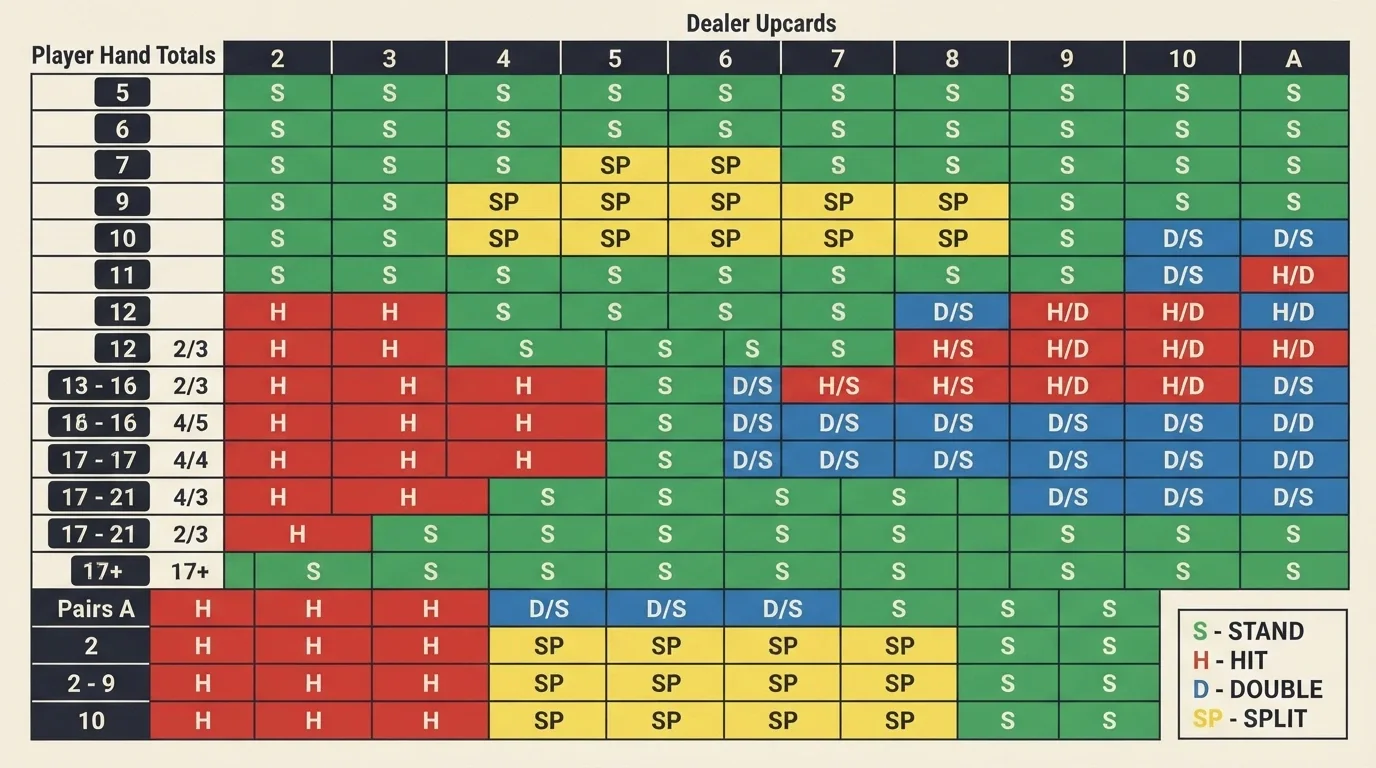
The foundational rules are standard across live dealer tables. Cards 2 through 9 carry face value. Tens and face cards count as 10. Aces count as 1 or 11, whichever helps the hand. The dealer deals two cards to each player and two to themselves, one face-up and one face-down. The player decides whether to hit (take another card), stand (keep the current total), double down (double the bet, take one card, then stand), split (if the two cards match, split them into two hands with separate bets) or — where offered — surrender (give up half the bet and end the hand). The dealer then plays their hand according to a fixed rule: at most Evolution Gaming tables, the dealer must stand on all 17s.
The Rules of the Game: Card Values, the Deal and the Dealer’s Hand
A hand of blackjack begins with a two-card deal. The player sees both of their own cards and one of the dealer’s — the upcard. The other dealer card, the hole card, stays face-down until the dealer’s turn. The player acts first; the dealer acts second. That order is the source of the house edge: the player can bust before the dealer ever plays a card, and a busted hand loses regardless of what the dealer does next.
The dealer’s play rule is fixed. On the standard Evolution Gaming configuration, the dealer stands on all 17s — both the hard 17 (no ace, or ace counting as 1) and the soft 17 (ace counting as 11). Some tables run the alternative rule: the dealer hits soft 17, taking an additional card on an ace-six total. The rule variation costs the player approximately 0.22% in expected return. It is a small number. It is also the difference between a 0.43% house edge and a 0.65% house edge on the same basic strategy — and a player who does not know which rule the table runs is playing blind to the arithmetic.
Basic Strategy: The Chart That Minimises the House Edge
Basic strategy is the mathematically optimal play for every player-hand against every dealer-upcard. The chart is not a guess and not a feel — it is the output of a combinatorial calculation that accounts for every card combination the shoe can produce, weighted by the probability each combination occurs under the rules in play. With perfect basic strategy and good rules, the house edge sits at approximately 0.43% to 0.5%. Without basic strategy — with the player guessing, “going with the gut” — the house edge can rise to 2% or more.
The strategy chart covers the decisions. Hard hands: hit or stand. Soft hands: hit, stand or double. Pairs: split or play as a single hand. The chart is not a single rule but a grid: 10 possible dealer upcards (ace through 10-value) crossed with the player’s possible hand totals (roughly 5 through 21, with splits broken out separately). Every cell carries the right action. Memorising the chart is the difference between a 0.43% edge and a 2% edge — and it is the one piece of work that pays for itself in the first session.
The chart does not overcome bad rules. The 6:5 payout rule — a blackjack paying A$6 for every A$5 wagered rather than the standard A$7.50 for every A$5 — is a −1.39% penalty to player return. It is the single worst rule variation in blackjack. Basic strategy cannot compensate for it. A player who sits at a 6:5 table is giving up more in expected return than the chart can recover.
First Time at a Live Dealer Table: What to Expect and What to Avoid
- Join a table and watch a hand before betting. The betting interface takes a few seconds to learn; the dealer’s rhythm takes a few hands to read; the latency takes a few decisions to calibrate against.
- Pick a 3:2 table and refuse a 6:5 table. The payout difference is the largest single rule variation. A 3:2 table gives the player a 0.43% house edge; a 6:5 table gives roughly 1.9%. The arithmetic is the choice.
- Prefer tables where the dealer stands on soft 17. The S17 rule is the Evolution Gaming default. The H17 alternative costs 0.22% in expected return.
- Use basic strategy from the first hand. A chart on a second screen is not cheating. It is the optimal play.
- Plan decisions inside the betting window. Australian latency runs at 1.5 to 3 seconds. The window is short. Decisions made after the window closes do not register.
- Avoid insurance. Insurance is a side bet on the dealer having blackjack. The house edge on insurance is high. Basic strategy says decline it.
- Set a session budget and stop at it. The house edge is small per hand but compounds over volume. A session budget is the player’s defence against the volume.
Why the Casino Wins at Blackjack — and How to Close the Gap
The house always has an edge. In blackjack, the edge is small — smaller than in roulette, smaller than in slots, smaller than in most table games the offshore casino offers. The player controls how wide that gap is through the choice of table and the discipline of the play.
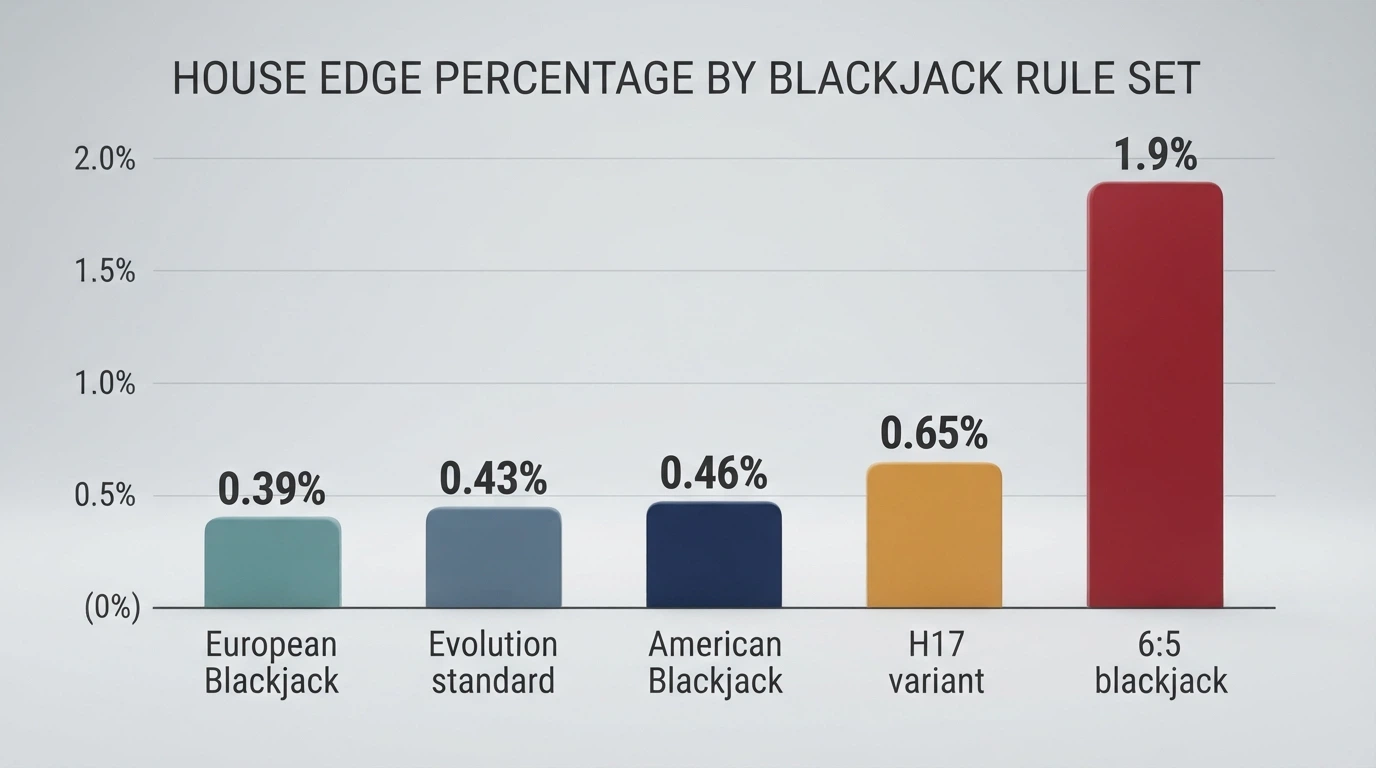
The base house edge under good rules — 3:2 payout, dealer stands on soft 17, double after split allowed — is approximately 0.43% to 0.5% with perfect basic strategy. The player’s expected loss per A$100 wagered is approximately A$0.43 to A$0.50. Over a session of A$1,000 in total wagers, the expected loss is A$4.30 to A$5.00. Over a session of A$10,000 in total wagers, the expected loss is A$43 to A$50. The math is not punitive. It is also not zero.
The gap between 0.43% and 1.9% is the gap between a 3:2 table and a 6:5 table. The gap between 0.43% and 0.65% is the gap between S17 and H17. The gap between 0.43% and 2% is the gap between basic strategy and undisciplined play. Each of those gaps is a choice the player makes — and each one widens or narrows the slice of every wager the house keeps.
The House Edge Explained: How the Maths Works Against You
The house edge in blackjack is the product of three structural elements and one player-side element. The structural elements: the player acts first and busts lose regardless of the dealer’s outcome; the dealer draws from the same shoe and therefore shares the player’s probability of busting, but the player has already lost by the time the dealer plays; the rules are set by the casino and not by the player. The player-side element: the player chooses whether to follow basic strategy or to play by feel.
The 6:5 payout rule is the single worst variation. A blackjack paying 6:5 rather than 3:2 is a −1.39% penalty to player return. On a A$5 hand, a blackjack pays A$6 instead of A$7.50 — a difference of A$1.50 per natural. Over a session of 100 blackjacks, the player loses A$150 to the rule alone. The rule is the difference between a 0.43% house edge and a 1.9% house edge on identical play.
The soft-17 rule is the second-worst variation, and a much smaller one. A dealer hitting soft 17 (H17) rather than standing (S17) costs the player approximately 0.22% in expected return. The rule is the difference between a 0.43% house edge and a 0.65% house edge. It is a small number. It is also the difference between a table the player should pick and a table the player should leave.
The number of decks is a third variation, smaller still. Evolution Gaming’s eight-deck configuration is near the middle of the range; a two-deck configuration gives a marginally lower house edge; a six-deck configuration gives a marginally higher one. The differences are small — hundredths of a percent — and most players do not need to track them.
The Best-Odds Live Blackjack Variants and Their Payout Rates
The table below compares the house edge across the live blackjack rule sets and variants Australian players encounter at offshore casinos.
| Rule Set / Variant | Decks | Dealer Soft 17 Rule | Blackjack Payout | Approximate House Edge |
|---|---|---|---|---|
| European Blackjack | 2 (commonly 6–8 online) | S17 | 3:2 | ~0.39% |
| American Blackjack | 6 or more | S17 | 3:2 | ~0.46% |
| Evolution Gaming standard | 8 | S17 | 3:2 | ~0.43% (Atlantic City equivalent) |
| 6:5 blackjack (any variant) | Varies | Varies | 6:5 | ~1.9% |
| H17 variant (any) | Varies | H17 | 3:2 | +0.22% vs S17 equivalent |
European Blackjack is the best-odds variant on the Australian-facing offshore market: approximately 0.39% with two decks and the standard 3:2 / S17 rules. American Blackjack runs marginally higher at approximately 0.46% with six or more decks. Evolution Gaming’s standard configuration — eight decks, S17, 3:2 — sits at approximately 0.43%, equivalent to the classic Atlantic City ruleset.
The 6:5 row is the one that matters most. The 6:5 payout quadruples the house edge. A player sitting at a 6:5 table is not playing the same game as a player at a 3:2 table; the rules have changed the mathematics, and the change runs against the player by approximately 1.39% of every wager. The 6:5 row is not a small variation to tolerate. It is a table to leave.
The side-bet columns are deliberately not on this table. Perfect Pairs and 21+3 — the side bets available on Evolution Gaming’s standard table — carry house edges that research did not quantify for this page, and the table does not invent figures the research did not provide.
The Blackjack Table: Layout, Dealer and Chips Explained
A live blackjack table is a semicircular felt with up to seven betting positions arrayed along the curve. The dealer stands behind the straight edge, facing the players, with a chip rack to one side and the shoe to the other. The shoe holds eight decks of cards in Evolution Gaming’s standard configuration; the dealer draws from it manually, exposes each card to the camera before placing it on the felt.
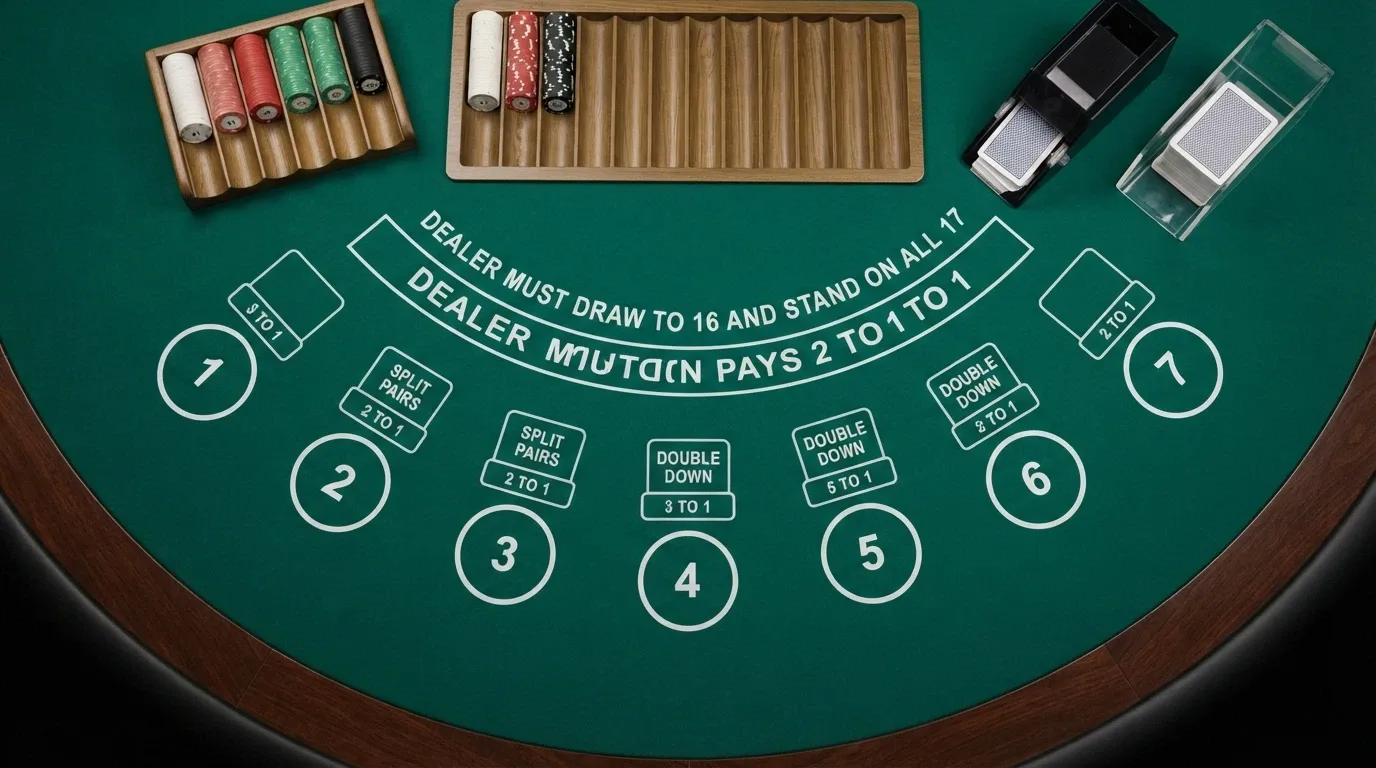
The betting positions are marked on the felt: a circle or a rectangle for the main bet, smaller areas for the side bets where they are offered. Perfect Pairs and 21+3 sit beside the main betting circle. The player’s chips are placed inside the marked area before the betting window closes. Once the window closes, the dealer runs the hand.
The chip rack holds the dealer’s inventory — the casino’s chips, not the player’s. The player buys in at the table through the on-screen interface; the dealer confirms the buy-in amount and pushes the chips to the player position. Cash-out runs in reverse: the player signals the cash-out amount, the dealer takes the chips and credits the player’s account through the casino interface.
The Dealer, the Shoe and the Table: What You See on Screen
The dealer’s job on a live stream is procedural. They deal the cards, run the player’s decisions through the terminal in front of them, play their own hand according to the fixed rule, settle the bets and prepare the next round. The dealer does not engage with chat beyond scripted courtesy; a moderator at the studio handles player-facing disputes. The dealer’s face is on camera for the entire shift; the dealer’s hands are on camera for every action; the dealer’s voice is on the stream for every call.
The shoe is the mechanism that defines the game’s randomness. An eight-deck manual shoe holds 416 cards; the dealer draws from it without reshuffling between rounds; the cut card is placed roughly two decks from the end to signal the reshuffle. A player counting cards can track the shoe’s composition; most players do not, and most offshore casinos ban card-counting devices and may ban players suspected of counting.
The table layout is functional. Seven positions, one dealer, one shoe, one discard tray. The on-screen betting interface overlays the stream; the player’s chips appear on the felt as the dealer confirms the bet. The visual experience is closer to a land-based casino than anything else the online gambling market offers — and that closeness is the reason players who came up on real casino floors sit at live dealer tables rather than RNG tables.
Blackjack Variants at Offshore Casinos: Switch, Slots and More
Offshore casinos expand the live blackjack catalogue with variants the land-based market rarely runs. Blackjack Switch deals two hands simultaneously and lets the player swap the top cards between them — a rule change that alters the basic strategy chart and shifts the house edge in a direction research did not quantify for this page. The variant is offered by some live dealer providers; the house edge is lower than standard blackjack in theory, but the optimal play is different enough that a basic strategy chart for standard blackjack does not apply.
The blackjack-slots hybrid is a separate category: games that use blackjack-style hand outcomes to drive a slot-style payout structure. The visual format is a slot; the outcome logic borrows from blackjack; the house edge is closer to a slot’s than to a blackjack table’s. Research did not surface per-variant house-edge figures for this category, and the page does not invent them.
The honest verdict on the variant category is that the standard rules of blackjack — the 0.43% to 0.5% house edge, the basic strategy chart, the 3:2 payout, the S17 rule — apply to the standard game. Variants change the mathematics, and a player who moves from standard blackjack to a variant without re-checking the maths is exposed to an edge they have not measured.
Staying in Control: Responsible Gambling Tools for Australian Players
The gambling harm data for Australia in 2026 is not reassuring. As of March 2026, 15.1% of the Australian adult population — an estimated 3.32 million people — are experiencing some level of harm from their own gambling or that of people close to them. Problem gambling incidence has increased from 1.9% in 2022–23 to 2.9% in 2024–25, with over 620,000 problem gamblers identified and the majority aged under 35. Risky gambling almost doubled between 2024 and 2025, from 13.7% to 19.4% — a number that tracks the post-COVID normalisation of online gambling access.
The offshore casino sits outside every Australian responsible-gambling system. BetStop — the National Self-Exclusion Register — binds Australian-licensed wagering services. An offshore casino is not connected. A person who has self-excluded through BetStop can still deposit at an offshore site, and the offshore site will accept the deposit. The exclusion does not extend to the product the IGA prohibits.
The Australian help infrastructure exists regardless of where someone gambles. The National Gambling Helpline — 1800 858 858 — is free, confidential and staffed 24 hours a day, 7 days a week. Gambling Help Online offers chat and counselling at gamblinghelponline.org.au. Both are available to anyone in Australia, including players at offshore casinos, players at land-based casinos and players who are gambling with someone close to them. The help exists. The offshore operator’s systems do not connect to it.
The Australian Help Infrastructure: BetStop, Helplines and What Actually Works Offshore
BetStop launched on 21 August 2023. By Q3 FY 2025–2026, 59,830 people had registered to self-exclude from all licensed online and phone wagering providers in Australia. As of 31 March 2026, 37,247 of those people held active exclusions — the remainder had completed their exclusion period or cancelled early. The register works as designed for the licensed market. It does not extend offshore.
The National Gambling Helpline is the universal resource. 1800 858 858 — free, confidential, 24/7. The helpline is staffed by counsellors trained in gambling-specific support; calls are not traced back to the gambler’s identity or their wagering accounts. Gambling Help Online extends the same service to chat and email channels. Both are reachable regardless of whether the gambler is playing at an Australian-licensed wagering provider, an offshore casino or a land-based casino.
The gap is the offshore casino’s own responsible-gambling tools — or rather, the absence of them as a guaranteed framework. Some offshore operators offer deposit limits, time-out periods and self-exclusion options within their own platforms. Some do not. The Australian player using an offshore casino cannot rely on the offshore operator’s tools the way they can rely on BetStop. The protection depends on the operator’s terms, the operator’s enforcement and the operator’s continued operation — and all three of those are outside Australian law.
Only 13.5% of those engaged in moderate-risk and high-risk gambling reported seeking help for gambling-related issues. The help infrastructure exists. The gap is in the proportion of people who reach it.
How We Selected and Ranked These Live Blackjack Casinos
The ranking is built on three inputs: the Australian-market affiliate-review landscape that dominates the search results for “live blackjack Australia”, the operators-skill traffic snapshot that orders the brands by visibility to Australian players, and the ACMA regulatory framework that defines the legal position of every brand on the list.
The ten featured operators were drawn from the operators-skill traffic snapshot — the brands that appear with measurable share in the Australian-facing offshore market. The ranking reflects traffic share, not safety or quality. The affiliate-review pages that populate the search results generally do not surface the structural risks of offshore play; they surface the brands and the bonus terms, and they leave the legal reality to a footer caveat. The ranking on this page does the opposite: it leads with the legal reality and treats the traffic order as a selection snapshot.
The honest caveat on this ranking: per-operator bonus specifics, licence jurisdictions and game-provider counts could not be independently verified for every brand in the research cycle behind this page. The traffic-share data and the legal-status data are verified. The bonus and licence data are not, and the write-ups above mark that gap rather than filling it with invented figures. Where research did not supply a figure, the write-up is qualitative. Where a figure is on the page, it carries the source’s qualifier.
The evaluation criteria that ordered the ranking — legal status (offshore for all ten), live blackjack table availability (where verifiable), provider mix (where verifiable), and bonus terms (where verifiable) — were applied within the limits the research cycle allowed. The reader weighing this list should weigh it as a snapshot of the most-visible offshore platforms offering live dealer blackjack to Australian players, not as an endorsement of any one of them.
So, Should You Play Live Blackjack at an Offshore Casino?
The decision turns on what the player is willing to risk beyond the bet. The mathematics of blackjack is favourable — a 0.43% to 0.5% house edge under good rules with basic strategy is the lowest the casino offers on any table game. The mathematics of the bonus is unfavourable — 350x effective wagering on a 35x headline, with a win cap that may sit at A$100. The mathematics of the offshore exposure is binary — every protection an Australian licence activates is absent, and the balance sitting on an offshore platform is exposed to the ACMA’s blocking list and to the operator’s own discretion.
The house always has an edge. In blackjack, the edge is narrow — and the player controls how narrow through rule selection and strategy. The structural risks of offshore play are not a game-mechanics problem; they are a legal-reality problem. The “magic” of a live dealer stream — and offshore marketing leans hard on the word — does not change the regulatory perimeter the operator sits outside.
The player who chooses to play should do so with eyes open to every protection they are leaving behind. The player who chooses not to play is making the decision the Australian regulatory framework was designed to support. The arithmetic earns each position. The reader’s circumstances — bankroll, risk tolerance, awareness of the help infrastructure, willingness to accept the offshore exposure — decide between them.
The help infrastructure is real. The National Gambling Helpline — 1800 858 858 — is free, confidential and 24/7. Gambling Help Online runs the chat and counselling channels. BetStop works for the licensed market. The data on gambling harm in Australia in 2026 — 15.1% of adults experiencing harm, 2.9% classified as problem gamblers, risky gambling nearly doubling between 2024 and 2025 — is the data the offshore marketing page does not show. The decision the reader makes with that data in view is a decision the page has argued for.
Frequently Asked Questions
Can I play live dealer blackjack for real money from Australia?
Yes — offshore casinos accept Australian players and offer live dealer blackjack for real money. No operator holds an Australian online casino licence because no such licence exists. Every site offering live blackjack to Australian players is an offshore operator outside the Interactive Gambling Act 2001, with no Australian consumer protection and no BetStop coverage.
What is the house edge in live blackjack and how does it compare to other casino games?
Under good rules — 3:2 payout, dealer stands on soft 17, double after split allowed — the house edge in live blackjack sits at approximately 0.43% to 0.5% with perfect basic strategy. A 6:5 payout table quadruples it to roughly 1.9%. Roulette runs at 2.7% (European) to 5.3% (American); slots typically sit at 4% to 10%. Blackjack is the lowest-edge table game the offshore casino offers.
What payment methods can I use to deposit at an online casino in Australia?
Offshore casinos accept crypto (Bitcoin, Ethereum, Litecoin), debit cards processed through offshore payment providers, and — on some platforms — PayID, Osko and BPAY. The credit and crypto ban applies to licensed wagering from 11 June 2024; an operator asking for credit or crypto is, by definition, outside Australian rules. From 1 January 2027, banks and payment providers gain authority to block transactions to illegal gambling operators.
Are live blackjack bonuses worth claiming and what are the wagering requirements?
The headline rarely survives contact with the terms. Live blackjack typically contributes only 10% toward wagering, so a 35x bonus becomes an effective 350x on blackjack play. Win caps on bonus-derived winnings can sit as low as A$100. A 30x to 40x wagering multiple is considered reasonable in the Australian offshore market; anything above 50x significantly reduces the realistic chance of converting bonus funds.
What happens if an offshore casino blocks my withdrawal — can I get my money back?
No Australian regulator can recover the money. ACMA enforces the Interactive Gambling Act 2001 against operators, but it does not arbitrate consumer disputes or recover funds for individual players. Disputes with offshore casinos are governed by the operator’s licensing jurisdiction. A player whose withdrawal is refused has no Australian complaints body to appeal to.
How does BetStop work and does it cover offshore casino sites?
BetStop — the National Self-Exclusion Register — binds every Australian-licensed online and phone wagering service. One registration excludes a person from all of them simultaneously. By Q3 FY 2025–2026, 59,830 people had registered; 37,247 held active exclusions as of 31 March 2026. BetStop does not cover offshore casinos. An offshore casino is not connected to the register and will keep accepting a self-excluded person’s money.