
Live Baccarat at Online Casinos: The Australian Player’s Honest Guide for 2026
Live dealer baccarat is the game Australian players search for most often when they look for online casino tables. The draw is straightforward: a real dealer, real cards, a real shoe, streamed in real time to a phone or laptop. The reality is less simple. Online casino is prohibited in Australia under the Interactive Gambling Act 2001 — no Australian-licensed casino exists, no Australian-licensed live baccarat table exists, and every table an Australian actually plays sits on an offshore server, outside Australian consumer-protection law. The list of casinos on this page reflects that fact, and so do the verdicts beside each one. Data current as of 22 November 2026; offshore licence claims verified against Curaçao eGaming, Anjouan and Kahnawà:ke public registers where stated.

Table of Contents
- Why Live Baccarat Is the Online Casino Game Australians Actually Play
- How Baccarat Actually Works — Rules, Card Values and the Table
- Why Your Baccarat Banker Bet Costs Less Than You Think — Strategy and Odds
- The Best Live Baccarat Casinos for Australians in 2026 — What Each One Brings to the Table
- Every Live Baccarat Variant Worth Knowing — From Squeeze to Speed
- Baccarat Bonuses That Actually Count Toward Your Play — And Most Do Not
- PayID, Bitcoin and Getting Money to the Live Baccarat Table
- Is Live Baccarat Legal in Australia? The Offshore Reality Every Player Needs to Read
- Playing Smart — Responsible Gambling Tools and Real Limits for Australian Baccarat Players
- How We Evaluated Every Live Baccarat Casino on This Page
- What the Australian Live Baccarat Player Should Actually Do in 2026
- Frequently Asked Questions
Why Live Baccarat Is the Online Casino Game Australians Actually Play
Baccarat sits inside an awkward gap in the Australian market. Land-based baccarat has been available at Crown Melbourne, The Star Sydney and the larger casino floors for decades. Online casino — the version a player reaches from a phone in Adelaide — is not. The Interactive Gambling Act 2001 prohibits providing online casino games, online pokies and in-play betting to anyone in Australia. The Act targets the provider, not the player. The player is not prosecuted for opening an account at an offshore site, but the operator offering that account is breaking Australian law to do so.
That gap — a game Australians know and play, with no legal domestic way to reach it — is exactly what live dealer baccarat fills. The game streams from a studio in Riga or Malta or Manila, the dealer calls the hand, the player bets on Banker or Player from their couch. The format dominates the Australian-facing search results for “baccarat online” because no competitor exists. There is no locally licensed live baccarat lobby to compare against.
Live Dealer vs RNG Baccarat — What You Are Actually Playing
A live dealer baccarat table is a physical table in a studio, run by a human dealer, with cards drawn from a real shoe and broadcast over multiple camera angles. The result is determined by the cards, not by a random number generator. An RNG baccarat table is software: no dealer, no shoe, no cameras, just a number generator producing outcomes against an animated felt. Both are sold as “online baccarat”, and both look similar on first glance. The trust dynamic is the difference. A live dealer table lets the player watch the cards leave the shoe. An RNG table lets the player do nothing but trust an algorithm and a regulator’s audit certificate.
For Australian players the live format also doubles as a legal-distancing trick. A live studio stream is closer to “playing at a casino” than clicking a button on a slot-style table, and offshore operators lean on that association in marketing. The format itself does not change the IGA’s prohibition. The studio is still offshore, the account is still offshore, the Australian player is still playing an unlicensed product.
The main studios serving Australian-facing casinos include Evolution Gaming, Playtech, Pragmatic Play and Iconic21. Each provider maintains specific live baccarat tables with Australian dollar betting limits.
Inside a Live Baccarat Studio — Dealers, Cameras and the Shoe
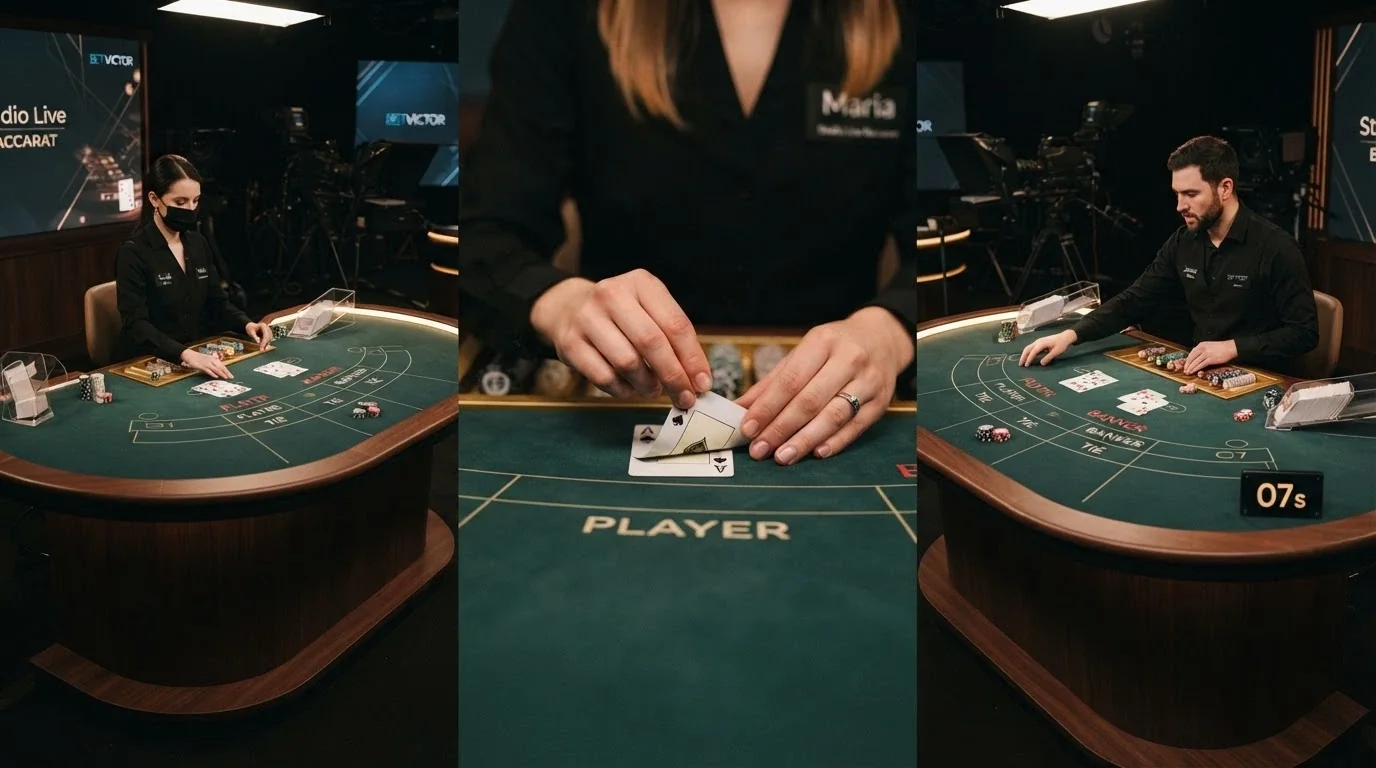
A live baccarat table on screen is a compressed version of what the studio actually contains. The dealer stands behind the table and runs the shoe — the clear plastic box that holds six or eight decks of cards. Cameras cover the table from above for the dealing area, from the side for the betting layout, and from close range for the squeeze. Multiple screens on the studio wall show every angle to the floor manager, who watches for procedural errors and suspicious betting patterns.
The dealer follows a strict script. Cards leave the shoe in fixed order — Player hand first, then Banker. The dealer announces each card as it lands. In a squeeze variant, the dealer slowly peels back the edges of the face-down cards with both hands, building suspense before the full reveal. The Squeeze Baccarat product from Evolution is built around this mechanic: close-up camera angles show only the edge of each card during the squeeze, and the full value appears at the end. The player sees the suspense but not the result until the dealer commits.
What the player sees on their screen is roughly a third of what the studio contains. The rest is operating equipment — card-checking machines, shoe-loading stations, surveillance cameras the player will never see, dealer rotation schedules, floor managers who can void a hand if a card flips exposed. A live studio is closer to a small factory floor than a casino pit.
Playing Live Baccarat from Australia — What the Landscape Actually Looks Like
The Australian player’s practical reality is that every live baccarat table they reach sits offshore. No Australian-licensed casino exists. The closest domestic alternative is the licensed wagering sector — Sportsbet, bet365, Ladbrokes and around fifty others — but those are bookmakers, not casinos. They take bets on horse races, sport and greyhounds, and a small handful offer a few table games bundled into the betting product. None runs a live dealer studio.
The offshore options are reachable but not protected. The ACMA has directed Australian ISPs to block 1,564 illegal gambling and affiliate websites since November 2019 (as at March 2026), and more than 225 illegal services have withdrawn from the Australian market since 2017. A blocked site is unreachable from an Australian IP address, but balances sitting on that site when the block lands are typically inaccessible too. The offshore casino does not move the balance back. Players keep choosing offshore tables because the game is the game, but the choice carries real legal and financial risk that no marketing page describes.
How Baccarat Actually Works — Rules, Card Values and the Table
Baccarat is one of the simpler casino games to read once a player is sitting at the table. The complication is mostly the language: baccarat has its own vocabulary for things a blackjack or roulette player already knows. The game itself is mechanical and fast.
Card Values and Hand Scoring — Why a Nine Is the Number That Counts
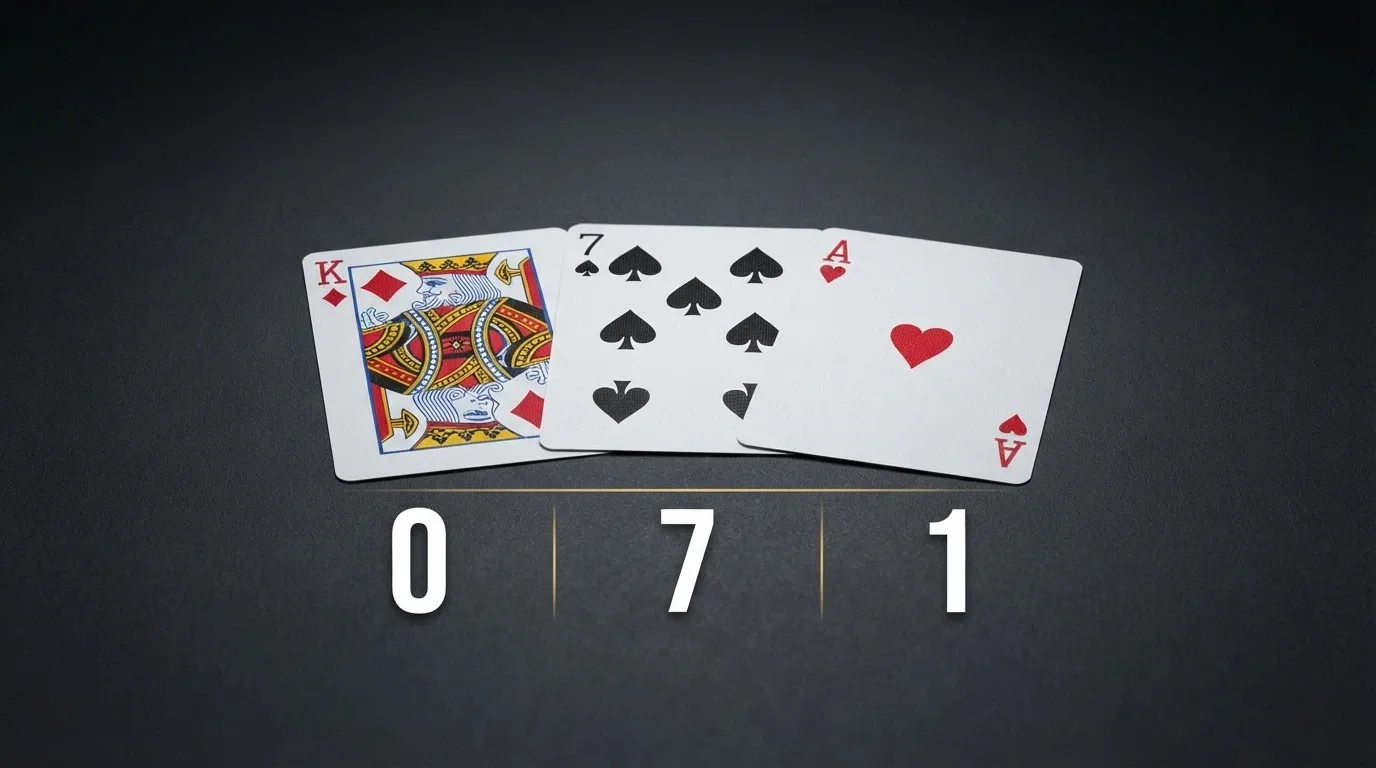
Baccarat cards are valued in a way that has nothing to do with poker or blackjack. Number cards — 2 through 9 — count at face value. Tens and face cards — Jack, Queen, King — count as zero. Aces count as one. The total of a hand is the sum of its cards, taken modulo ten. A hand of 7 and 8 totals 15, but the baccarat score is 5. A hand of King and 9 totals 9. A hand of King, 9 and 8 totals 17, but the score is 7.
The number that counts most is nine. A two-card hand totalling eight or nine is called a “natural”, and the hand ends immediately unless the Banker hand also has a natural of the same value, in which case it is a tie. Anything else stays in play, and the dealer may draw a third card according to a fixed rulebook that the player does not influence. The player does not make decisions about hit or stand — the table does, and the dealer follows the script.
The result is that baccarat has no real strategy on the player’s side. The hands are dealt under fixed rules, the player picks one of three bets, and the shoe moves on. The only decision that matters — and it matters a great deal — is which of those three bets to place.
The Baccarat Table and Scoreboard — Reading the Game at a Glance
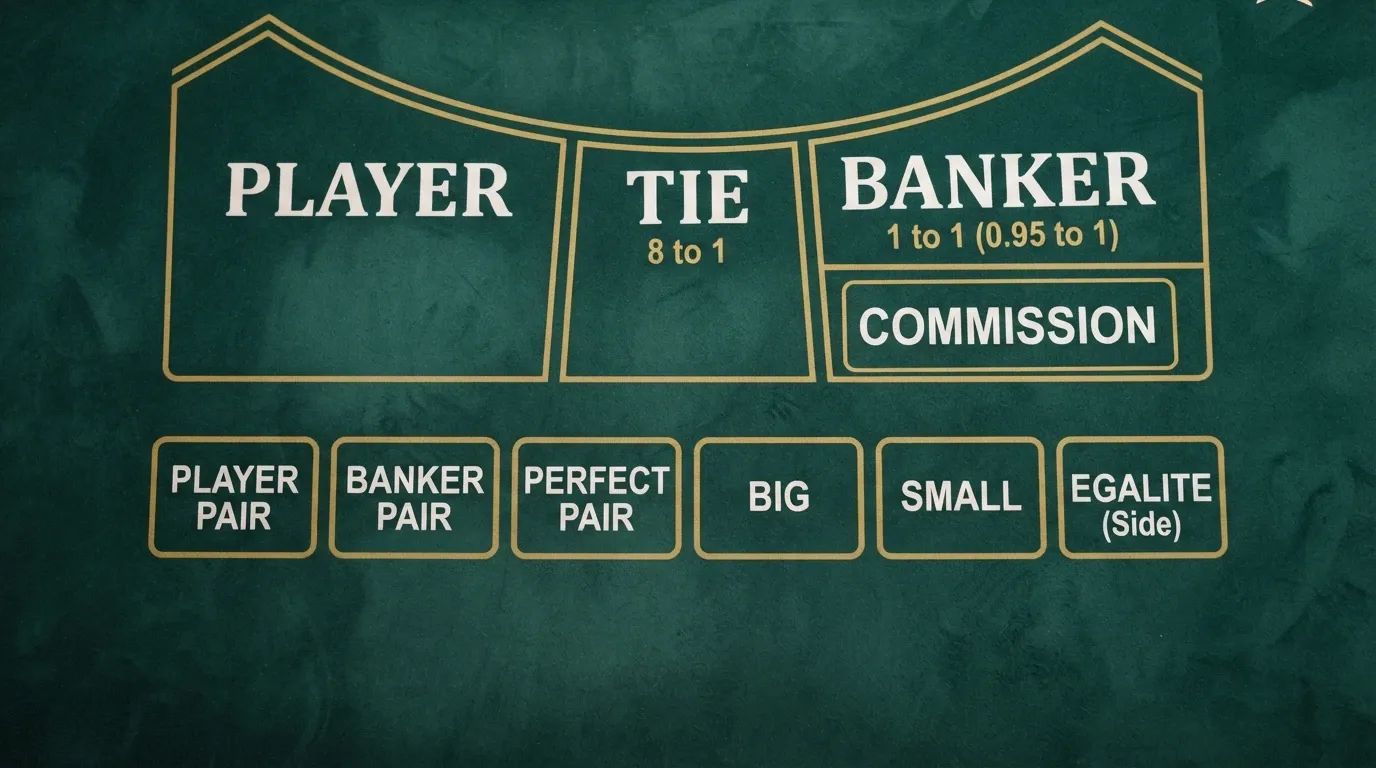
A baccarat table layout is simple in shape and rich in detail. The felt has three main betting areas marked across the arc facing the dealer: Player on one side, Banker on the other, Tie in the middle. Below those, a row of side bet boxes runs along the felt — Player Pair, Banker Pair, Perfect Pair, Either Pair, Big, Small, and the various bonus bets the variant offers. A small commission box sits next to the Banker area to remind the player that a winning Banker bet pays 0.95 to 1, not 1 to 1.
A live table mirrors the physical layout exactly. The betting interface on screen uses the same arrangement, and the dealer calls the result by hand — “Banker wins” or “Player wins” — so the player does not need to read the result from the layout. The interface highlights the winning bet area in green for a few seconds after the hand resolves.
Behind the dealer, or alongside the table on the player’s interface, sits the scoreboard. The scoreboard is the most argued-over object in baccarat. It tracks results hand by hand in the “Big Road” — a grid that records Player wins as blue dots, Banker wins as red dots, and ties as green slashes. From the Big Road, derivative roads (the Bead Plate, the Small Road, the Cockroach Pig) attempt to identify streaks and patterns. The roads look precise. They are not. Baccarat outcomes are independent from hand to hand; the scoreboard records what already happened, not what comes next. Punters who bet on streaks are betting against mathematics, not on a hidden system the road reveals.
The Shoe, the Cards and the Deal — What Happens Hand by Hand
A live baccarat shoe holds six or eight standard decks. The dealer slides the shoe to the table, removes the first few cards as a burn ritual, and signals the player that betting is open. The bettor has a few seconds to place chips on Player, Banker or Tie, or on any of the side bets the variant offers. When betting closes, the dealer deals two cards each to the Player and Banker hands, in that order.
The dealer calls each card as it lands, and the camera shows the value on a graphic overlay at the side of the screen. The score updates instantly. If either hand totals eight or nine from the first two cards, the hand ends. Otherwise the dealer consults a chart on the table and draws a third card to Player or Banker (or both) according to the rulebook. The dealer then calls the result, the losing bets are cleared, and the winning bets are paid.
The full cycle takes about fifteen to twenty seconds at a standard table. Speed Baccarat compresses that to eight or nine seconds by skipping the squeeze and pre-revealing the cards. Squeeze Baccarat stretches it by adding a slow reveal at the critical moment. The shoe itself is not reshuffled hand to hand; the dealer works through the cards until the shoe runs low, at which point the studio swaps in a fresh shoe and the cycle restarts.
Why Your Baccarat Banker Bet Costs Less Than You Think — Strategy and Odds
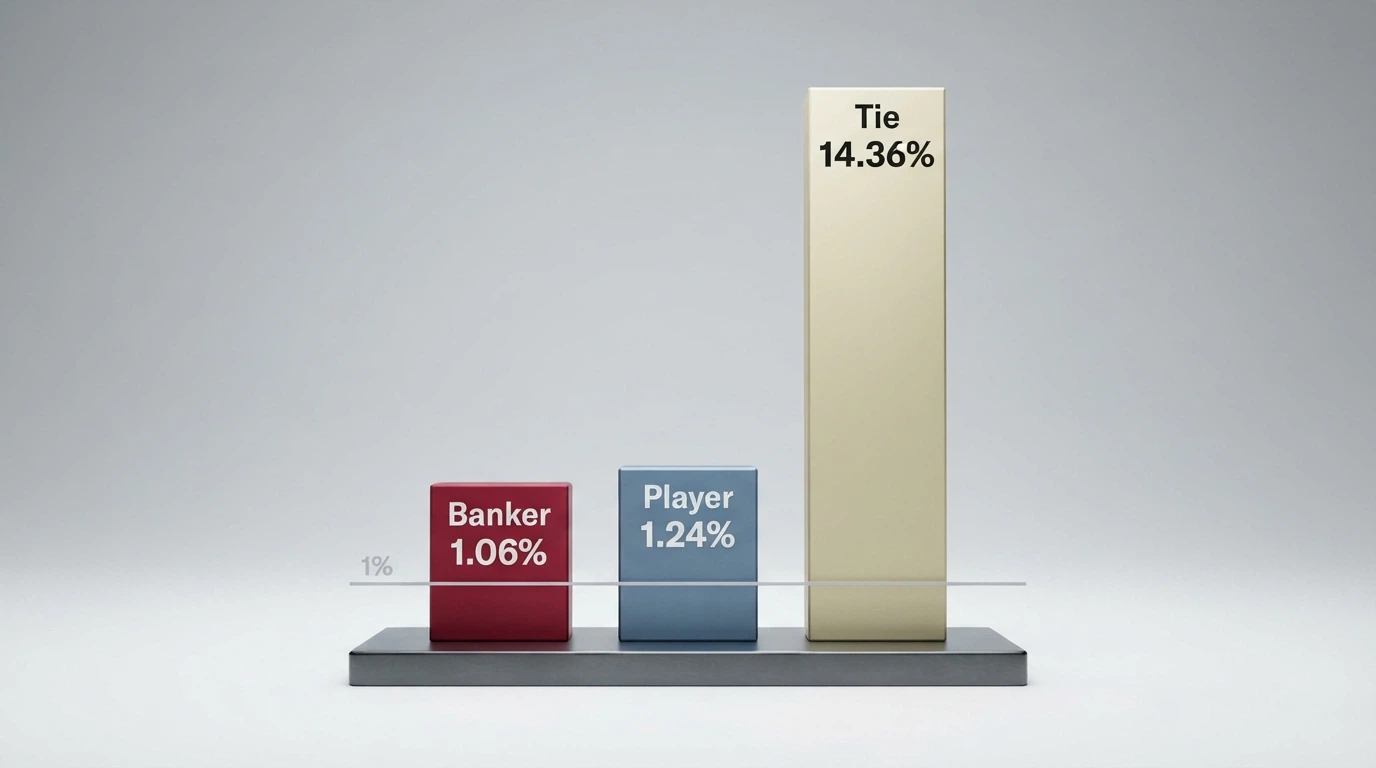
Baccarat’s house edge is one of the lowest in a casino. Most table games sit at 2% to 5%. Blackjack at full rules can dip below 1%. Baccarat’s Banker bet sits at 1.06% — lower than almost every other bet a casino offers, including most blackjack rule sets. The catch is that baccarat offers no room for player skill to narrow the edge further. The rules are fixed, the shoe is mechanical, and the only decision is which of three bets to place.
Banker, Player or Tie — The Only Betting Decision That Matters
Three bets, three edges. The Banker bet wins on roughly 45.86% of hands and carries a house edge of 1.06%. The Player bet wins on roughly 44.62% of hands and carries an edge of 1.24%. The Tie bet wins on roughly 9.51% of hands and carries an edge of 14.36%. The Tie looks tempting at 8 to 1 payout, but the math is brutal — for every A$100 wagered on Tie over hundreds of hands, the player loses about A$14.36 on average. The Banker bet loses the player about A$1.06 per A$100 wagered. The Tie bet is more than thirteen times worse.
The Banker bet’s edge is slightly lower than Player despite winning more often because it pays 0.95 to 1 — the casino takes a 5% commission on Banker wins. That commission is the price of the best bet on the table. The math still works in the player’s favour: even after the commission, Banker carries a smaller edge than Player’s even-money payout. Over 100 hands at A$10 per spin, the expected loss on Banker is roughly A$10.60. On Player, roughly A$12.40. On Tie, roughly A$143.60. The Tie number is not a typo. The Tie bet is where bankrolls go to die.
Streaks are real but irrelevant. A Banker streak of eight in a row is not rare, and it does not change the next hand’s odds. The shoe has no memory. Betting systems that chase streaks — doubling after a loss, doubling after a win — are betting on a sequence of independent events, and the math on independent events does not bend to a streak. The only thing that matters across hundreds of hands is which bet carries the lowest house edge. That bet is Banker. Always.
Baccarat Betting Systems — Why They Cannot Beat the House Edge
The Martingale system — double your bet after every loss — is the most famous casino betting progression, and baccarat is one of the games it gets applied to. The logic is clean: an eventual win recovers all previous losses plus a profit equal to the original bet. The implementation is not clean. A Martingale progression at A$10 base stake hits A$640 after six losses. Seven losses in a row is A$1,280. Eight losses is A$2,560. Baccarat streaks of eight consecutive Banker losses are not common, but they happen often enough that a Martingale progression crashes against the table’s maximum bet limit. The progression does not change the house edge. It changes how the loss is delivered — concentrated into one catastrophic hand rather than spread across many small ones.
Paroli — the reverse Martingale — increases the bet after a win, capping the progression at three or four wins before resetting. The Paroli reduces the maximum stake the player is exposed to, but it also does not change the house edge. The player wins three in a row more often than loses three in a row, but the winning streaks and losing streaks are short and frequent, so the progression rarely runs to completion. The end result is a flat-bet player’s average loss with extra volatility.
Flat betting — the same stake on every hand — is the only approach that does not pretend to overcome the edge. The player bets A$10 on Banker every hand and accepts that the expected loss per 100 hands is roughly A$10.60. Flat betting minimises volatility and lets the player set a session budget by counting hands, not by chasing losses. It is the least-bad approach in a game where the house edge cannot be beaten.
The one true edge in baccarat is picking Banker. No system changes that. A system changes how the loss is paid, not how much is paid over hundreds of hands.
The Best Live Baccarat Casinos for Australians in 2026 — What Each One Brings to the Table
Every operator below is offshore. No Australian-licensed casino exists, so no operator on this list — or any other list — can carry an Australian licence for the product they sell. The ranking is built on Australian-facing market share, then on live baccarat availability, then on bonus applicability for live table games. The bonus applicability column is largely empty: most welcome bonuses either exclude live dealer baccarat or carry contribution rates so low (0–10%) that the bonus is not worth claiming for a baccarat-only player. Where research did not confirm a value, the cell carries an em dash. Read those dashes as a signal — a value that the operator has not made easy to verify is, in itself, information.
| Operator | AU Legal Status |
|---|---|
| Rocket Play | Offshore (no Australian casino licence) |
| Skycrown | Offshore (no Australian casino licence) |
| Royal Reels | Offshore (no Australian casino licence) |
| Stake | Offshore (no Australian casino licence) |
| FairGO | Offshore (no Australian casino licence) |
| WinSpirit | Offshore (no Australian casino licence) |
| Rainbet | Offshore (no Australian casino licence) |
| Scream Casino | Offshore (no Australian casino licence) |
| Bizzo Casino | Offshore (no Australian casino licence) |
| Rocket Casino | Offshore (no Australian casino licence) |
The table shows what the ranking cannot. Every brand is in the same legal column. The “best live baccarat casino for Australians” is, structurally, the least-bad offshore casino for Australians — and the spread between the top and bottom of this list is not a spread between licensed and unlicensed but a spread between bigger and smaller offshore books. That is a real spread, and it matters for game selection, payout reliability and the depth of the live studio catalogue. It does not matter for the legal column.
Rocket Play
Rocket Play is the highest-share brand on this list. Australian-facing players recognise the name because the brand advertises heavily in the regional market and runs a deep live casino lobby. Live baccarat at Rocket Play is provided by Evolution Gaming, Pragmatic Play and Playtech — at least in the general AU-facing landscape, though specific provider confirmation for Rocket Play’s lobby was not available this review. That provider mix is the standard top-tier offering for AU-facing casinos: Evolution for squeeze and Speed Baccarat, Playtech for no-commission and side bet variants, Pragmatic Play for VIP and themed tables. Welcome-bonus terms for Rocket Play’s live baccarat bonus were not confirmed this run; the player should check the bonus terms page directly before claiming, particularly the contribution rate for live dealer games and any maximum-cashout cap attached to the bonus. Offshore status means no BetStop connection, no AU consumer protection and the risk of the site being blocked by ACMA at any time.
The brand is the deepest live baccarat lobby on this list by market share, and the spread of providers is what a serious live baccarat player wants. The verification gap on bonus terms is the trade-off — a player signing up is doing the due diligence the operator’s marketing does not do for them.
Skycrown
Skycrown sits just behind Rocket Play in AU-facing market share, and runs a similar live baccarat offering. The provider mix is drawn from the same landscape — Evolution Gaming, Pragmatic Play, Playtech — though Skycrown’s specific lobby composition was not separately confirmed this review. A Skycrown player gets the same studio access a Rocket Play player gets, in most cases, because both brands run on similar aggregator platforms that pull from the same provider pools. Bonus terms were not confirmed; the same verification gap applies.
The verdict is short. Skycrown is the same kind of product as Rocket Play, in the same offshore column, with the same legal caveats. The marginal difference between the two brands is brand familiarity, marketing reach and which one has the cleaner lobby on the day the player signs up. Players who find one site inaccessible often have success with the other.
Royal Reels
Royal Reels sits lower in the AU-facing market-share table. Live baccarat availability and provider mix were not confirmed this review — Royal Reels’ lobby may or may not carry Evolution or Playtech tables, and the player should check the live casino tab before depositing. Bonus terms were also not confirmed. A smaller market-share brand means a smaller live studio catalogue in most cases, but not always; a small operator can run a curated set of premium tables from a single top-tier provider.
The honest read on Royal Reels is that the player is taking on more due diligence for the same offshore product. The smaller brand carries the same legal risk as the bigger ones, with less public reputation to fall back on if a withdrawal stalls or a bonus term is misinterpreted. Verify the live baccarat availability before depositing. Verify the licence. Verify the bonus terms if a bonus is being claimed. The smaller share is not a reason to skip the brand, but it is a reason to take the verification step more seriously.
Stake
Stake is the most globally recognised crypto-native casino on this list. The brand runs a deep live casino lobby with Evolution Gaming and Pragmatic Play tables (in the general AU-facing landscape; specific confirmation for Stake’s lobby was not available this review). Crypto deposits and withdrawals are core to the product, and Stake accepts Bitcoin, Ethereum and several other digital currencies directly. Australia’s 2024 ban on crypto as a payment method for online wagering applies to licensed Australian operators only — Stake is offshore, so the ban does not bind it. From 1 January 2027, Australian banks gain authority to block transactions to illegal gambling operators; that authority extends to crypto on-ramps as the regulatory framework catches up. The player using crypto at Stake today is operating in a window the regulator has signalled will close.
Stake’s draw is the crypto model — fast deposits, fast withdrawals, no bank intermediary, no AUD conversion friction. The trade-off is the same as every other entry on this list: offshore status, no BetStop coverage, no AU consumer protection. A crypto-native player picks Stake because the model fits; a PayID player has better options closer to the top of the list.
FairGO
FairGO carries an Australian-sounding brand name, an Australian-flag logo and AU-facing branding throughout the site. None of that changes the legal status. FairGO is offshore. No Australian casino licence exists for any operator, including one that wraps itself in the flag. The Australian-branded offshore casino is a specific category of product: it sells familiarity to an Australian player who would otherwise be cautious about an unknown brand, and it operates from outside Australian jurisdiction. Welcome-bonus and provider data were not confirmed for FairGO this review.
FairGO does not connect to BetStop. A self-excluded Australian can deposit and play at FairGO today, tomorrow and any day until the operator blocks them by choice — which the operator has no incentive to do. The Australian-facing branding is marketing. The legal reality is what the marketing looks away from.
WinSpirit
WinSpirit is a mid-tier AU-facing casino brand. Live baccarat availability and provider mix were not confirmed this review, and the same verification gap applies on bonus terms. WinSpirit runs as an offshore casino in the same legal category as every other entry on this list — no Australian licence, no AU consumer protection, no BetStop coverage. The IGA targets the provider of a prohibited service, not the individual player. The player is not prosecuted for opening an account at WinSpirit, but the player also has no Australian recourse if a withdrawal is refused or a balance sits on a blocked site.
The verdict on WinSpirit is the same verdict as for any other mid-tier offshore brand on this list: the player is buying access to the game in exchange for every Australian safeguard the licensed market offers. Deciding between brands should rely on lobby quality and game variety rather than brand recognition.
Rainbet
Rainbet is a smaller AU-facing operator. Specific provider and bonus confirmation was not available this review. The smaller market share means a smaller live studio catalogue in most cases, and a smaller brand means a thinner public reputation to lean on if a dispute arises. The ACMA’s site-blocking programme — 1,564 sites blocked since November 2019 — applies to every brand on this list, including Rainbet. A balance sitting on Rainbet when an ACMA block lands is typically inaccessible. The risk is not theoretical.
The honest read on Rainbet is that the smaller-share entry is a thinner brand for the same offshore product. A player considering Rainbet specifically should treat the thinner data as a signal — if the operator does not make its providers, bonus terms and licence status easy to verify, the player is doing more work than they would with a bigger brand.
Scream Casino
Scream Casino sits lower in the AU-facing market share. The same verification gap applies on providers and bonus terms. The product is the same category as every other entry on this list: offshore, unlicensed in Australia, no BetStop connection, no AU consumer protection. The brand name is the only distinguishing feature. A player choosing Scream Casino is choosing a smaller brand for reasons that are not visible from this review.
The verdict is short: there is no Australian-licensed comparison point because none exists. Scream Casino is offshore like every other brand on this list. The player should verify the live baccarat lobby before depositing, and should not assume the smaller share means a worse product — it often means a smaller marketing budget, not a smaller live studio catalogue.
Bizzo Casino
Bizzo Casino is the second-smallest share entry on this list. Specific provider and bonus data were not confirmed this review. Bizzo runs in the same offshore column as every other brand. The same legal caveats apply: no Australian licence, no BetStop coverage, no AU consumer protection, ACMA blocking risk at any time.
The verdict on Bizzo follows the same shape as the smaller-share brands above: the player should verify the live baccarat lobby, the licence and the bonus terms before depositing, and should not assume the smaller share means a worse product. It often means a smaller marketing footprint.
Rocket Casino
Rocket Casino is the smallest-share entry on this list, and shares a similar name with Rocket Play without being the same brand. The two operate as separate offshore casinos, with separate lobbies, separate bonus terms and separate licence arrangements. A player who confuses the two is signing up for the wrong one.
Live baccarat availability and bonus terms were not confirmed this review. The same verification gaps apply as for every other entry. Offshore status, no Australian licence, no BetStop coverage. The smaller share is the smallest on the list, and a player considering Rocket Casino specifically should verify the live baccarat lobby, the licence and the bonus terms before depositing. The similar name to Rocket Play is a clerical trap, not a feature.
Every Live Baccarat Variant Worth Knowing — From Squeeze to Speed
The live baccarat variants an Australian player will encounter at offshore casinos fall into a handful of clear categories. The base game is the same — bet on Player, Banker or Tie — but the table rules, the dealing pace and the payout structure shift the experience. Most operators offer several variants from each provider; the table below shows what each one actually changes.
| Variant | Provider | Distinguishing Feature | Standard Players |
|---|---|---|---|
| Standard Baccarat | Evolution, Playtech, Pragmatic Play | Base game; Banker pays 0.95:1 with 5% commission | — |
| Baccarat Squeeze | Evolution | Dealer slowly reveals card edges; close-up camera angles | — |
| Baccarat Controlled Squeeze | Evolution | Player reveals cards via touchscreen; full suspense control | — |
| Speed Baccarat | Evolution, Pragmatic Play | Compressed dealing cycle (~8–9 seconds per hand) | — |
| No Commission Baccarat | Evolution, Playtech | Banker pays 1:1 with rule adjustment on certain totals | — |
| Mini Baccarat | Playtech, Pragmatic Play | Smaller table; dealer controls the shoe | — |
| Prestige Mini Baccarat | Playtech | Squeeze procedure on a mini table; floral/orange backdrop | — |
| VIP Baccarat | Iconic21, Pragmatic Play | Premium stake limits; single-seat or low-seat tables | — |
| Dragon Tiger | Winfinity | Head-to-head card derivative of baccarat | — |
The variant changes the rhythm and the payout structure, not the house edge on the main three bets. No Commission Baccarat looks like a generous payout shift, but the rule adjustment on a Banker win of 6 (typically a half-win or push) keeps the overall edge close to the standard Banker bet. Squeeze and Speed Baccarat change how the hand feels, not how it pays. Side bets — Player Pair, Banker Pair, Perfect Pair, Either Pair, the bonus bets on big-and-small margins — carry much higher edges than the main bets and should be treated as entertainment bets, not as strategy.
Mini Baccarat vs Full-Table Baccarat — What Changes When the Table Shrinks
Mini baccarat is played on a smaller table. A standard baccarat table seats up to nine players; a mini table seats seven. The dealer controls the shoe in mini baccarat, where some full-table formats historically allowed the player-dealt rotation. Cards are dealt face-down in mini baccarat until the Player hand is called, which speeds up the round. The full hand cycle at a mini table is shorter than at a full table, both because fewer players are betting between hands and because the dealer is running the show.
Playtech’s Prestige Mini Baccarat is the squeeze variant on a mini table — the same close-up camera angles and slow card-edge reveal as the full-table squeeze, but on a smaller felt with a distinctive backdrop. The pace is faster than the full-table squeeze and slower than Speed Baccarat, and the stake limits typically run lower than VIP variants. For an Australian player who wants the squeeze aesthetic without committing to VIP stake limits, Prestige Mini Baccarat is the middle option.
Mini baccarat is the dominant live format at most offshore casinos serving Australian players because it suits a smaller-stake, faster-pace market. Full-table baccarat still exists at some VIP and premium tables, but the typical live dealer lobby an Australian player reaches runs mostly mini variants.
Squeeze, Speed, No Commission — The Variants That Change How You Play
Squeeze Baccarat from Evolution is the most theatrical variant. The dealer performs the squeeze — a slow peel-back of the card edges — with close-up cameras showing only the edge of each card until the full reveal. The player sees the suspense without seeing the result early. Baccarat Controlled Squeeze moves the squeeze control to the player via a touchscreen interface: the player drags their finger across the card, controlling how fast the edge reveals. The mechanic is the same, but the agency is reversed.
Speed Baccarat compresses the dealing cycle. A standard live baccarat hand takes 15–20 seconds; Speed Baccarat runs the hand in 8–9 seconds by skipping the squeeze and pre-revealing the cards. The faster pace suits experienced players who want more hands per session, but it also means a player betting through a Speed Baccarat session reaches their stake limit faster. The house edge does not change. The number of hands per session does.
No Commission Baccarat removes the 5% commission on Banker wins. Banker pays 1:1. To preserve the edge, the variant typically introduces a rule adjustment on a Banker win with a total of 6 — most commonly a half-win (the bet is paid at 0.5:1) or a push (the bet is returned). The adjustment keeps the overall Banker edge close to the standard 1.06%. The marketing makes No Commission look like a generosity shift. The rule adjustment makes it a rebalancing. A player should pick the variant they enjoy, not the variant that promises a better payout — the math has already been done.
Baccarat Bonuses That Actually Count Toward Your Play — And Most Do Not
Welcome bonuses at offshore casinos are usually built for slots players. Slots contribute 100% to wagering requirements, and the bonus is designed to be cleared on slots. Live dealer baccarat is treated differently — most welcome bonuses either exclude live dealer baccarat entirely from wagering contribution, or assign it a contribution rate so low (typically 0–10%) that the bonus is effectively worthless for a baccarat-only player. The reason is the house edge. Slots have a much higher house edge than baccarat, and a bonus cleared on slots generates more expected loss for the operator than the same bonus cleared on baccarat. The contribution rate is the operator’s way of restoring the math.
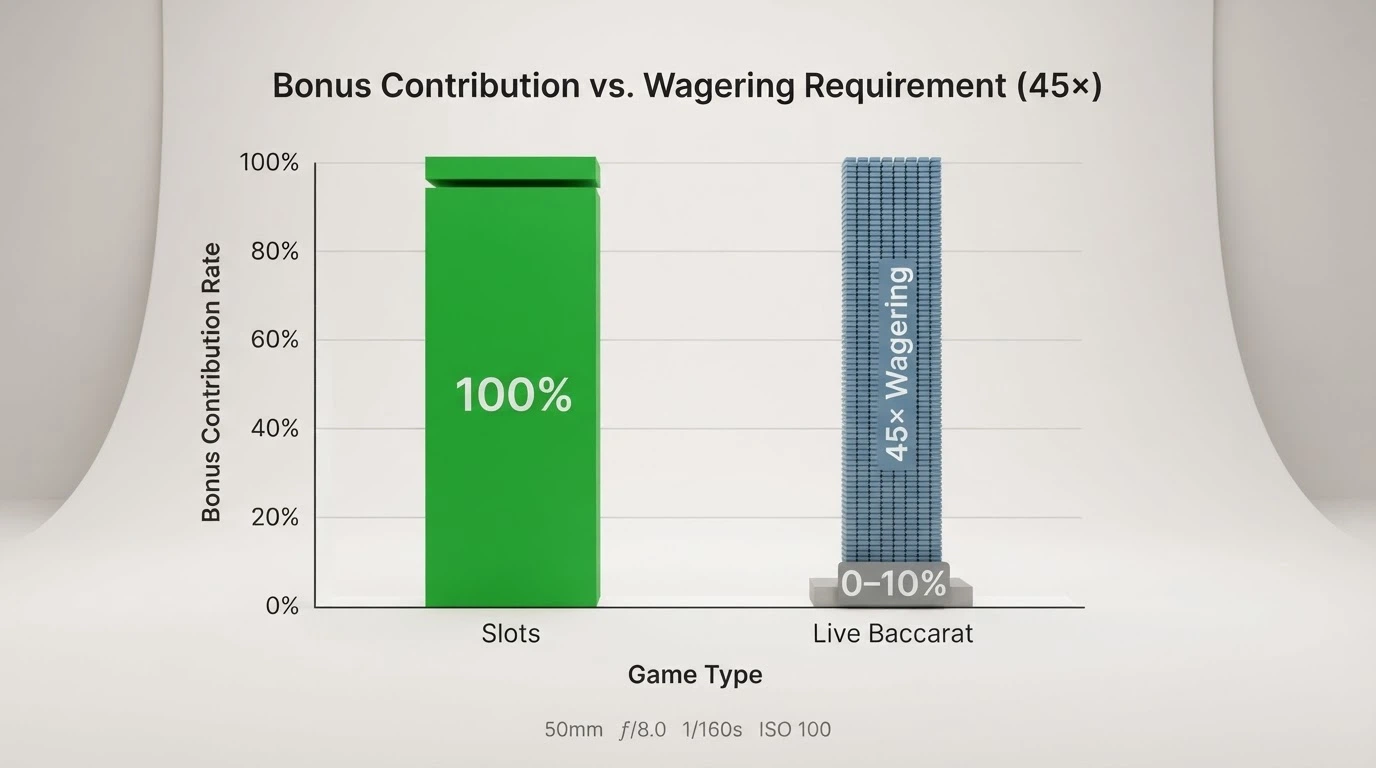
The best contribution a baccarat player will see is 10% — and that is rare. Let’s Lucky offers 10% contribution on all baccarat games including live dealer, which is the highest figure that appears across the AU-facing landscape. Most operators exclude live dealer baccarat from bonus contribution entirely. KingMaker’s welcome package — up to A$2,000 + 50 free spins — is excluded: live dealer baccarat at KingMaker does not contribute to wagering requirements. The reason KingMaker is not the top-ranked AU-facing brand for live baccarat is precisely that exclusion.
Why Baccarat Bonuses Are Harder to Find — and What the Contribution Figure Means
The contribution figure is the percentage of each bet that counts toward clearing the wagering requirement. A 10% contribution rate means that for every A$10 wagered on baccarat, only A$1 counts toward the wagering requirement. A 100% contribution rate means the full A$10 counts. The math at 10% is brutal. A 45x wagering requirement on a A$450 bonus — the Bambet first-deposit package — is A$20,250 in required turnover. At 10% contribution on baccarat, the player needs to wager A$202,500 on baccarat to clear the bonus. At A$1 per spin and 5 seconds per spin, that is roughly 281 hours of continuous play. The bonus is a slot product. A baccarat-only player should not claim it.
The expected cost of the bonus under that calculation is also worth holding onto. Required turnover of A$202,500 on a game with a Banker-bet house edge of 1.06% produces an expected loss of roughly A$2,146.50 across the clearing period. That is the cost the bonus is asking the baccarat player to pay to extract the A$450 bonus itself. The player pays roughly A$2,150 in expected loss to win A$450. The arithmetic is not subtle.
A baccarat player should claim a bonus only when the contribution rate is high enough to make the expected-loss-per-dollar-of-bonus reasonable. The 10% at Let’s Lucky is the best the market currently offers. Anything below that should be evaluated against the same formula before claiming.
Cashback and Live-Dealer-Specific Offers — The Better Deal for Baccarat Players
Cashback is the bonus product live baccarat players should look for. The mechanism is straightforward: a percentage of net losses over a week is returned to the player as cash or as bonus funds with low wagering requirements. Live dealer cashback at some AU-facing casinos runs up to 25% weekly on all live dealer games, with a cap of A$300 per week. The cap is the catch — a player losing more than A$1,200 in a week gets A$300 back, and the rest is gone.
Vegas Now runs a dedicated Live Casino Bonus section with boosted deposit bonuses for live games and 10% cashback on live dealer games every Tuesday. The Tuesday cadence is unusual — most cashback is weekly — and the 10% rate is lower than the 25% weekly cashback available elsewhere. The Vegas Now structure rewards consistent midweek play rather than compensating for a bad week. For a baccarat player, the weekly 25% cashback at operators that offer it is the better fit, because baccarat variance is gentle and the weekly window matches a normal play pattern.
Mega Medusa’s weekly cashback applies across all games, including live baccarat, and is structured as a percentage of net losses returned as bonus funds. The exact percentage was not confirmed this review, but the all-games structure means live baccarat is not excluded. A baccarat player who plays one session a week and wants a partial recovery on a bad week should look for this kind of all-games cashback, not for a slots-focused welcome package.
The reason cashback beats a match bonus for baccarat players is the contribution rate. A match bonus cleared at 10% contribution on baccarat is worth a fraction of its face value. Cashback returns a percentage of net losses directly, with no wagering multiplier to clear, and the expected-value calculation is straightforward. The baccarat player should look for cashback, not for the biggest welcome package.
PayID, Bitcoin and Getting Money to the Live Baccarat Table
The payment routes Australian players use to fund offshore live baccarat play split into two groups: AUD-denominated methods that flow through the Australian banking system (PayID, bank transfer, debit card) and crypto-denominated methods that bypass the banking system (Bitcoin, Ethereum, selected altcoins). The legal treatment is also split. Australia’s 2024 ban on credit cards and crypto as payment for online wagering applies to licensed Australian operators only — offshore casinos are not bound by it, because the ban attaches to the licensed operator’s payment processing, not to the player’s use of the method. The offshore operator can still accept a credit card deposit (most do not) and can still accept crypto (most do).
The practical methods an Australian player actually uses at an offshore live baccarat casino are PayID, bank transfer, Visa or Mastercard debit (not credit), e-wallets and crypto. Each method has a different speed, a different cost and a different regulatory risk profile.
PayID and Bank Deposits — The Fastest AUD Route to an Offshore Table
PayID is the fast AUD route. PayID uses the New Payments Platform (NPP) and Osko to settle transactions between Australian bank accounts in near-real-time, typically within a minute. An offshore casino that accepts PayID gives the player a PayID address (typically an email or a phone number linked to the casino’s account) and the player initiates the deposit from their own banking app. The deposit lands within seconds. The withdrawal side runs in reverse, and PayID withdrawals typically settle within an hour.
The trade-off is traceability. A PayID deposit to an offshore casino leaves a record in the player’s bank transaction history, and the receiving PayID is registered to an entity outside Australia. From 1 January 2027, Australian banks gain express authority to block transactions to illegal gambling operators. PayID sits inside that authority — a bank can refuse to process a PayID transaction to a PayID it has identified as belonging to an illegal gambling operator, and can refuse to allow the customer to send one. The 2027 framework does not require the bank to identify every offshore casino in advance; it gives the bank the authority to block on suspicion, and to rely on ACMA’s blocked-sites list as the reference.
A player using PayID at an offshore casino today is operating in the same window the regulator has signalled will close. The PayID route is fast and AUD-native, but the 2027 framework makes it the most regulatory-exposed of the AUD methods. Bank transfers and debit card deposits face the same exposure.
Crypto and Bitcoin Baccarat — What the Australian Ban Actually Means
Crypto deposits at offshore casinos are not constrained by the 2024 ban. The ban applies to licensed Australian wagering operators — the ones offering pre-event sports and racing bets through NT licences. Offshore casinos do not hold those licences, so the ban’s payment-processing prohibition does not bind them. Bitcoin, Ethereum and selected altcoins are accepted at most AU-facing offshore casinos, including Stake and the major brands on this list. The deposit settles in minutes; the withdrawal settles in minutes. No bank intermediary, no AUD conversion friction.
The trade-off is regulatory. The 2027 framework gives banks authority to block transactions to illegal gambling operators, and the regulatory perimeter around crypto on-ramps is tightening in parallel. Australian exchanges that hold an AUSTRAC registration are required to report suspicious transactions, and a pattern of crypto transfers to known gambling operators can trigger reporting. The player is not prosecuted for the transfer today, but the audit trail exists.
The argument for crypto at an offshore casino is speed and the absence of a bank intermediary. The argument against is the regulatory perimeter closing, and the loss of the AUD-native speed that PayID offers. A player choosing between PayID and crypto at an offshore casino today is choosing between a fast AUD route with a closing regulatory window and a crypto route with the same window and a tighter exchange-level audit trail.
Is Live Baccarat Legal in Australia? The Offshore Reality Every Player Needs to Read
Online casino is not legal in Australia. The Interactive Gambling Act 2001 prohibits providing online casino games — including live dealer baccarat — to anyone in Australia. No licence exists, federally or in any state or territory, for online casino. Every live baccarat table an Australian plays is reached through an offshore operator that is breaking Australian law by offering the service. The player is not the target of the law. The operator is.
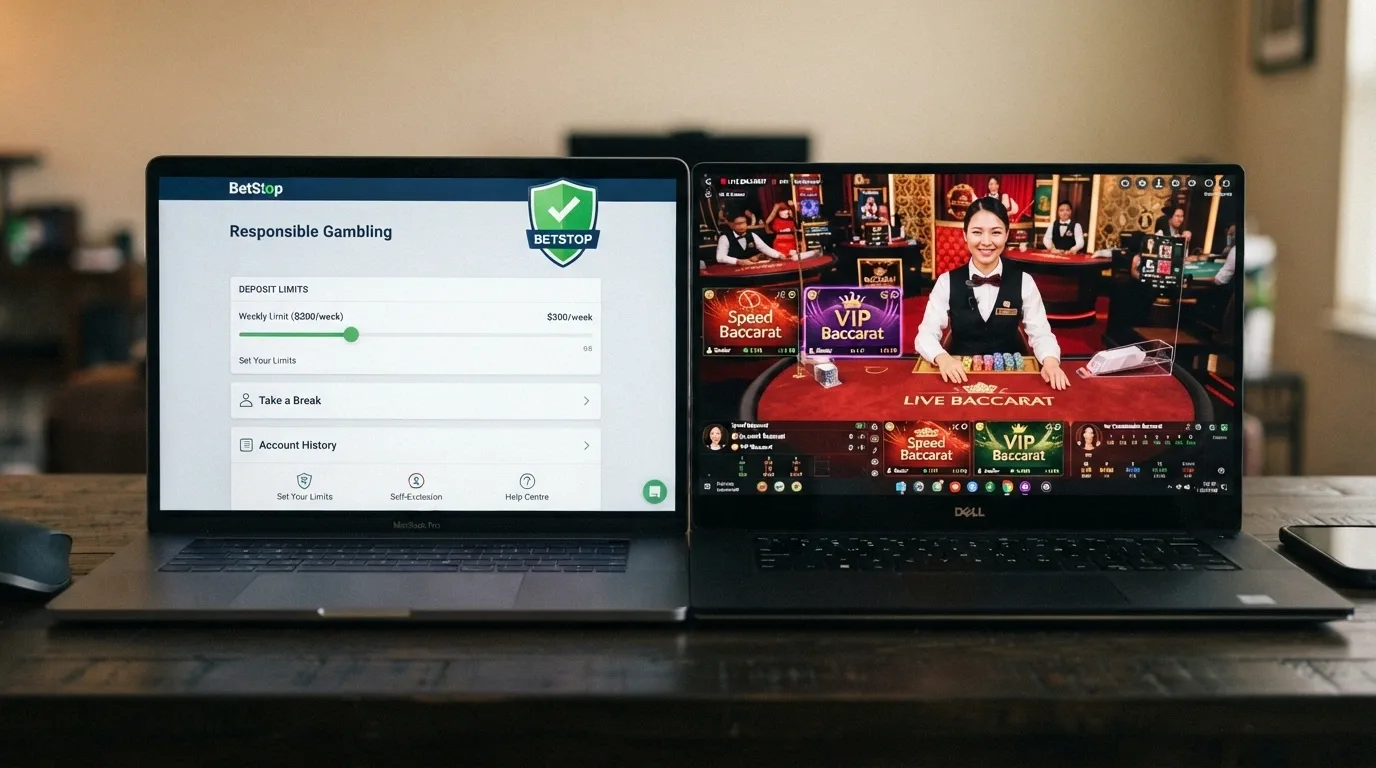
The Interactive Gambling Act — What It Bans and What It Leaves Alone
The IGA prohibits online casino games, online pokies and in-play sports betting. What it leaves licensed is pre-event sports and racing wagering, lotteries and keno — all of which are licensed through state and territory regulators. The Northern Territory Racing and Wagering Commission (NTRWC), administered through Licensing NT, is the de facto national licensor for online wagering; large operators like Sportsbet, bet365 and Ladbrokes hold NT licences running for terms of up to 20 years. The product those licensed operators sell is betting on outcomes, not casino games. A live baccarat table is not a wagering product, and no NT licence covers it.
The 2017 amendments to the IGA strengthened enforcement. The ACMA gained authority to issue formal warnings, civil penalty proceedings and directions to ISPs to block illegal sites. The 2026 reform — the Interactive Gambling Amendment (Gambling Reform) Bill 2026 — passed Parliament on 19 August 2026 and commences on 1 January 2027. The reform adds advertising caps (three wagering ads per hour between 6:00 am and 8:30 pm, with a blackout from 15 minutes before a live sporting event until 5 minutes after), inducement marketing restrictions (no direct marketing for 14 days after sign-up, three months after BetStop deregistration, indefinitely for at-risk customers) and the bank-blocking authority described above.
The reform is built around licensed wagering. It does not legalise online casino. It tightens the perimeter around the legal product while leaving the illegal product offshore.
Offshore Casinos vs Licensed Wagering — Two Completely Different Worlds
A deposit with a licensed Australian bookmaker and a deposit with an offshore casino look similar from the player’s screen. They are not the same product. A licensed Australian wagering operator must offer customer-set deposit limits and activity statements under state and territory conditions. The customer sets the deposit limit before the first bet is placed, the operator enforces it, and the customer can review the activity statement to see exactly what was wagered and when. The licensed operator is connected to BetStop — one registration excludes the customer from every AU-licensed online and phone wagering service. The licensed operator is supervised by ACMA, and the customer has Australian consumer protection law as recourse if a dispute arises.
The offshore casino offers none of this. There is no Australian-set deposit limit unless the player imposes one on themselves. There is no BetStop connection — a self-excluded Australian can open an offshore account today and deposit tomorrow. There is no Australian consumer protection. There is no Australian regulator to complain to. There is no guarantee the site will still be reachable next week — the ACMA can block it at any time, and balances on a blocked site are typically inaccessible.
The two products look like the same kind of betting. They are different in every consumer-protection dimension that matters.
BetStop, Self-Exclusion and Why It Does Not Cover the Casinos on This Page
BetStop is the National Self-Exclusion Register, live since August 2023. One registration excludes the customer from every AU-licensed online and phone wagering service. As at 31 July 2026, BetStop had recorded 67,480 registrations since launch, with 41,290 exclusions still active. 78% of registrants were under 40, and 38% chose lifetime exclusion. The register is the strongest gambling-harm safeguard Australia offers.
BetStop binds Australian-licensed wagering services. It does not bind offshore casinos. An offshore casino is not connected to the register and will keep accepting deposits from a self-excluded person. The exclusion does not reach the live baccarat tables on this page. A person who has registered with BetStop and then opens an offshore casino account is not breaking their BetStop exclusion — the offshore operator has no obligation to check — but is also not protected by the safeguard they signed up for.
The 2026 reform adds a marketing-side protection: from 1 January 2027, direct marketing of inducements is prohibited for three months after a person deregisters from BetStop. That restriction applies to licensed operators only. Offshore casinos are not bound by it. The BetStop gap is the most consequential consumer-protection difference between licensed wagering and offshore casino, and it is the one a self-excluded Australian is most likely to encounter.
Playing Smart — Responsible Gambling Tools and Real Limits for Australian Baccarat Players
The responsible-gambling infrastructure an Australian can actually use is the National Gambling Helpline, Gambling Help Online, BetStop and the player’s own limits. The first three are Australian services, free and confidential. The fourth is the player’s own discipline. For an offshore casino player, the Australian services still work, but the operator-side tools (deposit limits, time-outs, self-exclusion at the operator) depend entirely on what the offshore casino chooses to offer. Most offer some form of deposit limit, but the enforcement is operator-side, not regulator-side.
About 2.1% of Australian adults — roughly 430,000 people — experience problem gambling. The Australian Institute of Health and Welfare put high-risk gambling at 1.8% in 2022. The numbers are stable year on year, and they make the case for limits clear. A player who is going to play offshore live baccarat should set a loss limit before the first hand and stop when the limit is reached.
Where to Get Help — The Services That Actually Work for Australian Players
The National Gambling Helpline is 1800 858 858. Free, confidential, staffed 24 hours a day, 7 days a week. Gambling Help Online is the online counterpart, with live chat and counselling at gamblinghelponline.org.au. Both services work for any Australian, whether the gambling is happening on a licensed wagering site or an offshore casino. The help is not site-specific. The counsellors work with the gambler, not with the platform.
BetStop registration is the right step for a person who has decided to stop gambling on licensed Australian wagering services. The registration excludes the person from every AU-licensed operator in one step. It does not reach offshore casinos. A player who has registered with BetStop and is still playing at an offshore casino needs additional support, and the helpline and Gambling Help Online are the right place to start.
The minimum gambling age in Australia is 18 for all commercial gambling. The offshore casinos on this list enforce age checks; the enforcement quality varies.
The House Edge Is Your First Line of Defence — Knowing What You Are Paying to Play
The house edge is the number that tells a player what a session is going to cost in expected-loss terms. Baccarat’s Banker bet edge of 1.06% means that for every A$10,000 wagered on Banker, the player loses roughly A$106 on average. A one-hour session at A$10 per hand and 200 hands per hour is A$2,000 wagered, with an expected loss of about A$21.20. A two-hour session is A$42.40. The expected loss is small per hour, but the variance is real — the player can be up or down by hundreds of dollars in a single session, and the expected loss is the long-run average, not the short-run outcome.
Knowing the edge changes behaviour. A player who knows the edge treats the session budget as a fixed cost — A$50 for the night, A$100 for the weekend — rather than as a stake to be recovered. The expected loss is the price of the entertainment. The session ends when the budget is reached, not when the player decides the next hand will recover the loss. The baccarat player who picks Banker every hand and stops at the budget is playing the game the way the math says it should be played.
How We Evaluated Every Live Baccarat Casino on This Page
The ranking on this page was built from three inputs: AU-facing market share (the operators skill’s table of Australian-facing casino brands by player share), live baccarat availability (whether the operator runs an Evolution, Playtech, Pragmatic Play or Iconic21 live dealer lobby) and bonus applicability for live table games. The order is market-share primary, then live baccarat availability, then bonus applicability. The bonus applicability criterion produced a largely empty field — most welcome bonuses exclude live dealer baccarat or assign a 0–10% contribution rate.
Every operator on the list was checked against Australian licensing registers. None holds an Australian casino licence because none can. The legal status column is the same for every brand. The bonus terms, wagering requirements, game-provider lists and licence dates for individual operators were not confirmed by live search this run, and the table reflects that gap with em dashes in the cells where research did not carry a specific value. The one-successful-search this run did not return operator-specific data for the 10 featured brands.
What the reader should verify independently before depositing: the operator’s licence (Curaçao eGaming, Anjouan, Kahnawà:ke — the typical offshore jurisdictions), the live baccarat lobby composition, the bonus terms for live dealer games (contribution rate, maximum cashout, validity period), and whether the operator is currently accessible from an Australian IP address (the ACMA’s blocked-sites list is the reference). The market-mechanics for offshore status are described in the legal section above.
What the Australian Live Baccarat Player Should Actually Do in 2026
The trade-off at the heart of live baccarat for Australian players is real and unavoidable. The game is available only at offshore casinos. Every offshore casino is unlicensed in Australia, unconnected to BetStop, outside Australian consumer-protection law, and one ACMA blocking decision away from being unreachable. The price of access is the loss of every safeguard the licensed market offers.
The decision that matters most is the bet. Banker, every hand. The 1.06% edge is the lowest on the table, lower than Player, lower than Tie by more than an order of magnitude. Tie is the bet the marketing makes look attractive. The math makes it the bet that empties bankrolls. A baccarat player who sticks to Banker and walks away at the session budget is playing the game the way the math rewards.
The bonus question is cashback, not match. Welcome packages are designed for slots. Live baccarat is excluded or near-excluded from contribution. The cashback product — weekly or per-session — returns a percentage of net losses directly, with no wagering multiplier to clear. The 25% weekly live dealer cashback at some operators is the strongest offer a baccarat player can claim today.
The payment route is PayID for AUD-native speed, with the 2027 regulatory window in mind. Crypto is faster on the operator side, but the audit trail at Australian exchanges is tightening. The 2027 framework gives banks the authority to block transactions to illegal gambling operators, and PayID sits inside that authority. A player using PayID today is using the method the regulator has signalled will be the first one policed.
The self-protection checklist is short. Set a loss limit before the first hand. Verify the site is still accessible from an Australian IP address before depositing. Verify the live baccarat lobby is actually live (some operators advertise live dealer games they do not run). Do not deposit more than the session budget, and treat the deposit as an entertainment expense, not as a stake to be recovered. If the gambling stops being entertainment, the National Gambling Helpline is 1800 858 858, free and confidential, 24 hours a day. Gambling Help Online is at gamblinghelponline.org.au. Both services work for any Australian, on any platform.
Live baccarat is one of the lowest-edge games a casino offers. The game rewards the player who picks the right bet and walks away at the budget. The offshore context rewards the player who knows what the licence column actually says, and what it does not.
Frequently Asked Questions
Is it legal to play live baccarat online in Australia?
Online casino — including live dealer baccarat — is prohibited in Australia under the Interactive Gambling Act 2001. No Australian-licensed casino exists. Every live baccarat table an Australian plays sits on an offshore server. The IGA targets the provider, not the individual player, so the player is not prosecuted for opening an account, but the player also has no Australian consumer protection, no BetStop coverage and no recourse if a withdrawal stalls.
What is the house edge on baccarat and which bet gives the best return?
The standard Banker bet carries a house edge of approximately 1.06%. The Player bet carries approximately 1.24%. The Tie bet carries approximately 14.36%. The Banker bet is the best return on the table despite a 5% commission on wins, because the commission does not erase the underlying edge advantage. The Tie bet is the worst bet on the table by a wide margin.
Can I use PayID or Bitcoin to deposit at an online casino for live baccarat?
Yes — most AU-facing offshore casinos accept PayID, bank transfers, debit cards, e-wallets and crypto. Australia’s 2024 ban on credit cards and crypto as payment for online wagering applies to licensed Australian operators only; offshore casinos are not bound by it. From 1 January 2027, banks gain authority to block transactions to illegal gambling operators, and PayID sits inside that authority. Crypto on-ramps are also tightening under AUSTRAC reporting.
Do welcome bonuses actually apply to live dealer baccarat games?
Most welcome bonuses either exclude live dealer baccarat entirely from wagering contribution or assign it a contribution rate of 0–10%. The best contribution rate currently available is 10% at Let’s Lucky. A 10% contribution rate on a 45x wagering requirement means a baccarat player must wager roughly ten times the bonus amount on baccarat to clear the bonus, which produces a heavy expected loss against the bonus value. Cashback is the better offer for live baccarat players.
What is BetStop and does it cover the casinos on this page?
BetStop is Australia’s National Self-Exclusion Register, live since August 2023. As at 31 July 2026, 67,480 registrations had been recorded, with 41,290 exclusions still active. BetStop binds Australian-licensed wagering services only. Offshore casinos are not connected to BetStop and will keep accepting deposits from a self-excluded person. The exclusion does not reach the live baccarat tables on this page.
How are baccarat card values scored and what triggers a third card?
Number cards count at face value (2 through 9). Face cards and tens count as zero. Aces count as one. Hand totals are taken modulo ten — a 7 and an 8 score 5, not 15. A two-card total of eight or nine is a “natural” and the hand ends. Otherwise, the dealer draws a third card according to a fixed rulebook, and the player has no decision to make. The game is mechanical from the dealer’s side, and the player’s only decision is which of three bets to place.