
Casino Dice Game in Australia: What Actually Exists, What Costs What, and What the Law Says
The casino dice game most Australians search for is craps. When an Australian player types “casino dice game” into a search bar, they almost always mean the game with two dice, a come-out roll, and a Pass Line that runs the length of a green felt table. Sic Bo is the second answer, and it uses three dice instead of two. Beyond those two, the category thins out fast.
This page was last verified against ACMA and the Interactive Gambling Act 2001 framework as at 22 November 2026. Every bonus figure, licence status, and wagering multiple below was checked against the operator’s published terms or the cited source at the same date.
What makes the Australian version of this question different from every other market is the legal position. Online casino is prohibited in Australia under the Interactive Gambling Act 2001. No online casino licence exists anywhere in the country, not federally and not in any state or territory. Every real-money craps site that an Australian can actually deposit with is offshore-licensed, sits outside Australian consumer protection law, and connects to none of the self-exclusion or harm-reduction infrastructure that the licensed Australian wagering market offers. That is the single fact that changes how the rest of this page reads, and it sits at the top so nothing below it is mistaken for a recommendation to play.
Table of Contents
- What a Casino Dice Game Actually Is — and Why It’s Almost Always Craps
- Craps — The Casino Dice Game That Pays You to Play Smart
- The Best Offshore Dice Casinos for Australian Players in 2026
- Why Most ‘Australian’ Dice Casinos Aren’t Australian at All
- Playing Safe — The Tools Australian Dice Players Actually Have
- How We Assessed Every Dice Casino on This List
- Your 2026 Casino Dice Game Plan — What to Do Next
- Frequently Asked Questions
What a Casino Dice Game Actually Is — and Why It’s Almost Always Craps
A casino dice game is any table game where the result comes from the roll of one or more dice and the player bets on the outcome. In practice, two games fill that definition in almost every casino worldwide. The first is craps, played with two dice on a long table with a stickman calling the action and shooters rotating around the curve. The second is Sic Bo, played with three dice on a smaller layout that looks more like a roulette board than a craps table. Craps is the game most people picture when they hear the phrase; Sic Bo is the answer to the follow-up question of what else uses dice.
Craps is built around the sum of two dice. Players bet on whether the shooter will roll a winning number on the come-out roll or whether the shooter will establish a point and either make it before a seven or seven-out before making it. The table is a community game in the sense that most players bet on the same shooter rolling for everyone, but each player picks their own bets and the betting grid runs the full length of the felt.
Sic Bo is built around the combinations of three dice. The player picks a betting area on a layout and wins if the dice match the prediction. Possible bets run from small (total of 4 to 10) and big (total of 11 to 17) through single-number bets, doubles, triples, and specific triples. The pace is faster than craps because every roll resolves all bets at once rather than building into a multi-roll point phase.
The Two Dice Games You’ll Find in Every Casino
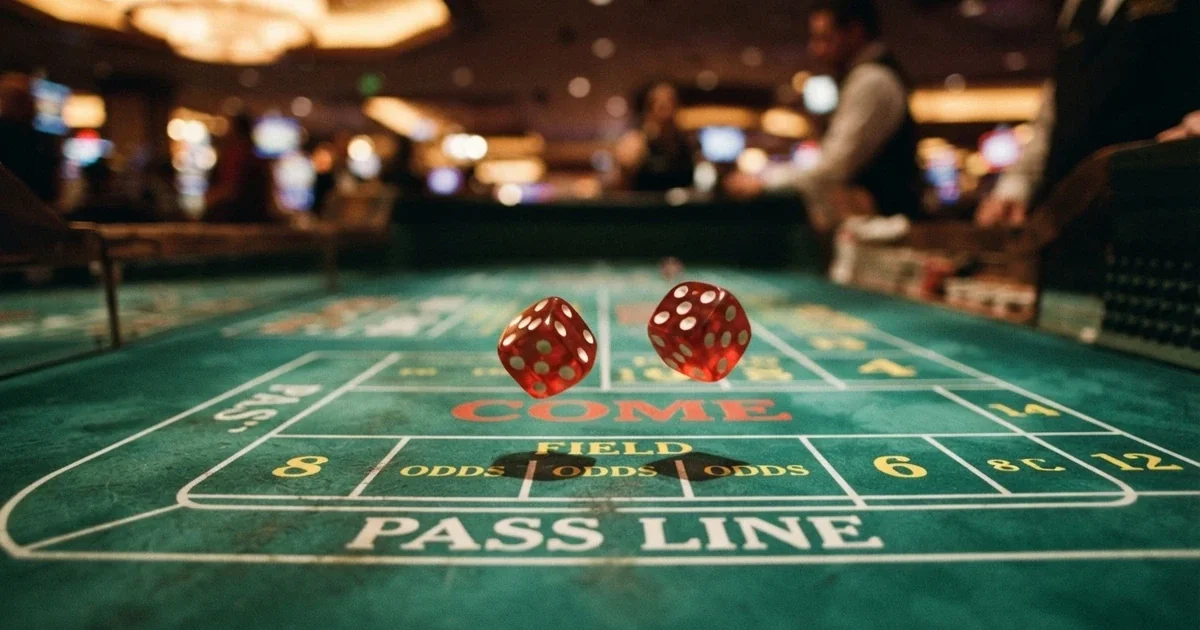
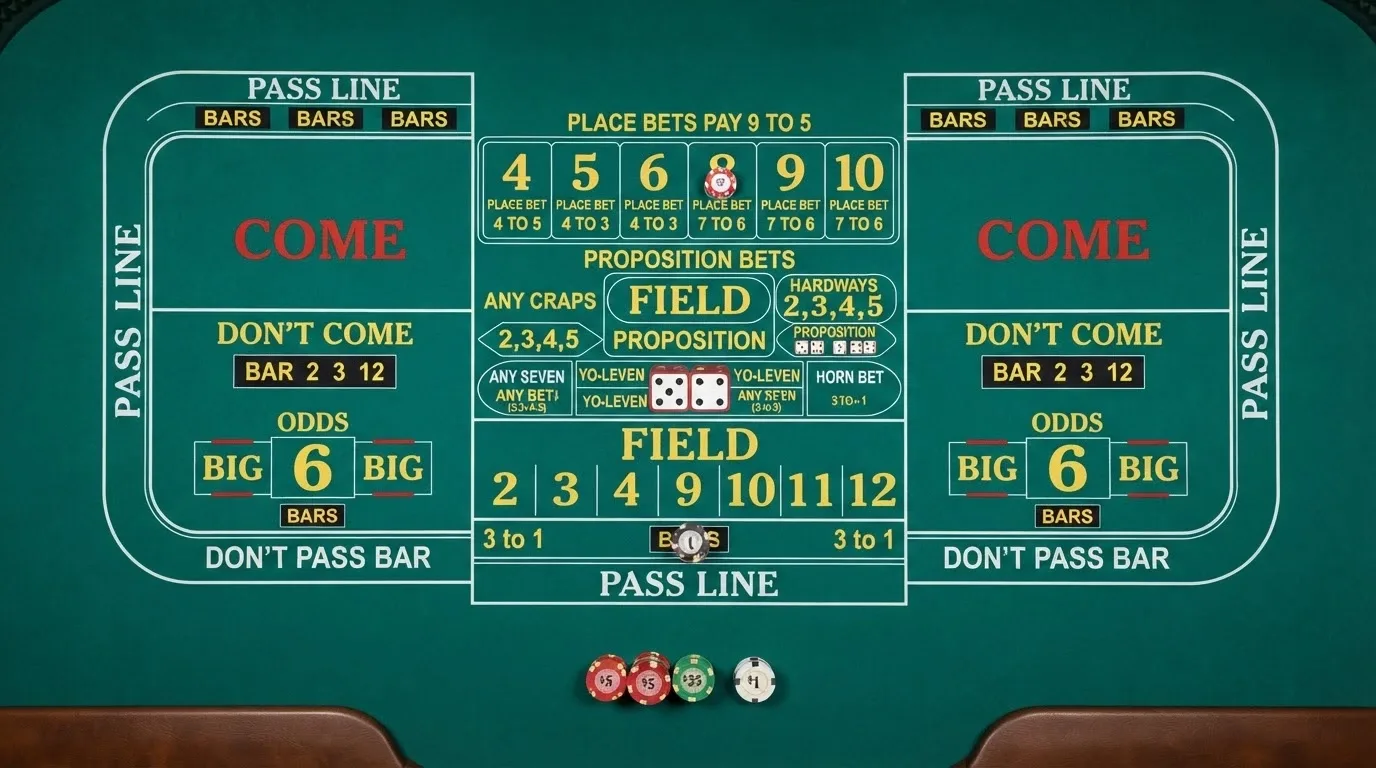
Craps and Sic Bo look nothing like each other on the table. Craps runs on a long rectangular felt with a curved end, marked with Pass Line and Don’t Pass running down the sides, Come and Don’t Come in the middle, Place bets on the numbers, Field in front of the stickman, and Proposition bets in the centre. Sic Bo runs on a layout closer to a roulette table, with each betting option printed as a labelled box and three dice tumbled from a sealed chest or, online, animated onto the screen.
The number of dice is the most obvious difference. Craps uses exactly two, and the sum of the two is what matters. Sic Bo uses exactly three, and the combinations across all three matter. That change in dice count shifts the entire mathematics: craps has 36 possible outcomes on each roll (6 × 6), while Sic Bo has 216 (6 × 6 × 6), and the betting grid expands to fill that larger space.
Craps is also the more social game. Players bet on a single shooter, the stickman calls the roll, and the table either erupts or goes quiet depending on the result. Sic Bo is closer to roulette in feel — each player bets alone, the dice are rolled, and outcomes are settled. An Australian player who wants the craps-table energy will not find it in Sic Bo, and a player who wants to bet quickly without tracking a come-out and a point will find Sic Bo faster.
In terms of Australian availability, craps is the game most offshore casinos offer. Sic Bo is offered less often and tends to sit alongside Asian-themed table games rather than as a standalone feature. An Australian player who specifically wants Sic Bo should check the operator’s table-games lobby before depositing, since not every offshore casino that runs craps also runs Sic Bo.
How to Play Dice at a Casino — a Walkthrough
A craps round moves through two phases. The walkthrough below covers the standard sequence from the first roll to the final payout.
- Come-out roll. The shooter rolls two dice for the table. A 7 or 11 wins Pass Line bets on the spot. A 2, 3, or 12 loses Pass Line bets (2 and 3 are “craps”; 12 is a tie on Pass Line and called “boxcars”). Any other number — 4, 5, 6, 8, 9, or 10 — becomes the point.
- Point phase. The dealer flips a marker (the “puck”) onto the point number. The shooter keeps rolling. If the shooter rolls the point again before rolling a 7, Pass Line bets win. If the shooter rolls a 7 first (a “seven-out”), Pass Line bets lose and the dice pass to the next shooter.
- Don’t Pass and Don’t Come. The mirror image: Don’t Pass wins on a come-out 2 or 3, pushes on a 12, and loses on a 7 or 11. Once a point is established, Don’t Pass wins if the shooter sevens-out before making the point.
- Come and Don’t Come. These work the same as Pass and Don’t Pass but are placed after the point is established, so each bet effectively has its own mini come-out roll.
- Free odds. Once a Pass, Don’t Pass, Come, or Don’t Come bet is placed, the player can back it with an “odds” bet that pays true odds with no house edge. The payoff depends on the point: 2:1 on points of 4 or 10, 3:2 on 5 or 9, and 6:5 on 6 or 8.
- Place bets. The player can bet directly that a specific number (4, 5, 6, 8, 9, or 10) will be rolled before a 7. Payoffs are 9:5 on 4 and 10, 7:5 on 5 and 9, 7:6 on 6 and 8. The house edge on Place 6 and Place 8 is 1.52%. Place 4 and Place 10 are worse, at 6.67%.
- Field bets. A one-roll bet that the next roll will land in the Field (3, 4, 9, 10, 11) — even money — or hit a 2 (pays 2:1) or a 12 (pays 3:1). The bet loses on 5, 6, 7, or 8.
- Seven-out ends the round. When the shooter sevens-out, the dice move to the next player. The new shooter starts a fresh come-out roll.
The Rules Every Player Should Memorise
The rules that govern every roll fall into a handful of clear categories, and the ones below are non-negotiable for anyone who wants to play without confusion.
Pass Line and Don’t Pass are the table’s main bets. Pass Line pays even money on a come-out 7 or 11, loses on 2, 3, or 12, and rides the point from there. Don’t Pass is the inverse: wins on 2 or 3, pushes on 12, loses on 7 or 11. The come-out phase is governed by these three outcomes only — 7/11 win Pass, 2/3/12 lose it (or push on 12 for Don’t Pass). Any other number becomes the point.
Place bet payoffs are fixed: 9:5 on 4 and 10, 7:5 on 5 and 9, 7:6 on 6 and 8. A winning Place bet on 6 or 8 returns the stake plus seven-sixths of it. A Place bet on 4 or 10 returns the stake plus nine-fifths. A Place bet on 5 or 9 returns the stake plus seven-fifths. These are not the same as the true odds behind the free odds bet, which is why the house edge on Place bets is higher than the house edge on a Pass Line bet backed by free odds.
Field bets pay even money on 3, 4, 9, 10, and 11; 2:1 on a 2; and 3:1 on a 12. They lose on 5, 6, 7, and 8. The 3:1 payoff on the 12 is the bait: the 12 only comes up once in 36 rolls, so the Field bet’s house edge sits at 5.56% in most versions (2.78% if the layout also offers 2:1 on the 12 alongside the 3:1 — a layout worth seeking out, although rare online).
Etiquette at a live table is its own short list: handle the dice with one hand, set the dice before the come-out, don’t reach across the felt, and tip the dealers when the table is winning. Online and live-dealer play removes all of this, which is one of the reasons online dice is faster.
Strategy Basics for Smarter Dice Play
The house edge figures on a craps table range from 0% to over 9%, and the gap between the best and worst bets is wider than on almost any other table game in a casino. Strategy, to the extent strategy exists in a game where the dice have no memory, is a matter of staying on the low end of that range.
Stick to Pass Line and Don’t Pass on the come-out, and back them with free odds once a point is established. Pass Line carries a house edge of about 1.41%, and Don’t Pass carries about 1.36%. The free odds bet added on top pays true odds and carries a house edge of 0%. The combined effect of Pass Line plus six-times odds is to drag the overall house edge down to roughly 0.39%, and the same combination on Don’t Pass brings it down to about 0.19%. That is the lowest house edge a craps player can reach without leaving the table.
Come and Don’t Come work the same way and are the natural place to put extra money once a point is established. Place bets on 6 and 8 carry a house edge of 1.52% — not bad, but worse than Pass Line plus odds. Place bets on 5 and 9 sit at 4.00%. Place bets on 4 and 10 climb to 6.67%, and that is where craps starts to feel ordinary.
Big 6 and Big 8 are proposition-style bets that pay even money if a 6 or 8 is rolled before a 7. They look like Place bets on the same numbers, but the payoff is worse: 1.52% on Place 6/8 versus over 9% on Big 6/8. The Big 6/8 box is a layout relic from before Place bets were common, and a player who understands the math never bets it.
Proposition bets and single-roll bets are where the house edge climbs past 9%. Any Seven pays 4:1 with a house edge around 16.7%. Hardways sit in the 9%–11% range. The Field bet lives at 5.56% (or 2.78% on the better-paying layouts). These bets are entertaining but expensive, and a player on a budget should leave them alone.
Playing Dice Online vs at a Land-Based Casino
The two formats are not equivalent, and the difference is bigger than the screen.
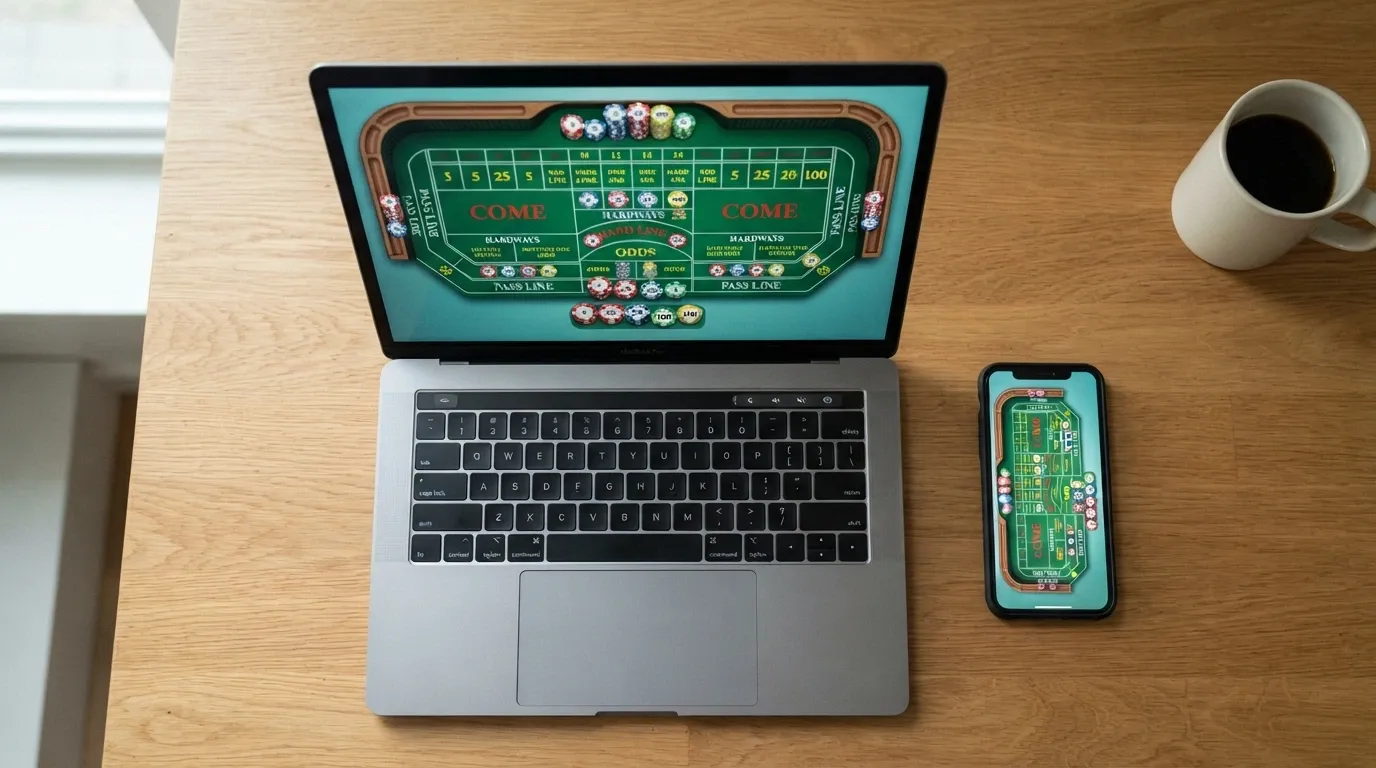
Online craps runs on a random number generator (RNG). Every roll is independent and software-determined. The pace is whatever the player wants — 60 rolls an hour is achievable at full speed, against roughly 60 rolls an hour at a real table when the table is busy, and far slower when the shooter takes time setting the dice. The minimum bet at an offshore online craps table can be as low as A$1, and the maximum rarely exceeds A$500 on a virtual table. There is no social element: no shooter rotation, no stickman calling the number, no cheers when the dice are hot. What the player gains is speed, control, and the ability to play at stakes a land-based table would not accept.
Land-based craps is the full experience. The shooter rotates, the stickman calls, the boxman watches the bets. The table minimum at a typical Australian venue (Crown Melbourne, The Star Sydney) sits higher than an offshore online minimum. The atmosphere is part of the product. Land-based craps is also legal in Australia, which is a meaningful distinction given the offshore-only reality of online dice.
Live-dealer craps splits the difference. A real table is streamed from a studio or a casino floor, with real dice and a real stickman. The player bets through a digital overlay. The pace is closer to a land-based table than to RNG play, and the social feel is partially restored through the live video feed. Live-dealer craps is rarer than live-dealer blackjack or roulette, and players should check individual operator lobbies for availability.
Joe Fortune lists craps with a minimum bet of A$1 and a maximum of A$500 per round on virtual tables, rising to A$2,000 on live-dealer craps. That gives a sense of the scale offshore operators offer at the table: a player can start at A$1, push to A$500 on the virtual interface, and step up to A$2,000 if they want the live-dealer stream.
Australian players do not have a locally licensed online craps option. The Interactive Gambling Act 2001 prohibits online casino games, and no state or territory issues an online casino licence. Every real-money craps site an Australian can deposit with is offshore-licensed — usually Curaçao, sometimes Kahnawake or Anjouan — and operates outside Australian consumer protection law.
Free-Play and Demo Mode — Practising Without Risk
Demo mode is the standard way to learn a casino dice game before risking money. Most offshore casinos offer a free-play version of craps and Sic Bo that runs on the same RNG as the real-money version, with the same betting grid and the same payouts. Demo mode teaches the rules, the bet placement, and the pace of play without touching a balance.
Demo mode does not teach bankroll management. The emotional weight of a real loss, the tilt after a bad run, the way a small wagering requirement feels when there is money behind it — none of that carries across to practice play. A player who learns craps in demo mode and then sits down at a real-money table with A$200 is playing a different game in psychological terms.
Demo availability varies by operator. Some offshore casinos make every craps and Sic Bo title playable without registration; others require an account and a verified email before unlocking demo play. A few do not offer demo mode for table games at all. Australian players should expect demo mode to be available at most offshore casinos but should not assume it, and the absence of a demo toggle is worth checking before signing up.
Live-Dealer Dice Tables — the Real Casino, Streamed
Live-dealer craps is the closest online experience to a land-based craps table. A real table is set up in a studio or on a casino floor, real dice are tumbled against a back wall, and a real stickman calls the result. The player sees the action on a streaming video feed and places bets through a digital overlay that overlays onto the live picture.
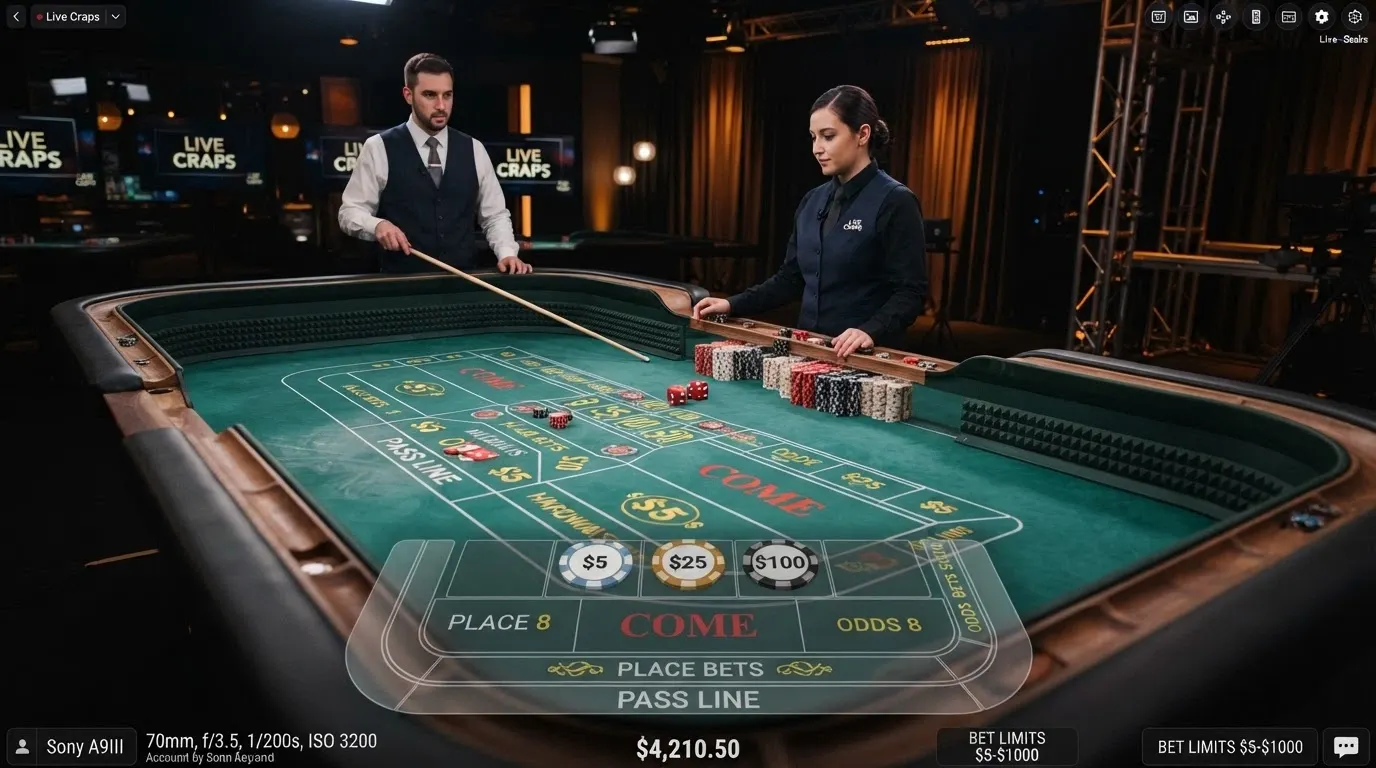
The pace of live-dealer craps is slower than RNG play. The stickman has to call each roll, the overlay has to settle bets, and the video stream introduces a few seconds of latency per round. A session that would run 80 rolls an hour on an RNG table might run 40–50 on a live-dealer feed. The minimum bet is usually higher (often A$5 or A$10 rather than A$1), and the maximum is higher too. Joe Fortune lists a maximum of A$2,000 per round on live-dealer craps, compared with A$500 on its virtual tables.
Live-dealer craps is less common than live-dealer blackjack or live-dealer roulette. The studio infrastructure for craps is heavier (the table is larger, the camera angles are harder, the dice need to be tracked against a back wall) and the player demand is lower, so not every offshore casino that runs live blackjack also runs live craps. An Australian player who specifically wants live-dealer craps should check the operator’s live-casino lobby before depositing.
Craps — The Casino Dice Game That Pays You to Play Smart
Craps is the dice game that earns its place at the top of the category. It is the game casinos build their largest tables around, the game with the most vocal crowd, and the game that rewards a player who understands the house-edge ranking more generously than almost any other table game.
The reasons for craps’ cultural dominance are practical. Two dice and a come-out roll produce enough outcomes to support a betting grid of real depth without requiring a layout so complex that players get lost. The table is long enough that a dozen players can bet on the same shooter without crowding. The pace is right — fast enough to keep the action moving, slow enough that the stickman’s call gives a beat of anticipation before each result. No other dice game combines those qualities at scale.
Why Craps Is the Casino’s Signature Dice Game
Craps is the named casino dice game in the same way blackjack is the named casino card game. The history runs deep: craps descends from an English dice game called “hazard” and was popularised in the United States through the nineteenth century, evolving into the bank craps format that spread worldwide in the twentieth. The vocabulary — shooter, stickman, point, seven-out, boxcars — is uniquely craps vocabulary. The table layout is uniquely craps layout. The cultural shorthand is clear: a search for “casino dice game” returns craps content first, and a search for “the dice game in casinos” returns craps definitions first.
Craps Variants and Table Formats
Not every craps table is the same. The standard table carries the full bet menu described above. Simplified craps strips the layout back to Pass, Don’t Pass, Come, Don’t Come, Field, and a handful of place bets, with everything else removed. Speed craps cuts the betting window to a few seconds and the dealer calls the roll faster, so more rolls happen per hour. Both variants are more common online than in land-based casinos, where the standard table dominates.
Virtual vs live-dealer is the more meaningful split for online play. Virtual craps is an RNG game with a digital layout. Live-dealer craps is a streamed game with real dice and real dealers. The house edge on the bets themselves is identical between formats — the math doesn’t change — but the pace, the minimum bet, and the social feel all shift.
The table below ranks the standard craps bets by house edge. Players who want to spend their bankroll efficiently should sit at the top of the table.
| Bet Type | House Edge | Payout | Notes |
|---|---|---|---|
| Free Odds (any point) | 0.00% | True odds (2:1 on 4/10, 3:2 on 5/9, 6:5 on 6/8) | Backed behind Pass/Don’t Pass/Come/Don’t Come |
| Don’t Pass | 1.36% | Even money | Loses to come-out 7/11 |
| Pass Line | 1.41% | Even money | Wins on come-out 7/11 |
| Don’t Come | 1.36% | Even money | Same as Don’t Pass after point |
| Come | 1.41% | Even money | Same as Pass Line after point |
| Place 6 / Place 8 | 1.52% | 7:6 | Wins if number rolls before 7 |
| Place 5 / Place 9 | 4.00% | 7:5 | Wins if number rolls before 7 |
| Field (2 pays 2:1, 12 pays 3:1) | 5.56% | Even money on 3/4/9/10/11 | Single roll |
| Place 4 / Place 10 | 6.67% | 9:5 | Wins if number rolls before 7 |
| Big 6 / Big 8 | 9.09% | Even money | Same as Place 6/8 with worse payoff |
| Hardways (6/8) | 9.09% | 9:1 / 10:1 | Two-roll bet |
| Hardways (4/10) | 11.11% | 7:1 / 15:1 | Two-roll bet |
| Any Seven | 16.67% | 4:1 | Single roll |
| Any Craps | 11.11% | 7:1 | Single roll on 2/3/12 |
| Hop Bets | ~11–14% | Varies | Single roll on specific combination |
The Dice and Equipment That Make the Game
Craps dice are precision-manufactured, transparent red cubes with white pip faces and a serial number on each face. The serial numbers let the pit boss track a single set of dice through a shift, and casinos rotate dice out of service regularly to prevent any individual pair from developing worn faces. Online craps uses a random number generator, not physical dice, but the game uses the same two-dice model.
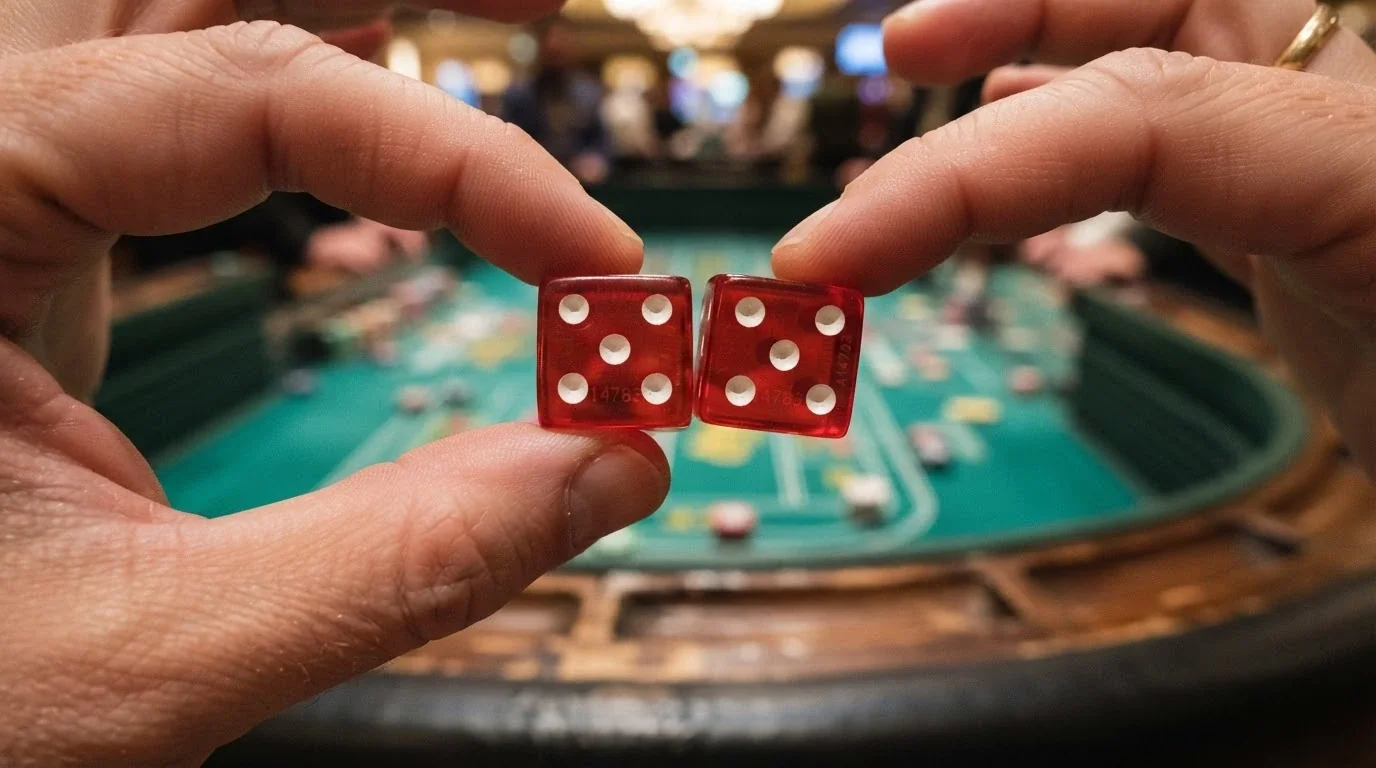
The table layout is a green felt rectangle roughly four metres long, with a curved end where the stickman stands. The Pass Line runs down both sides; Come and Don’t Come sit in the middle; Place bets are in their own boxes; the Field is in front of the stickman; and the Proposition bets cluster in the centre, where the worst house-edge bets sit. Every bet on the layout is a separate wager, and the stickman keeps the centre moving by calling each roll and announcing the result.
The stick is the long wooden tool the stickman uses to push the dice and call the roll. The boxman sits opposite the stickman and supervises the dealers and the chip bank. At a typical live table, three dealers cover the sides. Online and live-dealer play compresses the crew into one or two visible dealers, with the rest of the action handled by software.
The back wall at a real craps table is the angled rubber strip that the dice hit after each roll. The angle is what makes dice tumble randomly enough to be unpredictable — a flat surface would let a skilled shooter throw the dice the same way every time. The back wall, combined with the requirement that the dice hit it before stopping, is the physical mechanism that prevents controlled throws.
The Best Offshore Dice Casinos for Australian Players in 2026
The table below ranks the 10 offshore casinos that accept Australian players for real-money dice games. Every operator on this list is offshore-licensed and holds no Australian casino licence, because no such licence exists. The ranking reflects AU-player accessibility, bonus value where confirmed, and wagering terms where confirmed. Fields research did not confirm are marked with an em dash.

| Operator | Legal Status in Australia | Welcome Bonus AUD | Wagering Requirement |
|---|---|---|---|
| Skycrown | Offshore — no AU licence | Up to A$4,000 + 350 FS (multi-deposit) | 40× |
| Rocket Play | Offshore — no AU licence | 100% up to ~A$2,000 + 100 FS | 40× (bonus) |
| Fair Go | Offshore — no AU licence | 100% up to A$200 × 5 (A$1,000 total) | 30× (deposit + bonus) |
| WinSpirit | Offshore — no AU licence | 200% + 25 FS | 40× |
| Stake | Offshore — no AU licence | — | — |
| Royal Reels | Offshore — no AU licence | — | — |
| Bizzo Casino | Offshore — no AU licence | — | 40× (FS winnings) |
| Scream Casino | Offshore — no AU licence | — | — |
| Rainbet | Offshore — no AU licence | — | — |
| Rocket Casino | Offshore — no AU licence | — | 30× |
A few things to read off this table before reading the operator write-ups below. The wagering requirements shown are the confirmed multiples only — the cells where research did not return a number carry an em dash rather than a guess. Five of the ten operators have a confirmed bonus value in AUD; the other five do not, and the gaps are real, not clerical. The legal status column is identical down the page: every operator is offshore, and no operator holds an Australian casino licence, because none can.
Real Money vs Practice Mode — What Changes When You Play for Cash
The mechanical difference between demo mode and real-money play is small — the dice still produce the same RNG outcomes, the layout still looks the same, the payouts still pay the same multiples. What changes is everything around the game.
Bonus terms attach only to real-money play. The wagering requirement on a welcome bonus is a number that a real-money player must clear before withdrawing any bonus-related winnings. At Fair Go, that requirement is 30× the combined deposit and bonus; at Skycrown and Rocket Play, it is 40× the bonus amount; at Rocket Casino, it is 30× on a maximum bonus of A$150. None of those numbers apply to a demo session.
Game contribution rules apply only to real-money play. At Fair Go, table games and video poker do not contribute to wagering at all. At Joe Fortune, craps contributes only 5% to wagering — a standard that holds across most offshore casinos. The implication is straightforward: a player who accepts a bonus and tries to clear it by playing craps will move the wagering bar by roughly 5 cents for every A$1 they wager, which means clearing a 30× bonus on craps is effectively impossible at the standard contribution rate.
Bankroll psychology also shifts the moment real money is on the table. A A$200 balance feels different from a A$200 demo balance even when the outcomes are identical, and the difference is what makes demo mode an unreliable rehearsal for the real thing. A player who has only practised craps in demo mode has not yet learned how they respond to a seven-out at the wrong moment, and they will not know until they play for real.
How to Choose a Trustworthy Dice Site
The check that matters first is the licence. Every offshore casino an Australian can deposit with holds a licence from somewhere other than Australia, and the quality of those licences varies. Curaçao is the most common issuer for offshore casinos accepting Australian traffic, and it is a real licence — not a seal of approval, but a regulatory framework with dispute procedures. Kahnawake, Anjouan, and the Malta Gaming Authority appear less often in this market. What a licence is not, in this context, is an Australian licence — none of these are, and the phrase “licensed and regulated” in offshore casino marketing should never be read as “licensed in Australia.”
The second check is AUD banking. An Australian player needs a deposit route that works in Australian dollars without forcing a currency conversion fee on every transaction. PayID and POLi are the two Australian-friendly deposit methods most offshore casinos list, alongside Visa and Mastercard debit cards and bank transfer. The presence of PayID is a strong signal that the operator has built specifically for Australian players; its absence is not necessarily a red flag but is worth noting.
The third check is the bonus terms. The wagering multiple (30×, 40×, 60×) is the headline number, but the game contribution table is the number that actually matters for a dice player. A 30× bonus on slots with craps contributing 5% is, in practice, a 600× bonus on craps. The maximum cashout on bonus winnings is the next number to find — Fair Go has no cap on deposit-bonus cashouts, which is unusually generous; most offshore casinos cap bonus winnings at a multiple of the bonus amount.
The fourth check is the payment-method tell. Since 11 June 2024, credit cards and cryptocurrency have been banned as payment for online wagering in Australia. An offshore casino that still accepts credit-card deposits from Australian players is operating outside Australian rules, and a player funding an account through credit or crypto is doing so through a channel the ACMA has explicitly prohibited. The legal deposit routes — debit card, bank transfer, PayID/Osko, BPAY — are the safer path.
Skycrown — Up to A$4,000 Welcome Package with 350 Free Spins
Skycrown’s welcome package is one of the larger multi-deposit offers on this list: up to A$4,000 in bonus money and 350 free spins, spread across the first deposits. The wagering requirement sits at 40×, applied to the bonus amount. A player who deposits the full qualifying amount and accepts the full bonus has to wager roughly A$160,000 in bonus-eligible play before any bonus-related winnings become withdrawable, and the bulk of that wagering will need to run through slots rather than craps because of the standard 5% table-game contribution.
Skycrown is offshore-licensed (Curaçao — though the specific licence number was not confirmed in this round, and the operator’s site should be checked directly). It accepts Australian players and processes AUD deposits. Specific bonus validity period, free-spin game allocation, and maximum cashout were not confirmed at review time, and a player should verify these on the operator’s current terms page before depositing.
For a craps player specifically, Skycrown’s package is volume-heavy but contribution-light. The bonus value is real, but the 40× multiple combined with the low table-game contribution rate means the bonus is effectively a slots bonus that happens to be usable for table play. A player who accepts it should expect to do most of the wagering on slots.
Rocket Play — 100% First-Deposit Match with 100 Free Spins
Rocket Play’s first-deposit bonus is a 100% match up to roughly A$2,000 in bonus money plus 100 free spins, with a 40× wagering requirement on the bonus amount. The 100 free spins are credited in batches of 20 per day over five days, which spreads the value across the first week of play rather than dumping it all on the first deposit. A second-deposit 200% match is part of the package structure.
Rocket Play is licensed in Curaçao and runs games from BGaming and Pragmatic Play, among other providers. The minimum deposit sits around A$30 equivalent. Specific bonus validity period and maximum cashout were not confirmed for the Australian-facing version of the welcome package, and the operator’s current terms should be checked.
For a craps player, the same contribution caveat applies: 40× wagering on craps at 5% game contribution is a heavy lift, and most of the wagering will need to run through slots. The 20-per-day free-spin drip is a moderate feature — useful for keeping a new account active for five days rather than forcing a single big session.
Fair Go — A$1,000 Across Five Deposits at a 30× Wagering Rate
Fair Go’s welcome package is structured differently from the other operators on this list. Instead of one large bonus across the first deposit, the offer is a 100% match up to A$200 on each of the first five deposits, taking the total possible bonus to A$1,000. The minimum deposit per bonus is A$20. The wagering requirement is 30× on the combined deposit and bonus, which is the lowest multiple on this list.
The terms carry two specific features worth flagging. First, there is no maximum cashout on deposit-bonus winnings, which is unusually generous in a market where most offshore operators cap bonus withdrawals at a multiple of the bonus amount. Second, table games and video poker do not contribute to wagering at all — not 5%, but zero. A Fair Go player who accepts the bonus and plays craps will not move the wagering bar at all, which means clearing the bonus through craps is impossible and the bonus is effectively a slots-only offer.
Fair Go is licensed offshore (Curaçao) and runs on RealTime Gaming (RTG) software. The no-deposit bonus tier carries 60× wagering on winnings, which is steep but standard for no-deposit offers across the offshore market.
For a craps player specifically, Fair Go’s bonus structure is unfavourable. The 30× multiple is the best on this list, but the zero contribution from table games means the bonus cannot be cleared through craps at all. A craps player at Fair Go should treat the bonus as either a separate slots bankroll or decline it outright and play with the deposit alone.
WinSpirit — 200% Welcome Bonus and Weekly Reload Offer
WinSpirit’s welcome bonus is a 200% match plus 25 free spins, with a 40× wagering requirement. The match percentage is higher than the 100% offers elsewhere, but the wagering multiple is also at the standard 40× level. A no-deposit tier carries 40× wagering and an A$100 maximum bonus.
The weekly reload is the standout feature: a 50% match up to A$100 every Monday, which means a returning player has a recurring reason to deposit on the same day each week. The reload terms are not confirmed for the Australian-facing version of the site, and players should verify current terms on the operator’s page.
WinSpirit’s licence authority and game providers remain unverified for this assessment. The bonus validity period and maximum cashout on bonus winnings also require checking on the operator’s site directly.
For a craps player, WinSpirit’s offer is competitive on the match percentage but standard on the wagering terms. The weekly reload is the part that rewards long-term play rather than a single first deposit.
Stake — Proprietary Dice Game with a 1% House Edge
Stake is not a craps site. Stake is a crypto casino whose in-house dice game has earned its own reputation in the crypto-gambling community: a flat 1.00% house edge on every roll, with win chance adjustable from 0.01% to 98%. The game is not craps and does not use craps rules — it is a simple over/under bet on a generated number, with the player choosing where to set the win-chance dial.
The math is what makes Stake’s dice game notable. A flat 1% house edge on every roll, regardless of the player’s chosen win chance, is a clean and predictable cost. Compare it to craps’ Pass Line at 1.41% or to craps’ Big 6/8 at over 9%, and the proposition looks different from anything on a standard craps table. The auto-bet suite allows scripted staking plans, and the seed verification system allows players to check that each roll was generated fairly.
Stake is licensed in Curaçao and runs games from Pragmatic Play, Evolution, Hacksaw, Nolimit City, and others alongside its in-house dice product. Welcome bonus terms vary by region and were not confirmed for Australian players at review time. The platform is crypto-focused, and a player funding an account from Australia using a fiat deposit route will need to use the available conversion path; crypto funding from Australia raises the payment-ban issues covered in the section on Australian legality below.
For a player who specifically wants craps, Stake’s proprietary dice game is a different proposition and not a substitute. For a player who wants a low-house-edge dice game and is comfortable with the crypto-casino format, Stake’s dice product is the closest thing to a flat-rate bet in the category.
Rocket Casino — 30× Wagering and A$150 Maximum Bonus
Rocket Casino’s headline offer carries a 30× wagering requirement — the lowest multiple on this list alongside Fair Go — but the maximum bonus is capped at A$150. The minimum deposit is A$20. The smaller bonus cap combined with the lower wagering multiple means the player is clearing a smaller bonus through fewer cycles of wagering, which is structurally easier than a large bonus at a higher multiple.
Specific welcome package structure, free-spin allocation, licence authority, and game providers were not established for this assessment, and the operator’s current terms page should be checked directly.
For a craps player, Rocket Casino’s combination of a low wagering multiple and a low maximum bonus is the closest thing on this list to a manageable offer. The same table-game contribution caveat applies: craps will not move the wagering bar much, but the bar itself is lower.
Bizzo Casino — Low Minimum Deposit and 40× Wagering
Bizzo Casino’s confirmed figure is a 40× wagering requirement on free-spin winnings. The minimum deposit sits around A$10, which is the lowest confirmed entry point on this list. Welcome bonus structure, licence authority, and game providers remain unverified for this assessment, and the operator’s terms page should be checked for current details.
For a player with a small bankroll, the low minimum deposit is the meaningful feature — it lowers the cost of testing an operator before committing more. The 40× multiple on free-spin winnings is the standard level for this market and not a distinguishing factor.
Royal Reels — Offshore Casino Accepting Australian Players
Royal Reels is an offshore-licensed casino that accepts Australian players. Bonus terms, wagering requirement, licence authority, and provider mix were not confirmed at review time. Royal Reels appears on lists of offshore casinos serving Australian traffic but did not return specific terms in this round of research.
A player considering Royal Reels should verify the licence directly on the operator’s site (the footer or “About” page usually carries the licence number and issuer), check the bonus terms page for the current welcome package and wagering multiple, and confirm that AUD deposits and PayID or POLi are supported before signing up.
Scream Casino — Offshore Option for Australian Dice Players
Scream Casino is an offshore-licensed casino that accepts Australian players. Bonus terms, wagering requirement, licence authority, and provider mix were not confirmed at review time. The operator appears on lists of offshore casinos serving Australian traffic but did not return specific terms in this round of research.
A player considering Scream Casino should treat the absence of confirmed data as a reason to do more diligence before depositing rather than as a reason to write the operator off. The standard checks — licence in the footer, bonus terms on the promotions page, AUD and PayID support in the cashier — apply.
Rainbet — Offshore Casino with Dice Games
Rainbet is an offshore-licensed casino that accepts Australian players. Bonus terms, wagering requirement, licence authority, and provider mix were not confirmed at review time. Rainbet appears on lists of offshore casinos serving Australian traffic but did not return specific terms in this round of research.
The same diligence applies as for any operator where research did not return confirmed figures: verify the licence, read the bonus terms, check the cashier for AUD support, and confirm the operator processes withdrawals through a method accessible from Australia.
Why Most ‘Australian’ Dice Casinos Aren’t Australian at All
The phrase “Australian online casino” is, in this market, a contradiction in terms. No Australian online casino exists, because the Interactive Gambling Act 2001 prohibits the supply of online casino games to anyone in Australia. What does exist is a global offshore casino industry that accepts Australian players, processes Australian-dollar deposits through a handful of payment routes, and markets heavily to Australian traffic despite having no legal standing inside the country.
A player who lands on an offshore casino homepage and sees the word “Australian” in the welcome banner is not looking at an Australian-licensed site. They are looking at an offshore operator that has built an Australian-facing version of its product, with AUD displayed for convenience and PayID or POLi listed in the cashier. The licence in the footer will be Curaçao, Kahnawake, or another offshore jurisdiction, and there will be no reference to ACMA, no reference to BetStop, and no recourse to Australian consumer law if something goes wrong.
How Dice Games Are Regulated in Australia
The Interactive Gambling Act 2001 (IGA) is the statute that governs online gambling in Australia. The IGA, as strengthened by the Interactive Gambling Amendment Act 2017, makes it an offence to provide online casino games (including craps, Sic Bo, and pokies), online in-play sports betting, and certain other services to a person physically in Australia. The prohibition is on the provider, not the player — the Act does not criminalise the act of placing a bet online from Australia, but it does make the supply of the betting service illegal.
There is no licence for online casino anywhere in Australia. Not federally, not in New South Wales, not in Victoria, not in the Northern Territory, not in Western Australia. The Northern Territory Racing and Wagering Commission (NTRWC), administered through Licensing NT, is the de facto national wagering licensor, but the licences it issues cover pre-event sports and racing wagering, not online casino games. Crown Melbourne and The Star Sydney are state-licensed land-based casinos that can offer craps on the floor, but neither operates a licensed online casino.
The practical effect is that every real-money online dice site an Australian can deposit with is operating outside Australian law. The operator is breaking the IGA by serving Australian customers. The player is not breaking the law by using the site, but is also not protected by it — no Australian regulator has jurisdiction over the operator’s behaviour, no Australian dispute-resolution body will hear a complaint, and no Australian consumer protection law applies.
The Registers and Protection Bodies
The Australian gambling-harm infrastructure is built around the licensed wagering market, not the offshore casino market, and that is the structural reason offshore casino play sits outside its protection.
ACMA — the Australian Communications and Media Authority — is the federal regulator that enforces the IGA. ACMA investigates complaints, issues formal warnings, refers operators for civil penalty proceedings, and directs Australian ISPs to block illegal sites at the DNS level. ACMA has had 1,564 illegal gambling and affiliate websites blocked since November 2019, and more than 225 illegal services have withdrawn from the Australian market since enforcement was strengthened in 2017. ACMA’s reach is real, but it acts against providers, not players.
BetStop — the National Self-Exclusion Register — is the federal self-exclusion system that has been live since August 2023. A single registration on BetStop excludes a person from every Australian-licensed online and phone wagering service. The numbers are large: 67,480 registrations as at 31 July 2026, with 41,290 exclusions still active; 78% of registrants were under 40, and 38% chose lifetime exclusion. The limitation that matters for this page is direct: BetStop binds Australian-licensed wagering services only. An offshore casino is not connected to the register. A person who self-excludes through BetStop and then opens an account with an offshore casino will not be blocked from that casino, and the offshore casino has no obligation to honour the exclusion.
The state and territory gambling regulators (the NSW Independent Liquor and Gaming Authority, the Victorian Gambling and Casino Control Commission, and their equivalents in other jurisdictions) license and supervise land-based casinos and the licensed wagering operators. They have no jurisdiction over offshore casino sites.
What Betting and Casino Dice Activity Is Actually Legal
The line between legal and illegal in Australian gambling runs through the licensing regime, and the product distinction is the cleanest way to read it.
Legal under Australian law: pre-event wagering on races and sport, through operators licensed by a state or territory (TAB, Sportsbet, Ladbrokes Australia, Bet365 Australia, and the other Australian-licensed bookmakers); lotteries; keno (in physical venues and licensed online channels). These products can be offered online, with AUD deposits and Australian consumer protection.
Prohibited under the IGA: online casino games including craps, Sic Bo, blackjack, roulette, and pokies; online in-play sports betting (placing a bet after a sporting event has started); online keno in the form of “pocket pokies”; foreign-matched lotteries (lotteries operated outside Australia and matched to Australian players).
Land-based casinos are a separate legal category. Crown Melbourne, The Star Sydney, Crown Perth, The Star Gold Coast, and the other Australian land-based casinos are state-licensed and offer table games including craps on the floor. They do not offer online casino games, because no Australian licence covers online casino.
The 2026 reform — the Interactive Gambling Amendment (Gambling Reform) Bill 2026 — passed Parliament on 19 August 2026 and commences on 1 January 2027. The reform adds several measures to the existing framework: wagering advertising capped at three ads per hour between 6:00 am and 8:30 pm; a live-sport blackout from 15 minutes before to 5 minutes after each event; athletes, celebrities, and influencers barred from promoting wagering products; direct marketing of inducements prohibited for 14 days after sign-up, for 3 months after BetStop deregistration, and indefinitely for at-risk customers; online keno “pocket pokies” and foreign-matched lotteries banned; and banks and payment providers gaining express authority to block transactions to illegal gambling operators. None of these measures are in force at the time of writing; all of them will be in force from 1 January 2027.
Playing Safe — The Tools Australian Dice Players Actually Have
The harm-reduction infrastructure built around Australian gambling is real, well-funded, and effective for the licensed market. It is largely absent for the offshore market, which is where every Australian craps player actually plays.

The National Gambling Helpline (1800 858 858) is the central point of contact. The line is free, confidential, and staffed 24 hours a day, 7 days a week. Online chat and counselling are available through Gambling Help Online at gamblinghelponline.org.au. Interpreter access is available through the Translating and Interpreting Service on 131 450. The helpline is run by qualified counsellors and is the first number every Australian player should save.
The harm data is the reason these tools exist. Approximately 2.1% of Australian adults (roughly 430,000 people) experience problem gambling (AIHW, 2022), and 1.8% experience high-risk gambling. An estimated 1.97 million adults are classified as having at-risk or problem gambling under the PGSI 1+ threshold (Browne et al., Journal of Gambling Studies, 2026). A model estimates approximately 3.29 million Australians aged 5 and over are affected annually by their own or another person’s gambling, including approximately 1.38 million adult affected others. Australians lose approximately A$25 billion on legal gambling each year, and problem gamblers lose approximately A$21,000 per year on average — six times more likely to go through a divorce than the general population. About 70% of Australian adults take part in some form of gambling each year.
The scope of the problem is the reason the offshore-only nature of online craps is a structural concern rather than a procedural footnote. The tools that work for the licensed market do not reach the offshore market.
Safer-Play Tools Every Australian Player Should Know
Australian-licensed wagering platforms offer a standard set of safer-play tools: customer-set deposit limits (daily, weekly, monthly), activity statements, take-a-break and time-out periods, and full self-exclusion through BetStop. These tools are mandatory under state and territory licensing conditions and are enforced by the regulator.
Offshore casinos may offer some of these tools, but the offering varies by operator and is not enforced by any Australian regulator. A player relying on a deposit limit at an offshore casino has no regulatory backstop if the operator fails to honour the limit. The same is true for self-exclusion: a player who asks an offshore casino to close their account has no guarantee the operator will do so, and BetStop does not reach the offshore site.
The practical implication for a player at an offshore casino is that the safer-play tools must be self-imposed and self-enforced. Setting a deposit limit at an offshore casino and then depositing anyway defeats the limit. The only structural protection is the player’s own discipline, supported by the helpline and BetStop.
Deposit and Time Limits — Setting Your Own Guardrails
Australian-licensed wagering platforms offer customer-set deposit limits, time-out periods, and session reminders. The licensed market also bans credit cards and cryptocurrency as payment methods, which removes two of the easier routes to over-spend.
The offshore market offers none of these guarantees. A player at an offshore casino must set their own budget before signing in, must enforce it themselves, and must accept that the tools the licensed market provides are not available. The practical steps are simple: set a session budget before opening the site, use a separate bank account or payment method for gambling, set a timer for the session, and walk away when the timer ends.
From 1 January 2027, the 2026 reform will give banks and payment providers express authority to block transactions to illegal gambling operators, which is the first structural measure that reaches into the offshore market from the Australian side. Until that date, the only enforcement is the player’s own.
Help and Helplines — Where to Go When You Need Support
The help infrastructure is free, confidential, and available to anyone in Australia, regardless of where they gamble or how much.
The National Gambling Helpline is 1800 858 858, free and confidential, staffed 24/7. Gambling Help Online (gamblinghelponline.org.au) provides online chat, counselling, and self-help resources. BetStop (betstop.gov.au) is the National Self-Exclusion Register, and a single registration blocks access to all Australian-licensed online and phone wagering services. Interpreter access is available through 131 450.
The data behind these services shows why they exist. Approximately 430,000 Australian adults experience problem gambling, and an estimated 1.97 million are at-risk or problem gambling under the standard PGSI threshold. Problem gamblers lose approximately A$21,000 per year on average and are six times more likely to go through a divorce. Approximately 3.29 million Australians are affected annually by gambling harm, including affected others. The A$25 billion lost on legal gambling each year is the cost across the whole licensed market, and the offshore market adds an unknown but meaningful figure on top.
How We Assessed Every Dice Casino on This List
The operators on this list were evaluated against a consistent set of criteria, and the criteria are stated here so the ranking can be read on its own terms.
The first criterion is AU-player accessibility: does the operator accept Australian players, does it process AUD deposits, and does it support Australian-friendly payment methods like PayID and POLi. The second is licence transparency: is the licence authority clearly stated on the operator’s site, and is the licence number verifiable. The third is bonus fairness: what is the wagering multiple, what is the game-contribution table, and what is the maximum cashout on bonus winnings. The fourth is the dice-game offering: does the operator run craps, does it run Sic Bo, and does it run either in a live-dealer format.
The sources consulted for this assessment were the operator websites (for current bonus terms and licence disclosure), CrapsOnline.au (for craps-specific availability and Joe Fortune table limits), SlotBonuses.info (for Fair Go’s bonus structure), Pokie777.com (for Skycrown and WinSpirit terms), Strafe.com (for Rocket Play’s package structure), and the AU Regulation Skill data set (for ACMA, IGA, and 2026 reform citations). Gambling Help Online and the Australian Institute of Health and Welfare were consulted for the responsible-gambling figures.
The ranking reflects the data available at review time. Operators where the data set did not return confirmed bonus terms, wagering multiples, or licence authorities are marked accordingly rather than ranked on assumed figures. A player who finds updated terms on an operator’s current page should treat those terms as the live figure, not the figures carried in the table above.
Your 2026 Casino Dice Game Plan — What to Do Next
Three figures from the page above carry most of the decision weight, and they sit in tension with each other.
The first is the legal reality: no Australian online casino licence exists, every operator on this list is offshore, and the player is outside Australian consumer protection law by the act of signing up. This is the figure that reframes everything else, because a casino bonus only matters if the player can trust the operator to honour it, and an offshore operator’s track record is not visible through any Australian register.
The second is the house edge: Pass Line at 1.41%, Don’t Pass at 1.36%, free odds at 0%, Big 6/8 at over 9%, Any Seven at 16.67%. The gap between the best and worst bets on a craps table is wider than the gap on almost any other table game, and a player who understands the ranking will play the top of it. The arithmetic behind a Pass Line bet plus six-times odds is the closest thing to a fair bet the craps table offers.
The third is the bonus cost: at Fair Go, a A$200 deposit matched 100% requires the player to wager A$12,000 on the combined deposit and bonus at 30×, and the table games that the player actually wants to play contribute zero to that total. The bonus is not free, the wagering requirement is not the whole cost, and the game-contribution table is the number that determines how much of the bonus the player will actually clear.
The practical order a player should follow runs in this sequence. Read the section on Australian legality before opening any offshore site, because the offshore-only nature of the market is the single most important fact about it. Verify the licence on the operator’s own page before depositing, because the table above carries only what research confirmed and the operator’s current terms are the live document. Check the bonus terms — wagering multiple, game contribution, maximum cashout, validity period — before claiming any welcome offer, because the headline number is rarely the whole story. Set a deposit limit and a session timer before signing in, because the safer-play tools the licensed market offers do not reach the offshore site. Save the National Gambling Helpline number (1800 858 858) before the first deposit, because the cost of having it is zero and the cost of needing it and not having it is not.
What an Australian craps player should not do is treat the offshore casino market as equivalent to the licensed Australian wagering market. The two markets look similar from a product standpoint — both offer table games, both offer bonuses, both accept AUD — but they are not equivalent in the protections they offer, the regulator that oversees them, or the recourse available if something goes wrong. An Australian player making this choice with clear eyes is making a different choice from one making it without them, and the page above is written so the choice can be made with them.
Frequently Asked Questions
Is online craps legal for Australian players?
Online craps is not licensed in Australia. The Interactive Gambling Act 2001 prohibits the supply of online casino games — including craps — to anyone in Australia, and no online casino licence exists in any state or territory. Australian players who play online craps do so through offshore-licensed operators that sit outside Australian consumer protection law. The Act targets the provider, not the player, and no Australian has been prosecuted for playing.
What is the house edge on a Pass Line bet in craps?
A Pass Line bet has a house edge of approximately 1.41%. The mirror bet, Don’t Pass, runs at about 1.36%. A Pass Line bet backed by free odds — the only bet on the table with a 0% house edge — drags the combined edge down: with six-times odds, the combined house edge is roughly 0.39% on Pass and about 0.19% on Don’t Pass. Place bets on 6 and 8 sit at 1.52%, and Big 6/8 climbs past 9%.
What is the difference between craps and Sic Bo?
Craps uses two dice and runs through a two-phase structure — a come-out roll that either resolves the round or establishes a point. Sic Bo uses three dice and resolves every bet on every roll, with no point phase. The betting grid in Sic Bo covers small/big totals, single numbers, doubles, triples, and specific combinations across all three dice. Craps is the more social game with a shooter rotation; Sic Bo is closer to roulette in pace and feel.
What payment methods can Australian players use at offshore casinos?
The legal deposit routes for licensed Australian wagering are debit card, bank transfer, PayID/Osko, and BPAY. Credit cards, credit-related products, and cryptocurrency have been banned as payment for online wagering in Australia since 11 June 2024. An offshore casino that accepts credit-card or crypto deposits from Australian players is operating outside Australian rules. From 1 January 2027, banks and payment providers gain express authority to block transactions to illegal gambling operators.
Does BetStop cover offshore casino sites?
No. BetStop — the National Self-Exclusion Register — binds Australian-licensed wagering services only. An offshore casino is not connected to the register and will continue to accept a self-excluded person’s deposits and bets. BetStop has 67,480 registrations since August 2023, with 41,290 exclusions still active as at 31 July 2026, but the register’s protective effect does not extend past the licensed Australian market.
What Is a Casino Dice Game, Exactly?
A casino dice game is a wagering game where the outcome is determined by rolling dice. The two games that fill the category are craps and Sic Bo. Craps uses two dice and runs through a two-phase structure: a come-out roll that either resolves Pass Line bets immediately or establishes a point number that the shooter then has to roll again before rolling a seven. Sic Bo uses three dice and resolves every bet on every roll, with no come-out or point phase to track. The rest of the casino dice category is thin: a handful of proprietary online games (Stake’s in-house dice product being the most prominent) and minor variants like simplified craps and speed craps that trim the craps bet menu for faster play.
The reason craps carries the name “the casino dice game” is the cultural weight behind it. Craps dominates the dice category in casinos from Las Vegas to Macau. The table is large, the crowd is loud when the dice are hot, and the ritual of the shooter choosing dice, setting the stick, and calling the number on each roll gives the game an identity that Sic Bo, for all its elegance, does not match. An Australian player asking which dice game to learn first should learn craps. An Australian player asking which dice game an offshore casino is most likely to offer will also find craps first, with Sic Bo a distant second.