
Live Dealer Roulette in Australia: A Real-Money Guide for 2026
Last reviewed: 22 November 2026. Cross-checked against the Interactive Gambling Act 2001 and the Australian Communications and Media Authority enforcement register as of 2026.
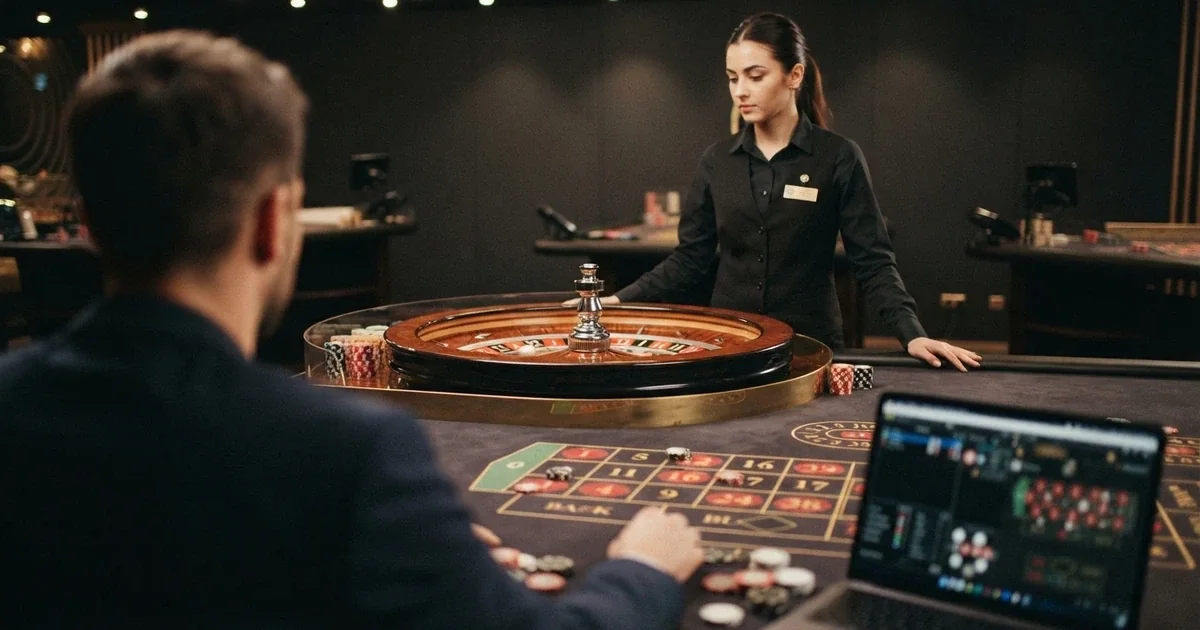
No online casino in Australia holds a local licence. The Interactive Gambling Act 2001 makes providing one a federal offence, and the Australian Communications and Media Authority has been blocking the offshore sites that fill the gap — 1,564 of them, plus affiliate pages, as of March 2026. Players are not the target of that Act. The Act targets the operator. What follows is the practical guide to live roulette in that gap: the studios, the bonuses, the wagering maths, and the protections an Australian player gives up when they deposit offshore.
Table of Contents
- Live Roulette in Australia: What the Market Actually Looks Like in 2026
- Why Live Dealer Roulette Hits Differently Than RNG Tables
- Roulette Rules, Odds and the Strategies That Will Not Save You
- Roulette Variants That Change the Game
- Where Australian Players Play Live Roulette in 2026
- Crypto and Bitcoin Roulette: The Anonymous Route
- Roulette Bonuses and the Fine Print That Makes Them Cost More Than They Are Worth
- The Legal Reality for Australian Roulette Players in 2026
- Staying in Control: Responsible Gambling Tools That Actually Work
- How We Evaluate Live Roulette Sites for Australian Players
- What Your Next Roulette Session Should Look Like
- Frequently Asked Questions
Live Roulette in Australia: What the Market Actually Looks Like in 2026
Live dealer roulette is a real wheel, spun by a real croupier, streamed to a player’s screen in real time. The bets go in through the same betting grid a software roulette game shows, the spin happens in a studio rather than inside the player’s device, and a chat window lets the player type back to the croupier. That combination is what makes the category feel different from an RNG table, and it is what draws Australian players to offshore sites that route to Evolution and Pragmatic Play Live studios.
Australian players reach those tables through offshore casinos, because no Australian licence covers online roulette. The provider is committing the offence, not the player — the IGA targets the operator of a prohibited service, and the regulator pursues operators through site blocking, formal investigations and civil penalty proceedings. ACMA launched 25 formal investigations covering 60 gambling websites in a single recent quarter, identifying at least one breach of the Interactive Gambling Act in 23 of those cases. More than 225 illegal services have withdrawn from the Australian market since 2017. The enforcement is real, and it runs against the operator, not against the player.
What a Live Roulette Table Looks Like Online
A live roulette game opens with a video window showing the studio: the wheel, the croupier standing behind it, the betting grid laid out below. The studio backdrop is branded for the operator — Pragmatic Play Live uses its deep blue and gold, Evolution uses a darker, more cinematic frame — but the layout under it is the same. The wheel sits centre-stage, often with a slow-motion replay loop running on the side, and the betting grid below accepts chips on inside bets, outside bets and the racetrack for call bets.
The camera work is the difference a player actually sees. Evolution runs more than 30 studios worldwide — Latvia, Malta, Georgia, the Philippines and others — with streams up to 4K on flagship tables and three to five camera angles per table. Pragmatic Play Live runs six or more studios across Romania and the Philippines, with 1080p as the standard stream resolution and two to three camera angles. The picture quality difference is real at the high end, though both networks are sharp enough that an Australian player on a stable home connection rarely notices the difference during a normal session.
The dealer is the other piece. Croupiers at Evolution and Pragmatic Play Live studios speak English as their default studio language, and most sessions run 24 hours a day — there is no AU evening hour that lands on a closed studio. That round-the-clock coverage is what makes live roulette usable at any hour from Sydney to Perth without a player having to wait for a particular table to come online.
Playing for Real Money from Australia
Funding an offshore casino account from Australia is straightforward at the deposit stage and slower at the withdrawal stage. The fastest local route is PayID: deposits from around A$10 land instantly on the player’s balance. Most offshore sites accept PayID but do not pay back to it — withdrawals go through crypto or bank transfer, which adds a step.
For crypto, the typical Australian route is PayID funding into an AUSTRAC-registered exchange like CoinSpot or Swyftx, then a transfer from the exchange wallet to the casino. The exchange-to-casino leg takes 1–15 minutes depending on the coin and the network fee. Bitcoin, Ethereum and Litecoin are the common choices. Some operators also accept bank transfer, though that route is slower on both ends. A withdrawal back through crypto typically clears faster than a bank transfer, which is one of the practical reasons crypto is popular at the offshore end.
Two things to know about this picture. First, credit cards and crypto are banned as payment for licensed Australian wagering — that ban commenced on 11 June 2024, with penalties up to A$247,500 for operators that fail to enforce it. Second, that ban applies to licensed operators, not to offshore casinos. The offshore route is unaffected by the credit and crypto ban, which is one reason Australian players still use it.
Bet limits at AU-accessible live tables run from A$0.50 at the casual end to more than A$10,000 at the high-roller tables. The table itself sets the limit, not the casino — and the same operator will host Evolution’s lower-limit Speed Roulette and Pragmatic’s higher-limit Mega Roulette side by side. The practical implication is that a player can move between formats without changing casinos.
Mobile Roulette: Playing on Your Phone
The mobile experience is, for most players, the entire experience. Offshore casinos are browser-based for the most part — there is no Australian App Store listing for a Curaçao-licensed casino — and the live dealer interface has been adapted for the smaller screen. The video window fills the top of the screen, the betting grid fits below with the chip stack on the right, and the chat window collapses to an icon that opens on tap. The stream holds up on a recent iPhone or Android device on a stable 4G or 5G connection; older devices on weaker networks will see the resolution drop as the stream adapts.
The key practical point: the live stream is the same stream an Australian player gets on a desktop. The studio does not know what device is on the other end. What changes is data usage — a 4K Evolution stream will chew through a phone plan if a player is not on Wi-Fi — and connection stability, because the dealer is real and a stuttering stream means a missed betting window. A player with a flaky mobile connection is better off on an RNG table than on a live one, because the live format punishes a missed bet in a way the software version does not.
Why Live Dealer Roulette Hits Differently Than RNG Tables
A software roulette game rolls a random number generator, displays a result, and pays out. A live dealer game spins a physical wheel and broadcasts the result. The mathematics are the same — both versions pay 35:1 on a straight-up number — but the experience is not. Players who want a real wheel, a real croupier and a chat window they can type into are choosing the live format. Players who want faster spins and lower minimums are often better served by RNG.
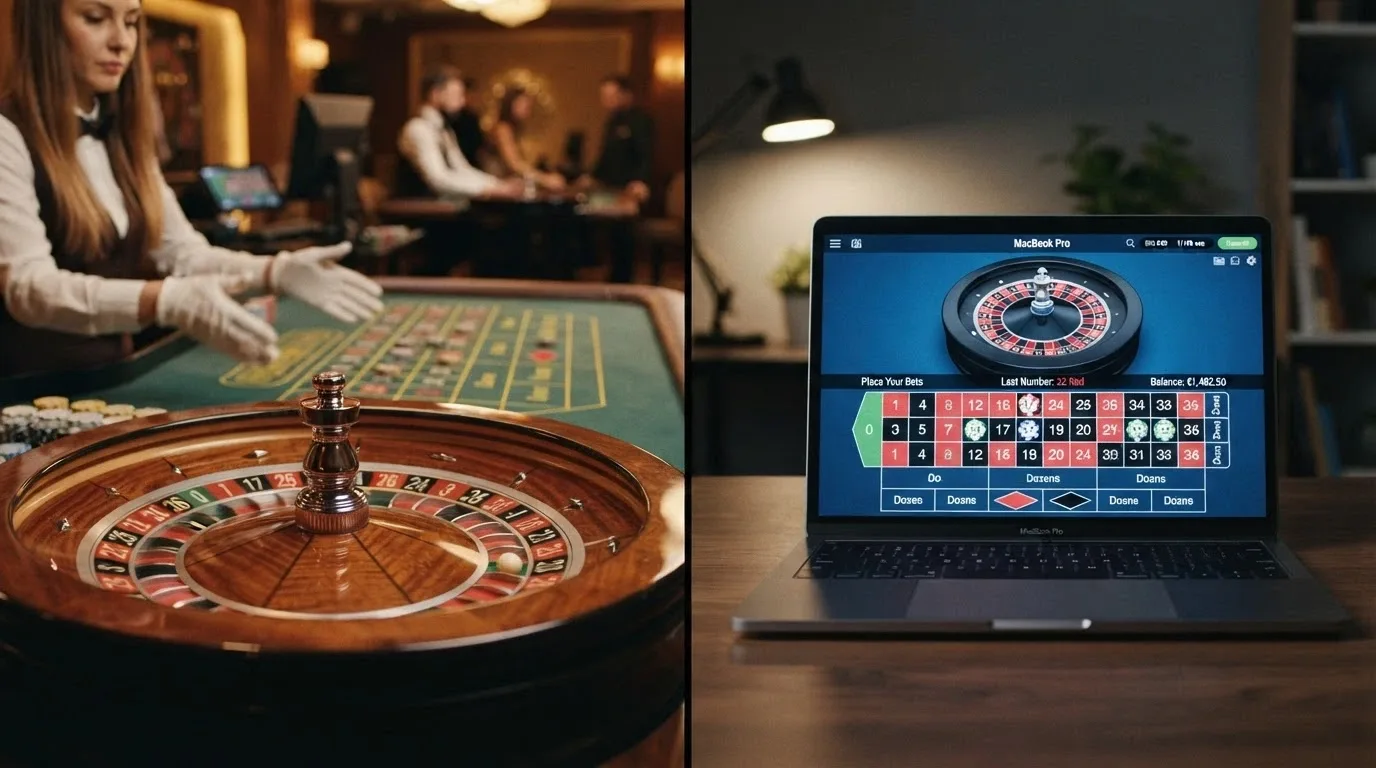
The pace is one honest trade-off. A live roulette round runs at the croupier’s pace, usually 30–60 seconds between spins, with a betting window that closes before the wheel stops. RNG roulette runs as fast as a player can click. The live format also imposes table etiquette — players cannot change a bet after the croupier signals no more bets — and that constraint is part of what makes the format feel like a real table rather than a slot machine with extra steps.
English at the Table: What a Native-Speaking Dealer Changes
English is the default studio language for Evolution, Pragmatic Play Live and LuckyStreak — the three providers Australian players see most often at offshore casinos. Their croupiers speak English as their primary language, with bilingual capability on some tables. An Australian player at one of these tables is not gambling on whether the dealer will understand “red, please” — that is the assumption built into the studio.

The distinction worth noting is between English-only studios (the norm) and multilingual studios where English is one of several languages. Multilingual tables tend to be aimed at European markets with non-English-language bases, and the player sees the available languages on the table lobby screen. For the Australian audience, the practical check is the lobby screen — if English is listed, the croupier speaks it.
What “English-speaking dealer” actually delivers is modest. Native-speaking croupier tables for non-English European languages exist (BetConstruct and others run multilingual studios), and the differentiator makes sense for a French or German player. For an Australian player, the differentiator is barely a differentiator at all — it is what the table already offers. A player who chooses a live roulette game specifically for an English-speaking croupier is choosing a feature that comes standard rather than a feature that commands a premium.
The Studios Behind the Stream
| Provider | Studios Worldwide | Stream Quality | Camera Angles |
|---|---|---|---|
| Evolution | 30+ | Up to 4K | 3–5 |
| Pragmatic Play Live | 6+ | 1080p | 2–3 |
| LuckyStreak | — | 360° on Oracle titles | — |
| BGaming | — | — | — |
The two networks an Australian player actually encounters are Evolution and Pragmatic Play Live. Evolution’s flagship tables — Lightning Roulette, Immersive Roulette, Speed Roulette, Auto Roulette, Instant Roulette — come out of its larger studio footprint and the highest stream quality in the market. Pragmatic Play Live carries Mega Roulette and PowerUp Roulette, with a smaller studio base but the same 24/7 coverage.
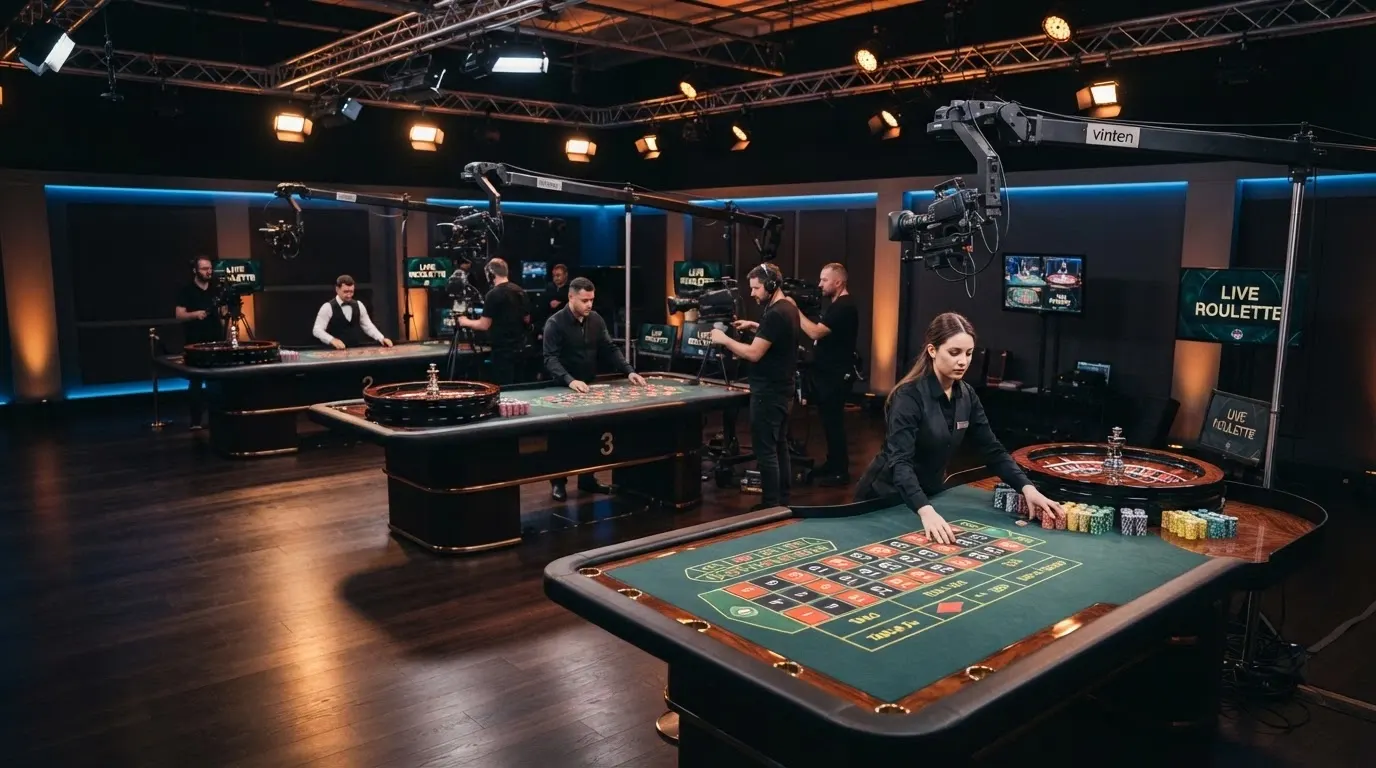
LuckyStreak and BGaming surface less often at AU-accessible offshore casinos but bring distinctive products when they do. LuckyStreak’s Oracle 360 line uses a 360-degree multi-camera view that gives the player a wheel-from-above perspective mid-spin — useful if a player wants to see the ball drop in slow motion. BGaming’s Royal Roulette 500X targets the high-limit end of the market with maximum bet ceilings that suit a serious bankroll.
Best Live Roulette Tables for Australian Players
For an Australian evening session, the practical answer is Evolution’s Immersive Roulette or Speed Roulette for a steady stream of high-quality spins, with Lightning Roulette as the choice for a player who wants the multiplier format. Pragmatic’s Mega Roulette is the equivalent multiplier game on the Pragmatic network, with PowerUp Roulette as a secondary pick. Bet limits across these tables run from A$0.50 at the entry tables to A$10,000-plus at the high-roller rooms, and every studio network runs 24/7.
The player-facing question is which table best fits the bankroll and the time available. Immersive Roulette’s slow-motion replays and multi-camera setup make it the most cinematic of the lot — a player pays for that with longer rounds. Speed Roulette compresses the spin cycle and gives a player more bets per hour, which is what most casual players prefer. The multiplier games change the maths on straight-up bets rather than the pace, and that is a different conversation altogether.
Roulette Rules, Odds and the Strategies That Will Not Save You
Roulette is one of the simpler casino games to learn, and one of the harder ones to outplay. The wheel has either 37 pockets (European, single-zero) or 38 pockets (American, double-zero), the croupier spins the ball, and the player bets on where it lands. The payouts are fixed, the house edge is fixed, and no betting system changes either.
The bets run from a single number (straight-up, pays 35 to 1) through splits, streets, corners and six-lines (17:1, 11:1, 8:1, 5:1 respectively) to outside bets on red or black, odd or even, columns and dozens, which pay 1:1 or 2:1. Every bet on a European wheel loses the casino 2.70% in expectation — that is the house edge, and it is identical on every wager, inside or outside.
That edge is what a player is up against. It does not move when a player bets more, bet less, doubles down after a loss, or follows a progression. The math holds for every dollar wagered in aggregate.
The Roulette Table and Betting Layout Explained
The European wheel has the numbers 0–36 laid out around its circumference, with the single zero in green and the rest split between red and black. The betting grid mirrors the wheel — numbers 1–36 down the centre with 0 at the top — and around them sit the outside bets: red or black, odd or even, high (19–36) or low (1–18) on one side, and the dozens (1–12, 13–24, 25–36) and three columns down the other side.
A straight-up bet is a chip on a single number. A split is a chip on the line between two numbers. A street is a chip on the outside edge of a row of three. A corner is a chip at the intersection of four numbers. A six-line is two streets together. Outside bets cover larger groups — red or black covers 18 numbers, a column covers 12, a dozen covers 12. The racetrack — the curved section around the outside of the betting grid — holds the call bets, which are announced rather than placed on individual numbers (Voisins du Zéro, Tiers du Cylindre, Orphelins). The call bets are a European roulette convention and are not available on every table.
The payouts follow the same logic: the rarer the event, the higher the payout. A straight-up hits 1 in 37 on a European wheel and pays 35:1. A red-black hit pays 1:1 and lands just under half the time. The payout is what makes a straight-up bet feel exciting — a A$10 chip that returns A$360 on a single number is a memorable outcome — but the maths behind it is the same maths as the boring red-black bet that returns A$10. The 2.70% edge is paid on both.
How to Play Roulette: A Beginner’s Walkthrough
Open a live roulette table from the casino lobby. The video stream loads, the croupier greets the table, and the betting grid appears below. Place a chip on a number, a colour, a dozen or a column — the chip snaps to the grid and stays there. The croupier announces the betting window is closing and signals no more bets. The wheel spins, the ball drops, and the winning number lights up on the grid.
Winning bets pay out automatically — chips land on the player’s stack, losing chips clear. The next round opens with a fresh betting window. A 30–60 second round is typical at a standard table; Speed Roulette compresses that to closer to 20 seconds.
The common beginner mistakes are predictable. Betting before the betting window opens (the bet does not register). Betting after the croupier has signalled no more bets (the bet is refused). Betting more than the table’s stated max during wagering on a bonus (the bet may be voided or the bonus confiscated). And forgetting to verify the table’s actual variant — a player who thinks they are on a European single-zero table when it is actually American double-zero has just doubled the house edge without noticing.
The etiquette is the easy part. Don’t type spam in the chat. Don’t blame the dealer for a loss. Don’t ask the dealer for a “system” — they have heard every one and they will not tell you what works because nothing works.
Roulette Strategy Systems: Martingale, Fibonacci and Why the House Still Wins
The Martingale is the most popular roulette progression. The player doubles the bet after every loss, with the idea that one win will recover everything. The system works until it does not, and the point at which it does not is the table limit. At an AU-accessible offshore table with a A$7.50 max bet during bonus wagering, a player who started at the table’s minimum and doubled on every loss would hit the ceiling within a handful of rounds. Outside of bonus play, the table max runs higher, but it still runs — and a long enough losing streak is mathematically certain to arrive.
Fibonacci and D’Alembert are slower-burn progressions. The Fibonacci sequence (1, 1, 2, 3, 5, 8, 13…) walks up one step after a loss and two steps back after a win. D’Alembert increases the bet by one unit after a loss and decreases by one after a win. Both feel safer than the Martingale because the bet sizes grow more slowly, but they share the same fundamental flaw: the house edge is invariant to bet sizing. The 2.70% on European roulette is paid on every dollar wagered, in aggregate, over time, regardless of whether the player bets in flat units, doubles after losses, or walks the Fibonacci. The math does not care.
The gambler’s fallacy is the error underneath all of these. Each spin of a roulette wheel is independent of the last. Red has not “come up too much” and is not “due” to land on black. The wheel does not remember. The 2.70% edge holds for every dollar. A player who keeps doubling after losses is not “due” a win — they are extending a session that the house edge is gradually draining.
The honest summary is the one the maths supports. No betting system beats a game with a fixed house edge and independent spins. A progression can change the path a session takes — how the wins and losses are spaced — but it cannot change where the session ends. The casino wins on volume, and volume is what the wagering requirement forces the player to provide.
The House Edge Across Every Roulette Variant
| Variant | House Edge | RTP | Key Rule |
|---|---|---|---|
| European Roulette | 2.70% | 97.30% | Single-zero wheel (37 pockets) |
| American Roulette | 5.26% | 94.74% | Double-zero wheel (38 pockets) |
| French Roulette (La Partage / En Prison) | ~1.35% on even-money bets | n/a | Even-money bets returned half on zero |
| Lightning Roulette | 2.70% on outside/even-money; 2.90–3.90% on straight-up | 97.10% on straight-up | 1–5 random numbers multiplied 50×–500×; straight-up pays 29:1 |
The single decision that matters most is which wheel a player sits at. The European 2.70% edge becomes a 5.26% edge on an American wheel, with no change in payout structure. That is the difference between losing A$2.70 and A$5.26 on every A$100 wagered in expectation. Choose the wheel first, everything else second.
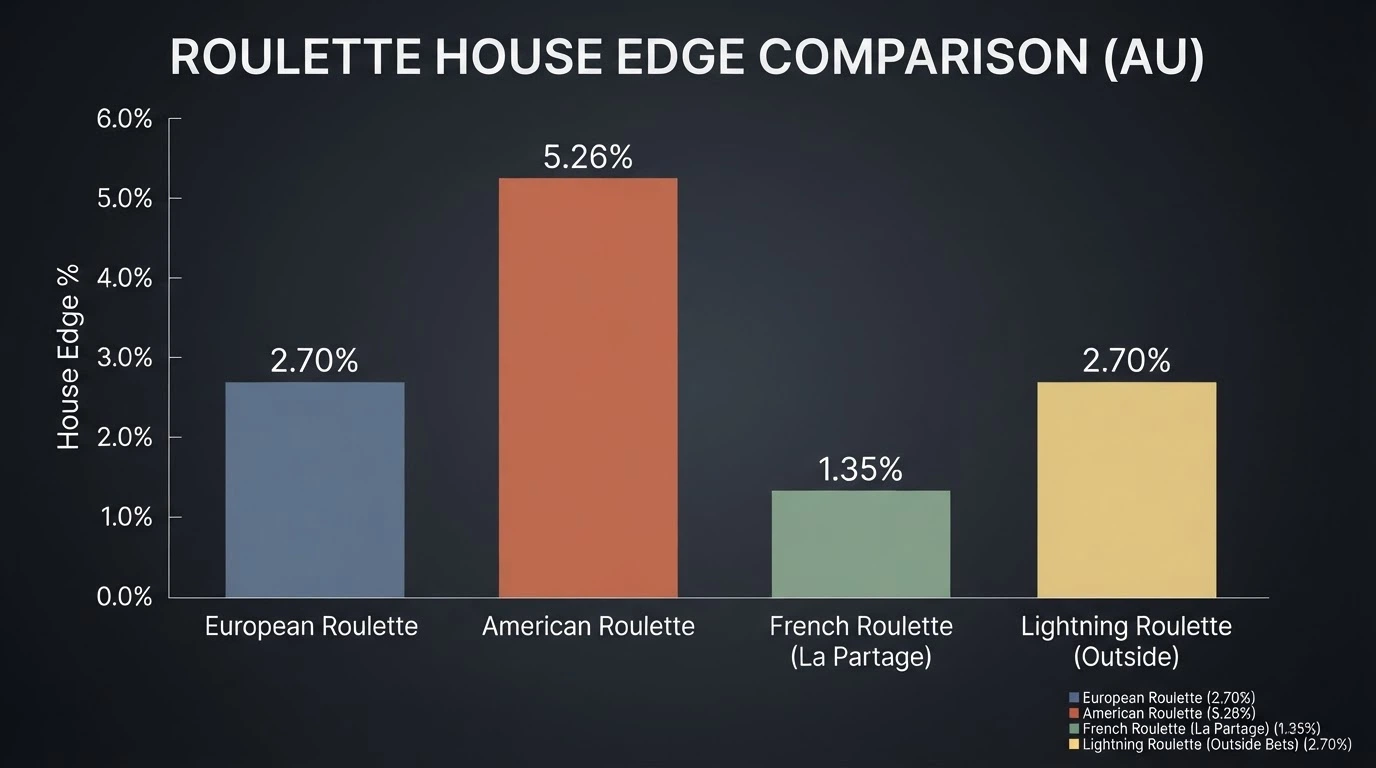
Lightning Roulette’s RTP of 97.10% on straight-up bets looks close to European’s 97.30%, but the effective house edge on straight-ups is higher — between 3.0% and 3.4% depending on multiplier frequency and operator settings — because the base straight-up payout drops from 35:1 to 29:1 to fund the multipliers. Even-money and outside bets on Lightning Roulette carry the standard 2.70% edge. A player who bets on red at Lightning Roulette is paying the same edge as a player at a standard European table — and not getting the multipliers on top.
Roulette Variants That Change the Game
A player who treats roulette as a single game is leaving money on the table. The variants differ enough that the same bankroll behaves differently across them — and the choice between them is a choice the player makes before the first spin.
European single-zero roulette is the baseline worth seeking. American double-zero roulette is the variant to avoid unless a specific table layout appeals. Lightning Roulette, XXXtreme Lightning and Fireball are Evolution’s show-format games, where multipliers come in but the base payouts shrink to fund them. French roulette with La Partage or En Prison is the cheapest version a player can find for even-money betting, but it is harder to locate at AU-accessible offshore casinos.
European vs American Roulette: The Single-Zero Edge
European roulette’s wheel has 37 pockets — the numbers 1–36 plus a single zero. The zero is the casino’s edge: every other pocket would pay out at true odds, and the zero breaks the symmetry. American roulette adds a second zero — the double-zero — for 38 pockets and a second break. The payout structure is identical on both wheels, which means the American wheel pays the player less for the same bet.
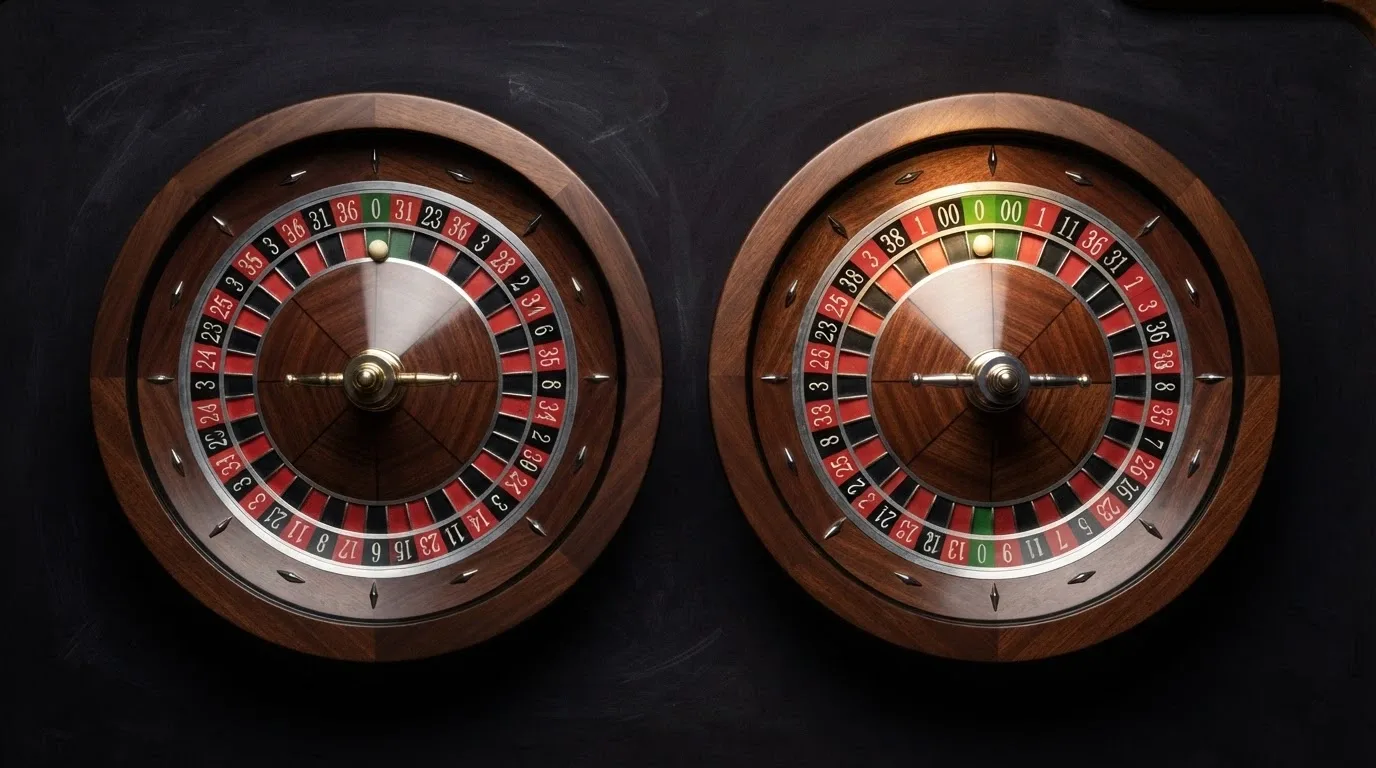
The maths: on every A$100 wagered in aggregate, a player loses A$2.70 at the European wheel and A$5.26 at the American wheel. The double-zero is not a small difference. It nearly doubles the cost of playing, and the only thing that changes is which wheel a player chooses. The Australian offshore market has both, and a player who walks up to a table without checking the layout pays whatever the table charges.
AU-accessible offshore casinos predominantly run European wheels. American roulette is rarer on the live side, but a player who finds it should know what they are looking at before sitting down. One extra pocket nearly doubles the casino’s take, and the player gets nothing in return for it.
Lightning, XXXtreme and Fireball: When Roulette Gets Multipliers
Evolution’s Lightning Roulette is the most popular of the multiplier-format roulette games. Each round, between one and five random straight-up numbers receive a multiplier of between 50× and 500×. If a player’s straight-up bet hits one of the multiplied numbers, the payout is the multiplier rather than the standard 35:1. The catch is the base straight-up payout: it drops from 35:1 to 29:1 to fund the multiplier pool. The marketing pitches the 500× ceiling; the maths quietly gives the house an extra 0.20 percentage points on every straight-up bet in expectation.
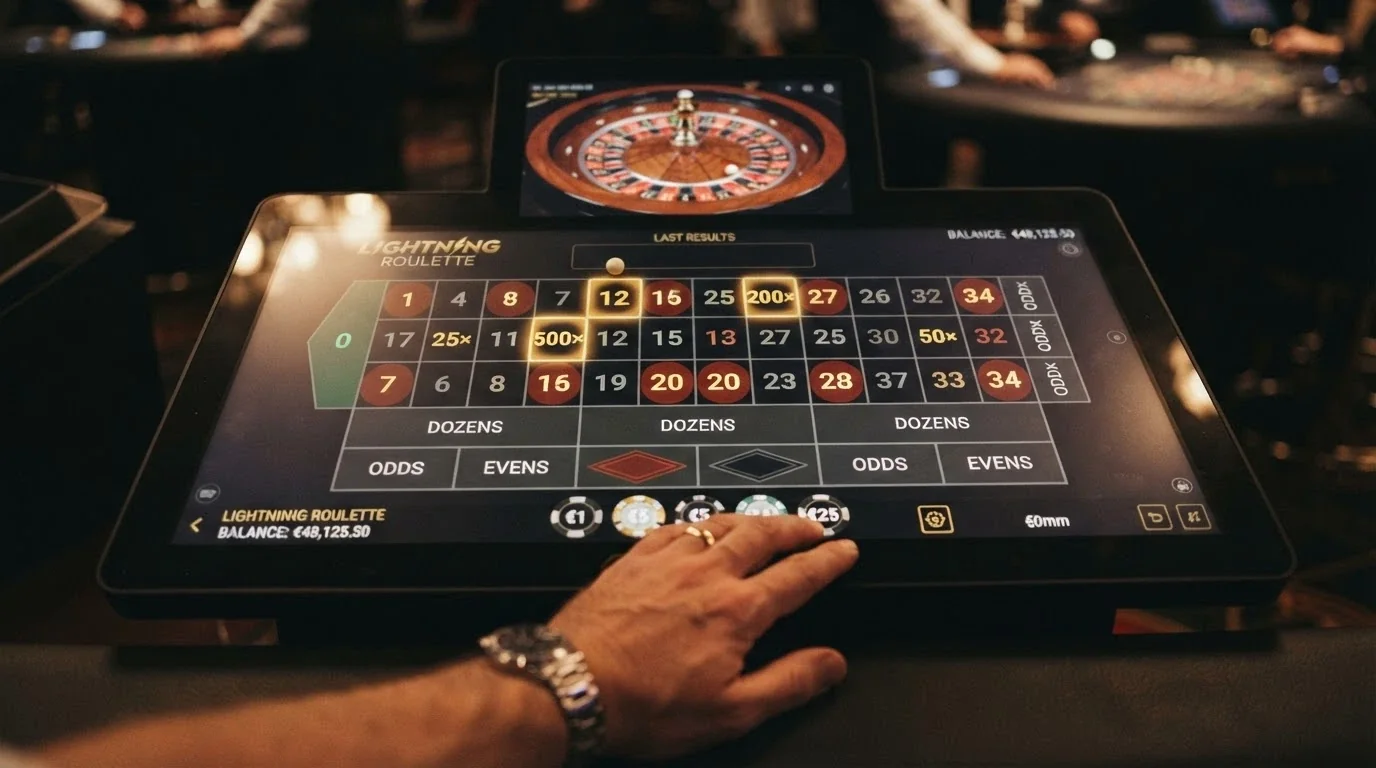
XXXtreme Lightning Roulette goes further: one to ten multiplied numbers per round, with a maximum multiplier of 2,000×. The volatility is extreme — a player can win 200× their bet on a single spin or lose the same amount on a routine miss. Fireball Roulette, Evolution’s 2024 release, layers in a free-spins bonus round on top of multiplied numbers, with multipliers up to 2,500×.
The maths under the multipliers is less generous than the marketing suggests. Lightning Roulette’s RTP on straight-up bets is 97.10% — about 0.20 percentage points below standard European roulette — and the effective house edge on straight-ups is higher still because of the payout reduction. Even-money and outside bets carry the standard 2.70% edge, which means the multipliers don’t actually help a player who bets on red. The multipliers are a feature of straight-up bets only, and the cost of the feature is built into the payout on those same bets.
Where Australian Players Play Live Roulette in 2026
| Operator | Legal Status in Australia | BetStop Coverage |
|---|---|---|
| RocketPlay | Offshore, no AU licence | No — not connected to AU register |
| Skycrown | Offshore, no AU licence (MGA reported, unverified) | No — not connected to AU register |
| Royal Reels | Offshore, no AU licence | No — not connected to AU register |
| WinSpirit | Offshore, no AU licence | No — not connected to AU register |
| Stake | Offshore, no AU licence (Curaçao reported, unverified) | No — not connected to AU register |
| Rainbet | Offshore, no AU licence | No — not connected to AU register |
| Scream Casino | Offshore, no AU licence | No — not connected to AU register |
| Fair Go Casino | Offshore, no AU licence (Curaçao reported, unverified) | No — not connected to AU register |
| Bizzo Casino | Offshore, no AU licence | No — not connected to AU register |
| Rocket Casino | Offshore, no AU licence | No — not connected to AU register |
Every brand in this table is an offshore casino. No Australian licence covers online roulette, and the column reads that way deliberately — a player looking for a licensed Australian online roulette site is looking for something that does not exist. What follows is what is known about each operator from public sources, what is not confirmed, and what the practical differences between them look like for a real-money player.
RocketPlay
RocketPlay runs Evolution, Pragmatic Play and BGaming, which covers most of the live roulette titles an Australian player would want. The welcome package is split across the first two deposits: 100% up to A$1,000 plus 100 free spins on the first deposit, then 200% up to A$1,000 on the second. The free spins land in batches of 20 over five days on Aztec Magic (BGaming), and the bonus amount carries 40× wagering, with a maximum bet of A$7.50 during wagering and a five-day validity.
The maths on that welcome offer are the rough ones. Free spin winnings are capped at A$300, and the maximum win from either deposit bonus is A$5,000. The five-day validity is tight for a roulette bonus — a player who plans to grind through the wagering has roughly 120 hours to do it, and that window closes whether the wagering is complete or not. PayID, crypto (BTC, ETH, LTC) and bank transfer cover the deposit options, and the live roulette tables are confirmed available with a noted A$750 table limit on at least one Evolution table. Worth the offer for a player who can grind a bonus inside a tight window; expensive for one who cannot.
Skycrown
Skycrown carries Evolution and Pragmatic Play Live in its live dealer section, and the welcome bonus spreads smaller — 100% up to AU$200 plus free spins across the first three deposits rather than concentrated on the first. The wagering is 30× on the bonus amount with a seven-day expiry and a maximum cashout of AU$500 per bonus. PayID, crypto, bank transfer and e-wallets cover the deposit options, and e-wallet withdrawals reportedly land within 24 hours, with card withdrawals taking 2–3 business days.
The headline numbers work in the player’s favour compared to most offshore welcome offers: 30× is lower than the market, the seven-day window is more generous than RocketPlay’s five, and the AU$500 max cashout is honest about the ceiling. For a player who wants Evolution and Pragmatic tables and a bonus that can actually be cleared, Skycrown is a credible pick.
Stake
Stake is crypto-only — Bitcoin, Ethereum, Litecoin, Dogecoin and USDT — and built on a different model from the rest of this list. There is no traditional welcome bonus. The compensation comes through rakeback and a VIP rewards structure that pays returning players based on their wagering volume rather than a one-time match on the first deposit.
The live dealer section is solid: Evolution and Pragmatic Play tables cover roulette, blackjack and baccarat. For an Australian player already comfortable with crypto and looking for a long-term platform rather than a one-off bonus, Stake provides an alternative model that prioritises rewards based on wagering volume.
Fair Go Casino
Fair Go runs on RealTime Gaming, which is a software provider focused on RNG games rather than live dealer tables. Live roulette availability is not confirmed at Fair Go, and RTG-powered sites typically do not carry a live dealer section. The casino does surface a rotating no-deposit offer — 30 free spins on Fu Long Treasures (BGaming) with a maximum cashout of A$180 surfaced this run — which is one of the closer things to a roulette-friendly free play available without a deposit.
Payments run through Visa, Mastercard, Neosurf, Bitcoin and bank transfer. For a player specifically looking for live roulette, Fair Go is the wrong pick — but it is the right pick for a player who values a no-deposit free spins offer and does not need a live dealer.
Royal Reels
Royal Reels appears in Australian search results for live roulette but its specifics — the licence jurisdiction, the live dealer providers, the welcome bonus terms, the withdrawal times — were not confirmed this run. The brand has market presence, and the practical guidance is the same as for any unconfirmed offshore operator: read the terms page before depositing, check the licence jurisdiction named there, and verify the bonus conditions in writing. A player who has used Royal Reels before has more information than this page can offer. A player meeting it for the first time should treat it as an unverified product.
WinSpirit
WinSpirit sits in the same position as Royal Reels — offshore, accepting Australian players, surfacing in the AU search landscape for live roulette, with the specifics not confirmed this run. No licence jurisdiction, no confirmed provider list, no confirmed bonus terms, no confirmed live roulette availability. What WinSpirit offers beyond what Royal Reels offers is not established in the public sources this page read. Treat the bonus terms and the live roulette availability as unconfirmed, and verify them on-site before depositing.
Rainbet
Rainbet is another offshore operator surfacing in Australian live roulette searches. Nothing additional is confirmed this run beyond its presence in the market and its offshore status. Until a player can confirm the licence jurisdiction, the provider list and the live roulette availability on-site, this page has nothing more to say about Rainbet beyond its offshore status and its place in the AU search landscape.
Scream Casino
Scream Casino appears in the same Australian search landscape as the other unconfirmed operators. Licence, providers, bonus terms and live roulette availability are not confirmed this run. One honest line on Scream Casino: offshore, accepting Australian players, no further specifics confirmed.
Bizzo Casino
Bizzo Casino is another offshore brand surfacing for Australian live roulette searches. What is confirmed about Bizzo Casino is its offshore status and its presence in the Australian search results. What is not confirmed is the rest of the operator profile — the licence jurisdiction, the providers, the bonus terms and the live roulette availability. A player should not assume the standards of the confirmed operators apply here.
Rocket Casino
Rocket Casino completes the list — offshore, accepting Australian players, with specifics not confirmed this run. No licence jurisdiction verified, no provider list confirmed, no bonus terms or live roulette availability to point to. Treat it the same way as the rest of the unconfirmed set: verify before deposit, or treat the bonus terms as unconfirmed.
Crypto and Bitcoin Roulette: The Anonymous Route
Bitcoin, Ethereum and other cryptocurrencies have a different legal status at offshore casinos than they do at Australian-licensed wagering operators. Credit cards, credit-related products and digital currencies were banned as payment for licensed online wagering on 11 June 2024 under the Interactive Gambling Amendment (Credit and Other Measures) Act 2023, with penalties up to A$247,500 for operators that fail to enforce the ban. Offshore casinos are not bound by that ban. They can still accept crypto, and most do.
The Australian on-ramp to crypto gambling runs through an AUSTRAC-registered exchange — CoinSpot and Swyftx are the two most used — funded by PayID. The exchange-to-casino leg takes 1–15 minutes depending on the coin and the network fee, and once a player has a balance in their exchange wallet the rest works like any other payment method. Some players use crypto for the speed of withdrawal; others use it because the offshore site accepts nothing else. Crypto is the route that bypasses the credit card ban entirely — though the ban does not reach the offshore route in the first place.
Two forward-looking changes matter here. From 1 January 2027, banks and payment providers gain express authority to block transactions to illegal gambling operators — which could include some offshore casino deposits, depending on how the banks interpret the new rule. And from the same date, direct marketing of inducements is prohibited for 14 days after a customer signs up, three months after a person deregisters from BetStop, and indefinitely for customers identified as at-risk. That second rule targets licensed operators, but it is part of a wider tightening that includes the offshore route by virtue of how it changes the banks’ behaviour.
Roulette Bonuses and the Fine Print That Makes Them Cost More Than They Are Worth
A welcome bonus looks like free money until a player runs the wagering maths. The structure is the same across most offshore welcome offers: a percentage match on the first deposit, free spins bundled in, and a wagering requirement that multiplies the bonus amount by a factor that is usually between 30× and 50×. The player has to wager that multiple before any winnings become withdrawable.
RocketPlay’s offer is the worked example. A player who claims the full A$1,000 first-deposit bonus at RocketPlay and grinds through the 40× wagering on a European roulette table — assuming only the bonus amount is wagered — must turn over A$40,000. At the 2.70% house edge on European roulette, that carries an expected loss of about A$1,080. That is the bonus’s real cost. The free spin caps and max cashout caps are where the bonus stops being a bonus and starts being a ceiling — Skycrown caps winnings at AU$500 per bonus, and RocketPlay at A$5,000 per deposit bonus with A$300 from free spin winnings.
Skycrown’s 30× wagering requirement softens the maths. The same A$1,000 bonus at 30× carries A$30,000 in required turnover, an expected loss of A$810 on European roulette. Lower than RocketPlay, but still a real cost. The seven-day expiry is a more honest window than RocketPlay’s five-day one. Most players who grind bonuses to completion treat 30× as the floor and 40× as ordinary, and anything tighter than that as a reason to walk away from the offer.
The expected loss is a statistical estimate, not a guaranteed outcome. A player can come out ahead on a small sample of spins. The estimate says what happens on average across the wagering volume, not what happens to any individual session.
No-Deposit Free Spins: What They Actually Deliver
No-deposit free spins are the closest thing to a roulette no-deposit bonus in the Australian offshore market. Fair Go’s rotating offer — 30 free spins on Fu Long Treasures (BGaming) with a A$180 maximum cashout — surfaced this run, valid until August 2026. 7Bit’s offer runs 30 free spins on Deep Sea (BGaming) with a A$50 maximum win, 45× wagering on winnings, a three-day validity window and a A$0.15 maximum bet per spin.
The honest summary of these offers: the maximum cashout caps — A$180 at Fair Go, A$50 at 7Bit — mean a player is unlikely to walk away with much, and the 45× wagering on winnings at 7Bit is steep. The upside is that the player has not deposited. For a player testing a casino or trying a few spins without committing bankroll, a no-deposit offer is worth the time it takes to claim. It is not a path to a serious payout.
The gap between the search for a “roulette no deposit bonus” and what is actually available is worth stating plainly: no featured operator in this ranking carries a dedicated roulette no-deposit bonus. The free spins are the substitute, and the cashout caps make clear what the operators expect from them. BC.GAME’s free spins run on a 24-hour window with a A$5 limit per batch; Jackbit caps free spins cashout at A$100. The pattern is consistent: small prize, tight window, real money on the line if a player ignores the conditions.
The Legal Reality for Australian Roulette Players in 2026
Online casino is prohibited in Australia. The Interactive Gambling Act 2001 makes providing online casino games — roulette, blackjack, online pokies, online poker — to a person in Australia a federal offence. There is no licence for it anywhere in the country, federally or in any state or territory. The Australian Communications and Media Authority enforces the prohibition through site blocking, formal investigations and civil penalty proceedings, and has had 1,564 illegal gambling and affiliate websites blocked by Australian ISPs as of March 2026, with more than 225 illegal services having withdrawn from the Australian market since 2017.
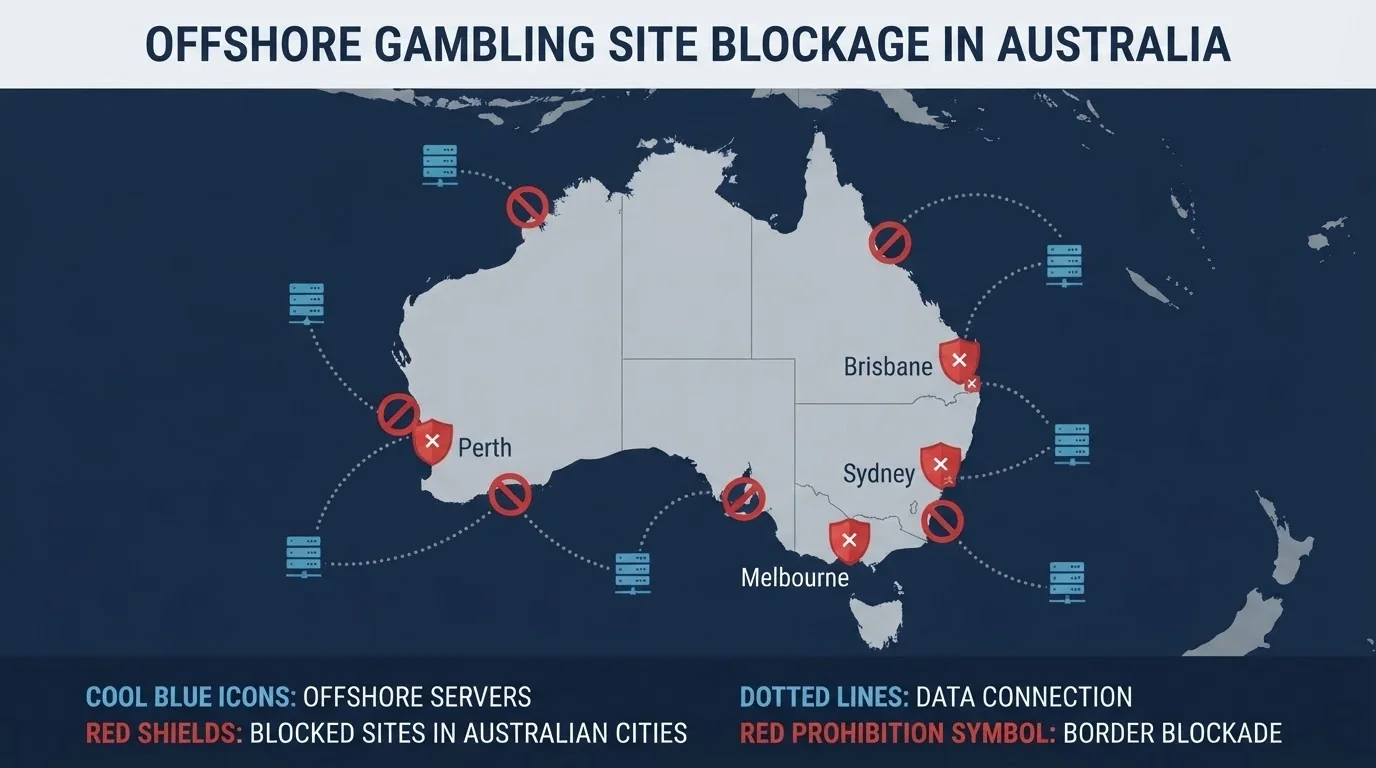
The individual player is not prosecuted under the IGA. The Act targets the operator of the prohibited service. But the player loses the entire Australian consumer-protection layer in the process: no ACMA complaints body, no BetStop coverage, no Australian deposit guarantee, and no recourse if an offshore site refuses to pay out. The site can also be blocked at any time, including with a player balance on it — ACMA’s blocking list has grown past 1,500 sites, and the operator does not need to give a player notice before it happens.
The 2026 reform tightens the picture further. The Interactive Gambling Amendment (Gambling Reform) Bill 2026 passed Parliament on 19 August 2026, with measures commencing on 1 January 2027. The reform bans wagering advertising during live sporting events, caps TV gambling ads at three per hour between 6:00 am and 8:30 pm, and bars athletes, celebrities and influencers from promoting wagering products. It also gives banks express authority to block transactions to illegal gambling operators from 1 January 2027 — which could affect how Australian players fund offshore accounts.
What Australian Consumer Protections You Lose at an Offshore Casino
The protections a player takes for granted at an Australian-licensed operator do not exist at an offshore casino. There is no ACMA complaints body to escalate a withdrawal refusal to. BetStop — the National Self-Exclusion Register — does not reach offshore casinos; a self-excluded Australian can keep depositing at an offshore site, and the offshore operator has no obligation to honour the BetStop registration. And there is no Australian deposit guarantee if the operator collapses or walks away with player funds.
The practical risks are three. The site can be blocked by ACMA at any time, with a balance on it. The operator can refuse a withdrawal, void winnings, or close an account on terms buried in its small print. And the bank-blocking reform coming on 1 January 2027 gives Australian banks explicit authority to refuse payments to illegal gambling operators, which could affect the player’s deposit and withdrawal paths in ways the offshore operator does not control.
For a player weighing these trade-offs, the honest framing is that the offshore route offers the live roulette experience no Australian licence covers, in exchange for every protection an Australian licence would have provided. A player who can absorb a blocked-site loss or a refused withdrawal is in a different position from one who cannot.
Licensed Wagering vs Offshore Casino: Knowing the Difference
A bright line divides the Australian market. Wagering on races and sports placed before the event begins is legal and licensed — through operators holding state or territory licences, primarily Northern Territory licences administered by the Northern Territory Racing and Wagering Commission (NTRWC) through Licensing NT. Those licences run for terms up to 20 years and cover the major Australian online bookmakers.
Online casino games — including live dealer roulette — are not part of that licensed offering. Casino licensees cannot offer online casino games, retail wagering licensees and corporate bookmakers can offer online betting placed before the event but not in-play, and online roulette sits outside the licensed product entirely. A player who thinks they are playing at “a licensed Australian casino” is playing at an offshore site with no local licence.
The 2026 reform also expands the prohibition: from 1 January 2027, foreign matched lotteries and online keno are prohibited, and wagering advertising content cannot promote odds outright. None of this changes the offshore roulette position — the offshore site is already outside the licensed frame — but it is part of a wider regulatory tightening that affects the Australian wagering market as a whole. The NT regime was itself reformed in 2026 after criticism of the regulator’s structure, which is worth knowing if a player is comparing NT-licensed bookmakers to other licensed operators.
Staying in Control: Responsible Gambling Tools That Actually Work
The Australian harm-minimisation framework is built around the National Gambling Helpline — 1800 858 858, free, confidential and staffed 24 hours a day, seven days a week — with online chat and counselling through Gambling Help Online at gamblinghelponline.org.au. These services exist for an Australian player regardless of where they gamble, and they are the first call a player should make if gambling is becoming a problem.
BetStop — the National Self-Exclusion Register, live since August 2023 — is the formal self-exclusion tool. As at 31 July 2026, BetStop had recorded 67,480 registrations, with 41,290 exclusions still active. Seventy-eight per cent of registrants were under 40, and 38% chose lifetime exclusion. The register is meaningful protection against Australian-licensed wagering services. A self-excluded Australian cannot open a new account with Sportsbet, bet365, Ladbrokes or any of the roughly fifty other NT-licensed bookmakers while the exclusion is active.
The gap is offshore. BetStop binds only Australian-licensed wagering services, and an offshore casino is not connected to the register. A self-excluded Australian can keep depositing at an offshore site, and the offshore operator has no obligation to honour the BetStop registration. For a player who has registered with BetStop and is still gambling, the offshore route is the gap the exclusion does not cover.
Problem gambling affects roughly 2.1% of Australian adults — about 430,000 people — with the Australian Institute of Health and Welfare putting high-risk gambling at 1.8% in 2022. Those numbers are a reminder that the harm is not rare.
Practical Limits and Self-Help Tools
Australian-licensed wagering platforms offer deposit limits, session time reminders and take-a-break tools as standard. Offshore casinos vary widely, and research does not confirm that any of the operators in this ranking provide a standard harm-minimisation toolkit. Where platform tools are absent, the burden falls on the player to set them.
The practical version is straightforward. Set a session budget before logging in and stop at it. Set a time limit — a 60-minute timer on the phone is the simplest tool. Do not chase losses. Do not deposit more to “win back” what was lost. And if a session is not fun, stop.
There is no federal deposit, loss or stake ceiling for online gambling in Australia because the product those ceilings would govern is banned outright. That absence is a feature of the prohibition, not a gap in the rules — Australia caps how a player pays (credit and crypto are banned for licensed wagering) rather than how much a player wagers, because the wagering product itself is not legal. A player who wants a hard ceiling on losses cannot rely on the regulator to provide one at an offshore site; the ceiling has to come from the player’s own discipline.
How We Evaluate Live Roulette Sites for Australian Players
The evaluation rests on five checks. The first is legal status: every operator in the table is verified as offshore against the Interactive Gambling Act 2001, and the operator’s claimed licence jurisdiction is checked against the named regulator’s public register where research confirms it. The second is live dealer quality: the studio network (Evolution, Pragmatic Play Live, LuckyStreak, BGaming), the stream resolution and the camera coverage, with the assumption that an Australian player will encounter Evolution or Pragmatic at the dominant offshore brands.
The third is bonus terms. Every welcome offer and no-deposit offer in this ranking is read through the wagering multiple, the max cashout cap, the max bet during wagering and the validity window — and the worked maths on RocketPlay’s welcome package is the example of how those terms add up. The fourth is payment: PayID, crypto, bank transfer and e-wallet coverage, with the explicit note that PayID is deposits-only at most offshore sites and that the credit/crypto ban applies only to licensed wagering, not to the offshore route.
The fifth is BetStop coverage. BetStop does not reach offshore casinos, and every operator in this ranking is noted as not connected to the Australian register. That fact is repeated in the table on purpose: it is the single biggest practical difference between licensed Australian wagering and the offshore route, and a player comparing the two should weight it accordingly.
The sources consulted are the ACMA’s published enforcement data, the ICLG Gambling Laws and Regulations Report 2026 Australia, public statements from the Parliament of Australia on the 2026 reform, and the named providers’ published studio and game specifications. Operator specifics were taken from each casino’s published terms pages and from review aggregators. Where research could not confirm a specific — a licence jurisdiction, a withdrawal time, a bonus cap — the page says so rather than guessing, and the operator write-up carries that gap into the reader’s hands.
What Your Next Roulette Session Should Look Like
The case for playing live roulette from Australia is that the format is genuinely different from an RNG table, the English-speaking croupier is standard rather than a premium feature, and the offshore market makes it available in a way the Australian licence does not. The case against is the 2.70% — or 5.26% on an American wheel, which a player should refuse — and the absence of every Australian consumer protection in the process.
The practical verdict. Pick a European single-zero table. Avoid American roulette at all costs. Read the welcome bonus terms before claiming and run the wagering maths before depositing. Use PayID for fast deposits, but plan for crypto or bank transfer on the withdrawal side. Register with BetStop if gambling is starting to feel like a problem, and know that the registration does not reach the offshore site.
The one call every Australian player should make before depositing is to the National Gambling Helpline on 1800 858 858 if any of this has felt like a closer call than it should. The helpline is free, confidential, 24 hours a day. It exists for this.
Frequently Asked Questions
Is it against the law to play online roulette in Australia?
No, playing online roulette from Australia is not a criminal offence for the player. The Interactive Gambling Act 2001 targets the operator of a prohibited service, not the person placing the bet. What the player loses is the entire Australian consumer-protection layer — no ACMA complaints body, no BetStop coverage, no Australian deposit guarantee, and no recourse if an offshore site refuses to pay out.
Will the croupier at a live roulette table speak English?
Yes — English is the default studio language for Evolution, Pragmatic Play Live and LuckyStreak, the providers most offshore casinos route Australian players to. Their croupiers speak English natively or near-natively. The practical distinction is between English-only studios (the norm) and multilingual studios where English sits alongside other languages, which matters more for European markets than for Australian players.
Which roulette wheel gives me the best chance — single-zero or double-zero?
The single-zero European wheel, every time. It carries 37 pockets and a 2.70% house edge. The American double-zero wheel has 38 pockets and a 5.26% edge — nearly double. French roulette with La Partage or En Prison cuts even-money bets further, to about 1.35%. Choosing the wheel is the single biggest decision a player makes at any roulette table.
How do I deposit at an online casino from Australia using PayID or crypto?
PayID is the fastest local route — deposits from around A$10 land instantly, though most offshore casinos will not let a player withdraw back to PayID. Crypto routes through an AUSTRAC-registered exchange like CoinSpot or Swyftx; the exchange-to-casino transfer takes 1–15 minutes. Credit cards and crypto are banned for licensed Australian wagering, but offshore casinos are not bound by that ban.
Can a betting system beat the casino’s mathematical advantage in roulette?
No. No system — Martingale, Fibonacci, D’Alembert, anything else — changes the house edge, which is set by the wheel and the payouts and never moves regardless of bet sizing. Systems manage the path of wins and losses but cannot invert the maths. The 2.70% on European roulette is paid on every dollar wagered, in aggregate, over time. There is no edge case.
Does BetStop self-exclusion cover offshore online casinos?
No. BetStop binds only Australian-licensed wagering services. An offshore casino is not connected to the National Self-Exclusion Register and will keep taking deposits from a self-excluded Australian player. As of 31 July 2026, BetStop had 67,480 registrations and 41,290 active exclusions — meaningful protection against licensed wagering, but it does not reach the offshore route.
Can I get my money back if an overseas casino refuses to pay out?
Generally no. Offshore casinos sit outside the Australian regulatory framework, so ACMA cannot compel a payout. Most accept that position when a player signs up, hidden in the terms. If a site refuses a withdrawal, the practical recourse is the site’s own complaints process, the licence jurisdiction named in its terms (often Curaçao), or a chargeback through the card issuer — and each is uncertain.